HOW THE CAPITAL WAS SAVED.
Reading edition
The ancestors of Joe Rolette, the leading character in the story which I am about to relate, emigrated at a very early day from Normandy, in France, to Canada. It is believed that the celebrated Montcalm was one of this party. Many of these emigrants became disheartened by the hardships they encountered, and returned to France; but not so the Rolettes. Jean Joseph Rolette, the father of our Joseph, was born in Quebec, on Sept. 24, 1781. He was originally designed for the priesthood, but fortunately for that holy order his inclinations led him in another direction, and he became an Indian trader. His first venture in business was at Montreal, next at Windsor opposite Detroit, finally winding up at Prairie du Chien, about the year 1801 or 1802.
In the war of 1812, with Great Britain, the Americans captured Prairie du Chien in 1814, and built a stockade there, which was called Fort Shelby. The British, under Colonel McKay, besieged it, Rolette having some rank in the attacking party. He was offered a captaincy in the British army for his good behavior in this affair, but declined it. He continued his Indian trade successfully up to 1820, when John Jacob Astor offered him a leading position in the American Fur Company, which he accepted, and held until 1836, when he was succeeded by Hercules L. Dousman. He died at Prairie du Chien, Dec. 1, 1842, leaving a widow and two children, a son and daughter. His daughter married Captain Hood of the United States army, and was a very superior woman. His son was the hero of this story. Rolette senior was called by the Indians, "Sheyo" ("The Prairie Chicken"), from the rapidity with which he travelled. Joe was called "Sheyo chehint Ku" ("The Prairie Chicken's Son").
Joe Rolette was born on Oct. 23, 1820, at Prairie du Chien. He received a commercial education in New York, but having inherited the free and easy, half-savage characteristics of his father, he soon gravitated to the border, and settled at Pembina, on the Red River of the North, near the dividing line between the United States and Canada. At this point an extensive trade in furs had sprung up, in opposition to the Hudson Bay people, who had monopolized the trade for British interests for many long years. The catch of furs was brought down to the Mississippi every year by brigades of carts, constructed entirely of wood and rawhide, which were drawn by a single horse or ox, and carried a load of from 800 to 1,000 pounds. These vehicles were admirably adapted to the country, which was in a perfectly natural state, without roads of any kind, except the trail worn by the carts. They could easily pass over a slough that would obstruct any other forms of wheeled carriage, and one man could drive four or five of them, each being hitched behind the other. They were readily constructed on the border, by the unskilled half-breeds, where iron was unobtainable. This trade, with an occasional arrival of dog trains in the winter, was the only connecting link between far away Pembina and St. Paul.
When the Territory of Minnesota was organized, in 1849, St. Paul was designated as the capital, and a plain but suitable building was erected by the United States for the purpose of the local government, and when finished the territorial legislature convened there annually.
Joe Rolette, being the leading citizen of Pembina, and naturally desirous of spending his winters at the capital, had himself elected to the legislature, first to the house of representatives in 1853, and again in 1854 and 1855. In 1856 and 1857 he was returned to the council, which was the upper house, corresponding to the senate as the legislature is now composed. This body consisted of fifteen members. The sessions were limited by the organic act to sixty days.
That the capital should be located and remain at St. Paul had been determined by the leading citizens of this region, as far as they could decide this question, before the organization of the territory, but there were from the beginning manifestations of a desire to remove it exhibited in several localities. Wm. R. Marshall resided at St. Anthony, and at the first session in 1849 worked hard to have it removed to that point, but failed, and no serious attempt was again made until 1857, when, on February 6th, a bill was introduced by a councillor from St. Cloud, to remove it to St. Peter, a town on the Minnesota river, which had grown into considerable importance. General Gorman was the governor, and largely interested in St. Peter. He gave the scheme the weight of his influence. Winona, through its councillor, St. A. D. Balcombe, was a warm advocate of the change, and enough influence was secured to carry the bill in both houses. It, however, only passed the council by one majority, eight voting in its favor, and seven against it.
It was at this point in the fight that Rolette proved himself a bold and successful strategist. He was a friend of St. Paul, and was determined that the plan should not succeed if it was possible for him to prevent it. He never calculated chances or hesitated at responsibilities, but would undertake any desperate measure to carry a point with the same unreflecting dash and heedlessness of danger that he would plunge his horse into a herd of buffalo, shooting right and left, trusting to luck to extricate him. It happened that Joe was chairman of the committee on enrolled bills of the council, and all bills had to pass through his hands for enrollment and comparison. On the 27th of February the removal bill reached him, and he instantly decided that the legislature should never see it again, so he put it in his pocket and disappeared. He had, however, foresight enough carefully to deposit the bill in the vault of Truman M. Smith's bank, in the Fuller House, on the corner of Seventh and Jackson streets, before his vanishment.
On the 28th Joe did not appear in his seat, and no one seemed to know anything of his whereabouts. As his absence was prolonged, some of the advocates of the removal became uneasy, and sent to the enrollment committee for the bill, but none of them knew anything about it. At this point Mr. Balcombe offered a resolution, calling on Rolette to report the bill forthwith, and on his failure to do so, that the next member of the committee, Mr. Wales, procure another enrolled copy and report it. He then moved the previous question on his resolution. At this point, Mr. Setzer, a friend of St. Paul, moved a call of the council, and Mr. Rolette, being reported absent, the sergeant-at-arms was sent out to find him, and bring him in.
To comprehend the full bearings of the situation, it should be known that, under the rules, no business could be transacted while the council was under a call, and that it required a two-thirds vote to dispense with the call. As I have said before, the bill was passed in the council by a vote of eight for and seven against, which was the full vote of the body; but in the absence of Rolette there were only fourteen present. Luckily for St. Paul, it takes as many to make two-thirds of fourteen as it does to make two-thirds of fifteen, and the friends of the bill could only muster nine on the motion to dispense with the call. Mr. John B. Brisbin was president of the council, and a strong friend of St. Paul, so no relaxation of the rules could be hoped for from him. In this dilemma, the friends of removal were forced to desperate extremes, and Mr. Balcombe actually made an extended argument to prove to the chair that nine was two-thirds of fourteen. Both gentlemen were graduates of Yale, and, on the completion of his argument, Mr. Brisbin said, "Balcombe, we never figured that way at Yale; the motion is lost," and the council found itself at a deadlock, with the call pending, and no hope of transacting any business, unless some member of the five yielded. They were all steadfast, however, and there was nothing to do but to receive the daily report of the sergeant-at-arms that Mr. Rolette could not be found. Sometimes he would report a rumor that Rolette had been seen at some town up the river, making for Pembina with a dog train, at the rate of fifteen miles an hour; again, that he had been assassinated,—in fact, everything but the truth, which was that he was luxuriously quartered in the upper story of the Fuller House, having the jolliest time of his life, surrounded by friends, male and female, and supplied with the best the town afforded, including buckets of champagne.
The 5th of March was the last day of the session, and the council camped in its chamber, theoretically handcuffed and hobbled, until midnight of that day, when President Brisbin took the chair, and pronounced the council adjourned sine die.
The sergeant-at-arms was John Lamb, well known to all old settlers. He was a resident of St. Paul, and true to her interests, as his conduct proved. I don't suppose any man ever spent five days and nights trying harder how not to find his man than he did on this occasion. Whether his fidelity was ever rewarded I am unable to say.
During the deadlock the friends of removal got a copy of the bill through, but neither the speaker of the house nor the president of the council would sign it. The governor, however, did approve it, but the first time it was tested in court it was pronounced invalid, and set aside. Other attempts at capital removal were made, but none of them proved successful.
Rolette and I were close friends. We had served together in the council at its preceding session, and afterwards in the constitutional convention, and always roomed together when in St. Paul. I lived at Traverse des Sioux, which is next door to St. Peter, at the time of this attempt to remove the capital there, but vigorously opposed the measure. Rolette's life was threatened by the friends of removal, and many is the night I have played the part of bodyguard to him, armed to the teeth; but fortunately he was not assailed.
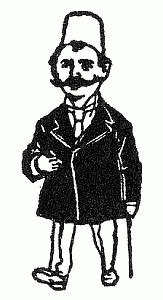
As I rather admired the plucky manner in which my friend had stood by St. Paul in this, the hour of her danger, I conceived the idea of preserving the event to history by presenting his portrait to the Historical Society of the state, which I did, in April, 1890, and also hung one in the Minnesota Club. It is a capital likeness, representing him, full life size, in the wild and picturesque costume of the border. A brass tablet on the frame is inscribed with the following legend: "The Hon. Joe Rolette, who saved the capital to St. Paul, by running away with the bill removing it to St. Peter, in 1857."
Joe died at Pembina, and is buried in the graveyard of the old Catholic church of Belencourt, under a cross of oak, which once bore the words:
"Here reposes Joseph Rolette. "Born Oct. 23, 1820. "Died May 16, 1871."
The simple chronicle is long since effaced.
"Requiescat in pace!" is the wish and hope of his historian and friend.
Back to contents