HISTORY OF LYNN. PART III. (continued 4)
Reading edition
Such were some of the numerous miracles which Anthony is said to have worked in his lifetime, exclusive of others said to have been wrought afterwards at his grave, and which were perhaps no fewer. Of those who have heard of these mighty and wonderful works of Anthony, the far greater part in all ages, even to the present day, have believed the report, and admitted the reality of the miracles: which, however, will not establish the fact, that they were actually performed, any more than the faith of the mahometans in the alleged miracles of their pretended prophet will establish that fact, or prove that the miracles ascribed to him did really take place. In each case we have a sad specimen of that easy and miserable credulity by which poor human nature has often most wretchedly disgraced herself, and unintentionally aided the cause and triumphs of imposture. Nor will it follow from the abundance of false miracles that have been heard of, or because the world has been so often imposed upon by them, that there never have been any real ones; on the contrary, all counterfeits seem invariably to imply the existence of what is real and genuine; and that, it is presumed, may be proved to be the case here. But this is not a place to enter largely upon this subject.
Anthony had been some years among the Franciscans before he instituted the order de Penitantia, which was in 1221, when he also fixed at Padua, where he sometimes preached in the open air to 30,000 persons, who came to hear him from all the neighbouring towns. His discourses, it is said, had a wonderful effect in converting prostitutes, delivering prisoners, reconciling enemies, procuring restitution of usury, remission of debts, &c. He was indefatigable, and preached every day. Many persons expressing a desire to embrace the order, he was unwilling to dissolve so many regular marriages, and dispeople the country: he therefore gave them a rule, according to which they might serve God in a similar manner in their houses, living in some measure like monks, but without austerity.—This is the substance of what we have learnt about this order. He died in the year above mentioned at the age of 36, and was canonized the next year. We are told that he was ten years among the Franciscans, if indeed it can be said that he afterwards properly quitted them for the friars de Penitentia are accounted a 3rd order of Franciscans. [525a] We are told that they settled at Lynn before the 5th of Edward I. and that their house here was dissolved by Henry VIII. [525b] but where it stood cannot now be ascertained. Parkin seemed inclined to indentify it with the well known convent of the Grey Friars, but that idea or supposition seems not at all admissible, as our apparently most accurate accounts of the religious houses dissolved here represent that of the friars of this order as quite distinct from the said convent, and this seems corroborated by Parkin’s own assertion, that “in 1307, Roger Flegg was vicar general of the order of friars de Penitentia in England at Lenne.” [526a] From the peculiar constitution of this order it seems rather probable that its houses or convents might be neither so large nor yet so numerous as those of most of the other orders. As that at Lynn might be but small, there may not be much reason to wonder that its site is not now discoverable; that being also the case with some others of our smaller religious houses.—With all its profound and extravagant reverence for its founder, St. Anthony, and its unlimited credulity, or faith in his pretended miracles, this does not appear to be the worst of the popish orders, but rather one of the better sort of them, as it seemed earnestly to set its face against many of the prevailing vices of the times, which must have somewhat checked the progress of immorality and licentiousness.—These friars might therefore be of some use here: but if they were so, and did some good, in partially checking the progress of vice and immorality, is it not also to be feared, on the other hand, that they did no less, or rather much more harm, in checking likewise the progress of virtue and true religion, and promoting to the utmost of their power an intolerant, persecuting, and antichristian spirit? [526b] That such was really the fact seems unquestionable; so that these friars had little room to boast of their good doings. But we will now quit them, and proceed to
The College. This edifice stands near the Town Hall, and is now inhabited by Mr. Toosey, a respectable merchant. It is by far the most entire, and best preserved of all the religious houses that were here dissolved; and were popery again to become predominant among us, this fabrick might be very easily converted or restored to its original use.—Parkin gives of it a very odd and confused account, as if it had been a part of the Priory, though somewhat detached from it—“The cell, or college of priests (says he) was near the Guildhall, and the prior’s house was somewhat remote from it, by St. Margaret’s Church.” It does not seem, however, that it had in fact any connection with the said priory: and it is certainly a place of much later erection; probably by no less than 3 or 400 years.—Mackerell also takes some slight notice of it, and says, “Not far from the church was a certain college, founded by Mr. Thomas Thorisby, as by the inscription carved upon the door still remain . . . Magistri Thome Thorisby, Fundatoris hujus loci.” This Thomas Thorisby, the munificent founder of this college, was one of the great men of Lynn in the latter part of the 15th century, and for sometime after, as appears from our lists of Mayors, among whom his name occurs three different times; 1st in 1477, again in 1482, and lastly in 1502. That he was a magistrate of a serious and religious character, seems to admit of no doubt; but how many of his successors, including those of the present day, have thought the better of him for that, is a question that appears involved in no small uncertainty. The College is said to have been founded about the year 1500, and it was dissolved about 30 years after, so that it was not long appropriated to the use for which it was designed by the founder. It does not appear to whom it went at the dissolution, nor do we know through how many hands, or how many different families it has passed, from that to the present time. Latterly, and for many years, it has been the residence successively of some of our principal mercantile families, without any material change in its external appearance. Of its original constitution we have not obtained any particular information, and the above being the substance of what we have learnt concerning it, our account of it must be here closed.
Another House, suppressed here at the general dissolution, was St. John’s Hospital: of which the information we have been able to obtain is very imperfect and scanty. Its very site, like that of the friars de Penitentia, seems no longer discoverable; and yet it was evidently, in its day, a place of some note and consequence here, and had a chapel, or church, as it is usually called, attached to it. Fox, the martyrologist, mentions St. John’s church, or the church of the Hospital of St. John, in this town, as one of the places where the memorable Sir William Sautre, parish priest of St. Margaret’s, when taken up for heresy in the reign of Henry IV. was obliged to read his recantation. Parkin takes very little notice of it, except quoting what Fox had said: and the same is the case with Mackerell, with this slight difference, that he in one place hazards a conjecture, that the site of this church was the same with that of the old grammar school, which was taken down some years ago. But if the church stood there, the hospital itself must also, in all probability, have stood close by, if not contiguous; and that seems not very likely, in so confined a situation. We know of no existing record that any way corroborates this conjecture, unless it be a hint in our tables of memorable events, “That in the year 1506, St. Margaret’s church was suspended, and the christenings were performed in the charnel belonging to St. John’s chapel:” but it seems too vague and obscure to establish the point. It is indeed very clear and certain that there did exist here formerly the Hospital and church of St. John, and that they were suppressed at the general dissolution, but as we know no more about them, we must here dismiss the subject.
Section VII.
Account of St. Mary Magdalen’s Hospital, the Lazar Houses, St. Lawrence’s Hospital, &c.
The Hospital of St. Mary Magdalen was one of the most ancient of those religious houses that were suppressed here by Henry VIII. It is said to have been founded by Petrus Capellanus, in the reign of King Stephen, in honour of St. Mary Magdalen. It consisted of a prior and twelve brethren and sisters; of whom ten, including the prior were sound, and three unsound, or leprous; some ecclesiastical, and some secular; who were bound to perform rites and prayers for the souls of certain men who had departed this life, viz. for the soul of Petrus Capellanus their founder, the souls of popes, bishops, abbots, priors, kings, queens, and others, their benefactors; as appears by their ancient book of obiits and Orisons, and by the ancient instrument of articles, which the brethren and sisters were bound to observe: and all, or most of the lands given to the said hospital were for the maintaining of prayers for the dead, as appears by divers deeds and charters, without date, of the first donations of those lands. [531]
In Mr. Kings MS. Volume there is a larger account of this ancient hospital than has been given by Mackerell and Parkin. We have there the ancient instrument of articles, or the fundamental rules of the fraternity, in Latin, under XVIII heads: annexed to which is the following account—
“This Instrument of Articles was made in the year that Petrus Capellanus died [A.D. 1174.] and himself consented, with the two archbishops, for ordaining the same.”—Then follows what has been given by Mackerell, that “this ancient hospital continued in a prosperous state from its first foundation about 400 years. But after the statute of 1st Edward VI. was made, for dissolving all colleges, chauntries fraternities, &c. this, with the lands &c. came to, and were invested in the crown, by the said statute. The fraternity, however, was not then broke up or dispersed, and might, perhaps, have been still continued, but for the breaking out of what is called Kett’s rebellion. A party of the rebels were encamped at Rising: and they attacked Lynn, in hopes of surprising it, but being repulsed and disappointed, they, on their return, fell upon this hospital, which they violently entered, and not only robbed the poor people there, and expelled them out of the house, but took away all their common stock, and rased their chapel and most part of the buildings there down to the ground: by means of which barbarous usage, the said hospital was so impoverished, wasted, and spoiled, that from thence forward it was quite destitute of brethren and sisters, and utterly relinquished, saving that the mayor and burgesses of Lynn maintained some poor people there, and endeavoured to uphold the said ancient hospital, out of their charitable disposition, for the purposes aforesaid.” [532]
“Nevertheless (says the author of the MS. account) some covetous persons, taking advantage of the depressed state of the said hospital, procured divers letters patents of concealment, from the crown; some of the site of the same, and some of other parcels of the lands and possessions belonging to the said hospital, intending to convert them to their own private lucre. But the said mayor and burgesses, (still having a great care that the said lands and possessions should be preserved for charitable uses) did purchase of some of the concealers the site of the said hospital, and a great part of the lands thereunto belonging, and at their great costs and charges supported and defended the same against all other concealers and their agents, purposing always to erect anew the said hospital, and employ the revenues thereof for the sustentation of poor people.
“But finding both by the advice of the king’s councill [counsel] and their own, that all the said patents of concealment were defective and utterly void in law, through many imperfections therein, and that (notwithstanding the said patents) the scite of the said hospital and the lands and possessions thereof still remained in the crown—therefore they made humble suit to the king’s majesty [James I.] for a grant thereof, and, of his Highness’ gracious favour and pious inclination to works of charity, they obtained Letters Patents of grant unto the mayor and aldermen, as well of the scite of the said hospital, as also of the lands, &c. thereunto belonging, who by the same are created governors thereof, and made a body corporate for the defence and maintenance of the said hospital new founded by his majestie.”
[An abridgement of those Letters Patents, transcribed from the Latin copy, is here subjoined, and is as follows.
“JAMES by the grace of God king of England, &c. to all to whom these Letters shall come, greeting, &c.—Whereas a certain ancient Hospital or Almshouse was founded and erected in Gaywood, called the House or Hospital of St. Mary Magdalen—And whereas divers lands, tenements, and hereditaments, were given and granted for the maintenance and relief of divers poor and needy men and women therein for ever—And we being informed, that certain evil minded men, covetously pursuing their own private lucre, have endeavoured utterly to demolish the state of the said Hospital, pretending some defect in the foundation thereof, or that the same have been dissolved—We favouring the sustentation of the poor, and such like charitable deeds, do of our special grace, for us, our heirs and successors, grant all that right, title, &c. which we have or might have in the premises, fully and graciously to be conferred and extended towards the establishment of the said Hospital, for poor and infirm men and women to dwell therein: and for the causes aforesaid the same shall for ever hereafter be called by the name of The Hospital of St. Mary Magdalen, of the foundation of king James, consisting of a Master and Warden and 10, 9, 8, 7, 6, or 5 poor needy men and women, who shall likewise be called, The Brethren and Sisters of the said Hospital, from henceforth for ever.—And for the more effectual performance of this our grant on our part, We have chosen nominated and appointed our well beloved Peter Tudman to be the first and present warden, or master of the said hospital, and to continue in the said office for and during his natural life, unless for some default, trespass, misdemeanor, &c. omitted or committed by him, contrary to the constitutions or ordinances hereafter to be made and ordained, he shall be from thence removed.—And moreover out of our own especial grace, certain knowledge, and mere motion, We have also chosen, nominated, &c. our well beloved John Tilney and Avis his wife, Isabel wife of the said Peter Tudman, John Pillow, Alice Briggs, and William Mason, to be the first and present brethren and sisters of the said hospital, there to be relieved and maintained during their natural lives, unless for some fault or misdemeanor they shall from thence be removed.
“And that this our pious and charitable intention may take the better effect, and that the lands, tenements, goods and chattels, and hereditaments, towards the maintenance of the said hospital and the warden or master, and the poor brethren and sisters &c. may the more effectually be given, granted, enjoyed, possessed and disposed, We will, and by these Letters Patents for us our heirs and successors of our like special grace &c. do grant ordain and constitute that the Mayor of our Burgh of King’s Lynn that now is, or hereafter shall be, and all the aldermen that now are or hereafter shall be, shall, from henceforth forever be our Body corporate and politique, in deed, fact, and name, by the title of The Governors of the lands, tenements, revenues, possessions, and hereditaments of the Hospital of St. Mary Magdalen upon the Cawsey between Lynn regis and Gaywood, of the foundation of James king of England, &c.—And by the said name of Governors, &c. to be always hereafter so called, termed, and nominated, for ever: and by the same to have perpetual succession, and to be both able and capable in law to obtain, receive, have, and possess the manors, lands, tenements, meadows, pastures, feedings, rents, reversions, remainders, and all other hereditaments whatsoever, to them and their successors for ever, as well from us our heirs, &c. as from any person or persons whatsoever; as also all goods and chattels for the maintenance and relief of the said hospital, the warden or master, and the poor brethren and sisters which shall, from time to time, live and be sustained therein.—And we do likewise by these presents for us and our heirs &c. grant unto them and their successors to have a common seal for all matters and businesses concerning the said hospital &c.—And that they by the name aforesaid may answer and be answered in any of his majesty’s courts or elsewhere within this kingdom of England.
“And we will that whensoever it shall happen, that the said master or any of the said 10, 9, 8, 7, 6, or 5 of the brethren shall die or be removed, it shall and may be lawful for the said governors (whereof the mayor to be always one) within 20 days after, to choose another in their room—And we will and grant that the said Warden or Master and his successors shall take his corporal oath on the evangelists for the due performance of his office, before the mayor for the time being, in the Guildhall of the said Burgh—And we will and grant that the said governors, or the greatest part of them (whereof the mayor to be always one) and their successors with the assent and consent of the bishop of Norwich for the time being, may make and constitute such and so many good and wholesome statutes, laws, &c. in writing, as well concerning the celebration of divine service every day in the said hospital to the honour of God, as for the government, election, expulsion, punishment and direction of the said master and poor there, and also concerning their stipends, salaries, liveries, habits, and all other necessaries whatsoever, as also concerning the ordinary, preservation, and disposing of all the lands, tenements &c.—And also may give and grant to the master and poor there, such useful things as they shall think fit: and may revoke, change, determine, augment, alter, and make new the same as they think most convenient; which said statutes, laws, and ordinances, to be made and constituted as aforesaid we straitly charge and command to be kept inviolable, from time to time for ever, yet so as the same be not contrary to the laws and statutes of this kingdom of England.
“And further for the continual relief and sustentation of the said hospital we have given and granted, and by these presents do give and grant to the said governors all the lordships, manors, messuages, lands, meadows, pastures, feeding-grounds, liberties, franchises and hereditaments whatsoever, lying in Gaywood, East Lexham, Dunham, Narford, West Lexham, Westwinch, and Holkham, in our said county of Norfolk, or any where elsewhere, which formerly were any part of the possessions of the said hospital, however before this time called or reputed, and which had not indeed though not by the law alienated, bargained and sold by the prior, brethren and sisters of the said hospital, and of which his Highness from the beginning of his reign had not taken any yearly profits, revenues, or rents.—And further we do give and grant unto the said governors, &c. To have, hold, and enjoy all the aforesaid premisses, together with court-leet, frank-pledge, liberties, franchises, goods and chattels waved of felons as well as felo de se, as of all other felons, fugitives, out-lawries, and taken in exigent, or in any other lawful way, right or title, they shall be convicted, condemned, extrahur deodands and all rights, jurisdiction, franchises, liberties, privileges, commodities, advantages, possessions, emoluments and hereditaments whatsoever, as fully, freely, and absolutely as any prior, brethren and sisters, as well sound as sick, ever had, held, or enjoyed heretofore, &c.—To have, hold, and enjoy all the privileges aforesaid to the only use and behoof of them the said governors, &c., in free, pure, and perpetual alms, for all rents, services, claims, and demands whatsoever, to be rendered, paid, or done to us our heirs &c. And we do likewise give and grant unto them all and singular, issues, fines, rents, revenues, annual profits whatsoever, of all and singular the premises aforesaid, whatsoever due before the grant of these Letters Patent, or within 60 years last past without giving any account of the same. And further we, our heirs, &c. will for ever acquit, exonerate, and keep indemnified to the said governors, &c. all and singular the premises aforesaid, against us our heirs &c. of and from coridies, rents, fees, annual pensions, portions and sums of money whatsoever, &c.
“And we will and straitly charge our Treasurer, Chancellor, and Barons of our Exchequer, their heirs and successors, and all other our Receivers, Auditors, Officers and Ministers whatsoever, upon producing these our Letters Patents, or the enrollment thereof without any other Breve or Warrant from us, that they make or cause to be made to the said governors &c. a full and plenary discharge of all the corodies, fees &c. whatever, for which these our Letters Patents shall be to them a sufficient warrant and discharge.—And we will and grant that these our Letters Patents and the enrollment thereof shall be in all things as firm, strong and good, sufficient and effectual in law against us, our heirs &c. in all our courts and elsewhere within out kingdom of England, without any further confirmation, licence, or toleration from us or our successors to be procured or obtained.—Notwithstanding the misnaming, misreciting, or not reciting the aforesaid premisses by these Letters Patents, Or the not finding only the office or inquisition of the premisses or any parcel thereof whereby our title ought to be found before the making of these our Letters Patents, Or the misreciting or misnaming, or not reciting or not naming any demise or grant of the premisses or any part thereof, on record or not on record, or any way whatsoever before this grant:—Or the misnaming or not naming any village, hamlet, parish, race, or county, in which the premisses or any part thereof be:—Or the full, true, and certain mention of the names of the tenements, farmers, occupiers of the premisses or any part thereof:—Or any defect in the certainty, account, or declaration of the true yearly value of the same as aforesaid:—or any other defects in not naming aright any one tenement, farmer, or occupier &c. or the statute made in parliament in the first year of the late king Edward VI. our predecessor, or the statute made in parliament in the 18th year of the late king Henry VIII. our progenitor.
“And further we will, straitly charge and command the aforesaid governors &c. that they expend, convert, and apply all and every the premisses aforesaid towards the relief and maintenance of the master and poor of the said hospital, and for the repairition and defence of all and singular the premisses aforesaid, and to no other use and purpose whatsoever.—Yet so that express mention be made of the true yearly value, or certainly of the premisses or any part of them, or any gifts or grants made before this time by us or any of our predecessors to the governors aforesaid and their successors, or any statutes, acts, ordinance, provision or restriction to the contrary before this had made published or ordained in any thing cause or matter whatsoever notwithstanding.—In Testimony whereof we have caused these our Letters to be made Patents. Witness ourself at Westminster this 22d. day of April in the year of our reign of England, France, and Ireland the 9th and of Scotland the 44th.
Per Breve de privato sigillo.
“After the grant aforesaid, the mayor and aldermen endeavoured by all fair means, to prevail with the concealers and usurpers of the many lands, &c. to yield and deliver up the quiet possession thereof to them, the said governors, without suit in law; but not able to succeed therein, they thereupon exhibited a bill of complaints into [in] the High Court of Chancery, against those who withheld the same, and had likewise gotten into their hands sundry Deeds, Evidences, Writings, Charters, Copies of Court Rolls, and Muniments, concerning the said Hospital, for about thirty years before the king’s majesty’s Letters Patents: whose names are as follow, viz. Sir Philip Woodhouse; Thomas Thoresbie Esq.; Henry Bastard, Gent.; Henry Baker, Gent.; Thomas Baxter; Robert Anderson; Richard Cross; Jefferie Pell; Robert Large; Robert Trollop; William Simpson, clerk; Robert Say, junr; Robert Spence, Gent.; Robert Webster; William Collis, als Glover:—Who having given in their several answers to the said bill, an order was made by the court, that the complainants should set down in writing, the particular lands and fold courses by them claimed, together with the evidences for proof thereof, that the same belonged to the said hospital, and how much the defendants have of those lands in their several possessions, &c. which they did as followeth”—
[The lands, &c. in question, are then particularly specified and described, being chiefly in East and West Lexham, and Dunham and Gaywood. They are denominated “Lands of the Lepers, or Spittle lands, pertaining to the brethren and sisters of the House, called The Spittle, upon the cawsey between Lynn and Gaywood”—the whole amounting to 305 acres—The complainants having thus specified their claims, the suit went on.]
“After divers hearings on both sides, in the high court of Chancery, for about four years together, the plaintiffs being prepared to move the lord chancellor with all speed for a decree, and for their costs and damages, Sir Philip Woodhouse defendant, (who had most of the lands, &c. in his hands,) solicited and intreated Sir H. Hobart, knt. and bart. Lord chief justice of the Common Pleas, to hear and determine the cause between them, which being consented to by the plaintiffs, his lordship gave his opinion, that the plaintiffs had right to all the lands and foldcourses, in the boundary before mentioned, in such manner as they have been claimed by them, excepting the messuage Warm, and 5 acres thereunto adjoining. And therefore to prevent further suit and expences on both sides, his lordship advised Sir Ph. Woodhouse to suffer that which he could not contradict, viz. that a decree should pass of all the lands and foldcourses (except as before excepted) for the plaintiffs, as in law and equity it ought to be: but withal mediated and intreated the counsel of the plaintiffs, in behalf of the said Sir Ph. that in regard so much of the lands and fold courses as were in the possession of Sir Philip, did lye so intermixed with his lands, it would be a great annoyance to him, and little profit to the plaintiffs, if the same were severed, that therefore it would please the plaintiff’s counsel to consent that the plaintiffs, after the decree passed, should make a lease to him of the premises aforesaid for 99 years, at the yearly rent of 16l. viz. their foldcourses at East Lexham, being in his possession for 10l. per annum, and all their grounds in West Lexham and great Dunham, also in his possession at 2s. 6d. for every acre per annum, and that the said Sir Philip Woodhouse should be discharged of all the rents, issues, and profits of the said lands and fold courses, for the time past; whereof the plaintiff’s counsel agreed, and promised to procure the same, which conclusion on both sides being made known the next day to the lord Chancellor, by the plaintiff’s counsel, his lordship upon their motion, ordered and decreed their possession of the said lands and foldcourses, unto the plaintiff’s, not having any relation to the said agreement made before the Lord chief justice, as aforesaid, saving in the exception before excepted, and in the omitting of damages and costs, which was promised in the last order.
“Afterwards, that it, upon the feast day of the decollation of St. John Baptist, next following, Sir Philip Woodhouse came to Lynn, and in the presence of John Spence, then Mayor, Thomas Oxburgh Esq. recorder, the aldermen and the rest of the Society then assembled in the common council house, the said Sir Philip did bring the draught of a Lease, (perused by the Lord Chief Justice Hobart), of the Spittle fold course of East Lexham, and of the lands which, by the mediation of the said lord chief justice, were to be demised by the mayor and aldermen to the said Sir Philip, a copy of which being formally delivered to the said mayor, &c. they caused the same to be engrossed on a pair of Indentures to that purpose, bearing date 17 May, 1615, then last past, (upon which day the last order for the decree was made) which Indentures were openly read, sealed, and delivered interchangeably in the said council house the said day of the decollation, being the election day for the succeeding mayor. The said Sir Ph. sent a fat buck, and gave his honourable promise, that he and his heirs should every year after, during the time of his Lease, give a like fat buck to every mayor for the time being towards their festival upon the said day; which was, for sometime, faithfully performed.—About a year after a Lease was granted by the mayor, &c. of all those their fold courses, foldage, and sheep pasture in the town of great Dunham for 250 sheep, to be goeing, fed, and depastured in and upon all the common, and common pasture fields and amble grounds there, as well demesnes as otherwise, anciently accustomed, to Sir Thomas Hogan, Henry Bastard, Henry Barker, Thomas Baxter, Thomas Burton, for 21 years, from Lady day 1616, for 10l. per annum, free and clear from all manner of quit rents and charges whatsoever. Both which sheep walks, with the lands thus demised, were anciently in Lease to the lords of the manor of East Lexham, from the old hospital, under the yearly rent of 20s. 4d. as appears by two ancient rentals, [copies of which are preserved in Mr. King’s MS. and are here given in the note below. [544]]—The flocks of the lords of Dunham went and were depastured in and upon the common of Dunham—as more appeareth by an ancient survey upon oath, both of the freehold and copyhold tenants, made in the 4th Edward 2. which is in the hands of Henry Bastard, Gent. now [i.e. about 1724] Lord of the manor of Great Dunham.”
[A true copy of which subjoined: it is in Latin, and too long to be inserted here, as it fills near four folio pages.]
After some recapitulation, by way of summary, of the above account, the writer proceeds to treat of the then present state of the hospital (i.e. now near a 100 years ago) and he observes again,
“that the house was first granted by the founder for the society of a prior and 12 men and women, called brethren and sisters, by which last style and title it was again newfounded by the aforesaid Letters Patents of K. James I. as appears by the 6th paragraph thereof. But this mixture or medley of sexes being not afterwards well and rightly approved of, it have been since thought necessary to alter and change the same [546a] and instead thereof to establish a sisterhood only, consisting of a master and eleven poor widows, [546b] who have formerly lived well and creditably in the world; but are not usually admitted under the age of sixty.” [546c]
The above account was probably taken from the MS. vellum book, which Parkin mentions, [546d] and is supposed still to exist among the town archives. It appears to have been written in 1617, under the sanction of the then mayor, recorder, and aldermen, and bears date on St. John’s day that year, when John Wallis was mayor, Richard Stonham, mayor elect, Thomas Oxburgh, recorder, and the following made up the remainder of the then magistrates, or aldermen, viz. Thomas Baker, Thomas Gibson, John Spence, Matthew Clerk, John Atkyn, Thomas Soame, John Wormell, Thomas Leighton, William Doughty, William Atkyn, and Thomas Gurlyn.—As these seem to be the persons who had been so active, a few years before, in recovering the lands belonging to our Magdalen Hospital, and in promoting the reestablishment and perpetuation of that charity, their names are worthy of being kept in remembrance; for they certainly deserved well of their country, and especially of the town of Lynn. The above law-suit, which they so successfully carried on, appears to have been one of the most justifiable and commendable of any that this corporation has ever been engaged or concerned in. Some of our corporation law-suits in more modern times were, it seems, of a different character.
For more than thirty years after the date of king James’ Letters Patents, and till sometime after the commencement of the civil wars, things went on well with our Magdalen Hospital, or Gaywood Almshouse. Its subsequent history, down to some part of the last century, is given by Mackerell, as follows—[547]
In the year 1643 this hospital suffered another dissolution, being purposely burnt down, when the Earl of Manchester came with the parliament forces to besiege the town of Lynn, at that time fortified, and standing out for the king, whereby it was then become utterly dissolved for some time.—But in the year 1649 the corporation being obliged to build it anew, which is very commodiously done, as it now appears, with two courts, [548] a chapel, and convenient apartments for the master, brethren, and sisters to dwell in, it was thought fit to put up the two following Inscriptions in proper places, to denote the occasion of this last disaster. The first is over the arch, upon a square free stone, as you enter into the second court, [and reads thus.]
THIS HOSPITAL WAS BURNT DOWN AT LYNN SIEGE, AND REBUILT 1649, NATH. MAXEY MAYOR, AND EDW. ROBINSON Alderman and Treasurer.
[The other] inscription, with the arms of the corporation in a shield over it, is engraven on a marble stone, which is affixed over the portal next the road, [and is as follows.]
THOMAS RIVET, MAYOR, ANNO 1650. E. R.
Thus after divers revolutions we now see it again erected, established, and committed to the care and management of two of the elder aldermen of the corporation, chosen and appointed annually from among the rest of their brethren, the governors, for that purpose, who with their joint advice and consent, ordain rules and orders for the better guidance and direction of the society; as may be seen fairly written in a Table hanging constantly up in the chapel, whereby every one of the members is obliged to be present to hear divine service daily read by the Master, after the tolling of the bell, and not to neglect their duty in attending, (unless upon just cause to be given to the master) under the penalty, or mulct prescribed in the said order.—The improvement of the lands and revenues of the hospital have been so far advanced of late [1724] by the provident and prudent management of the two last worthy gentlemen, the two deputed governors thereof, that the poor have now an addition to their former salaries, of twelve pence per week to the master, and sixpence to each of the women, or sisters; and it is to be hoped they may in a little time be yet further advanced. [549]—The parish church which they are appointed to resort to on Sundays, is that of Gaywood, in which [parish] this hospital is situated, where they have a convenient pew, purposely provided for them to sit in: but they may go to any other church or chapel at Lynn, or elsewhere, when and as often as they please.—So much shall suffice to have been spoken of this ancient hospital, being without the walls and limits of the borough of king’s Lynn, though wholly depending on the corporation there. [550]
From the date of the above account (which seems to be brought down to 1737, when Mackerell’s work was published) to the present time, our information concerning the said hospital is not so correct, particular, or ample as we could wish.—It appears however, that divers changes have taken place from time to time since king James’s grant was obtained: first from a mixed society of brethren and sisters to that of sisters only: at first, it seems, these sisters were to be all widows, but latterly there is said to have been a departure from that plan, and old maids have been admitted, in some instances, as well as widows; which seems not at all objectionable. Changes also, of course, there have been in the weekly allowances of the respective pensioners; but not (at least during the present reign) in proportion to the changes in the price of the necessaries of life. Half a Crown a week, which was the allowance a hundred years ago, was to the full as good as ten or twelve shillings a week now: and yet the poor women during any part of this long jubilee reign (when the shilling has sunk in value to three-pence, or a groat, at most) never had above five shillings a week, till the commencement of the present year: Nor had they been long in the receipt of even so much as five shillings, or more than four and sixpence a week, which was their stated allowance for sometime till within these very few years. They must have been, therefore, till this present year, and during most part of this long reign of boasted prosperity and glory, in a very unenviable, miserable, ragged, and half starving condition, although the acting governor was generally a man of fortune: and a late one immensely so; but they never fared worse than under his inspection, for his humanity or charity did not appear to be commensurate with his wealth. In short it is well for these poor pensioners that the acting government of their house is at present in the hands of a gentleman that seems determined to do them justice, and promote their comfort and happiness to the utmost of his power.
As to the four Lazar Houses, or Lepers Hospitals, paid to have been suppressed here at the general dissolution, it is likely that one of them was attached to, or connected with our Magdalen Hospital, for it appears to have been partly founded for unsound or leprous persons. This therefore may be supposed to have been one of those four suppressed houses. Of the other three, one was probably at West Lynn, one at Cowgate, and the other at Hardwick. The disease, for the relief of those afflicted with which these houses were founded, is said to have been introduced, or brought from the East into this country, and to Europe, by the madbrained crusaders, who became many ways a terrible grievance and pest to their respective countries and nations. It was a proof, certainly, of the humanity of our countrymen, in those times, that houses were erected and endowed for the reception and relief of persons afflicted with so grievous and incurable a disorder. So little do we know about the order, or economy, or laws of these Lazar Houses, that we must here necessarily dismiss the subject.
Of the Hospital of St. Lawrence very little is known, except that it was one of the four Lazar houses and stood at Hardwick, or Herdwyk Dam, as Parkin calls it. He says
“that in the 11th of Edward III. Matthew Herlewine conveyed by fine and trust to Thomas Duraunt, parson of Clenchwarton; William Duraunt of South Lynn, and John Kervyle of Wygenhale (along with other possessions) the advowson of the hospital of St. Lawrence at Herdwyk Dam, together with the rents, homages, services, &c. of the master of the said hospital, of the prior of Wirmegey, the prior of Westacre, and of John de Lenn.”
He also says, that—
“John Duraunt Esq. granted to Robert Synkclere and Agnes his wife the hospital, or house of lepars, with the chapel of St. Lawrence situate on the cawsey of Hardwyke, by Lenne, with the appertenances for their lives, from the feast of St. Michael in 27 Henry VI. paying to him, his heirs and assigns, for every brother and sister entering into the said hospital, and made by the said Robert and Agnes, 20d. and it shall not be lawful for the said John, his heirs &c. to put in or out, any brother or sister during the lives of the aforesaid Robert and Agnes.”
He further informs us, that—
“in 17 Edward, IV. Edmund Bedingfeld, lord of the manor of Hall Place, (in the hamlet of Seche Parva, in South Lynn) and in a court held of the said manor, grants to John Norris, [553a] vicar of South Lynn, the scite of the Hospital of St. Lawrence (which was then burnt) till it was rebuilt.” [553b]
Section VIII.
Of the Red Mount, and our Lady’s Chapel there—also her Chapel by the Bridge which still bears her name—St. Ann’s Chapel, with those of St. Catherine, St. Laurence, &c.
From the particular situation of the Red Mount, (on the out-side of the town-walls, and within the wet foss which flanked those walls,) there can be little doubt of its being once a small fortress, or fortified and castellated place; so that it might without much impropriety be denominated a castle. What will further corroborate this opinion is a fact noticed among our remarkable or memorable occurrences, that in 1469 king Edward IV. came to Lynn with a great retinue, and was lodged in this place; from which it may be very naturally inferred and concluded, that it was then well fortified; for the king in his then situation, (retreating before Warwick,) would hardly have been lodged without the walls in an unfortified place. From the same premises it may be likewise fairly inferred, that it was also a large and sumptuous structure—Edward’s numerous retinue requiring it to be of the former description, and his royal dignity of the latter: had it been small it could not have accommodated so large a company, and had it been mean, the king would not have been lodged there—[554] But however strong, large, or sumptuous the edifice on the Red Mount then was, most of it has long ago disappeared, and the little that now remains is chiefly the chapel, which was once of considerable celebrity, but is now in a dilapidated state. Of this curious piece of antiquity, one of the most remarkable that Lynn can boast of, the following description has lately appeared in a popular and respectable work, which we have often before referred to—
“At the eastern extremity of the town is a curious ancient building, called The Lady’s Chapel, or The Red Mount. It has been erroneously named a castle, but is evidently an ecclesiastical structure. [555a] It consists of an octagonal wall of red brick and is constructed on a very singular plan, of which, perhaps, not a similar example is to be found in the kingdom. Within the exterior wall is a handsome cruciform chapel, measuring from east to west seventeen feet seven inches, by fourteen from north to south, and thirteen in height. The roof is formed of stone, with numerous groins, &c. and exactly resembles the much admired ceiling of King’s College Chapel, Cambridge. This curious building is in a dilapidated state, and it is much feared will soon fall a victim to neglect and wantonness. Such a singular edifice should be carefully preserved, and as the expence to effect this would be trivial, it is hoped the corporation, to whom it belongs, will not neglect it, and thereby entail on themselves the perpetual reproaches of history, and the lasting censures of antiquarian record.” [555b]
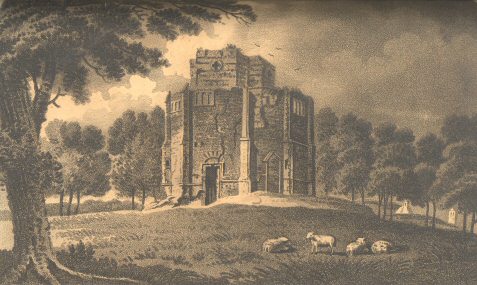
At what time this notable fabrick was erected, does not appear; but we may pretty safely conclude that it was at a period subsequent to the conquest, and perhaps not before the 12th or 13th century. It appears to have been dissolved, or laid by, at the reformation, and it was defaced, as Parkin says, before the 3rd of Elizabeth. As there has been little or no attention bestowed upon it ever since that time, it is no wonder that it should be now in so ruinous a state. It has been often said that this place was, in its day, the receptable of the pilgrims, in their way to, and from Walsingham. If so, it amounts to a pretty good proof, that it was very capacious, and well endowed, or furnished with ample revenues; for the pilgrims to Walsingham, like those to Loretto, swarmed on all the roads that led thither; but on no road more, or perhaps so much as that through Lynn, as all the devout people from the northern and north western parts of the kingdom must have passed this way, perhaps by hundreds at a time. That house must have been both large and wealthy, that could lodge and entertain such hosts of travellers.—Another reason for pilgrims frequenting our chapel on the Mount might be, because there was there also an image of the Virgin, which had attained to some celebrity; not indeed like that at Walsingham, [556] but evidently beyond any thing of the kind at Lynn. We may therefore be very sure that the holy travellers to Walsingham would pay a greater regard to the chapel of our Lady on the Mount than to any other religions place in this town. It has been observed before, that the offerings to this image of the Virgin on the Mount exceeded sometimes the offerings to all our other images and in all our other religious houses here, numerous as they were. In short, we may venture to affirm, that in former days no one place in Lynn was of greater note or celebrity than the Red Mount, and especially our Lady’s Chapel and Image there.
Of the Chapel of our Lady on the Bridge, we know much less than of that on the Mount, though our knowledge of the latter also is but very imperfect. When the former was erected, whether before or after the other, or why there should be two chapels in this town dedicated to the Virgin, are questions which we are unable to resolve. They were both probably more ancient than some of our other religious houses: but they were dissolved, or laid by at the same time with most of the rest. They were probably demolished not long after, and this on the bridge much more entirely than the other. Parkin says, that this chapel was defaced before the reign of Elizabeth, as appears by an inquisition taken in her third year. Our Lady’s Gild in Lynn had seemingly some connection with this chapel, as well as with that on the Mount; but we know too little of the constitution and circumstances of that ancient fraternity to pronounce any thing positively on this head. [558] Some small remains of this chapel, converted into a little dwelling, stood, till very lately, on the eastern side of the bridge; but when the said bridge was widened, by order of the paving-act commissioners, those remains were entirely removed, and there is no longer one stone upon another of that consecrated and venerated fabrick, or the least sign or indication, except in the name of the bridge, that such an edifice ever stood there.—The modern substitutes for this and the other ancient chapels, here suppressed and demolished, are four very decent and commodious dissenting meeting houses; one in New Conduit Street, one in Clough Lane, and two in Broad Street; all, or most of them, at present pretty well attended. Of each of which a particular account shall be given in the course of this work.
Of St. Ann’s Chapel very little is at present known. That it stood somewhere near St. Ann’s Fort, and that the latter took its name from it, can scarcely be doubted. The stones that are still to be seen in some of the adjacent walls did once, in all probability, belong to this ancient consecrated structure. [559] We have, however, no reason to suppose that it was a very large edifice, but rather one of our smaller size chapels, like that of our Lady on the Bridge, and some others. It probably stood contiguous to other houses, without any yard, or burying-ground adjoining; which may be one, and, perhaps, the chief reason, why its site has so entirely disappeared, so as to baffle, or render fruitless every attempt to discover the exact spot on which it stood. All that can now be fairly concluded is, that it must have been somewhere near the Fort.
The site of St. Catherine’s Chapel seems to be involved in still greater uncertainty than even that of St. Ann. By something that the present writer has somewhere met with, he has been led to think, that this chapel stood without the East Gates, and at no great distance; but as he cannot now recollect upon what he founded that opinion, he will not take upon him here to defend it, or assert that the chapel actually stood there. Parkin owns that he did not know where it stood, but says that it was defaced before the 3rd of Elizabeth, as appears by an inquisition then taken. He also says that it is “mentioned in 1497, and the charity Gyld of the town of Lenn,” which, as he supposes, may allude to our houses of lepers. But those houses were probably not under the direction of any one of the gilds, but rather of a particular religious order, called the order of St. Lazarus of Jerusalem; of which, however, we know not enough to give here a particular account of it. But as to the chapel in question, Parkin further informs us that “in 5 Richard II. Henry le Despencer, bishop of Norwich, wrote a letter to Roger Paxman, mayor, and to the burgesses of Lynn, wherein he desires that they would, for the love they bore for the bishop, grant part of the house of St. Catherine to one John Consolif, late servant to his brother, the lord le Despencer, there to live a solitary life, upon the alms of the good people; the other part of the house belonging to the archdeacon of Norwich, being before granted to the said John Consolyf.” [560] This shews that there was here formerly a House or Hospital, as well as a Chapel, dedicated to St. Catherine; to which house or hospital, in all probability, the said chapel belonged: but whether they pertained to our Lazarettos, or were founded for some other purposes, it is very difficult now to determine. Beside this chapel of St. Catherine, there was here another chapel dedicated to her, in the church of the friars preachers, or Dominicans: [561a] but this was nothing very remarkable, as we had here also more than one chapel dedicated to the Trinity, as well as to the blessed virgin, if not likewise to some others.
The Chapel of St. Lawrence, (like those of St. Catherine and St. John) appears to have belonged to the Hospital of the same name, and therefore must have stood at Hardwick, contiguous, probably, or very near to the said hospital. That house being one of our Lazarettos, its use, or designation is sufficiently obvious. We learn from Parkin,
“that John Duraunt Esq. in the 27 Henry VI. granted to Robert Synkclere and Agnes his wife the hospital, or house of lepars, with the chapel of St. Lawrence situate on the cawsey of Hardwyke, by Lynn—Also that William Walton, Esq. and Catherine, his wife, daughter and heiress of the said John Duraunt Esq. conveyed by fine, in Hillary term, 36th year of the same reign, to Sir Thomas Tudenham, knight, the advouson of the chapel of St. Lawrence, with the manor of Hall Place, and divers other possessions. [561b] This chapel seems therefore to have been an endowed place, whose advouson was deemed an object of no trivial consideration. The hospital to which it belonged, as well as the rest of our Lazar houses, may be supposed to have been in some sort of subjection to the master of the order of St. Lazarus, whose chief residence, or station, appears to have been at Burton Lazars, in Leicestershire. Parkin mentions a remarkable deed which he had seen, whereby brother Richard de Sulegrave, knight, master of the whole order of St. Lazarus of Jerusalem, and all the brethren of the said order, dwelling at Burton, by common assent and council of the whole chapter, grant to Alan de Kele, burgess of Lenn, his heirs and assigns, a certain piece of land, called Lazar Hill, lying by the common wall of the said village, containing 7 perches and 7 feet in breadth, on the north side; and 10 perches and 14 feet, on the south side; 5 perches and half broad, on the east side; 6 perches broad in the middle, and 7 on the west side, &c. [562] This seems, by the names of the witnesses, to have been as early as the reign of king John. “This piece of land,” (our author adds) “I find afterwards in the hands of Rd. Spany and John de Teryngton, in the reign of Richard II.”
But the present writer is not able to point out this remarkable spot, or yet to describe the nature and extent of that jurisdiction which the master and chapter of the order of St. Lazarus had over the Lynn Lazarettos.
Most if not all the rest of the smaller chapels were attached to, or connected with our different churches and convents, of which several belonged to St. Margaret’s church: we will therefore give here no separate account of them. Such little chapels and chauntries were pretty numerous here, and mark the character of the inhabitants, and particularly the most devout part of them, in those times. There was here also in former ages, at least one [563a] hermitage, or retreat of an anchoret, and that was at the Crouch, or Crutch, as it is now commonly called. Of this remarkable place, and its adjacent cross, Parkin gives the following account—
“The mayor and commonalty petition William (Bateman) bishop of Norwich, begging his favour towards John Puttock, to admit him as a hermit, who had, in the bishop’s marsh by Lenn, on the sea shore, in a certain place, called Lenn Crouch, made a cave there, till he could build himself a proper mansion; purposing, as he declares, to spend all his time, by your permission and license, in the service of God there: and the said John Puttock has there erected a certain remarkable cross, of great service for all shipping coming that way, of the height of 110 feet, at his own great cost and charge.” [563b]
This occurred as long ago as 1349. To our thinking the Crutch must be a most improper and strange place for a hermitage, where people are continually passing and repassing, and those, at least many of them, some of the rudest and most lawless of the whole population. How the hermits did there in popish times we know not, but we are apt to think that they would not fare very comfortably there in this protestant age.
Section IX.
Account of St. James’s Chapel (now the Workhouse) from its first erection, in the twelfth century, to the present time.
The founder of this chapel, as well as that of St. Nicholas, according to our best accounts, was William Turb, or Turbus, alias De Turba Villa, or Turbeville, the third bishop of Norwich, who was promoted to that see in 1146, [564a] in the reign of king Stephen. It was probably built before the end of that reign, as Parkin refers to a certain charter of that bishop, which proves that it was in being at the commencement of the next reign. [564b] Both this of St. James and that of St. Nicholas were chapels of ease to the church of St. Margaret. These three churches had in those times abundance of officiating priests, or chaplains. The great fraternity, called Trinity Gild, alone, maintained no less than thirteen; six for St. Margaret’s, four for St. Nicholas’s, and three for St. James’s. [564c] How many they had besides, does not appear; but they had, no doubt, several more. This chapel is said to contain in length five score feet, and in breadth 24 feet; exclusive of the cross aisle, and a chapel attached to it, dedicated to the Trinity. The altar of St. Lawrence stood somewhere in this chapel, and, at the east end of it, an image of our Saviour, to which devout folks were wont to bring their offerings. A particular division of the town appears to have been at one time consigned or appropriated to the officiating services of the chaplains or clergy of this chapel, comprehending, probably, all on the sides next to it of Damgate, Broadstreet, Blackboystreet and Codlin lane. St Nicholas’s clergy appear also to have had appropriated to them another division of the town: hence we find, that—
“on Friday before the feast of St. Tiburtius and Valerian, in the 35th of Edward III. it was ordered by the commonalty, assembled in the Guild hall, that the clerks of St. James’s in Lynn, for the future, shall carry the holy water from the East Gate of Lynn, through all the south part of Damgate, and through the whole street called Webster’s row; and that the clergy or clerks of St. Nicholas’ shall likewise carry from the aforesaid gate through all the north part of the aforesaid street of Damgate.” [565a]
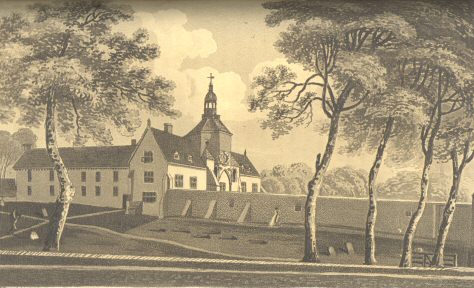
At the general dissolution this chapel was, it seems, laid by, and shut up, which appears an odd and unaccountable circumstance, as it had not any connection with the convents, being merely a parochial place of worship. We are told that it was pulled down, all but the cross aisle, in 1549, (by order of the mayor and corporation, it is supposed,) when it had four bells, which were worth, with the bell of the charnel-house, CCl. We are further told, “that there did also, in the mean time, belong to the said chapel and charnel-house, stone, iron, and glass, to the value of one hundred marks: also timber and lead to the value of 300l. also plate, jewels, and stock, to the value of 200l. also certain lands and tenements in Lynn, to the yearly value of 5l.” [565b] All this property appears to have come into the hands of the mayor and corporation; not very fairly and honourably, it seems; for we find that it rather belonged to the Dean and Chapter of Norwich, who, about seventeen years after, on what occasion does not appear, relinquished their right and claim to it, by a formal deed to that purpose, a copy of which is given below. [566a] This was about the year 1566. [566b] From that period it lay, probably, in ruins till 1581, when it was, at the expense of the corporation, prepared and made a place for the manufacture of bays, &c.—How long it was occupied for that purpose is not said; but we learn that the undertaking did not succeed.—About a century after, in the year 1682, it was repaired and fitted up, by the liberal benefactions of the corporation and principal inhabitants, and converted into a hospital, or workhouse for fitly decayed old men, women, and poor children; a good endowment and provision being made for their work, instructions, and maintenance, and for putting the children out to trades.—On that occasion were made and adopted the following
“Rules, Ordinances and Statutes made and established by the mayor and burgesses of the burgh of King’s Lynn in the county of Norfolk, for the good government of the Hospital or Workhouse of St. James, there erected and founded, and of the children’s being, and to be placed therein.—Imprimis, That the children be instructed in their duty towards God, and in good manners.—That the master for the time being shall cause the children every Lord’s day, both in the forenoon and afternoon, constantly to repair to the parish church of St. Margaret, diligently to attend divine service and sermons there.—That some fit person, to be elected by the mayor and burgesses, shall daily read the prayers and collects appointed for that purpose in the chapel of the said house, every morning by eight of the clock, and every evening by four of the clock precisely, all the children there attending with becoming reverence.—That such person, after prayers so read at the times aforesaid, shall teach the children to read for the space of one hour and an half, twice in the day, by calling together four at a time, and no more, whilst the rest are at work.—That such person every Sunday, after divine service in the afternoon, calling all the said children into the chapel, shall instruct them in the church Catechism appointed for children, for the space of one hour, concluding with the prayers and collects.
“Item, For their Recreation and Correction. That the children be kept at work between our Lady and Michaelmas from Six of the clock in the morning till Twelve at noon; and between Michaelmas and our Lady from Eight till twelve, and in all afternoons from One to Seven: the time for prayers, reading, and refreshment, excepted. That on festivals and holy-days observed by the church, and every Thursday after three in the afternoon, they be allowed reasonable recreation. That for offences committed, gentle and moderate chastisement be given; and such as will not thereby be reformed, be sent to the house of correction, to be there punished.
“Item, For their Diet, Cloaths, Firing, and necessary Provisions. That three days in the week they have once in the day competent allowance of flesh meat hot, and three other days like allowance of other hot provision, to be ready at twelve at noon; and on the other day fit provision; as also a reasonable breakfast and supper every day of the week. That all sorts of provision, bread, beer, and meat, and all other victuals, be good, fresh, and wholesome. That once every year, a month before Christmas, they be allowed new suits of cloaths of the usual colours, and new shifting, shoes, and stockings, so often as it shall be necessary and convenient, and washing allowed them. That out of six chaldron of coals to be allowed to the master, a convenient fire be kept in the working-room all the cold season of the year. That such children as shall appear to be sick, be removed into a room for that purpose; and if any be infirm, or taken with contagious distempers (such as are catching) that special care be taken to lodge them apart from the others.
“Item, For the Visitation, Overseeing, Defraying necessary charges, and Regulation of Abuses. That on the usual day of electing the corporation officers in every year, the mayor, aldermen, and common-council, or the major part of them, shall elect and choose three discreet and fitting persons to be governors of the same Hospital, or Workhouse, for the year from Michaelmas thence next ensuing, whose care shall be to inspect and oversee the same, and the children therein, from time to time; and to order and direct all expences, charges, payments, and disbursements concerning the same; and to see and cause all the rules, ordinances, and statutes thereof to be put in due execution.—That all gifts, benevolences, contributions, payments, and sums of money whatsoever, now or hereafter to be made and given to the same Hospital or Workhouse, or the poor children therein, shall from time to time be paid into the hands of such governors; and a true account thereof, and of all expences, charges, payments and disbursements concerning the same, shall yearly be made and audited on the usual day appointed for auditing the accompts of the mayor and burgesses.—That a book be kept, wherein all gifts and benevolences, that have been or shall hereafter be given to, or bestowed on the said Hospital or Workhouse, or the poor children therein, shall be fairly registered, to be kept in the said chapel.—That one other book be kept, wherein the names or times of placing or removing of all masters and poor children of the same Hospital or Workhouse shall be entered and recorded.—That a sufficient chest or box be provided, with two locks, for the reposing and safe keeping therein the Deeds of Foundation, Endowment, and other writings, that do or shall belong thereunto, as also the common seal of the said Hospital, or Workhouse; one key whereof to remain with the mayor of this burgh for the time being, the other with the senior governor thereof.—That the mayor, aldermen, and common-councilmen, or so many as shall think fit, by appointment of the mayor for the time being, shall four times in every year, or oftener if need require, visit the said hospital or workhouse, for the better encouragement thereof, and discovering abuses that may be committed contrary to these rules and ordinances.” [570]
“The first Collection among the inhabitants towards this charitable design, and preparing this chapel, amounted to the sum of 406l. 1s. 6d.—The Corporation also made an order among themselves, That every Alderman new elected should pay at his admittance 10l. and every common-council-man 20 nobles, which, to the year ending at Lady day 1724, amounted to 726l. 13s. 4d. The legacies of persons deceased (besides other benefactions) given to the same” [up to the above specified time] “amounted to 90l. 0s. 0d.—In all 1222l. 14s. 10d.—They also endowed it with 20l. per annum.” [571a]
For some reason, to us unknown, the above order of things did not long continue. In the course of a few years another revolution took place: most, if not all the above regulations were repealed, or laid aside, and the house, by an act of parliament, was consigned to the superintendence and management of the Guardians of the Poor. [571b] That act passed in 1701, the 12th of William III. For erecting Hospitals and Workhouses in King’s Lynn. It contains, as Mackerell observes, the following clause—
“The Workhouse, founded by the mayor and burgesses, called St. James’s Workhouse, and all lands, tenements, rents, revenues, goods, and chattels, belonging to the same, are by this act vested and settled in the guardians of the poor, and their successors.” [571c]
We are further told, that by another clause in this act, it was to continue in force only so long as the rates did not exceed what had been paid towards the maintenance of the poor, for any one of the then three last years. [572] That excess, no doubt, took place pretty soon, though we have not learnt the exact year when it so happened: and yet the guardians, it seems, long after, and even till very lately, acted under that same obsolete law; a conduct which may be thought not altogether justifiable or defensible. But as the proverb says, that “half a loaf is better than no bread,” so they might judge that an obsolete law was better than no law. However that was, one would think that they must cease to be guardians, when the law that constituted them such lost its authority, or ceased to be in force.
From the period when the superintendence and management of St. James’s Hospital were committed to the guardians, it appears to have become the proper poor house of St. Margaret’s parish, and general workhouse of the town.—Of the exact state and regular variations of the poor rates in Lynn during the first sixty years, and more, after the above act had passed, we have but little knowledge; but for the last forty years our information is much more extensive and authentic. During this period our poor-rates, or what we have raised for the support of the poor, have increased tenfold, and the number of paupers four or five fold.—In 1770 these rates amounted to only 976l.—In 1796 they amounted to 7713l.—and in 1809 to about, or near 9000l. and the whole expenditure, up to the end of January in the present year, (1810) to the enormous sum of 10,243l. 10s. 3d.—for, after the manner of our superiors, who sit above at the helm, we manage and contrive that our outgoings should exceed our income.—The following statements of our out-door expenditure in two different years, (the first and the last of the above period,) extracted from Mr. Grisenthwaite’s Remarks, p. 19 and 20, may throw some further light upon this subject.
Abstract of Out-door Expenditure in 1770, as published by order of the Court of Guardians.
No. of families in each ward. Wards. No. of persons. Cash paid to each ward weekly.
l. s. d.
30. 1. North End Ward 78 2. 14. 0.
6. 2. Kettlewell ditto 9 0. 7. 6.
5. 3. Trinity Hall ditto 16 0. 9. 6.
5. 4. Jews’ Lane ditto 10 0. 11. 6.
13. 5. Paradise ditto 34 l. 6. 0.
26. 6. Sedgeford Lane ditto 41 1. 18. 6.
19. 7. Stonegate ditto 34 1. 13. 0.
20. 8. Chequer ditto 41 1. 6. 6.
8. 9. New Conduit ditto 17 0. 11. 6.
In St. James’s Workhouse 0. 2. 6.
131. Total as establishment account. 280. 10. 19. 6. [573]
Abstract of Out-door Expenditure in 1809, as published by order of the Court (or corporation) of Guardians.
No. of families in each ward Wards. No. of persons. Cash paid to each ward weekly.
l. s. d.
85. North End Ward 172. 9. 19. 9.
44. Kettlewell ditto 78. 5. 16. 0.
58. Paradise ditto 141. 8. 18. 6.
36. Jews’ Lane ditto 99. 5. 10. 6.
44. New Conduit ditto 91. 6. 12. 0.
58. Chequer ditto 120. 9. 2. 6.
33. Trinity Hall ditto 64. 5. 2. 6.
76. Sedgeford Lane ditto 158. 10. 9. 6.
80. Stonegate ditto 150. 12. 0. 0.
514. Weekly Allowance 1050. 75. 11. 3.
Sick poor 60. 8. 17. 0.
Illegitimate 39. 3. 13. 9.
Total. 1149. 88. 1. 9. [574]
The difference between the latter and the former of the above Statements, in so short a period, comprehending only a part of the present prosperous reign, and what some seem to deem the most blessed and glorious part of if, must be exceedingly remarkable and wonderful. In 1770 the rates of the town were only 4s. in the pound on the rent, raising an annual revenue of 976l; of which 579l. were appropriated for the use of the out door poor, leaving only 397l. for the maintenance of the Workhouse and all other contingent expences. Thus the total expenditure of the House was then only 397l; now it is 3496l. 3s. 5d.—Then the total annual expenditure for both the in-door and out-door poor was only 976l; now it is above 10,000l. [575a] Of course, the charge for the maintenance of the poor is now become a very serious matter, and even a heavy and grievous burden to many of the inhabitants.
Our poor rates have arrived at their present unexampled height under the new heaven-born poor-law, which was to be the prolific parent of so many inestimable blessings to the town; not one of which, alas! has yet been, or is ever likely to be realized. This memorable law, and its worthy twin-sister, the paving law, have been already productive of incalculable mischief. The vast additional burden which they have brought upon the inhabitants has lessened the value of houses 15 or 20 per cent, and multiplied the number of untenanted dwellings to five or six score, at least. [575b] Nor is it possible at present to calculate how far the evil will or may extend. For such a town as this to contain a large and increasing number of empty houses must certainly have a very dark and unpropitious appearance, and is utterly repugnant to every idea of our being at present in a flourishing or prosperous condition. [576a]
When it was made to appear that the poor rates of Lynn amounted to nearly, if not quite, as much as those of Hull and Exeter, places three times its population, it was impossible to avoid suspecting the existence of some sad mismanagement, if not also of most foul and criminal misdoings. The same suspicion was not likely to be lessened, but rather to issue in full conviction, when it was discovered, that the maintenance of each pauper in this workhouse, or hospital, costs even more than that of each pensioner in Greenwich Hospital, [576b] and twice or thrice as much as that of each pauper in some, if not all, of the most noted and respectable workhouses, or poorhouses in the kingdom. That the report of these circumstances, with the increasing pressure of the rates, should excite a spirit of mistrust, inquiry, and investigation in the town, was no more than what might naturally be expected. It accordingly did so happen: and the result proved that the previous suspicious were not groundless.
In the course of the investigation, Butcher’s Meat appeared to be here consumed in such unusual quantities [577a] as are utterly irreconcilable with any and every idea of economy and good management: and in the article of Cheese the consumption appeared to be still more palpably disproportionate, unexampled, and excessive; so as to set the wisdom and competency of our managers in a very unfavourable and unseemly point of view.—This the reader will easily perceive, when he is told, that it costs in this house, for cheese alone, between 4 and 5l. a week, or that there is consumed here weekly no less than 1 Cwt. of that article. That this is out of all proportion to what is usual in other Poor-houses, will appear from the following statement, extracted from Mr. Grisenthwaite late publication. [577b]
At the Norwich Poor-houses, among 1343 persons, during one of the late years of scarcity, the annual expence for cheese was 135l. 2s. 5d.—At Shrewsbury, among 274 persons, (in 1801, if we are not mistaken,) the annual expence for the same article was 56l. 2s. 4d.—At Hull, in 1808, (number of persons not mentioned, but doubtless, not fewer than those in our Poor-house,) the annual expence for the said article was 29l. 16s.—At Lynn, the same year, among 200 persons, for that article, 226l. 8s.—At the same town, among about the same number of persons, for the last year, (1809,) the annual expence for that very article amounted to the still more enormous sum of 259l. 15s. 11d. [578a]—If we go on at this rate, we shall soon have 3 or 400l. a year to pay for cheese only, for the use of our Workhouse; a sum equal to what the whole of that establishment cost forty years ago. [578b]
The statement here following will shew the respective and total amount of the expence of the other articles consumed in this house within the last year, with the proportion they bore to the single article above specified.—The Butter used in this house for the whole year cost 30l. 11s. ld.—The Milk 33l. 14s. 2d.—Potatoes 37l. 2s.—Oatmeal and Peas 56l. 6s. [Total 157l. 13s. 3d.] That the sum total of the expence for the above four, or rather five articles, should fall short above 100l. of what it cost for cheese only, must surely be very strange: and yet it appears not to be more strange than true. The whole year’s expence for Grocery was 158l. 1s. 7d.—And for Beer, 157l. 7s.—Here also it may be thought not a little remarkable, that the Grocery and even the Beverage used here should so much fall short of the Cheese as each of them not to amount to very much above half the expence of that article. Of the two most important articles, Flour and Meat, (the only two which exceeded the expence of cheese!) the former, including Bread, cost 1001l. 10s. 9d. [579a]—and the latter, (Meat,) cost 1110l.—Coals cost 134l. 5s. 10d.—Turf 9l. 3s.—Oil 8l. 4s.—The total expenditure of the house for the whole year, including sundry other articles, with repairs, &c. 3496l. 3s. 5d. [579b]—and with the disbursements to the out-door pensioners, the entire expenditure, up to the end of last January, as was before observed, appeared to amount to 10,243l. 10s. 3d.: [579c] an enormous sum, surely, for a town that does not contain 11,000 inhabitants, or any manufacture, or even any trade now, of much consequence, except the coal trade. Under these circumstances, such a rapid and vast increase of poor, and of the poor rates, must amount to an irrefragable proof, that we are now in a state of actual and fast declension, whatever some people may insinuate, or pretend to the contrary. But the more evident this declension is, the more incumbent it must be on those who have the management of our affairs to observe the utmost economy, and spare as much as possible the industrious and lower orders of the community, who can so ill bear the burden of additional charges. Whether they have hitherto ever thought of this, or not, it seems to be now high time that it should occupy its full share of their attention. [580a]
It has also been thought, or rather suspected, that our distributers of parochial relief do not always distribute or administer that relief with judgment and discrimination, or even with a scrupulous or due regard to justice and impartiality: and such statements as the following might be supposed to afford some colour or countenance to such suspicions—
“Weekly allowances—To a man and wife and 5 children, 2s. 6d. To a young woman, aged 24, and one child 2s.—To a man and wife near 70 years of age, 1s. To a single woman, aged 19, 2s. 6d.—To a widow, aged 76, 2s. To a single woman, aged 31, 2s. 6d.—To a widow, aged 78, 2s. To a single woman, aged 22, 1s. 6d.—To an aged woman, 102 years old, 2s. 6d. To a widow, aged 48, 3s. 6d.—To a widow, aged 38, with 3 children, 3s. To a single woman, aged 36, 2s. 6d.” [580b]
Such a Statement, which may be taken as a sample, or specimen of our out-door distributions, has something like partiality, or inconsiderateness, marked on its very forehead.—“Kisses,” according to the old adage, “go by favour;” and so, it is to be feared, do our out-door parochial allowances, in too many instances. But upon this topic we will not now enlarge, as we may have occasion hereafter to resume the subject, in the latter part of the work. [581a]
At this time (July 1810) a revolution, or new arrangement is said to be actually taking place among our indoor-pensioners, or in the management of St. James’s Hospital, from which very important benefits are expected soon to result: and it is much to be wished that the event may correspond with the present expectations. The household expences have been already, it seems much reduced, [581b] without the least detriment to the poor inmates; and we hear, that the plan is to be followed up with the strictest attention to sound and rigid economy. The present state of the town certainly requires it, and those who have come forward on this occasion seem to be very much in earnest; but it remains to be seen how far our present hopes and expectations will be realized, or whether, after all, we are not destined to be, in this case, as we have been in many others, the miserable victims of delusion and disappointment. [581c]
With very little propriety, especially of late years, has our St. James’s Hospital been called a Work-house: it might full as well, and even better, have been called a play-house; for it is certain that there is more play than work going on there. Among its 200 pensioners, one half, at least, may be supposed capable of doing some, and even a great deal of work: and yet all their earnings during all the last year amounted to no more than 170l. 1s. 5d. which was at the rate of little more than a penny a day. The work, therefore, done by the numerous residents in this house is scarcely worth mentioning, except for the purpose of exhibiting the palpable neglect and mismanagement of the conductors, and their utter incompetency for the charge which they have undertaken. As things have stood hitherto, this house has been little better than a nest of sloth, or an asylum for idleness; where young and strong paupers are so treated as if it were actually wished and intended to unfit them, as much as possible, for any future use or employment in society, or as if their admission here had been meant for their ruin, and not for their relief and benefit—Care, certainly, ought to be taken, that the children, and youth, and hale people, in our poor-houses, be inured to habits of industry, as well as provided with food and raiment; otherwise, the succour afforded will be most materially defective.
The foregoing narration, it is presumed, will enable the reader to form a pretty accurate and adequate idea, of the history of this notable house, from its first erection, or foundation, in the reign of king Stephen, or that of his successor, to the present time. At first, as has been shewn, it was a chapel, or place of worship, of no small consideration in the town, being little inferior to St. Nicholas’ chapel, or even St. Margaret’s church, and continued to be so till the reformation, when it was unaccountably desecrated, and most of it pulled down. After which, it was appropriated successively to different uses, till it became the poor-house of St. Margaret’s parish, and the general work-house of the town, with the annexation, of late years, of extensive new buildings. This is its state at present: but how long it may so continue, it is impossible to say, as we can see but little into futurity. How far the recent change and expected reform will realize or disappoint our hopes, must be left at present among the mysteries. Time is the only revealer of such secrets. We will now take our leave of St. James’s Chapel and Hospital, and proceed to other matters, somewhat less connected with the affairs of the present generation.
CHAP. VII.
Brief biographical notices of the most remarkable or distinguished personages that appeared among the inhabitants of Lynn, in the intervening period between the Conquest and the Reformation.
During the period now under consideration, it is not known that many eminently distinguished, or very memorable characters appeared among the inhabitants of this town, full as it was, in the mean time, of ecclesiastics or priests, and monks or friars of different orders, among whom was usually confined all the little knowledge and learning that did then exist in the nation. But though the population of Lynn, during the said period, did not abound in characters of the above description, yet it does not appear to have been altogether destitute of them. The names of several have been preserved, who seem to have made in their day no mean figure among their most enlightened contemporaries; of whom the following were, perhaps, the most estimable and worthy of remembrance.
1. Nicholas de Lenna, or Nicholas of Lynn. He was a native of this town, and flourished in the reign of Edward III. He was educated at Oxford, where his literary proficiency may be supposed to have been very considerable, as he afterwards appeared to exceed most of his fellows, especially in some rare studies and distinguishing departments. To him is supposed chiefly to apply that observation of Voltaire, in his Essay on Universal History, (vol. 3. pp. 182, 183.) “That the first [in Europe] who certainly made use of the compass were the English, in the reign of Edward III.” [586a] Hackluyt, in his Voyages, makes particular and honourable mention of him, observing, that Nicholas de Lenna, an excellent musician, mathematician, and astrologer, bred at Oxford, after having applied his studies chiefly to astronomy, by the help of his Astrolabe, [586b] made six voyages to the North seas, of which he published an account, in a book entitled “Inventio Fortunata (aliter Fortunæ,) qui liber incipit a gradu 54 usq; ad polum.” In the first (which seems to have taken place as early as 1330) he sailed from Lynn to Iceland, with Company, whom he left on the sea-coast, while he himself travelled up into the island in search of discoveries. He presented his charts of the northern seas, at his return, (from his last voyage, we may suppose) to Edward III, in 1360; and they were afterwards made use of in the reign of Henry VI, and probably much later. He died in 1369, and was buried at Lynn. We are told that he was much esteemed by his celebrated contemporary Chaucer, who styled him ‘Frere Nicholas Linn, a reverend clerke.’
Like the great Roger Bacon, who lived about half a century before him, Nicholas belonged to the religious order of Grey Friars, or Franciscans, otherwise called Cordeliers, and minor brethren. [587] One is apt to forget or overlook, in some measure, the extravagances of the order, in the contemplation of its being capable of producing, and that it actually did produce such men as these. As Nicholas is supposed to have spent the most part of his time at Lynn, among the brethren of his order, it may very naturally and reasonably be concluded, or supposed, that the Grey Friars’ tower, which is still standing, was often used by him, as an observatory, in the course of his astronomical studies here; which may suggest no despicable reason for preserving that ancient ruin from the ravages of time, and keeping it up as long as possible. The repair which it lately underwent must be creditable to the feelings of those by whom it was promoted. It may seem somewhat odd and remarkable that it has stood so long, and still exists, the last and only remain of our numerous monasteries and conventual towers; (though, perhaps, from the slightness of its structure, the most unlikely of any of them to survive;) as if time, or providence had favoured its preservation, by way of approval of the useful purposes to which it had been once appropriated, or in honour of the memory of him who so laudably occupied it, and was so eminent a benefactor to his country. Much stress, however, is not meant to be laid on these ideas: yet we cannot help thinking that this supposed, or presumed and probable observatory of our ancient astronomer and navigator is entitled to some real and lasting respect from the enlightened part of our population.
It has been already observed that our worthy and respectable townsman, the subject of this brief memoir, died in 1369, and was buried here, [in the church, or dormitory of the Grey Friars, in all probability;] but at what age, does not appear: yet if his first voyage took place in 1330, as it is said, he must have lived to be pretty far advanced in years; it being not probable that he was less than thirty when he set out on that voyage. Between the first and sixth, or last of his voyages there seem to have been nearly if not quite thirty years. They were all apparently voyages of discovery and experiment, and for improvement in the art and knowledge of navigation, and proved, no doubt, of no small advantage and benefit to his countrymen. It is much to be wished that a particular account of them had been preserved, which could not fail of being very interesting; but as such an account is not known to exist, our wishing for it must be all vain and useless. Any records which our worthy voyager might leave behind him have probably perished long ago; but we have from other sources sufficient proofs that he must have been in his day an extraordinary man, greatly distinguished as a mathematician and astronomer, and especially as a navigator. He and the person whose name next follows may pretty safely be deemed the two most eminent characters that appeared among our townsmen, during the long period of which we are now treating, or, perhaps, during any other period.
2. William Sawtre, or Salter, otherwise Sawtry, Chawtrey and Chatris, and commonly called Sir William Sawtre, &c. it being usual in those days, and long after, to prefix that title to the names of a certain description of ecclesiastics. He is rendered peculiarly memorable as the English proto-martyr; it being generally agreed that he was the first Englishman that was burnt for his religion. We have no authority to say of Sautre, as we did of Nicholas, that he was born here. The place of his birth, as far as we know, has been no where mentioned. It appears that he took up his residence and settled here, as parish priest of St. Margaret’s, in the time of bishop Spencer, of fighting, crusading, and persecuting memory; and that he was afterwards suspected and found to be a Lollard or Wickliffite, [590] which meant pretty much the same with what we call being a protestant, but was then deemed, by the rulers, in church and state, a very grievous offence, and even a most shocking, pestilent, damnable, and insufferable heresy. The defection of Sawtre, from the established or national faith, roused his ecclesiastical superiors, and he was cited to appear before his haughty and furious diocesan, at his palace of south Helingham; which accordingly he did, on the last day of April, and the first of May 1399. In the mean time he appears to have undergone a long and strict examination, in the chapel belonging to the said episcopal palace, before the bishop, the archdeacon of Norwich, and divers others, consisting of doctors, divines, and notaries. It also appears that he was then so far from being ashamed of the opinions he had espoused, or intimidated by the danger to which they might expose him, that he did not at all scruple or hesitate to avow and defend them. This we may be sure, did not please and conciliate his examiners, or promote and facilitate his acquittal and liberation.
We are not particularly informed how he was disposed of immediately after this examination: but it seems pretty certain, that he then became a close prisoner in some place of confinement within the precincts of the said episcopal palace. A prison, for reputed heretics and other delinquents, was formerly considered among the necessary appendages to a prelatical mansion or residence: and it cannot be supposed, considering the character of bishop Spencer, but that a very complete one was then to be found at South Helingham. In a complete episcopal prison there was usually, it seems, a cell, called Little-Ease; which was a small hole, so constructed, that the person there immured could neither stand upright, lie straight, sit comfortably, or enjoy any degree of ease: in short, it was designed as a place of torment, where the sufferer was to be continually tortured, and deprived, as much as possible, of every thing that could render his situation in any degree tolerable or supportable. This diabolically ingenious contrivance could scarcely fail of answering the purpose of its inventors, as it seems to have been most admirably adapted for taming, subduing, and breaking the spirits of reputed heretics and religious free thinkers: few of whom, it is presumed, could stand such an ordeal, or terrible test, for any length of time. The romish hierarchy must have been tremendously formidable, when its prelates had such prisons in their own houses, and were empowered to confine there any that dissented from the church, or objected to its tenets and observances. [592]
That there was such a place of incarceration and torture then attached to the episcopal palace of South Helingham, seems highly probable; and if there were, there can be no doubt but that Sawtre was there confined from the first to the nineteenth day of the month last mentioned.—That he underwent some very severe treatment, in the meantime, seems morally certain, as the remarkable change in his conduct, at the close of that interval, cannot be reasonably or well accounted for on any other ground or supposition. [593] On the first of May he resolutely avowed and defended the obnoxious opinions imputed to him, but on the nineteenth of the same month, the next time he was brought before his judges, he appeared ready to relinquish them all, and pronounce his recantation. There is no reason to think that his opinions had now undergone any change, or that he had become really convinced of their falsity or untenableness; for he appeared, almost immediately after, to be as fully persuaded as ever of their truth and importance. It was evidently the state of his mind that had experienced a change: his fears had got the better of his firmness, and he no longer possessed that fortitude and boldness which he had at first displayed. Torturing severities have often made people deny their principles, and deny, or confess, any thing that their tormentors required. On this ground (and on no other that we know of) can we account for Sawtre’s change and subsequent recantation.
It was determined, by the bishop and his coadjutors, that Sawtre should publicly pronounce his recantation at different places—in order, perhaps, the more effectually to expose and humble him, and so prevent his ever daring again to broach his recanted tenets in these parts. They probably suspected his sincerity, and were resolved to render their triumph over him as complete as possible.—The obnoxious things, or enormities laid to his charge were chiefly and substantially comprised under the following heads—That the Cross on which Christ suffered was not a fit object of worship—That it was more reasonable to worship a temporal prince than that wooden cross—That the worship of angels is unlawful, even more so than the worship of holy or truly good men—That going on pilgrimage is useless, and that vows for that purpose are not binding, and that the money so expended had better be bestowed in alms to the poor—That priests are more bound to preach the word of God than to say their mattins, or observe the canonical hours—and that, after the sacramental words are pronounced, the bread remaineth the same as before, and so does not cease to be bread, or undergo a transubstantiation.—It was a sad time when people held these opinions at the risk of their lives!