HISTORY OF LYNN. PART III. (continued 3)
Reading edition
[2.] If any brother of the said guild shall dye in the said town, another brother of the same, deputed by the alderman shall appoint 12 torches to be at the funeral of the said deceased; and further every brother of the guild in town, shall be warned to make his offering for the deceased, at the mass that is celebrated on the day of the burial.
[3.] It any of the aforesaid brethren shall dye in the said town or elsewhere, as soon as knowledge thereof shall come to the alderman, the said alderman shall order solemn Mass to be celebrated for him, at which every brother of the said guild, that is in town, shall make their offering; and further, the alderman shall make every chaplain of the said guild, immediately on the death of any brother, to say 30 Masses for the deceased.
[4.] The alderman and skivins of the said guild are by duty obliged to visit, four times a year, all the infirm, all that are in want, need, or poverty, and to minister to, and relieve all such, out of the alms of the said guild.
[5.] If any brother shall become poor and needy, he shall be supported in food and cloathing, according to his exigency, out of the profits of the lands and tenements, goods and chattels of the said guild.
[6.] If any one has a desire and is willing, for the honour of the holy Trinity, to be received into the said guild, that he may be partaker of the alms and benefactions thereof, he shall give to the said guild a certain sum of money to the maintenance of the said alms and benefactions according to what shall be agreed up on by the alderman and brethren thereof.
[7.] If any brother has a son, or sons, after his entrance into the guild, lawfully born and begotten, especially if such be of good and honest fame and conversation, they are to be received every one of them into the said guild, if he so thinks well, four shillings each.
[8.] No born slave, [461] or one of such like condition, nor any apprentice can be received, and if any one of such like condition should be received into the said guild, the alderman and his brethren not knowing it, when it is truly and lawfully proved, such a one shall lose the benefit of the said guild.
[9.] No one until he arrive at the age of 21 years, and is of honest fame and condition, can be received into the said guild.
[10.] If any alderman shall happen to dye, or shall be removed from his office on [for] any just and reasonable cause, the community of the said town shall immediately choose another into the said office, which alderman so elected, in the presence of the said community, shall promise, that he will faithfully perform and observe all and singular those things which belong to his office.
[11.] When any one shall be received into the said guild, he shall promise in the hands of the said alderman on his faith, that he will be obedient unto the said alderman and his officers of the guild for the time being, in all lawful and honest things touching their office, and that he will faithfully observe, as far as he is able, all the lawful ordinances which, for the good rule and government of the said guild, and honourable support of the said chaplains, and the alms and good works of the said guild, are already made, or shall be made hereafter.
[12.] It was ordained on Wednesday in the week of Pentecost in the 7. of Edward [462a] that the brethren should keep a general Morwespech [462b] three times a year; to wit, on Friday in Whitsun week, on Friday after the exaltation of the Holy Cross, and on Friday on the first week of Lent.
[13.] Likewise it was ordained, by common consent, that the alderman and his brethren should take care that a solemn mass should be celebrated for the soul of John de Grey, formerly bishop of Norwich, who first obtained the liberty of the said guild; viz. on the feast of the holy Trinity, where every one of the brethren was to make an offering of an halfpenny, and if any one made default, he was to give one sextary of wine to the alms of the said house and gild.
[14.] And on Friday on the week of Pentecost in the 44. Edward III. [1370] Thomas de Bockisham then alderman of, &c. it was agreed unanimously that all the brethren who were well in town should meet at Vespers at St. Margaret’s church, and should hear together Vespers and Placebo for the soul of the aforesaid king John and John [de] Grey bishop of Norwich, and on the day following, on the feast of the holy Trinity, they should all be there present, and hear the mass said of the holy Trinity, and, immediately after that, the mass for the dead, by note, for the souls aforesaid.
[15.] On Friday on the week of Pentecost, in the 23 Edward 3. it was provided by common assent, for ever, that no brother ought to buy or sell any millstones, or marble stones, brought to Lynn to be sold, as long as the scabini of this house would buy them for the profit of the guild and pay for them to the full, and if any one brother should act contrary hereto, he should for ever be deprived of the society.
[16.] On Friday the week of Pentecost the 24. Edward 3. it was provided and agreed that every one of the skivins shall faithfully and separately give in his account before the alderman and his brethren to shew to them how many millstones he has bought or sold, to whom he has sold, and for what price; and what size every millstone was which he either bought or sold: and all the ready money (silver) he has he shall bring with him; and if he does not, as is here provided, he shall give six pound of silver to the use and profit of the said house, or be discharged the society.
[17.] If any brother shall be elected to the office of a skivin and he shall refuse it, he shall pay 40s. to the good of the house, or be expelled.
[18.] On Friday in Pentecost week, 16. Edward III. it was provided and ordained unanimously by the alderman and the fraternity that the skivins for the time being may at any time of the year distrain and bring their distresses for rents and farms belonging to the guild, according to the customs, &c. of the Burgh of Lynn, and that for the time to come the skivins should be responsible for the full payments of the said rents and firmis till the time of their accounting shall come, and that the skivins for the time being, whether they are elected this present year or have been elected the foregoing year shall every year at the feast of St. John Baptist account with their tenants, and the said tenants shall hire again of the said skivins the houses which they shall hold beyond the term of the said St. John as the said skivins shall see to be most for the profit of the said guild: and whatever accident shall happen, either by the occupation of the said houses, the king’s ministers, or any other persons whatever, or by any other accident whatever, the said tenants of the farms aforesaid shall answer for the whole time to the said skivins in full without any deductions at the terms aforesaid. [464]
[ 19.] On Friday on the week of Pentecost in the 27. of Edward III. Jeffrey Drew then alderman, it is provided that if any brother was found guilty and convicted of any notorious and scandalous falsehood to the loss or disgrace of the guild, he should be deprived, and never be reconciled, but looked upon as a convict and perjured person.
[20.] On Friday next after the feast of the exaltation of the holy Cross, in the 31. of Edward 3. Jeffrey Drew then alderman, it was unanimously agreed by the alderman and his brethren, that as by the grant of the king in his charter the Burgh of Lynn Epi. had this Liberty, that the burgesses of the same in all fairs through the kingdom of England were free and enjoyed that freedom; when therefore any one of the said burgesses or brethren should go to the fair at Stirbridge, or where any such like fair is held, and has taken his place by the consent of any of the bailiffs of those places, and marked it out by stakes or pins, by wood or stone, if any other burgess of Lynn, or brother, either by presents or favour should deprive of or expel the aforesaid burgess, or brother, from his place so taken as aforesaid, he is to be looked upon and esteemed as a transgressor of the aforesaid Liberty, and to be fined 40s. so that the person so deprived and expelled may have 20s. of it; and if the transgressor shall happen to be a brother of the said gild, he shall be obliged by the alderman to pay 20s. for the benefit of the said guild; and if the transgressor shall be a burgess, and not a brother of the guild, he shall be obliged to pay 20s. by the mayor of the town, for the benefit of the commonalty of the said town.
[21.] It is provided that none of our brethren shall come into the guild before the alderman and his brethren capped, or hooded, or barefooted, or in any other rude or rustick manner, and if he does he shall pay 4d. for alms. [466a]
[22.] 16. Richard 2. 1393. Licence was granted that John de Brunham and Thomas de Couteshale, of Lynn, might give to Henry de Betely, alderman, the rents and profits of five messuages, one Kay, 11l. 6s. 8d. rent, and the profit of one passage boat beyond the port of Lynn Epi. with the appurtenances in Lynn, P. C. P. &c. N. 54. pt. 2. [466b]
It is very evident from the above extracts that the fraternity of the holy Trinity stood very high among the Lynn Gilds; and there is reason to believe that it far surpassed any of the rest in power and opulence: of which the number of its chaplains and the extent of its possessions may be considered as very good and competent proofs. Of those possessions we can form but a very imperfect idea from what has been above said upon that subject. A much more correct and adequate idea may be obtained from the charter of Edward VI. after the dissolution of the gilds, in which the said possessions are by him transferred or granted to the mayor and burgesses.—This Charter bears date 21. May 1548, the 2nd year of that reign. The substance of it, as it relates to this gild, and serves to elucidate the present subject, is as follows—
“Edward VI. by the grace of God, &c:—Whereas certain lands and tenements, and other hereditaments lying in our burgh of Lynn Regis, South Lynn, Hardwick, Gaywood, Sechehithe, Middleton, Westwinch, Snetsham, Shernborn, Eaton, Ingoldesthorpe, in the County of Norfolk, and certain lands and tenements lying in Brandon Ferry in Suffolk, which amount to the yearly value of 32l. 12s. 11d. besides all reprises, were formerly given and granted to the alderman, custodes, or scabins, and the brethren of the Merchants’ guild of the Holy Trinity, in Lynn Regis aforesaid, and their successors.—and all and singular whereof come to us, and are in our keeping, by virtue of an act of parliament made at Westminster 4. Nov. in the 1st year of our reign; and whereas the rents and profits of the same were formerly laid out in defending the breaches of the sea, repairing of banks, walls, fleets, and water courses, in Lynn aforesaid, without which the said village could not be kept and preserved against the violence of the sea. We therefore considering and having regard to the good state and defence of the said village, out of our good will, and by the advice, &c. . . . have given and granted to the Mayor and Burgesses of Lynn aforesaid, out of the aforesaid lands and tenements, &c. two messuages, one water-mill, 241 acres and 2 roods of arable land, 6 acres and 1 rood of meadow inclosed, and 46 acres of pasture inclosed, lying and being in the village and fields of Snetsham, Ingoldesthorpe, Eaton, and Shernborn, now or late in the tenure of William Overend; one messuage called the Chequer with 2 acres of land thereto belonging, and another messuage called Pepers, with 2 acres thereunto adjoining; 120 acres of arable land, 3 acres of pasture, and the liberty of a fold for 340 sheep, and the rent of 24d. per annum, in Brandon Ferry aforesaid, in the tenure of John Atmere. Also one tenement now or late in the tenure of William Bolton, two tenements in the tenure of John Salter, one tenement now or lately in the tenure of Thomas Wyer; one tenement now or lately in the tenure of Thomas Wild, one tenement now or lately in the tenure of John Standfast, one tenement, &c. in the tenure of John Shoemaker, one tenement in the tenure of Jas. Mayner, one pasture in the tenure of John Waters, one messuage, or inn, called the White Hart, &c. in the tenure of Thomas Mese, one tenement in the tenure of Edward Baker, one tenement in the tenure of Richard Norman, one tenement in the tenure of Richard Newgate, one tenement in the tenure of Beatrice Isloppe, one tenement in the tenure of Joan Wilson, diverse tenements in the tenure of George Felton, two tenements in the tenure of James . . . one tenement in the tenure of Robert Bleisby, one tenement in the tenure of Edw. Newton, one tenement in the tenure of Edw. Irishman, one tenement in the tenure of the Mayor and Burgesses, two tenements in the tenure of Wm. Manderson, one tenement in the tenure of . . . Jareth, one tenement in the tenure of Alan Newton, one tenement in the tenure of . . . Coke, one tenement in the tenure of John Hart, one tenement in the tenure of Nich. Feries, one tenement in the tenure of Francis Balden, one tenement in the tenure of John Cragge, one garden in the tenure of John Wrenche, one tenement in the tenure of Cornelius Adrianson, one messuage, called Le Guild Hall, in the tenure of the Mayor and Burgesses, one tenement in the tenure of . . . Wilson; seven houses, called warehouses, and six chambers over them on the north side of the port called Common Stath; nine houses, called warehouses, with chambers over them, on the south side of the Common Stath; one tenement in the tenure of Thomas Courte, one tenement in the tenure of Robt. Smith, one tenement in the tenure of Cuthbert Atkinson, one tenement in the tenure of Rt. Rowes, two tenements in the tenure of Wm. Clayborne, one Curtilage in the tenure of John Wilson, one Cartilage in the tenure of Tho. Lockwood, one Curtilage in the tenure of Rt. Parke, one Curtilage in the tenure of Sim. Newell, one tenement in the tenure of John Curson, one tenement in the tenure of John Eldred, one tenement in the tenure of John Sharpe, one tenement in the tenure of Thomas Furnes, one tenement in the tenure of Tho. Archers, one tenement in the tenure of Andrew Skite, one in the tenure of Tho. Maltward, one in the tenure of Reginald Taylor, one in the tenure of Robt. Weyman, one capital messuage, late Brasum, now or lately in the tenure of the guild of the holy Trinity, one Messuage, called New-hall, in the tenure of the mayor and burgesses, one garden in the tenure of Thomas Miller, and one passage over the port of Lynn, late in the tenure of Oliver Braikett; all and every part of which are and lie in the Village of Lynn aforesaid. And also 15 acres of land in Islington, in the tenure of Robert Balding, 15 acres of land in Sechehithe in the tenure of John Barvell, 3 acres of land in Westwinch, in the tenure of Malachy Cogley, 3 acres of land in Seche, in the tenure of Thomas Baker, one pasture in Gaywood, in the tenure of Barnard Water, and one messuage, 46 acres of land, an 100 acres of pasture, 45 acres of meadow and 50 acres of marsh with the appurtenances lying in South Lynn in the tenure of Henry Bleisby. Also certain yearly rents issuing out of the tenements called Baretts, and out of the tenements late Richard Humphreys, and out of the tenements of William Pipers, and out of the tenements late Wilsons, and out of the tenements of Thomas Dawson; and out of the tenements late John Alexander, and out of the tenements of John Parmyter, and out of the tenements late Robert Amflet, lately belonging to the mayor and burgessess, and out of a curtilage late John Baxter’s and William Hall, and out of the tenement of Robert Gervys, and out of the tenements belonging to the Warden of the chapel of St James in Lynn, and out of a Pasture called Paradise in Lynn, and out of the tenements late John Powers, and out of the tenements of Henry Duplack, called the White Horse, in Lynn, which were lately parcell of the lands, possessions and revenues belonging to the Merchants’ Guild of the Holy Trinity in Lynn aforesaid; together with all the wood, timber, trees, underwood, &c. liberties of foldage, and all other lands, tenements, &c. lying in Lynn Regis, Snetsham, Ingoldesthorpc, Eaton, Sherborne, South Lynn, Hardwick, Gaywood, Sechehythe, Middleton, Seche, [471] and Westwinch in Norfolk, and Brandon Ferry in Suffolk, belonging to the guild of the Holy Trinity, to be held of the king and his heirs, paying 13l. 16s. yearly, at the feast of St. Michael and the annunciation, by equal portions, the court augmentations. And we further grant to the said mayor and burgesses all the stock of millstones, amounting to the value 40l. late parcell of the goods and chattels of the Guild of the Holy Trinity. And we further grant to the said mayor and burgesses and their successors, that they may purchase and acquire to themselves and successors lands and tenements to the value of 100l. per annum, or any other sum than 100l. per annum, without any fine to us or to our use, and that these Letters patents should be granted them without any fee to be paid or given. Dated at Wansted, 21 May Aº 2º.” [472]
This document makes it very clear, that our Trinity Gild had acquired large possessions: nor is it to be concluded that the above items, or specifications, constituted the whole of them; their mercantile property and revenue, at least, are still to be added, which cannot be supposed inconsiderable; and there might be lands and tenements beside, that belonged to them, which the king might not choose to include in the above grant. However that was, it may be reasonably and safely presumed that the possessions of this fraternity were much larger than those of any of the rest, and that its weight and influence in the town were also very considerable, not only exceeding those of any of the others, but even, perhaps, of the corporation itself.—Its 13 chaplains may be considered as a proof of its great opulence, as well as of its assuming a very high religious character, which was looked upon, it seems, in those times, as essential to the reputation and prosperity of all social institutions, those of a civil and commercial, as well as of an ecclesiastic nature. The case is not exactly so in the present day. Between our present protestant corporation, with only two chaplains, and this same gild with thirteen, one may presume there must be what may be called a pretty strong and striking contrast. We would fain hope, however, that the advantage to the community lies very materially on the protestant side.—Be that as it may, very different from what it is at present must have been the state of things at the period of which we are now treating, when the members of a fraternity which comprehended the first families in the town, were prohibited, as has been already remarked, to appear before the alderman, or at the gild meetings, barefooted; which clearly indicates that it was then customary, for even the principal families, to go about, ordinarily, without shoes and stockings. It was the case, no doubt, with those of both sexes—shoes and stockings constituting then only a part of the Sunday and holyday dress, or the full dress, of even the people of the first fashion in the place, such as the Bagges, the Everards, and the Hoggs of those days: Nor are we warranted to conclude, that they were, therefore, less respectable or less happy than their successors of the present generation. It was the fashion in those times, and it could affect neither their respectability nor their happiness.
Section VI.
Account of the remaining Gilds, and particularly those of St. Francis and St. William.
Next, in the Catalogue, after the gild of the Trinity, are those of St. Andrew, Holy Rood, St. Lovis, St. Austin, St. Barbara, St. Antony, and St. Stephen; of none of which have we been able to obtain any further information.—They were, probably, fraternities of the lower sort; and having no large or permanent possessions attached to them, such necessary records as might exist among them would not be likely to remain to any distant period. Whatever they were, they seem to have long ago perished; and so, in all likelihood, had also their very names, but for the laudable care and industry of the unknown compiler of Mr. King’s valuable MS. Volume, who, finding them in some old record which fell in his way, thought proper to transcribe and insert them among his curious collections and memoranda.
Of the next gild, the 28th, in the catalogue, that of St. Francis, the said MS. volume contains a very particular, and what may also be called a very curious account. It has preserved a copy, as it seems, of the incorporating instrument, original agreement, or foundation deed of this gild. This document is certainly uncouth enough, both as to style and orthography: but as it may on that account be no less valuable or interesting, it shall be here inserted, for the entertainment and information of the curious and intelligent reader.—We find that the Gild to which it relates was founded by a priest, or friar, of the name of John Wells, who is called Sir John Wells, it being customary in those days to prefix the term, or title of Sir, mostly, if not always, to the name of an ecclesiastic. He seems to have been also its alderman in 1467, if he was not so from the time of its foundation, 13 years earlier.—The said Deed, or Instrument, reads as follows.
“Be yt knowen to all chrysten evydently be yis present wryghthyng, yat in ye yeer of our Lord M, CCCC, LIIII. a certen compan [company] of ye towne of Lenn begonne a gilde in the honour and reverence of all myghty God, & of his blessyd confessour seynt Ffransseis, for to be holde and kept perpetually in the convent of the ffryers mynors of Lynn before seyde. Wherefore the brethryn be comown assent of hem all ordeynd hir statuys [statutys] wretyn in a forme to be pronownsyd & redde two tymys in ye yeer among all ye brethryn of ye gilde, & if it be not so yat be ye negligens of ye aldyrman yeis statutys be not redde in all ye yeer ye aldyrman shall pay to ye mendyng of ye company 1lb. wax. Be yt ordeynd yt every yeer shall be schosyn an aldyrman in yis foorme, first & foremost ye aldyrman shll chose iiij men, and ye iiij men shll calle to hem other iiij men, and ye viii sall chose an aldyrman, to whose precepts & commandments ye hole ffraternyte sall abeygn, and be hym yei sall be governd in all thynggs yat be loful & proffytabyl to ye gylde, & also yei chose iiij skevents in whos handys sall be ye catel of ye gylde, & yerof to geeve a trewe a counth at dew tyme asynd by ye aldyrman & yt be ye oths made beforne all ye brethryn, of ye which iiij ij sall be ffrers of ye same place: Also yei shall chese a clarke & a dene to whose offyce yt lougyth to somawne and warne ye brethryn to cwm toged yr whan ye aldyrman send for yem for to have her mornspicheoz or any other thyng ye which sulld be to ye hononr & worshyp of ye gylde in peyne of a lb. of wax, & when ye fforseyd viii men have gevyn ye verdyt of her electyon and ye aldyrman which is chosyn at ye tyme refuse to execute ye office he shall paye to ye encres of ye gylde iiijs. iiijd. & on the same wysse every skeventh 2s. & ye clarke 12d. & ye dean 12d. It is ordeynd ye clerke for his labour in ye yeer sall have 10d. and ye dene 12d.
“Also yt [is] ordeynd yt every yere ye new officerys, yt is to say, ye alderman skyventys clarke and dene, sulld make an othe or a promesse to ye olde aldyrman aforne all ye brethyrn at yt time present to make a promise yat yei sall honestly governe ye fraternyte in her yer folowyng up her power with all her myght & her understandyng & manfully ye aldyrman sall defendyn all maner of hevynes & prejudicys fallyng to ye gylde.
“Also yts ordeynd yt ye generall day sall be holden honestly on ye Sonday after ye feast of sent Francesse in ye monyth of October, les yan sent Francesse day fall on Sonday, yan sall yt be holden ye same day, lesse yan any reasonabyl cawes why yt may be holdyn yan, & yan yt sall befall to ye aldyrman to sett a day as hym thynkkyth behovely to be sett on in the honowr & reverens of yat blyssyd conffessour yat he may be good mediator betwix God & us, [476] for ye which solempnite non of ye brethyrn sull absent yem in peyne of a lb. wax, but he have a resonabyl excusacyon: also yt ys ordeynd yt every yer upon ye day beforne ye generall sall be seyd a placebo for all our gyld brethyrn & systers, & on ye next day followyng a messe of requiem be noate at ye awter of Sent Frawnces for ye sowlys of all ye brethyrn & sisters yat be paseyd outh of yis ward, at ye which messe every one sall offer an ob. [477a]
“Also yt ys ordende yat yis gyld sall have iij or iiij morspytch ys ye yer, ye fyrst to be holdyn on ye general day, ye othyr morspytchys to be holdyn most behovely at dyverse tymes in ye yer to ye most proffitt of ye gyld be ye avyse & assent of ye aldyrman & his officerys convenyently accordyng.
“Also yt ys ordeynd yt every brodyr shall kepe pes love & charyte with othyr in as myche as he can or may; harm nor hevynes wyllfully he sall not do but what with worde strenkyth & mygth as weel with owthyn ye towne as with inne, he sall socowr & keep hym yt need. [477b]
“Also yt ys ordeynd yt yf any dyscorde or heavynesse ffall betwix ye brethyrn, thorow ye informatyon of any othyr wickyd man, yat neydyr of hem sall vexen nor sewyn othyr in temporal cowrthe nor spyrytual in to ye tyme yt ye aldyrman and brethyrn competently & wysly make thereof a ffynial ende in ye payne of 40d. so yat ye cawce be swyche yt lawfully it may be determynd betwix ye brethyrn.
“Also yt ys ordeynd yat yf any of ye brethyrn or systyrs be somownd of ye dene in lefull [477c] & lawful tyme & will not obeygn nor aperyn in honest place as wyr a synyd be ye alderman & ye skeventys at yer morspychys or for othyr thyngs whych sulld profyth to ye gylde, or yer cum not at ye warnyng of ye dene, yei sall pay 1lb. wax, but yf he have a reasonabyl excusacyon ye whych excuse sall be examynd wysly a mong ye brethyrn whedyr yt be leful or nowth, & yf ye dene faile in yer somewnys of any brodyr or systyr yat yan ben not warnyd thorowhys defawthe ye dene sall pay for every brodyr & sistyr not warnd thorow hys defawte 1d.
“Also yt ys ordend yt yf any of ye brethyrn or systyrs dey yt all ye breyeryn [bretheryn] sull cum to ye place of ye dede berying ye body to chyrche & yer to offyr for ye sowle & for to have messe of requiem & sythe to be tendannce in yat holy place tyl ye body be beryde & browth to erde, lesse yay have leve of the aldyrman for to go hoome, to ye which statute ye ffryerys ben exempte save a cowpul or too [two] & ye dene for his labour & lyghtys sall have of ye dede iiijd.
“Also what brodyr or systyr sall be receyvyd into yis gylde he sall paye fyrste hys ffees yt ys vd. to ye wax 1d. to ye aldyman ijd. to ye clerke 1d. to ye dene 1d. & moreover to ye encres of ye gylde aft yt he sall pay xiid.
“Wher yt was ordeynd syne be ye eleccyon of viii men so yt yt sulld be consent of ye aldyrman and ye gylde breyeryn, every brodyr & systyr yt sall be reseyves all pay iis. & thereto they sall make a promesse upon yer feyth to be trew brodyr & systyr & to kepyn ye cowncellys of ye gylde & not to bewray yem & to kepe ye statutys of ye gylde & yt ye clerke geff hem her charge fforthwyth on ye sam day whych yf any go undyschargyd thorow ye negligens of ye clerke he sail for yche of yem 1lb. wax,—Also ye aldyrman sall have to hys costys on ye general day brede & ale & of sylvyr xid.”
[To the above in the said MS. volume are subjoined the following particulars.]
“MEMORANDUM. Sr John Wells has gyffen to this ffraternite a Maser with a prynte of seynt John’s hede in ye bothome, with a cover to ye same, wryten with, soft words swageth ye suffyr and have thi desyre, which maser shall remayne with the Wardeyn for the time beyng & alway to be present at every mornspech & general [479]—Also a towelle with a dubbyl w of dyapyr & a dozen sponys.
“N.B. The above Sr John Wells was ffounder of this gild.”
“Memorandum. There be xii sponys sylvyr gevyn be Willm. Lyster ye which weyyth xiii vn. [oz] a quartr. less.
“Item, A maser with the bond & a prente of sylvyr gilte yt weyyth xiii vn: s. d.
The Charge of a General Day.—In brede iii. iiij.
In Ale iij dosey iiij Galons v.
In xii Gees [3d. ¾ apiece] iij. ix
In Moton [Mutton; but we know not how much] iiij ij.
In Conynys [Rabbits; we know not how many] ij iiij
In Onyonys [Onions.] ob [480a]
In Mylk iiij.
In Colys iiij b. [cabbages probably.] vi.
In Garlek [Garlick] ob [480c]
In ye Cok [quere, Cooking] xii.
For ye tornors [quere, turnspits] ij.
For ye lyth be forn seynt Ffrawseys xii.
For Swyllers i.
For half an hondryd woode of belet vi.
For ye holdyrs of ye torchys ij.
For Rich. Wylgele i.
For sponys ij.
Sum. xxiis. viid.
“Memr. The price of 3 sheep 8s. & 3 calves 8s. 10d. [480b]
“At a generall day holden at ye ffryers mynors, als. Grey ffryers, on St. Lucas day, in ye yere of our Lord God M VC XII [1512] it was ordaynd yt ye morespech shal be kept on Sonday after St. ffraunces, & ye ffryers of ye order of St. ffraunces to have vd. for ever dede broder & systyr yt ys dede this yer followyng.
“Ordeynd yt John Judd shall finde contenuelly ye wax lyght before St. ffraunces, & to have for his wax & labour iis. viiid. & all overplus money to go towards repairing the north yle of ye Grey ffryers chirch.
“The good wills of those yt have gyven toward ye said Grey ffryers chirch as follows—
s. d.
Ffryer Thomas Peke warden iii. iiij.
Ffryer Water Martyn Lycster xx.
Willm. Gerves thelder iii. iiij.
John Dowghty smyth iii. iiij.
Willm. Barker painter iiij treys lyme
John Judd—iiij treys lyme
Willm. Hall tailor xx.
Willm. Wiggon iij ml. [3000] lath nayles
Willm. Hall draper iii bunches lath
Robt. Smyth, a smyth ii ml. [2000] lath nayles
“1524 Ordeynd yt ther shall be kept every sonday next before All Seynts yearly a solemn masse with dirge for ye sowles ye byfore tyme departyd & ye dene to warne every broder to offer for ye dede upon ijd. loss to St. Ffraunces.
“The monastry of ye ffryars minorites als. white ffryars [it should be alias Greyfriars] of the order of st. Ffraunces, in which was ye warden & 9 ffryars.
“1508. Ffrater Rich. Flete, Prior of ye ffryars Augustus.
Ffrater John Wells, Prior of ye ffryars Carmelites.
Ffrater John Lobby, Prior of ye ffryars Preachers.
Ffrater Thomas Peke Gaurdian [Warden] of ye ffryars minos.
It does not appear that the above Gild had a separate hall, like some of the others, but met, as we have seen, in the abbey, or monastery, of the Grey friars. It seems a very remarkable fraternity, being a mixture of friars, or ecclesiastics, and laics. Its very founder, and, seemingly, its first alderman, and perhaps all its succeeding aldermen, were of the monkish order, and therefore it may be supposed that that description of members bore in it the principal sway, and had the chief management in the direction of its affairs. However that was, it might be in its time a very useful institution, and productive of many valuable and important benefits to its respective constituents. Like the other gilds it appeared particularly attentive to what was then deemed sound doctrine in regard to morality and religion; and, from the character of its leading members, it may be supposed to have exceeded the others, rather than fallen short of them, in the strictness of its attention to those matters, as well as in the rigidness, or severity of its general discipline.
The above extract, with all its uncouthness of style and orthography, will yet, it is presumed and hoped, add to the value of this work, at least, in the estimation of its most curious and enlightened readers, who will be able to draw from it many useful inferences, which are here necessarily omitted, in order to avoid being too tiresome to others whom the author would wish to gratify, and who probably constitute by far, the most numerous part of the encouragers of this undertaking.—Dry and insipid, as many, perhaps, will deem these old documents relating to our gilds, they seem nevertheless to cast a greater light on the state of society in this town, during the period now under consideration, than any other materials that have fallen in the way of the present writer, or whose existence lie within the compass of his knowledge.
What now remains, before we dismiss this tedious subject, is to say a few words respecting the three remaining gilds mentioned in the catalogue. The next, or 29th in that list, is the gild of the Shoemakers, which consisted, probably, of persons of that occupation, or the brethren of the gentle craft, as it has been sometimes called. They might be pretty numerous then at Lynn; and yet it would seem rather odd if they were so, when most of the inhabitants, those of the better sort as well as others, seem to have been pretty much in the habit of going about barefooted; unless it might be supposed that shoes were then made here for exportation, as is now the case in many places, where a great many more hands are employed, of course, than is necessary for furnishing the population of those places with that article. This point, however, must be left undetermined: all we know is, that, among the numerous Lynn Gilds, one was called the gild of the Shoemakers, who, whether very numerous or otherwise, seem to have been then a thoughtful, provident, and brotherly set of people.
The 30th Gild was called the Red Gild. The reason for giving it that name we are utterly unable to discover, or even to conjecture. Nor do we know whether it was rich or poor—consisted of many, or of but few members—managed its affairs wisely or unwisely:—We just learn, that it was called the red gild; and there our knowledge of it begins and ends.—Some may, perhaps, be apt to suspect, that both this and the preceding gild were no better than they ought to be, in point of piety, or what in those days was so denominated, as they did not assume the name of any saint, or angel, or sacred object, like the other gilds, but went each of them, by a plain, simple name, that had nothing in it sanctimonious, venerable, or prepossessing. As the times went, it cannot be thought that these two gilds could be in favour with the friars and the other orders of religious functionaries: nor are we sure that they were at all solicitous about it, or thought proper to employ a single chaplain in their service. They might, however, not be the worse for that, if they were duly attentive to those moral obligations which they owed to one another, and to the rest of their fellow-citizens.
The 31st Gild, and the last in the catalogue, had also, like most of the others, a saint in its belly; and that saint was the poor lad whom the Jews were said to have crucified at Norwich in the 12th century, (as was before noted, at page 352,) and whom the pope sometime after canonized, under the name of saint William. [485] His patronage, no doubt, was as effectual a guard to those good folks who chose to put themselves under his protection as that of any other dead saint would have been. This gild, as we are told, traded to North Bern, which plainly implies, that it was another mercantile fraternity, or gild of merchants. By North Bern is probably meant North Bergen, or Bergen in Norway, with which country Lynn appears to have carried on a considerable trade from a very remote period. The connection between this town and those parts was then so great that Lynn merchants usually resided there: and there is to be seen in Mr. Day’s MS. volume, p. 55, the copy of a Latin letter, of the date of 1305, from Bartholomew, the king of Norway’s chancellor, to the mayor of Lynn, in behalf of Thurkill and other merchants resident there. It was also customary for our merchants to have a consul of their own, or alderman, as they called him, appointed for Norway: for which purpose or appointment it was necessary, it seems, to obtain a royal warrant. There is in Mackerell the copy of such a warrant from Henry V. which runs thus—
“Henry, by the grace of God, king of England and of France, and lord of Ireland; to our trusty and well beloved the mayor, aldermen, and other merchants inhabiting within our town of Lynn, shewed unto us, that by the old privilege among you, used in exercising the sale of your merchandizes in the lands and countries of Denmark and Norway, ye have an ancient custom to have an alderman chosen by election among you to be ruler and governor of your company in the said countries, and to see good rule and order kept among you there, which we woll be content to help and see to be holden for the increasing and augmentation of the common weal and prosperity of you and all other our true subjects; we having the same in our good remembrance, be content and woll, that ye gadre and assemble toguider, and among you chuse such oon to be your said alderman, as ye shall think convenient, good, honest, and sufficient for the premisses; and to use, have, enjoy, and occupy the liberties and franchises in this cause heretofore accustomed. Yeven under our Signet at our Manor of Greenwich, the 18th. day of July, the fifth year of our reign.”
As to our Gild of St. William, that seems to have consisted of mercantile adventurers who traded only to Bergen, which was probably at that time the capital of Norway. It was perhaps an opulent gild, but as none of its records are known now to remain, we must here close our account of it, and so dismiss the subject. [486]
CHAP. VI.
Account of the Monasteries and Religious Houses that were formerly at Lynn.
From the fraternities called gilds the transition is pretty short and natural to the monasteries and religious houses. Of these there were here formerly a great many, the account of some of which is so imperfect and confused, that it is difficult to fix their exact number, or point out the places where they all stood. The following were probably the chief of them—1. A Nunnery, or Convent of Nuns: the site unknown. 2. A Priory of Benedictins; situated in Priory Lane. 3. A monastery or Convent of the Carmelites, or White Friars; situated in South Lynn. 4. Another of the Grey-friars, Friars minors, or Franciscans; situated in Fuller’s Row, now St. James’s Street. 5. Another of the Black Friars, preaching friars, or Dominicans; situated in Clough Lane, or rather between that and Spinner Lane. 6. Another of Austin Friars, or Hermits of the order of St Augustin; situated in Hogman’s Lane, alias Hopman’s Way, now St. Austin’s Street. 7. Another of Friars de Penitentia Jesu; its site now unknown. 8. A College; situated near the Town Hall; now inhabited by Mr. Toosey. 9. St. John’s Hospital; the site not known. 10. St. Mary Magdalen’s Hospital; its site where the Gaywood Almshouse now stands. 11. Four Lazar Houses; sites, it seems, at West Lynn, Cowgate, Hardwick, and Gaywood.—To these may be added divers other religious houses and chapels, such as those of St. James’s, our Lady’s on the Mount, our Lady’s on the Bridge, St. Anne’s, St. Catherine’s, &c. the sites of some of which appear not very easy now to mark out. They seem, all of them, to have been laid by at the reformation, when the dissolution of the monasteries and gilds took place: except the Nunnery first above-mentioned; which had long before been removed hence to Thetford. Concerning which removal we are informed, that a certain priory of monks at Thetford being, in 1176, reduced to two, the Abbot of Bury persuaded them to resign; upon which he placed in their stead a convent of nuns who had previously resided at Lynn. [488] But it is not said how long their residence here had been, or for what reason they were removed hence. Of the other convents, &c. we propose giving a further account, under the several following subdivisions or sections.
Section I.
Account of the House of the Benedictins in Priory lane, with a sketch of that religious order.
This House, or Priory, was founded by Herbert Lozinga, first bishop of Norwich, in the reign of William Rufus. [489a] We are told that this house and the church of St. Margaret were both built by bishop Herbert at the request of the men of the town of Lenn; and that he, in order to facilitate the undertaking, granted an indulgence of 40 days pardon to all who should contribute towards it: also that he settled the tithes and ecclesiastical dues of the whole town upon this church and priory, and had the same confirmed by the pope. He is also said to have given or settled upon them all he had or possessed, as far as the church of William the son of Stanquin, [489b] on the other side of Scwaldsfeld, in rents, lands, and men, [489c] except Seman and his land, and the saltwork which the mother of Seman held. He likewise granted the Saturday mercate, and the Fair on St. Margaret’s day to this house, or rather to his great house the priory of the Holy Trinity at Norwich, to which this priory of Lynn was a cell. The said bishop also gave them the new mill in Gaywode marsh, with that marsh, the churches of Gaywode and Mintling, the priest at Mintling, the tithes of his demeans at Gaywode, with a villain called Edward, and all his land; also his saltworks in the said town, except two, and that which Leofric, son of Limburgh held, and the mother of Seman: also the church of Sedgford with the tithes, and all that Walter the archdeacon had, as he held it; the church of Thornham, with the tithes and all belonging to it; his land at Fringes, with 70 acres of land in Sedgeford, free and quit of all service, with the land of Owen of Lakesle. [490] Thus were the donations or endowments specified.
This Lynn Priory being accounted only a cell to the Priory of Norwich, that house appointed a monk of their body to be prior here at Lynn, who was responsible to the priory of Norwich for the rents and profits he received, and seems to have been removable at pleasure. Many other grants were afterwards by succeeding bishops made to this priory, as may be seen at large in Blomefield and Parkin.
This house stood on the north side of Priory Lane, which took its name from it; but it took up a considerable part of the ground between that lane and the church, and seems to have been a pretty extensive building. Its prior, though subordinate to him of Norwich, and removable by him and his monks at their pleasure, was yet a person of no small consequence among the monks of Lynn, as well as in the estimation of the inhabitants. He was, no doubt, looked up to, for many ages, and esteemed among the principal personages of the place: but he is no longer remembered; and in a few years the present heads of the town will be as little thought of. After the dissolution, the Lynn Priory was partly pulled down, to enlarge the church yard. What was then left was in time removed, and scarcely any remains of it now exist, except what may be discovered in some of the walls of the old dwellings on the north side of the lane. The monks of this house, at one time, according to Parkin, were grown so rich, beyond the design of the founder, as to endanger the bishop’s preponderance in the place; which occasioned bishop De Grey, who then filled the see, to take measures for reducing their power and securing his own, by making an exchange with the priory of Norwich, of lands or possessions belonging to them here, for other lands belonging to his see elsewhere. A copy of the bishop’s deed for this purpose has been preserved by Parkin, [491a] as have been also many particulars relating to this priory, which, though not altogether uninteresting, must be here omitted.
The Benedictine order, to which the monks of this house belonged, is of considerable antiquity. It was instituted, according to Mosheim [491b] A.D. 529, by Benedict of Nursia, a man of piety and reputation for the age he lived in. From his rule of discipline, which is yet extant, we learn that it was not his intention to impose it upon all the monastic societies, but to form an order whose discipline should be milder, their establishment more solid, and their manners more regular, than those of the other monastic bodies; and whose members during the course of a holy and peaceful life, were to divide their time between prayer, reading, the education of youth, and other pious and learned labours. But in process of time the followers of this celebrated ecclesiastic degenerated sadly from the piety of their founder, and lost sight of the duties of their station and the great end of their establishment.
Having acquired immense riches from the devout liberality of the opulent, they sunk into luxury, intemporance, and sloth, abandoned themselves to all sorts of vices, extended their peal and attention to worldly affairs, insinuated themselves into the cabinets of princes, took part in political cabals and court factions, made a vast augmentation of superstitious rites and ceremonies in their order, to blind the multitude and supply the place of their expiring virtue; and, among other meritorious enterprizes, laboured most ardently to swell the arrogance, by enlarging the power and authority, of the Roman pontif. The good Benedict never dreamt that the great purposes of his institution were to be thus perverted, much less did he give any encouragement or permission to such flagrant abuses. His rule of discipline was neither favourable to luxury nor ambition; and it is still celebrated on account of its excellence, though it has not been observed for many years.
The same writer observes, that this order made a most rapid progress in these western parts, and in a short time arrived at the most flourishing state. “In Gaul its interests were promoted by Maurus; in Sicily and Sardinia by Placidus; in Italy, &c. by Gregory the Great; in England, by Augustin and Mellitus.” Its sudden and amazing progress as ascribed by the Benedictins to the wisdom and sanctity of their discipline, and to the miracles which were worked by their founder and his followers. But a more attentive view of things will convince the impartial observer, that the protection of the Roman pontifs, to the advancement of whose grandeur and authority the Benedictins were most servilely devoted, contributed much more to the lustre and influence of their order, than any other circumstance, nay, than all other considerations united together. In the ninth century the credit and power of those of this order became so great and predominant as actually to absorb all the other religious societies, and hold unrivalled the reins of monastic empire. But by that time, and therefore long before their settlement at Lynn, they had departed from their original simplicity and were become a degenerate and corrupt order. Consequently it is not very likely that its establishment here could be of any very substantial or important advantage to our ancestors.
Section II.
Account of the convent of the Carmes, Carmelites, or White Friars, in South Lynn, with a sketch of that religious order.
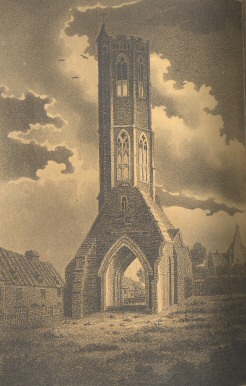
This House stood close to the river Lenn or Nar, in the field now called the friars. All the remains of it have long disappeared, except the Gateway or Gate-house, which is supposed to have been the principal entrance into the place. It is said to be founded about 1269, by the lord Bardolph of that time; though others say that the founder was Thomas de Feltsham, but that the lord Bardolph, the lord Scales, and Sir John Wigenhale were also considerable benefactors to it. William le Breton was also among its benefactors in the reign of Henry III. having endowed it with lands in South Lynn, Burgh Green, Dillingham and other places, in Norfolk and Cambridgeshire. William lord Randolph, who died in the 9th of Richard II. was buried here. In the 12th of the same reign these monks had a patent for the rent of ten quarters of frumenti, and ten quarters of barley, to receive them annually of the manor of Stow Bardolph, granted by John lord Bardolph.—April 13th, 1379, Sir Hamon Felton, of Litcham willed his body to be buried in the church of the Carmes, at Lynn. The noble family of Hastings also appear to have been great benefactors to this house.—From all these circumstances it may be very plainly seen, that this convent was a place of considerable note and reputation, and that, probably, for many ages. But nothing could save it from that dissolution which all such places experienced in the memorable reign of Henry VIII.—The site of it was then purchased by John Eyre Esq. who was one of that king’s auditors or receivers; and he conveyed it to a priest, from whom the corporation purchased it, who have been in possession of it ever since. How long after that it was suffered to stand does not appear. The Steeple was probably that part of it which stood the longest, except the Gatehouse above-mentioned. The said Steeple appears to have stood near a 100 years after the dissolution: it fell, as we are told, for want of due repair, on the 9th of April 1631, after having stood upwards of 360 years. Where this lofty steeple and the great church and convent of the Carmelites stood for so many ages, not a stone is now left upon another. A plain field or pasture is all that is now to be seen; just as if such an extensive edifice had never existed or stood there. The case is much the same with the other Lynn monasteries, except that of the Grey Friars, whose steeple still remains, owing to more attention being paid to the keeping of it in repair.
The Carmelites, together with the Franciscans, Dominicans, and Augustinians, constituted the four famous orders of Mendicants: and it is somewhat remarkable that they all established themselves at Lynn, and had the whole town, in a manner, divided among themselves, which seems not to have been unusual with them. [495]—Of the present order, that of the Carmes, or Carmelites, the following account will give the reader, it is presumed a sufficiently correct idea.
“About the middle of this century (the 12th) a certain Calabrian, whose name was Berthold, set out with a few companions for mount Carmel, and there, upon the very spot where the prophet Elias is said to have disappeared, built an humble cottage with an adjoining chapel, in which he led a life of solitude, austerity, and labour. This little colony subsisted, and the places of those that died were more than filled by new comers; so that it was at length erected into a monastic community by Albert, patriarch of Jerusalem. This austere prelate drew up a rule of discipline for the new monks, which was afterwards confirmed by the authority of the Roman pontiffs, who modified and altered it in several respects, and among other corrections mitigated its excessive rigour and severity. Such was the origin of the famous Order of Carmelites, or, as they are commonly called, of the Order of our Lady of mount Carmel, which was afterwards transplanted from Syria into Europe, and obtained the principal rank among the mendicant or begging orders. It is true the Carmelites reject, with the highest indignation, an origin so recent and obscure, and affirm to this very day, that the prophet Elias was the founder of their ancient community. Very few, however, have been engaged to adopt this fabulous and chimerical account of their establishment, except the members of the order, and many Roman Catholic writers have treated their pretensions to such a remote antiquity with the utmost contempt.”
“Scarcely, indeed, (says Maclaine) can any thing be more ridiculous than the circumstantial narrations of the occasion, origin, founder, and revolutions of this famous order, which we find in several ecclesiastical authors. They tell us, that Elias was introduced into the state of monachism by the ministry of angels; that his first disciples were Jonah, Micah, and also Obadiah, whose wife, in order to get rid of an importunate crowd of lovers, who fluttered about her at the court of Achab after the departure of heir husband, bound herself by a vow of chastity, received the veil by the hand of father Elias, and thus became the first abbess of the Carmelite order. They enter into a vast detail of all the circumstances that relate to the rules of discipline, which were drawn up for this community, the habit which distinguished its members, and the various alterations which were introduced into their rule of discipline in process of time. They observe, that among other marks which were used to distinguish the Carmelites from the seculars, the tonsure was one; that this mark of distinction exposed them, indeed to the mockeries of a profane multitude; and that this furnishes the true explication of the term bald-head, which the children addressed, by way of reproach, to Elishah, as he was on his way to Carmel. (2 Kings ii. 23) They tell us, moreover, that even Pythagoras was a member of this ancient order; that be drew all his wisdom from mount Carmel, and had several conversations with the prophet Daniel at Babylon, upon the subject of the Trinity. Nay they go still further into the region of fable, and assert, that the Virgin Mary and Jesus himself assumed the habit and profession of Carmelites; and they load this fiction with a heap of absurd circumstances, which it is impossible to read without the highest astonishment.” [498]
The Carmelites came into England in 1240, and appear to have obtained an establishment at Lynn not a very long while after. What sort of men they were, the reader can now form some idea.
Section III.
Account of the convent of the Grey Friars, Friars Minors, or Franciscans, in Fuller’s Row, now St. James’s Street, with a sketch of that religious order.
This Convent is said to have been founded about 1264; [499a] and the founder’s name, according to Parkin, was Thomas Feltham, or de Folsham, [499b] the very same person, probably, he mentions as one of the reputed founders of the Carmelite Convent, though the name is somewhat differently spelt. Parkin says, that the Grey Friars settled here about the 52d. of Henry III, (a date, by the bye, somewhat later than that given above,) “and built this convent near Synolf’s fleet, on which the mill formerly called Swagg’s mill, afterwards the common mill, or town mill, stands.” That mill, however, has long ago ceased to stand there, though the memory of it is still preserved in the name of the adjoining lane, which is yet called mill lane. “In 1287, (as the same writer informs us) on Monday August 7, in the court at Lenn, Adam de St. Omer being then mayor, and Richard de Walsingham, steward, Richard Sefull gave by deed 12d. rent per ann. which his ancestors used to receive out of a certain area by the church-yard of Saint James’s to the west, which the said Adam de St. Omer purchased of Adam Silvester, for the enlarging of the area, where the Friars Minors now inhabit.” He also says, that Bernard le Estree, within the same year, purchased of William de Lindesey, in St. James’s Street, a certain area, and gave it to enlarge the friars minors’ area. In the 7th of Edward II, as we are further told, these friars had a patent for bringing the water to their house from a spring in North Runcton, called Bukenwell. In the 38th of Edward III, they had a patent for two messuages to enlarge their manse. From the same writer we also learn, that Richard Peverel, Esq. of Tilney, by will, dated March 15, 1423, bequeath his body to be buried in the church of the friars minors of Lynn Bishop, appoints Mr. John Spencer, vicar of Tilney, his executor—proved May 15, 1424.—The said testator also left a house of 10l. value to the duke of Exeter, to be supervisor of his will, of whom he held lands. This is the chief of what Parkin relates of the Lynn Grey Friars and their convent; except that the house was surrendered by the Warden and nine brethren Oct. 1, the 1539, the 30th of Henry VIII.—It is some what remarkable that the steeple or tower of this edifice, or of the church of the Grey Friars, though apparently but of slight construction, has survived all the rest, and is still standing: and it may, possibly, with proper attention, stand yet many years. The Dominicans, and Augustinians had probably their towers also, as well as the Carmelites, but they have all long ago disappeared.
Of this famous order of mendicants it will not be easy, perhaps, to give the reader a better idea that by laying before him the following outline of the history and character of its founder, commonly called saint Francis. This distinguished personage appeared a short time before his equally distinguished contemporary St. Dominic. He was born in 1182, at Assisi, in Umbria. In his youth he is said to have been of a debauched and dissolute character, but at 25, after his recovery from a severe fit of illness, occasioned by his licentious course of life, he became so wholly religious, and so unfit for any other business, that his father threatened to disinherit him; to which he was so far from having any objection that, in presence of the bishop of Assisi, he solemnly disclaimed all expectation from him, and declared that from that time he would acknowledge only his father in heaven. He is said to have then devoted himself to works of charity of the most humiliating kind: and being one day at church, hearing mass, he was so forcibly struck with those words, Matt. x. 9. Provide neither gold, nor silver, nor brass in your purses, nor scrip for your journey, neither two coats, neither shoes, nor yet staves, for the workman is worthy of his meat; that he cried out “This is what I seek!” and immediately threw away his shoes, staff, wallet, and all his money, and kept only one coat. He also laid aside his girdle, which was of leather, and made use of a piece of rope in its stead. From this time, in imitation of the apostles, he began to exhort other persons to repent; and he did it in a very forcible manner, and with wonderful success, always beginning his discourse with saying “God give you peace.”—When he had got three disciples, they dispersed, to preach in different places. Some received them with great humanity, looking with astonishment on their extraordinary dress and great austerities, while others made a mock of them and abused them: this however they bore very patiently.
When he had seven disciples, he exhorted them to go to different countries, preaching repentance, without regarding any treatment they might meet with; assuring them that in a short time many learned and noble would join them, and they would preach to kings and princes, as well as to the common people. When he had eleven disciples, one of whom was a priest, he wrote out a rule for them, taken wholly out of the Gospels, and presented it to pope Innocent III, who, after making some objection, approved of it, in 1210.—Having obtained this confirmation of his institute, Francis went with 12 disciples and established himself in a church which he had repaired at Pontremoli, and this was the first house of his order, which, by way of humility, he called that of the minor brethren, frates minores, in French feres, in English by corruption friars, as the Dominicans had at the same time assumed the name of preaching brothers, or friars.—From this place they went forth preaching in the neighbouring towns and villages, not with studied harangues, (but like the methodists of our time) in a manner that made uncommon impression upon the hearers, as they had the appearance of men of another world, having their faces always turned towards those regions whither they were continually directing their audience.—In 1211 they founded several convents, the most considerable of which were those of Cottona, Pisa, and Bologna; and Francis himself, having preached through all Tuscany, returned to Assisi, in Lent, 1212.
In such veneration was he held at this time, that when he went into any city, they rung the bells, and the clergy and people went to meet him, bearing branches of trees, and singing, thinking themselves happy, who could kiss his hands or feet. That Lent he preached at his native place, where he had many converts, and among them St. Claire, a young woman of a noble family, who by his direction, though only at the age of eighteen, abandoned the world, and notwithstanding the remonstrances of her relations, fixed herself in a monastery, first at St. Ange de Pansa, where she was joined by her sister Agnes, and then at St. Damien of the order of the Benedictines, which was the first church St. Francis had repaired. Here she continued 42 years, many disciples joining her; and thus was formed the order of poor women, or that of St. Claire, being the second order of Franciscans.
About 1216, he gave instructions for his disciples to go in pairs, as the Apostles had done. Thus they went into Spain, Provence, and Germany, into which country he sent no less than 60 brothers.—So rapidly did the order now increase, that at a chapter general held in 1219, when Dominic was present, there appeared to be not less than 5000 in it; though they had not been established more than 9 or 10 years.—In June, 1219, pope Honorious III issued a bull, addressed to all bishops, recommending the Franciscans as apostolical men.—Many women, now converted by his preachers, formed themselves into monasteries, but he refused to take charge of any of them, except that of St. Claire.
After this he sent his chief disciples into distant countries with a number of companions, taking for himself and 12 others the mission of Syria and Egypt. They went forth in the spirit of confessors and martyrs; for when men expose themselves to almost certain death, there cannot be a doubt of their being in earnest. Two going to Africa endeavoured to go into a mosque; and preaching in the streets, and putting themselves in the way of the king, he first ordered them to be confined; but as they continued their importunity, he was so enraged, that he struck off their heads with his own hands, while they suffered with great resignation. Francis himself went to Egypt, during the siege of Damieta, and getting access to the Sultan, he offered to go into the fire in proof of the truth of his religion. But the Sultan, who heard him with great patience, did not choose to put him to the test, but admiring his courage, dismissed him with much good humour, desiring him to pray to God, that he would shew him what religion was most agreeable to him. In 1221, seven went to Ceuta to preach to the Moors; but they were soon apprehended, and not yielding to the command of the king to turn Mahometans, they were all beheaded. [504]
In the Rule of the Franciscans, which was fully confirmed in 1213, by Pope Nicholas III, besides engaging to live in obedience to their superior, in chastity, and without property, they also vowed obedience to the pope and his successors. These orders of mendicants, particularly this and that of St. Dominic, were of much greater use in support of the papal hierarchy, and combating heretics than all the orders of monks had ever been. Such was the number of persons in this period disaffected to the see of Rome, that it is very doubtful whether without this seasonable assistance it could have been supported at all. In this view we cannot contemplate their labours without regret: but even here they may not have been more blameable than some of our present religious orders, who, though seemingly well meaning people, are ever ready to defend, or at least to make excuses for almost every species of corruption.
St. Francis pretended, or, at least, his adherents did so, that the particulars of his rule had been dictated to him by God himself. It is also said of him that retiring to Mount Alverne on the borders of Tuscany, in 1224, to pass the Easter, he saw in a vision the appearance of Christ on the cross, descending from heaven; and when he awoke he found all the marks of crucifixion on his own body. Such tales were doubtless invented to magnify his name and promote the credit of the order. They might answer then, and still in some places; but they are not here introduced as worthy of belief. The Franciscans came into England in the reign of Henry III, and in that same reign established themselves in this town: but their first establishment in England is said to have been at Canterbury. Of the probable effects of their making Lynn one of their head quarters, or places of residence, the reader must now form his own opinion. [505]
Section IV.
Account of the convent of the Black Friars, Preaching Friars, or Dominicans, in Clough Lane, with a Sketch of that famous order.
Of this convent, (once perhaps inferior to none of the rest, if indeed it did not exceed them all, both in size and magnificence,) nothing is now to be seen but some old walls, whose thickness and massy appearance seem to indicate that they once sustained a large and sumptuous fabric. It was founded, as Parkin says, by Thomas Gedney, who was then, no doubt, a great and leading character in these parts. The above author does not seem to know the exact time when this convent was built, but it must have been sometime previous to 1272, for he assures us that these friars were then here. Indeed he says also, that they settled here about the time the Grey Friars did, as appears from a writ, Ad quod damnum, for a fountain or spring granted them in Middleton, by William, lord Bardolph, called Brokewell, and a certain aqueduct coming from that spring to their convent at Lynn; (for which he refers to Esch. in Turri Lond. Aº. 21, Edw. I. Nº. 71.) We may therefore fairly conclude, that this convent was built almost, if not altogether as early as that of the Grey Friars.
The following is the chief of what that writer has further said, relating to this convent.—
“Thomas Thorndon aliened to these friars preachers a piece of land 18 feet long and 21 broad, in Lenn Episcopi, in the 3d. of Edw. III. In the same year these friars had a patent to enlarge their house here.—Simon Parche, alias Tyler, of Watlyngton, Norfolk, wills, in 1442, to be buried in the chancel of the friars preachers, or black friars, of Lyn, and gives to the fabrick, de la stalles in the said chancel, to be new made, 16l. Reg. Doke, Norw.—The chapel of St. Catherine, in the church of the friars preachers, mentioned in 1497. Reg. Sayve. Norw.—The image of our Lady in the body of the church.” [507]
Of this convent, as well as that of the Carmelites, we are also told that an anchorage belonged to it: by which we are probably to understand, a place in the harbour for mooring ships, or a certain duty, payable by the ships there moored to the said convents. The ground in all ports and harbours being considered as the king’s, this anchorage may be supposed to have been a grant from the crown to those two orders of friars at Lynn.
The same writer further informs us that this convent of Dominicans was surrendered by the prior and eleven brethren on the 30th of Sept. 1539, 30th of Henry VIII. Its site, as we further learn, was granted, about six years after, to John Eyre Esq. with land there in the tenure of John Kempe. This John Ayre, (our author adds) on the dissolution had 37 messuages, 9 gardens, in the tenure of divers persons, given him by the said king in his 36th year, and messuages and tenements called Bishops Stath, and an house called the Steward’s Hall, with other messuages and lands here, belonging to the see of Norwich. The site of this convent the said John Eyre conveyed to a priest, from whom it came to Thomas Waters, of —, who had Edward Waters, and a daughter married to George Baker. The said Edward’s son in law, Sir John Bolls, of Scampton, in Lincolnshire, Bt. sold it to one Killingtree, since which time it seems to have passed through a great many hands. The said site at present is thought to be partly the property of the corporation, and partly that of the Carey family. About the garden of the chief mansion of that family are several scattered remains of this ancient edifice. We shall next endeavour to acquaint the reader with the character of that religious order, or fraternity for whose use this convent was originally erected, and in whose occupation it ever after continued.
The Dominicans, although their settlement at Lynn was not anterior to that of the Franciscans, yet they appear to have found their way to England a good many years before them: for we are told, that Dominic, just before his death, sent Gilbert de Fresney, with twelve of the brethren into England, where they founded their first monastery at Oxford in 1221, and soon after another at London. In the latter place they became in time so popular, and so much in favour with the corporation, that, in 1276, the mayor and aldermen, as we are told, gave them two whole streets by the river Thames, where they erected a very commodious convent, whence that place is still called Black-Friars, for so they were called in this country, [508] perhaps from the colour of the habit. They were also called Friars preachers, or preaching friars, from preaching being their chief object, employment, or profession; and Dominicans, from the name of their memorable founder; an epitome, or outline of whose history and character we shall here subjoin. It will enable the reader, it is hoped, or, at least, help him in some measure, to form a pretty correct estimate of the merits and demerits of these predicant friars; as it may be very confidently and safely expected that they resembled their leader, according to the old adage “Like master like man.”
Dominic, commonly called Saint Dominic, the father of the Dominicans, was a Spaniard. He was surnamed de Guzman, being descended from an ancient and noble family of that name. Having finished his studies at Palencia, he was made canon, and afterwards archdeacon of Osma in Castille, and then professor of Theology at Placentia. But this he quitted to go to preach after the manner of Francis, which he did in several parts of Spain, giving proof in the meantime of great charity towards the poor and afflicted. Coming into France with the bishop of Osma, he greatly distinguished himself by preaching against the Albigenses, and there he formed the design of instituting an order of preachers. Fulk bishop of Thoulouse brought him to the council of Lateran, in 1215, that he might be examined by the pope. His holiness approving of the scheme of Dominic, the latter consulted with his followers, when they agreed to adopt the rules of St. Austin, but with several additions. They resolved to have no estate in lands, but only revenues. They were then sixteen in number, and the bishop of Thoulouse gave them their first church, that of St. Romanus in that city; and near it he built cloisters, with cells over them, where they might study and sleep. Pope Honorious III. confirmed the order in 1216, exempting them from paying tithes of their possessions, and ordering that they should depend upon the diocesan for episcopal functions; and the prior to be chosen by the free votes of the brethren: so that the Dominicans, at their first institution, were not beggars, nor exempt from episcopal jurisdiction, but canons regular.
Next year Dominic sent out his followers in pairs, after choosing a superior, to whom he gave the tide of abbot; but all the succeeding ones were called masters, and the superiors of particular houses priors. He sent four to Spain, four to France, and two more to study there. Hearing of the death of that ferocious and bloody crusader, Simon de Montfort, at the siege of Thoulouse, Dominic went thither to comfort the brethren. Thence, in 1218, he went into Spain, and founded two monasteries, one at Madrid, and the other at Segovia. Thence he went to Paris, where he found thirty brethren: thence he proceeded to Bologna, where Arnauld, who joined him at Rome, had been very successful, and had formed a large society. Going to Parma, he there met St. Francis, of whom he seemed to entertain a very high opinion, when, after conferring together, they agreed not to accept of church livings: which might suggest to Dominic the idea of that profession of poverty which he afterwards imposed upon those of his order. [511]
In 1220 he made some new and more rigorous regulations respecting the nuns. In the same year he held the first chapter general of his order at Bologna, when it was resolved that the preaching friars should profess perfect poverty, and make that the fundamental principle of their order. It was now agreed that these chapters should be held every year, at Paris and Bologna alternately. At the second chapter general at Bologna eight provincials were chosen to superintend the preachers in the eight provinces of Spain, France Lombardy, Romagna, Provence, Germany, Hungary and England. Presently after this, August 26, 1221, Dominic died in the 51st year of his age. [512] Lest his order should be hurt by the maxims of worldly prudence, he forbad, under the curse of God and his own, the introduction of temporal possessions into the order. The second year after his death he was canonized, and so reached the very summit of ecclesiastical dignity and fame.
These preaching friars, as we are told, were so zealous at the first, and considered preaching as so essential to their institution, that they were not satisfied if they did not exhort some, at least one person, every day.
Each of them carried with him a copy of the gospel of Matthew, and of the seven canonical epistles, according to the express order of Dominic: but that could redound to the credit of neither him nor them, while they lived in open violation of the most important precepts and the very spirit of those sacred writings. Had they made them, indeed, the ground of their religion, and the rule or guide of their lives, they would have been a blessing to the world in their day, and their memory would have been revered by all good men, to the latest posterity. But they preferred their own rule to that of the New Testament, and the persecuting and murderous ferocity of Dominic to the forbearance and meekness of Christ, and so became the oppressors instead of the benefactors of their species. In short we know not of any material benefit which the former inhabitants of this town derived from the Clough Lane convent, [513] or the incessant labours of its preaching friars. The reader however, on this point, as well as all others, must judge for himself.
Section V.
Account of the Convent of the Austin Friars, or Hermits of the order of St. Augustin, in Hogman’s Lane, or Hopman’s Way, now St. Austin’s Street, with a sketch of that religious order.
This house must have been once a large, respectable, and stately edifice, inferior to none, and in some respects superior to most, and probably to all others in this town; especially in point of fitness for the accommodation of illustrious personages, or those of princely dignity, who might happen to come this way. It accordingly became the abode, or place of residence of the king and queen, the prince of Wales, the king’s mother, and the royal retinue, during their visit or stay here in 1498. Had there been any other house then in the town better adapted for their reception, it would, no doubt, have been chosen in preference, or instead of this, on so unusual and important an occasion. But however commodious, respectable, or stately a structure, this Augustinian convent then was, it has long ago disappeared, and not a stone of it has been left upon another. A gateway, or the arch of a gateway, filled up with brick, but once, perhaps, the principal entrance into the hallowed premises, is all that now remains, or is recognised as having ever belonged to it. Thus our firmest fabrics, though they may endure for ages, are doomed to perish like the very mortals by whose hands they were constructed.
Parkin says that the Augustin friars settled herein the beginning of Edward the First’s reign, as appears by a writ Ad quod damnum, for a messuage in Lynn, granted by Margaret de Southmere to them.—Inquis. 22. Ed. I. in turri Lond. N°. 112. He also adds, that they had a patent granted them by Edward II. in his 4th year, for purchasing, of Thomas Lexham, one messuage contiguous and adjoining, for the enlargement of their manse or house.—Pat. 4th. Ed. II. pt. 2. m. 14.—He further says, that Licence was granted by Ed. III. to Thomas Drew, William Bitering, John de Couteshale, and John Drew of Lenn Bishop, that they might give and assign five messuages in Lenne, adjoining to the manse of the prior and brethren of hermits of the order of St. Augustin of Lenn, to the said prior, &c. for the enlargement of their manse, on condition that the reverend father, Thomas, bishop of Norwich, of whom the said messuages are held, will grant his licence to the said prior, &c. And the said king gave licence to Robert de Cokesford, Agnes his wife, and to Richard de Houton and Alice his wife, that they may give one messuage in Lynn, (not held of us, as appears by the inquisition of Roger de Wolfreton, escheator of Norfolk) to the bishop and his successors, on the same condition of granting licence to the prior, &c. of receiving the said five messuages of Thomas Drew, &c.—Teste Rege, dated at Westminster, 6 May, 38. Edw. III.—The bishop’s licence was soon after obtained, dated 1 July following.
In the 6th of Richard II. these friars had a patent for a certain aqueduct, to be made by them from Gaywode.—In the 7th Henry IV. they had a patent to enlarge their manses and in the 1st Henry V. a patent for certain messuages granted to them. For each of these particulars Parkin refers to his authorities; the insertion of which here seems needless.—He also asserts on the authorities of Bale and Holinshed, that in the last mentioned reign, William Wellys, or Wallys, was a monk here, a learned man, and general of the order, who wrote many books, (which he does not name,) and died in 1421.—It seems therefore that learning was not entirely neglected here among our Austin friars, and that they had at least one learned man in their fraternity.
Our author further informs us, “that this house was surrendered 30th Sept. 1539, 30th of Henry VIII. by the prior and 4 brethren:” if so they must have been then reduced below their wonted number. But 4 brethren is probably a mistake for 14, which is the number given by Burnet in his history of the reformation, and other authorities.—About 6 years after the above date, this house was granted to John Ayre, who conveyed it to a priest, who sold it to Shavington, a bastard, who by will gave it to — Waters, who dying without issue it reverted to Shavington’s heir; John Ditefield afterwards had it, and his son John gave it in marriage to Thomasine his sister, married to Christopher Puchering, brother to the lord keeper of that name, and they sold it to John Lease, who pulled it down, and sold the stones and the ground to divers persons: so that it seems to have stood a good while after the dissolution, and passed through a great many hands.—Its site is at present partly the property of Martin Folkes Rishton, Esq. Joseph Lawrence Esq. and Mr. Thomas Marshall. For the most part it is now garden ground.
It was to this very order of mendicants, the Austin friars, or monks, or Augustinian Eremites, as they are sometimes called, that the famous Martin Luther belonged before he quitted the church of Rome, and when he began to oppose the papal corruptions: and it is supposed not to have been then quite so bad or depraved, as some of the other mendicant orders, particularly the Dominicans and Franciscans. However that was, it was, no doubt, bad enough, even in the opinion of Luther himself, for he soon withdrew from it, as well as from all manner of connection with the Romish church. It is to be wished it could also be said, that he and all other descriptions of protestants took special care when they renounced popery, to retain none of its enslaving and persecuting spirit. Most of them, however, quite forgot to do that, and so retained and cherished in their bosoms the very worst part of the religion they had renounced.
As to the religious order now under consideration, the Austin friars, or Hermits of St. Augustin, we are told that they had for their founder, pope Alexander IV. who, observing that the Hermits were divided into several societies, some of which followed the maxims of the famous William, others the rule of St. Augustin, while others again were distinguished by different denominations, formed the project of uniting them all into one religious order, and subjecting them to the same rule of discipline, even that which bears the name of St. Augustin. This project, we are told, was put in execution in 1256: [517] so that this order is somewhat younger, or of later origin than any of the other orders of mendicants; though not much later than the two preceding ones, for all the three sprung up within the same century.—What good or benefit the former inhabitants of Lynn might derive from the erection of this convent in their town, or from the exertions of the Austin Friars among them, is a question which the present writer is not fully prepared to answer. The reader, as in the former cases, is left to think and judge for himself, as he has an undoubted right to do. But whatever good or ill, advantage or disadvantage, benefit or detriment might accrue to the inhabitants from the residence of the said four orders of friars among them, their convents, unquestionably, must have contributed not a little to give additional grandeur and respectability to the appearance of the town. Four large and stately monasteries, with their lofty towers, ranged along the whole town from south to north, must have given Lynn an appearance, especially from the country, very different, and far superior to what it can boast of at present. In short, we may safely say, that it must have appeared before the reformation, from the circumstances just alluded to, as a place of at least double the size and double the consequence that it has done since that period. After all, it is not meant here to disparage the reformation, or to suggest that it did not prove beneficial to Lynn, as well as to the kingdom at large.—It is only meant to assert, that this town, from the great size and number of its monasteries and other religious houses, must have made a very different, and far more splendid appearance before the reformation, than it has done since. But we will here drop the subject, and conclude the present section.
Section VI.
Of the Friars de Penitentia, or brothers of repentance, and their Convent—also the College of Priests—with the Hospital and Church of St. John in this town.
It seems remarkable that out of 1148 monasteries and religious houses, seized upon by the sovereign and suppressed at the general dissolution, no less than 79 were in Norfolk, and 10 of them in this town alone; which must be a large proportion of those of the county, and still larger of those of the whole kingdom. Norfolk was also distinguished, and is so still, for its number of parishes, exceeding that of any other county, even of Yorkshire, though four times its size. This superabundance of parishes and convents, &c. seems to indicate that its inhabitants were formerly of an uncommonly devout and religious, or at least superstitious and sanctimonious cast: which character may be supposed to have belonged to the people of Lynn as much as to any of the rest. At present a very large proportion of the inhabitants of Norfolk, especially in country places, are exceedingly ignorant, boorish and heathenish. Nor do the generality of the established clergy appear to give themselves the least concern about this, or express any serious desire to promote the conversion and civilization of their poor neighbours. The dissenters, and particularly those of them called Methodists, have done already far more in this way than the whole body of the national or parochial priesthood: and they are continually enlarging their scale of operation, and extending their labours, with great effect, to the most retired and obscure places, where the divine power of the Gospel and the happy influence of its moral precepts were hardly ever before felt or experienced.
Of the ten houses suppressed in this town at the general dissolution, one is said to belong to the friars de Penitentia. This religious order appears to have sprang up in the same century with the proceeding ones; for we are told that it was instituted in 1221, by the famous St. Anthony of Padua, who was born at Lisbon, in 1195, and whose original name was Ferrand. After going through his studies with reputation, he entered into a monastery of canons regular, of the order of St. Austin, where he continued two years; when, for the sake of greater solitude, he retired with the leave of his superior to Coimbra, where he distinguished himself by his exposition of the scriptures. At this time St. Francis was living, and some of his order having suffered martyrdom, in consequence of undertaking to preach to the Mahometans in Africa, they were so much celebrated on that account, that it excited in Ferrand, as well as many others, an ardent desire to follow their example, though they should share the same fate. With the leave of his superior, he therefore joined this new society; and entering one of their monasteries, called that of St. Anthony, he took their habit and assumed their name.
Presently after this, his zeal actually carried him to Africa; but he was obliged to return, in consequence of a disease with which he was seized upon the coast; but was driven by a tempest to Sicily, where hearing of a general chapter of his order being to be held at Assisi in Italy, he repaired to it. Tho’ he was then little known, the provincial of his order was so much pleased with his appearance, that he took him with him, and placed him in a convent called the mount of St. Paul. After some months, his superiors procured him holy orders, and sent him, together with some other priests, to Forli, where he distinguished himself by his preaching. Being greatly concerned at the progress of heresy then in the northern parts of Italy, in order the better to prepare himself for encountering the heretics, he went through a course of theology at Vercelli, under a famous doctor there; but he soon surpassed him in knowledge, and was thought equal to any undertaking.
Being sent by his superiors to undertake the office of guardian to Limiges in France, in order to the conversion of the heretics in that place, it happened at one time, that his business as a preacher required him to be in one place, and his office of guardian in another: and this was the occasion of the first of the many miracles that his historian ascribes to him, and it was of a very singular kind: for it is asserted that he was actually in both places at the same time. After an earnest prayer for this purpose, he without leaving the pulpit in which he was preaching on a Good Friday, appeared in the choir, and sung the lesson which was his part of the service there. At Montpellier also, he once preached in the dome at the same time that he was singing hallelujah in the choir of the church. After this his whole life seems to have consisted of little more than a series of miracles, and many of them of quite an original and extraordinary kind; so that it must have required much ingenuity to devise them. [522]—Some of them may be here inserted by way of sample, and to enable the reader to judge of the probable effect or consequence of the settlement of Anthony’s disciples, the friars de Penitentia, in this town.
When Anthony was at one time preaching in a temporary building, constructed of wood, he apprised his audience that the devil was about to terrify and hurt them, but that no harm would eventually happen to any of them. Accordingly while he was preaching, the devil untied the ropes by which the boards were held together, so that the whole erection came down. But when it might have been expected that many of the persons assembled would have been crushed to death, or at least maimed, not one of them was found to have received the smallest hurt!—Another time a pious woman, much attached to Anthony, who had a son of a reprobate character, when she was attending one of his sermons the devil came in the form of a courier, and delivering a letter informed her that her son was dead. This news threw her, and the audience in general, into such disorder, that the congregation was breaking up; when Anthony cried out that the news was not true, that it was the devil that had brought it, and that the young man was alive, as they would soon be convinced; accordingly, while he was speaking he entered the place, and the devil absconded.
Something more extraordinary than any of the preceding miracles, was exhibited at Rome. For being required by the pope to preach to a congregation, consisting of people of very different countries, assembled for a crusade, they all heard him speak in their different languages, though he spoke in Italian only.—But the astonishing miracle exhibited at Rimini, contributed more to the fame of Anthony than all his other miracles. Preaching in that city, which abounded with heretics, and the people refusing to hear him, he went to the sea side, followed by a great crowd; when, the sea being remarkably calm, he addressed himself to the fishes; saying, “Since men will not hear me, come you and hearken to what God will tell you by me.” Immediately on this the sea was covered with the heads of fishes, which with open mouths fixed their eyes on him; and notwithstanding their hostility to each other, they mildly and humbly (as it is said) without moving their fins, or making the least motion in the water, attended to him. After a discourse of some length, he exhorted them to praise God; and since they could not do it in words shew some visible signs of reverence. On this they all bowed their heads, moving them very gently, and with gestures expressive of humility and devotion, acknowledged their obligation to God, and signified their apt probation of what had been addressed to them. The spectators greatly amazed (and well they might: for who could avoid it?) looked sometimes on the fishes, and sometimes on the preacher; and being reproved by him for their infidelity, thus upbraided by the mute fishes, they fell on their knees, asking his pardon, and promising to live and die in the catholic faith. He then pronounced a blessing, both on the men and the fishes, and they departed with great joy. [524]