Volume 1 — CHAPTER LIX. CHARLES I. (continued 2)
Reading edition
In proportion to the enormity of the violences and usurpations, were augmented the pretences of sanctity, among those regicides. “Should any one have voluntarily proposed,” said Cromwell in the house, “to bring the king to punishment, I should have regarded him as the greatest traitor; but since Providence and necessity have cast us upon it, I will pray to God for a blessing on your counsels; though I am not prepared to give you any advice on this important occasion. Even I myself,” subjoined he, “when I was lately offering up petitions for his majesty’s restoration, felt my tongue cleave to the roof of my mouth, and considered this preternatural movement as the answer which Heaven, having rejected the king, had sent to my supplications.”
A woman of Hertfordshire, illuminated by prophetical visions, desired admittance into the military council, and communicated to the officers a revelation, which assured them that their measures were consecrated from above, and ratified by a heavenly sanction. This intelligence gave them great comfort, and much confirmed them in their present resolutions.[*]
* Whitlocke, p. 360.
Colonel Harrison, the son of a butcher, and the most furious enthusiast in the army, was sent with a strong party to conduct the king to London. At Windsor, Hamilton, who was there detained a prisoner, was admitted into the king’s presence: and falling on his knees, passionately exclaimed, “My dear master!”—-“I have indeed been so to you,” replied Charles, embracing him. No further intercourse was allowed between them, The king was instantly hurried away. Hamilton long followed him with his eyes all suffused in tears, and prognosticated, that in this short salutation, he had given the last adieu to his sovereign and his friend.
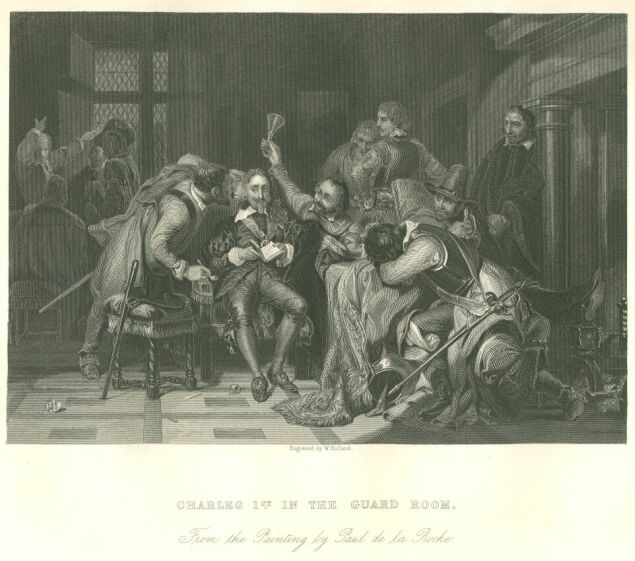
Charles himself was assured that the period of his life was now approaching; but notwithstanding all the preparations which were making, and the intelligence which he received, he could not even yet believe that his enemies really meant to conclude their violences by a public trial and execution. A private assassination he every moment looked for; and though Harrison assured him that his apprehensions were entirely groundless, it was by that catastrophe, so frequent with dethroned princes, that he expected to terminate his life. In appearance, as well as in reality, the king was now dethroned. All the exterior symbols of sovereignty were withdrawn, and his attendants had orders to serve him without ceremony. At first, he was shocked with instances of rudeness and familiarity, to which he had been so little accustomed. “Nothing so contemptible as a despised prince!” was the reflection which they suggested to him. But he soon reconciled his mind to this, as he had done to his other calamities.
All the circumstances of the trial were now adjusted, and the high court of justice fully constituted. It consisted of one hundred and thirty-three persons, as named by the commons; but there scarcely ever sat above seventy: so difficult was it, notwithstanding the blindness of prejudice and the allurements of interest, to engage men of any name or character in that criminal measure. Cromwell, Ireton, Harrison, and the chief officers of the army, most of them of mean birth, were members, together with some of the lower house, and some citizens of London. The twelve judges were at first appointed in the number: but as they had affirmed, that it was contrary to all the ideas of English law to try the king for treason, by whose authority all accusations for treason must necessarily be conducted, their names, as well as those of some peers, were afterwards struck out. Bradshaw, a lawyer, was chosen president. Coke was appointed solicitor for the people of England. Dorislaus, Steele, and Arke, were named assistants. The court sat in Westminster Hall.
It is remarkable, that in calling over the court, when the crier pronounced the name of Fairfax, which had been inserted in the number, a voice came from one of the spectators, and cried, “He has more wit than to be here.” When the charge was read against the king, “In the name of the people of England,” the same voice exclaimed, “Not a tenth part of them.” Axtel, the officer who guarded the court, giving orders to fire into the box whence these insolent speeches came, it was discovered that Lady Fairfax was there, and that it was she who had had the courage to utter them. She was a person of noble extraction, daughter of Horace Lord Vere of Tilbury; but being seduced by the violence of the times, she had long seconded her husband’s zeal against the royal cause, and was now, as well as he, struck with abhorrence at the fatal and unexpected consequence of all his boasted victories.
The pomp, the dignity, the ceremony of this transaction corresponded to the greatest conception that is suggested in the annals of human kind; the delegates of a great people sitting in judgment upon their supreme magistrate, and trying him for his misgovernment and breach of trust. The solicitor, in the name of the commons, represented, that Charles Stuart, being admitted king of England, and intrusted with a limited power, yet nevertheless, from a wicked design to erect an unlimited and tyrannical government, had traitorously and maliciously levied war against the present parliament, and the people, whom they represented, and was therefore impeached as a tyrant, traitor, murderer, and a public and implacable enemy to the commonwealth. After the charge was finished, the president directed his discourse to the king, and told him that the court expected his answer.
The king, though long detained a prisoner, and now produced as a criminal, sustained, by his magnanimous courage, the majesty of a monarch. With great temper and dignity, he declined the authority of the court, and refused to submit himself to their jurisdiction. He represented, that having been engaged in treaty with his two houses of parliament, and having finished almost every article, he had expected to be brought to his capital in another manner, and ere this time to have been restored to his power, dignity, revenue, as well as to his personal liberty: that he could not now perceive any appearance of the upper house, so essential a member of the constitution; and had learned, that even the commons, whose authority was pretended, were subdued by lawless force, and were bereaved of their liberty: that he himself was their “native, hereditary king;” nor was the whole authority of the state, though free and united, entitled to try him, who derived his dignity from the Supreme Majesty of heaven: that, admitting those extravagant principles which levelled all orders of men, the court could plead no power delegated by the people; unless the consent of every individual, down to the meanest and most ignorant peasant, had been previously asked and obtained: that he acknowledged, without scruple, that he had a trust committed to him, and one most sacred and inviolable; he was intrusted with the liberties of his people, and would not now betray them by recognizing a power founded on the most atrocious violence and usurpation: that having taken arms, and frequently exposed his life in defence of public liberty, of the constitution, of the fundamental laws of the kingdom, he was willing in this last and most solemn scene, to seal with his blood those precious rights for which, though in vain, he had so long contended: that those who arrogated a title to sit as his judges, were born his subjects, and born subjects to those laws which determined “that the king can do no wrong:” that he was not reduced to the necessity of sheltering himself under this general maxim which guards every English monarch, even the least deserving; but was able, by the most satisfactory reasons, to justify those measures in which he had been engaged: that to the whole world, and even to them, his pretended judges, he was desirous, if called upon in another manner, to prove the integrity of his conduct, and assert the justice of those defensive arms to which, unwillingly and unfortunately, he had had recourse; but that, in order to preserve a uniformity of conduct, he must at present forego the apology of his innocence lest, by ratifying an authority no better founded than that of robbers and pirates, he be justly branded as the betrayer instead of being applauded as the martyr, of the constitution.
The president, in order to support the majesty of the people, and maintain the superiority of his court above the prisoner still inculcated, that he must not decline the authority of his judges; that they overruled his objections; that they were delegated by the people, the only source of every lawful power; and that kings themselves acted but in trust from that community which had invested this high court of justice with its jurisdiction. Even according to those principles, which, in his present situation, he was perhaps obliged to adopt, his behavior in general will appear not a little harsh and barbarous; but when we consider him as a subject, and one too of no high character, addressing himself to his unfortunate sovereign, his style will be esteemed to the last degree audacious and insolent.
ENLARGE
Three times was Charles produced before the court, and as often declined their jurisdiction. On the fourth, the judges having examined some witnesses, by whom it was proved that the king had appeared in arms against the forces commissioned by the parliament, they pronounced sentence against him. He seemed very anxious at this time to be admitted to a conference with the two houses; and it was supposed, that he intended to resign the crown to his son: but the court refused compliance, and considered that request as nothing but a delay of justice.
It is confessed, that the king’s behavior during this last scene of his life does honor to his memory; and that, in all appearances before his judges, he never forgot his part, either as a prince or as a man. Firm and intrepid, he maintained, in each reply, the utmost perspicuity and justness both of thought and expression; mild and equable, he rose into no passion at that unusual authority which was assumed over him. His soul, without effort or affectation, seemed only to remain in the situation familiar to it, and to look down with contempt on all the efforts of human malice and iniquity. The soldiers, instigated by their superiors, were brought, though with difficulty, to cry aloud for justice. “Poor souls!” said the king to one of his attendants, “for a little money they would do as much against their commanders.”[*] Some of them were permitted to go the utmost length of brutal insolence, and to spit in his face, as he was conducted along the passage to the court. To excite a sentiment of pity was the only effect which this inhuman insult was able to produce upon him.
* Rush. vol. viii. p. 1425.
The people, though under the rod of lawless, unlimited power, could not forbear, with the most ardent prayers, pouring forth their wishes for his preservation; and in his present distress, they avowed him, by their generous tears, for their monarch, whom, in their misguided fury, they had before so violently rejected. The king was softened at this moving scene, and expressed his gratitude for their dutiful affection. One soldier, too, seized by contagious sympathy, demanded from Heaven a blessing on oppressed and fallen majesty: his officer, overhearing the prayer, beat him to the ground in the king’s presence. “The punishment, methinks, exceeds the offence:” this was the reflection which Charles formed on that occasion.[*]
As soon as the intention of trying the king was known in foreign countries, so enormous an action was exclaimed against by the general voice of reason and humanity; and all men, under whatever form of government they were born, rejected the example, as the utmost effort of undisguised usurpation, and the most heinous insult on law and justice. The French ambassador, by orders from his court, interposed in the king’s behalf: the Dutch employed their good offices: the Scots exclaimed and protested against the violence: the queen, the prince, wrote pathetic letters to the parliament. All solicitations were found fruitless with men whose resolutions were fixed and irrevocable.
Four of Charles’s friends, persons of virtue and dignity, Richmond, Hertford, Southampton, Lindesey, applied to the commons. They represented, that they were the king’s counsellors, and had concurred by their advice in all those measures which were now imputed as crimes to their royal master: that, in the eye of the law, and according to the dictates of common reason, they alone were guilty, and were alone exposed to censure for every blamable action of the prince; and that they now presented themselves, in order to save, by their own punishment, that precious life which it became the commons themselves, and every subject, with the utmost hazard to protect and defend.[**] Such a generous effort tended to their honor, but contributed nothing towards the king’s safety.
* Warwick, p. 339. ** Perinchef, p, 85. Lloyde, p. 319.
The people remained in that silence and astonishment, which all great passions, when they have not an opportunity of exerting themselves, naturally produce in the human mind. The soldiers, being incessantly plied with prayers, sermons and exhortations, were wrought up to a degree of fury, and imagined, that in the acts of the most extreme disloyalty towards their prince consisted their greatest merit in the eye of Heaven.[*]
Three days were allowed the king between his sentence and his execution. This interval he passed with great tranquillity, chiefly in reading and devotion. All his family that remained in England were allowed access to him. It consisted only of the princess Elizabeth and the duke of Gloucester; for the duke of York had made his escape. Gloucester was little more than an infant: the princess, notwithstanding her tender years, showed an advanced judgment; and the calamities of her family had made a deep impression upon her. After many pious consolations and advices, the king gave her in charge to tell the queen, that during the whole course of his life, he had never once, even in thought, failed in his fidelity towards her; and that his conjugal tenderness and his life should have an equal duration.
To the young duke, too, he could not forbear giving some advice, in order to season his mind with early principles of loyalty and obedience towards his brother, who was so soon to be his sovereign. Holding him on his knee, he said, “Now they will cut off thy father’s head.” At these words, the child looked very steadfastly upon him. “Mark, child! what I say: they will cut off my head! and perhaps make thee a king: but mark what I say: thou must not be a king as long as thy brothers Charles and James are alive. They will cut off thy brothers’ heads, when they can catch them! And thy head, too they will cut off at last! Therefore I charge thee, do not be made a king by them!” The duke, sighing, replied, “I will be torn in pieces first!” So determined an answer, from one of such tender years, filled the king’s eyes with tears of joy and admiration.
Every night during this interval the king slept as sound as usual; though the noise of workmen employed in framing the scaffold, and other preparations for his execution, continually resounded in his ears.[**]
* Burnet’s History of his Own Times. ** Clement Walker’s History of Independency.
The morning of the fatal day he rose early, and calling Herbert, one of his attendants, he bade him employ more than usual care in dressing him, and preparing him for so great and joyful a solemnity. Bishop Juxon, a man endowed with the same mild and steady virtues by which the king himself was so much distinguished, assisted him in his devotions, and paid the last melancholy duties to his friend and sovereign.
The street before Whitehall was the place destined for the execution; for it was intended, by choosing that very place, in sight of his own palace, to display more evidently the triumph of popular justice over royal majesty. When the king came upon the scaffold, he found it so surrounded with soldiers, that he could not expect to be heard by any of the people: he addressed, therefore, his discourse to the few persons who were about him; particularly Colonel Tomlinson, to whose care he had lately been committed, and upon whom, as upon many others, his amiable deportment had wrought an entire conversion. He justified his own innocence in the late fatal wars; and observed, that he had not taken arms till after the parliament had enlisted forces; nor had he any other object in his warlike operations, than to preserve that authority entire which his predecessors had transmitted to him. He threw not, however, the blame upon the parliament, but was more inclined to think, that ill instruments had interposed, and raised in them fears and jealousies with regard to his intentions. Though innocent towards his people, he acknowledged the equity of his execution in the eyes of his Maker; and observed, that an unjust sentence which he had suffered to take effect, was now punished by an unjust sentence upon himself. He forgave all his enemies, even the chief instruments of his death; but exhorted them and the whole nation to return to the ways of peace, by paying obedience to their lawful sovereign, his son and successor. When he was preparing himself for the block, Bishop Juxon called to him: “There is, sir, but one stage more, which, though turbulent and troublesome, is yet a very short one. Consider, it will soon carry you a great way; it will carry you from earth to heaven; and there you shall find, to your great joy, the prize to which you hasten, a crown of glory.” “I go,” replied the king, “from a corruptible to an incorruptible crown; where no disturbance can have place.” At one blow was his head severed from his body. A man in a visor performed the office of executioner: another, in a like disguise, held up to the spectators the head, streaming with blood, and cried aloud, “This is the head of a traitor!”
It is impossible to describe the grief, indignation, and astonishment which took place, not only among the spectators, who were overwhelmed with a flood of sorrow, but throughout the whole nation, as soon as the report of this fatal execution was conveyed to them. Never monarch, in the full triumph of success and victory, was more dear to his people, than his misfortunes and magnanimity, his patience and piety, had rendered this unhappy prince. In proportion to their former delusions, which had animated them against him, was the violence of their return to duty and affection; while each reproached himself either with active disloyalty towards him, or with too indolent defence of his oppressed cause. On weaker minds, the effect of these complicated passions was prodigious. Women are said to have cast forth the untimely fruit of their womb: others fell into convulsions, or sunk into such a melancholy as attended them to their grave: nay, some, unmindful of themselves, as though they could not or would not survive their beloved prince, it is reported, suddenly fell down dead. The very pulpits were bedewed with unsuborned tears; those pulpits, which had formerly thundered out the most violent imprecations and anathemas against him. And all men united in their detestation of those hypocritical parricides, who, by sanctified pretences, had so long disguised their treasons, and in this last act of iniquity had thrown an indelible stain upon the nation.
A fresh instance of hypocrisy was displayed the very day of the king’s death. The generous Fairfax, not content with being absent from the trial, had used all the interest which he yet retained to prevent the execution of the fatal sentence; and had even employed persuasion with his own regiment, though none else should follow him, to rescue the king from his disloyal murderers. Cromwell and Ireton, informed of this intention, endeavored to convince him that the Lord had rejected the king; and they exhorted him to seek by prayer some direction from Heaven on this important occasion: but they concealed from him that they had already signed the warrant for the execution. Harrison was the person appointed to join in prayer with the unwary general. By agreement, he prolonged his doleful cant till intelligence arrived, that the fatal blow was struck. He then rose from his knees, and insisted with Fairfax, that this event was a miraculous and providential answer which Heaven had sent to their devout supplications.[*]
* Herbert, p. 135.
It being remarked, that the king, the moment before he stretched out his neck to the executioner, had said to Juxon with a very earnest accent, the single word “Remember,” great mysteries were supposed to be concealed under that expression; and the generals vehemently insisted with the prelate, that he should inform them of the king’s meaning, Juxon told them that the king, having frequently charged him to inculcate on his son the forgiveness of his murderers, had taken this opportunity, in the last moment of his life, when his commands, he supposed would be regarded as sacred and inviolable, to reiterate that desire; and that his mild spirit thus terminated its present course by an act of benevolence towards his greatest enemies.
The character of this prince, as that of most men, if not of all men, was mixed; but his virtues predominated extremely above his vices, or, more properly speaking, his imperfections; for scarce any of his faults rose to that pitch as to merit the appellation of vices. To consider him in the most favorable light, it may be affirmed, that his dignity was free from pride, his humanity from weakness, his bravery from rashness, his temperance from austerity, his frugality from avarice; all these virtues in him maintained their proper bounds, and merited unreserved praise. To speak the most harshly of him, we may affirm, that many of his good qualities were attended with some latent frailty, which, though seemingly inconsiderable was able, when seconded by the extreme malevolence of his fortune, to disappoint them of all their influence: his beneficent disposition was clouded by a manner not very gracious; his virtue was tinctured with superstition; his good sense was disfigured by a deference to persons of a capacity inferior to his own; and his moderate temper exempted him not from hasty and precipitate resolutions. He deserves the epithet of a good, rather than of a great man: and was more fitted to rule in a regular established government, than either to give way to the encroachments of a popular assembly, or finally to subdue their pretensions. He wanted suppleness and dexterity sufficient for the first measure; he was nor endowed with the vigor requisite for the second. Had he been born an absolute prince, his humanity and good sense had rendered his reign happy and his memory precious; had the limitations on prerogative been in his time quite fixed and certain, his integrity had made him regard as sacred the boundaries of the constitution. Unhappily, his fate threw him into a period, when the precedents of many former reigns savored strongly of arbitrary power, and the genius of the people ran violently towards liberty. And if his political prudence was not sufficient to extricate him from so perilous a situation, he may be excused; since, even after the event, when it is commonly easy to correct all errors, one is at a loss to determine what conduct, in his circumstances, could have maintained the authority of the crown, and preserved the peace of the nation. Exposed, without revenue, without arms, to the assault of furious, implacable, and bigoted factions, it was never permitted him, but with the most fatal consequences, to commit the smallest mistake; a condition too rigorous to be imposed on the greatest human capacity.
Some historians have rashly questioned the good faith of this prince; but, for this reproach, the most malignant scrutiny of his conduct, which in every circumstance is now thoroughly known, affords not any reasonable foundation. On the contrary, if we consider the extreme difficulties to which he was so frequently reduced, and compare the sincerity of his professions and declarations, we shall avow, that probity and honor ought justly to be numbered among his most shining qualities. In every treaty, those concessions which he thought he could not in conscience maintain, he never could, by any motive or persuasion, be induced to make. And though some violations of the petition of right may perhaps be imputed to him, these are more to be ascribed to the necessity of his situation, and to the lofty ideas of royal prerogative, which, from former established precedents, he had imbibed, than to any failure in the integrity of his principles.[*] 20
* See note T, at the end of the volume.
This prince was of a comely presence; of a sweet, but melancholy aspect. His face was regular, handsome, and well complexioned; his body strong, healthy, and justly proportioned; and being of a middle stature, he was capable of enduring the greatest fatigues. He excelled in horsemanship and other exercises; and he possessed all the exterior, as well as many of the essential qualities which form an accomplished prince.
The tragical death of Charles begat a question, whether the people, in any case, were entitled to judge and to punish their sovereign; and most men, regarding chiefly the atrocious usurpation of the pretended judges, and the merit of the virtuous prince who suffered, were inclined to condemn the republican principle, as highly seditious and extravagant: but there still were a few who, abstracting from the particular circumstances of this case, were able to consider the question in general, and were inclined to moderate, not contradict, the prevailing sentiment. Such might have been their reasoning. If ever, on any occasion, it were laudable to conceal truth from the populace, it must be confessed, that the doctrine of resistance affords such an example; and that all speculative reasoners ought to observe, with regard to this principle, the same cautious silence which the laws, in every species of government, have ever prescribed to themselves. Government is instituted in order to restrain the fury and injustice of the people; and being always founded on opinion, not on force, it is dangerous to weaken, by these speculations, the reverence which the multitude owe to authority, and to instruct them beforehand, that the case can ever happen when they may be freed from their duty of allegiance. Or should it be found impossible to restrain the license of human disquisitions, it must be acknowledged, that the doctrine of obedience ought alone to be inculcated; and that the exceptions, which are rare, ought seldom or never to be mentioned in popular reasonings and discourses. Nor is there any danger that mankind, by this prudent reserve, should universally degenerate into a state of abject servitude. When the exception really occurs, even though it be not previously expected and descanted on, it must, from its very nature, be so obvious and undisputed, as to remove all doubt, and overpower the restraint, however great, imposed by teaching the general doctrine of obedience. But between resisting a prince and dethroning him, there is a wide interval; and the abuses of power which can warrant the latter violence, are greater and more enormous than those which will justify the former. History, however, supplies us with examples even of this kind; and the reality of the supposition, though for the future it ought ever to be little looked for, must, by all candid inquirers, be acknowledged in the past. But between dethroning a prince and punishing him, there is another very wide interval; and it were not strange, if even men of the most enlarged thought should question, whether human nature could ever, in any monarch, reach that height of depravity, as to warrant, in revolted subjects, this last act of extraordinary jurisdiction. That illusion, if it be an illusion, which teaches us to pay a sacred regard to the persona of princes, is so salutary, that to dissipate it by the formal trial and punishment of a sovereign, will have more pernicious effects upon the people, than the example of justice can be supposed to have a beneficial influence upon princes, by checking their career of tyranny. It is dangerous also, by these examples, to reduce princes to despair, or bring matters to such extremities against persons endowed with great power as to leave them no resource, but in the most violent and most sanguinary counsels. This general position being established, it must, however, be observed, that no reader, almost of any party or principle, was ever shocked, when he read in ancient history, that the Roman senate voted Nero, their absolute sovereign, to be a public enemy, and, even without trial, condemned him to the severest and most ignominious punishment; a punishment from which the meanest Roman citizen was, by the laws, exempted. The crimes of that bloody tyrant are so enormous, that they break through all rules; and extort a confession, that such a dethroned prince is no longer superior to his people, and can no longer plead, in his own defence, laws which were established for conducting the ordinary course of administration. But when we pass from the case of Nero to that of Charles, the great disproportion, or rather total contrariety, of character immediately strikes us; and we stand astonished, that, among a civilized people, so much virtue could ever meet with so fatal a catastrophe. History, the great mistress of wisdom, furnishes examples of all kinds; and every prudential, as well as moral precept, may be authorized by those events which her enlarged mirror is able to present to us. From the memorable revolutions which passed in England during this period, we may naturally deduce the same useful lesson which Charles himself, in his later years, inferred; that it is dangerous for princes, even from the appearance of necessity, to assume more authority than the laws have allowed them. But it must be confessed, that these events furnish us with another instruction, no less natural and no less useful, concerning the madness of the people, the furies of fanaticism, and the danger of mercenary armies.
In order to close this part of British history, it is also necessary to relate the dissolution of the monarchy in England: that event soon followed upon the death of the monarch. When the peers met, on the day appointed in their adjournment, they entered upon business, and sent down some votes to the commons, of which the latter deigned not to take the least notice. In a few days, the lower house passed a vote, that they would make no more addresses to the house of peers nor receive any front them; and that that house was useless and dangerous, and was therefore to be abolished. A like vote passed with regard to the monarchy; and it is remarkable, that Martin, a zealous republican, in the debate on this question, confessed, that if they desired a king, the last was as proper as any gentleman in England.[*] The commons ordered a new great seal to be engraved, on which that assembly was represented, with this legend, “On the first year of freedom, by God’s blessing, restored, 1648.” The forms of all public business were changed, from the king’s name, to that of the keepers of the liberties of England.[**] And it was declared high treason to proclaim, or any otherwise acknowledge Charles Stuart, commonly called prince of Wales.
* Walker’s History of Independency, part ii. * The court of king’s bench was called the court of public bench. So cautious on this head were some of the republicans, that, it is pretended, in reciting the Lord’s prayer, they would not say, “thy kingdom come,” but always, “thy commonwealth come.”
The commons intended, it is said, to bind the princess Elizabeth apprentice to a button-maker: the duke of Gloucester was to be taught some other mechanical employment. But the former soon died; of grief, as is supposed, for her father’s tragical end: the latter was, by Cromwell, sent beyond sea.
The king’s statue, in the exchange, was thrown down; and on the pedestal these words were inscribed: “Exit tyrannus, regum ultimus;” The tyrant is gone, the last of the kings.
Duke Hamilton was tried by a new high court of justice, as earl of Cambridge, in England; and condemned for treason. This sentence, which was certainly hard, but which ought to save his memory from all imputations of treachery to his master, was executed on a scaffold erected before Westminster Hall. Lord Capel underwent the same fate. Both these noblemen had escaped from prison, but were afterwards discovered and taken. To all the solicitations of their friends for pardon, the generals and parliamentary leaders still replied, that it was certainly the intention of Providence they should suffer; since it had permitted them to fall into the hands of their enemies, after they had once recovered their liberty.
The earl of Holland lost his life by a like sentence. Though of a polite and courtly behavior, he died lamented by no party. His ingratitude to the king, and his frequent changing of sides, were regarded as great stains on his memory. The earl of Norwich and Sir John Owen, being condemned by the same court, were pardoned by the commons.
The king left six children—three males: Charles, born in 1630; James, duke of York, born in 1633; Henry, duke of Gloucester, born in 1641;—and three females: Mary, princess of Orange, born 1631; Elizabeth, born 1635; and Henrietta, afterwards duchess of Orleans, born at Exeter, 1644.
The archbishops of Canterbury in this reign were Abbot and Laud; the lord keepers, Williams bishop of Lincoln, Lord Coventry, Lord Finch, Lord Littleton, and Sir Richard Lane; the high admirals, the duke of Buckingham and the earl of Northumberland; the treasurers, the earl of Marlborough, the earl of Portland, Juxon bishop of London, and Lord Cottington; the secretaries of state, Lord Conway, Sir Albertus Moreton, Coke, Sir Henry Vane, Lord Falkland, Lord Digby, and Sir Edward Nicholas.
It may be expected that we should here mention the Icon Basiliké, a work published in the king’s name a few days after his execution. It seems almost impossible, in the controverted parts of history, to say any thing which will satisfy the zealots of both parties: but with regard to the genuineness of that production, it is not easy for an historian to fix any opinion which will be entirely to his own satisfaction. The proofs brought to evince that this work is or is not the king’s, are so convincing, that if an impartial reader peruse any one side apart,[*] he will think it impossible that arguments could be produced, sufficient to counterbalance so strong an evidence: and when he compares both sides, he will be some time at a loss to fix any determination. Should an absolute suspense of judgment be found difficult or disagreeable in so interesting a question, I must confess, that I much incline to give the preference to the arguments of the royalists. The testimonies which prove that performance to be the king’s, are more numerous, certain, and direct, than those on the other side. This is the case, even if we consider the external evidence: but when we weigh the internal, derived from the style and composition, there is no manner of comparison. These meditations resemble, in elegance, purity, neatness, and simplicity, the genius of those performances which we know with certainty to have flowed from the royal pen; but are so unlike the bombast, perplexed, rhetorical, and corrupt style of Dr. Gauden, to whom they are ascribed, that no human testimony seems sufficient to convince us that he was the author. Yet all the evidences which would rob the king of that honor, tend to prove that Dr. Gauden had the merit of writing so fine a performance, and the infamy of imposing it on the world for the king’s.
* See, on the one hand, Toland’s Amyntor, and on the other, Wagataffe’s Vindication of the Royal Martyr, with Young’s Addition. We may remark, that Lord Clarendon’s total silence with regard to this subject, in so full of history, composed in vindication of the king’s measures and character, forms a presumption on Toland’s side, and a presumption of which that author was ignorant; the works of the noble historian not being then published. Bishop Burnet’s testimony, too, must be allowed of some weight against the Icon.
It is not easy to conceive the general compassion excited towards the king, by the publishing, at so critical a juncture, a work so full of piety, meekness, and humanity. Many have not scrupled to ascribe to that book the subsequent restoration of the royal family. Milton compares its effects to those which were wrought on the tumultuous Romans by Anthony’s reading to them the will of Cæsar. The Icon passed through fifty editions in a twelvemonth; and, independent of the great interest taken in it by the nation, as the supposed production of their murdered sovereign, it must be acknowledged the best prose composition which, at the time of its publication, was to be found in the English language.