Chapter VIII
Reading edition
Following the protocol and the cessation of hostilities, two major tasks were to be performed. One was to remove the Spanish forces from the island and to establish permanent terms of peace, and the other was to organize and establish a permanent Cuban government.
The former of these was promptly undertaken, by the governments of the United States and Spain. A joint commission arranged the details of evacuation, which was a formidable undertaking because of the number of persons to be transported and the paucity of shipping facilities at the command of the Peninsular government. The city of Havana was not evacuated until January 1, 1899, and the last Spanish troops were not removed from the island until the middle of February following. There were about 130,000 officers and soldiers transported, together with some 15,000 military and civilian employes and their families.
Simultaneously the task of treaty-making proceeded. President McKinley on August 26 appointed five Commissioners to conduct the negotiations. They were William R. Day, Secretary of State, Chairman; Cushman K. Davis, Senator; William P. Frye, Senator; Whitelaw Reid, Ambassador; and Edward D. White, Justice of the Supreme Court. Mr. White found himself unable to serve, and on September 9 George Gray, Senator, was appointed in his place. The Spanish government named as Commissioners five of Spain's foremost statesmen: Eugenio Montero Rios, Buenaventura d'Abarzuza, Jose de Garnica, Wenceslao Ramirez de Villa Urrutia, and Rafael Cerero. The Commissioners began their deliberations in Paris on October 1.
The first question discussed was the disposition of Cuba, and over it strong disagreement arose on two major points. The Spanish Commissioners declined to recognize the existence of any Cuban government, and argued that as there was no such government, and as Spain in relinquishing sovereignty over the island could not let that sovereignty lapse but must transfer it to some other responsible and competent power, the United States should accept cession of Cuba to it; which Spain was willing to grant. The American Commissioners replied that the United States was pledged not to annex the island, and as a matter of fact did not intend to do so and therefore could not and would not accept cession of the island to itself. Spain in the protocol had agreed to renounce her sovereignty without any stipulations further, and by that arrangement she must abide. The United States would, however, make itself responsible for the due observance of international law in Cuba so long as its occupation of the island lasted. The Spaniards were reluctant to yield, as a matter of pride and sentiment preferring to give Cuba to the United States rather than to surrender it to the insurgent Cubans. But the American Commissioners were resolute, and on October 27 the first article of the treaty was adopted; to wit:
"Spain relinquishes all claim of sovereignty over and title to Cuba.
"And as the island is, on its evacuation by Spain, to be occupied by the United States, the United States will, so long as such occupation shall last, assume and discharge the obligations that may under international law result from the fact of its occupation for the protection of life and property."
This was clear and unmistakable notice to the world that the American government intended to fulfil its pledge, not to annex Cuba but to render that island to the control and government of its own people. True, not yet were all convinced that this would be done. The Spaniards were courteously skeptical. A considerable faction in the United States, half "Jingo" and half sordid, insisted that the island must be annexed. The majority of Cubans, inclined to judge all governments by their bitter experiences with that of Spain, were frankly incredulous, not understanding how any government could be thus altruistic and self-denying.
The second point of dispute was that of the Cuban debt. The Spanish government for years had been charging against Cuba the cost of maintaining an army for its subjugation and the costs of suppressing the various insurrections that had occurred, and the Commissioners proposed that all that enormous debt should be saddled upon the island and made a first charge upon its customs revenues. To this the American Commissioners demurred. Cuba had for centuries been "the milch cow of Spain," and had given to Spain far more than she had ever received in return. It would be monstrous injustice to burden a people with the cost of subjugating them and keeping them in slavery. In the end the Spanish Commissioners yielded, and no mention was made in the treaty of any debt resting upon Cuba.
It was further agreed that both parties should release and repatriate all prisoners of war, and that the United States would undertake to obtain such release of all Spanish prisoners held by the Cubans. Each party relinquished all claims for indemnity of any and every kind which had arisen since the beginning of the Cuban war. Spain relinquished in Cuba all immovable property belonging to the public domain and to the crown of Spain; such relinquishment not impairing lawful property rights of municipalities, corporations or individuals. Spanish subjects were to be free to remain in Cuba or to remove therefrom, in either event retaining full property rights; and in the former case being free to become Cuban citizens or to retain their allegiance to Spain; and they were to be secured in the free exercise of their religion. There were various other stipulations, such as are customary in treaties, intended to assure Spain and Spaniards of equitable treatment and relationships in Cuba. It was added that the obligations of the United States in Cuba were to be limited to the period of its occupation of that island; but upon the termination of that occupation the United States promised to advise the succeeding Cuban government to assume the same obligations. The treaty was finally agreed to and signed on December 10, 1898, and it was ratified by the United States Senate on February 6, 1899.
General Ramon Blanco meanwhile, on November 26, 1898, resigned the Governor-Generalship of Cuba and returned to Spain. To General Jiminez Castellanos was left the unwelcome duty of holding nominal sway for a few weeks and then surrendering the sovereignty of four centuries to an alien power. Already American troops were in actual occupation and control of nearly all the island. In the latter part of December, 1898, the Seventh Army Corps, commanded by Major-General Fitzhugh Lee, was brought into the outskirts of Havana in readiness for the final function which was to be performed on the first day of the new year.
The end came. It was on January 1, 1899. Four hundred and six years, two months and three days before, the first Spaniard had landed upon Cuban soil and had planted there the quartered flag of Leon and Castile in token of sovereignty. Now, after all that lapse of time, largely, it must be confessed, ill spent and ill-improved, the Spanish flag was finally to be lowered and withdrawn, in token of the passing away of Spanish sovereignty forever from the soil of Cuba.
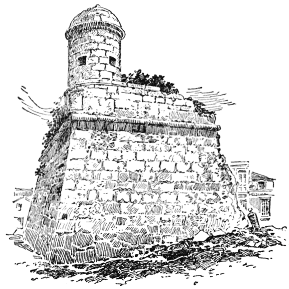
PART OF OLD CITY WALL OF HAVANA, STILL STANDING
The ceremonies were brief and simple; far more brief and simple, we may well believe, than were those with which the imaginative and exuberant Admiral proclaimed possession of the island centuries before. The official representatives of Spain and the United States met at noon in the Hall of State in the Governor's Palace, the scene of so many proud and imperious events in Spanish colonial history. On the one side the chief was General Jiminez Castellanos, the last successor of Velasquez. On the other, Major-General John R. Brooke. The one was the last of a long, long line of Spanish Governors-General; the other was the first of a brief succession of American Military Governors who were soon to give way to an unending line of native Cuban Republican Presidents and Congresses. With a sad heart, with tear-suffused eyes, and with a hand that trembled to hold a pen far more than ever it had to wield a sword, General Jiminez Castellanos signed the document which abdicated and relinquished Spanish sovereignty in that Pearl of the Antilles which was nevermore to be known as the "Ever Faithful Isle." The crimson and gold barred banner of Spain descended. The Stars and Stripes rose in its place. The deed was done. The final settlement was made with Spain.
For three hundred and eighty-seven years Spain had been the sovereign of Cuba, exercising her power through one hundred and thirty-six administrations, of which the first was one of the longest and the last was one of the shortest. It will be worth our while to recall the roll, which bears some of the noblest and some of the vilest names in Spanish history:
No. Date
11512 Diego Velasquez, Lieutenant-Governor
21524 Manuel de Rojas, Lieutenant-Governor, provisional
31525 Juan de Altamirano, Lieutenant-Governor
41526 Gonzalo de Guzman, Lieutenant-General
51532 Manuel de Rojas, Lieutenant-Governor, provisional
61535Gonzalo de Guzman, Lieutenant-Governor
71538Hernando de Soto, Governor-General
81544Juan de Avila, Governor-General
91546Antonio Chavez, Governor-General
101550Gonzalo Perez de Angulo, Governor-General
111556Diego de Mazariegos, Governor-General
121565Francisco Garcia Osorio, Governor-General
131568Pedro Menendez de Avilas, Governor-General
141573Gabriel Montalvo, Governor-General
151577Francisco Carreno, Governor-General
161579Gaspar de Torres, Governor-General, provisional
171581Gabriel de Lujan, Captain-General
181589Juan de Tejada, Captain-General
191594Juan Maldonado Balnuevo, Captain-General
201602Pedro Valdes Balnuevo, Captain-General
211608Gaspar Ruiz de Pereda, Captain-General
221616 Sancho de Alguizaz, Captain-General
231620 Geronimo de Quero, Captain-General, provisional
241620 Diego Vallejo, Captain-General
25Aug. 14, 1620 Francisco de Venegas, Captain-General
26 Juan Esquivil, Captain-General, provisional
27 Juan Riva Martin, Captain-General, provisional
281624 Garcia Giron de Loaysa, Captain-General, provisional
291624 Cristobal de Aranda, Captain-General, provisional
301625 Lorenzo de Cabrera, Captain-General
311630 Juan Bitrian de Viamontes, Captain-General
321634 Francisco Riano de Gamboa, Captain-General
331639 Alvaro de Luna, Captain-General
341647 Diego de Villalba, Captain-General
351653 Francisco Xeldes, Captain-General
361655 Juan Montano, Captain-General
371658 Juan de Salamanca, Captain-General
381663 Rodrigo de Flores, Captain-General
391664 Francisco Dairle, Captain-General
401670 Francisco de Ledesma, Captain-General
411680 Jose Fernandez de Cordoba, Captain-General
421685 Andres Munibe, Captain-General, provisional
43 Manuel Murguia, Captain-General, provisional
441687 Diego de Viana, Captain-General
451689 Severino de Manraneda, Captain-General
461695 Diego de Cordoba, Captain-General
471702 Pedro Benites de Lugo, Captain-General
481705 Nicolas Chirino, Captain-General, provisional
49.... Luis Chacon, Captain-General, provisional
501706 Pedro Alvares Villarin, Captain-General
511708 Laureano de Torres, Captain-General
521711 Luis Chacon, Captain-General
531713 Laureano de Torres, Captain-General
541716 Vicente Baja, Captain-General
551717 Gomez de Alvarez, Captain-General
561717 Gregorio Guazo, Captain-General
571724 Dionisio Martinez, Captain-General
581734 Juan F. Guemes, Captain-General
591745 Juan A. Tineo, Captain-General
601745 Diego Pinalosa, Captain-General
611747 Francisco Cagigal, Captain-General
621760 Pedro Alonso, Captain-General
631761 Juan de Prado Portocarrero, Captain-General
64July 1, 1762 Ambrosio Villapando, Count of Riela, Captain-General
65June, 1765 Diego Manrique, Captain-General
66July, 1765 Pasual Jimenez de Cisners, Captain-General, provisional
67March 19, 1766 Antonio M. Bucarely, Captain-General
681771 Marques de la Torre, Captain-General
69June, 1777 Diego J. Navarro, Captain-General
70May, 1781 Juan M. Cagigal, Captain-General
711782 Luis de Unzaga, Captain-General, provisional
721785 Bernardo Troncoso, Captain-General, provisional
73.... Jose Espeleta, Captain-General, provisional
74.... Domingo Cabello, Captain-General, provisional
75Dec. 28, 1785 Jose Espeleta, Captain-General
76Apr. 20, 1789 Domingo Cabello, Captain-General, provisional
77July 8, 1790 Luis de las Casas, Captain-General
78Dec. 6, 1796 Juan Bassecourt, Captain-General
79May 13, 1799 Salvador de Muro, Captain-General
80Apr. 14, 1812 Juan Ruiz de Apodaca, Captain-General
81July 2, 1816 Jose Cienfuegos, Captain-General
82Apr. 20, 1819 Juan M. Cagigal, Captain-General
83Mar. 3, 1821 Nicolas de Mahy, Captain-General
84July 2, 1823 Sebastian Kindelan, Captain-General, provisional
85May 2, 1823 Dionisio Vives. Given absolute authority by royal decree, 1821
86May 2, 1832 Mariano Rocafort. Given absolute authority by royal decree, 1825
87June 1, 1834 Miguel Tacon. Given absolute authority by royal decree of 1825
88From June 1, 1834, to Apr. 16, 1838Lt.-Gen. Miguel Tacon y Rosique, Captain-General
89From April 16, 1838 to Feb., 1840 Lieut. Gen. Joaquin Espeleta y Enrille
90Feb., 1840, to May 10, 1841 Lieut. Gen. Pedro Tellez de Gironm, Prince of Anglona
91From May 10, 1841, to Sept. 15, 1843 Lieut. Gen. Geronimo Valdes y Sierra
92From Sept. 15, to Oct. 26, 1843Lieut. Gen. of the Royal Navy, Francis Xavier de Ulloa, provisional
93From Oct. 26, 1843, to Mar. 20, 1848 Lieut. Gen. Leopoldo O'Donnell y Joris, Count of Lucena.
94From Mar. 20, 1848, to Nov. 13, 1850 Lieut. Gen. Federico Roncali, Count of Alcoy
95From Nov. 13, 1850, to Apr. 22, 1852 Lieut. Gen. Jose Gutierrez de la Concha
96From Apr. 22, 1852, to Dec. 3, 1853 Lieut. Gen. Valentin Canedo Miranda
97From Dec. 3, 1853, to Sept. 21, 1854 Lieut. Gen. Juan de la Pezuela, Marquis of de la Pezuela
98From Sept. 14, 1854, to Nov. 24, 1859 Lieut. Gen. Jose Gutierrez de la Concha, Marquis of Habana, second time
99From Nov. 14, 1859, to Dec. 10, 1862Lieut. Gen. Francisco Serrano, Duke de la Torre
100From Dec. 10, 1862, to May 30, 1866Lieut. Gen. Domingo Dulce y Garay
101From May 20, 1866, to Nov. 3, 1866 Lieut. Gen. Francisco Lersundi
102From Nov. 3, 1866, to Sept. 24, 1867 on which date he diedLieut. Gen. Joaquin del Manzano y Manzano
103From Sept. 24, 1867, to Nov. 3, 1866 Lieut. Gen. Blas Villate, Count of Valmaseda
104From Dec. 13, 1867, to Jan. 4, 1869 Lieut. Gen. Francisco Lersundi
105From Jan. 4, 1869, to June 2, 1869Lieut. Gen. Domingo Dulce y Garay, second time
106From June 2, 1869, to June 28, 1869 Lieut. Gen. Felipe Ginoves del Espinar, provisional
107From June 28, 1869, to Dec. 15, 1870Lieut. Gen. Antonio Fernandez y Caballero de Rodas
108From Dec. 15, 1870, to July 11, 1872Lieut. Gen. Blas Villate, Count of Valmaseda
109From July 11, 1872, to Apr. 18, 1873Lieut. Gen. Francisco Ceballos y Vargas
110From Apr. 18, 1873, to Nov. 4, 1873Lieut. Gen. Candido Pieltain y Jove-Huelgo
111From Nov. 4, 1873, to Apr. 7, 1874 Lieut. Gen. Joaquin Jovellar y Soler
112From Apr. 7, 1874, to May 8, 1875Lieut. Gen. José Gutierrez de la Concha, Marquis of Habana
113From May 8, 1875, to June 8, 1875 Lieut. Gen. Buenaventura Carbo, provisional
114From June 8, 1875, to Jan. 18, 1876Lieut. Gen. Blas Villate, Count of Valmaseda, third time
115From Jan. 18, 1876, to June 18, 1878Lieut. Gen. Joaquin Jovellar y Soler. He was under Martinez Campos, who was the general in chief
116From Oct. 8, 1876, to Feb. 5, 1879 Lieut. Gen. Arsenio Martinez Campos
117From Feb. 5, 1879, to Apr. 17, 1879 Lieut. Gen. Cayetano Figueroa y Garaondo, provisional
118From Apr. 17, 1879, to Nov. 28, 1881 Lieut. Gen. Ramon Blanco y Erenas
119From Nov. 28, 1881, to Aug. 5, 1883 Lieut. Gen. Luis Prendergast y Gordon, Marquis of Victoria de las Tunas
120From. Aug. 5, 1883, to Sept. 28, 1883 Lieut. Gen. of Division Tomas de Reyan y Reyna, provisional
121From Sept. 28, 1883, to Nov. 8, 1884 Lieut. Gen. Ignacio Maria del Castillo
122From Nov. 8, 1884, to Mar. 25, 1886 Lieut. Gen. Ramon Fajardo e Izquierdo
123From Mar. 25, 1886, to July 15, 1887 Lieut. Gen. Emilio Calleja e Isasi
124From July 15, 1887, died Feb. 6, 1890 Lieut. Gen. Saba Marin y Gonzalez
125From Mar. 13, 1889, died Feb. 6, 1890 Lieut. Gen. Manuel Salamanca y Begrete
126From Mar. 13, 1889, to Apr. 4, 1890 General of Division Jose Sanchez Gomez, provisional
127From Apr. 4, 1890, to Aug. 20, 1890 Lieut. Gen. Jose Chinchilla y Diez de Onate
128From Aug. 20, 1890, to June 20, 1892 Lieut. Gen. Camilo Polavieja y del Castillo
129From June 20, 1892; died July 15, 1893 Lieut. Gen. Alejandro Rodriguez Arias
130From July 15, 1893, to Sept. 5, 1893 General of Division Jose Arderius y Garcia, provisional
131From Sept. 5, 1893, to Apr. 16, 1895 Lieut. Gen. Emilio Calleja e Isasi
132From Apr. 16, 1895, to Jan. 20, 1896 Captain Gen. Arsenio Martinez Campos
133From Jan. 20, 1896, to Feb. 11, 1896 Lieut. Gen. Savas Marin y Gonzalez
134From Feb. 11, 1896, to Oct. 31, 1897Lieut. Gen. Valeriano Weyler y Nicolau
135From Oct. 31, 1897, to Nov. 30, 1898 Capt. Gen. Ramon Blanco y Erenas
136 Nov. 30, 1898, to Jan. 1, 1899, at 12 noon.Lieut. Gen. Adolfo Jimines Castellanos
There must be added an unwelcome note. The Spaniards—not their high officials—left most ungraciously. It is not to be wondered at that they were sad, that they were sullen, that they were resentful; that they were fearful lest the Cubans should rise against them at the last moment and inflict upon them vengeance for the treasured wrongs of many years. But there was of course no such uprising. The Cubans wished to make the day an occasion of great public celebration, but the authorities—Cuban and American as well as Spanish—would not permit it. It was not courteous to exult over a beaten foe. Besides, any such celebration would have caused great danger of trouble. What was inexcusable, however, was the condition in which the Spanish left all public buildings. They looted and gutted them of everything that could be removed. They destroyed the plumbing and lighting fixtures. They broke or choked up the drains. They left every place in an indescribably filthy condition. There was nothing in all their record in Cuba more unbecoming than their manner of leaving it. Such was the last detail of the settlement with Spain.
The settlement with Cuba came next. Indeed, it was concurrently undertaken. And it was by far the more formidable task of the two. It was necessary to arrange for the transfer of the temporary trust of the United States to a permanent Cuban authority, and to do so in circumstances and conditions which would afford the largest possible degree of assurance of success. It is said that when the American flag was raised at Havana in token of temporary sovereignty, on January 1, 1899, an American Senator among the spectators exclaimed, "That flag will never come down!" There were also, doubtless, those among the Cuban spectators who thought and said that it should never have been raised, but that sovereignty should have been transferred directly from Spain to Cuba.
Both were wrong; as both in time came to realize. It was necessary for the sake of good faith and justice that the American flag should in time come down and give place to the flag of Cuba. It was equally necessary for the sake of the welfare of Cuba and of its future prosperity and tranquillity that there should be a period of American stewardship preparatory to full independence.
There was, as we have already indicated, some friction between Cubans and Americans at the time of intervention in the Spring of 1898. The Cubans thought that the American army should not enter Cuba at all, save with an artillery force to serve as an adjunct to the Cuban army. On the other hand, Americans were too much inclined to disregard the Cuban army and Provisional Government, to forget what the Cubans had already achieved, and to act as though the war were solely between the United States and Spain. When the actual landing of Shafter's army was made, however, the Cubans accepted the fact loyally and gracefully, and gave the fullest possible measure of helpful cooperation.
The Provisional Government of the Cuban Republic, as soon as hostilities were ended and negotiations for peace had begun, decided to summon another National Assembly to determine what should be done during the interval which should elapse before the United States placed the destinies of Cuba in the hands of Cubans. This decision was made at a meeting at Santa Cruz on September 1, at which were present the President, Bartolome Maso; the Vice-President, Mendez Capote; and the three Secretaries, Aleman, Fonts-Sterling and Moreno de la Torre. It was felt, and not without reason, that the Insular government and its forces had not received the recognition which was their due. Calixto Garcia and Francisco Estrada had given valuable participation in the siege and capture of Santiago, yet they were not permitted by General Shafter to participate in the ceremony of the surrender of the Spanish forces, or even to be present on that exultant occasion. When the Americans thus took possession of Santiago and Oriente, the Cuban government, military and civil, was ignored, and General Leonard Wood was made Military Governor just as though there was no Cuban government in existence.
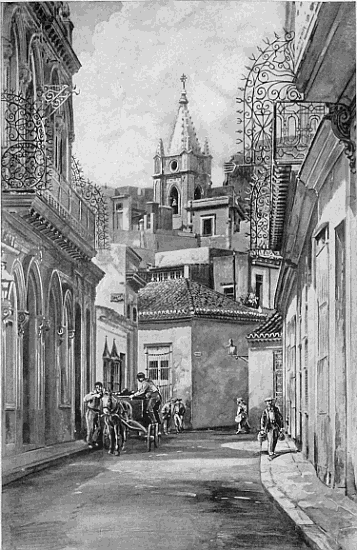
OLD AND NEW IN HAVANA
The architecture of Havana ranges from the sixteenth century to the twentieth, and specimens of all five centuries may in some places be found grouped within a single scene; with electric lights and telephones in buildings which were standing when Francis Drake threatened the city with conquest.
During the months of the American blockade of the island, moreover, the Cubans had suffered perhaps even more than the Spanish from lack of supplies. It was felt that while it was well thus to deprive the Spanish army of supplies, the Cuban people ought not to have been left to suffer. After the armistice affairs remained in a distressing condition. The Cuban army was without food and without pay with which to purchase food; and the Provisional Government was powerless to help it or to help the starving civilian population. It had no funds, and of course could not now raise any either by taxation or by loans. Late in November some relief was afforded by the sending of food from the United States, but on the whole the conditions were unsatisfactory, and did not conduce to cordial confidence between the Cubans and the Americans.
The National Assembly which had been called on September 1 met at Santa Cruz on November 7, and resolved upon the disbandment of the Provisional Government, and the appointment of a special Commission to look after Cuban interests during the period of American occupation. This Commission consisted of Domingo Mendez Capote, President; Ferdinand Freyre de Andrade, Vice-President; and Manuel M. Coronado and Dr. Porfirio Caliente, Secretaries. The army organization was to be retained, for the present, with General Maximo Gomez as Commander-in-Chief.
The real crux of the situation, at the moment, was the demobilization of the Cuban army. This could not be done—Gomez would not consider it—until the men could be paid, and there was no money with which to pay them. Among the 36,000 men on the rosters, there were said to be 20,000 who had served two years or more, and who were entitled to pay. Gomez issued an appeal to the army and to the Cuban people generally to accept loyally the temporary American occupation and to cooperate with the Americans in the reestablishment of order and the development of governmental institutions, in order that at the earliest possible moment Cuba might be able to assume the whole task of self government. At the same time he urgently requested the United States government to advance money with which to pay off the soldiers, in order that the army might be disbanded and the men might return to their homes and their work, and thus restore the industrial prosperity of the island. For this purpose he suggested the sum of $60,000,000, not only for actual pay but also for compensation for the losses which the officers and men had suffered during the war. He was inclined to keep his men under arms until the United States should relinquish control of Cuba to the Cubans, or should fix a date for so doing; and toward the end of January, 1899, he mustered all his forces in the Province of Havana, and made his staff headquarters in the former palace of the Captain-General. Meantime the Commission of the Cuban National Assembly recommended that the men be granted furloughs, to enable them to go to work in response to the great demand for labor that was arising throughout the island. This course was pursued to a considerable extent.
Ultimately the United States government granted the sum of $3,000,000 for the purpose of paying off the soldiers. This was not a loan, to be repaid, but was an outright gift, being the remainder of the sum of $50,000,000 which had been voted to the President at the beginning of the war to use at his discretion. It was given on the conditions that every recipient should prove his service in the army and should surrender a rifle. To this latter requirement, which meant the disarming of the Cubans, General Gomez strongly objected, but in the end he acquiesced and agreed to carry out the plan as soon as the money was at hand. Thereupon some other Cuban officers disputed his right to commit the Cuban army to any such arrangement. They were dissatisfied with the small amount, and they insisted that only the Cuban Assembly had power to act upon the American offer. They added that they would refuse to obey the orders of General Gomez, and would look to the Assembly for justice. It should be added that these officers were not those who had been most active and efficient in the field.
General Gomez ignored this mutinous demonstration, and proceeded with arrangements to receive and distribute the $3,000,000; whereupon the Assembly came together and on March 12 impeached General Gomez and removed him from office as Commander-in-Chief, the charge being that he had failed in his military duties and had disobeyed the orders of the Assembly. This scandalous performance was ignored by Gomez, and was condemned by the great majority of the Cuban people. It was also ignored by the American authorities. General Brooke continued his negotiations with Gomez, and finally reached an agreement. The terms were as follows: Every Cuban soldier who had been in service since before July 17, 1898, and who was not in receipt of salary from any public office, upon delivery of his arms and equipments was to receive $75 in United States gold. The arms and equipments were to be surrendered to municipal authorities, and to be placed and kept in armories, under the charge of armorers appointed by General Gomez, as memorials of the War of Independence. The Cuban Commissioners protested against and resisted this settlement, but finally yielded when they saw all the soldiers accepting it. They continued for some time, however, to manifest disaffection and distrust toward the United States, and to propagate doubt whether that country would ever fulfill its promise to make Cuba independent. Some agitators went so far as to try to provoke insurrections against the American administration. But all such things met with no encouragement from General Gomez or from any of the real leaders of the Cuban people, who expressed the fullest confidence in the good faith of the United States and did their utmost to lead the nation to take advantage of the unparalleled opportunity which had been placed before it. Day by day the magnitude of that opportunity became more apparent, as did the practical beneficence of the American administration.