Part 10 / Book 1 — CHAPTER XXVII. THE LAST DAYS OF THE REPUBLIC (continued 2)
Reading edition
In his relations to women his sensual sultanic nature and his chivalrous character unite. We need not here concern ourselves with the foul love stories of his youth. His enemy Cicero speaks frequently of Antony’s men and women friends and also of others about whom it is uncertain whether they should be classed with the former or with the latter. Antony was always regardless of his reputation; he well knew that in this direction he had nothing left to spoil. We will not here intrude upon his innumerable liaisons with beautiful dancers, distinguished Roman ladies and eastern princesses. Cleopatra alone could claim, at all events in their last years, to exercise her dominion over him undivided with any other wife or mistress. This dominion was so absolute and so enduring that in the days of the ancients it was thought impossible to explain it by natural means and recourse was had to the superstition of a magic potion.
Could we have seen Antony on foot with a bevy of eunuchs following the litter of his mistress at the entry into some Egyptian town, we might have concluded him to be a knight doing homage to his lady’s honour. Mediæval worship of women is absolutely foreign to antiquity; but Antony based his descent on Hercules, who after his twelve Labours became a slave of Omphale, and laid aside club and crossbow to help his lady at the spinning-wheel. Antony followed the example of his great ancestor and paid obedience in effeminate sloth where it was within his power and his duty to be sovereign. The sacrifices he made to his lady are without a parallel in the history of the world; and Cleopatra’s thanks were, to betray him first at Actium and then at his death in Alexandria. In a word one may sum up the verdict in the language of the ancients: Nature had intended Mark Antony for a Deuteragonist, chance and misfortune made him Protagonist. But Shakespeare says: “His taints and honours waged equal with him.”f
FOOTNOTES
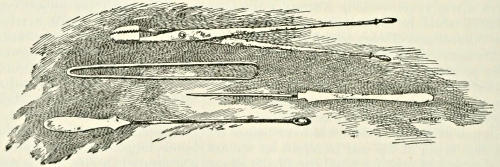
Roman Surgical Instruments
(In the British Museum)