Part 10 / Book 1 — CHAPTER XIV. CIVILISATION AT THE END OF THE PERIOD OF CONQUEST (continued 2)
Reading edition
The fathers of the Catholic Church have compared the institutions of Numa, with their minute and multiplied proscriptions, to Mosaic law. The Romans, who prided themselves on following them to the letter, could be exposed to becoming absolutely like the Jews; and one asks how it is that, amongst such a devoted people, religious authority did not end by dominating over all others. What preserved them from this fate was their great political instinct.
No other nation has ever been so taken up as have the Romans with the importance of the rights of the state, and everything was sacrificed to that—their oldest customs and their dearest prejudices. It was a general belief amongst them that dead persons became gods and protected those nearest to them, and were as close as possible to those they should save; they were buried in the house and thus became good spirits. One day, however, the law ordained, by reason of hygiene, that nobody should be buried within the precincts of the towns, and everybody obeyed this law. This example shows that in Rome nothing could resist civil power; paternal authority, in spite of the extent of its rights, gave way before it.
The father of the family is the absolute master of his children; he can sell or kill his child, but if his son is in public office the father has to obey him like the others, and when he meets him on his path he must get off his horse to let him pass.
Roman religion, so powerful, so respected as it was, had to submit to the same yoke. It was thus subject to the state, or rather was blended to it. What most aided religion to attain this result was the manner in which it recruited its priests. “Our ancestors,” says Cicero, “were never wiser nor more surprised by the gods than when they decided that the same persons would preside over religion and govern the republic. It was by this means that the magistrates and pontiffs fulfilling their duties with wisdom, agreed together to save the state.” In Rome, religious functions were not separated from political ones, and there was nothing incompatible between them.
Any one could act as pontiff in the same time as consul and for the same motives. Those who wished to become such were never required to possess any special knowledge; it was sufficient for attaining these duties to have served his country in the deliberating assemblies or the battle-field. Those that obtained them did not, whilst exercising them, take a narrow and exclusive attitude, so common to sacerdotal castes; they continued to mix with the world, they sat in the senate in the same time as in the great colleges of priests of which they formed a member; their new functions, far from taking them away from the government of their countries, gave them more right to take part in it.
These soldiers, politicians, men of business in Rome, gave to religious things that cold, practical sense which they gave to everything else. It is thanks to them that a laic undercurrent always circulated in Roman religion, that during the whole duration of the republic and of the empire no conflict ever broke out between it and the state; and that the government of Rome, in spite of all the demonstrations of piety which it lavished, never threatened to become a theocracy.g
TREATMENT OF OTHER NATIONS
But while morality, good faith, and self-denial prevailed among themselves, it is clear that the Romans laid no such restrictions upon their dealings with other nations. This great defect is common to Rome with all antiquity. The calmest Greek philosopher, Aristotle, regarded barbarians as naturally the slaves of the Greeks. International law was unknown, except in certain formalities observed in declaring war and making peace, and in the respect paid to the persons of ambassadors. This absence of common humanity and generosity to foreigners appears in many pages of this history, in none more strongly than in that which records the treatment of the Samnite leader C. Pontius. Gleams of better feeling appear in the war with Pyrrhus; the chivalric character of the king awakened something of a kindred spirit in the stern and rigid Romans. But nothing could be more ungenerous than the conduct of Rome to Carthage, after the Mercenary War; and still baser pieces of diplomacy occur in the subsequent dealings of the senate with the Achæans and with Carthage.
THE FINE ARTS
If Hellenic forms of thought and speech invaded the domain of literature, much more was this the case with the arts of design. There are not wanting examples to show that before this time sculpture and painting were held in honour at Rome. The consul Carvilius (in 293 B.C.) employed part of the spoils taken from the Samnites in setting up a colossal bronze statue on the Capitoline. A quadriga, executed in terra-cotta by an Etruscan artist, is ascribed to the same date. Statues were erected in the Forum to honour divers great men of olden time. Many temples were built in thanksgiving for victories, most of which were adorned by Etruscan or Greek artists. The temple of Salus was ornamented about 305 B.C. by paintings from the hand of that C. Fabius who adopted the name of Pictor and transmitted it as an honour to his family. The Ogulnii, in their ædileship (296 B.C.), set up in the Capitol a bronze group representing the wolf suckling the twins. A painting of the battle in which the Romans defeated Hiero in 263 adorned the walls of the senate house.
Of these works, and others not recorded by history, no trace remains except the famous wolf now preserved in the Capitoline Museum. The twins are a later addition, but the animal is probably the original work noticed by Cicero and Livy. It bears the well-known marks of the archaic Greek art in the sharp, rigid forms of the limbs and muscles, the peculiar expression of the face, and the regular knots of hair about the neck and head. Here, then, we trace Hellenic artists at Rome. Others of the works mentioned are expressly assigned to Etruscan artists; and it may be remarked that Fabius, the only native artist of whom we hear, belonged to a family always associated in history with Etruscans.
But when Rome had conquered southern Italy, she was brought at once in contact with works of the finest Greek art. No coins of old Greece are so beautiful as those of her colonial settlements in the west; and it is in the coins of Rome, strange to remark, that we first trace the indisputable effect of Greek art.
Up to the time when Italy was conquered, the Romans had used only copper money of a most clumsy and inconvenient kind. A pound of this metal by weight was stamped with the rude effigy of a ship’s prow, and this was the original as or libra. Gradually the as was reduced in weight till, in the necessities of the Second Punic War, it became only one-sixth of the libra by weight; yet it retained its ancient name, just as the pound sterling of silver, originally equivalent to a pound Troy-weight, is now not more than one-third, or as the French livre is a much smaller fraction of that weight.[72] But even this diminished coin was clumsy for use, as trade increased with increasing empire. After the conquest of southern Italy the precious metals became more plentiful, and the coinage of the conquered cities supplied beautiful models. The first denarius, or silver piece of ten asses, was struck in the year 269 B.C., and is evidently imitated from the coins of Magna Græcia. The Roman generals who commanded in these districts stamped money for the use of their armies with the old insignia of the conquered cities. The workmanship is, indeed, inferior to the best specimens of Hellenic coins, but far superior to anything Roman, before or after. Gold coins of similar model were not struck till near the close of the Hannibalic War (205 B.C.). The great mass of Roman coins which we possess belongs to the last century of the republic. They usually bear the family emblems of the person who presided over the mint, or of the consuls for whose use they were struck; but the execution always remained rude and unattractive.
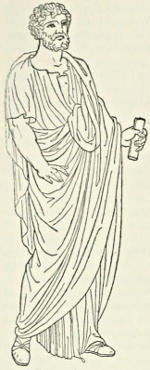
A Roman Orator
(After Hope)
Afterwards, Roman conquest gave the means of supplying works of art by the easier mode of appropriation. In the conquest of Etruria, years before, the practice had been begun; from Volsinii alone we read that two thousand statues were brought to Rome. In following years Agrigentum, Syracuse, Corinth, and other famous cities, sent the finest works of Hellenic art to decorate the public buildings and public places of the barbarous city of the Tiber, or in many cases to ornament the villas of the rapacious generals.
In the more intellectual even of the useful arts the Romans made no great progress. The contrivances of Archimedes for the defence of Syracuse struck them with amazement. In Cicero’s time they usually carried the sciences of quantity and magnitude no further than was necessary for practical arithmetic and mensuration. In 293 B.C. L. Papirius Cursor the younger set up a sun-dial at Rome, and thirty years later another was brought from Sicily by the consul M. Valerius Messalla; but no one knew how to place them, so as to make the shadow of the gnomon an index of time. A water-clock, resembling our sand-glass, was not introduced till 159 B.C.
Nor were the common conveniences of life in an advanced state. Up to the year 264 the houses were commonly roofed with shingles of wood, like the Alpine cottages of our days; then first earthen tiles began to supersede this rude material. Agriculture must have been roughly carried on by men who were as much soldiers as countrymen. The wine of Latium was so bad that Cineas, when he tasted it, said—and the witticism was remembered—“he did not wonder that the mother of such wine was hung so high”; alluding to the Italian custom, still retained, of training the vine up elms and poplars, while in Greece it was trained (as in France and Germany) on short poles and exposed to all the heat of the sun.
A form of architecture called the Tuscan was mostly used, which bore an imperfect resemblance to that early Greek style usually called the Doric. But the existing remains of the republican period are too scanty to allow of any precise statements. The true arts of Rome were, then and always, the arts of the builder and engineer. It would not be wrong to call the Romans the greatest builders in the world. Some of their mighty works, works combining solidity of structure with beauty of form and utility of purpose, still remain for our admiration, having survived the decay of ages and the more destructive hands of barbarian conquerors. In every country subject to their sway, roads and bridges and aqueducts remain in sufficient number and perfection to justify all praise. We class the roads among the buildings, according to their own phraseology,[73] and their construction deserves the name as justly as the works upon our own railways. The first great military road and the first aqueduct are due to the old censor Appius Cæcus, and they both remain to preserve the memory of the man, often self-willed and presumptuous, but resolute, firm of purpose, noble in conception, and audacious in execution. Other aqueducts and other roads rapidly followed; the spade and trowel were as much the instruments of Roman dominion as the sword and spear. By the close of the Punic Wars solid roads, carried by the engineer’s art over broad and rapid streams, through difficult mountain passes, across quaking morasses, had already linked Rome with Capua in the south, with Placentia and Cremona in the north. Such were the proud monuments of the Appii, the Æmilii, the Flaminii.
It may be said that these magnificent works, as well as the vast amphitheatres and baths which afterwards decorated Rome and every petty city in her provinces, were due to the invention of the arch. This simple piece of mechanism, so wonderful in its results, first appears in the Great Cloaca. It was unknown to the Greeks, or at least not used by them. It may be that the Romans borrowed it from the Etruscans; the Cloaca is attributed to an Etruscan king, and similar works are discovered in ruined cities of Etruria. But if they borrowed the principle they used it nobly, as witness the noble bridges still remaining, the copious streams carried over the plain for miles at the height of sixty or seventy feet from the level of the soil. If they had little feeling for beauty and delicacy in the use of the pencil or the chisel, their buildings are stamped with a greatness which exalted the power of the state while it disregarded the pleasure of the individual.
Their attention to practical utility in draining and watering their city is especially noted by Strabo in contrast with the indifference shown by the Greeks to these matters. To the facts already stated may be added their rule, established so early as the year 260 B.C., that no one should be buried within the city—a rule scarcely yet adopted in London. From this time dates the beginning of those rows of sepulchral monuments which the traveller beheld on either side of the road as he entered the Eternal City. It was a gloomy custom, but better at least than leaving graveyards in the heart of crowded cities.
A striking proof of engineering skill is shown in the tunnels cut through solid rock for the purpose of draining off volcanic lakes; this art we may also believe to have been originally borrowed from the Etruscans. The first tunnel of which we hear was that by which the Alban Lake was partially let off during the siege of Veii, a work which was suggested by an Etruscan soothsayer. Other works of like kind still remain, though the time of their execution is not always known. Here shall be added the notice of one work of kindred sort, which happens by a rare coincidence to combine great utility with rarest beauty. The famous M. Curius Dentatus, when censor in 272, cut a passage through the rock, by which the waters of Lake Velinus were precipitated into the Nar. By this means he recovered for his newly conquered Sabine clients a large portion of fertile land, and left behind the most lovely, if not the most sublime, of all waterfalls. The Falls of Terni, such is the famous name they now bear, were wrought by the hand of man. “Thousands of travellers visit them,” says Niebuhr; “how few know that they are not the work of Nature!”b
LITERATURE
Rome during this period began to form the literature which has come down to us; but unfortunately, instead of being national and original, it was imitative and borrowed, consisting chiefly of translations from the Greek. In the year after the end of the First Punic War (240), L. Livius Andronicus, an Italian Greek by birth, represented his first play at Rome. His pieces were taken from the Greek; and he also translated the Odyssey out of that language into Latin. Cn. Nævius, a native of Campania, also made plays from the Greek, and he wrote an original poem on the First Punic War, in which he had himself borne arms. These poets used the Latin measures in their verse; but Q. Ennius, from Rudiæ in Calabria, who is usually called the father of Roman poetry, was the first who introduced the Greek metres into the Latin language. His works were numerous tragedies and comedies from the Greek, satires, and his celebrated Annals, or poetic history of Rome, in hexameters, the loss of which (at least of the early books) is much to be lamented. Maccius Plautus, an Umbrian, and Cæcilius Statius, an Insubrian Gaul, composed numerous comedies, freely imitated from the Greek. M. Pacuvius of Brundusium, the nephew of Ennius, made tragedies from the Greek; L. Afranius was regarded as the Menander of Rome; and P. Terentius (Terence), a Carthaginian by birth, gave some beautiful translations (as we may perhaps best term his pieces) of the comedies of Menander and Apollodorus. None of these poets but Plautus and Terence has reached us, except in fragments; the former amuses us with his humour, and gives us occasional views of Roman manners, while we are charmed with the graceful elegance of the latter. It is remarkable that not one of these poets was a Roman. In fact Rome has never produced a poet.
Q. Fabius Pictor, L. Cincius Alimentus, A. Postumius Albinus, M. Porcius Cato, and L. Cassius Hemina wrote histories (the first three in Greek) in a brief, dry, unattractive style. Cincius also wrote on constitutional antiquities, and seems to have been a man of research; and a work of Cato’s on husbandry has come down to us which we could well spare for his Origines, or early history of Italy.e
FOOTNOTES