Sir William Cornwallis Harris (continued 7)
Reading edition
Volume One—Chapter Forty Two.
The Weekly Market.
Surrounded by the myrmidons who collect the royal dues, Ayto Kálama Work was every Friday morning to be seen seated beneath the scanty shelter of an ancient acacia, which throws its withered arms over the centre of the market-place. On this day alone are purchases to be made, and the inhabitants of the adjacent villages pouring from all quarters to lay in their weekly supplies, a scene of unusual bustle and confusion animates this otherwise most quiet and uninteresting location.
Shortly after daybreak, wares of every description are displayed under the canopy of heaven, and crowds of both sexes flocking to the stall of the vendor, the din of human voices is presently at its height. Honey, cotton, grain, and other articles of consumption, the produce of the estate of the Amhára farmer, are exposed for sale or barter. The Dankáli merchant exhibits his gay assortment of beads, metals, coloured thread, and glass ware. The wild Galla squats beside the produce of his flocks, and the Moslem trader from the interior displays ostrich feathers, or some other article of curiosity from the distant tribe. Bales of cotton cloth, and bags of coffee from Cáffa and Enárea, are strewed in every direction. Horses and mules in numbers are shown off among the crowd to increase the turmoil; nor is even the wandering Hebrew wanting to complete the scene of traffic, haggling, and barter, which continues, without intermission, until a late hour in the afternoon, when the village relapses again into its wonted six days of quiet and repose.
Swathed and folded in dirty cotton cloth, behold in the cultivator of the soil the original of the Egyptian mummy. Greasy and offensive in person and in habits, he moves cringingly to pay his tax to the governor of the fair, who sits in conscious dignity upon a stone; and prostrating himself with shoulders bared among the mud, the serf hands forth the measure of grain from the leathern scrip, or scoops out the prescribed meed of butter from the jar—the vassal token of permission enjoyed to earn his bread by the unceasing hand of labour. No spark of intelligence illumines his dull features; not a trace of independence can be discovered in his slouching gait; and the cumbrous robe with which he is invested would indeed seem far better adapted for the quiet resting-place in the tomb, than for the bustling avocations of stirring life.
Here swaggers a valiant gun-man of the king’s matchlock guard. The jealousy of the monarch forbids the removal of the primitive weapon from the royal presence, but the white herkoom feather floats in all the pride of blood over clotted tufts moist with the beloved grease; and the dark scowl and the lowering brow betoken the reckless cruelty which stains the character of the band. But the man is a poor slave, and his degraded state has entirely destroyed the few traits of humanity which might have smiled upon his nativity.
The surly Adaïel brushes past in insolent indifference to examine the female slaves in the wicker hut of the rover from the south. His murderous creese ensures from the bystanders a high respect, which frequent disasters in the low country has riveted on the heart of the Amhára; and men turn in wonder to gaze upon the mortal who entertaineth not a slavish adoration for the great monarch of Shoa.
Squatted beside his foreign wares and glittering beads, see the wily huckster of Hurrur, with his turban and blue-checked kilt. His dealings, it is true, are of no very extensive amount, and salt, not silver, is the medium of exchange; but there is still room for the exercise of his knavery. The countenance both of buyer and seller exhibits an anxious and business-like expression, and the same noise and confusion prevails regarding an extra twopence-halfpenny, as if the transaction involved a shower of golden guineas.
The Christian women flit through the busy fair with eggs and poultry, and other produce of the farm. Their ill-favoured features are not improved either by the eradication of the eyebrow, or by the bare shaven crown dripping with rancid butter; and the dirty persons of all are invariably shrouded in yet dirtier habiliments, from the tall masculine damsel of sixteen summers, to the decrepit and wrinkled hag who in cracked notes proclaims ever and anon, “amole alliche bir,” “salt to sell for silver.”
The free and stately mien of the oriental female, and the light graceful garment of the east, are alike wanting. The heavy load is tied as upon the back of the pack-horse, and the bent and broken figure of the Amhára dame is debarred by the severe law of the despot from the decoration of finery or costly ornament. A huge bee-hive-shaped wig, elaborately curled and frosted, and massive pewter buttons thrust through the lobe of the ear, constitute her only pride; and nature, alas! has too often withheld even the smallest portion of those feminine attractions which in other climes form the charm of her sex.
The inhabitants of Argóbba or Efát, under the control of the sinister eye of the Wulásma, are followers of the false Prophet, and speak a distinct language. Little difference, however, is observable in the external appearance of the males from that of the Amhára subject of the empire; and it is not until the removal of the muffling cloth that the rosary of bright-spotted beads is displayed in lieu of the dark blue emblem of Christianity worn throughout Ethiopia. The women, on the other hand, are at once recognisable, no less by their Arab gypsy features, than by their long braided tresses streaming ever the shoulder, the ample smock of red cloth, dyed purple with accumulated lard, and the nunlike hood of the same material, buttoned close under the chin.
Fairer, more slender, and better favoured than their coarse Christian sisters of the more alpine regions, they are still scarcely less greasy and unattractive. Loaded with amulets and beads, their belief is proclaimed by the oft-repeated exclamation, “Hamdu-lillah!” “Praise be unto Allah!”—the courteous interrogatories of every passer-by, anent health, rest, and welfare, being by the burly and masculine ladies of Shoa, responded by the words “Egzia behere maskin!” “Thanks be unto God!” Unrestricted by harem law they fidget about in every direction, their great sparkling eyes peering through a mass of coal-black hair, half concealed by the crimson cowl, and the large shining necklace of amber reaching nearly to the waist. But the hideous sack chemise veils every feature of figure and personal beauty, and the naked hands and feet are alone exhibited, both rather misshapen from hard work and undue exposure to the climate.
The crowd makes way for a great Christian governor, probably from some distant province near the Nile. He is surrounded by a boisterous host of armed attendants, and, like them, paddles with unshod feet through the stiff black mire. The capacious stomach, and the bright silver sword with tulip scabbard, betoken high honour and command. An ambling mule tricked out in brass jingles and chains follows in his path; a long taper wand towers above his shoulder; and his portly figure is completely shrouded in the folds of a cotton robe, bedecked from end to end with broad crimson stripes. The garment might be improved by ablution; but repose upon the hide of a bullock is no aid to purity of apparel, and it is white in comparison with those of his unwashed retinue.
The arrangement of his hair has occupied the entire morning, and the steam of the fetid butter, which glistens among the minute curls, pervades the entire atmosphere. Muffled high above the chin, the eyes and nose of the functionary are alone submitted to the vulgar gaze, and as he halts for a moment to wonder at the unwonted sight of the Gyptzi strangers, the bloodshot eye betrays the midnight debauch, and the wrinkles of his turned-up nose, the scorn of the savage at the difference of costume and complexion. Approaching the acacia his shoulders are temporarily bared to the pompous dignitary presiding over the fair, who rising to receive him, returns the compliment, and there ensues a tissue of inquiries unknown even to the code of Chesterfield. Cantering over the tiny plain—a scanty level of an hundred yards—the wild Galla enters the scene of confusion, his long tresses streaming in the wind, and his garment blue with the grease of ages. A jar of honey, or a basket of butter, is lashed to the crupper of his high-peaked saddle; the steed is lean and shaggy as the rider, and the snort and the start from either proclaim undefined terror and amazement at the strange sights, and the rugged rocks and precipices, unknown to the boundless meadows of their own green land.
Dandies there are none, in aught of outward appearance, for the arrangement of the hair is the only latitude allowed to the invention of the would-be fop. The cotton cloth in every degree of impurity, floats over the swart shoulder both of noble and of serf. Bare heads and naked feet are the property of all, and the possession of the spear and shield alone marks the difference of rank. The chief scorns to carry a weapon except during the foray or the fight, whereas his followers never leave the threshold of their rude dwellings, without the lance in their hand, and buckler on their arm.
The terror and abhorrence in which the low country and its attendant dangers are held by the Abyssinian population, have placed nearly the entire trade of Alio Amba in the hands of the Danákil, who are treated by the monarch of Shoa with all deference and respect. Caravans arrive every month during the fair season from Aussa and Tajúra, and the traffic, considering the manifold drawbacks, may be said to be brisk and profitable. Numbers of foreign merchants, those of Hurrur especially, whilst disposing of their goods, hold their temporary residence at the market-town, the climate of which, many degrees warmer than the cold summit of the range which towers two thousand feet above, proves far more congenial to their taste and habits.
With the proceeds of foreign imported merchandise, human beings kidnapped in the interior countries of Africa are purchased in the adjacent slave mart of Abd el Russool. These wretched victims are then taken through the Amhára province of Giddem to the Wollo and Argóbba frontiers, some five days’ journey to the north, and resold at a profit of fifty per cent,—the sums realised being there invested in amoles, or blocks of black salt, the size of a mower’s whetstone. Obtained between Agámê and the country of the Dankáli, from a salt plain which not only supplies all the Abyssinian markets, but many also far in the interior of Africa, they pass as a currency, and, being bought on the frontier at the rate of twenty-five for a German crown, are retailed in Alio Amba at a profitable exchange. A large investment of slaves is finally purchased with the wealth thus laboriously amassed, and the merchant returns to his native country to traffic in human flesh at the sea-ports of Zeyla and Berbera, or on the opposite coast of Arabia—anon to revisit Shoa with a fresh invoice of marketable wares.
Ever ravaged by war and violence, the unexplored regions of the interior pour forth a continual supply of ill-starred victims of all ages to feed the demand, and the hebdomadal parade in the market-place under the ruthless Moslem monsters by whom they are imported, is sufficiently harrowing to those unaccustomed to such revolting spectacles. Examined like cattle by the purchaser, the sullen Shankala fetches a price proportioned to the muscular appearance of his giant frame; and the child of tender years is valued according to the promise of future development. Even the shamefaced and slenderly-clad maiden is subjected to every indignity, whilst the price of her charms is estimated according to the regularity of her features, the symmetry of her budding form, and the luxuriance of her braided locks; and when the silver has rung in confirmation of the bargain, the last tie is dissolved which could hold in any restraint the appetite of her savage possessor.
Volume One—Chapter Forty Three.
The Principality of Hurrur.
Not many weeks had elapsed since certain substantial merchants of Hurrur, after visiting the shrine at Medina, and making a long and profitable sojourn in Alio Amba, had returned to their native land to enjoy the honours attaching to their religious pilgrimage. Slaves, ivory, and precious gums had been disposed of to great advantage in Arabia, and the proceeds invested in beads, berillés, and broad-cloth, with which the enterprising traders landed at the maritime town of Tajúra. Proceeding thence to Efát, they embarked their gains in slaves, mules, and cotton cloths; and designing to pass the residue of their days in ease and affluence, set out by way of Hurrur for the great annual fair at Berbera.
In advance of the time, however, these luckless individuals had ventured to speculate to their envious countrymen upon the advantage to be derived from foreign traffic and the presence of the white man. The incautious word had caught the ear of Abdel Yonag, the wily chief of the Hurrurhi, and letters were secretly despatched to his master the Ameer, representing the wealthy hajjis to be men of turbulent and ambitious views, who had devised dangerous innovations, and were plotting, with the Adaïel, the monopoly of the commerce in slaves. With hearts bounding at the sight of their native minarets, and utterly unconscious of the slander that had preceded them, the pilgrims entered the Isma-deen gate of the city; but ere return had been welcomed by wife or child, they were hurried by the soldiery to the presence of the despot, and, without even the mockery of a trial, were beaten to death with huge maces of iron.
The independent principality of Hurrur is a spot yet unvisited by any European, and is remarkable for its isolated position among the Pagan and Mohammadan Galla, against whose continual inroads it has hitherto contrived, with the aid of two hundred matchlock-men and a few archers, to maintain its integrity. The Alla, the Nooli, the Geeri, the Tarsoo, the Babili, the Bursoo, the Burteera, and the Gooti, compass it on every side, and making sudden descents, sweep the ripe crops from off the face of the smiling land; but their efforts against the town have uniformly proved unsuccessful, and caravans continue, in spite of hostilities, to carry on a very considerable traffic through the Ittoo and Aroosi tribes, with Shoa and the Somauli coast.
Originally founded and peopled by a colony of the sons of Yemen, the town is described to be situated in a pleasant and well-watered valley, surrounded by hills, and enjoying a cool and salubrious climate. A wall of mud and stone, six miles in circumference, with five fortified gates, affords security to the entire population, whose houses, many of them two-storied, are constructed of stone, whitewashed, and terraced. Mosques and minarets are conspicuous in every street. The matin voice of the muezzin is regularly heard, and the Jama el Musjid is believed to be the abode of guardian angels, who stretch the strong pinion of protection over the heads of the Faithful. “How could Hurrur have triumphed thus long over the unbelievers,” inquire the devout citizens, “had Allah not extended his right arm to succour the followers of his Prophet?”
Aboo Bekr, the reigning Ameer, has wielded the sceptre during the last seven years, and pursuing the barbarous custom of Shoa, his brothers and family are permanent inmates of subterranean dungeons, which for better security are constructed immediately below the foundations of his own palace. Although cruel and vindictive, he is reputed a brave prince, heading the foray in person, and taking the front in the battle field; but suspicion of the stranger would seem to form the ruling feature of his character, nor is this to be wondered at, since bloodshed and aggression are known to have once marked the footstep of the intruder.
During the reign of Abd el Kurreem, uncle to the present Ameer, a large body of Arabs from Mocha, instigated by a disgraced member of the blood-royal, who had fled thither for safety, laid siege to the town, and assisted by guns of small calibre, which are now mounted on the walls, had nearly prevailed. Again the guardian angels stretched their white wings over the beleaguered city. The magazine blew up and destroyed numbers of the enemy, and their traitorous leader, who had induced the attack by representing his countrymen to be infidels and apostates from the true religion, falling into the hands of the garrison, had his head exalted on a pole in the market-place, after the brains had been dashed out with an iron club. Death is now the portion of every fool-hardy wanderer from the shores of Araby, and whilst the Galla is compelled to relinquish his arms at the gate, every precaution is taken to exclude from the land the foreigner of whatever nation.
In the features of the Hurrurhi is to be traced a strong resemblance to those of the parent stock. The costume consists of a checked kilt, a creese, and a cotton toga; the display of a turban being restricted to the Ameer, to the moolahs, and to those who have performed the pilgrimage to the shrine of the Prophet. Although distinct in itself, the language bears a singular affinity to that of the Amhára, but Arabic forms the written character. Barter is the most usual system of commerce, but the mahaluk, a small copper coin resembling the dewáni of Jiddah, is current in the realm. Twenty-two of these go to a nominal coin styled ashrafi, whereof forty are equivalent to the German crown. It bears on the reverse the name of the reigning Prince, and on the obverse the quotation from the Korán, “La illah, illilah!” “there is none other God but Allah.”
Around Hurrur the soil is rich, and extensively cultivated, especially in coffee. Two thousand bales of the finest quality are annually exported into India and Arabia by the ports of Zeyla and Berbera, which are visited thrice during the year by large caravans laden with ivory, ostrich feathers, ghee, saffron, gums, and myrrh, which latter is produced in great abundance. Blue and white calico, Indian piece goods, English prints, silks, and shawls, red cotton yam, silk thread, beads, frankincense, copper wire, and zinc, are received in exchange, and a transit duty of one frazil of the latter metal is levied by the Ameer on every slave passing through his dominions from the cold hills of his brother of Shoa, where these commodities are bartered.
(The distance of Hurrur from Zeyla may be assumed at 150 miles south-south-west and from Ankóber, 190 miles East.)
Between Aboo Bekr and the Christian monarch the most friendly intercourse subsists. Letters continually pass and repass, and scarcely a month elapses without the arrival of a caravan. The chief of the Wurj or merchants of Hurrur, standing specially appointed by the Ameer, possesses absolute power to punish all offences, and adjust all disputes amongst his own countrymen, who are not less fond of drawing the creese than their Adaïel brethren. Tullah, an inferior description of beer, being brewed and swallowed in alarming quantities, brawls and scuffles too frequently terminate the debauch in blood. Should a Christian subject of Shoa be slain, the offence is passed over in politic silence, but when the reverse is the case, the worldly wealth of the sinning Abyssinian is confiscated by the crown, and his person handed over to the tender mercies of the Moslem savages.
The continual change of inhabitants, the excessive cheapness of provisions, and the prevalent custom of hand-fasting for the visit, tend little to improve the morality of the market-town. The chains of the convenient alliances formed, are by no means binding on either party, and the sum of twopence-halfpenny is perfectly sufficient to support during the week the trader and his temporary mate. One hundred pieces of salt are considered a large dowry; the nuptials are celebrated by feasting and routing alone, and whilst the utmost indifference prevails on the part of the husband, he loosens the matrimonial knot at pleasure, by carrying his partner before the kázi, and thrice repeating the words, “Woman, I thee divorce.”
One fourth of the entire population of Alio Amba are Hurrurhi and Danákil. Of the worthies who accompanied the Embassy from Tajúra, the majority continued to reside at Fárri and Chánnoo for the convenience of foraging their camels, but flocking every Friday to the market, they never failed to confer the pleasure of their society for a few hours. Gubaïyo, the deputy-governor of the town, had been specially appointed to the service of the foreigners, and whilst discharging his office of spy with the most creditable diligence, he exercised with strict impartiality his functions as door-keeper, enforcing, greatly to the amazement of the independent Adaïel, the Abyssinian usage, which precludes the invasion of visitors unless duly introduced. The obnoxious red man, whose iniquities had well nigh cost the lives of the whole party at the Great Salt Lake, and who had now the impudence to seek a reward for his services on the road, was the first who came under the remorseless lash of the despotic bully; and it was a not less cheering and delightful sight to behold the warm-blooded little warrior, Ibrahim Shehém Abli, flying like a football down the steps leading from the court-yard into the muddy lane, before the propulsive impetus of a Christian toe, which presently sent the tyrannical Izhák bounding after his colleague, with many a severe thwack from the wand of office, ringing across his Moslem shoulders, as he vainly proclaimed himself own brother to the reigning Sultán of Tajúra.
Volume One—Chapter Forty Four.
Escape from the Market-Town.
Abyssinian despots sully not their dignity by condescending to divulge even the smallest design to the most confidential of their courtiers. In elegant Amháric phraseology “the belly of the master is never known;” and thus it occurred that had any possessed the inclination to predict the probable period of detention, none could boast the ability. A fortnight rolled tardily away, and the burning curiosity of the savage having meanwhile overcome the scruples dictated by state policy, it became matter of public notoriety that the king had taken up his residence at the adjacent palace of Machal-wans, where preparations were actually in progress towards the long-desired audience.
The reappearance of the commander-in-chief of the body-guard, with the escort of honour, was the first welcome sign of approaching release from the vile market-town of Alio Amba; and the most illustrious peer of the realm, attended by a junto of scribes, and a host of reluctant porters, was not far behind him. Penmanship being so extremely tedious a process, it is not the court etiquette to endite letters when a verbal communication will answer the purpose; and the visitors were accordingly charged with abundant compliments, and with an invitation to behold the royal person on the ensuing Sabbath, which had been pronounced by the astrologers “a day of good omens.”
“Tarry not by day, neither stay ye by night, for the heart of the father longeth to see his children. Hasten that he be not again disappointed.”
But, unfortunately, the hour selected by the skill of “those who read the stars” did not find approval in the sight of the guests; and in order to gratify the royal impatience, it was therefore proposed that the interview should take place one day earlier. His Majesty, however, laboured under the effects of cosso, a drug resorted to by all who revel in raw diet; and feeling yet unequal to appear in public, it was finally arranged that audience should be deferred until the Monday following. A fresh inventory of boxes was immediately commenced; and, after much opposition, those intended for presentation to the throne were separated, and sent off to await arrival at a hamlet distant two miles from Machal-wans.
The next labour was to dismantle the structure of bales and packages which during the detention at Alio Amba had been piled in view to the economy of space, so as to admit of some of the party occupying the tier next the roof, whilst others had slept in cabins formed below, or upon, or underneath, the table. But no sooner had the king’s baggage departed than the Wulásma came to announce that there were no more porters, and that if any thing still remained it must be left behind. Another battle followed, and a war of words, which lasted a full hour and a half, was again crowned with victory.
Ayto Kálama Work, who had been the chief instigator of this opposition, is charged with manifold affairs. Independent of his important duties at the seat of his authority, where he is responsible for all tribute in salt, in honey, and in specie, he is entrusted with the treasures lodged in Ankóber, Arámba, Debra Berhán, and Kondie, and is expected to be present on all state occasions at the palace. To assist in the discharge of these onerous and multifarious duties, he has many stewards and subordinates, of whom the chief, who superintends the ghemdjia house, or royal wardrobe, wherein the most costly manufactures are deposited, had already proceeded in advance to spread the carpets in the great reception hall. He was accompanied by Déftera Sena, the secretary, whose business it is to receive and register all transfers to the state revenues, and who had been for the last fortnight almost incessantly busied with his pen.
Liberated from irksome captivity, the utmost difficulty was next experienced in procuring mules—no steps to supply the place of those destroyed having been taken by the inimical functionaries whose express duty it was. The few survivors of the late numerous drove were mustered, but only one proved in a condition to proceed, and it was not until a messenger had actually set out with a complaint to the king, that measures were taken to supply the number required. A clamorous mob now assembled in order to witness the difficulties raised in the way of the foreigners; and it required the utmost exertion on the part of Gubaïyo, both with his long stick and still longer tongue, to keep the idle crowd at a respectful distance.
Mounted at length, the party turned their backs towards the market-place, and entered upon a circuitous path, winding, by abrupt declivities and steep ascents, over three mountain torrents, towards the village of Sallal Hoola, at which the night was to be passed. Kind nature had everywhere spread the ground with her gifts in inexhaustible profusion and variety, supplying all the more immediate wants of mankind, yet enforcing the doom of labour so wisely imposed upon her lazy children. Rich acres of com by the wayside were interspersed with quiet hamlets, and with luxuriant meadows abounding in trefoil and a vast variety of red and white clover. Crystal brooks leapt in numerous cascades, and hedge-rows gay with endless flowers, the dog-rose and the fragrant jessamine, imparted to the rural landscape an aspect quite European.
Southern Abyssinia proper commences with Efát, at the foot of the first range of hills, which continue to increase both in altitude and fertility to the summit of the lofty barrier that stretches north and south to form the brink of the elevated table-land of Shoa. Violent storms of thunder and lightning, which usher in the rainy season, are attracted to this region as well by the great elevation of the mountain as by the highly ferruginous nature of the rocks. It is a land of hill and valley, smiling under the influence of the copious deluge; and so striking a contrast does it present to the general character and climate of the torrid zone, that at first sight the delighted traveller might believe himself transported by some fairy agency to his northern home.
Ayto Wolda Hana, although loquacious enough, had been somewhat subdued by the temperature of the low country, to which, as well as to every thing Mohammadan, he evinced an insuperable disrelish; but once again within the influence of the cold mountain breeze beyond the limits of the Wulásma’s jurisdiction, and he was in his glory. Two running footmen kept pace with his gaily-caparisoned mule. Immediately behind him rode a confidential henchman carrying the emblazoned shield and decorated lances which denoted his position in society; and in the height of Highland anarchy the tail of the McGregor was seldom of longer dimensions than that of the pompous governor of Ankóber.
Suddenly leaving the party, the great man was observed to dive into a village by the road-side, whence in a few minutes he returned, issuing a variety of orders in a far from melodious tone of voice, which evidently had reference to the mulberry steed already mentioned as having been brought from Aden. The animal had not been seen for many days, and every application regarding it had been so dexterously evaded, that, although the tail had not been brought in, it was believed to have gone the way of all flesh. To the surprise of every one, the charger, prancing and neighing, was now led forth, in the best condition, by one of the King’s grooms. So thoroughly had the worthy functionary been impressed with the erroneous conviction, that it formed a part of the present designed for his royal master, that the fortunate beast had been turned into clover, and duly fed with the choicest barley, whereas all its companions, although surrounded by plenty, had been suffered to starve.
At Sallal Hoola, another hovel had been provided by the royal bounty, smaller in dimensions, more dark, dirty, and dismal, and infinitely better garrisoned with vermin than the abode wherein the last fortnight had been passed. Environed by miry swamps and stagnant pools, it presented an appearance the most gloomy and wretched, whilst the materials for comfort were, as usual, denied by the officious functionaries, who had taken care to deposit the baggage most needed in quarters of the village where, at so late an hour, free access was impossible. The gloomy recesses of the veranda were crowded with female slaves, occupied in the various processes of preparing bread, which the population had been called upon to supply in large quantities to the palace against the approaching arrival of the foreigners. In one corner, two old women who alternately plied their pestles to a most monotonous ditty were pounding grain in a wooden mortar. In another a group of buxom lasses were rocking themselves to and fro over mills fashioned like the high-heeled slipper of the days of good Queen Bess, upon the inclined surface of which they contrived, with a stone and great personal labour, to convert the grain into a form something resembling flour. It trickled in a scanty stream into a vessel placed below the depressed plane for its reception, and was presently wrought into thick cakes, full a foot and a half in diameter. These were merely shown to the fire, and a crude substance was thus produced, which by a well-fed Indian elephant would certainly have been rejected with a severe admonition to his keeper.
In this dreary and soul-depressing spot, destitute of beds and not overburdened with food, were experienced the very opposite of the delights of the Salt Lake—cold, damp, and wet in perfection; but the glad prospect of an interview with His Majesty on the morrow buoyed up the spirits of all, and misery was disregarded. Ayto Kátama had proceeded in advance to Machal-wans to seek at the royal hands permission to fire a salute of twenty-one guns on the British Embassy reaching the royal lodge—a point previously urged, but without success. It had already been brought to the King’s notice that the foreigners partook of food which had been prepared by Mohammadans—a proceeding which in Shoa is reckoned equivalent to a renunciation of Christianity. Ideas the most extravagant were, moreover, in circulation relative to the powers of the ordnance imported, the mere report of which was believed sufficient to set fire to the earth, to shiver rocks, and dismantle mountain fastnesses. Men were said to have arrived with “copper legs,” whose duty it was to serve these tremendous and terrible engines; and in alarm for the safety of his palace, capital, and treasures, the suspicious monarch still peremptorily insisted upon withholding the desired licence, until he should have beheld the battery “with his own eyes.”
Volume One—Chapter Forty Five.
Presentation at Court.
It rained incessantly with the greatest violence throughout the entire night, and until the morning broke, when a great volume of white scud, rising from the deep valleys, and drifting like a scene-curtain across the stern summit of the giant Mamrat—now frowning immediately overhead—foretold the nature of the weather that might be anticipated during the important and long-looked-for day. The baggage having with considerable difficulty been collected from the various nooks and comers wherein the porters had deposited their loads, and no prospect of a brighter sky being in store, the circumjacent morasses were waded to the face of the hill which obscured Machal-wans. Too steep and slippery for mules, this was also ascended on foot, with the aid of long staves; and the rain, which had been dropping gently for some time, again setting-in with the most malicious steadiness, as if resolved to mar all attempt at display, the whole cavalcade was presently drenched to the skin.
An hour’s toil over very heavy ground opened a sudden turn in the road, whence the escort, resting their cumbrous matchlocks over the rocks, commenced an indiscriminate fire—the reports of their heavily-loaded culverins, mingled with the answering note of welcome from the expectant crowd below, echoing long and loud among the broken glens. As the clouds of smoke floated slowly away on the dense atmosphere from the shoulder of the mountain, there burst upon the sight a lovely view of the stockaded palace at Machal-wans. Its conical white roofs were embosomed in a fair grove of juniper and cypress, which crested a beautifully wooded tumulus rising at the extreme verge of the valley from the very banks of a roaring torrent. A bright green meadow, spangled with flowers, lay stretched at its foot: the rose, the eglantine, and the humble violet, grew around in all the grace of native wildness, to recall recollections of happier lands, whilst the great Abyssinian range, which even here towered almost perpendicularly some two thousand feet overhead, and whose peaks were veiled in wreaths of white fog, formed a magnificent background to the picture. Isolated farm-houses were profusely scattered over the verdant landscape—rich fields glistened in various stages of maturity—and the rills, swollen by the recent storm, came thundering over the mountain side, in a succession of foaming cascades.
Another hour’s wading through deep ploughed fields of beans and peas and standing corn, and across the rapid torrent brawling over a rocky bed, brought the draggled party to two time-worn awnings of black serge, which not five minutes before had been pitched for its accommodation in a swamp below the royal residence, and which admitted the rain through an infinity of apertures. This continued up to the last moment, thick and heavy; but the utmost efforts of the deluge had proven insufficient to cleanse the mud-stained garments; and now the tramp of six hundred porters, in addition to the vast crowd which had assembled to witness the long-looked-for arrival of the British Embassy, soon converting the ground into a positive quagmire, ankle-deep in black mud, seemed to render utterly hopeless any attempt at the exhibition of broad-cloth and gold lace on the approaching presentation at the Court of Shoa.
The governors of Ankóber and Alio Amba, whose special affair it was to provide food, and otherwise to render assistance needed, left the visitors to pitch their own tent, whilst they lounged in the palls, and contented themselves with urging the instant gratification of the royal curiosity, which was momentarily becoming more and more intense. Persecution on the part of the unruly and boisterous mob, to whom every object was new, meanwhile waxed greater and greater—thousands pressing forward to gaze as at wild beasts, and all contributing their mite to promote confusion and discomfort, now at the climax. Sally after sally was made by the uproused commander-in-chief of the body-guard, and many were the long sticks broken to small fragments over the backs and shoulders of the wild spectators in the course of his vigorous applications. But it was to no purpose. The ring was no sooner formed than broken, and the self-constituted clerk of the course, becoming at length weary of his occupation, he joined his idle colleagues in the tent, and left the multitude to their own devices.
A remonstrance to the King, touching the indignities to which the liege subjects of Great Britain were thus exposed at the hands of the Amhára rabble, on the very outskirts of the palace, was followed by a visit from Birroo, the favourite page, bearing an apologetic message on the score of ignorance; and repeated messages through this shrewd little confidant of royalty, who possessed all the airs of a spoiled pet, elicited first permission to fire a single gun—then five—and lastly, the desired salute. With his assistance, moreover, the crowd was to a certain extent repelled, and the spacious tent having finally been erected, amid peals of savage wonder, the floor was strewed with heather and with branches lopped from the myrtles and from various aromatic shrubs that grew thickly around, and preparations were at length commenced for the interview, which, during the continuance of the tumult and uproar, had been by a succession of messages repeatedly and earnestly desired.
It was now noon, and the weather having temporarily cleared, the British party, radiant with plumes and gold embroidery, succeeded, after much fruitless opposition, in mounting their gaily-caparisoned steeds, and escorted by the governors, the commander-in-chief of the body-guard, and by a numerous and clamorous escort, proceeded in full uniform towards the palace. Many were the attempts made to enforce the etiquette which denies ascent in equestrian order; but as, on gaining the foot of the eminence, the roar of artillery burst from the centre of the encampment, and the deep valley, filling fast with a cloud of white smoke, began to echo back the salute at the rate of six discharges in a minute, no further interference was attempted, and an universal shout arose of “Malifia Ungliz, melcom! melcom!” “Wonderful English, well done! well done!”
Noise, bustle, and confusion, which in Abyssinia are reckoned highly honourable to the guest, were again at their climax on reaching the outer cricket, where the form of obtaining the royal permission to pass was to be observed ere entrance could be accorded by the state door-keepers. Further detention was experienced in the court-yard, at the hands of sundry officers of the privy chamber, whose visages were but ill-adapted to sustain the character of high official importance, and whose assumption of dignity proved singularly ludicrous. At length came a message expressive of His Majesty’s unqualified surprise and satisfaction at the extraordinary celerity with which the guns were being served, and his desire to see the Embassy forthwith; but attempting to advance, opposition was again interposed, and it needed another message, and yet another command, before admission could be obtained to the royal presence.
The last peal of ordnance was rattling in broken echoes along the mountain chain, as the British Embassy stepped at length over the high threshold of the reception hall. Circular in form, and destitute of the wonted Abyssinian pillar in the centre, the massive and lofty clay walls of the chamber glittered with a profusion of silver ornaments, emblazoned shields, matchlocks, and double-barrelled guns. Persian carpets and rugs of all sizes, colours, and patterns, covered the floor, and crowds of Alakas, governors, chiefs, and principal officers of the court, arrayed in their holyday attire, stood around in a posture of respect, uncovered to the girdle. Two wide alcoves receded on either side, in one of which blazed a cheerful wood fire, engrossed by indolent cats, whilst in the other, on a flowered satin ottoman, surrounded by withered eunuchs and juvenile pages of honour, and supported by gay velvet cushions, reclined in Ethiopic state His Most Christian Majesty Sáhela Selássie. The Dech Agafari, or state door-keeper, as master of the ceremonies, stood with a rod of green rushes to preserve the exact distance of approach to royalty, and as the British guests entered the hall and made their bows to the throne, motioned them to be seated upon chairs that had previously been sent in—which done, it was commanded that all might be covered.
The King was attired in a silken Arab vest of green brocade, partially shrouded under the ample folds of a white cotton robe of Abyssinian manufacture, adorned with sundry broad crimson stripes and borders. Forty summers, whereof eight-and-twenty had been passed under the uneasy cares of the crown, had slightly furrowed his dark brow, and somewhat grizzled a full bushy head of hair, arranged in elaborate curls after the fashion of George the First; and although considerably disfigured by the loss of the left eye, the expression of his manly features, open, pleasing, and commanding, did not in their tout ensemble belie the character for impartial justice which the despot has obtained far and wide—even the Danákil comparing him to “a fine balance of gold.”
All those manifold salutations and inquiries which overwrought politeness here enforces, duly concluded, the letters with which the Embassy had been charged—enveloped in flowered muslin and rich gold kimkhab—were presented in a sandal wood casket, minutely inlaid with ivory; and the contents having been read and expounded, the costly presents from the British government were introduced in succession, to be spread out before the glistening eyes of the Court. The rich Brussels carpet which completely covered the hall, together with Cachemire shawls and embroidered Delhi scarfs of resplendent hues, attracted universal attention, and some of the choicest specimens were from time to time handed to the alcove by the chief of the eunuchs. On the introduction of each new curiosity, the surprise of the King became more and more unfeigned. Bursts of merriment followed the magic revolutions of a group of Chinese dancing figures; and when the European escort in full uniform, with the sergeant at their head, marched into the centre of the hall—faced in front of the throne, and performed the manual and platoon exercises amidst jewellery glittering on the rugs, gay shawls and silver cloths which strewed the floor, ornamented clocks chiming, and musical boxes playing “God save the Queen,” His Majesty appeared quite entranced, and declared that he possessed no words to express his gratitude. But many and bright were the smiles that lighted up the royal features, as three hundred muskets, with bayonets fixed, were piled in front of the footstool. A buzz of mingled wonder and applause, which half drowned the music, arose from the crowded courtiers; and the measure of the warlike monarch’s satisfaction now filled to overflowing, “God will reward you,” he exclaimed, “for I cannot.”
But astonishment and admiration knew no bounds, as the populace next spread over the face of the hills to witness the artillery practice, which formed the sequel to the presentation of these princely gifts. A sheet was attached to the opposite face of the ravine. The green valley again rung to the unwonted roar of ordnance; and as the white cloth flew in shreds to the wind, under a rapid discharge of round shot, canister, and grape, amidst the crumbling of the rock, and the rush of the filling stones, the before despised sponge staves became a theme of eulogy to the monarch as well as to the gaping peasant. A shout rose long and loud over the pealing echoes which rattled from hill to hill; and far along the serrated chain was proclaimed the arrival of foreign guests, and the royal acquisition through their means of potent engines of war.
Compliments from the throne, and personal congratulations from the principal courtiers and officers of state, closed the evening of this unwonted display; and the introduction, by the hands of the favourite page, of a huge pepper pie, the produce of the royal kitchen, with a command that “the King’s children might feast,” was accompanied by the unheard-of honour of a visit from the dwarf father confessor, who might without difficulty have concealed his most diminutive person beneath the ample pastry. Enveloped in robes and turbans, and armed with silver cross and crosier, the deformed little priest, whose entire long life has been passed in doing good to his fellow-creatures, seating his hideous and Punch-like form in a chair placed for its reception, in squeaking accents delivered himself thus:—
“Forty years have rolled away since Asfa Woosen, on whose memory be peace, grandsire to our beloved monarch, saw in a dream that the red men were bringing into his kingdom curious and beautiful commodities from countries beyond the great sea. The astrologers, on being commanded to give an interpretation thereof, predicted with one accord that foreigners from the land of Egypt would come into Abyssinia during His Majesty’s most illustrious reign, and that yet more and wealthier would follow in that of his son, and of his son’s son, who should sit next upon the throne. Praise be unto God that the dream and its interpretation have now been fulfilled! Our eyes, though they be old, have never beheld wonders until this day, and during the reign over Shoa of seven successive kings, no such miracles as these have been wrought in Ethiopia.”
Volume One—Chapter Forty Six.
By the passage of the polar star over the meridian, the magnetic variation at Ankóber was observed, with the aid of a well-regulated chronometer, to be 7 degrees westerly.
The longitude was determined both by a series of lunars, and by the eclipses of Jupiter’s satellites, the mean of upwards of 150 observations having been taken.
Remarks on the Natural History of that Portion of the Adel Country Situated along the Route from the Sea-Coast to the Frontier of Efát.
From Tajúra to Killulloo.
The advanced state of the season was unfavourable for observations in the department of natural history. Both animal and vegetable life were apparently in a state of torpor; the trees and shrubs were in general leafless; and no annual plant whatever was to be seen, even in the immediate vicinity of the watering-places. The few insects that were not in a state of chrysalis, seemed drowsily to procrastinate their existence until food for the new generation should be prepared by nature. Amphibia, Saurii, and Ophidii, which are generally not so dependent on a supply of water, existed in small numbers in their lurking-places, whilst birds and larger animals must at this season have migrated to more favoured countries.
Basaltic and trachytic hills, either isolated or in chains, rise at a distance of about half a mile from the sea-shore, which is winding and shelving. The hills are in general rounded, and marked by broad veins of similar composition, but containing more perfectly crystallised felspar, quartz, and zeolith. They have not the sharp peak, but are broken and cliffy, and have apparently been upheaved at different periods.
On leaving the shore, a most striking specimen of columnar basalt presented itself in the ravine of Galeylaféo, which, for nearly half a mile, runs through the heart of a huge mountain. In width it is about 200 yards, and the perpendicular pillars are 200 feet in height. It is evident that water could not have been the sole agent in producing such a huge cleft, although at present the ravine presents the appearance of a regular water-course. The surrounding hills consist of the same rock, but covered with loose boulders, which are much stained with oxide of iron.
Amongst the confusion of volcanic masses on the plain of Warelissán, excepting in some rare cases, when the true lava stream could be traced to its source, it was difficult to determine the exact site of the craters from whence they had been ejected. The hill which separates Báhr Assai from the sea, with its singular tops of limestone, slate, and creta, deserves a more minute examination than could be given at this season of withering heat. The western side is the most interesting, as being more open and disclosed; there is, however, as in all formations in the vicinity of volcanic countries, no uniform inclination of the layers. The range bordering the eastern shore of the lake is basalt and basaltic wacke; on the western, it is partly gypsum and limestone, but resting on basalt.
The great salt lake is a deep extensive basin, separated by an immense lava stream from the remainder of the bay, the head of which it once formed. Resembling the Dead Sea in the depression of its level, in the density and chemical constitution of the fluid, and in the loneliness, sterility, and desolation of its borders, it yet differs from it materially in the ways by which volcanic action has produced the strange phenomenon of the existence of shores so considerably below the level of the ocean. In the Dead Sea, the lake of Tiberias, and the valley of the Jordan between them, it has apparently been a distortion and crushing of immense masses which have subsided into subterranean caverns. In the Báhr Assai it has been produced by the erection of a new bank, serving as a dam or barrier across the head of a long narrow bay, by which a considerable body of sea-water was separated from the former common receptacle. As high as the level of the Arabian Gulf are to be found, in the basin of Báhr Assai, the salts and earthy (magnesian) precipitates of the salt water, which in the course of time was reduced to its present level by evaporation, the yearly supply of rain-water being but as a drop to the ocean. Huge heaps of lava, having been apparently in strife with the opposite element, are erected on the banks over wacke, or in other cases over a finely-grained soft mart. The latter, when clear of lava, presents a thin layer of gypsum, with numerous shells of Melania, Limnaeus, Physa, Planorbis, Cyclostoma, Unio, and Cycas, some of which are at present to be found in the distant fresh-water pools and rivulets.
The shallow water on the borders of the lake presents natural salt-pans, and a crust of fine salt, two inches thick and tolerably clean, covers nearly the whole of the surface. The supply would seem to be inexhaustible; for when cut out with a spaddle, a new crust is soon furnished from the waters beneath. Being visited by almost every tribe of the Adaïel and Somauli, and unhappily situated on the borders of the most lawless and savage of them, this remarkable spot is almost forbidden ground for the observer, not to speak of the obstacles thrown in the way by the destructive temperature and the general absence of the necessaries of life.
In the ravine of Goongoonteh, and during the continuation of the journey as far as Killulloo, slight variations of trap formation were met with. The wacke is of a fine grain, and its constituents are indistinctly mingled; it is traversed by empty holes and bubbles, and occasionally by druses of zeolith. Coarse quartz, sandstone, and conglomerates are sometimes found towards the surface. The country must have frequently been agitated by violent earthquakes, detaching huge masses of rocks from the hills; and, bereft alike of vegetation and animal life, it presents altogether a most monotonous appearance.
The lower classes of animals, of ephemeral existence, are found on every living or vegetating body.
Of Coleoptera were observed: two species of Pimelia (longipes), one of Cetonia, of Copris (Isidis), of Erodius (gibbus), several Staphylini and one Gyrinus.
Of Orthoptera: Locusts, Blattidae, Mantidae, Truxalidae.
Of Hymenoptera; several bees, especially at Killulloo, one of which, marked with light brown segments on the abdomen and bearing a long sting, was exceedingly annoying.
Of Piezata: many different ants.
Of Diptera and Hemiptera: several species.
Of Lepidoptera: two species of Papilio and several of moths; and it was a matter of great wonder whence these butterflies obtained food in a country where even one flower could not be discovered.
Of Myriapoda: one Iulus, and several Scolopendra.
Arachnida were in great numbers: Mygale, Epeira, Lycosa, and one small Androctenus.
Of Crustaceae: near the sea-shore a Pagurus existed in astonishing numbers, and in the sweet waters a Daphnia.
Vertebrata were still scarcer; and the Reptilia had their representatives in the three orders Saurii, Ophidii, and Batrachii. A small lizard, very agile, existed under stones; also serpents, Vipera and Coluber, and in moist places Bufo and Rana.
Amongst the Birds—
Of Rapaces: Perenopterus and Falco are numerous.
Of Gallinacea: Numida meleagris, and various partridges.
Of Cursorii: Struthio-camelus and Otis.
Of Ciconidae: Ciconia Marabu.
Of Cantores: Corvus, Loxia, Sylvia, Vidua.
Of Mammalia, three species of Antelope, one of Hyrax, one of Equus (Onager), one of Sus (Phacochaerus); and fresh holes in the sand indicated the presence of animals most probably of the order Rodentia.
The sheep of the country are the Hejáz lamb (Ovis aries laticaudata); white body and black head and neck, covered with hair, and having thick, short, fat tails; male without horns. The goats and cattle are generally small in stature, of all colours, and surmounted with very large horns. The shepherd dogs are small, and spotted with yellow and white; they have long pointed skulls like the fox.
With regard to the flora of this part of the country, the small quantity found in flower, belongs, with few exceptions, to the family of the Leguminosae, amongst which the order of Mimoseae is the most extensive both in species and specimens; they are however all stunted and shrubby, and seldom attain any size. Still the only fuel and shade found during the journey was supplied by this tribe. There exist also several Capparideae; Cadaba, Sodada, Capparis. Cadaba rotundifolia is the most common.
The Asclepiadeae are represented in the Stapelia pulvinata, which however was seldom found in blossom, and in the Pergularia tomentosa, with stately flowers and capsules.
The Malvaceae existed in Ruitzia and Abutilon; and the other families found by the wayside, Moringeae, Rutaceae, Tamariscineae, Chenopodeae, Amaranthaceae, Cruciferae, presented only solitary specimens.
Of the Euphorbiaceae there were but three; and of the Palm tribe there only appeared to be two species, the Phoenix dactylifera and Hyphaene crucifera, both of which gradually disappeared as the soil improved.
Nature has scattered the necessaries of existence with a niggard hand over these desert plains, and the supply of water is indeed scanty. In such a hot climate, those pools which are not fed by running streams soon become adulterated by the decomposition of organic and inorganic matter. The wacke cannot resist any long exposure, and thence the water imbibes oxide of iron and muriate of soda, discovered in the pools of Goongoonteh, Allooli, and Bedi Kuroof; and again the numerous flocks and cattle of the caravans which are driven into the pools taint and corrupt the liquid in a still more offensive manner. The fetid smell and taste of the waters of Duwáylaka, Amádoo, Fiáloo, and Killulloo, is indeed so oppressive as to be subdued only by a considerable quantity of spirit; and moreover the deposited mud, when stirred up, emits a volume of sulphuretted hydrogen. During the wet season all the lower parts of the country are said to be exceedingly unhealthy, violent storms and incessant rain in the plains and wadies forcing the inhabitants to retreat to the mountains.
From Killulloo to the Foot of the Abyssinian Mountains.
The desert of the Adaïel, spreading from the sea to the foot of the Shoan Alps, is not altogether a plain, as it has been most likely in remote ages, numerous wadies, with banks more or less high, now intersecting the greater part of it. These banks rise in some instances to hills of firm rock, generally wacke. They however consist of but lightly cemented conglomerates, or loose boulders. Towards the middle, as the ground rises, extinct volcanoes make their appearance, sometimes scattered and solitary, with indistinct cones and craters, completely covered with volcanic cinders, and sending off sheets of lava in all directions; or in whole clusters, with cones and craters complete, connected with each other, and environed by belts of their products. The extensive plain of Eyrolúf is a solid level of a dark, black, undecayed lava.
The tract of land between Killulloo and Dathára especially has been visited and overwhelmed by the action from below, which, having reversed the original disposition, has covered the surface with the effects of its violence. There is little to be seen of the under parts, although here and there some of the later formation, the residuum of the calcareous waters, has spread like a thin coat over the low grounds; but violent commotions have again and again altered and destroyed the first appearance, and it is now difficult to determine the centre pool from whence the fiery stream issued. In the absence of a main volcano and a main volcanic range, it may be concluded that, similar to some violent eruptions in South America, large mountains have been thrown up in the midst of former extensive plains, the fluid and half-fluid matter having burst forth wherever they were nearest to the surface.
Small extinct volcanoes were found on the plains of Sultélli and Eyrolúf. The road passes close to the isolated cone of one of these, called Jebel Hélmund. The walls are straight and black, covered with several smaller cones of ashes; the hill itself is about four hundred feet in height; the crater is on the eastern side, a little below the top; and the sides, which are steep and sloping, are clothed with shrubs towards the base.
On the road to Moo stands a similar volcano; but the influence of these craters does not seem to have extended far beyond the immediate neighbourhood, although there is a connexion between the whole cluster on the plain of Mittur, which may be seen in the small lava streams and débris of volcanic product on the adjoining plains of Sultélli and Eyrolúf. It is not, however, apparent that they alone have formed the present state of the surface, as the south-eastern side of the plains is terminated by a much older formation of wacke.
Between Meinha-tólli and Madéra-dubba, obsidian, pumice, clinkstone, and fresh-water limestone containing shells of Melania, were strewed about Excellent soil is found in all these situations, the low grounds being overflowed at some seasons, and, as in all volcanic countries, producing much vegetation. The extensive plains of Moolu and Burdúdda are thickly covered with grass, and intersected by small brooks and pools, terminating towards the Háwash in very broken, hilly ground, and the large plain on the eastern bank of the river bears every sign of being annually deluged.
The country of the Adaïel is throughout very sparingly watered. During spring and autumn the hills collect sufficient rain-water for numerous rivulets, which after a course of scarcely one mile are absorbed by the sands, and dry up altogether by the end of the rains, whilst the deep hollows and clefts in the firmer rock preserve small quantities for the dry months of the year. The Háwash itself, although receiving all the rivers of Efát, and of the eastern declivity of the Shoan mountains, does not reach the sea. The banks, thickly overgrown, are about thirty feet in height, and very abrupt. Its fall is scarcely perceptible, yet the rush of the water is very considerable.
On the western bank volcanic hills and sheets of water again appear, the latter being situated lower than the bed of the stream. One of these, impregnated with alkali, is evidently an old crater filled up, and supplied by a hot mineral spring. The water is much esteemed for washing clothes; it possesses an hydrothionic smell and a bitter taste, resembling that of the salt of magnesia; but the borders are verdant, and a species of Cyperus grows luxuriantly in the water.
This portion of the country, though still sparingly supplied with the means of subsistence, is more favourable for specimens of zoology than the burning tract between Tajúra and Killulloo.
Of Beetles the family Coprophaga had many representatives: Scarabaeus, Copris, Ateuchus, Onitis, Aphodius, Trox; Melolontha; four species of Cetonia (on the Aloe); one Silpha, Hister, Abax, Graphipterus, Anthia, Staphylinus, Elater, Cantharis, Erodius, Moluria, Pimelia, Mylabria, Chrysomela.
Of Orthoptera, large flights of Gryllus migratorius were observed near Azbóti. Acrydium and Gryllotalpa very common throughout. Also many Neuroptera, and termite cone studding the face of the country.
Of Acephala only one, Unio, was found near the Háwash.
A few frogs were seen in the waters, but no fish; and although lizards abounded on the land, there were no serpents. One large-sized tortoise was picked up.
Birds of all descriptions inhabit the plains and enliven the scanty woods: the ostrich, Otis arabs, the partridge, ducks, adjutant, Charadrius spinosus, Psittacus, Lampromis, Tanagra erythrorhyncha, Pyrrhocorax. Of beasts, the giant in creation, the elephant, and his rival in hugeness, the hippopotamus, abound in the plain of the Háwash; and rapacious animals, the lion, the leopard, and the hyaena, prowling about the camp during the night, render indispensable the protection of a stout thorn fence.
Of the order Rodentia the porcupine is common; also a variety of rats.
Of Ruminantia: a few antelopes.
Of Fissungula: Hyrax.
Of Setigera; Phacochaerus abyssinicus; and of Lemures: Galago.
The flora, so dependent upon the nature of the ground, offers little variety throughout this tract, although a few new plants were found in the favoured plain of Sultélli. Four Compositae (one Santolina), three Leguminosae (one Cassia, resembling Senna), one Euphorbia (rotundifolia), one Solanum, one Cucurbitacea (Cucumis africanus), one Crucifera (Farsetia linearis), three Malvaceae (Hibiscus urens, Althaea spec.), one Tiliacea (Grewia spec.), one Cistinea (Helianthemum spec.), one Acanthacea (Acanthus carduifolius), four Gramineae, one Cyperacea.
There were, however, no large timber trees, though edible berries of a sub-acid taste were supplied from a Helianthemum and a Grewia. Between Waramilli and Naga Koomi the shrubs of the Balsamodendron myrrha were first discovered, and these continued as far as the Háwash. Grass too is met with on the wide plains. Large camel-thorn acacias, and a strange tree of the family Capparidea, at intervals interrupt the uniform desert waste; but even the luxuriant vegetation which prevails on the banks of the Háwash contains little besides the Tamarix africana.
A high jungle of Acacia extends near the plain of Azbóti, supplying an abundance of sweet gum-arabic, and the last stage to Dathára is encumbered with the Aloe soccotrina. There are also many fine forest trees in the valley of Kokaï, amongst which the Tamarindus indica stands conspicuous; but no cultivation whatsoever is to be seen during the entire progress of upwards of three hundred miles from the sea-coast to the green hills of Abyssinia.
Description of the Frankincense Tree, as Found near Cape Guardufoi, on the Somauli Coast, by Captain C.B. Kempthorne, Indian Navy, Commanding the Hon. Company’s Sloop of War “Clive.”
At Bunder Cassim, about one hundred miles to the eastward of Berbera, the mountains come close down to the coast. There is a pass and road over them, and a few hours’ walking will, it is said, lead to a fine climate, and to a beautifully fertile country, abounding in the elephant, the rhinoceros, and the lion, and thickly populated by pastoral tribes. Several rivers take their source in the high land, and, flowing to the southward and eastward, fall into the Indian Ocean, 4 degrees or 5 degrees north of the equator.
The chief town of the Miggertheyn Somauli is at Bunder Maryah, which lies twenty miles south-west of Ras Feeluk. The range is here about 5000 feet in altitude, and three miles from the shore. Ascending 1000 feet, a wide plain presents itself, bounded on every side by precipitous mountains studded with the frankincense and gum acacia trees, but looking bare and naked from the total absence of underwood.
The frankincense assumes the most singular aspect, from the fact of its invariably growing from the bare and smooth sides of the white marble rocks of which these bills are composed, without any soil whatever to nourish it. Many of the trees have even attached themselves to the huge masses that have rolled down into the valley, and now lie scattered over the stony surface. From the base of the trunk, and about treble its diameter, a very round thick substance is protruded, of a nature between bark and wood. This adheres most firmly to the stone, and at a distance resembles a mixture of mortar and lime. From the centre of the mass the stem, having first taken a bend or curve outwards of several inches, rises straight up to a height of forty feet. It throws from the top short branches covered with a very bright green foliage, the leaves being narrow and rounded at the end, five or six inches in length by one broad, crimped like the frill of a shirt; or rather bearing a stronger resemblance to that beautiful species of sea-weed found along the coast of England, and styled by urchins “the old gentleman’s ruffles.”
From a foot to eighteen inches is the usual girth of the stem, and it tapers gradually away to the summit. The bark is perfectly smooth, and consists of four distinct layers. The outermost of all is very thin, and similar to that of the beech. The two next are of a singularly fine texture, resembling oiled letter-paper, perfectly transparent, and of a beautiful amber colour. It is used by the Somaulis to write upon. The inner bark of all is about an inch thick, of a dull-reddish hue, tough, and not unlike leather, but yielding a strong aromatic perfume. The wood is white and soft, and might be applied to many useful purposes. By making a deep incision into the inner rind, the gum exudes profusely, of the colour and consistency of milk, but hardening into a mass by exposure to the atmosphere.
The whole mountain range from Bunder Maryah to Cape Guardufoi is composed of limestone and marble, and near the latter place especially the marble is so white and pure that it approaches to alabaster. Pink and greyish black are also common colours, and in parts it might be mistaken for sandstone, until chipped off with the hammer. On the plain visited the frankincense is nowhere to be found resting upon the ground, or upon any sort of soil, and the purer the marble to which it adheres the finer the growth of the tree. It would seem that this singular production of the vegetable world derives its sole nourishment from carbonate of lime. The young trees produce the best and most valuable gum, the older merely yielding a clear glutinous fluid resembling copal varnish, and exhaling a strong resinous odour.
During the south-west monsoon the pastoral tribes in the neighbourhood of Ras Feeluk collect large quantities of frankincense, which they barter to the Banians, of whom a few reside at the villages along the Abyssinian coast. Boats from Maculla, and from other ports on the opposite Arabian shore, also come across during the fine season and carry away the gums that have been accumulated, and which are exchanged for a coarse kind of cotton cloth worn by the Somauli.
End of the First Volume.
Volume Two—Chapter One.
The Capital of the Kingdom of Shoa.
His Christian Majesty passed the greater portion of the wet night succeeding the presentation of the British Embassy, in revels amid the foreign riches so unexpectedly heaped upon him. Long tormented by curiosity which he had been afraid to gratify, he now minutely examined every novel article with all the greediness of the savage; and the royal scribes having been duly assembled, elaborate inventories were penned upon scrolls of parchment, to be deposited for the edification of posterity in the archives of the kingdom. The fire-arms and the warlike munitions were transferred forthwith to the grand arsenal; the rich manufactures of the loom were added to the shelves of the palace wardrobes; and the curiosities, including the Chinese dancing girls, were carefully immured in the mouldy magazines of Mamrat, Kondie, and Arámba, with labels and tickets setting forth their respective properties, and proclaiming to future occupants of the throne of Shoa that these wonders were added to the state treasures by the red men called Gyptzis, who came from beyond during the auspicious reign of Sáhela Selássie.
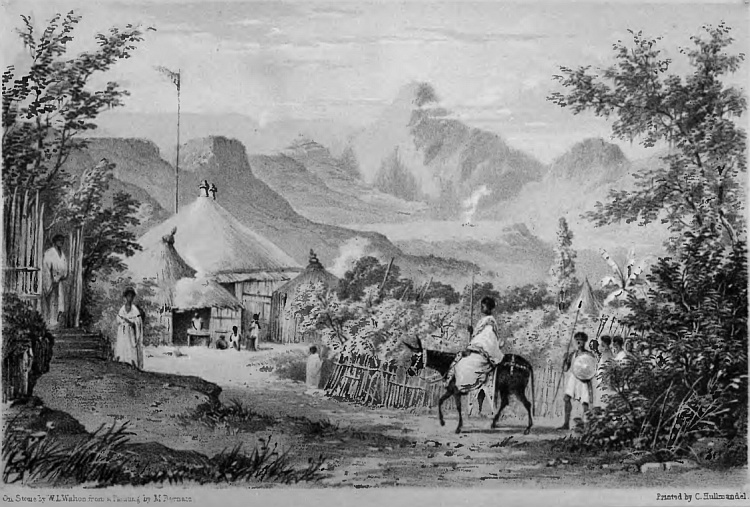
Ere day had dawned, the favourite page was deputed from the king to inquire whether all had slumbered happily. Etiquette demanded that our reply should be in the affirmative, but if an estimate were formed from the drenched and miserable aspect of the tent, the report made to the palace must have been far from favourable. In the absence of the cap, which had been lost upon the road, the fly of the marquee was hastily lashed with cords to the pole, and becoming saturated during the night by the pelting storm, it had presently slidden down, and formed a funnel, which completely put an end to sleep.
Hajji Kásim and Izhák, who, with some of their bigoted Moslem retainers, had repaired to court to witness the reception of “the Christian dogs,” had presented themselves at nightfall, wet, shivering, and famished, to implore food and shelter, which had been denied by the officers of the royal household. Upon the principle of good for evil, we gave them abundance to eat, and each of us contributed a share of his bedding, but the untoward fall of the canvass proved equally disagreeable to Christian and to Mohammadan. Drenched to the skin, the true believers, spite of their covering of lard, were fairly swamped where they lay; and the Ras el Káfilah’s pet Korán having been trampled under foot in the confusion attendant upon repitching, he angrily left the tent in the morning by one door, at the moment that the spoiled page entered by the other, grumbling as he went, “Allah! how could the sacred volume experience any better fate at the hand of infidels?”
Six hundred peasants, who had been pressed on the service of the state from the Mohammadan villages of Argobba, after transporting the king’s baggage from Alio Amba to Machal-wans, had bivouacked without food or shelter upon the bare saturated ground, and were strewed over the greensward like the slain on a battle-field. As the day dawned, their loud cries of “Abiet, abiet,” “Master, master,” arose to the palace-gates from every quarter of the valley; but they lifted up their sad voices in vain; and reiterated entreaties for dismissal passing unheeded, I with great difficulty succeeded in purchasing for them a sufficient number of oxen, which were instantly slaughtered, and eaten raw upon the spot.
The sceptic in Europe who still withholds his credence from Bruce’s account of an Abyssinian brind feast, would have been edified by the sight now presented on the royal meadow. Crowds swarmed around each sturdy victim to the knife, and impetuously rushing in with a simultaneous yell, seized horns, and legs, and tail. A violent struggle to escape followed the assault. Each vigorous bound shook off and scattered a portion of the assailants, but the stronger and more athletic still retained their grasp, and resolutely grappling and wrestling with the prize, finally prevailed. With a loud groan of despair the bull was thrown kicking to the earth. Twenty crooked knives flashed at once from the scabbard—a tide of crimson gore proclaimed the work of death, and the hungry butchers remained seated on the quivering carcass, until the last bubbling jet had welled from the widely-severed throat.
Rapidly from that moment advanced the work of demolition. The hide was opened in fifty places, and collop after collop of warm flesh and muscle—sliced and scooped from the bone—was borne off in triumph. Groups of feasting savages might now be seen seated on the wet grass in every direction, greedily munching and bolting the raw repast. Entrails and offal did not escape. In a quarter of an hour nought remained of the carcass save hoofs and horns, and the disappointed vultures of the air assembling round the scene of slaughter with the village curs, found little indeed to satisfy their hunger.
During this general carousal of the grateful host, the smooth-spoken purveyor-general, who was completely at a loss to comprehend the meaning of the liberality extended, advanced with a sleek and pampered band of parasites. The assistance of the unfeeling functionary had been craved in vain, and he now, after casting a contemptuous glance towards the sated serfs, in honied words inquired with obvious surprise, “whether the party had not rested well, that they thus troubled their heads unnecessarily about the worthless bondsmen of the Negoos?”
No suitable lodging being obtainable at Machalwans, I deemed it advisable to adopt the king’s proposal of proceeding at once into winter quarters at the capital. Preparatory to setting out thither we had an audience of the king. “My children,” quoth His Majesty, “all my gun-people shall accompany you; may you enter in safety! Whatsoever your hearts think and wish, that send word unto me. Saving myself, ye have no relative in this distant land. Ye have travelled far on my affairs. I will give you what I can, according to that which my country produces. I cannot give you what I do not possess. Be not afraid of me. Listen not to the evil insinuations of my people, for they are bad. Look only unto Sáhela Selássie. May his father die, he will accomplish whatsoever ye desire!”
The sun shone brightly through the fleecy white clouds, as our party left the wet encampment in the valley, and under an escort of fusiliers took the way to the capital without that regret which is usually felt on quitting the precincts of royalty. A green, swampy meadow led to the foot of the mountains, over which numberless cascades foamed furiously to the plain. Supported from the base to the utmost summit by artificial terraces, and clothed with the most luxuriant cultivation, there were parts over which it seemed hardly possible that the plough should have passed at so great an angle. But wheat and barley delight in a dry stony soil, and with a fair proportion of the “former and the latter rain,” will here yield abundant return to those who, by their industry, strive to emulate the prosperity of more happily located neighbours.
From Machal-wans to Ankóber the distance does not exceed six miles; but the ascent is great and immediate, and the reduction in temperature perceptible at every step. Springs gushed out clear and sparkling on either side of the rugged path, and beautiful plants luxuriated in the moist atmosphere. The prospect was altogether delightful, and the change more than ever striking from the hot deserts of the Adaïel, which now, at a yet greater depression, stretched away in fading tints to the extreme point of vision.
The latter portion of the road lay through the forest of Aferbeine. Cedar-like junipers, dried up by the blast of centuries, rearing towards the sky their tall skeleton forms, rocked to every breeze. Younger scions of the stock, clothed in a sombre cypress garb, flourished in vigour among the drooping and silvery woira, of which the pensive branches were hoary with ancient moss hanging in fanciful festoons; and saving when the zephyr sighed through the foliage, or a bird whistled from the topmost branch, silence reigned throughout the sylvan scene.
Whether in Europe or in half-civilised Abyssinia, monastic establishments are invariably seated in spots the most romantic. Deep in the recesses of Aferbeine stands the church and monastery dedicated to Tekla Haïmanót, an ecclesiastic of extraordinary abilities, who flourished during the thirteenth century, and rescuing the greater portion of the empire from the yoke of usurpation, restored it to the hands of Yekweno Amlak, the lineal descendant of the ancient Ethiopic dynasty. Subsequently canonised for his successful exertions in the cause both of Church and State, the monk, whose history is obscured with numberless superstitious traditions, is to the present day held in the highest veneration. Thrice during the year a festival is held in celebration of his birth, death, and ascension, and by the entire Christian population he is regarded as the patron saint of Abyssinia.
Instantly on emerging from the forest, the metropolis of Shoa, spreading far and wide over a verdant mountain, shaped like Afric’s appropriate emblem, the fabled sphynx, presented a most singular if not imposing appearance. Clusters of thatched houses of all sizes and shapes, resembling bams and haystacks, with small green enclosures and splinter palings, rising one above the other in very irregular tiers, adapt themselves to all the inequalities of the rugged surface; some being perched high on the abrupt verge of a cliff, and others so involved in the bosom of a deep fissure as scarcely to reveal the red earthen pot which crowns the apex. Connected with each other by narrow lanes and hedgerows, these rude habitations, the residence of from twelve to fifteen thousand inhabitants, cover the entire mountain-side to the extreme pinnacle—a lofty spire-like cone, detaching itself by a narrow isthmus to form the sphynxs head. Hereon stands the palace of the Negoos, a most ungainly-looking edifice with staring gable ends, well fortified by spiral lines of wooden palisades. They extend from the base to the summit, and are interspersed with barred stockades, between which are profusely scattered the abodes of household slaves, with breweries, kitchens, cellars, storehouses, magazines, and granaries.
Over those portions unengrossed by cultivation or by architecture, shrubs and bushes and great beds of nettles assumed the most luxuriant and lively appearance. Huge fallen masses of rock strewed the lower valleys, and others seemed ready to be launched at a moment’s notice upon the clustering habitations; whilst in the distance, the bronze cross of the church of “our Lady,” peeping above the dark foliage of the juniper, touched the chord of feelings but little in unison with the wild escort that surrounded us, above whose streaming locks floated bloody emblems, that breathed aught save conformity to the mild tenets of the Christian religion.
Ankóber, literally translated, signifies the gate of Anko. She was queen over the Galla tribe, by which this mountain was peopled from the invasion of Graan until its reconquest by the crown of Shoa, and has bequeathed her name to the narrow winding path which forms the “her” or gate to the suburbs. Skirting the brink of a yawning abyss, and scarcely wide enough for the foot of a mule, it is not traversed without a feeling of insecurity, and the labour of a few hours would suffice to render all approach to the capital impracticable, unless to the mountain goat. Loud cheers from the whole assembled population, female as well as male, greeted our arrival, for the thunder of our guns in the adjacent valley had given birth to a feeling of respect in the breast of all; nor was it without considerable difficulty that we made our way through the dense crowd that whitened the entire hill-side, and lined every valley. At length we reached a newly erected building fronting the palace, which had been set apart by His Majesty for our occupation, and which was now completely thronged by porters, and beleaguered by clamourous spectators.
Wistful looks were exchanged as we entered this barn-like and dreary abode, which for months, if not for years, was to form our asylum. A decent new thatch, and a neat basket-work ceiling, did indeed form a roof to the structure, but further, the crude and unfinished shell whereon they rested, could hardly claim the denomination of “a house.”
It rather resembled a den in Exeter ’change, or an aviary upon a magnified scale; and the open hide-lashed ribs, being innocent throughout of dab or plaster to choke the interstices, wind, rain, and mountain fog considered themselves to be equally His Majesty’s guests, and entitled to the occupation of the uninviting interior. Oblong in form, windowless, chimneyless, and provided at either end with a lofty but narrow door, rudely fashioned of massive planks and beams, each of which, in the absence of a saw, had involved the demolition of an entire tree, the edifice yet afforded an unusually favourable specimen of Shoan architecture; and to account for its desolate and unfinished condition, it may be proper to add, that the proprietor, who had been honoured with the fair hand of a princess of the blood royal, having a few weeks previously been so unfortunate as to incur the displeasure of his despotic father-in-law, now occupied apartments in the state prison, whilst the management of his estate was, ad interim, considerately undertaken by the crown, without even the preliminary of a fieri facias.
Inner walls divided the centre room from two narrow verandahs, intended for the reception of mules, horses, and household lumber. The floor was precisely as nature made it, depressed rather than raised, and little improved by the many recent inundations to which it had been subjected. Torrents of muddy water filled the trench which environed the entire structure, and occasionally bursting the banks of the dyke, oozed copiously between the palisades, to cover the soil with artificial lakes; whilst the small open area beyond, into which it disembogued—hemmed in on all sides by rank vegetation, stinging nettles, and half-ruined but noisily inhabited hovels—was, without any exaggeration, eighteen inches deep in honest mire.
Although our pilgrimage had at last terminated, the prospect, both within and without, was still far from encouraging. The mercury in Fahrenheit’s thermometer stood at 58 degrees, and it became necessary to adopt immediate measures towards the exclusion of the cold driving mist and the whistling wind, which the absence of a fire rendered far from agreeable. The union flag of old England, stretched across the hall, lent the aid of its ample folds to enliven the interior. Tent walls and tarpaulins composed tolerably comfortable cabins in the verandah closets. Gun-cases, placed on end, and connected by the lid of a chest, formed a temporary table, and with a puncheon as a washing-stand, and two swinging shelves overhead, completed the furniture of each apartment. Boxes and bales, as they continued to arrive, were piled around the inner walls, and soon reaching to the ceiling, the appearance of a booth at a country fair, on a rainy day, ere the wares have been exposed for sale, was gradually imparted to this highly unique residency in the capital of Shoa.
Volume Two—Chapter Two.
Residence in Ankóber.
But darkness now reigned within our cheerless abode. Candles that will burn for more than ten minutes together, or afford light sufficient either to read or write, are luxuries which have no existence in so primitive and benighted a land; and strips of old cotton rag dipped in unpurified bees’ wax, forming, like most other good things in the empire, a royal monopoly, are doled out by the purveyor-general to the favoured few with but a niggard hand; whilst the absence of glass or other transparent substance, and the continued presence of rain, sleet, clouds, and fog thicker than the steam of a wash-house, rendered it for some time difficult to admit the scanty light of heaven during its fitful visits through the overcast atmosphere.
Wood, too, belongs exclusively to the despot, and is far from being abundant in the timberless realm; but packing cases, as they became empty, were furnished with a sheet of oiled parchment, and these admirable substitutes for glazed sashes, were, in defiance of exhortations not to deface the king’s walls, inserted therein from time to time. A chafing dish, raised upon a high mud pedestal, at length cheered the long dreary evenings, although the wet sodden fuel yielded a very feeble blaze, whilst its dense smoke, choking the chimneyless room, covered walls and roof with soot. Last, but not least among our improvements, were tallow dips, which we manufactured of the fat tail of the Ethiopian sheep, and these afforded us sufficient light by which to retire to bed, where fleas, revived by the unwonted warmth of English blankets, denied all rest.
The low moaning of the storm behind Mamrat, and the distant growl of the thunder, usually ushered in the night. There was a sound as of the surf breaking over a rocky shore, and before many minutes the hurricane was at its height. Crashing reverberations of thunder rattled among the serrated cliffs, whilst the gates of heaven poured forth a deluge, which rendered every lane and footpath throughout the town, ankle deep in running water.
Often after one of those falls of rain so common in tropical countries, the face of the lowlands for fifty miles would be concealed under an impenetrable fog. The spectator rode upon a sea of billowy clouds which rolled beneath his foot, lashing with their spray the dark islands formed by the peaks of the higher mountains: and beyond, in the hot Adel plain might be seen the Háwash winding through the distance, until melted into the limits of the horizon. As the great bank ascended, all around became wet and clammy to the touch; and the mist, although sluggish and slow to move, was of a nature so keenly searching, that in defiance of all muffling, it seemed to penetrate to our very bones.
Together with those privations which are common to a residence among all savage nations, there are many which Abyssinia claims exclusively as her own; nor, if viewed only as a place of abode, does the country possess aught save the salubrity of the climate to counterbalance its manifold discomforts and disadvantages. Although in the midst of abundance, we experienced the utmost difficulty in obtaining the most common necessaries of existence—bread, meat, and water; and notwithstanding that a sufficiency of wheat to sustain life for an entire year may be purchased for one German crown, yet where the stranger is concerned, the grain, without the assistance of the monarch, can scarcely be converted into the staff of life—the process entailing all the petty worry and annoyance which in other lands are solely undertaken and performed by menials.
In a kingdom where the inhabitants are solely dependent upon the exertions of slaves, the difficulties are increased ten-fold to those who are obliged to employ hired domestics. The markets are at a great distance from the capital, and held at long intervals; nor are they ever so well supplied as to admit of the requisite weekly stock being purchased at any individual place. Hence much trouble and inconvenience arose from the necessity of dispatching messengers simultaneously to the various remote bazaars; and very great difficulty was experienced in preserving even the small number of live stock required for consumption in a country where all the surrounding meadows pertain alike to the crown, and where labour is so difficult to be procured.
Whilst porters are not to be obtained unless through a direct mandate from the king, the unwillingness of mule-owners to hire their cattle at the existing low rate, the displeasure and heartburning of the authorities if a larger bribe were offered, the badness of the roads, and the steepness of the hills, all combine to render it a perplexing matter to dispense with this species of service. On the other hand, the greatest difficulty is experienced in providing for a permanent establishment of baggage-horses with their attendants, owing to the existing necessity of distributing them in small lots among the limited private grazing grounds in the vicinity, whence, when wanted, they are not to be obtained without infinite difficulty.
Every arrangement, however minute in detail, or trivial in importance, here demands a sacrifice of time and temper in a tedious and lengthy conference, which, in accordance with the custom of the country, must be carried on by the principal persons engaged in the transaction. No article is readily to be purchased, nor can any thing, how trifling soever, be accorded without the royal mandate, and when that is at last obtained, the applicant would appear to be further than ever removed from the realisation of his object. “It is done,” is the mode of signifying that a request is granted, and the despot believes that to will is to accomplish; but whilst his commands are usually obeyed more to the letter than in the spirit in which they have been given, his public officers embrace every opportunity of consulting the interests of the privy purse, to the stranger’s disadvantage.
In utter abhorrence of the country and its inhabitants, the Moslem servants who accompanied the Embassy from India all took their departure, willing rather to brave the dangers and difficulties of a long journey through the inhospitable deserts of the Adaïel, than to prolong a hateful sojourn in Abyssinia. One half of the number were murdered on the way down, and the places of all long remained empty. In any part of the world it would be difficult to find domestics inferior to their Christian successors. The consumption of brundo, or raw beef, and the sleeping off a surfeit which, in its progress towards stupor, exhilarated them to positive intoxication, formed the sum total of their services; yet every idle noisy vagabond who was in the receipt of four pieces of salt per mensem, with the promise of a new cloth annually, value three shillings and nine-pence sterling, held himself entitled to a permanent place before the drawingroom fire.
All stipulated for one day out of the thirty on which to drink cosso, and during the other twenty-nine, few ever stirred without grumbling. Honesty is not prominent among the Abyssinian virtues, and the lack of it sometimes redounded to the discredit of the master. A youth who was entrusted with a dollar to purchase sheep in the adjacent market, ingeniously contrived to smuggle into the flock, two for which he had not paid, being convinced that such an economical arrangement must prove highly agreeable to his employers, and thus lead to his own advancement. A hue and cry was raised on the discovery of the theft, and it required some time to persuade the magisterial authorities that the goat-herd had not been defrauded with the cognisance of the bála-beit. (Master of the house.)
An áfero, or janissary, had been specially appointed as a spy over the actions of the foreigners, and he rendered himself sufficiently obnoxious. Not satisfied with prying into the contents of boxes for the information of the purveyor-general, his immediate superior, he reported to the throne every the most minute circumstance that occurred; and besides originating several ingenious falsehoods, was so indefatigable in proclaiming us to be heretics, that he was shortly turned out of the house in disgrace, with an order never to show his face again.
Ethiopia derived her faith from the fountain of Alexandria; but how is her Christianity disfigured by folly and superstition! The intolerance of the bigoted clergy, who rule with the iron hand of religious ascendancy, soon proclaimed the British worse than Pagans, for the non-observance of absurd fasts, and blasphemous doctrines; and the inhabitants, priest-ridden to a degree, received their cue of behaviour principally from their most despotic tyrant, the Church. Unquies, the Comus or Bishop of Shoa, was the most open and undisguised in his hostilities. Beset by evil thoughts at an early age, he imitated the example set by the celebrated Origenes; and so much is he respected by the monarch for his austerities and religious devotion, that His Majesty invariably speaks of him as “the strong monk.” To him was traced a report that the Embassy were to be summarily expelled the country, in consequence of the non-observance of the fasts prescribed by the Ethiopic creed, and because a Great Lady, whose spies they were, was on her way from the sea-coast, with a large military force, to overturn the true religion, put the king to death, and assume possession of all Abyssinia.
On the festival of the Holy Virgin, the cemetery was thrown open, wherein rest the remains of Asfa Woosen, grandsire to Sáhela Selássie. It is a building adjoining the church of Saint Mary; and being anxious to visit the mausoleum, I sent a message to the Lord Bishop, requesting permission to do so. An insolent reply was returned, that since the English were in the habit of drinking coffee and smoking tobacco, both of which Mohammadan abominations are interdicted in Shoa upon religious grounds, we could not be admitted within the precincts of the hallowed edifice, as it would be polluted by the foot of a Gyptzi.
Nevertheless, we were permitted to attend Divine service in the less inimical of the five churches of the capital, and offerings were made according to the custom of the country. The cathedral of Saint Michael, distinguished above all its compeers by a sort of Chinese lantern on the apex, being invariably attended by the monarch, came first in order; and after wading through the miry kennels that form the avenues of access, our slippers were put off in accordance with Jewish prejudice, and giving them in charge of a servant to prevent their being stolen, we stepped over the threshold. The scowling eye of the bigoted and ignorant priest sparkled with a gleam of unrepressed satisfaction at the sight of a rich altar-cloth, glowing with silk and gold, which was now unfolded to his gaze; and a smile of delight played around the corners of his mouth, as the hard dollars rung in his avaricious palm.
A strange, though degrading and humiliating sight, rewarded the admittance we had thus gained to the circular interior of the sacred building. Coarse walls, only partially white-washed, rose in sombre earth but a few feet overhead, and the suspended ostrich-egg—emblem of heathenish idolatry—almost touched our heads as we were ushered in succession to the seat of honour among the erudite. In a broad verandah, strewed throughout with dirty wet rushes, were crowded the blind, the halt, and the lame—an unwashed herd of sacred drones, muffled in the skin of the agázin; but beyond this group of turbaned monks and hireling beggars there was no congregation present.
The high-priest having proclaimed the munificence of the strangers, pronounced his solemn benediction. Then arose a burst of praise the most agonising and unearthly that ever resounded from dome dedicated to Christian worship. No deep mellow chant from the chorister—no soul-inspiring anthem, lifted the heart towards heaven. The Abyssinian cathedral rang alone to the excruciating jar of most unmitigated discord; and amid howling and screaming, each sightless orb was rolled in the socket, and every mutilated limb convulsed with disgusting vehemence. A certain revenue is attached to the performance of the duty; and for one poor measure of black barley bread, the hired lungs were taxed to extremity; but not the slightest attempt could be detected at music or modulation; and the dissonant chink of the timbrel was ably seconded by the cracked voice of the mercenary vocalist.
No liturgy followed the cessation of these hideous screams. The service was at an end, and the Alaka, beckoning us to follow, led the way round the edifice. The walls were adorned with a few shields, and with miserable daubs representing the Madonna, the Holy Trinity in caelo, the Father of Evil enveloped in flames, Saint Peter and Saint Paul, Saint George and his green dragon, Saint Demetrius vanquishing the lion, Saint Tekla Haïmanót, Saint Balaam and his ass, the Patron Saint, and every other saint in the Abyssinian calendar. But they boasted of no sculptured monument raised to departed worth or genius—no proud banner or trophy of heroic deeds—and no marble tablet to mark the quiet rest of the soldier, the statesman, or the scholar. In the holy of holies, which may be penetrated by none save the high-priest, is deposited the sacred tabot, or ark of the faith, consecrated at Gondar by the delegate of the Coptic patriarch; and around the veil that fell before this mysterious emblem, there hung in triumph four sporting pictures, from the pencil of Alken, which I had lately presented to His Majesty. They represented the great Leicestershire steeple-chase; and Dick Christian, with his head in a ditch, occupied by far the most prominent niche in the boasted cathedral of Saint Michael!