II. THE SOLAR SYSTEM. (continued 3)
Reading edition
174. Nature of the Grains.—The grains are, undoubtedly, incandescent clouds floating in the sun's atmosphere, and composed of partially condensed metallic vapors, just as the clouds of our atmosphere are composed of partially condensed aqueous vapor. Rain on the sun is composed of white-hot drops of molten iron and other metals; and these drops are often driven with the wind with a velocity of over a hundred miles a second.
As to the forms of the grains, Professor Young says, "If one were to speculate as to the explanation of the grains and thatch-straws, it might be that the grains are the upper ends of long filaments of luminous cloud, which, over most of the sun's surface, stand approximately vertical, but in the neighborhood of a spot are inclined so as to lie nearly horizontal. This is not certain, though: it may be that the cloud-masses over the more quiet portions of the solar surface are really, as they seem, nearly globular, while near the spots they are drawn out into filamentary forms by atmospheric currents."
175. Faculæ.—The faculæ are irregular streaks of greater brightness than the general surface, looking much like the flecks of foam on the surface of a stream below a waterfall. They are sometimes from five to twenty thousand miles in length, covering areas immensely larger than a terrestrial continent.
These faculæ are elevated regions of the solar surface, ridges and crests of luminous matter, which rise above the general level of the sun's surface, and protrude through the denser portions of the solar atmosphere. When one of these passes over the edge of the sun's disk, it can be seen to project, like a little tooth. Any elevation on the sun to be perceptible at all must measure at least half a second of an arc, or two hundred and twenty-five miles.
The faculæ are most numerous in the neighborhood of the spots, and much more conspicuous near the limb of the sun than near the centre of the disk. Fig. 192 gives the general appearance of the faculæ, and the darkening of the limb of the sun. Near the spots, the faculæ often undergo very rapid change of form, while elsewhere on the disk they change rather slowly, sometimes undergoing little apparent alteration for several days.
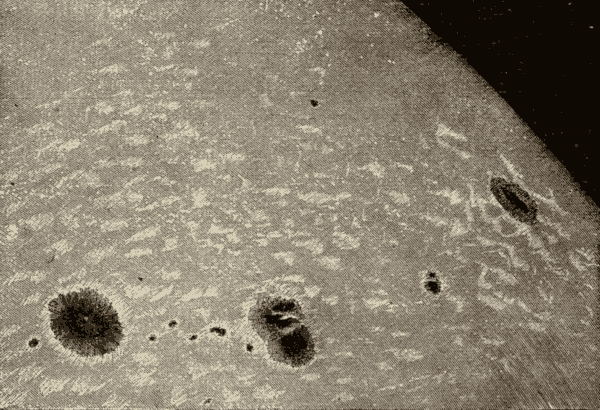
Fig. 192.
176. Why the Faculæ are most Conspicuous near the Limb of the Sun.—The reason why the faculæ are most conspicuous near the limb of the sun is this: The luminous surface of the sun is covered with an atmosphere, which, though not very thick compared with the diameter of the sun, is still sufficient to absorb a good deal of light. Light coming from the centre of the sun's disk penetrates this atmosphere under the most favorable conditions, and is but slightly reduced in amount. The edges of the disk, on the other hand, are seen through a much greater thickness of atmosphere; and the light is reduced by absorption some seventy-five per cent. Suppose, now, a facula were sufficiently elevated to penetrate quite through this atmosphere. Its light would be undimmed by absorption on any part of the sun's disk; but at the centre of the disk it would be seen against a background nearly as bright as itself, while at the margin it would be seen against one only a quarter as bright. It is evident that the light of any facula, owing to the elevation, would be reduced less rapidly as we approach the edge of the disk than that of the general surface of the sun, which lies at a lower level.
Sun-Spots.
177. General Appearance of Sun-Spots.—The general appearance of a well-formed sun-spot is shown in Fig. 193. The spot consists of a very dark central portion of irregular shape, called the umbra, which is surrounded by a less dark fringe, called the penumbra. The penumbra is made up, for the most part, of filaments directed radially inward.
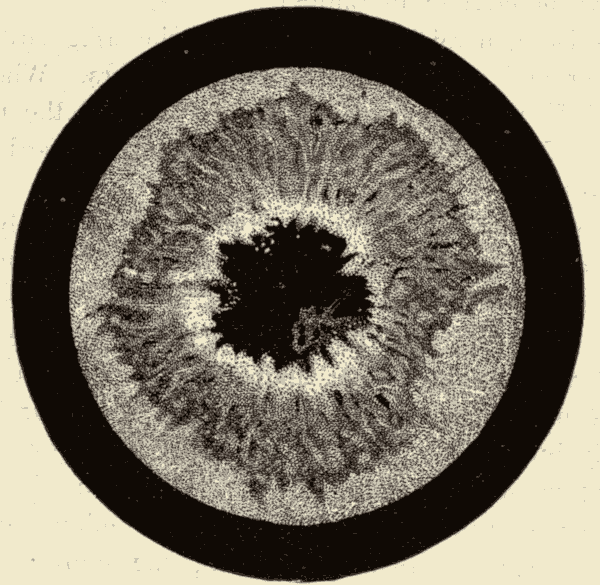
Fig. 193.
There is great variety in the details of form in different sun-spots; but they are generally nearly circular during the middle period of their existence. During the period of their development and of their disappearance they are much more irregular in form.
There is nothing like a gradual shading-off of the penumbra, either towards the umbra on the one side, or towards the photosphere on the other. The penumbra is separated from both the umbra and the photosphere by a sharp line of demarcation. The umbra is much brighter on the inner than on the outer edge, and frequently the photosphere is excessively bright at the margin of the penumbra. The brightness of the inner penumbra seems to be due to the crowding together of the penumbral filaments where they overhang the edge of the umbra.
There is a general antithesis between the irregularities of the outer and inner edges of the penumbra. Where an angle of the penumbral matter crowds in upon the umbra, it is generally matched by a corresponding outward extension into the photosphere, and vice versa.
The umbra of the spot is far from being uniformly dark. Many of the penumbral filaments terminate in little detached grains of luminous matter; and there are also fainter veils of a substance less brilliant, but sometimes rose-colored, which seem to float above the umbra. The umbra itself is made up of masses of clouds which are really intensely brilliant, and which appear dark only by contrast with the intenser brightness of the solar surface. Among these clouds are often seen one or more minute circular spots much darker than the rest of the umbra. These darker portions are called nuclei. They seem to be the mouths of tubular orifices penetrating to unknown depths. The faint veils mentioned above continually melt away, and are replaced by others in some different position. The bright granules at the tips of the penumbral filaments seem to sink and dissolve, while fresh portions break off to replace them. There is a continual indraught of luminous matter over the whole extent of the penumbra.
At times, though very rarely, patches of intense brightness suddenly break out, remain visible for a few minutes, and move over the spot with velocities as great as a hundred miles a second.
The spots change their form and size quite perceptibly from day to day, and sometimes even from hour to hour.
178. Duration of Sun-Spots.—The average life of a sun-spot is two or three months: the longest on record is that of a spot observed in 1840 and 1841, which lasted eighteen months. There are cases, however, where the disappearance of a spot is very soon followed by the appearance of another at the same point; and sometimes this alternate disappearance and re-appearance is several times repeated. While some spots are thus long-lived, others endure only a day or two, and sometimes only a few hours.
179. Groups of Spots.—The spots usually appear not singly, but in groups. A large spot is often followed by a train of smaller ones to the east of it, many of which are apt to be irregular in form and very imperfect in structure, sometimes with no umbra at all, often with a penumbra only on one side. In such cases, when any considerable change of form or structure shows itself in the principal spot, it seems to rush westward over the solar surface, leaving its attendants trailing behind. When a large spot divides into two or more, as often happens, the parts usually seem to repel each other, and fly apart with great velocity.
180. Size of the Spots.—The spots are sometimes of enormous size. Groups have often been observed covering areas of more than a hundred thousand miles square, and single spots occasionally measure from forty to fifty thousand miles in diameter, the umbra being twenty-five or thirty thousand miles across. A spot, however, measuring thirty thousand miles over all, may be considered a large one. Such a spot can easily be seen without a telescope when the brightness of the sun's surface is reduced by clouds or nearness to the horizon, or by the use of colored glass. During the years 1871 and 1872 spots were visible to the naked eye for a considerable portion of the time. The largest spot yet recorded was observed in 1858. It had a breadth of more than a hundred and forty-three thousand miles, or nearly eighteen times the diameter of the earth, and covered about a thirty-sixth of the whole surface of the sun.
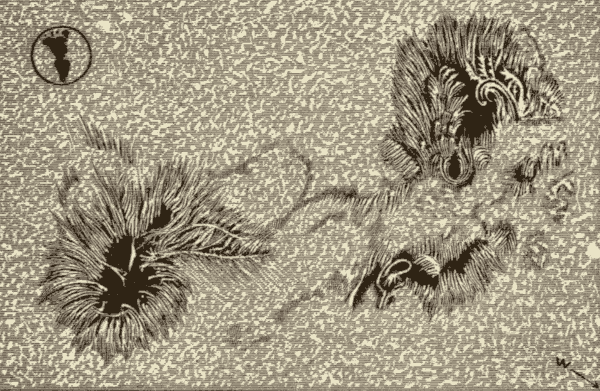
Fig. 194.
Fig. 194 represents a group of sun-spots observed by Professor Langley, and drawn on the same scale as the small circle in the upper left-hand corner, which represents the surface of half of our globe.
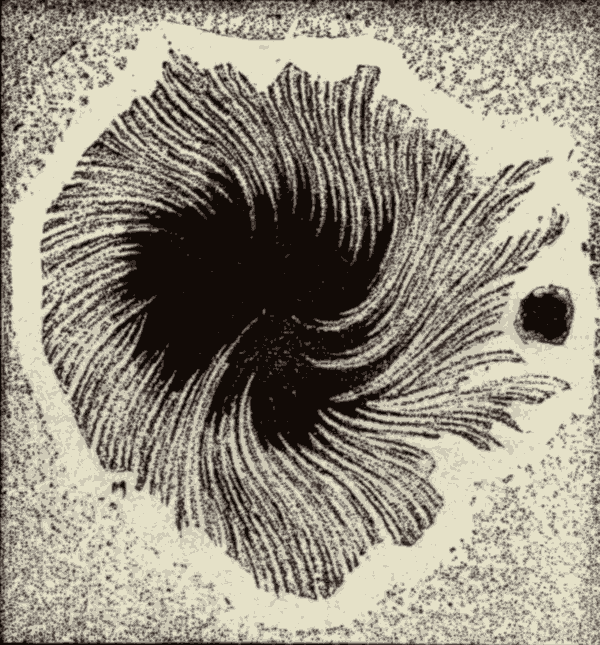
Fig. 195.
181. The Penumbral Filaments.—Not unfrequently the penumbral filaments are curved spirally, indicating a cyclonic action, as shown in Fig. 195. In such cases the whole spot usually turns slowly around, sometimes completing an entire revolution in a few days. More frequently, however, the spiral motion lasts but a short time; and occasionally, after continuing for a while in one direction, the motion is reversed. Very often in large spots we observe opposite spiral movements in different portions of the umbra, as shown in Figs. 196 and 197.
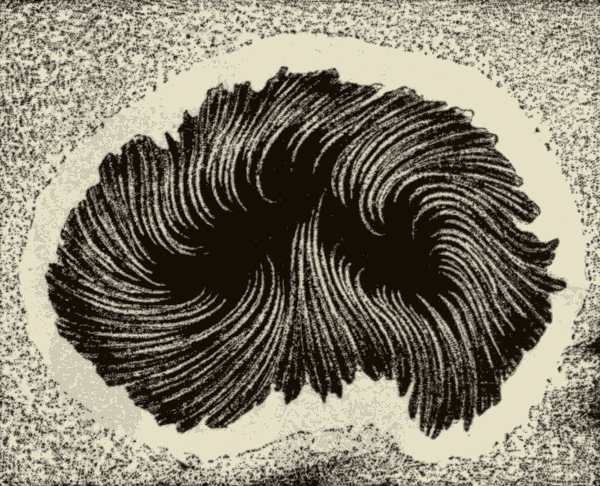
Fig. 196.
Neighboring spots show no tendency to rotate in the same direction. The number of spots in which a decided cyclonic motion (like that shown in Fig. 198) appears is comparatively small, not exceeding two or three per cent of the whole.
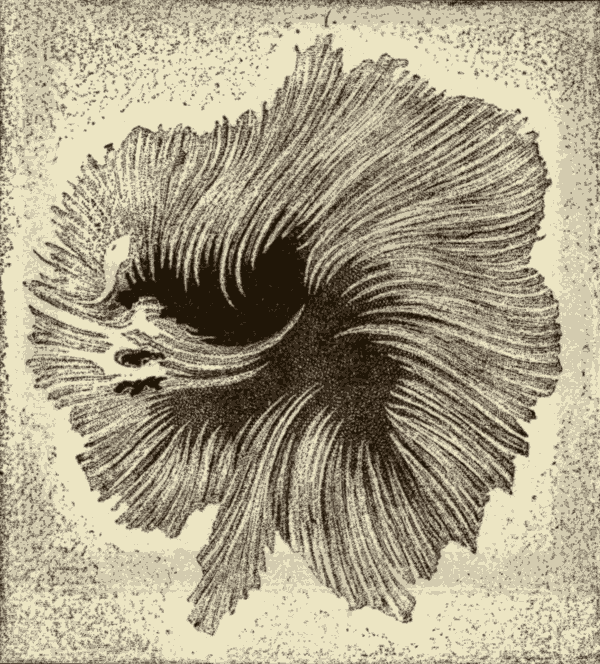
Fig. 197.
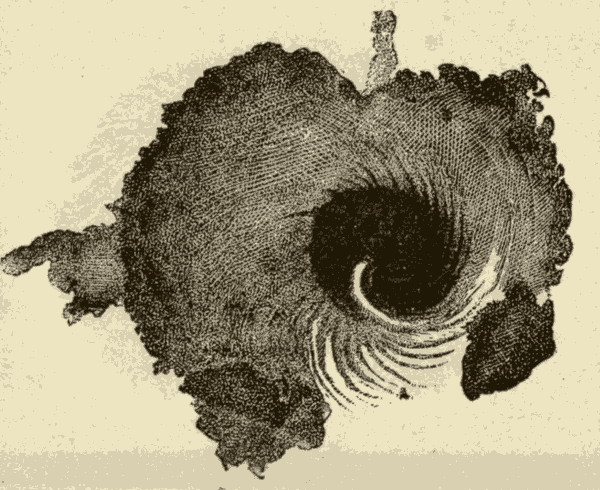
Fig. 198.
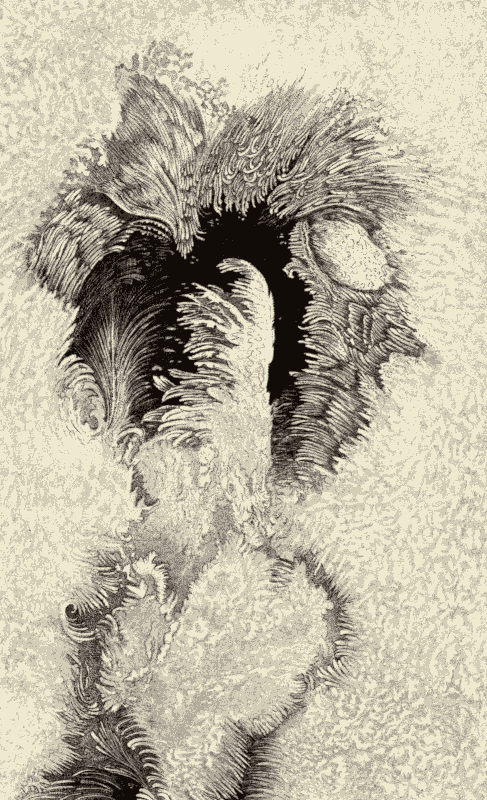
Plate 2.
Plate II. represents a typical sun-spot as delineated by Professor Langley. At the left-hand and upper portions of this great spot the filaments present the ordinary appearance, while at the lower edge, and upon the great overhanging branch, they are arranged very differently. The feathery brush below the branch, closely resembling a frost-crystal on a window-pane, is as rare as it is curious, and has not been satisfactorily explained.
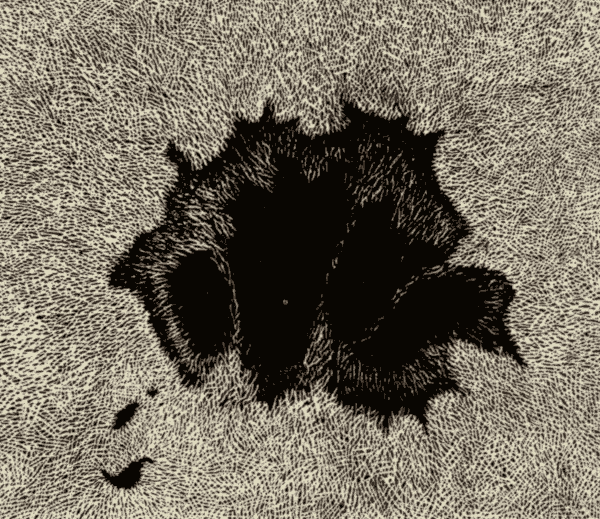
Fig. 199.
182. Birth and Decay of Sun-Spots.—The formation of a spot is sometimes gradual, requiring days or even weeks for its full development; and sometimes a single day suffices. Generally, for some time before its appearance, there is an evident disturbance of the solar surface, indicated especially by the presence of many brilliant faculæ, among which pores, or minute black dots, are scattered. These enlarge, and between them appear grayish patches, in which the photospheric structure is unusually evident, as if they were caused by a dark mass lying below a thin veil of luminous filaments. This veil seems to grow gradually thinner, and finally breaks open, giving us at last the complete spot with its penumbra. Some of the pores coalesce with the principal spot, some disappear, and others form the attendant train before described (179). The spot when once formed usually assumes a circular form, and remains without striking change until it disappears. As its end approaches, the surrounding photosphere seems to crowd in, and overwhelm the penumbra. Bridges of light (Fig. 199), often much brighter than the average of the solar surface, push across the umbra; the arrangement of the penumbra filaments becomes confused; and, as Secchi expresses it, the luminous matter of the photosphere seems to tumble pell-mell into the chasm, which disappears, and leaves a disturbed surface marked with faculæ, which, in their turn, gradually subside.
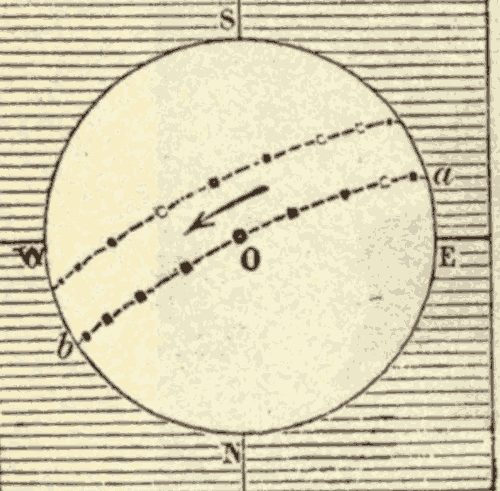
Fig. 200.
183. Motion of Sun-Spots.—The spots have a regular motion across the disk of the sun from east to west, occupying about twelve days in the transit. A spot generally appears first on or near the east limb, and, after twelve or fourteen days, disappears at the west limb. At the end of another fourteen days, or more, it re-appears at the east limb, unless, in the mean time, it has vanished from sight entirely. This motion of the spots is indicated by the arrow in Fig. 200. The interval between two successive appearances of the same spot on the eastern edge of the sun is about twenty-seven days.
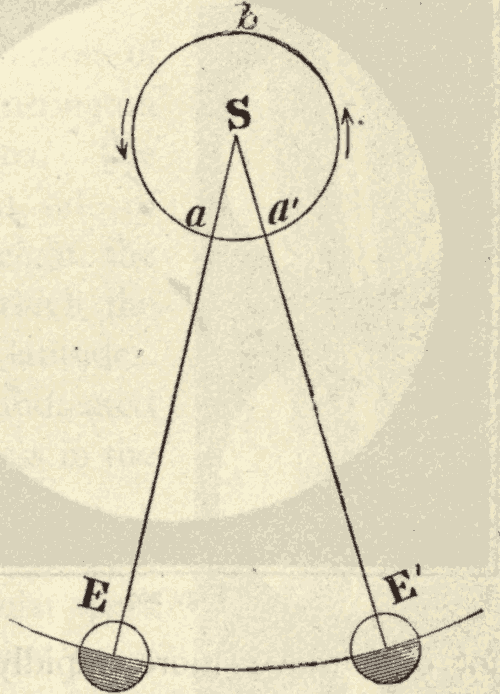
Fig. 201.
184. The Rotation of the Sun.—The spots are evidently carried around by the rotation of the sun on its axis. It is evident, from Fig. 201, that the sun will need to make more than a complete rotation in order to bring a spot again upon the same part of the disk as seen from the earth. S represents the sun, and E the earth. The arrows indicate the direction of the sun's rotation. When the earth is at E, a spot at a would be seen at the centre of the solar disk. While the sun is turning on its axis, the earth moves in its orbit from E to E': hence the sun must make a complete rotation, and turn from a to a' in addition, in order to bring the spot again to the centre of the disk. To carry the spot entirely around, and then on to a', requires about twenty-seven days. From this synodical period of the spot, as it might be called, it has been calculated that the sun must rotate on its axis in about twenty-five days.
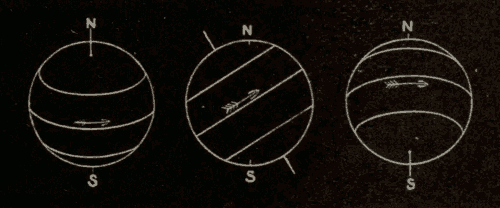
Fig. 202.
185. The Inclination of the Sun's Axis.—The paths described by sun-spots across the solar disk vary with the position of the earth in its orbit, as shown in Fig. 202. We therefore conclude that the sun's axis is not perpendicular to the plane of the earth's orbit. The sun rotates on its axis from west to east, and the axis leans about seven degrees from the perpendicular to the earth's orbit.
186. The Proper Motion of the Spots.—When the period of the sun's rotation is deduced from the motion of spots in different solar latitudes, there is found to be considerable variation in the results obtained. Thus spots near the equator indicate that the sun rotates in about twenty-five days; while those in latitude 20° indicate a period about eighteen hours longer; and those in latitude 30° a period of twenty-seven days and a half. Strictly speaking, the sun, as a whole, has no single period of rotation; but different portions of its surface perform their revolutions in different times. The equatorial regions not only move more rapidly in miles per hour than the rest of the solar surface, but they complete the entire rotation in shorter time.
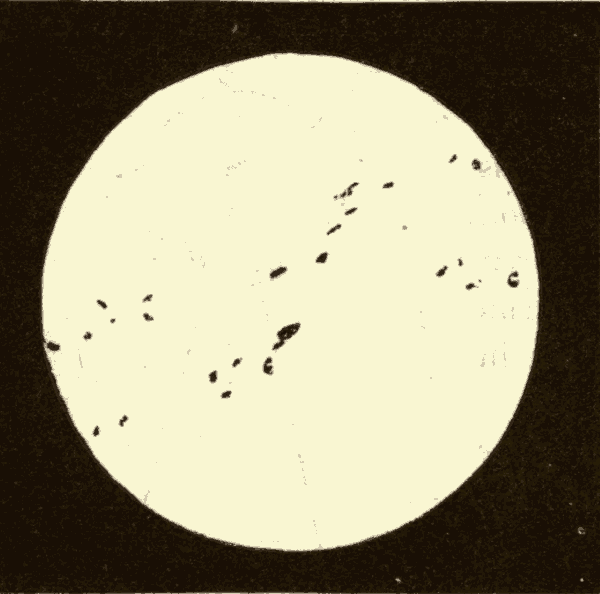
Fig. 203.
There appears to be a peculiar surface-drift in the equatorial regions of the sun, the cause of which is unknown, but which gives the spots a proper motion; that is, a motion of their own, independent of the rotation of the sun.
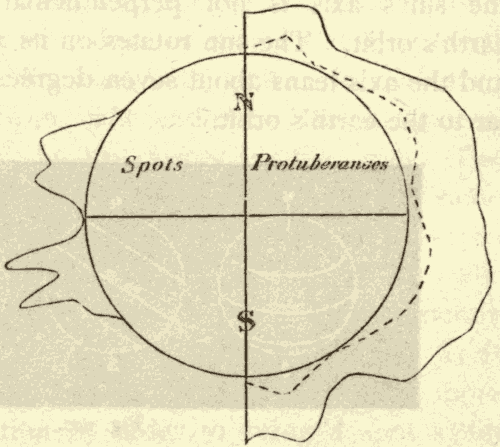
Fig. 204.
187. Distribution of the Sun-Spots.—The sun-spots are not distributed uniformly over the sun's surface, but occur mainly in two zones on each side of the equator, and between the latitudes of 10° and 30°, as shown in Fig. 203. On and near the equator itself they are comparatively rare. There are still fewer beyond 35° of latitude, and only a single spot has ever been recorded more than 45° from the solar equator.
Fig. 204 shows the distribution of the sun-spots observed by Carrington during a period of eight years. The irregular line on the left-hand side of the figure indicates by its height the comparative frequency with which the spots occurred in different latitudes. In Fig. 205 the same thing is indicated by different degrees of darkness in the shading of the belts.
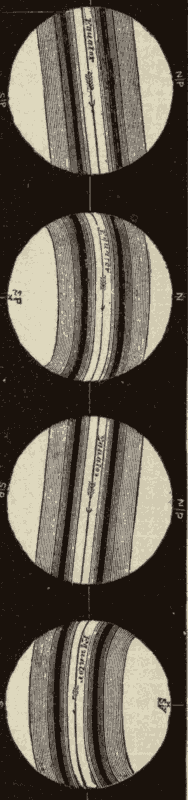
Fig. 205.
188. The Periodicity of the Spots.—Careful observations of the solar spots indicate a period of about eleven years in the spot-producing activity of the sun. During two or three years the spots increase in number and in size; then they begin to diminish, and reach a minimum five or six years after the maximum. Another period of about six years brings the return of the maximum. The intervals are, however, somewhat irregular.
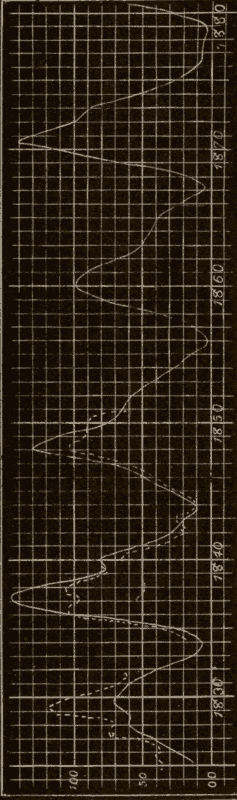
Fig. 206.
Fig. 206 gives a graphic representation of the periodicity of the sun-spots. The height of the curve shows the frequency of the sun-spots in the years given at the bottom of the figure. It appears, from an examination of this sun-spot curve, that the average interval from a minimum to the next following maximum is only about four years and a half, while that from a maximum to the next following minimum is six years and six-tenths. The disturbance which produces the sun-spots is developed suddenly, but dies away gradually.
189. Connection between Sun-Spots and Terrestrial Magnetism.—The magnetic needle does not point steadily in the same direction, but is subject to various disturbances, some of which are regular, and others irregular.
(1) One of the most noticeable of the regular magnetic changes is the so-called diurnal oscillation. During the early part of the day the north pole of the needle moves toward the west in our latitude, returning to its mean position about ten P.M., and remaining nearly stationary during the night. The extent of this oscillation in the United States is about fifteen minutes of arc in summer, and not quite half as much in winter; but it differs very much in different localities and at different times, and the average diurnal oscillation in any locality increases and decreases pretty regularly during a period of about eleven years. The maximum and minimum of this period of magnetic disturbance are found to coincide with the maximum and minimum of the sun-spot period. This is shown in Fig. 206, in which the dotted lines indicate the variations in the intensity of the magnetic disturbance.
(2) Occasionally so-called magnetic storms occur, during which the compass-needle is sometimes violently disturbed, oscillating five degrees, or even ten degrees, within an hour or two. These storms are generally accompanied by an aurora, and an aurora is always accompanied by magnetic disturbance. A careful comparison of aurora observations with those of sun-spots shows an almost perfect parallelism between the curves of auroral and sun-spot frequency.
(3) A number of observations render it very probable that every intense disturbance of the solar surface is propagated to our terrestrial magnetism with the speed of light.
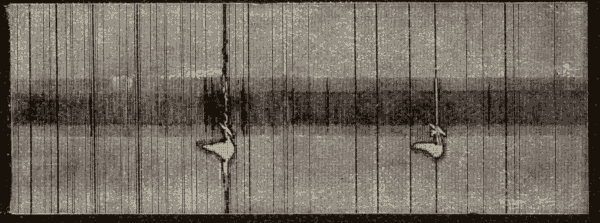
Fig. 207.
Fig. 207 shows certain of the solar lines as they were observed by Professor Young on Aug. 3, 1872. The contortions of the F line indicated an intense disturbance in the atmosphere of the sun. There were three especially notable paroxysms in this distortion, occurring at a quarter of nine, half-past ten, and ten minutes of twelve, A.M.
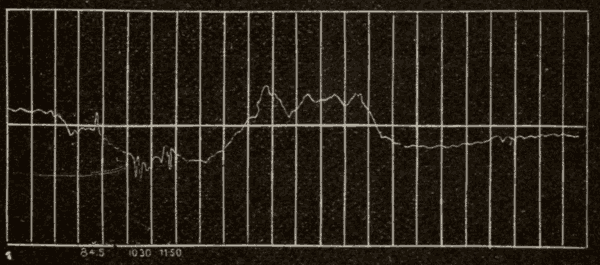
Fig. 208.
Fig. 208 shows the curve of magnetic disturbance as traced at Greenwich on the same day. It will be seen from the curve that it was a day of general magnetic disturbance. At the times of the three paroxysms, which are given at the bottom of the figure, it will be observed that there is a peculiar shivering of the magnetic curve.
190. The Spots are Depressions in the Photosphere.—This fact was first clearly brought out by Dr. Wilson of Glasgow, in 1769, from observations upon the penumbra of a spot in November of that year. He found, that when the spot appeared at the eastern limb, or edge of the sun, just moving into sight, the penumbra was well marked on the side of the spot nearest to the edge of the disk; while on the other edge of the spot, towards the centre of the sun, there was no penumbra visible at all, and the umbra itself was almost hidden, as if behind a bank. When the spot had moved a day's journey toward the centre of the disk, the whole of the umbra came into sight, and the penumbra on the inner edge of the spot began to be visible as a narrow line. After the spot was well advanced upon the disk, the penumbra was of the same width all around the spot. When the spot approached the sun's western limb, the same phenomena were repeated, but in the inverse order. The penumbra on the inner edge of the spot narrowed much faster than that on the outer, disappeared entirely, and finally seemed to hide from sight much of the umbra nearly a whole day before the spot passed from view around the limb. This is precisely what would occur (as Fig. 209 clearly shows) if the spot were a saucer-shaped depression in the solar surface, the bottom of the saucer corresponding to the umbra, and the sloping sides to the penumbra.
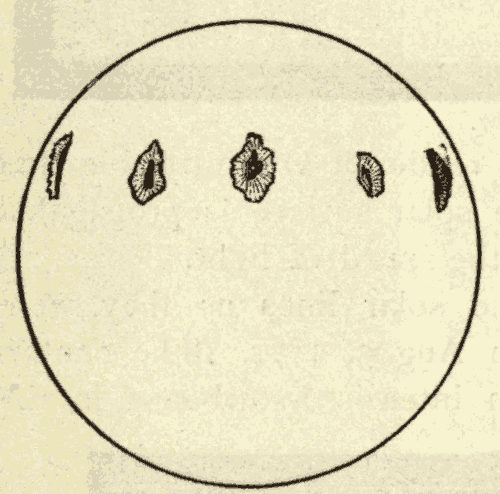
Fig. 209.
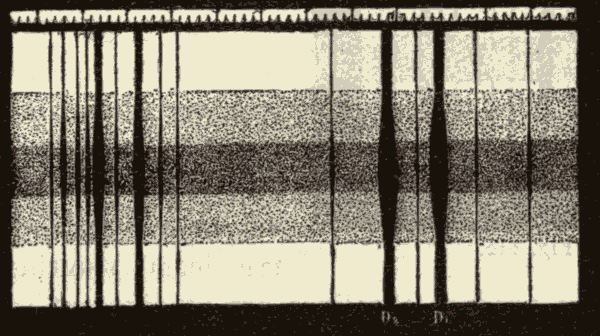
Fig. 210.
191. Sun-Spot Spectrum.—When the image of a sun-spot is thrown upon the slit of the spectroscope, the spectrum is seen to be crossed longitudinally by a continuous dark band, showing an increased general absorption in the region of the sun-spot. Many of the spectral lines are greatly thickened, as shown in Fig. 210. This thickening of the lines shows that the absorption is taking place at a greater depth. New lines and shadings often appear, which indicate, that, in the cooler nucleus of the spot, certain compound vapors exist, which are dissociated elsewhere on the sun's surface. These lines and shadings are shown in Fig. 211.
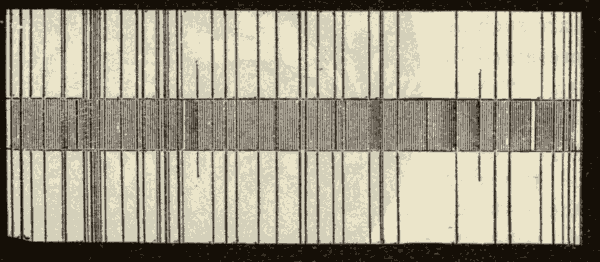
Fig. 211.
It often happens that certain of the spectral lines are reversed in the spectrum of the spot, a thin bright line appearing over the centre of a thick dark one, as shown in Fig. 212. These reversals are due to very bright vapors floating over the spot.
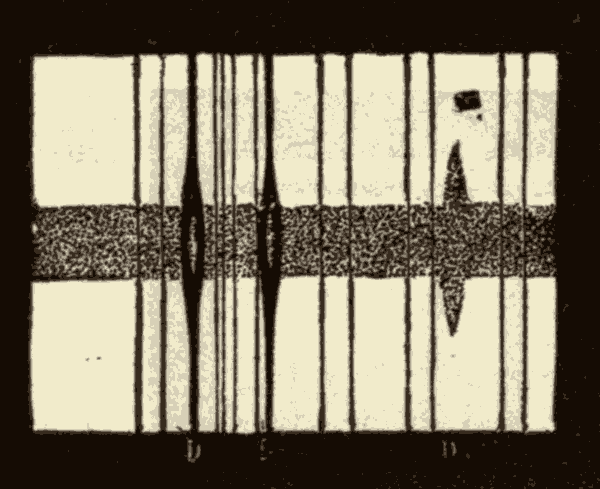
Fig. 212.
At times, also, the spectrum of a spot indicates violent motion in the overlying gases by distortion and displacement of the lines. This phenomenon occurs oftener at points near the outer edge of the penumbra than over the centre of the spot; but occasionally the whole neighborhood is violently agitated. In such cases, lines in the spectrum side by side are often affected in entirely different ways, one being greatly displaced while its neighbor is not disturbed in the least, showing that the vapors which produce the lines are at different levels in the solar atmosphere, and moving independently of each other.
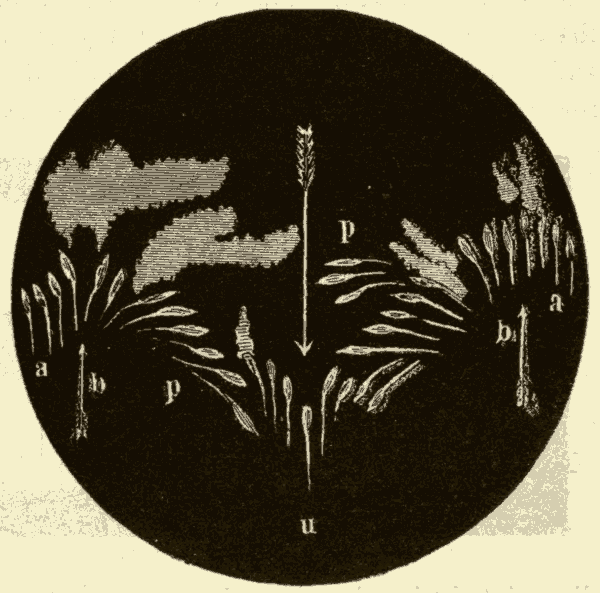
Fig. 213.
192. The Cause and Nature of Sun-Spots.—According to Professor Young, the arrangement and relations of the photospheric clouds in the neighborhood of a spot are such as are represented in Fig. 213. "Over the sun's surface generally, these clouds probably have the form of vertical columns, as at aa. Just outside the spot, the level of the photosphere is the most part, overtopped by eruptions of hydrogen and usually raised into faculæ, as at bb. These faculæ are, for metallic vapors, as indicated by the shaded clouds.... While the great clouds of hydrogen are found everywhere upon the sun, these spiky, vivid outbursts of metallic vapors seldom occur except just in the neighborhood of a spot, and then only during its season of rapid change. In the penumbra of the spot the photospheric filaments become more or less nearly horizontal, as at pp; in the umbra at u it is quite uncertain what the true state of affairs may be. We have conjecturally represented the filaments there as vertical also, but depressed and carried down by a descending current. Of course, the cavity is filled by the gases which overlie the photosphere; and it is easy to see, that, looked at from above, such a cavity and arrangement of the luminous filaments would present the appearances actually observed."
Professor Young also suggests that the spots may be depressions in the photosphere caused "by the diminution of upward pressure from below, in consequence of eruptions in the neighborhood; the spots thus being, so to speak, sinks in the photosphere. Undoubtedly the photosphere is not a strictly continuous shell or crust; but it is heavy as compared with the uncondensed vapors in which it lies, just as a rain-cloud in our terrestrial atmosphere is heavier than the air; and it is probably continuous enough to have its upper level affected by any diminution of pressure below. The gaseous mass below the photosphere supports its weight and the weight of the products of condensation, which must always be descending in an inconceivable rain and snow of molten and crystallized material. To all intents and purposes, though nothing but a layer of clouds, the photosphere thus forms a constricting shell, and the gases beneath are imprisoned and compressed. Moreover, at a high temperature the viscosity of gases is vastly increased, so that quite probably the matter of the solar nucleus resembles pitch or tar in its consistency more than what we usually think of as a gas. Consequently, any sudden diminution of pressure would propagate itself slowly from the point where it occurred. Putting these things together, it would seem, that, whenever a free outlet is obtained through the photosphere at any point, thus decreasing the inward pressure, the result would be the sinking of a portion of the photosphere somewhere in the immediate neighborhood, to restore the equilibrium; and, if the eruption were kept up for any length of time, the depression in the photosphere would continue till the eruption ceased. This depression, filled with the overlying gases, would constitute a spot. Moreover, the line of fracture (if we may call it so) at the edges of the sink would be a region of weakness in the photosphere, so that we should expect a series of eruptions all around the spot. For a time the disturbance, therefore, would grow, and the spot would enlarge and deepen, until, in spite of the viscosity of the internal gases, the equilibrium of pressure was gradually restored beneath. So far as we know the spectroscopic and visual phenomena, none of them contradict this hypothesis. There is nothing in it, however, to account for the distribution of the spots in solar latitudes, nor for their periodicity."
IV. THE CHROMOSPHERE AND PROMINENCES.
193. The Sun's Outer Atmosphere.—What we see of the sun under ordinary circumstances is but a fraction of his total bulk. While by far the greater portion of the solar mass is included within the photosphere, the larger portion of his volume lies without, and constitutes a gaseous envelope whose diameter is at least double, and its bulk therefore sevenfold, that of the central globe.
This outer envelope, though mainly gaseous, is not spherical, but has an exceedingly irregular and variable outline. It seems to be made up, not of regular strata of different density, like our atmosphere, but rather of flames, beams, and streamers, as transient and unstable as those of the aurora borealis. It is divided into two portions by a boundary as definite, though not so regular, as that which separates them both from the photosphere. The outer and far more extensive portion, which in texture and rarity seems to resemble the tails of comets, is known as the coronal atmosphere, since to it is chiefly due the corona, or glory, which surrounds the darkened sun during an eclipse.
194. The Chromosphere.—At the base of the coronal atmosphere, and in contact with the photosphere, is what resembles a sheet of scarlet fire. It appears as if countless jets of heated gas were issuing through vents over the whole surface, clothing it with flame, which heaves and tosses like the blaze of a conflagration. This is the chromosphere, or color-sphere. It owes its vivid redness to the predominance of hydrogen in the flames. The average depth of the chromosphere is not far from ten or twelve seconds, or five thousand or six thousand miles.
195. The Prominences.—Here and there masses of this hydrogen, mixed with other substances, rise far above the general level into the coronal regions, where they float like clouds, or are torn to pieces by conflicting currents. These cloud-masses are known as solar prominences, or protuberances.
196. Magnitude and Distribution of the Prominences.—The prominences differ greatly in magnitude. Of the 2,767 observed by Secchi, 1,964 attained an altitude of eighteen thousand miles; 751, or nearly a fourth of the whole, reached a height of twenty-eight thousand miles; several exceeded eighty-four thousand miles. In rare instances they reach elevations as great as a hundred thousand miles. A few have been seen which exceeded a hundred and fifty thousand miles; and Secchi has recorded one of three hundred thousand miles.
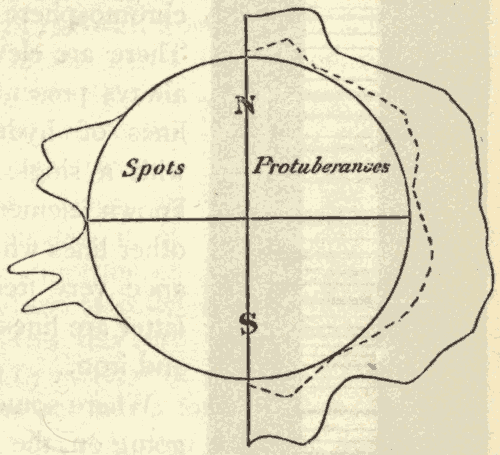
Fig. 214.
The irregular lines on the right-hand side of Fig. 214 show the proportion of the prominences observed by Secchi, that were seen in different parts of the sun's surface. The outer line shows the distribution of the smaller prominences, and the inner dotted line that of the larger prominences. By comparing these lines with those on the opposite side of the circle, which show the distribution of the spots, it will be seen, that, while the spots are confined mainly to two belts, the prominences are seen in all latitudes.
197. The Spectrum of the Chromosphere.—The spectrum of the chromosphere is comparatively simple. There are eleven lines only which are always present; and six of these are lines of hydrogen, and the others, with a single exception, are of unknown elements. There are sixteen other lines which make their appearance very frequently. Among these latter are lines of sodium, magnesium, and iron.
Where some special disturbance is going on, the spectrum at the base of the chromosphere is very complicated, consisting of hundreds of bright lines. "The majority of the lines, however, are seen only occasionally, for a few minutes at a time, when the gases and vapors, which generally lie low (mainly in the interstices of the clouds which constitute the photosphere), and below its upper surface, are elevated for the time being by some eruptive action. For the most part, the lines which appear only at such times are simply reversals of the more prominent dark lines of the ordinary solar spectrum. But the selection of the lines seems most capricious: one is taken, and another left, though belonging to the same element, of equal intensity, and close beside the first." Some of the main lines of the chromosphere and prominences are shown in Fig. 215.
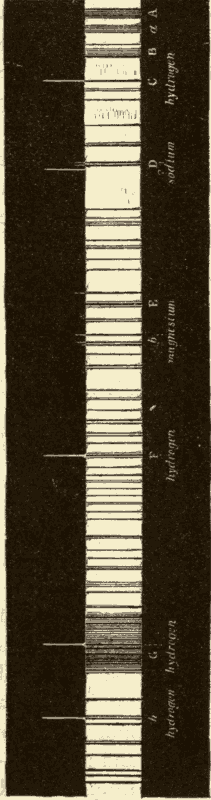
Fig. 215.
198. Method of Studying the Chromosphere and Prominences.—Until recently, the solar atmosphere could be seen only during a total eclipse of the sun; but now the spectroscope enables us to study the chromosphere and the prominences with nearly the same facility as the spots and faculæ.
The protuberances are ordinarily invisible, for the same reason that the stars cannot be seen in the daytime; they are hidden by the intense light reflected from our own atmosphere. If we could only get rid of this aerial illumination, without at the same time weakening the light of the prominences, the latter would become visible. This the spectroscope enables us to accomplish. Since the air-light is reflected sunshine, it of course presents the same spectrum as sunlight,—a continuous band of color crossed by dark lines. Now, this sort of spectrum is weakened by increase of dispersive power (159), because the light is spread out into a longer ribbon, and made to cover a greater area. On the other hand, the spectrum of the prominences, being composed of bright lines, undergoes no such diminution by increased dispersion.
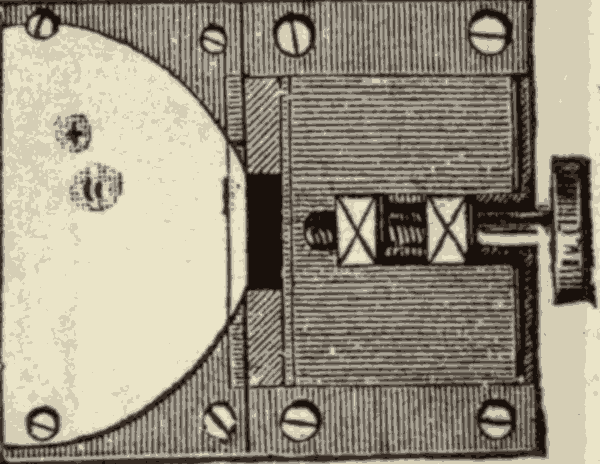
Fig. 216.
When the spectroscope is used as a means of examining the prominences, the slit is more or less widened. The telescope is directed so that the image of that portion of the solar limb which is to be examined shall be tangent to the opened slit, as in Fig. 216, which represents the slit-plate of the spectroscope of its actual size, with the image of the sun in the proper position for observation.
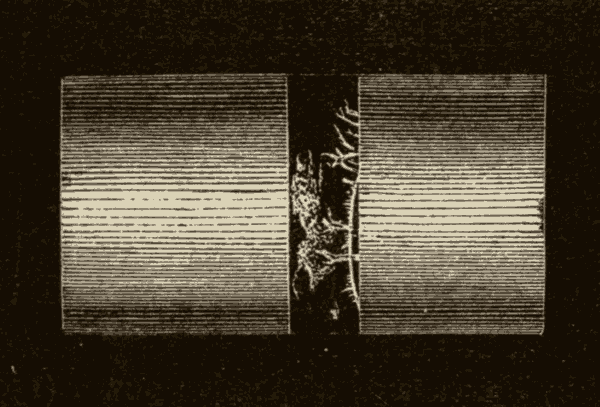
Fig. 217.
If, now, a prominence exists at this part of the solar limb, and if the spectroscope itself is so adjusted that the C line falls in the centre of the field of view, then one will see something like Fig. 217. "The red portion of the spectrum will stretch athwart the field of view like a scarlet ribbon with a darkish band across it; and in that band will appear the prominences, like scarlet clouds, so like our own terrestrial clouds, indeed, in form and texture, that the resemblance is quite startling. One might almost think he was looking out through a partly-opened door upon a sunset sky, except that there is no variety or contrast of color; all the cloudlets are of the same pure scarlet hue. Along the edge of the opening is seen the chromosphere, more brilliant than the clouds which rise from it or float above it, and, for the most part, made up of minute tongues and filaments."
199. Quiescent Prominences.—The prominences differ as widely in form and structure as in magnitude. The two principal classes are the quiescent, cloud-formed, or hydrogenous, and the eruptive, or metallic.
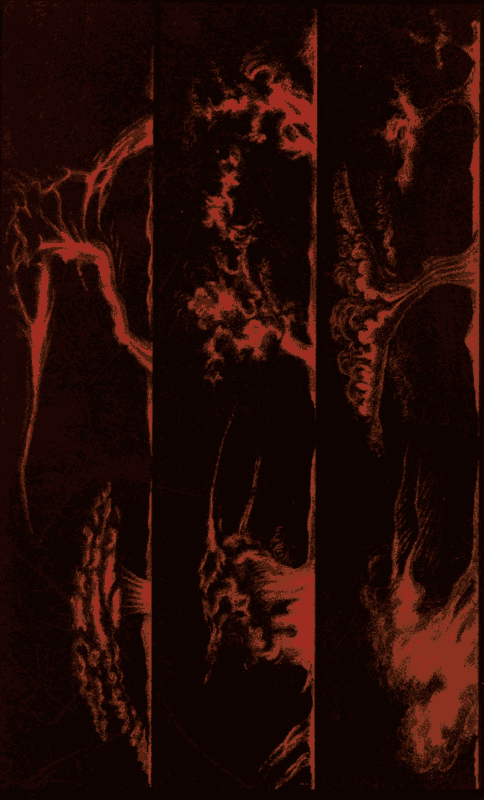
Plate 3.
The quiescent prominences resemble almost exactly our terrestrial clouds, and differ among themselves in the same manner. They are often of enormous dimensions, especially in horizontal extent, and are comparatively permanent, often undergoing little change for hours and days. Near the poles they sometimes remain during a whole solar revolution of twenty-seven days. Sometimes they appear to lie upon the limb of the sun, like a bank of clouds in the terrestrial horizon, probably because they are so far from the edge that only their upper portions are in sight. When fully seen, they are usually connected to the chromosphere by slender columns, generally smallest at the base, and often apparently made up of separate filaments closely intertwined, and expanding upward. Sometimes the whole under surface is fringed with pendent filaments. Sometimes they float entirely free from the chromosphere; and in most cases the larger clouds are attended by detached cloudlets. Various forms of quiescent prominences are shown in Plate III. Other forms are given in Figs. 218 and 219.
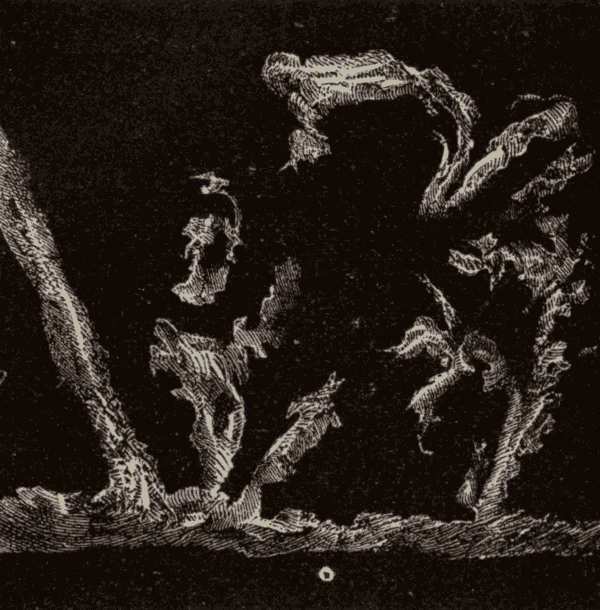
Fig. 218.
Their spectrum is usually very simple, consisting of the four lines of hydrogen and the orange D3: hence the appellation hydrogenous. Occasionally the sodium and magnesium lines also appear, even near the tops of the clouds.
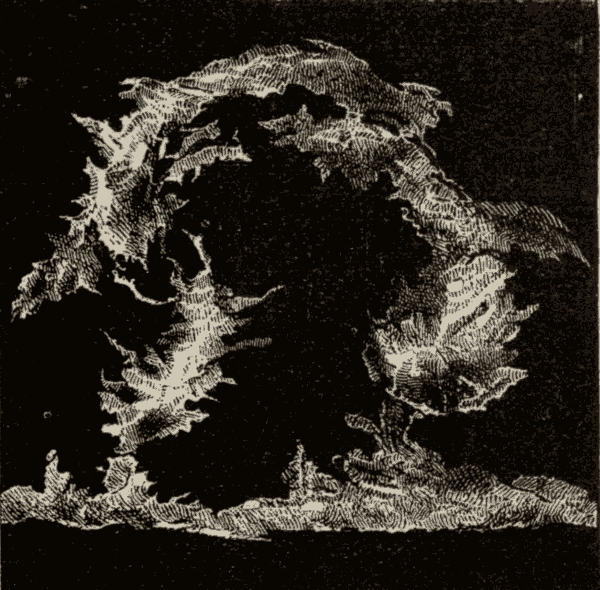
Fig. 219.
200. Eruptive Prominences.—The eruptive prominences ordinarily consist of brilliant spikes or jets, which change very rapidly in form and brightness. As a rule, their altitude is not more than twenty thousand or thirty thousand miles; but occasionally they rise far higher than even the largest of the quiescent protuberances. Their spectrum is very complicated, especially near their base, and often filled with bright lines. The most conspicuous lines are those of sodium, magnesium, barium, iron, and titanium: hence Secchi calls them metallic prominences.
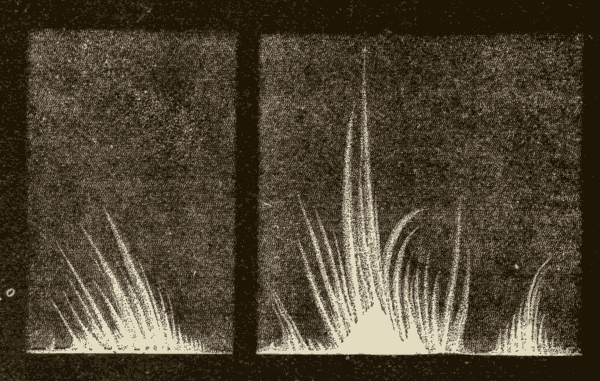
Fig. 220.
They usually appear in the immediate vicinity of a spot, never very near the solar poles. They change with such rapidity, that the motion can almost be seen with the eye. Sometimes, in the course of fifteen or twenty minutes, a mass of these flames, fifty thousand miles high, will undergo a total transformation; and in some instances their complete development or disappearance takes no longer time. Sometimes they consist of pointed rays, diverging in all directions, as represented in Fig. 220. "Sometimes they look like flames, sometimes like sheaves of grain, sometimes like whirling water-spouts capped with a great cloud; occasionally they present most exactly the appearance of jets of liquid fire, rising and falling in graceful parabolas; frequently they carry on their edges spirals like the volutes of an Ionic column; and continually they detach filaments, which rise to a great elevation, gradually expanding and growing fainter as they ascend, until the eye loses them."
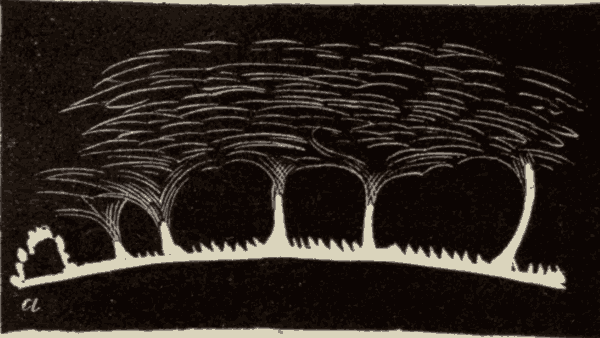
Fig. 221.
201. Change of Form in Prominences.—Fig. 221 represents a prominence as seen by Professor Young, Sept. 7, 1871. It was an immense quiescent cloud, a hundred thousand miles long and fifty-four thousand miles high. At a there was a brilliant lump, somewhat in the form of a thunder-head. On returning to the spectroscope less than half an hour afterwards, he found that the cloud had been literally blown into shreds by some inconceivable uprush from beneath. The prominence then presented the form shown in Fig. 222. The débris of the cloud had already attained a height of a hundred thousand miles. While he was watching them for the next ten minutes, they rose, with a motion almost perceptible to the eye, till the uppermost reached an altitude of two hundred thousand miles. As the filaments rose, they gradually faded away like a dissolving cloud.
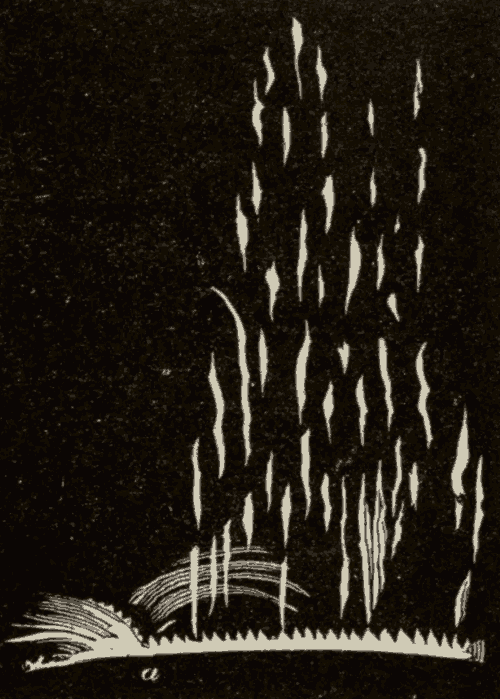
Fig. 222.
Meanwhile the little thunder-head had grown and developed into what appeared to be a mass of rolling and ever-changing flame. Figs. 223 and 224 give the appearance of this portion of the prominence at intervals of fifteen minutes. Other similar eruptions have been observed.
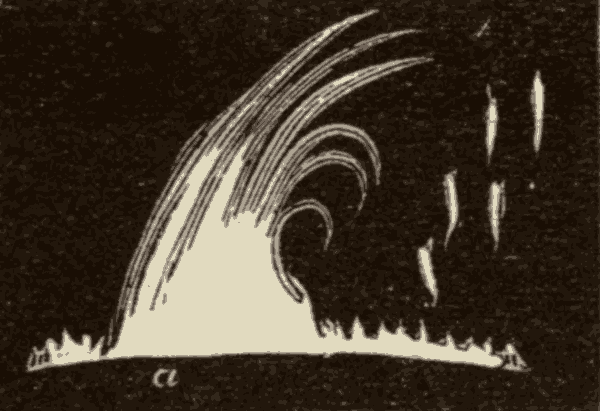
Fig. 223.
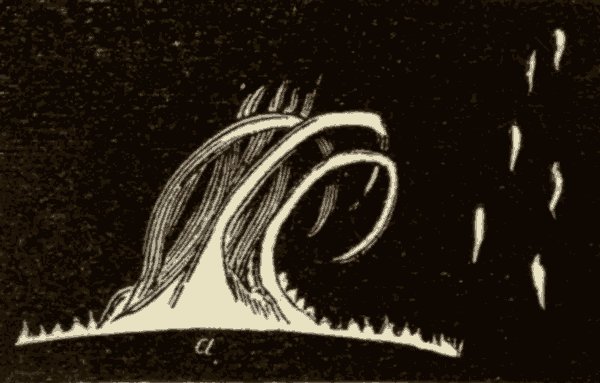
Fig. 224.
V. THE CORONA.
202. General Appearance of the Corona.—At the time of a total eclipse of the sun, if the sky is clear, the moon appears as a huge black ball, the illumination at the edge of the disk being just sufficient to bring out its rotundity. "From behind it," to borrow Professor Young's vivid description, "stream out on all sides radiant filaments, beams, and sheets of pearly light, which reach to a distance sometimes of several degrees from the solar surface, forming an irregular stellate halo, with the black globe of the moon in its apparent centre. The portion nearest the sun is of dazzling brightness, but still less brilliant than the prominences which blaze through it like carbuncles. Generally this inner corona has a pretty uniform height, forming a ring three or four minutes of arc in width, separated by a somewhat definite outline from the outer corona, which reaches to a much greater distance, and is far more irregular in form. Usually there are several rifts, as they have been called, like narrow beams of darkness, extending from the very edge of the sun to the outer night, and much resembling the cloud-shadows which radiate from the sun before a thunder-shower; but the edges of these rifts are frequently curved, showing them to be something else than real shadows. Sometimes there are narrow bright streamers, as long as the rifts, or longer. These are often inclined, occasionally are even nearly tangential to the solar surface, and frequently are curved. On the whole, the corona is usually less extensive and brilliant over the solar poles, and there is a recognizable tendency to accumulations above the middle latitudes, or spot-zones; so that, speaking roughly, the corona shows a disposition to assume the form of a quadrilateral or four-rayed star, though in almost every individual case this form is greatly modified by abnormal streamers at some point or other."
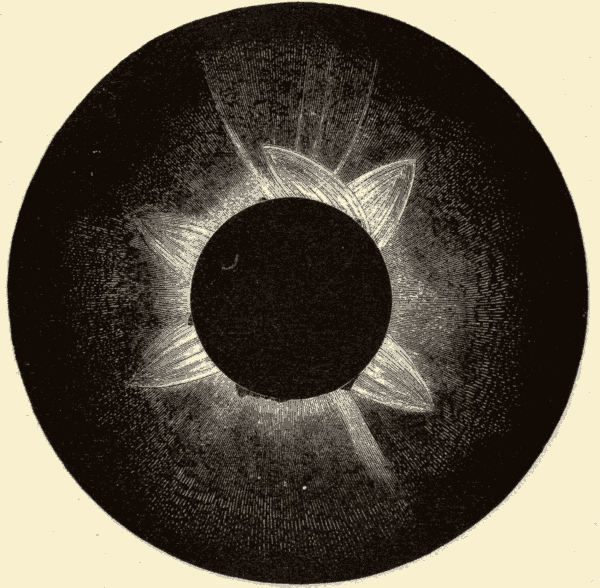
Fig. 225.
203. The Corona as seen at Recent Eclipses.—The corona can be seen only at the time of a total eclipse of the sun, and then for only a few minutes. Its form varies considerably from one eclipse to another, and apparently also during the same eclipse. At least, different observers at different stations depict the same corona under very different forms. Fig. 225 represents the corona of 1857 as observed by Liais. In this view the petal-like forms, which have been noticed in the corona at other times, are especially prominent.
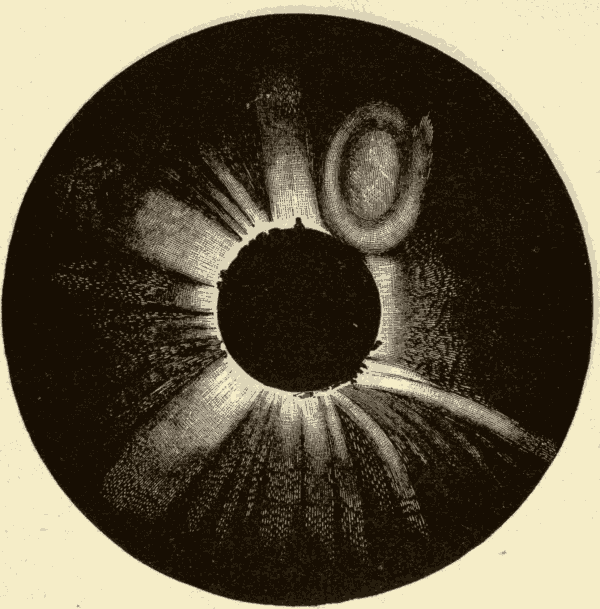
Fig. 226.
Fig. 226 shows the corona of 1860 as it was observed by Temple.
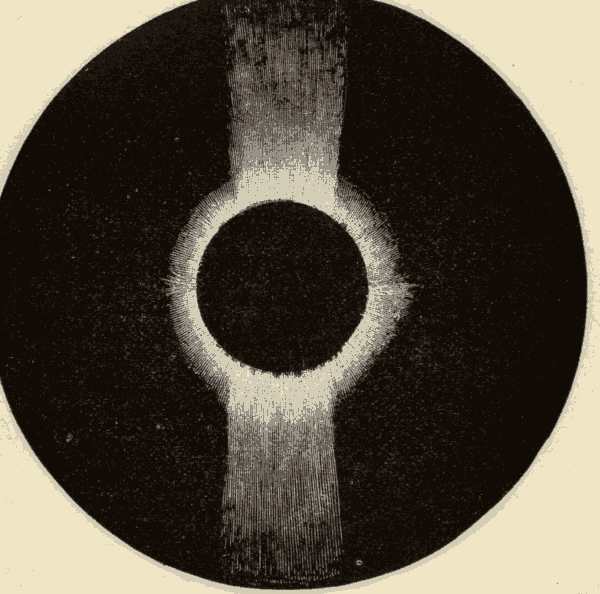
Fig. 227.
Fig. 227 shows the corona of 1867. This is interesting as being a corona at the time of sun-spot minimum.
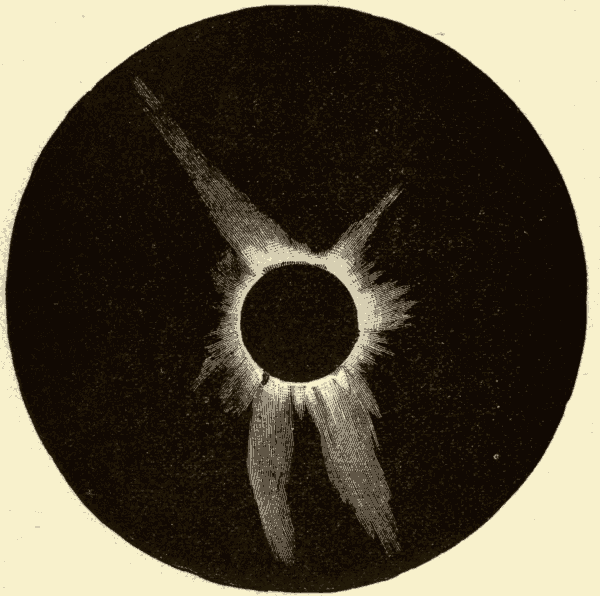
Fig. 228.
Fig. 228 represents the corona of 1868. This is a larger and more irregular corona than usual.
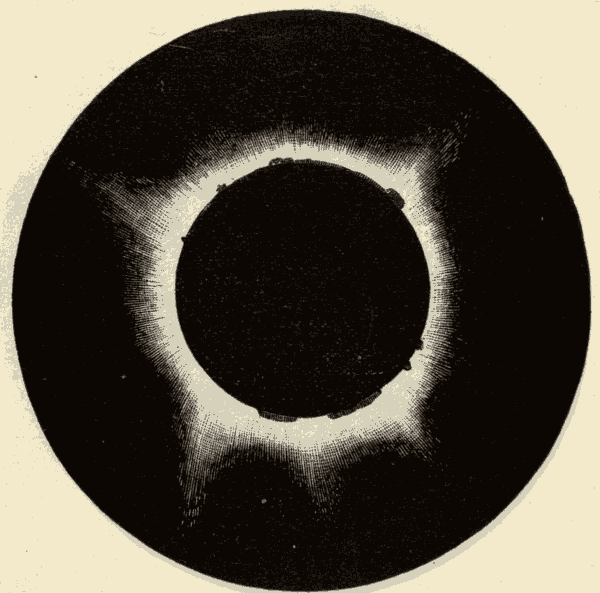
Fig. 229.
The corona of 1869 is shown in Fig. 229.
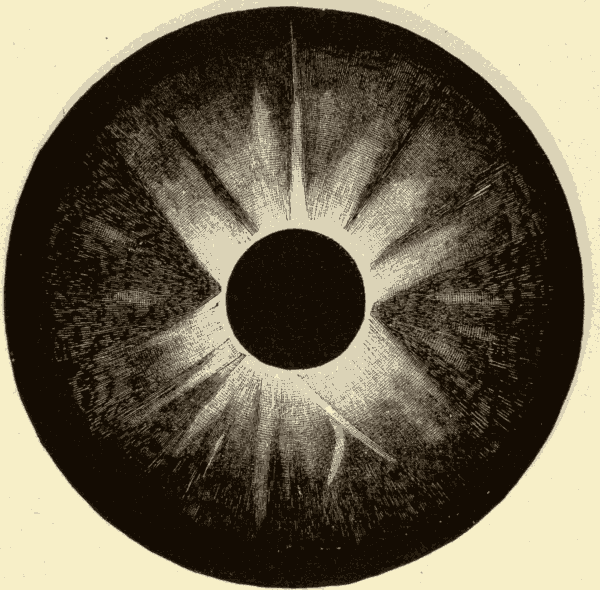
Fig. 230.
Fig. 230 is a view of the corona of 1871 as seen by Capt. Tupman.
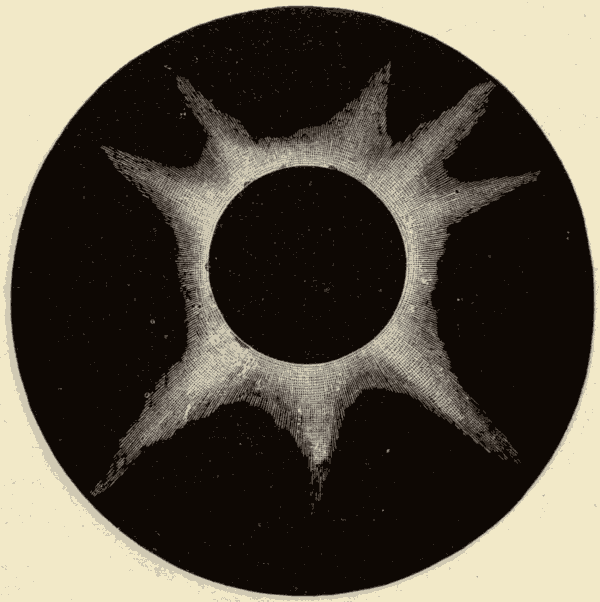
Fig. 231.
Fig. 231 shows the same corona as seen by Foenander.
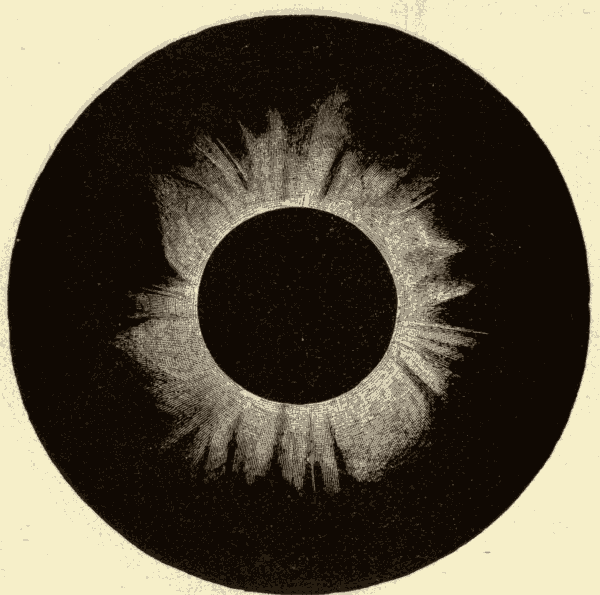
Fig. 232.
Fig. 232 shows the same corona as photographed by Davis.
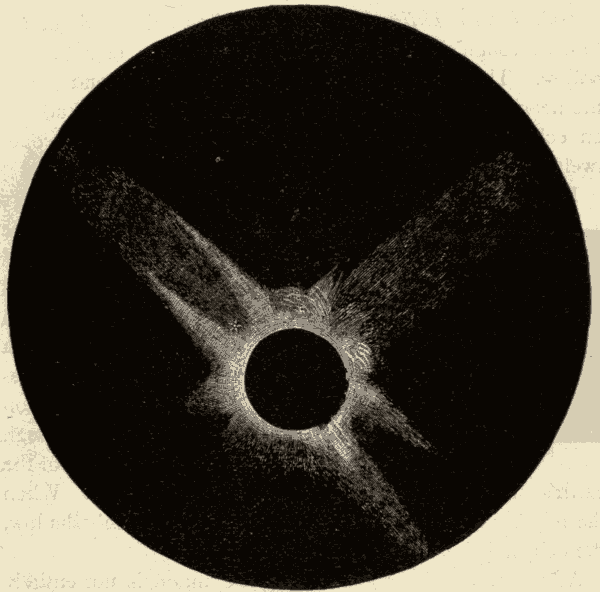
Fig. 233.
Fig. 233 shows the corona of 1878 made up from several views as combined by Professor Young.
204. The Spectrum of the Corona.—The chief line in the spectrum of the corona is the one usually designated as 1474, and now known as the coronal line. It is seen as a dark line on the disk of the sun; and a spectroscope of great dispersive power shows this dark line to be closely double, the lower component being one of the iron lines, and the upper the coronal line. This dark line is shown at x, Fig. 234.

Fig. 234.
Besides this bright line, the hydrogen lines appear faintly in the spectrum of the corona. The 1474 line has been sometimes traced with the spectroscope to an elevation of nearly twenty minutes above the moon's limb, and the hydrogen lines nearly as far; and the lines were just as strong in the middle of a dark rift as anywhere else.
The substance which produces the 1474 line is unknown as yet. It seems to be something with a vapor-density far below that of hydrogen, which is the lightest substance of which we have any knowledge. It can hardly be an "allotropic" form of any terrestrial element, as some scientists have suggested; for in the most violent disturbances in prominences and near sun-spots, when the lines of hydrogen, magnesium, and other metals, are contorted and shattered by the rush of the contending elements, this line alone remains fine, sharp, and straight, a little brightened, but not otherwise affected. For the present it remains, like a few other lines in the spectrum, an unexplained mystery.
Besides bright lines, the corona shows also a faint continuous spectrum, in which have been observed a few of the more prominent dark lines of the solar spectrum.
This shows, that, while the corona may be in the main composed of glowing gas (as indicated by the bright lines of its spectrum), it also contains considerable matter in such a state as to reflect the sunlight, probably in the form of dust or fog.
V. ECLIPSES.
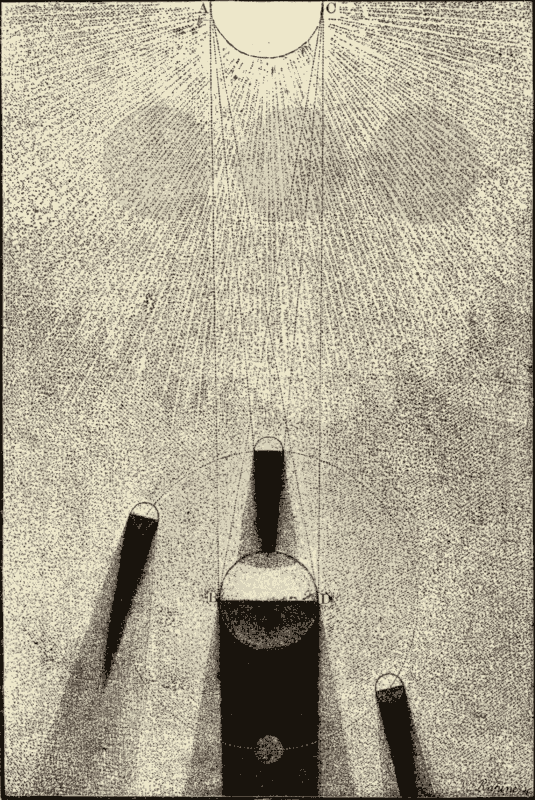
Fig. 235.
205. The Shadows of the Earth and Moon.—The shadows cast by the earth and moon are shown in Fig. 235. Each shadow is seen to be made up of a dark portion called the umbra, and of a lighter portion called the penumbra. The light of the sun is completely excluded from the umbra, but only partially from the penumbra. The umbra is in the form of a cone, with its apex away from the sun; though in the case of the earth's shadow it tapers very slowly. The penumbra surrounds the umbra, and increases in size as we recede from the sun. The axis of the earth's shadow lies in the plane of the ecliptic, which in the figure is the surface of the page. As the moon's orbit is inclined five degrees to the plane of the ecliptic, the axis of the moon's shadow will sometimes lie above, and sometimes below, the ecliptic. It will lie on the ecliptic only when the moon is at one of her nodes.
206. When there will be an Eclipse of the Moon.—The moon is eclipsed whenever it passes into the umbra of the earth's shadow. It will be seen from the figure that the moon can pass into the shadow of the earth only when she is in opposition, or at full. Owing to the inclination of the moon's orbit to the ecliptic, the moon will pass either above or below the earth's shadow when she is at full, unless she happens to be near her node at this time: hence there is not an eclipse of the moon every month.
When the moon simply passes into the penumbra of the earth's shadow, the light of the moon is somewhat dimmed, but not sufficiently to attract attention, or to be denominated an eclipse.
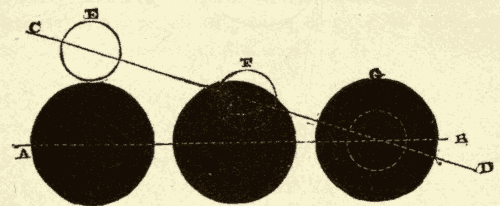
Fig. 236.
207. The Lunar Ecliptic Limits.—In Fig. 236 the line AB represents the plane of the ecliptic, and the line CD the moon's orbit. The large black circles on the line AB represent sections of the umbra of the earth's shadow, and the smaller circles on CD represent the moon at full. It will be seen, that, if the moon is full at E, she will just graze the umbra of the earth's shadow. In this case she will suffer no eclipse. Were the moon full at any point nearer her node, as at F, she would pass into the umbra of the earth's shadow, and would be partially eclipsed. Were the moon full at G, she would pass through the centre of the earth's shadow, and be totally eclipsed.
It will be seen from the figure that full moon must occur when the moon is within a certain distance from her node, in order that there may be a lunar eclipse; and this space is called the lunar ecliptic limits.
The farther the earth is from the sun, the less rapidly does its shadow taper, and therefore the greater its diameter at the distance of the moon; and, the nearer the moon to the earth, the greater the diameter of the earth's shadow at the distance of the moon. Of course, the greater the diameter of the earth's shadow, the greater the ecliptic limits: hence the lunar ecliptic limits vary somewhat from time to time, according to the distance from the earth to the sun and from the earth to the moon. The limits within which an eclipse is inevitable under all circumstances are called the minor ecliptic limits; and those within which an eclipse is possible under some circumstances, the major ecliptic limits.
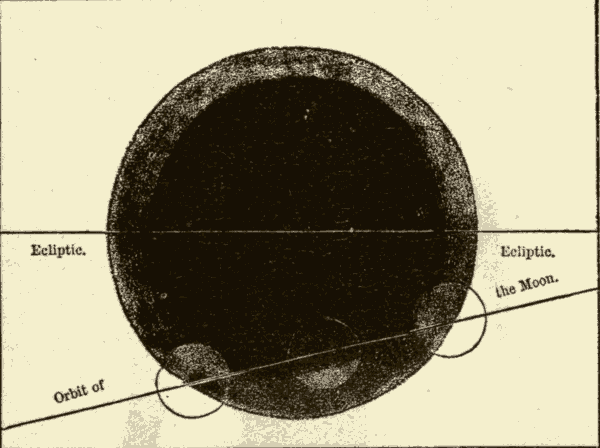
Fig. 237.
208. Lunar Eclipses.—Fig. 237 shows the path of the moon through the earth's shadow in the case of a partial eclipse. The magnitude of such an eclipse depends upon the nearness of the moon to her nodes. The magnitude of an eclipse is usually denoted in digits, a digit being one-twelfth of the diameter of the moon.
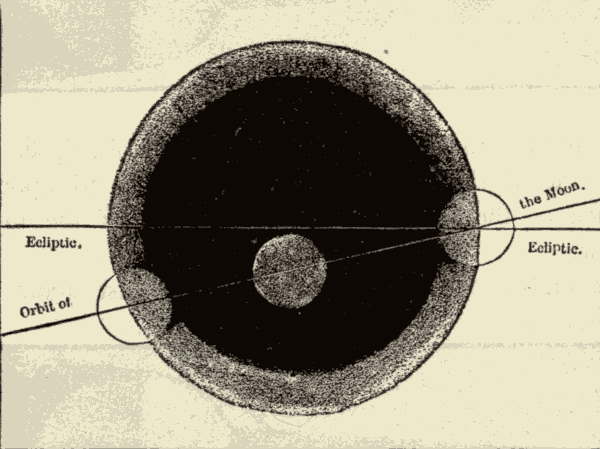
Fig. 238.
Fig. 238 shows the path of the moon through the earth's shadow in the case of a total eclipse. It will be seen from the figure that it is not necessary for the moon to pass through the centre of the earth's shadow in order to have a total eclipse. When the moon passes through the centre of the earth's shadow, the eclipse is both total and central.
At the time of a total eclipse, the moon is not entirely invisible, but shines with a faint copper-colored light. This light is refracted into the shadow by the earth's atmosphere, and its amount varies with the quantity of clouds and vapor in that portion of the atmosphere which the sunlight must graze in order to reach the moon.
The duration of an eclipse varies between very wide limits, being, of course, greatest when the eclipse is central. A total eclipse of the moon may last nearly two hours, or, including the partial portions of the eclipse, three or four hours.
Every eclipse of the moon, whether total or partial, is visible at the same time to the whole hemisphere of the earth which is turned towards the moon; and the eclipse will have exactly the same magnitude at every point of observation.
209. When there will be an Eclipse of the Sun.—There will be an eclipse of the sun whenever any portion of the moon's shadow is thrown on the earth. It will be seen from Fig. 235 that this can occur only when the moon is in conjunction, or at new. It does not occur every month, because, owing to the inclination of the moon's orbit to the ecliptic, the moon's shadow is usually thrown either above or below the earth at the time of new moon. There can be an eclipse of the sun only when new moon occurs at or near one of the nodes of her orbit.
210. Solar Ecliptic Limits.—The distances from the moon's node within which a new moon would throw some portion of its shadow on the earth so as to produce an eclipse of the sun are called the solar ecliptic limits. As in the case of the moon, there are major and minor ecliptic limits; the former being the limits within which an eclipse of the sun is possible under some circumstances, and the latter those under which an eclipse is inevitable under all circumstances.
The limits within which a solar eclipse may occur are greater than those within which a lunar eclipse may occur. This will be evident from an examination of Fig. 235. Were the moon in that figure just outside of the lines AB and CD, it will be seen that the penumbra of her shadow would just graze the earth: hence the moon must be somewhere within the space bounded by these lines in order to cause an eclipse of the sun. Now, these lines mark the prolongation to the sun of the cone of the umbra of the earth's shadow: hence, in order to produce an eclipse of the sun, new moon must occur somewhere within this prolongation of the umbra of the earth's shadow. Now, it is evident that the diameter of this cone is greater on the side of the earth toward the sun than on the opposite side: hence the solar ecliptic limits are greater than the lunar ecliptic limits.
211. Solar Eclipses.—An observer in the umbra of the moon's shadow would see a total eclipse of the sun, while one in the penumbra would see only a partial eclipse. The magnitude of this partial eclipse would depend upon the distance of the observer from the umbra of the moon's shadow.
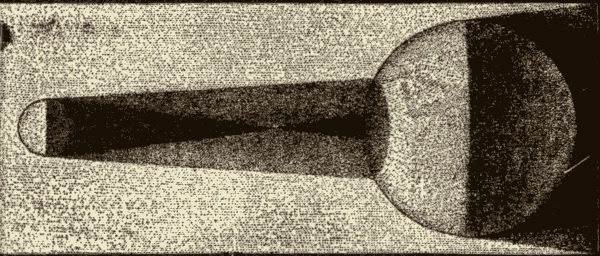
Fig. 239.
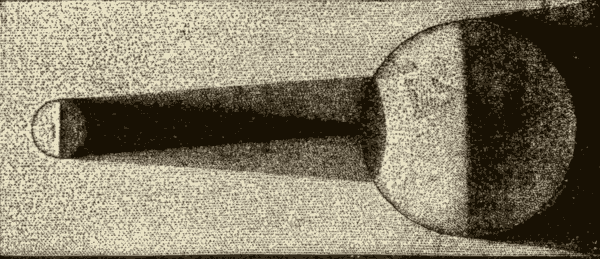
Fig. 240.
The umbra of the moon's shadow is just about long enough to reach the earth. Sometimes the point of this shadow falls short of the earth's surface, as shown in Fig. 239, and sometimes it falls upon the earth, as shown in Fig. 240, according to the varying distance of the sun and moon from the earth. The diameter of the umbra at the surface of the earth is seldom more than a hundred miles: hence the belt of a total eclipse is, on the average, not more than a hundred miles wide; and a total eclipse seldom lasts more than five or six minutes, and sometimes only a few seconds. Owing, however, to the rotation of the earth, the umbra of the moon's shadow may pass over a long reach of the earth's surface. Fig. 241 shows the track of the umbra of the moon's shadow over the earth in the total eclipse of 1860.
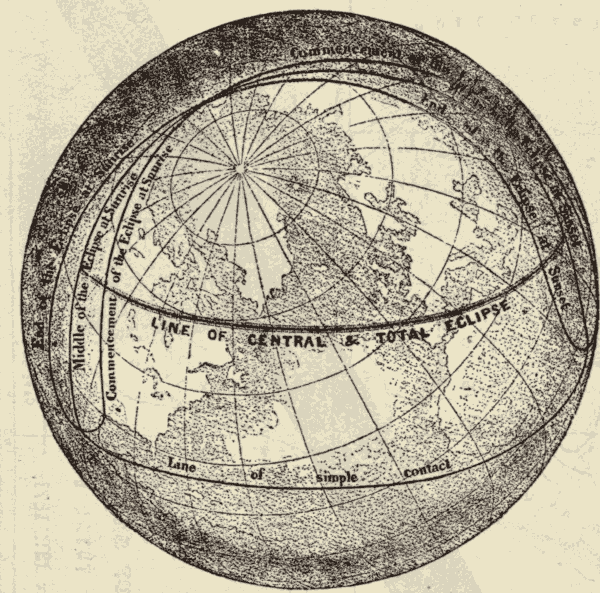
Fig. 241.
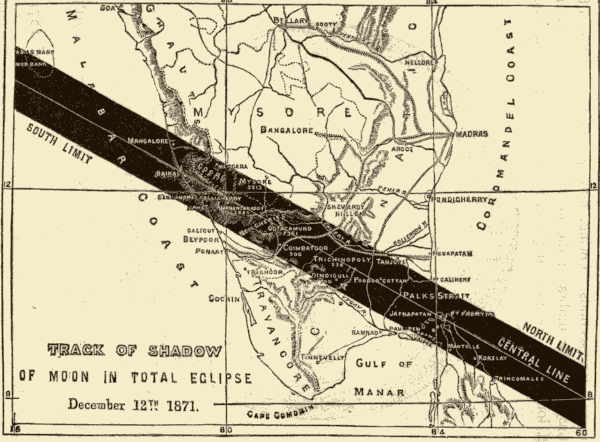
Fig. 242.
Fig. 242 shows the track of the total eclipse of 1871 across India and the adjacent seas.
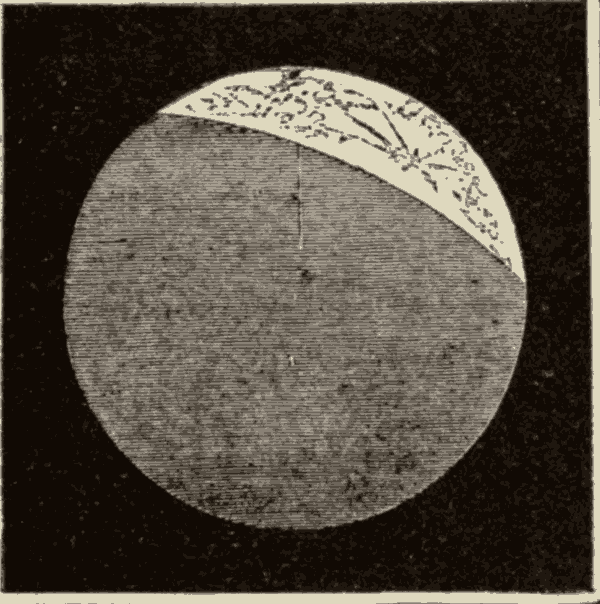
Fig. 243.
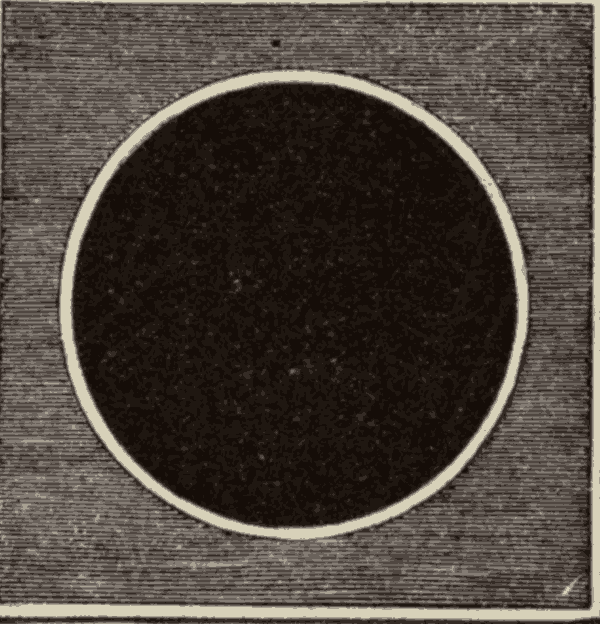
Fig. 244.
In a partial eclipse of the sun, more or less of one side of the sun's disk is usually concealed, as shown in Fig. 243. Occasionally, however, the centre of the sun's disk is covered, leaving a bright ring around the margin, as shown in Fig. 244. Such an eclipse is called an annular eclipse. An eclipse can be annular only when the cone of the moon's shadow is too short to reach the earth, and then only to observers who are in the central portion of the penumbra.
212. Comparative Frequency of Solar and Lunar Eclipses.—There are more eclipses of the sun in the year than of the moon; and yet, at any one place, eclipses of the moon are more frequent than those of the sun.
There are more lunar than solar eclipses, because, as we have seen, the limits within which a solar eclipse may occur are greater than those within which a lunar eclipse may occur. There are more eclipses of the moon visible at any one place than of the sun; because, as we have seen, an eclipse of the moon, whenever it does occur, is visible to a whole hemisphere at a time, while an eclipse of the sun is visible to only a portion of a hemisphere, and a total eclipse to only a very small portion of a hemisphere. A total eclipse of the sun is, therefore, a very rare occurrence at any one place.
The greatest number of eclipses that can occur in a year is seven, and the least number, two. In the former case, five may be of the sun and two of the moon, or four of the sun and three of the moon. In the latter case, both must be of the sun.
VI. THE THREE GROUPS OF PLANETS.
I. GENERAL CHARACTERISTICS OF THE GROUPS.
213. The Inner Group.—The inner group of planets is composed of Mercury, Venus, the Earth, and Mars; that is, of all the planets which lie between the asteroids and the sun. The planets of this group are comparatively small and dense. So far as known, they rotate on their axes in about twenty-four hours, and they are either entirely without moons, or are attended by comparatively few.
The comparative sizes and eccentricities of the orbits of this group are shown in Fig. 245. The dots round the orbits show the position of the planets at intervals of ten days.
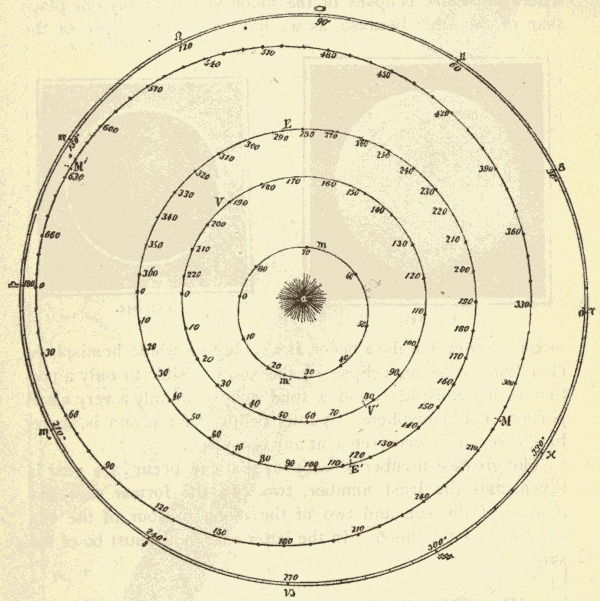
Fig. 245.
214. The Outer Group.—The outer group of planets is composed of Jupiter, Saturn, Uranus, and Neptune. These planets are all very large and of slight density. So far as known, they rotate on their axes in about ten hours, and are accompanied with complicated systems of moons. Fig. 246, which represents the comparative sizes of the planets, shows at a glance the immense difference between those of the inner and outer group. Fig. 247 shows the comparative sizes and eccentricities of the orbits of the outer planets. The dots round the orbits show the position of the planets at intervals of a thousand days.
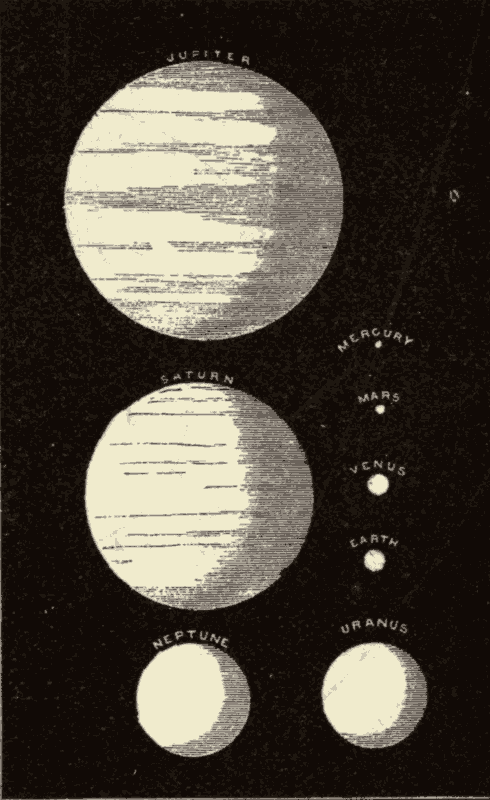
Fig. 246.
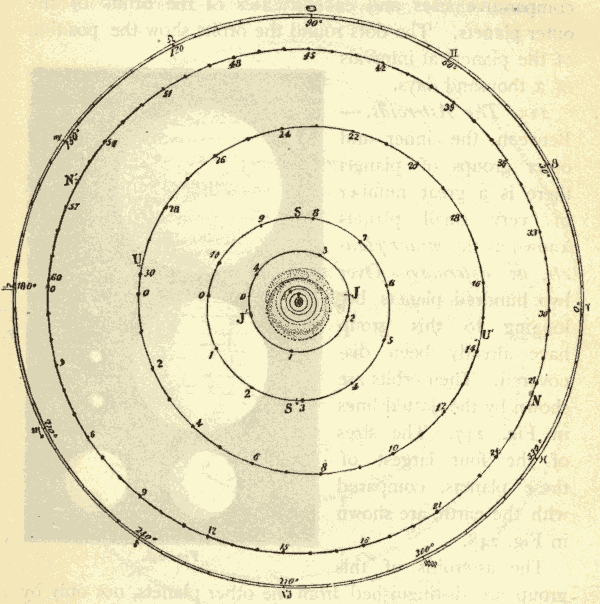
Fig. 247.
215. The Asteroids.—Between the inner and outer groups of planets there is a great number of very small planets known as the minor planets, or asteroids. Over two hundred planets belonging to this group have already been discovered. Their orbits are shown by the dotted lines in Fig. 247. The sizes of the four largest of these planets, compared with the earth, are shown in Fig. 248.
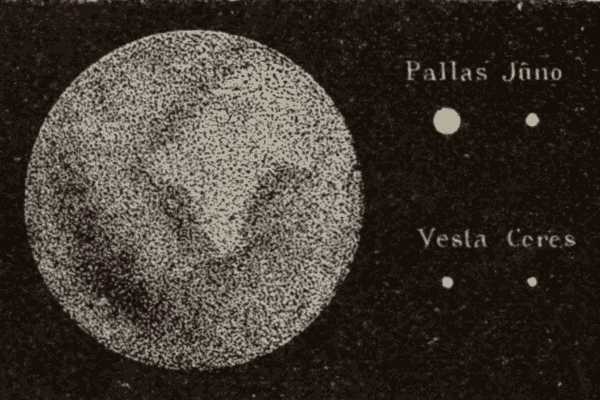
Fig. 248.
The asteroids of this group are distinguished from the other planets, not only by their small size, but by the great eccentricities and inclinations of their orbits. If we except Mercury, none of the larger planets has an eccentricity amounting to one-tenth the diameter of its orbit (43), nor is any orbit inclined more than two or three degrees to the ecliptic; but the inclinations of many of the minor planets exceed ten degrees, and the eccentricities frequently amount to an eighth of the orbital diameter. The orbit of Pallas is inclined thirty-four degrees to the ecliptic, while there are some planets of this group whose orbits nearly coincide with the plane of the ecliptic.
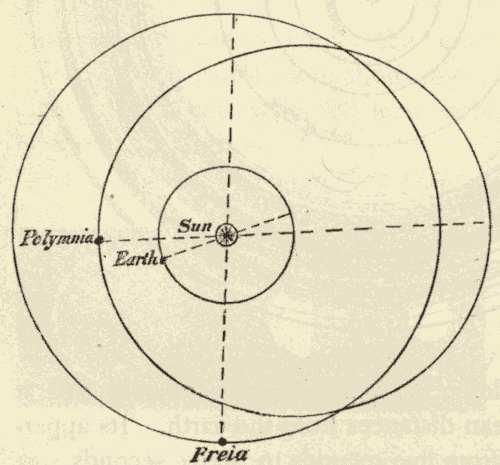
Fig. 249.
Fig. 249 shows one of the most and one of the least eccentric of the orbits of this group as compared with that of the earth.
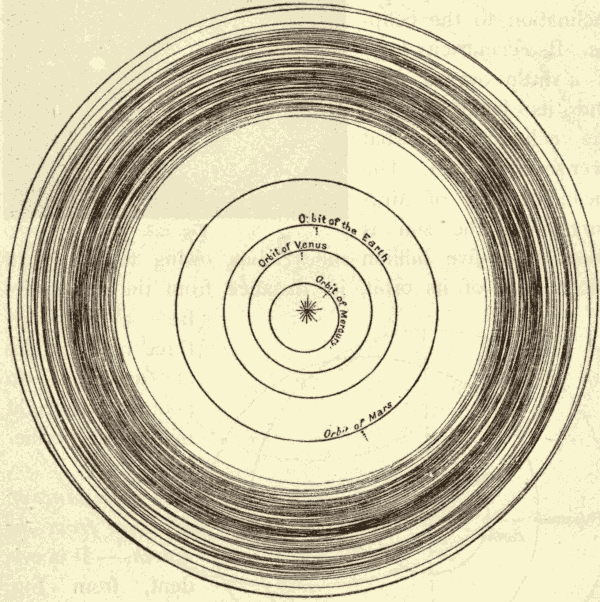
Fig. 250.
The intricate complexity of the orbits of the asteroids is shown in Fig. 250.
II. THE INNER GROUP OF PLANETS.
Mercury.
216. The Orbit of Mercury.—The orbit of Mercury is more eccentric than that of any of the larger planets, and it has also a greater inclination to the ecliptic. Its eccentricity (43) is a little over a fifth, and its inclination to the ecliptic somewhat over seven degrees. The mean distance of Mercury from the sun is about thirty-five million miles; but, owing to the great eccentricity of its orbit, its distance from the sun varies from about forty-three million miles at aphelion to about twenty-eight million at perihelion.
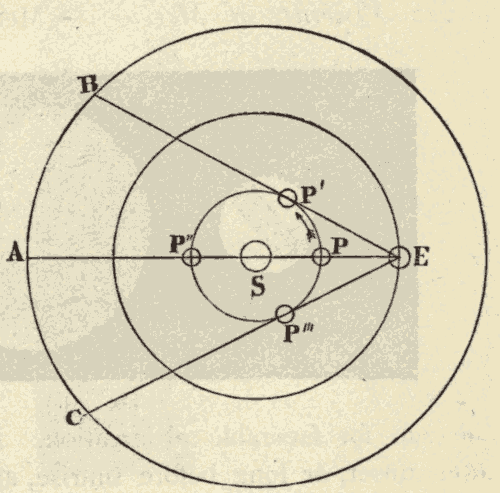
Fig. 251.
217. Distance of Mercury from the Earth.—It is evident, from Fig. 251, that an inferior planet, like Mercury, is the whole diameter of its orbit nearer the earth at inferior conjunction than at superior conjunction: hence Mercury's distance from the earth varies considerably. Owing to the great eccentricity of its orbit, its distance from the earth at inferior conjunction also varies considerably. Mercury is nearest to the earth when its inferior conjunction occurs at its own aphelion and at the earth's perihelion.
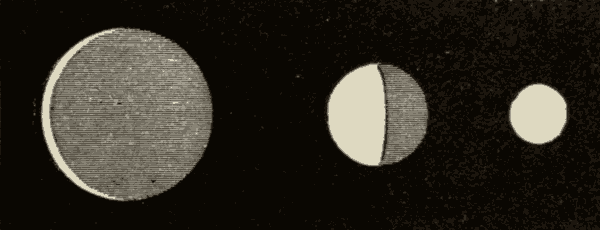
Fig. 252.
218. Apparent Size of Mercury.—Since Mercury's distance from the earth is variable, the apparent size of the planet is also variable. Fig. 252 shows its apparent size at its extreme and mean distances from the earth. Its apparent diameter varies from five seconds to twelve seconds.
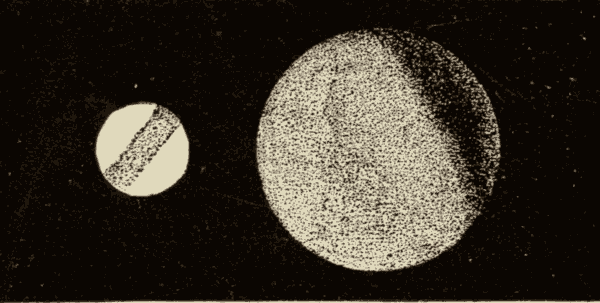
Fig. 253.
219. Volume and Density of Mercury.—The real diameter of Mercury is about three thousand miles. Its size, compared with that of the earth, is shown in Fig. 253. The earth is about sixteen times as large as Mercury; but Mercury is about one-fifth more dense than the earth.
220. Greatest Elongation of Mercury.—Mercury, being an inferior planet (or one within the orbit of the earth), appears to oscillate to and fro across the sun. Its greatest apparent distance from the sun, or its greatest elongation, varies considerably. The farther Mercury is from the sun, and the nearer the earth is to Mercury, the greater is its angular distance from the sun at the time of its greatest elongation. Under the most favorable circumstances, the greatest elongation amounts to about twenty-eight degrees, and under the least favorable to only sixteen or seventeen degrees.
221. Sidereal and Synodical Periods of Mercury.—Mercury accomplishes a complete revolution around the sun in about eighty-eight days; but it takes it a hundred and sixteen days to pass from its greatest elongation east to the same elongation again. The orbital motion of this planet is at the rate of nearly thirty miles a second.
In Fig. 251, P''' represents elongation east of the sun, and P' elongation west. It will be seen that it is much farther from P' around to P''' than from P''' on to P'. Mercury is only about forty-eight days in passing from greatest elongation east to greatest elongation west, while it is about sixty-eight days in passing back again.
222. Visibility of Mercury.—Mercury is too close to the sun for favorable observation. It is never seen long after sunset, or long before sunrise, and never far from the horizon. When visible at all, it must be sought for low down in the west shortly after sunset, or low in the east shortly before sunrise, according as the planet is at its east or west elongation. It is often visible to the naked eye in our latitude; but the illumination of the twilight sky, and the excess of vapor in our atmosphere near the horizon, combine to make the telescopic study of the planet difficult and unsatisfactory.
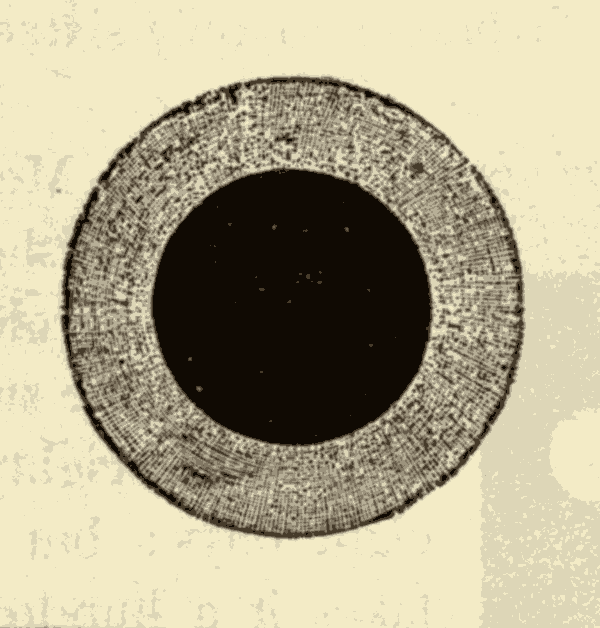
Fig. 254.
223. The Atmosphere and Surface of Mercury.—Mercury seems to be surrounded by a dense atmosphere. One proof of the existence of such an atmosphere is furnished at the time of the planet's transit across the disk of the sun, which occasionally happens. The planet is then seen surrounded by a border, as shown in Fig. 254. A bright spot has also been observed on the dark disk of the planet during a transit, as shown in Fig. 255. The border around the planet seems to be due to the action of the planet's atmosphere; but it is difficult to account for the bright spot.
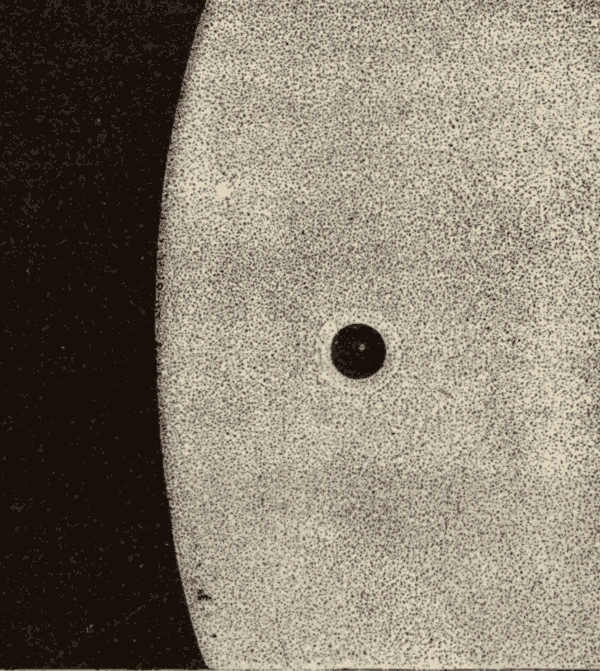
Fig. 255.
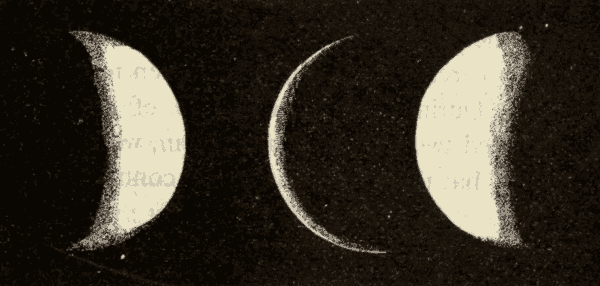
Fig. 256.
Schröter, a celebrated German astronomer, at about the beginning of the present century, thought that he detected spots and shadings on the disk of the planet, which indicated both the presence of an atmosphere and of elevations. The shading along the terminator, which seemed to indicate the presence of a twilight, and therefore of an atmosphere, are shown in Fig. 256. It also shows the blunted aspect of one of the cusps, which Schröter noticed at times, and which he attributed to the shadow of a mountain, estimated to be ten or twelve miles high. Fig. 257 shows this mountain near the upper cusp, as Schröter believed he saw it in the year 1800. By watching certain marks upon the disk of Mercury, Schröter came to the conclusion that the planet rotates on its axis in about twenty-four hours. Modern observers, with more powerful telescopes, have failed to verify Schröter's observations as to the indications of an atmosphere and of elevations. Nothing is known with certainty about the rotation of the planet.
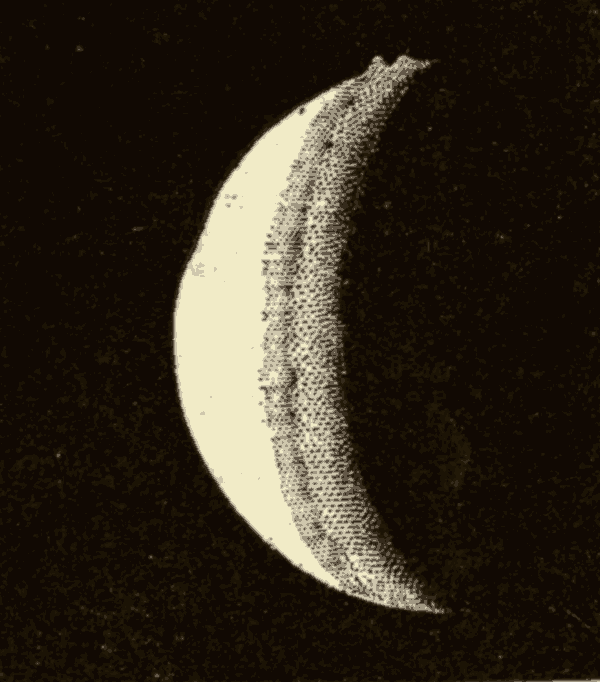
Fig. 257.
The border around Mercury, and the bright spot on its disk at the time of the transit of the planet across the sun, have been seen since Schröter's time, and the existence of these phenomena is now well established; but astronomers are far from being agreed as to their cause.
224. Intra-Mercurial Planets.—It has for some time been thought probable that there is a group of small planets between Mercury and the sun; and at various times the discovery of such bodies has been announced. In 1859 a French observer believed that he had detected an intra-Mercurial planet, to which the name of Vulcan was given, and for which careful search has since been made, but without success. During the total eclipse of 1878 Professor Watson observed two objects near the sun, which he thought to be planets; but this is still matter of controversy.
Venus.
225. The Orbit of Venus.—The orbit of Venus has but slight eccentricity, differing less from a circle than that of any other large planet. It is inclined to the ecliptic somewhat more than three degrees. The mean distance of the planet from the sun is about sixty-seven million miles.
226. Distance of Venus from the Earth.—The distance of Venus from the earth varies within much wider limits than that of Mercury. When Venus is at inferior conjunction, her distance from the earth is ninety-two million miles minus sixty-seven million miles, or twenty-five million miles; and when at superior conjunction it is ninety-two million miles plus sixty-seven million miles, or a hundred and fifty-nine million miles. Venus is considerably more than six times as far off at superior conjunction as at inferior conjunction.
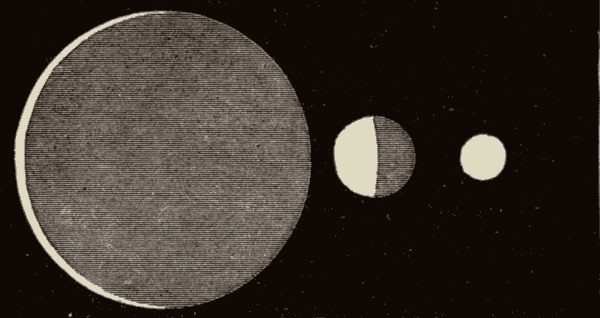
Fig. 258.
227. Apparent Size of Venus.—Owing to the great variation in the distance of Venus from the earth, her apparent diameter varies from about ten seconds to about sixty-six seconds. Fig. 258 shows the apparent size of Venus at her extreme and mean distances from the earth.
228. Volume and Density of Venus.—The real size of Venus is about the same as that of the earth, her diameter being only about three hundred miles less. The comparative sizes of the two planets are shown in Fig. 259. The density of Venus is a little less than that of the earth.
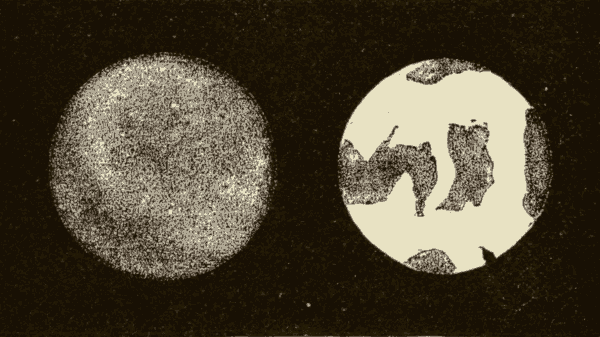
Fig. 259.
229. The Greatest Elongation of Venus.—Venus, like Mercury, appears to oscillate to and fro across the sun. The angular value of the greatest elongation of Venus varies but slightly, its greatest value being about forty-seven degrees.
230. Sidereal and Synodical Periods of Venus.—The sidereal period of Venus, or that of a complete revolution around the sun, is about two hundred and twenty-five days; her orbital motion being at the rate of nearly twenty-two miles a second. Her synodical period, or the time it takes her to pass around from her greatest eastern elongation to the same elongation again, is about five hundred and eighty-four days, or eighteen months. Venus is a hundred and forty-six days, or nearly five months, in passing from her greatest elongation east through inferior conjunction to her greatest elongation west.
231. Venus as a Morning and an Evening Star.—For a period of about nine months, while Venus is passing from superior conjunction to her greatest eastern elongation, she will be east of the sun, and will therefore set after the sun. During this period she is the evening star, the Hesperus of the ancients. While passing from inferior conjunction to superior conjunction, Venus is west of the sun, and therefore rises before the sun. During this period of nine months she is the morning star, the Phosphorus, or Lucifer, of the ancients.
232. Brilliancy of Venus.—Next to the sun and moon, Venus is at times the most brilliant object in the heavens, being bright enough to be seen in daylight, and to cast a distinct shadow at night. Her brightness, however, varies considerably, owing to her phases and to her varying distance from the earth. She does not appear brightest when at full, for she is then farthest from the earth, at superior conjunction; nor does she appear brightest when nearest the earth, at inferior conjunction, for her phase is then a thin crescent (see Fig. 258). She is most conspicuous while passing from her greatest eastern elongation to her greatest western elongation. After she has passed her eastern elongation, she becomes brighter and brighter till she is within about forty degrees of the sun. Her phase at this point in her orbit is shown in Fig. 260. Her brilliancy then begins to wane, until she comes too near the sun to be visible. When she re-appears on the west of the sun, she again becomes more brilliant; and her brilliancy increases till she is about forty degrees from the sun, when she is again at her brightest. Venus passes from her greatest brilliancy as an evening star to her greatest brilliancy as a morning star in about seventy-three days. She has the same phase, and is at the same distance from the earth, in both cases of maximum brilliancy. Of course, the brilliancy of Venus when at the maximum varies somewhat from time to time, owing to the eccentricities of the orbits of the earth and of Venus, which cause her distance from the earth, at her phase of greatest brilliancy, to vary. She is most brilliant when the phase of her greatest brilliancy occurs when she is at her aphelion and the earth at its perihelion.
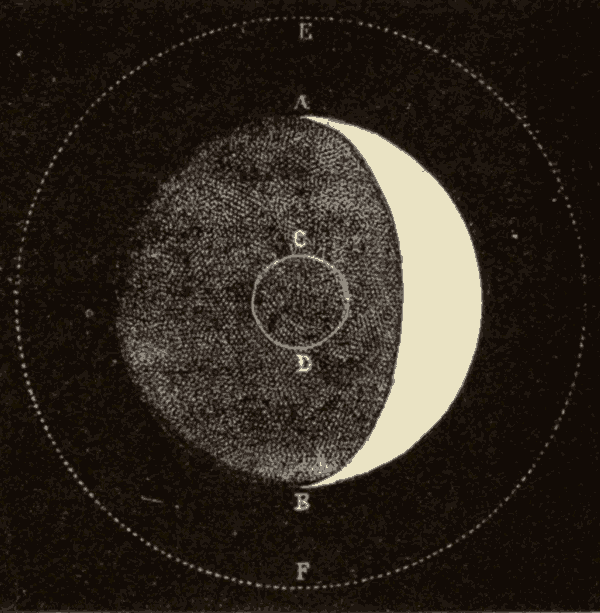
Fig. 260.
233. The Atmosphere and Surface of Venus.—Schröter believed that he saw shadings and markings on Venus similar to those on Mercury, indicating the presence of an atmosphere and of elevations on the surface of the planet. Fig. 261 represents the surface of Venus as it appeared to this astronomer. By watching certain markings on the disk of Venus, Schröter came to the conclusion that Venus rotates on her axis in about twenty-four hours.
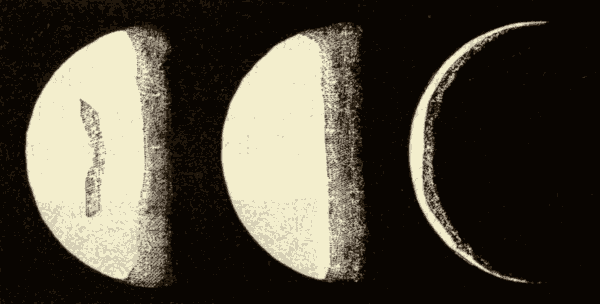
Fig. 261.
It is now generally conceded that Venus has a dense atmosphere; but Schröter's observations of the spots on her disk have not been verified by modern astronomers, and we really know nothing certainly of her rotation.
234. Transits of Venus.—When Venus happens to be near one of the nodes of her orbit when she is in inferior conjunction, she makes a transit across the sun's disk. These transits occur in pairs, separated by an interval of over a hundred years. The two transits of each pair are separated by an interval of eight years, the dates of the most recent being 1874 and 1882. Venus, like Mercury, appears surrounded with a border on passing across the sun's disk, as shown in Fig. 262.
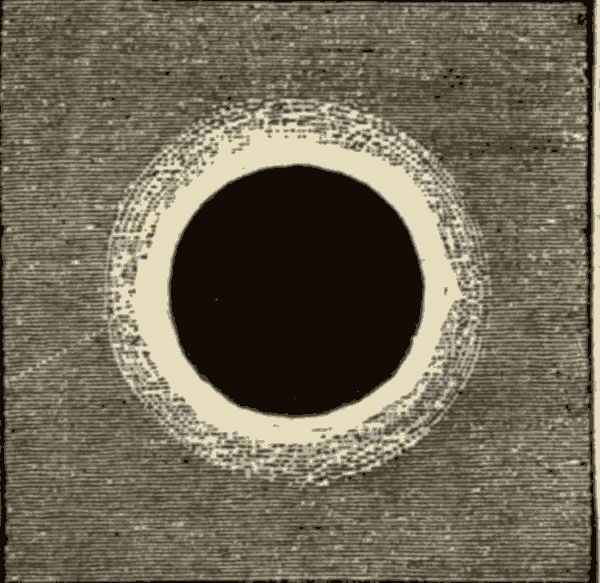
Fig. 262.
Mars.
235. The Orbit of Mars.—The orbit of Mars is more eccentric than that of any of the larger planets, except Mercury; its eccentricity being about one-eleventh. The inclination of the orbit to the ecliptic is somewhat under two degrees. The mean distance of Mars from the sun is about a hundred and forty million miles; but, owing to the eccentricity of his orbit, the distance varies from a hundred and fifty-three million miles to a hundred and twenty-seven million miles.
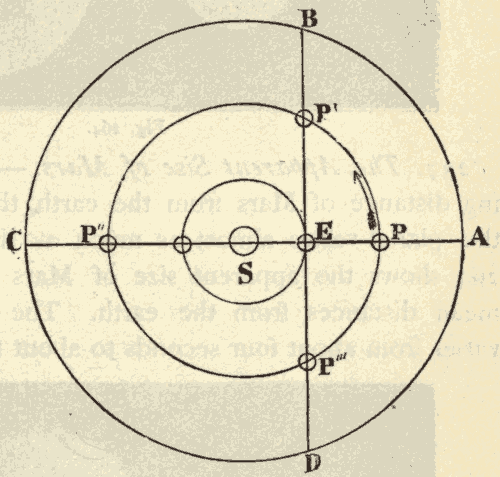
Fig. 263.
236. Distance of Mars from the Earth.—It will be seen, from Fig. 263, that a superior planet (or one outside the orbit of the earth), like Mars, is nearer the earth, by the whole diameter of the earth's orbit, when in opposition than when in conjunction. The mean distance of Mars from the earth, at the time of opposition, is a hundred and forty million miles minus ninety-two million miles, or forty-eight million miles. Owing to the eccentricity of the orbit of the earth and of Mars, the distance of this planet when in opposition varies considerably. When the earth is in aphelion, and Mars in perihelion, at the time of opposition, the distance of the planet from the earth is only about thirty-three million miles. On the other hand, when the earth is in perihelion, and Mars in aphelion, at the time of opposition, the distance of the planet is over sixty-two million miles.
The mean distance of Mars from the earth when in conjunction is a hundred and forty million miles plus ninety-two million miles, or two hundred and thirty-two million miles. It will therefore be seen that Mars is nearly five times as far off at conjunction as at opposition.
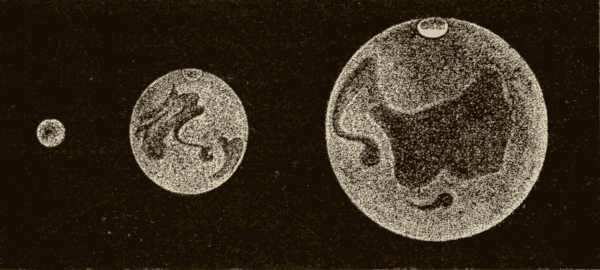
Fig. 264.
237. The Apparent Size of Mars.—Owing to the varying distance of Mars from the earth, the apparent size of the planet varies almost as much as that of Venus. Fig. 264 shows the apparent size of Mars at its extreme and mean distances from the earth. The apparent diameter varies from about four seconds to about thirty seconds.
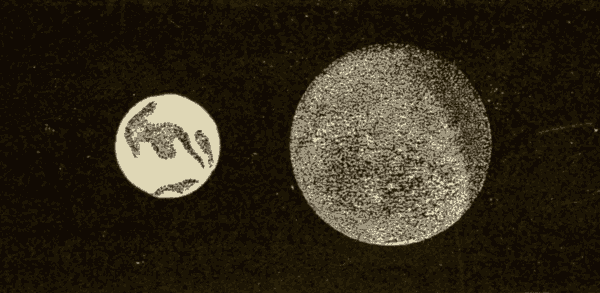
Fig. 265.
238. The Volume and Density of Mars.—Among the larger planets Mars is next in size to Mercury. Its real diameter is somewhat more than four thousand miles, and its bulk is about one-seventh of that of the earth. Its size, compared with that of the earth, is shown in Fig. 265.
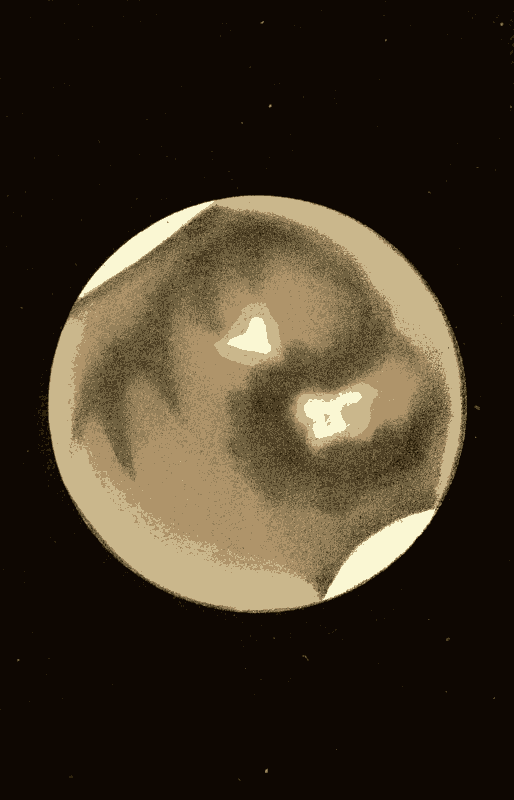
Plate 4.
The density of Mars is only about three-fourths of that of the earth.
239. Sidereal and Synodical Periods of Mars.—The sidereal period of Mars, or the time in which he makes a complete revolution around the sun, is about six hundred and eighty-seven days, or nearly twenty-three months; but he is about seven hundred and eighty days in passing from opposition to opposition again, or in performing a synodical revolution. Mars moves in his orbit at the rate of about fifteen miles a second.
240. Brilliancy of Mars.—When near his opposition, Mars is easily recognized with the naked eye by his fiery-red light. He is much more brilliant at some oppositions than at others, for reasons already explained (236), but always shines brighter than an ordinary star of the first magnitude.
241. Telescopic Appearance of Mars.—When viewed with a good telescope (see Plate IV.), Mars is seen to be covered with dusky, dull-red patches, which are supposed to be continents, like those of our own globe. Other portions, of a greenish hue, are believed to be tracts of water. The ruddy color, which overpowers the green, and makes the whole planet seem red to the naked eye, was believed by Sir J. Herschel to be due to an ochrey tinge in the general soil, like that of the red sandstone districts on the earth. In a telescope, Mars appears less red, and the higher the power the less the intensity of the color. The disk, when well seen, is mapped out in a way which gives at once the impression of land and water. The bright part is red inclining to orange, sometimes dotted with brown and greenish points. The darker spaces, which vary greatly in depth of tone, are of a dull gray-green, having the aspect of a fluid which absorbs the solar rays. The proportion of land to water on the earth appears to be reversed on Mars. On the earth every continent is an island; on Mars all seas are lakes. Long, narrow straits are more common than on the earth; and wide expanses of water, like our Atlantic Ocean, are rare. (See Fig. 266.)
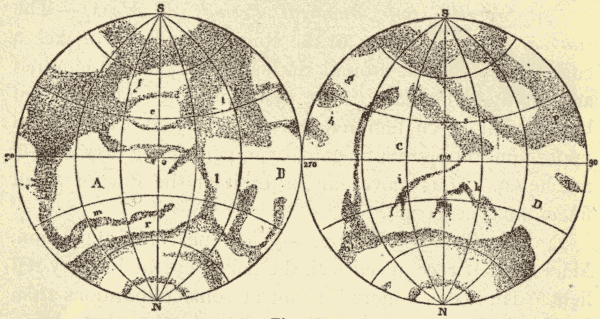
Fig. 266.
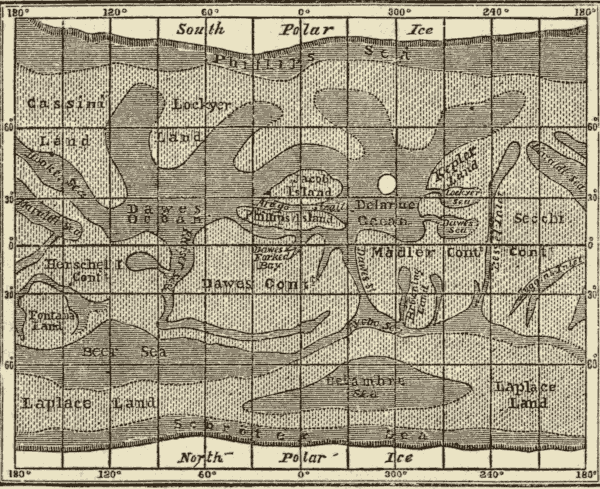
Fig. 267.
Fig. 267 represents a chart of the surface of Mars, which has been constructed from careful telescopic observation. The outlines, as seen in the telescope, are, however, much less distinct than they are represented here; and it is by no means certain that the light and dark portions are bodies of land and water.
In the vicinity of the poles brilliant white spots may be noticed, which are considered by many astronomers to be masses of snow. This conjecture is favored by the fact that they appear to diminish under the sun's influence at the beginning of the Martial summer, and to increase again on the approach of winter.
242. Rotation of Mars.—On watching Mars with a telescope, the spots on the disk are found to move (as shown in Fig. 268) in a manner which indicates that the planet rotates in about twenty-four hours on an axis inclined about twenty-eight degrees from a perpendicular to the plane of its orbit. The inclination of the axis is shown in Fig. 269. It is evident from the figure that the variation in the length of day and night, and the change of seasons, are about the same on Mars as on the earth. The changes will, of course, be somewhat greater, and the seasons will be about twice as long.
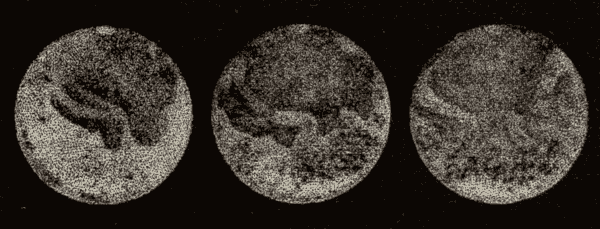
Fig. 268.
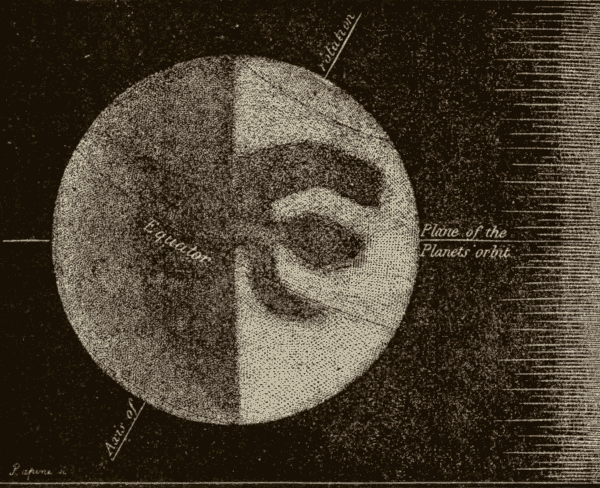
Fig. 269.
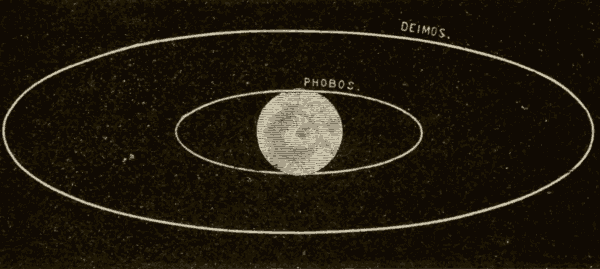
Fig. 270.
243. The Satellites of Mars.—In 1877 Professor Hall of the Washington Observatory discovered that Mars is accompanied by two small moons, whose orbits are shown in Fig. 270. The inner satellite has been named Phobos, and the outer one Deimos. It is estimated that the diameter of the outer moon is from five to ten miles, and that of the inner one from ten to forty miles.
Phobos is remarkable for its nearness to the planet and the rapidity of its revolution, which is performed in seven hours thirty-eight minutes. Its distance from the centre of the planet is about six thousand miles, and from the surface less than four thousand. Astronomers on Mars, with telescopes and eyes like ours, could readily find out whether this satellite is inhabited, the distance being less than one-sixtieth of that of our moon.
It will be seen that Phobos makes about three revolutions to one rotation of the planet. It will, of course, rise in the west; though the sun, the stars, and the other satellite rise in the east. Deimos makes a complete revolution in about thirty hours.
III. THE ASTEROIDS.
244. Bode's Law of Planetary Distances.—There is a very remarkable law connecting the distances of the planets from the sun, which is generally known by the name of Bode's Law. Attention was drawn to it in 1778 by the astronomer Bode, but he was not really its author.
To express this law we write the following series of numbers:—
0, 3, 6, 12, 24, 48, 96;
each number, with the exception of the first, being double the one which precedes it. If we add 4 to each of these numbers, the series becomes—
4, 7, 10, 16, 28, 52, 100;
which series was known to Kepler. These numbers, with the exception of 28, are sensibly proportional to the distances of the principal planets from the sun, the actual distances being as follows:—
Mercury. Venus. Earth. Mars. —— Jupiter. Saturn.
3·9 7·2 10 15·2 52·9 95·4
245. The First Discovery of the Asteroids.—The great gap between Mars and Jupiter led astronomers, from the time of Kepler, to suspect the existence of an unknown planet in this region; but no such planet was discovered till the beginning of the present century. Ceres was discovered Jan. 1, 1801, Pallas in 1802, Juno in 1804, and Vesta in 1807. Then followed a long interval of thirty-eight years before Astræa, the fifth of these minor planets, was discovered in 1845.
246. Olbers's Hypothesis.—After the discovery of Pallas, Olbers suggested his celebrated hypothesis, that the two bodies might be fragments of a single planet which had been shattered by some explosion. If such were the case, the orbits of all the fragments would at first intersect each other at the point where the explosion occurred. He therefore thought it likely that other fragments would be found, especially if a search were kept up near the intersection of the orbits of Ceres and Pallas.
Professor Newcomb makes the following observations concerning this hypothesis:—
"The question whether these bodies could ever have formed a single one has now become one of cosmogony rather than of astronomy. If a planet were shattered, the orbit of each fragment would at first pass through the point at which the explosion occurred, however widely they might be separated through the rest of their course; but, owing to the secular changes produced by the attractions of the other planets, this coincidence would not continue. The orbits would slowly move away, and after the lapse of a few thousand years no trace of a common intersection would be seen. It is therefore curious that Olbers and his contemporaries should have expected to find such a region of intersection, as it implied that the explosion had occurred within a few thousand years. The fact that the required conditions were not fulfilled was no argument against the hypothesis, because the explosion might have occurred millions of years ago; and in the mean time the perihelion and node of each orbit would have made many entire revolutions, so that the orbits would have been completely mixed up.... A different explanation of the group is given by the nebular hypothesis; so that Olbers's hypothesis is no longer considered by astronomers."
247. Later Discoveries of Asteroids.—Since 1845 over two hundred asteroids have been discovered. All these are so small, that it requires a very good telescope to see them; and even in very powerful telescopes they appear as mere points of light, which can be distinguished from the stars only by their motions.
To facilitate the discovery of these bodies, very accurate maps have been constructed, including all the stars down to the thirteenth magnitude in the neighborhood of the ecliptic. A reduced copy of one of these maps is shown in Fig. 271.
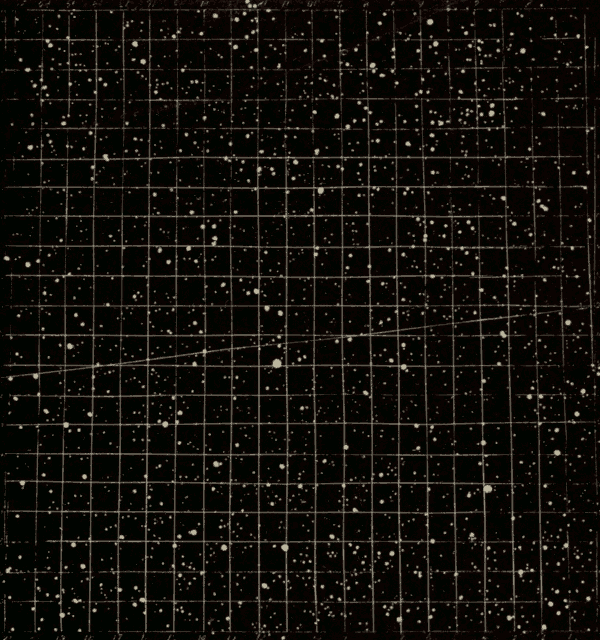
Fig. 271.
Furnished with a map of this kind, and with a telescope powerful enough to show all the stars marked on it, the observer who is searching for these small planets will place in the field of view of his telescope six spider-lines at right angles to each other, and at equal distances apart, in such a manner that several small squares will be formed, embracing just as much of the heavens as do those shown in the map. He will then direct his telescope to the region of the sky he wishes to examine, represented by the map, so as to be able to compare successively each square with the corresponding portion of the sky. Fig. 272 shows at the right hand the squares in the telescopic field of view, and at the left hand the corresponding squares of the map.
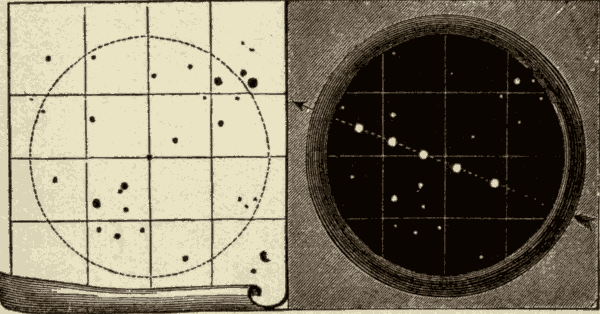
Fig. 272.
He can then assure himself if the numbers and positions of the stars mapped, and of the stars observed, are identical. If he observes in the field of view a luminous point which is not marked in the map, it is evident that either the new body is a star of variable brightness which was not visible at the time the map was made, or it is a planet, or perhaps a comet. If the new body remains fixed at the same point, it is the former; but, if it changes its position with regard to the neighboring stars, it is the latter. The motion is generally so sensible, that in the course of one evening the change of position may be detected; and it can soon be determined, by the direction and rate of the motion, whether the body is a planet or a comet.
IV. OUTER GROUP OF PLANETS.
Jupiter.
248. Orbit of Jupiter.—The orbit of Jupiter is inclined only a little over one degree to the ecliptic; and its eccentricity is only about half of that of Mars, being less than one-twentieth. The mean distance of Jupiter from the sun is about four hundred and eighty million miles; but, owing to the eccentricity of his orbit, his actual distance from the sun ranges from four hundred and fifty-seven to five hundred and three million miles.
249. Distance of Jupiter from the Earth.—When Jupiter is in opposition, his mean distance from the earth is four hundred and eighty million miles minus ninety-two million miles, or three hundred and eighty-eight million miles, and, when he is in conjunction, four hundred and eighty million miles plus ninety-two million miles, or five hundred and seventy-two million miles. It will be seen that he is less than twice as far off in conjunction as in opposition, and that the ratio of his greatest to his least distance is very much less than in the case of Venus and Mars. This is owing to his very much greater distance from the sun. Owing to the eccentricities of the orbits of the earth and of Jupiter, the greatest and least distances of Jupiter from the earth vary somewhat from year to year.
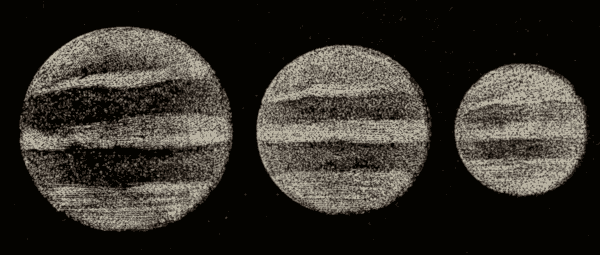
Fig. 273.
250. The Brightness and Apparent Size of Jupiter.—The apparent diameter of Jupiter varies from about fifty seconds to about thirty seconds. His apparent size at his extreme and mean distances from the earth is shown in Fig. 273.
Jupiter shines with a brilliant white light, which exceeds that of every other planet except Venus. The planet is, of course, brightest when near opposition.
251. The Volume and Density of Jupiter.—Jupiter is the "giant planet" of our system, his mass largely exceeding that of all the other planets combined. His mean diameter is about eighty-five thousand miles; but the equatorial exceeds the polar diameter by five thousand miles. In volume he exceeds our earth about thirteen hundred times, but in mass only about two hundred and thirteen times. His specific gravity is, therefore, far less than that of the earth, and even less than that of water. The comparative size of Jupiter and the earth is shown in Fig. 274.
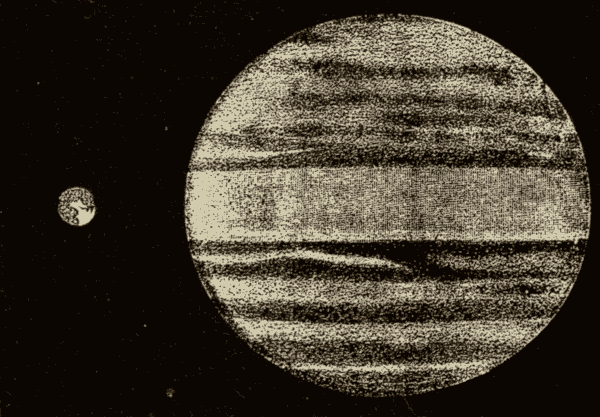
Fig. 274.
252. The Sidereal and Synodical Periods of Jupiter.—It takes Jupiter nearly twelve years to make a sidereal revolution, or a complete revolution around the sun, his orbital motion being at the rate of about eight miles a second. His synodical period, or the time of his passage from opposition to opposition again, is three hundred and ninety-eight days.
253. The Telescopic Aspect of Jupiter.—There are no really permanent markings on the disk of Jupiter; but his surface presents a very diversified appearance. The earlier telescopic observers descried dark belts across it, one north of the equator, and the other south of it. With the increase of telescopic power, it was seen that these bands were of a more complex structure than had been supposed, and consisted of stratified, cloud-like appearances, varying greatly in form and number. These change so rapidly, that the face of the planet rarely presents the same appearance on two successive nights. They are most strongly marked at some distance on each side of the planet's equator, and thus appear as two belts under a low magnifying power.
Both the outlines of the belts, and the color of portions of the planet, are subject to considerable changes. The equatorial regions, and the spaces between the belts generally, are often of a rosy tinge. This color is sometimes strongly marked, while at other times hardly a trace of it can be seen. A general telescopic view of Jupiter is given in Plate V.
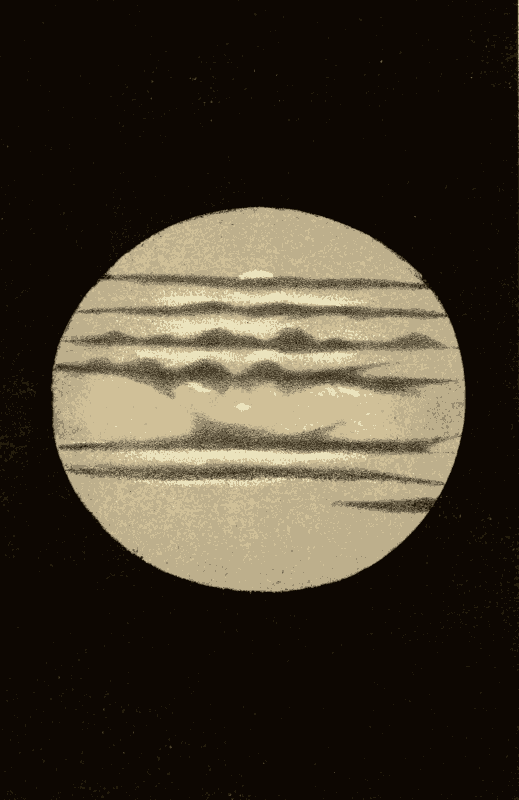
Plate 5.
254. The Physical Constitution of Jupiter.—From the changeability of the belts, and of nearly all the visible features of Jupiter, it is clear that what we see on that planet is not the solid nucleus, but cloud-like formations, which cover the entire surface to a great depth. The planet appears to be covered with a deep and dense atmosphere, filled with thick masses of clouds and vapor. Until recently this cloud-laden atmosphere was supposed to be somewhat like that of our globe; but at present the physical constitution of Jupiter is believed to resemble that of the sun rather than that of the earth. Like the sun, he is brighter in the centre than near the edges, as is shown in the transits of the satellites over his disk. When the satellite first enters on the disk, it commonly seems like a bright spot on a dark background; but, as it approaches the centre, it appears like a dark spot on the bright surface of the planet. The centre is probably two or three times brighter than the edges. This may be, as in the case of the sun, because the light near the edge passes through a greater depth of atmosphere, and is diminished by absorption.
It has also been suspected that Jupiter shines partly by his own light, and not wholly by reflected sunlight. The planet cannot, however, emit any great amount of light; for, if it did, the satellites would shine by this light when they are in the shadow of the planet, whereas they totally disappear. It is possible that the brighter portions of the surface are from time to time slightly self-luminous.
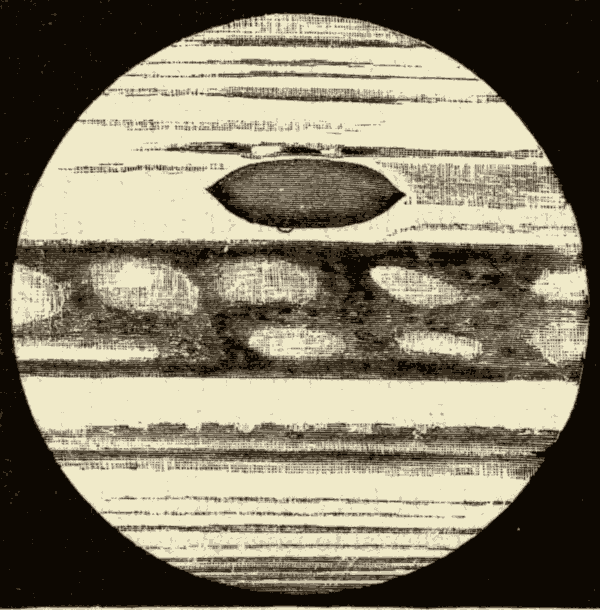
Fig. 275.
Again: the interior of Jupiter seems to be the seat of an activity so enormous that it can be ascribed only to intense heat. Rapid movements are always occurring on his surface, often changing its aspect in a few hours. It is therefore probable that Jupiter is not yet covered by a solid crust, and that the fiery interior, whether liquid or gaseous, is surrounded by the dense vapors which cease to be luminous on rising into the higher and cooler regions of the atmosphere. Figs. 275 and 276 show the disk of Jupiter as it appeared in December, 1881.
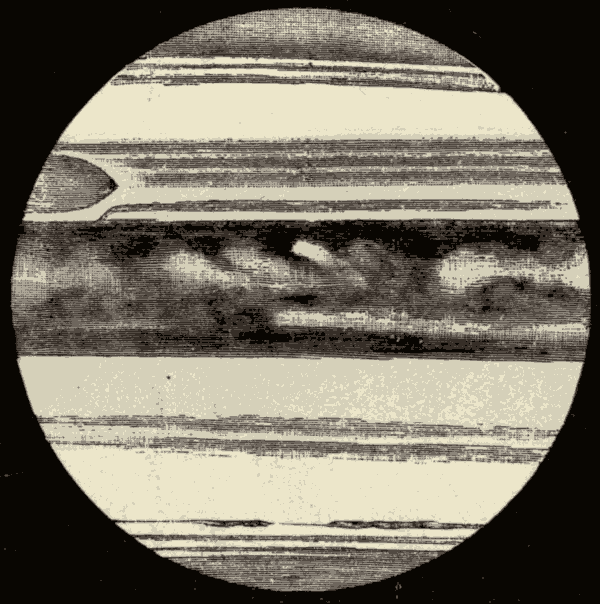
Fig. 276.
255. Rotation of Jupiter.—Spots are sometimes visible which are much more permanent than the ordinary markings on the belts. The most remarkable of these is "the great red spot," which was first observed in July, 1878, and is still to be seen in February, 1882. It is shown just above the centre of the disk in Fig. 275. By watching these spots from day to day, the time of Jupiter's axial rotation has been found to be about nine hours and fifty minutes.
The axis of Jupiter deviates but slightly from a perpendicular to the plane of its orbit, as is shown in Fig. 277.
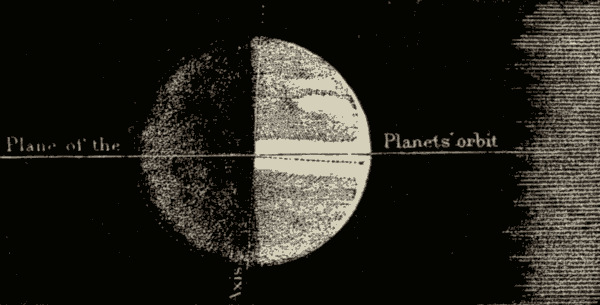
Fig. 277.
THE SATELLITES OF JUPITER.
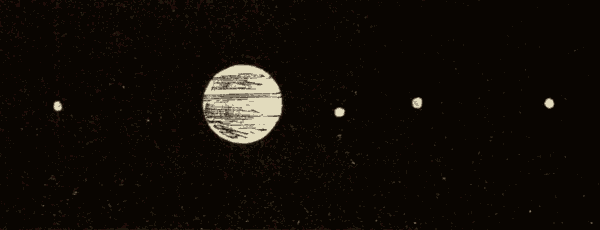
Fig. 278.
256. Jupiter's Four Moons.—Jupiter is accompanied by four moons, as shown in Fig. 278. The diameters of these moons range from about twenty-two hundred to thirty-seven hundred miles. The second from the planet is the smallest, and the third the largest. The smallest is about the size of our moon; the largest considerably exceeds Mercury, and almost rivals Mars, in bulk. The sizes of these moons, compared with those of the earth and its moon, are shown in Fig. 279.
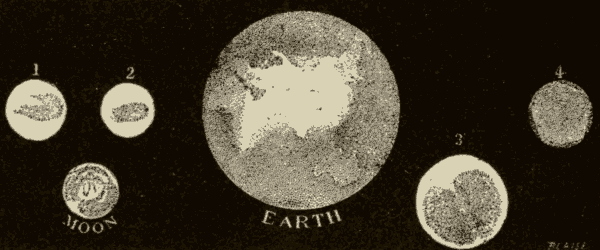
Fig. 279.
The names of these satellites, in the order of their distance from the planet, are Io, Europa, Ganymede, and Callisto. Their times of revolution range from about a day and three-fourths up to about sixteen days and a half. Their orbits are shown in Fig. 280.
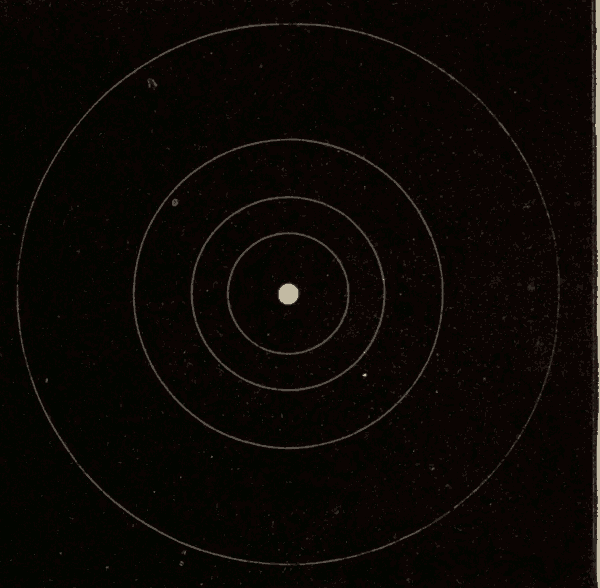
Fig. 280.
257. The Variability of Jupiter's Satellites.—Remarkable variations in the light of these moons have led to the supposition that violent changes are taking place on their surfaces. It was formerly believed, that, like our moon, they always present the same face to the planet, and that the changes in their brilliancy are due to differences in the luminosity of parts of their surface which are successively turned towards us during a revolution; but careful measurements of their light show that this hypothesis does not account for the changes, which are sometimes very sudden. The satellites are too distant for examination of their surfaces with the telescope: hence it is impossible to give any certain explanation of these phenomena.
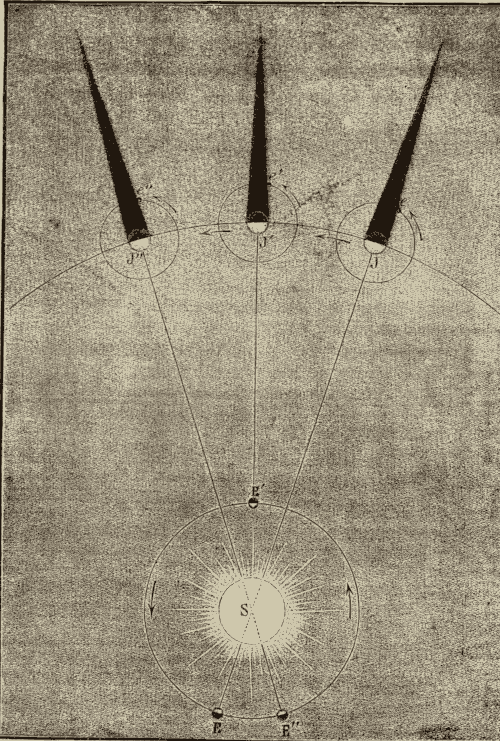
Fig. 281.
258. Eclipses of Jupiter's Satellites.—Jupiter, like the earth, casts a shadow away from the sun, as shown in Fig. 281; and, whenever one of his moons passes into this shadow, it becomes eclipsed. On the other hand, whenever one of the moons throws its shadow on Jupiter, the sun is eclipsed to that part of the planet which lies within the shadow.
To the inhabitants of Jupiter (if there are any, and if they can see through the clouds) these eclipses must be very familiar affairs; for in consequence of the small inclinations of the orbits of the satellites to the planet's equator, and the small inclination of the latter to the plane of Jupiter's orbit, all the satellites, except the most distant one, are eclipsed in every revolution. A spectator on Jupiter might therefore witness during the planetary year forty-five hundred eclipses of the moons, and about the same number of the sun.
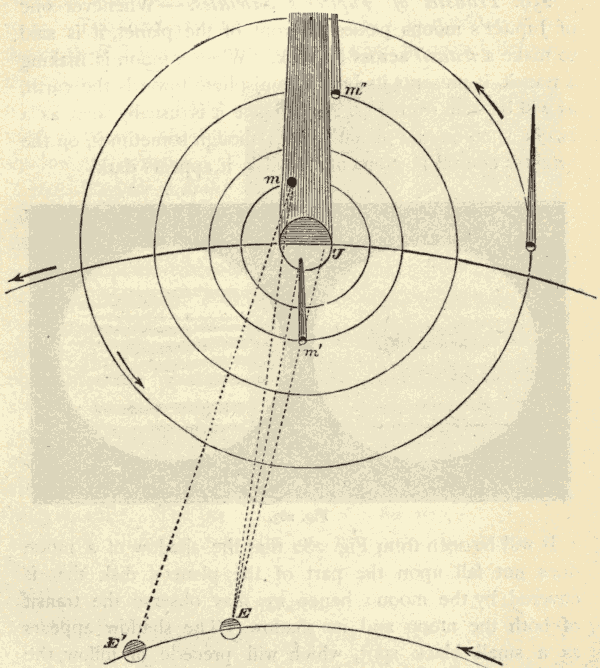
Fig. 282.
259. Transits of Jupiter's Satellites.—Whenever one of Jupiter's moons passes in front of the planet, it is said to make a transit across his disk. When a moon is making a transit, it presents its bright hemisphere towards the earth, as will be seen from Fig. 282: hence it is usually seen as a bright spot on the planet's disk; though sometimes, on the brighter central portions of the disk, it appears dark.
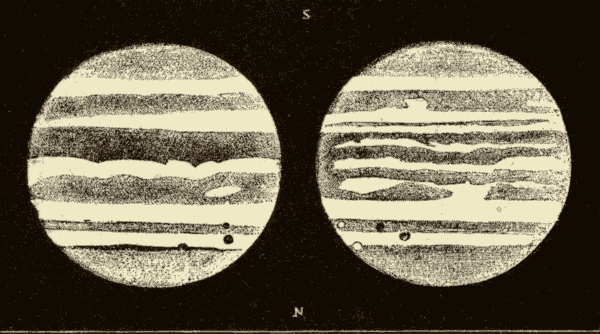
Fig. 283.
It will be seen from Fig. 282 that the shadow of a moon does not fall upon the part of the planet's disk that is covered by the moon: hence we may observe the transit of both the moon and its shadow. The shadow appears as a small black spot, which will precede or follow the moon according to the position of the earth in its orbit. Fig. 283 shows two moons of Jupiter in transit.
260. Occultations of Jupiter's Satellites.—The eclipse of a moon of Jupiter must be carefully distinguished from the occultation of a moon by the planet. In the case of an eclipse, the moon ceases to be visible, because the mass of Jupiter is interposed between the sun and the moon, which ceases to be luminous, because the sun's light is cut off; but, in the case of an occupation, the moon gets into such a position that the body of Jupiter is interposed between it and the earth, thus rendering the moon invisible to us. The third satellite, m'' (Fig. 282), is invisible from the earth E, having become occulted when it passed behind the planet's disk; but it will not be eclipsed until it passes into the shadow of Jupiter.
261. Jupiter without Satellites.—It occasionally happens that every one of Jupiter's satellites will disappear at the same time, either by being eclipsed or occulted, or by being in transit. In this event, Jupiter will appear without satellites. This occurred on the 21st of August, 1867. The position of Jupiter's satellites at this time is shown in Fig. 284.
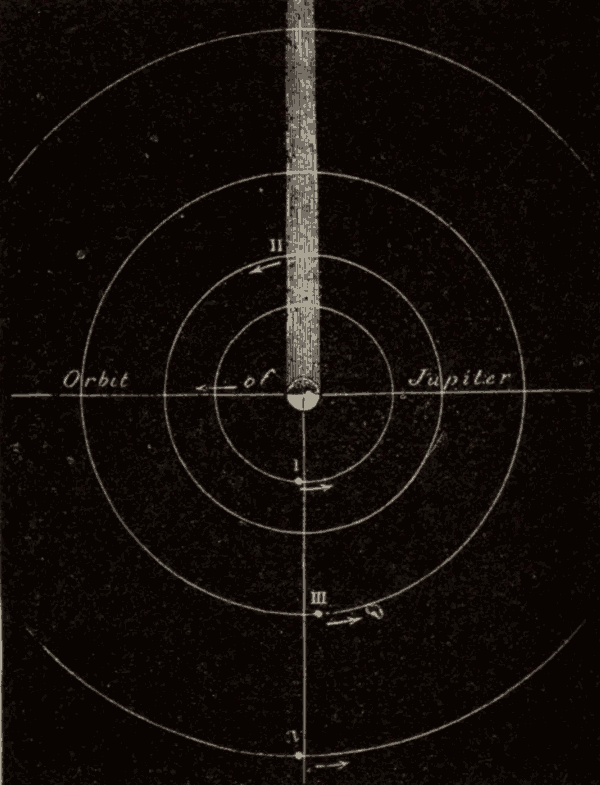
Fig. 284.
Saturn.
THE PLANET AND HIS MOONS.
262. The Orbit of Saturn.—The orbit of Saturn is rather more eccentric than that of Jupiter, its eccentricity being somewhat more than one-twentieth. Its inclination to the ecliptic is about two degrees and a half. The mean distance of Saturn from the sun is about eight hundred and eighty million miles. It is about a hundred million miles nearer the sun at perihelion than at aphelion.
263. Distance of Saturn from the Earth.—The mean distance of Saturn from the earth at opposition is eight hundred and eighty million miles minus ninety-two million miles, or seven hundred and eighty-eight million; and at conjunction, eight hundred and eighty million miles plus ninety-two million, or nine hundred and seventy-two million. Owing to the eccentricity of the orbit of Saturn, his distance from the earth at opposition and at conjunction varies by about a hundred million miles at different times; but he is so immensely far away, that this is only a small fraction of his mean distance.
264. Apparent Size and Brightness of Saturn.—The apparent diameter of Saturn varies from about twenty seconds to about fourteen seconds. His apparent size at his extreme and mean distances from the earth is shown in Fig. 285.
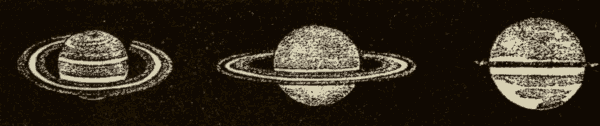
Fig. 285.
The planet generally shines with the brilliancy of a moderate first-magnitude star, and with a dingy, reddish light, as if seen through a smoky atmosphere.
265. Volume and Density of Saturn.—The real diameter of Saturn is about seventy thousand miles, and its volume over seven hundred times that of the earth. The comparative size of the earth and Saturn is shown in Fig. 286. This planet is a little more than half as dense as Jupiter.
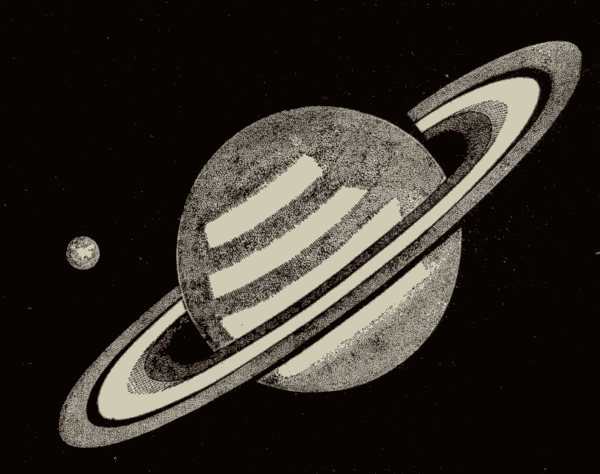
Fig. 286.
266. The Sidereal and Synodical Periods of Saturn.—Saturn makes a complete revolution round the sun in a period of about twenty-nine years and a half, moving in his orbit at the rate of about six miles a second. The planet passes from opposition to opposition again in a period of three hundred and seventy-eight days, or thirteen days over a year.
267. Physical Constitution of Saturn.—The physical constitution of Saturn seems to resemble that of Jupiter; but, being twice as far away, the planet cannot be so well studied. The farther an object is from the sun, the less it is illuminated; and, the farther it is from the earth, the smaller it appears: hence there is a double difficulty in examining the more distant planets. Under favorable circumstances, the surface of Saturn is seen to be diversified with very faint markings; and, with high telescopic powers, two or more very faint streaks, or belts, may be discerned parallel to its equator. These belts, like those of Jupiter, change their aspect from time to time; but they are so faint that the changes cannot be easily followed. It is only on rare occasions that the time of rotation can be determined from a study of the markings.
268. Rotation of Saturn.—On the evening of Dec. 7, 1876, Professor Hall, who had been observing the satellites of Saturn with the great Washington telescope (18), saw a brilliant white spot near the equator of the planet. It seemed as if an immense eruption of incandescent matter had suddenly burst up from the interior. The spot gradually spread itself out into a long light streak, of which the brightest point was near the western end. It remained visible until January, when it became faint and ill-defined, and the planet was lost in the rays of the sun.
From all the observations on this spot, Professor Hall found the period of Saturn to be ten hours fourteen minutes, reckoning by the brightest part of the streak. Had the middle of the streak been taken, the time would have been less, because the bright matter seemed to be carried along in the direction of the planet's rotation. If this motion was due to a wind, the velocity of the current must have been between fifty and a hundred miles an hour. The axis of Saturn is inclined twenty-seven degrees from the perpendicular to its orbit.
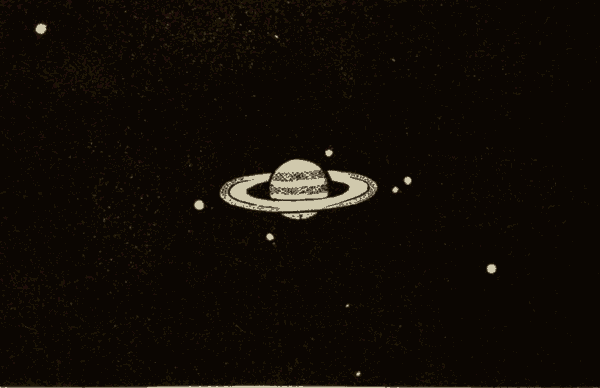
Fig. 287.
269. The Satellites of Saturn.—Saturn is accompanied by eight moons. Seven of these are shown in Fig. 287. The names of these satellites, in the order of their distances from the planet, are given in the accompanying table:—
Number. Name. Distance from Planet Sidereal Period. Discoverer.
1 Mimas 120,800 0 22 37 0.94 Herschel
2 Enceladus 155,000 1 8 53 1.37 Herschel
3 Tethys 191,900 1 21 18 1.88 Cassini