II. THE SOLAR SYSTEM. (continued 2)
Reading edition
(3) Parallactic Libration.—While an observer at the centre of the earth would get the same view of the moon, whether she were on the eastern horizon, in the zenith, or on the western horizon, an observer on the surface of the earth does not get exactly the same view in these three cases. When the moon is on the eastern horizon, an observer on the surface of the earth would see a little farther around on the western limb of the moon than when she is in the zenith, and not quite so far around on the eastern limb. On the contrary, when the moon is on the western horizon, an observer on the surface of the earth sees a little farther around on the eastern limb of the moon than when she is in the zenith, and not quite so far around on her western limb.
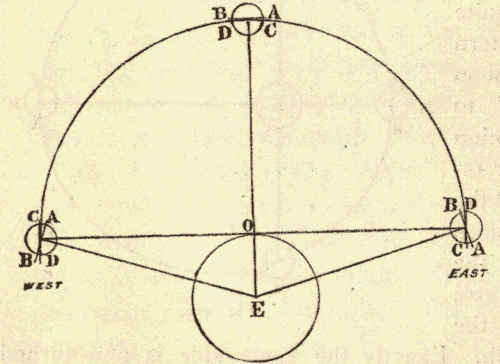
Fig. 120.
This will be evident from Fig. 120. E is the centre of the earth, and O a point on its surface. AB is a line drawn through the centre of the moon, perpendicular to a line joining the centres of the moon and the earth. This line marks off the part of the moon turned towards the centre of the earth, and remains essentially the same during the day. CD is a line drawn through the centre of the moon perpendicular to a line joining the centre of the moon and the point of observation. This line marks off the part of the moon turned towards O. When the moon is in the zenith, CD coincides with AB; but, when the moon is on the horizon, CD is inclined to AB. When the moon is on the eastern horizon, an observer at O sees a little beyond B, and not quite to A; and, when she is on the western horizon, he sees a little beyond A, and not quite to B. B is on the western limb of the moon, and A on her eastern limb.
Since this libration is due to the point from which the moon is viewed, it is called parallactic libration; and, since it occurs daily, it is called diurnal libration.
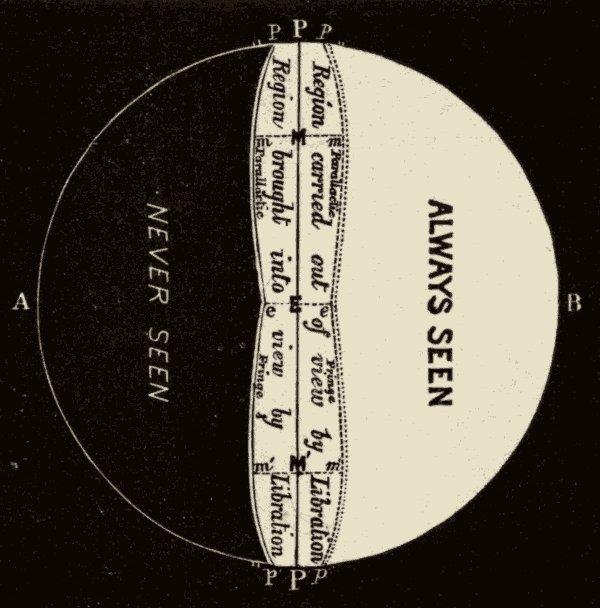
Fig. 121.
107. Portion of the Lunar Surface brought into View by Libration.—The area brought into view by the first two librations is between one-twelfth and one-thirteenth of the whole lunar surface, or nearly one-sixth of the hemisphere of the moon which is turned away from the earth when the moon is at her state of mean libration. Of course a precisely equal portion of the hemisphere turned towards us during mean libration is carried out of view by the lunar librations.
If we add to each of these areas a fringe about one degree wide, due to the diurnal libration, and which we may call the parallactic fringe, we shall find that the total area brought into view is almost exactly one-eleventh part of the whole surface of the moon. A similar area is carried out of view; so that the whole region thus swayed out of and into view amounts to two-elevenths of the moon's surface. This area is shown in Fig. 121, which is a side view of the moon.
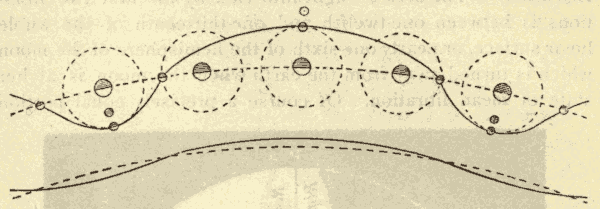
Fig. 122.
108. The Moon's Path through Space.—Were the earth stationary, the moon would describe an ellipse around it similar to that of Fig. 113; but, as the earth moves forward in her orbit at the same time that the moon revolves around it, the moon is made to describe a sinuous path, as shown by the continuous line in Fig. 122. This feature of the moon's path is greatly exaggerated in the upper portion of the diagram. The form of her path is given with a greater degree of accuracy in the lower part of the figure (the broken line represents the path of the earth); but even here there is considerable exaggeration. The complete serpentine path of the moon around the sun is shown, greatly exaggerated, in Fig. 123, the broken line being the path of the earth.
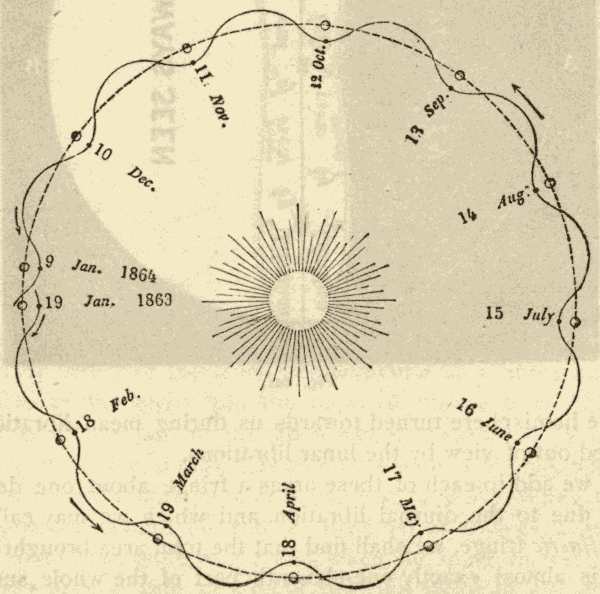
Fig. 123.
The path described by the moon through space is much the same as that described by a point on the circumference of a wheel which is rolled over another wheel. If we place a circular disk against the wall, and carefully roll along its edge another circular disk (to which a piece of lead pencil has been fastened so as to mark upon the wall), the curve described will somewhat resemble that described by the moon. This curve is called an epicycloid, and it will be seen that at every point it is concave towards the centre of the larger disk. In the same way the moon's orbit is at every point concave towards the sun.
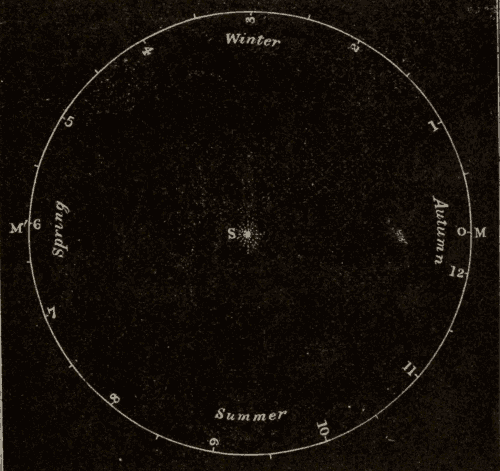
Fig. 124.
The exaggeration of the sinuosity in Fig. 123 will be more evident when it is stated, that, on the scale of Fig. 124, the whole of the serpentine curve would lie within the breadth of the fine circular line MM'.
109. The Lunar Day.—The lunar day is twenty-nine times and a half as long as the terrestrial day. Near the moon's equator the sun shines without intermission nearly fifteen of our days, and is absent for the same length of time. Consequently, the vicissitudes of temperature to which the surface is exposed must be very great. During the long lunar night the temperature of a body on the moon's surface would probably fall lower than is ever known on the earth, while during the day it must rise higher than anywhere on our planet.
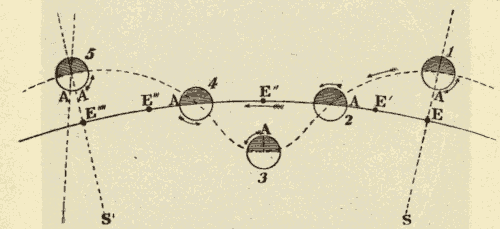
Fig. 125.
It might seem, that, since the moon rotates on her axis in about twenty-seven days, the lunar day ought to be twenty-seven days long, instead of twenty-nine. There is, however, a solar, as well as a sidereal, day at the moon, as on the earth; and the solar day at the moon is longer than the sidereal day, for the same reason as on the earth. During the solar day the moon must make both a synodical rotation and a synodical revolution. This will be evident from Fig. 125, in which is shown the path of the moon during one complete lunation. E, E', E'', etc., are the successive positions of the earth; and 1, 2, 3, 4, 5, the successive positions of the moon. The small arrows indicate the direction of the moon's rotation. The moon is full at 1 and 5. At 1, A, at the centre of the moon's disk, will have the sun, which lies in the direction AS, upon the meridian. Before A will again have the sun on the meridian, the moon must have made a synodical revolution; and, as will be seen by the dotted lines, she must have made more than a complete rotation. The rotation which brings the point A into the same relation to the earth and sun is called a synodical rotation.
It will also be evident from this diagram that the moon must make a synodical rotation during a synodical revolution, in order always to present the same side to the earth.
110. The Earth as seen from the Moon.—To an observer on the moon, the earth would be an immense moon, going through the same phases that the moon does to us; but, instead of rising and setting, it would only oscillate to and fro through a few degrees. On the other side of the moon it would never be seen at all. The peculiarities of the moon's motions which cause the librations, and make a spot on the moon's disk seem to an observer on the earth to oscillate to and fro, would cause the earth as a whole to appear to a lunar observer to oscillate to and fro in the heavens in a similar manner.
It is a well-known fact, that, at the time of new moon, the dark part of the moon's surface is partially illumined, so that it becomes visible to the naked eye. This must be due to the light reflected to the moon from the earth. Since at new moon the moon is between the earth and sun, it follows, that, when it is new moon at the earth, it must be full earth at the moon: hence, while the bright crescent is enjoying full sunlight, the dark part of its surface is enjoying the light of the full earth. Fig. 126 represents the full earth as seen from the moon.
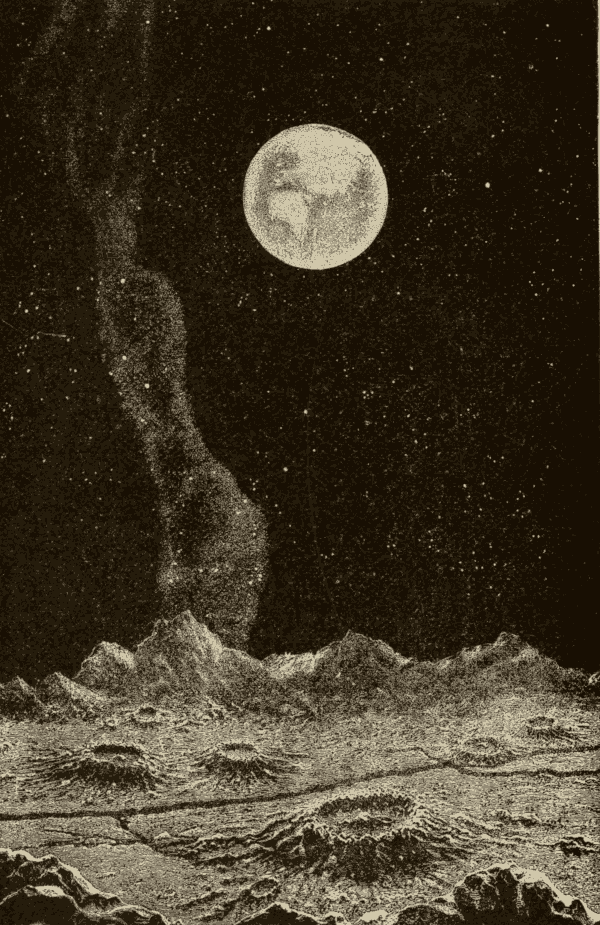
Fig. 126.
The Atmosphere of the Moon.
111. The Moon has no Appreciable Atmosphere.—There are several reasons for believing that the moon has little or no atmosphere.
(1) Had the moon an atmosphere, it would be indicated at the time of a solar eclipse, when the moon passes over the disk of the sun. If the atmosphere were of any considerable density, it would absorb a part of the sun's rays, so as to produce a dusky border in front of the moon's disk, as shown in Fig. 127. In reality no such dusky border is ever seen; but the limb of the moon appears sharp, and clearly defined, as in Fig. 128.
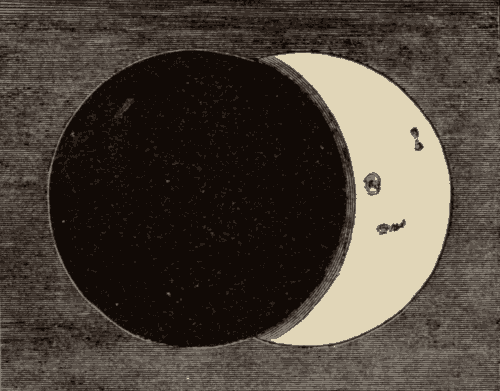
Fig. 127.
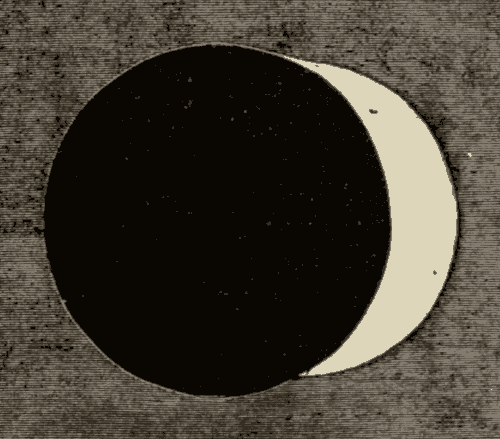
Fig. 128.
If the atmosphere were not dense enough to produce this dusky border, its refraction would be sufficient to distort the delicate cusps of the sun's crescent in the manner shown at the top of Fig. 125; but no such distortion is ever observed. The cusps always appear clear and sharp, as shown at the bottom of the figure: hence it would seem that there can be no atmosphere of appreciable density at the moon.
(2) The absence of an atmosphere from the moon is also shown by the absence of twilight and of diffused daylight.
Upon the earth, twilight continues until the sun is eighteen degrees below the horizon; that is, day and night are separated by a belt twelve hundred miles in breadth, in which the transition from light to darkness is gradual. We have seen (66) that this twilight results from the refraction and reflection of light by our atmosphere; and, if the moon had an atmosphere, we should notice a similar gradual transition from the bright to the dark portions of her surface. Such, however, is not the case. The boundary between the light and darkness, though irregular, is sharply defined. Close to this boundary the unillumined portion of the moon appears just as dark as at any distance from it.
The shadows on the moon are also pitchy black, without a trace of diffused daylight.
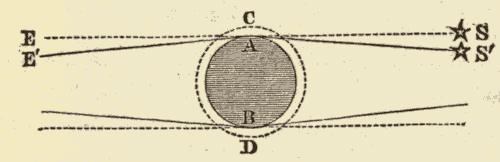
Fig. 129.
(3) The absence of an atmosphere is also proved by the absence of refraction when the moon passes between us and the stars. Let AB (Fig. 129) represent the disk of the moon, and CD an atmosphere supposed to surround it. Let SAE represent a straight line from the earth, touching the moon at A, and let S be a star situated in the direction of this line. If the moon had no atmosphere, this star would appear to touch the edge of the moon at A; but, if the moon had an atmosphere, a star behind the edge of the moon, at S', would be visible at the earth; for the ray S'A would be bent by the atmosphere into the direction AE'. So, also, on the opposite side of the moon, a star might be seen at the earth, although really behind the edge of the moon: hence, if the moon had an atmosphere, the time during which a star would be concealed by the moon would be less than if it had no atmosphere, and the amount of this effect must be proportional to the density of the atmosphere.
The moon, in her orbital course across the heavens, is continually passing before, or occulting, some of the stars that so thickly stud her apparent path; and when we see a star thus pass behind the lunar disk on one side, and come out again on the other side, we are virtually observing the setting and rising of that star upon the moon. The moon's apparent diameter has been measured over and over again, and is known with great accuracy; the rate of her motion across the sky is also known with perfect accuracy: hence it is easy to calculate how long the moon will take to travel across a part of the sky exactly equal in length to her own diameter. Supposing, then, that we observe a star pass behind the moon, and out again, it is clear, that, if there is no atmosphere, the interval of time during which it remains occulted ought to be exactly equal to the computed time which the moon would take to pass over the star. If, however, from the existence of a lunar atmosphere, the star disappears too late, and re-appears too soon, as we have seen it would, these two intervals will not agree; the computed time will be greater than the observed time, and the difference will represent the amount of refraction the star's light has sustained or suffered, and hence the extent of atmosphere it has had to pass through.
Comparisons of these two intervals of time have been repeatedly made, the most extensive being executed under the direction of the Astronomer Royal of England, several years ago, and based upon no less than two hundred and ninety-six occultation observations. In this determination the measured or telescopic diameter of the moon was compared with the diameter deduced from the occultations; and it was found that the telescopic diameter was greater than the occultation diameter by two seconds of angular measurement, or by about a thousandth part of the whole diameter of the moon. This discrepancy is probably due, in part at least, to irradiation (91), which augments the apparent size of the moon, as seen in the telescope as well as with the naked eye; but, if the whole two seconds were caused by atmospheric refraction, this would imply a horizontal refraction of one second, which is only one two-thousandth of the earth's horizontal refraction. It is possible that an atmosphere competent to produce this refraction would not make itself visible in any other way.
But an atmosphere two thousand times rarer than our air can scarcely be regarded as an atmosphere at all. The contents of an air-pump receiver can seldom be rarefied to a greater extent than to about a thousandth of the density of air at the earth's surface; and the lunar atmosphere, if it exists at all, is thus proved to be twice as attenuated as what we commonly call a vacuum.
The Surface of the Moon.
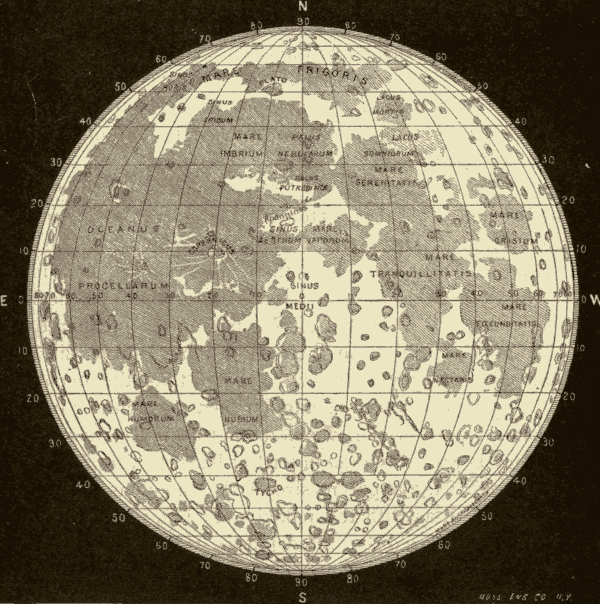
Fig. 130.
112. Dusky Patches on the Disk of the Moon.—With the naked eye, large dusky patches are seen on the moon, in which popular fancy has detected a resemblance to a human face. With a telescope of low power, these dark patches appear as smooth as water, and they were once supposed to be seas. This theory was the origin of the name mare (Latin for sea), which is still applied to the larger of these plains; but, if there were water on the surface of the moon, it could not fail to manifest its presence by its vapor, which would form an appreciable atmosphere. Moreover, with a high telescopic power, these plains present a more or less uneven surface; and, as the elevations and depressions are found to be permanent, they cannot, of course, belong to the surface of water.
The chief of these plains are shown in Fig. 130. They are Mare Crisium, Mare Foecunditatis, Mare Nectaris, Mare Tranquillitatis, Mare Serenitatis, Mare Imbrium, Mare Frigoris, and Oceanus Procellarum. All these plains can easily be recognized on the surface of the full moon with the unaided eye.
113. The Terminator of the Moon.—The terminator of the moon is the line which separates the bright and dark portions of its disk. When viewed with a telescope of even moderate power, the terminator is seen to be very irregular and uneven. Many bright points are seen just outside of the terminator in the dark portion of the disk, while all along in the neighborhood of the terminator are bright patches and dense shadows. These appearances are shown in Figs. 131 and 132, which represent the moon near the first and last quarters. They indicate that the surface of the moon is very rough and uneven.
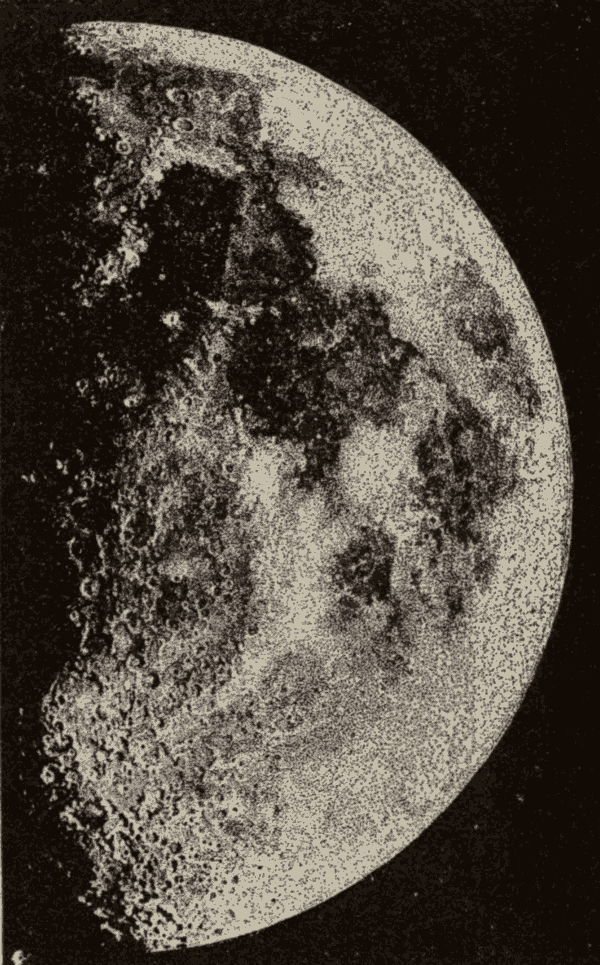
Fig. 131.
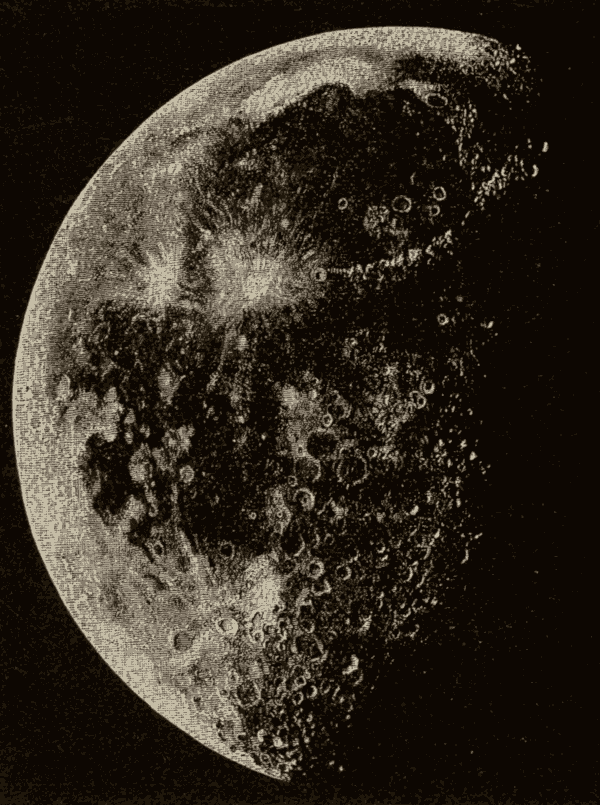
Fig. 132.
As it is always either sunrise or sunset along the terminator, the bright spots outside of it are clearly the tops of mountains, which catch the rays of the sun while their bases are in the shade. The bright patches in the neighborhood of the terminator are the sides of hills and mountains which are receiving the full light of the sun, while the dense shadows near by are cast by these elevations.
114. Height of the Lunar Mountains.—There are two methods of finding the height of lunar mountains:—
(1) We may measure the length of the shadows, and then calculate the height of the mountains that would cast such shadows with the sun at the required height above the horizon.
The length of a shadow may be obtained by the following method: the longitudinal wire of the micrometer (19) is adjusted so as to pass through the shadow whose length is to be measured, and the transverse wires are placed one at each end of the shadow, as shown in Fig. 133. The micrometer screw is then turned till the wires are brought together, so as to ascertain the length of the arc between them. We may then form the proportion: the number of seconds in the semi-diameter of the moon is to the number of seconds in the length of the shadow, as the length of the moon's radius in miles to the length of the shadow in miles.
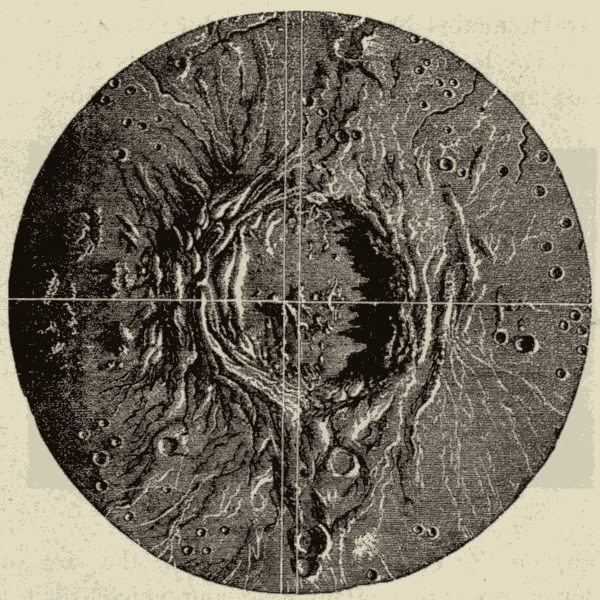
Fig. 133.
The height of the sun above the horizon is ascertained by measuring the angular distance of the mountain from the terminator.
(2) We may measure the distance of a bright point from the terminator, and then construct a right-angled triangle, as shown in Fig. 134. A solution of this triangle will enable us to ascertain the height of the mountain whose top is just catching the level rays of the sun.
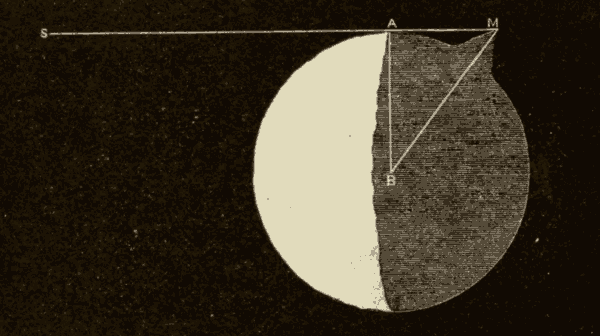
Fig. 134.
B is the centre of the moon, M the top of the mountain, and SAM a ray of sunlight which just grazes the terminator at A, and then strikes the top of the mountain at M. The triangle BAM is right-angled at A. BA is the radius of the moon, and AM is known by measurement; BM, the hypothenuse, may then be found by computation. BM is evidently equal to the radius of the moon plus the height of the mountain.
By one or the other of these methods, the heights of the lunar mountains have been found with a great degree of accuracy. It is claimed that the heights of the lunar mountains are more accurately known than those of the mountains on the earth. Compared with the size of the moon, lunar mountains attain a greater height than those on the earth.
115. General Aspect of the Lunar Surface.—A cursory examination of the moon with a low power is sufficient to show the prevalence of crater-like inequalities and the general tendency to circular shape which is apparent in nearly all the surface markings; for even the large "seas" and the smaller patches of the same character repeat in their outlines the round form of the craters. It is along the terminator that we see these crater-like spots to the best advantage; as it is there that the rising or setting sun casts long shadows over the lunar landscape, and brings elevations into bold relief. They vary greatly in size; some being so large as to bear a sensible proportion to the moon's diameter, while the smallest are so minute as to need the most powerful telescopes and the finest conditions of atmosphere to perceive them.
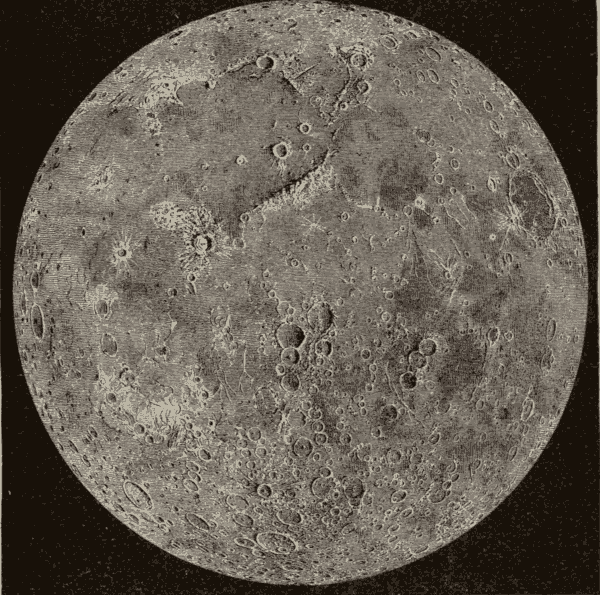
Fig. 135.
The prevalence of ring-shaped mountains and plains will be evident from Fig. 135, which is from a photograph of a model of the moon constructed by Nasmyth.
This same feature is nearly as marked in Figs. 131 and 132, which are copies of Rutherfurd's photographs of the moon.
116. Lunar Craters.—The smaller saucer-shaped formations on the surface of the moon are called craters. They are of all sizes, from a mile to a hundred and fifty miles in diameter; and they are supposed to be of volcanic origin. A high telescopic power shows that these craters vary remarkably, not only in size, but also in structure and arrangement. Some are considerably elevated above the surrounding surface, others are basins hollowed out of that surface, and with low surrounding ramparts; some are like walled plains, while the majority have their lowest depression considerably below the surrounding surface; some are isolated upon the plains, others are thickly crowded together, overlapping and intruding upon each other; some have elevated peaks or cones in their centres, and some are without these central cones, while others, again, contain several minute craters instead; some have their ramparts whole and perfect, others have them broken or deformed, and many have them divided into terraces, especially on their inner sides.
A typical lunar crater is shown in Fig. 136.
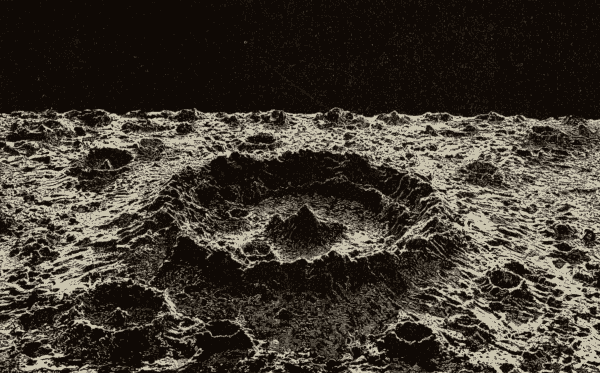
Fig. 136.
It is not generally believed that any active volcanoes exist on the moon at the present time, though some observers have thought they discerned indications of such volcanoes.
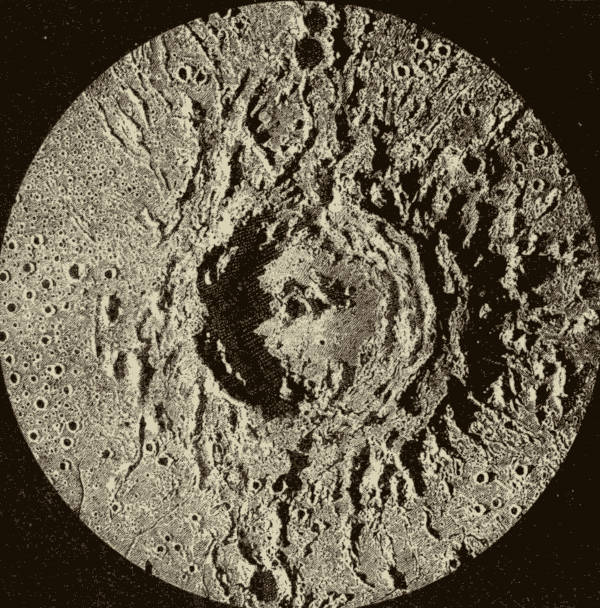
Fig. 137.
117. Copernicus.—This is one of the grandest of lunar craters (Fig. 137). Although its diameter (forty-six miles) is exceeded by others, yet, taken as a whole, it forms one of the most impressive and interesting objects of its class. Its situation, near the centre of the lunar disk, renders all its wonderful details conspicuous, as well as those of objects immediately surrounding it. Its vast rampart rises to upwards of twelve thousand feet above the level of the plateau, nearly in the centre of which stands a magnificent group of cones, three of which attain a height of more than twenty-four hundred feet.
Many ridges, or spurs, may be observed leading away from the outer banks of the great rampart. Around the crater, extending to a distance of more than a hundred miles on every side, there is a complex network of bright streaks, which diverge in all directions. These streaks do not appear in the figure, nor are they seen upon the moon, except at and near the full phase. They show conspicuously, however, by their united lustre on the full moon.
This crater is seen just to the south-west of the large dusky plain in the upper part of Fig. 132. This plain is Mare Imbrium, and the mountain-chain seen a little to the right of Copernicus is named the Apennines. Copernicus is also seen in Fig. 135, a little to the left of the same range.
Under circumstances specially favorable, myriads of comparatively minute but perfectly formed craters may be observed for more than seventy miles on all sides around Copernicus. The district on the south-east side is specially rich in these thickly scattered craters, which we have reason to suppose stand over or upon the bright streaks.
118. Dark Chasms.—Dark cracks, or chasms, have been observed on various parts of the moon's surface. They sometimes occur singly, and sometimes in groups. They are often seen to radiate from some central cone, and they appear to be of volcanic origin. They have been called canals and rills.
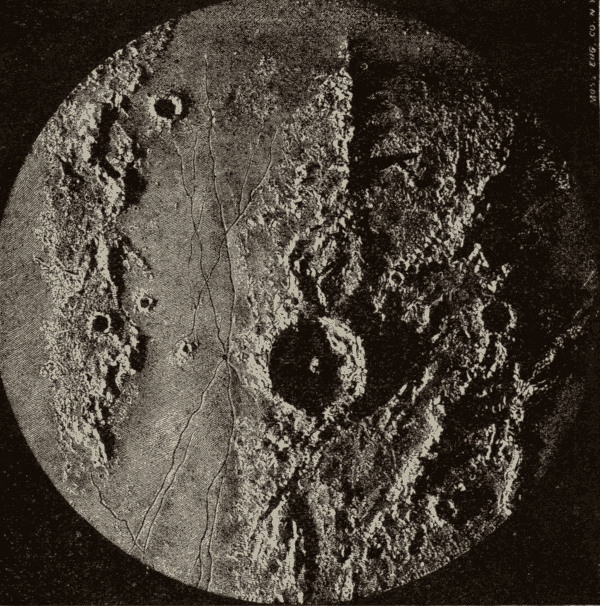
Fig. 138.
One of the most remarkable groups of these chasms is that to the west of the crater named Triesneker. The crater and the chasms are shown in Fig. 138. Several of these great cracks obviously diverge from a small crater near the west bank of the great one, and they subdivide as they extend from the apparent point of divergence, while they are crossed by others. These cracks, or chasms, are nearly a mile broad at the widest part, and, after extending full a hundred miles, taper away till they become invisible.
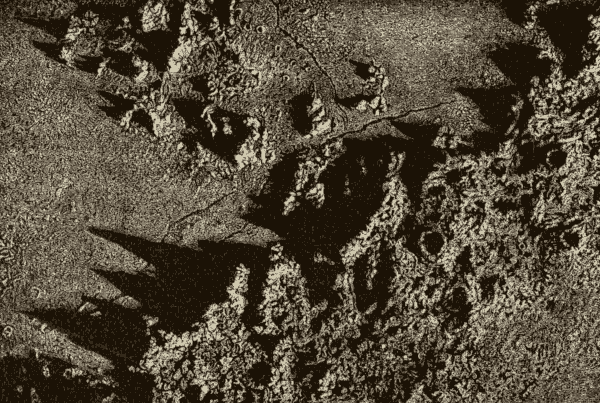
Fig. 139.
119. Mountain-Ranges.—There are comparatively few mountain-ranges on the moon. The three most conspicuous are those which partially enclose Mare Imbrium; namely, the Apennines on the south, and the Caucasus and the Alps on the east and north-east. The Apennines are the most extended of these, having a length of about four hundred and fifty miles. They rise gradually, from a comparatively level surface towards the south-west, in the form of innumerable small elevations, which increase in number and height towards the north-east, where they culminate in a range of peaks whose altitude and rugged aspect must form one of the most terribly grand and romantic scenes which imagination can conceive. The north-east face of the range terminates abruptly in an almost vertical precipice; while over the plain beneath, intensely black spire-like shadows are cast, some of which at sunrise extend full ninety miles, till they lose themselves in the general shading due to the curvature of the lunar surface. Many of the peaks rise to heights of from eighteen thousand to twenty thousand feet above the plain at their north-east base (Fig. 139).
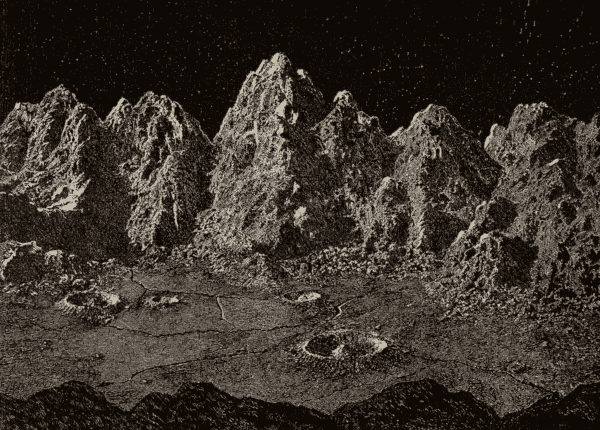
Fig. 140.
Fig. 140 represents an ideal lunar landscape near the base of such a lunar range. Owing to the absence of an atmosphere, the stars will be visible in full daylight.
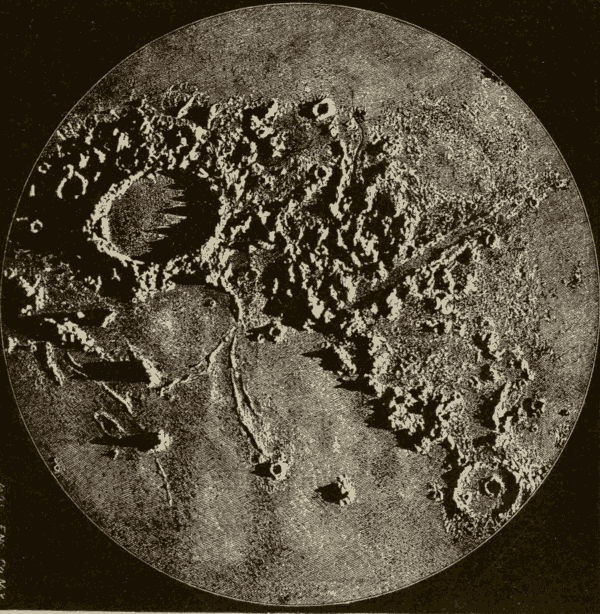
Fig. 141.
120. The Valley of the Alps.—The range of the Alps is shown in Fig. 141. The great crater at the north end of this range is named Plato. It is seventy miles in diameter.
The most remarkable feature of the Alps is the valley near the centre of the range. It is more than seventy-five miles long, and about six miles wide at the broadest part. When examined under favorable circumstances, with a high magnifying power, it is seen to be a vast flat-bottomed valley, bordered by gigantic mountains, some of which attain heights of ten thousand feet or more.
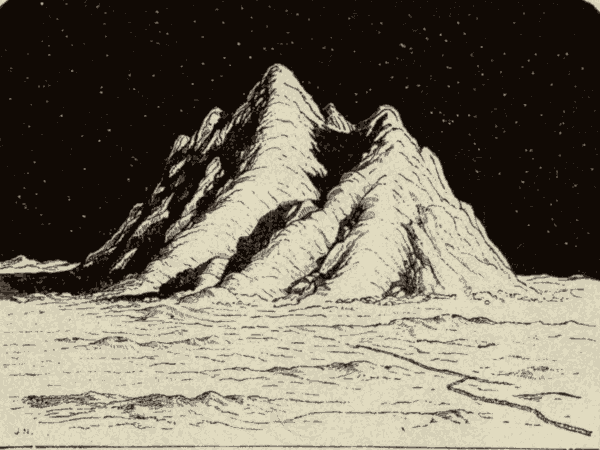
Fig. 142.
121. Isolated Peaks.—There are comparatively few isolated peaks to be found on the surface of the moon. One of the most remarkable of these is that known as Pico, and shown in Fig. 142. Its height exceeds eight thousand feet, and it is about three times as long at the base as it is broad. The summit is cleft into three peaks, as is shown by the three-peaked shadow it casts on the plain.
122. Bright Rays.—About the time of full moon, with a telescope of moderate power, a number of bright lines may be seen radiating from several of the lunar craters, extending often to the distance of hundreds of miles. These streaks do not arise from any perceptible difference of level of the surface, they have no very definite outline, and they do not present any sloping sides to catch more sunlight, and thus shine brighter, than the general surface. Indeed, one great peculiarity of them is, that they come out most forcibly when the sun is shining perpendicularly upon them: hence they are best seen when the moon is at full, and they are not visible at all at those regions upon which the sun is rising or setting. They are not diverted by elevations in their path, but traverse in their course craters, mountains, and plains alike, giving a slight additional brightness to all objects over which they pass, but producing no other effect upon them. "They look as if, after the whole surface of the moon had assumed its final configuration, a vast brush charged with a whitish pigment had been drawn over the globe in straight lines, radiating from a central point, leaving its trail upon every thing it touched, but obscuring nothing."
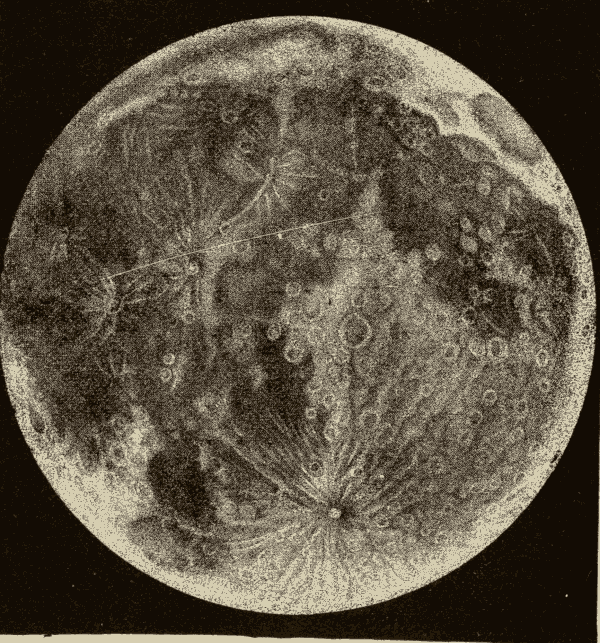
Fig. 143.
The three most conspicuous craters from which these lines radiate are Tycho, Copernicus, and Kepler. Tycho is seen at the bottom of Figs. 143 and 130. Kepler is a little to the left of Copernicus in the same figures.
It has been thought that these bright streaks are chasms which have been filled with molten lava, which, on cooling, would afford a smooth reflecting surface on the top.
123. Tycho.—This crater is fifty-four miles in diameter, and about sixteen thousand feet deep, from the highest ridge of the rampart to the surface of the plateau, whence rises a central cone five thousand feet high. It is one of the most conspicuous of all the lunar craters; not so much on account of its dimensions as from its being the centre from whence diverge those remarkable bright streaks, many of which may be traced over a thousand miles of the moon's surface (Fig. 143). Tycho appears to be an instance of a vast disruptive action which rent the solid crust of the moon into radiating fissures, which were subsequently filled with molten matter, whose superior luminosity marks the course of the cracks in all directions from the crater as their common centre. So numerous are these bright streaks when examined by the aid of the telescope, and they give to this region of the moon's surface such increased luminosity, that, when viewed as a whole, the locality can be distinctly seen at full moon by the unassisted eye, as a bright patch of light on the southern portion of the disk.
III. INFERIOR AND SUPERIOR PLANETS.
Inferior Planets.
124. The Inferior Planets.—The inferior planets are those which lie between the earth and the sun, and whose orbits are included by that of the earth. They are Mercury and Venus.
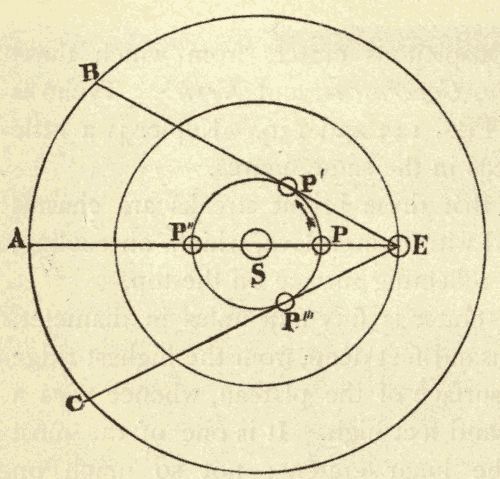
Fig. 144.
125. Aspects of an Inferior Planet.—The four chief aspects of an inferior planet as seen from the earth are shown in Fig. 144, in which S represents the sun, P the planet, and E the earth.
When the planet is between the earth and the sun, as at P, it is said to be in inferior conjunction.
When it is in the same direction as the sun, but beyond it, as at P'', it is said to be in superior conjunction.
When the planet is at such a point in its orbit that a line drawn from the earth to it would be tangent to the orbit, as at P' and P''', it is said to be at its greatest elongation.
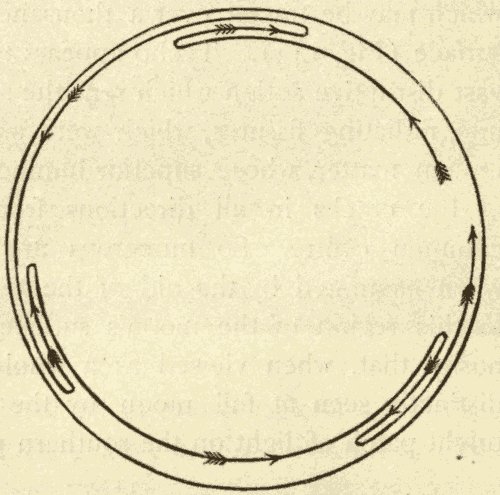
Fig. 145.
126. Apparent Motion of an Inferior Planet.—When the planet is at P, if it could be seen at all, it would appear in the heavens at A. As it moves from P to P', it will appear to move in the heavens from A to B. Then, as it moves from P' to P'', it will appear to move back again from B to A. While it moves from P'' to P''', it will appear to move from A to C; and, while moving from P''' to P, it will appear to move back again from C to A. Thus the planet will appear to oscillate to and fro across the sun from B to C, never getting farther from the sun than B on the west, or C on the east: hence, when at these points, it is said to be at its greatest western and eastern elongations. This oscillating motion of an inferior planet across the sun, combined with the sun's motion among the stars, causes the planet to describe a path among the stars similar to that shown in Fig. 145.
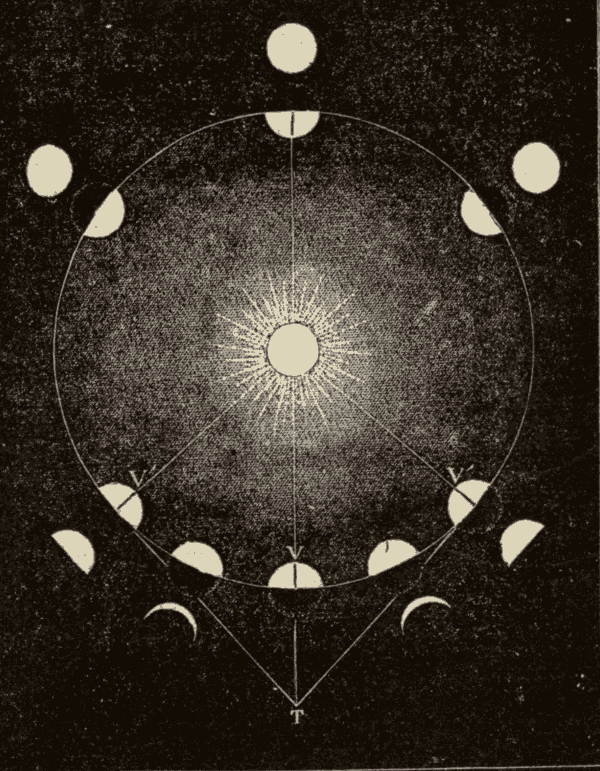
Fig. 146.
127. Phases of an Inferior Planet.—An inferior planet, when viewed with a telescope, is found to present a succession of phases similar to those of the moon. The reason of this is evident from Fig. 146. As an inferior planet passes around the sun, it presents sometimes more and sometimes less of its bright hemisphere to the earth. When the earth is at T, and Venus at superior conjunction, the planet turns the whole of its bright hemisphere towards the earth, and appears full; it then becomes gibbous, half, and crescent. When it comes into inferior conjunction, it turns its dark hemisphere towards the earth: it then becomes crescent, half, gibbous, and full again.
128. The Sidereal and Synodical Periods of an Inferior Planet.—The time it takes a planet to make a complete revolution around the sun is called the sidereal period of the planet; and the time it takes it to pass from one aspect around to the same aspect again, its synodical period.
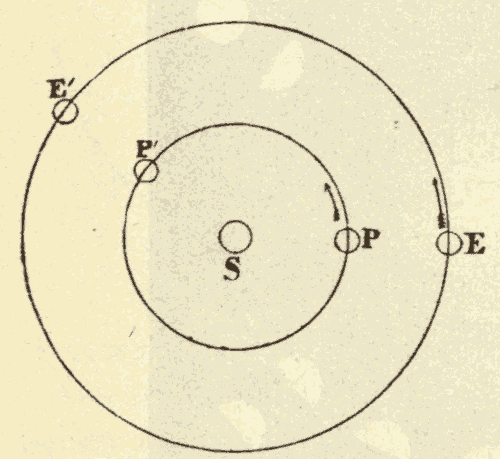
Fig. 147.
The synodical period of an inferior planet is longer than its sidereal period. This will be evident from an examination of Fig. 147. S is the position of the sun, E that of the earth, and P that of the planet at inferior conjunction. Before the planet can be in inferior conjunction again, it must pass entirely around its orbit, and overtake the earth, which has in the mean time passed on in its orbit to E'.
While the earth is passing from E to E', the planet passes entirely around its orbit, and from P to P' in addition. Now the arc PP' is just equal to the arc EE': hence the planet has to pass over the same arc that the earth does, and 360° more. In other words, the planet has to gain 360° on the earth.
The synodical period of the planet is found by direct observation.
129. The Length of the Sidereal Period.—The length of the sidereal period of an inferior planet may be found by the following computation:—
Let a denote the synodical period of the planet,
Let b denote the sidereal period of the earth,
Let x denote the sidereal period of the planet.
Then 360°/b = the daily motion of the earth,
And 360°/x = the daily motion of the planet,
And 360°/x - 360°/b = the daily gain of the planet:
Also 360°/a = the daily gain of the planet:
Hence 360°/x - 360°/b = 360°/a.
Dividing by 360°, we have 1/x - 1/b = 1/a;
Clearing of fractions, we have ab - ax = bx:
Transposing and collecting, we have (a + b)x = ab:
Therefore x = ab/a+b.
130. The Relative Distance of an Inferior Planet.—By the relative distance of a planet, we mean its distance from the sun compared with the earth's distance from the sun. The relative distance of an inferior planet may be found by the following method:—
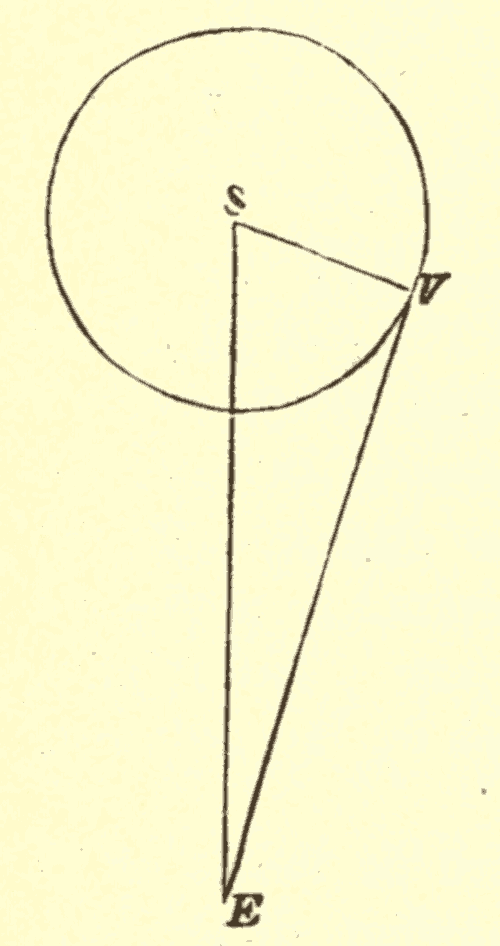
Fig. 148.
Let V, in Fig. 148, represent the position of Venus at its greatest elongation from the sun, S the position of the sun, and E that of the earth. The line EV will evidently be tangent to a circle described about the sun with a radius equal to the distance of Venus from the sun at the time of this greatest elongation. Draw the radius SV and the line SE. Since SV is a radius, the angle at V is a right angle. The angle at E is known by measurement, and the angle at S is equal to 90°- the angle E. In the right-angled triangle EVS, we then know the three angles, and we wish to find the ratio of the side SV to the side SE.
The ratio of these lines may be found by trigonometrical computation as follows:—
VS : ES = sin SEV : 1.
Substitute the value of the sine of SEV, and we have
VS : ES = .723 : 1.
Hence the relative distances of Venus and of the earth from the sun are .723 and 1.
Superior Planets.
131. The Superior Planets.—The superior planets are those which lie beyond the earth. They are Mars, the Asteroids, Jupiter, Saturn, Uranus, and Neptune.
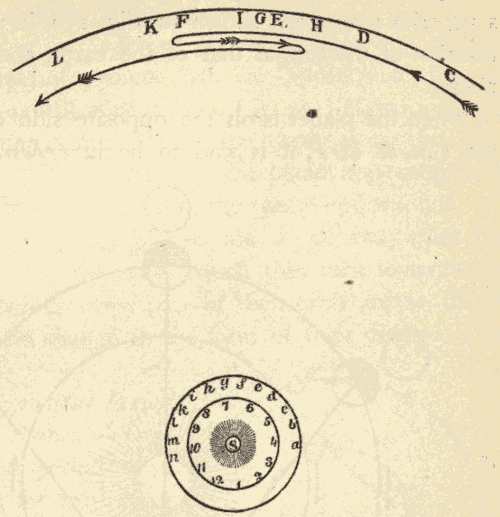
Fig. 149.
132. Apparent Motion of a Superior Planet.—In order to deduce the apparent motion of a superior planet from the real motions of the earth and planet, let S (Fig. 149) be the place of the sun; 1, 2, 3, etc., the orbit of the earth; a, b, c, etc., the orbit of Mars; and CGL a part of the starry firmament. Let the orbit of the earth be divided into twelve equal parts, each described in one month; and let ab, bc, cd, etc., be the spaces described by Mars in the same time. Suppose the earth to be at the point 1 when Mars is at the point a, Mars will then appear in the heavens in the direction of 1 a. When the earth is at 3, and Mars at c, he will appear in the heavens at C. When the earth arrives at 4, Mars will arrive at d, and will appear in the heavens at D. While the earth moves from 4 to 5 and from 5 to 6, Mars will appear to have advanced among the stars from D to E and from E to F, in the direction from west to east. During the motion of the earth from 6 to 7 and from 7 to 8, Mars will appear to go backward from F to G and from G to H, in the direction from east to west. During the motion of the earth from 8 to 9 and from 9 to 10, Mars will appear to advance from H to I and from I to K, in the direction from west to east, and the motion will continue in the same direction until near the succeeding opposition.
The apparent motion of a superior planet projected on the heavens is thus seen to be similar to that of an inferior planet, except that, in the latter case, the retrogression takes place near inferior conjunction, and in the former it takes place near opposition.
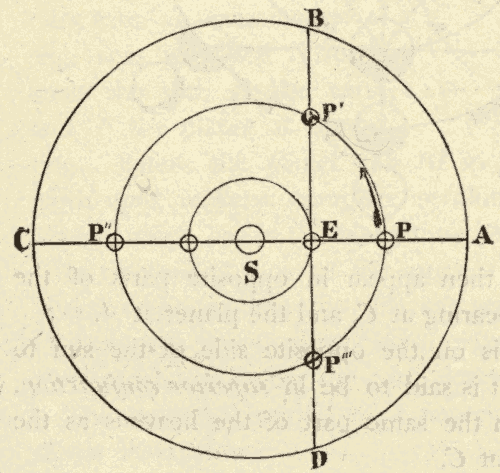
Fig. 150.
133. Aspects of a Superior Planet.—The four aspects of a superior planet are shown in Fig. 150, in which S is the position of the sun, E that of the earth, and P that of the planet.
When the planet is on the opposite side of the earth to the sun, as at P, it is said to be in opposition. The sun and the planet will then appear in opposite parts of the heavens, the sun appearing at C, and the planet at A.
When the planet is on the opposite side of the sun to the earth, as at P'', it is said to be in superior conjunction. It will then appear in the same part of the heavens as the sun, both appearing at C.
When the planet is at P' and P''', so that a line drawn from the earth through the planet will make a right angle with a line drawn from the earth to the sun, it is said to be in quadrature. At P' it is in its western quadrature, and at P''' in its eastern quadrature.
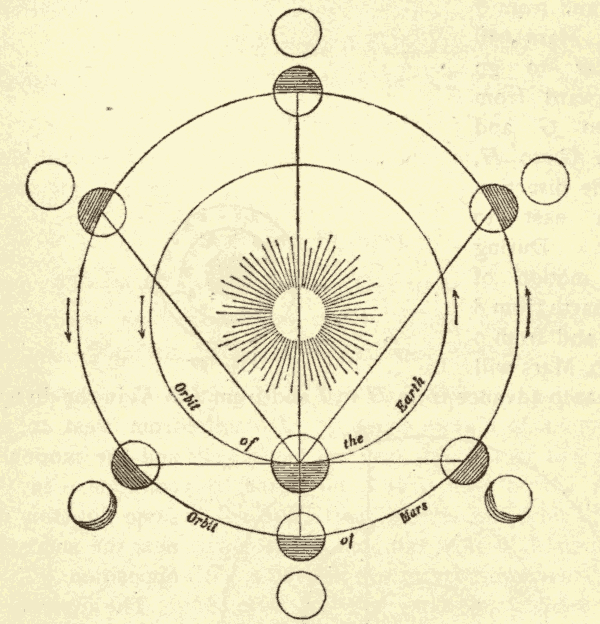
Fig. 151.
134. Phases of a Superior Planet.—Mars is the only one of the superior planets that has appreciable phases. At quadrature, as will appear from Fig. 151, Mars does not present quite the same side to the earth as to the sun: hence, near these parts of its orbit, the planet appears slightly gibbous. Elsewhere in its orbit, the planet appears full.
All the other superior planets are so far away from the sun and earth, that the sides which they turn towards the sun and the earth in every part of their orbit are so nearly the same, that no change in the form of their disks can be detected.
135. The Synodical Period of a Superior Planet.—During a synodical period of a superior planet the earth must gain one revolution, or 360°, on the planet, as will be evident from an examination of Fig. 152, in which S represents the sun, E the earth, and P the planet at opposition. Before the planet can be in opposition again, the earth must make a complete revolution, and overtake the planet, which has in the mean time passed on from P to P'.
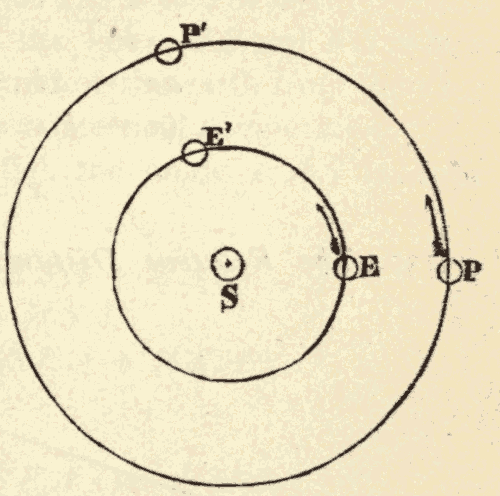
Fig. 152.
In the case of most of the superior planets the synodical period is shorter than the sidereal period; but in the case of Mars it is longer, since Mars makes more than a complete revolution before the earth overtakes it.
The synodical period of a superior planet is found by direct observation.
136. The Sidereal Period of a Superior Planet.—The sidereal period of a superior planet is found by a method of computation similar to that for finding the sidereal period of an inferior planet:—
Let a denote the synodical period of the planet,
Let b denote the sidereal period of the earth,
Let x denote the sidereal period of the planet.
Then will 360°/b = daily motion of the earth,
And 360°/x = daily motion of the planet;
Also 360°/b - 360°/x = daily gain of the earth.
But 360°/a = daily gain of the earth:
Hence 360°/b - 360°/x = 360°/a
1/b - 1/x = 1/a
ax - ab = bx
(a-b)x = ab
x = ab/(a-b).
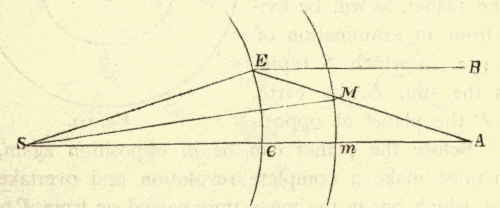
Fig. 153.
137. The Relative Distance of a Superior Planet.—Let S, e, and m, in Fig. 153, represent the relative positions of the sun, the earth, and Mars, when the latter planet is in opposition. Let E and M represent the relative positions of the earth and Mars the day after opposition. At the first observation Mars will be seen in the direction emA, and at the second observation in the direction EMA.
But the fixed stars are so distant, that if a line, eA, were drawn to a fixed star at the first observation, and a line, EB, drawn from the earth to the same fixed star at the second observation, these two lines would be sensibly parallel; that is, the fixed star would be seen in the direction of the line eA at the first observation, and in the direction of the line EB, parallel to eA, at the second observation. But if Mars were seen in the direction of the fixed star at the first observation, it would appear back, or west, of that star at the second observation by the angular distance BEA; that is, the planet would have retrograded that angular distance. Now, this retrogression of Mars during one day, at the time of opposition, can be measured directly by observation. This measurement gives us the value of the angle BEA; but we know the rate at which both the earth and Mars are moving in their orbits, and from this we can easily find the angular distance passed over by each in one day. This gives us the angles ESA and MSA. We can now find the relative length of the lines MS and ES (which represent the distances of Mars and of the earth from the sun), both by construction and by trigonometrical computation.
Since EB and eA are parallel, the angle EAS is equal to BEA.
SEA = 180° - (ESA + EAS)
ESM = ESA - MSA
EMS = 180° - (SEA + ESM).
We have then
MS : ES = sin SEA : sin EMS.
Substituting the values of the sines, and reducing the ratio to its lowest terms, we have
MS : ES = 1.524 : 1.
Thus we find that the relative distances of Mars and the earth from the sun are 1.524 and 1. By the simple observation of its greatest elongation, we are able to determine the relative distances of an inferior planet and the earth from the sun; and, by the equally simple observation of the daily retrogression of a superior planet, we can find the relative distances of such a planet and the earth from the sun.
IV. THE SUN.
I. MAGNITUDE AND DISTANCE OF THE SUN.
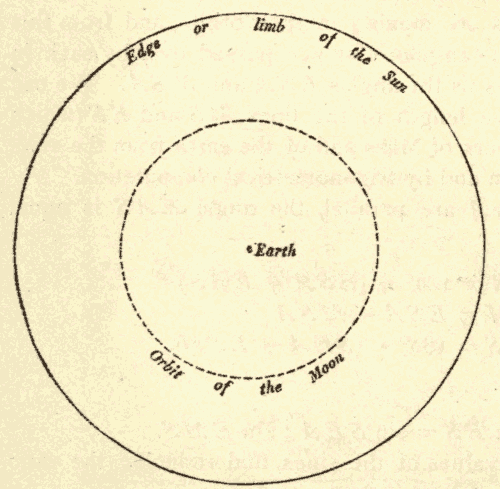
Fig. 154.
138. The Volume of the Sun.—The apparent diameter of the sun is about 32', being a little greater than that of the moon. The real diameter of the sun is 866,400 miles, or about a hundred and nine times that of the earth.
As the diameter of the moon's orbit is only about 480,000 miles, or some sixty times the diameter of the earth, it follows that the diameter of the sun is nearly double that of the moon's orbit: hence, were the centre of the sun placed at the centre of the earth, the sun would completely fill the moon's orbit, and reach nearly as far beyond it in every direction as it is from the earth to the moon. The circumference of the sun as compared with the moon's orbit is shown in Fig. 154.
The volume of the sun is 1,305,000 times that of the earth.
139. The Mass of the Sun.—The sun is much less dense than the earth. The mass of the sun is only 330,000 times that of the earth, and its density only about a fourth that of the earth.
To find the mass of the sun, we first ascertain the distance the earth would draw the moon towards itself in a given time, were the moon at the distance of the sun, and then form the proportion: as the distance the earth would draw the moon towards itself is to the distance that the sun draws the earth towards itself in the same time, so is the mass of the earth to the mass of the sun.
Although the mass of the sun is over three hundred thousand times that of the earth, the pull of gravity at the surface of the sun is only about twenty-eight times as great as at the surface of the earth. This is because the distance from the surface of the sun to its centre is much greater than from the surface to the centre of the earth.
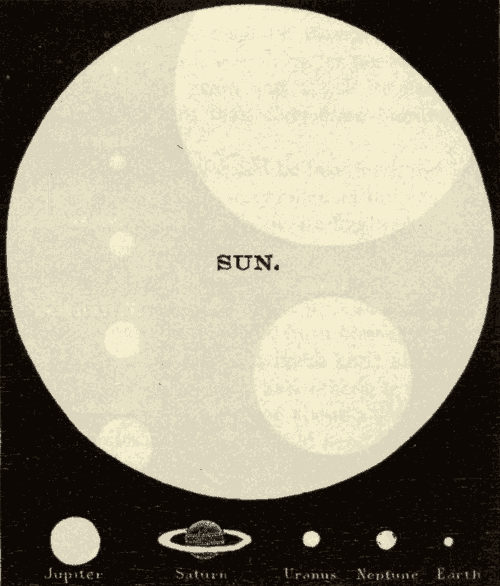
Fig. 155.
140. Size of the Sun Compared with that of the Planets.—The size of the sun compared with that of the larger planets is shown in Fig. 155. The mass of the sun is more than seven hundred and fifty times that of all of the planets and moons in the solar system. In Fig. 156 is shown the apparent size of the sun as seen from the different planets. The apparent diameter of the sun decreases as the distance from it increases, and the disk of the sun decreases as the square of the distance from it increases.
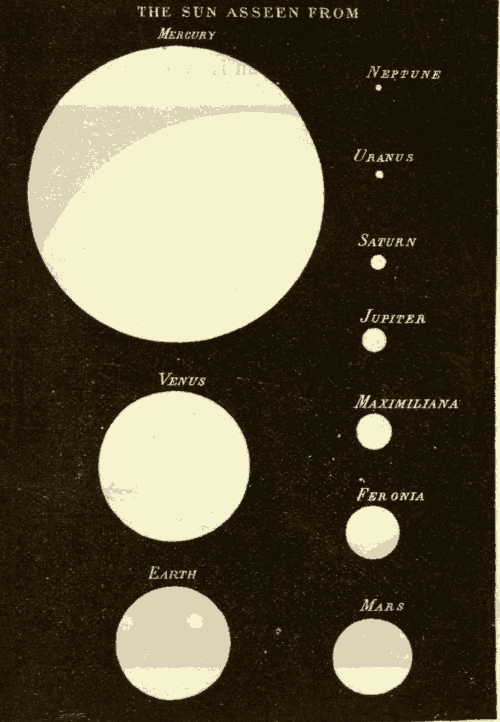
Fig. 156.
141. The Distance of the Sun.—The mean distance of the sun from the earth is about 92,800,000 miles. Owing to the eccentricity of the earth's orbit, the distance of the sun varies somewhat; being about 3,000,000 miles less in January, when the earth is at perihelion, than in June, when the earth is at aphelion.
"But, though the distance of the sun can easily be stated in figures, it is not possible to give any real idea of a space so enormous: it is quite beyond our power of conception. If one were to try to walk such a distance, supposing that he could walk four miles an hour, and keep it up for ten hours every day, it would take sixty-eight years and a half to make a single million of miles, and more than sixty-three hundred years to traverse the whole.
"If some celestial railway could be imagined, the journey to the sun, even if our trains ran sixty miles an hour day and night and without a stop, would require over a hundred and seventy-five years. Sensation, even, would not travel so far in a human lifetime. To borrow the curious illustration of Professor Mendenhall, if we could imagine an infant with an arm long enough to enable him to touch the sun and burn himself, he would die of old age before the pain could reach him; since, according to the experiments of Helmholtz and others, a nervous shock is communicated only at the rate of about a hundred feet per second, or 1,637 miles a day, and would need more than a hundred and fifty years to make the journey. Sound would do it in about fourteen years, if it could be transmitted through celestial space; and a cannon-ball in about nine, if it were to move uniformly with the same speed as when it left the muzzle of the gun. If the earth could be suddenly stopped in her orbit, and allowed to fall unobstructed toward the sun, under the accelerating influence of his attraction, she would reach the centre in about four months. I have said if she could be stopped; but such is the compass of her orbit, that, to make its circuit in a year, she has to move nearly nineteen miles a second, or more than fifty times faster than the swiftest rifle-ball; and, in moving twenty miles, her path deviates from perfect straightness by less than an eighth of an inch. And yet, over all the circumference of this tremendous orbit, the sun exercises his dominion, and every pulsation of his surface receives its response from the subject earth." (Professor C. A. Young: The Sun.)
142. Method of Finding the Sun's Distance.—There are several methods of finding the sun's distance. The simplest method is that of finding the actual distance of one of the nearer planets by observing its displacement in the sky as seen from widely separated points on the earth. As the relative distances of the planets from each other and from the sun are well known, we can easily deduce the actual distance of the sun if we can find that of any of the planets. The two planets usually chosen for this method are Mars and Venus.
(1) The displacement of Mars in the sky, as seen from two observatories which differ considerably in latitude, is, of course, greatest when Mars is nearest the earth. Now, it is evident than Mars will be nearer the earth when in opposition than when in any other part of its orbit; and the planet will be least distant from the earth when it is at its perihelion point, and the earth is at its aphelion point, at the time of opposition. This method, then, can be used to the best advantage, when, at the time of opposition, Mars is near its perihelion, and the earth near its aphelion. These favorable oppositions occur about once in fifteen years, and the last one was in 1877.
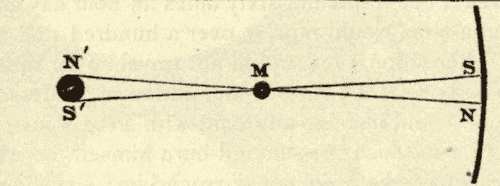
Fig. 157.
Suppose two observers situated at N' and S' (Fig. 157), near the poles of the earth. The one at N' would see Mars in the sky at N, and the one at S' would see it at S. The displacement would be the angle NMS. Each observer measures carefully the distance of Mars from the same fixed star near it. The difference of these distances gives the displacement of the planet, or the angle NMS. These observations were made with the greatest care in 1877.
(2) Venus is nearest the earth at the time of inferior conjunction; but it can then be seen only in the daytime. It is, therefore, impossible to ascertain the displacement of Venus, as seen from different stations, by comparing her distances from a fixed star. Occasionally, at the time of inferior conjunction, Venus passes directly across the sun's disk. The last of these transits of Venus occurred in 1874, and the next will occur in 1882. It will then be over a hundred years before another will occur.
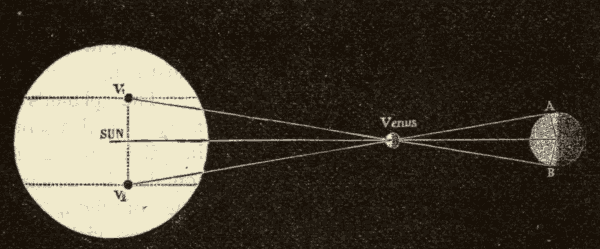
Fig. 158.
Suppose two observers, A and B (Fig. 158), near the poles of the earth at the time of a transit of Venus. The observer at A would see Venus crossing the sun at V2, and the one at B would see it crossing at V1. Any observation made upon Venus, which would give the distance and direction of Venus from the centre of the sun, as seen from each station, would enable us to calculate the angular distance between the two chords described across the sun. This, of course, would give the displacement of Venus on the sun's disk. This method was first employed at the last transits of Venus which occurred before 1874; namely, those of 1761 and 1769.
There are three methods of observation employed to ascertain the apparent direction and distance of Venus from the centre of the sun, called respectively the contact method, the micrometric method, and the photographic method.
(a) In the contact method, the observation consists in noting the exact time when Venus crosses the sun's limb. To ascertain this it is necessary to observe the exact time of external and internal contact. This observation, though apparently simple, is really very difficult. With reference to this method Professor Young says,—
"The difficulties depend in part upon the imperfections of optical instruments and the human eye, partly upon the essential nature of light leading to what is known as diffraction, and partly upon the action of the planet's atmosphere. The two first-named causes produce what is called irradiation, and operate to make the apparent diameter of the planet, as seen on the solar disk, smaller than it really is; smaller, too, by an amount which varies with the size of the telescope, the perfection of its lenses, and the tint and brightness of the sun's image. The edge of the planet's image is also rendered slightly hazy and indistinct.

Fig. 159.
"The planet's atmosphere also causes its disk to be surrounded by a narrow ring of light, which becomes visible long before the planet touches the sun, and, at the moment of internal contact, produces an appearance, of which the accompanying figure is intended to give an idea, though on an exaggerated scale. The planet moves so slowly as to occupy more than twenty minutes in crossing the sun's limb; so that even if the planet's edge were perfectly sharp and definite, and the sun's limb undistorted, it would be very difficult to determine the precise second at which contact occurs. But, as things are, observers with precisely similar telescopes, and side by side, often differ from each other five or six seconds; and, where the telescopes are not similar, the differences and uncertainties are much greater.... Astronomers, therefore, at present are pretty much agreed that such observations can be of little value in removing the remaining uncertainty of the parallax, and are disposed to put more reliance upon the micrometric and photographic methods, which are free from these peculiar difficulties, though, of course, beset with others, which, however, it is hoped will prove less formidable."
(b) Of the micrometric method, as employed at the last transit, Professor Young speaks as follows:—
"The micrometric method requires the use of a heliometer,—an instrument common only in Germany, and requiring much skill and practice in its use in order to obtain with it accurate measures. At the late transit, a single English party, two or three of the Russian parties, and all five of the German, were equipped with these instruments; and at some of the stations extensive series of measures were made. None of the results, however, have appeared as yet; so that it is impossible to say how greatly, if at all, this method will have the advantage in precision over the contact observations."
(c) The following observations, with reference to the photographic method, are also taken from Professor Young:—
"The Americans and French placed their main reliance upon the photographic method, while the English and Germans also provided for its use to a certain extent. The great advantage of this method is, that it makes it possible to perform the necessary measurements (upon whose accuracy every thing depends) at leisure after the transit, without hurry, and with all possible precautions. The field-work consists merely in obtaining as many and as good pictures as possible. A principal objection to the method lies in the difficulty of obtaining good pictures, i.e., pictures free from distortion, and so distinct and sharp as to bear high magnifying power in the microscopic apparatus used for their measurement. The most serious difficulty, however, is involved in the accurate determination of the scale of the picture; that is, of the number of seconds of arc corresponding to a linear inch upon the plate. Besides this, we must know the exact Greenwich time at which each picture is taken, and it is also extremely desirable that the orientation of the picture should be accurately determined; that is, the north and south, the east and west points of the solar image on the finished plate. There has been a good deal of anxiety lest the image, however accurate and sharp when first produced, should alter, in course of time, through the contraction of the collodion film on the glass plate; but the experiments of Rutherfurd, Huggins, and Paschen, seem to show that this danger is imaginary.... The Americans placed the photographic telescope exactly in line with a meridian instrument, and so determined, with the extremest precision, the direction in which it was pointed. Knowing this and the time at which any picture was taken, it becomes possible, with the help of the plumb-line image, to determine precisely the orientation of the picture,—an advantage possessed by the American pictures alone, and making their value nearly twice as great as otherwise it would have been.
"The figure below is a representation of one of the American photographs reduced about one-half. V is the image of Venus, which, on the actual plate, is about a seventh of an inch in diameter; aa' is the image of the plumb-line. The centre of the reticle is marked with a cross."
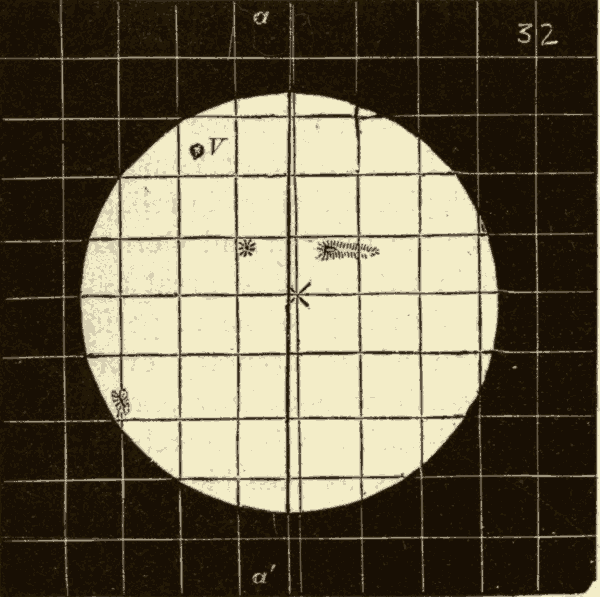
Fig. 160.
The English photographs proved to be of little value, and the results of the measurements and calculations upon the American pictures have not yet been published. There is a growing apprehension that no photographic method can be relied upon.
The most recent determinations by various methods indicate that the sun's distance is such that his parallax is about eighty-eight seconds. This would make the linear value of a second at the surface of the sun about four hundred and fifty miles.
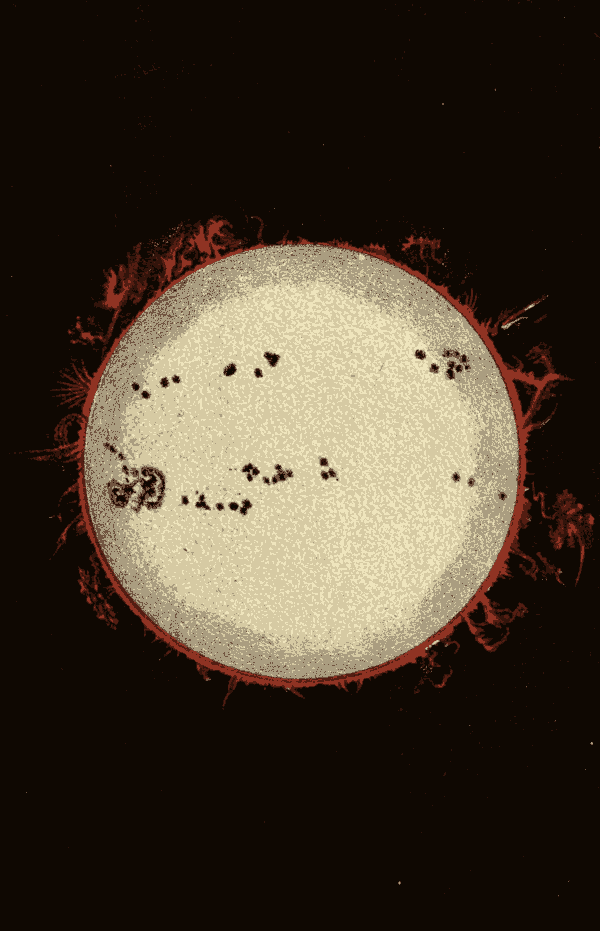
Plate 1.
II. PHYSICAL AND CHEMICAL CONDITION OF THE SUN.
Physical Condition of the Sun.
143. The Sun Composed mainly of Gas.—It is now generally believed that the sun is mainly a ball of gas, or vapor, powerfully condensed at the centre by the weight of the superincumbent mass, but kept from liquefying by its exceedingly high temperature.
The gaseous interior of the sun is surrounded by a layer of luminous clouds, which constitutes its visible surface, and which is called its photosphere. Here and there in the photosphere are seen dark spots, which often attain an immense magnitude.
These clouds float in the solar atmosphere, which extends some distance beyond them.
The luminous surface of the sun is surrounded by a rose-colored stratum of gaseous matter, called the chromosphere. Here and there great masses of this chromospheric matter rise high above the general level. These masses are called prominences.
Outside of the chromosphere is the corona, an irregular halo of faint, pearly light, mainly composed of filaments and streamers, which radiate from the sun to enormous distances, often more than a million of miles.
In Fig. 161 is shown a section of the sun, according to Professor Young.
The accompanying lithographic plate gives a general view of the photosphere with its spots, and of the chromosphere and its prominences.
144. The Temperature of the Sun.—Those who have investigated the subject of the temperature of the sun have come to very different conclusions; some placing it as high as four million degrees Fahrenheit, and others as low as ten thousand degrees. Professor Young thinks that Rosetti's estimate of eighteen thousand degrees as the effective temperature of the sun's surface is probably not far from correct. By this is meant the temperature that a uniform surface of lampblack of the size of the sun must have in order to radiate as much heat as the sun does. The most intense artificial heat does not exceed four thousand degrees Fahrenheit.
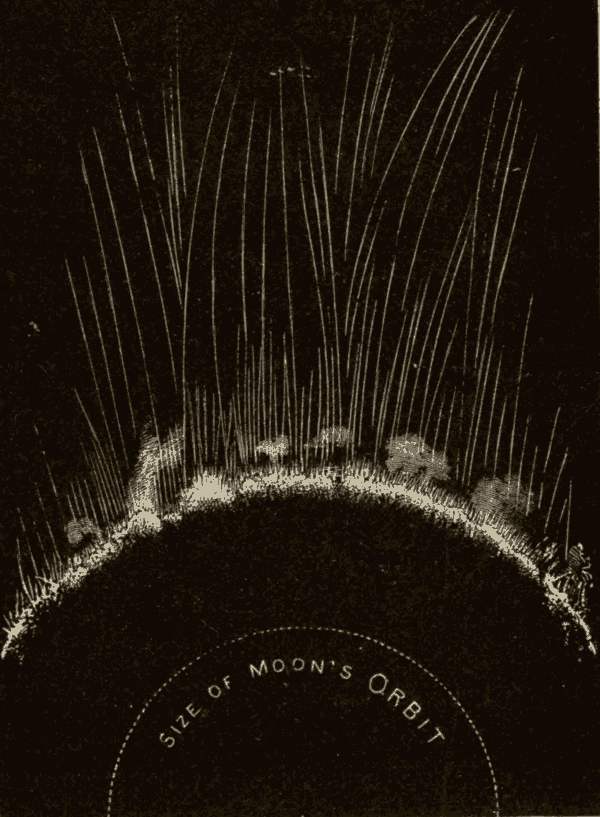
Fig. 161.
145. The Amount of Heat Radiated by the Sun.—A unit of heat is the amount of heat required to raise a pound of water one degree in temperature. It takes about a hundred and forty-three units of heat to melt a pound of ice without changing its temperature. A cubic foot of ice weighs about fifty-seven pounds. According to Sir William Herschel, were all the heat radiated by the sun concentrated on a cylinder of ice forty-five miles in diameter, it would melt it off at the rate of about a hundred and ninety thousand miles a second.
Professor Young gives the following illustration of the energy of solar radiation: "If we could build up a solid column of ice from the earth to the sun, two miles and a quarter in diameter, spanning the inconceivable abyss of ninety-three million miles, and if then the sun should concentrate his power upon it, it would dissolve and melt, not in an hour, nor a minute, but in a single second. One swing of the pendulum, and it would be water; seven more, and it would be dissipated in vapor."
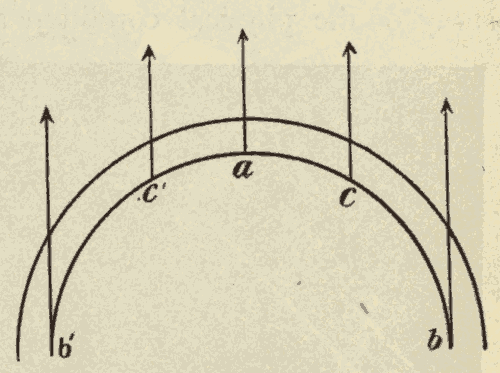
Fig. 162.
This heat would be sufficient to melt a layer of ice nearly fifty feet thick all around the sun in a minute. To develop this heat would require the hourly consumption of a layer of anthracite coal, more than sixteen feet thick, over the entire surface of the sun; and the mechanical equivalent of this heat is about ten thousand horse-power on every square foot of the sun's surface.
146. The Brightness of the Sun's Surface.—The sun's surface is a hundred and ninety thousand times as bright as a candle-flame, a hundred and forty-six times as bright as the calcium-light, and about three times and a half as bright as the voltaic arc.
The sun's disk is much less bright near the margin than near the centre, a point on the limb of the sun being only about a fourth as bright as one near the centre of the disk. This diminution of brightness towards the margin of the disk is due to the increase in the absorption of the solar atmosphere as we pass from the centre towards the margin of the sun's disk; and this increased absorption is due to the fact, that the rays which reach us from near the margin have to traverse a much greater thickness of the solar atmosphere than those which reach us from the centre of the disk. This will be evident from Fig. 162, in which the arrows mark the paths of rays from different parts of the solar disk.
The Spectroscope.
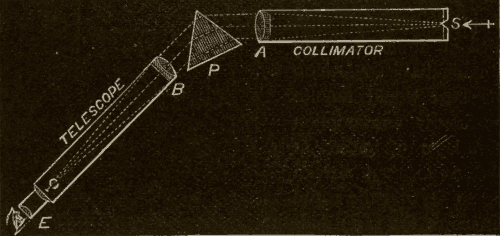
Fig. 163.
147. The Spectroscope as an Astronomical Instrument.—The spectroscope is now continually employed in the study of the physical condition and chemical constitution of the sun and of the other heavenly bodies. It has become almost as indispensable to the astronomer as the telescope.
148. The Dispersion Spectroscope.—The essential parts of the dispersion spectroscope are shown in Fig. 163. These are the collimator tube, the prism, and the telescope. The collimator tube has a narrow slit at one end, through which the light to be examined is admitted, and somewhere within the tube a lens for condensing the light. The light is dispersed on passing through the prism: it then passes through the objective of the telescope, and forms within the tube an image of the spectrum, which is examined by means of the eye-piece. The power of the spectroscope is increased by increasing the number of prisms, which are arranged so that the light shall pass through one after another in succession. Such an arrangement of prisms is shown in Fig. 164. One end of the collimator tube is seen at the left, and one end of the telescope at the right. Sometimes the prisms are made long, and the light is sent twice through the same train of prisms, once through the lower, and once through the upper, half of the prisms. This is accomplished by placing a rectangular prism against the last prism of the train, as shown in Fig. 165.
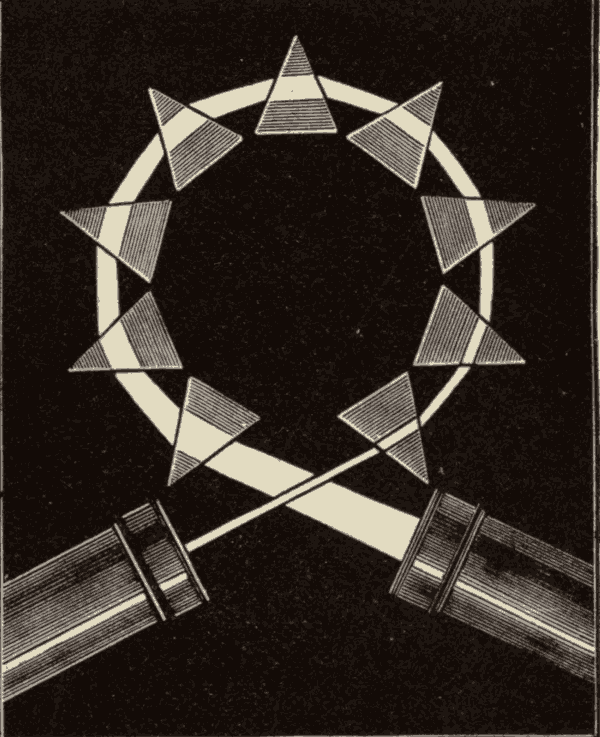
Fig. 164.
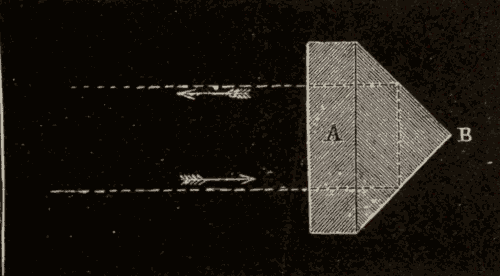
Fig. 165.
149. The Micrometer Scale.—Various devices are employed to obtain an image of a micrometer scale in the tube of the telescope beside that of the spectrum.
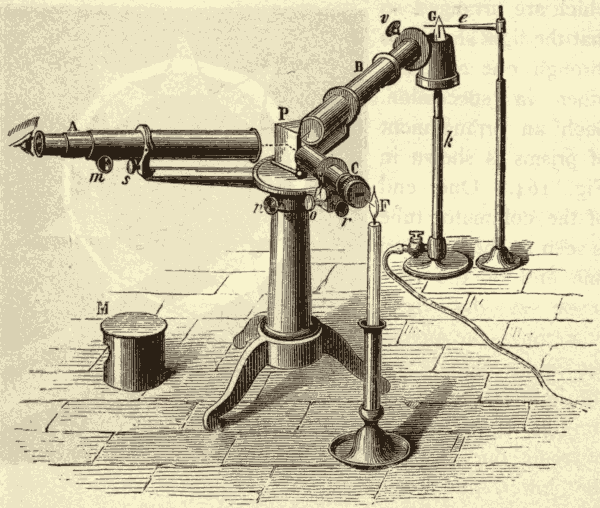
Fig. 166.
One of the simplest of these methods is shown in Fig. 166. A is the telescope, B the collimator, and C the micrometer tube. The opening at the outer end of C contains a piece of glass which has a micrometer scale marked upon it. The light from the candle shines through this glass, falls upon the surface of the prism P, and is thence reflected into the telescope, where it forms an enlarged image of the micrometer scale alongside the image of the spectrum.
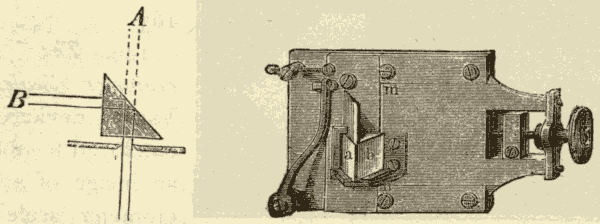
Fig. 167.
150. The Comparison of Spectra.—In order to compare two spectra, it is desirable to be able to see them side by side in the telescope. The images of two spectra may be obtained side by side in the telescope tube by the use of a little rectangular prism, which covers one-half of the slit of the collimator tube, as shown in Fig. 167. The light from one source is admitted directly through the uncovered half of the slit, while the light from the other source is sent through the covered portion of the slit by reflection from the surface of the rectangular prism. This arrangement and its action will be readily understood from Fig. 167.
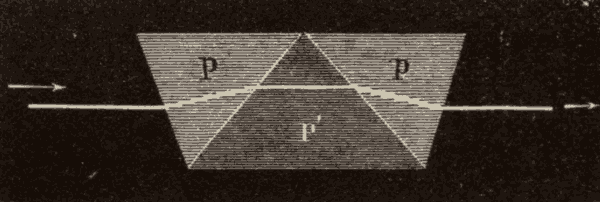
Fig. 168.
151. Direct-Vision Spectroscope.—A beam of light may be dispersed, without any ultimate deflection from its course, by combining prisms of crown and flint glass with equal refractive, but unequal dispersive powers. Such a combination of prisms is called a direct-vision combination. One of three prisms is shown in Fig. 168, and one of five prisms in Fig. 169.
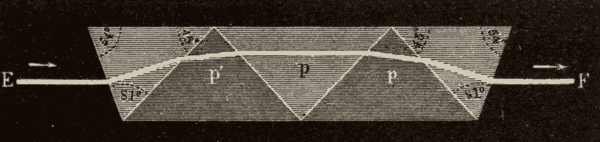
Fig. 169.
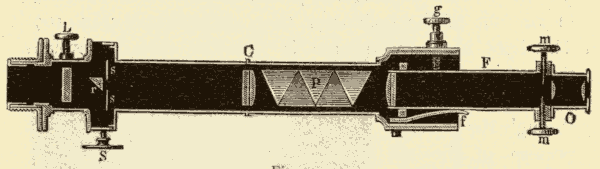
Fig. 170.
A direct-vision spectroscope (Fig. 170) is one in which a direct-vision combination of prisms is employed. C is the collimator tube, P the train of prisms, F the telescope, and r the comparison prism.
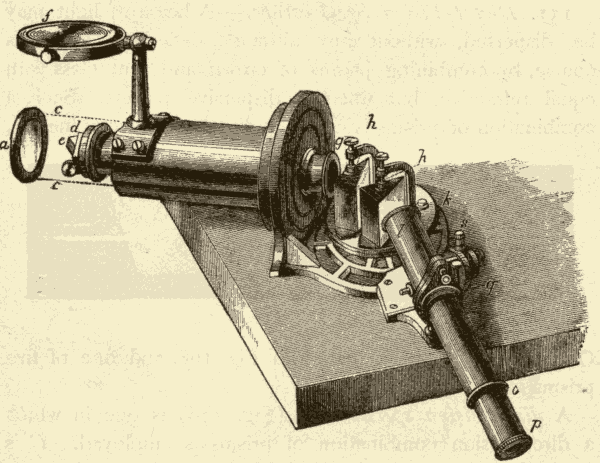
Fig. 171.
152. The Telespectroscope.—The spectroscope, when used for astronomical work, is usually combined with a telescope. The compound instrument is called a telespectroscope. The spectroscope is mounted at the end of the telescope in such a way that the image formed by the object-glass of the telescope falls upon the slit at the end of the collimator tube. A telespectroscope of small dispersive power is shown in Fig. 171; a being the object-glass of the telescope, cc the tube of the telescope, and e the comparison prism at the end of the collimator tube. A more powerful instrument is shown in Fig. 172. A is the telescope, C the collimator tube of the spectroscope, P the train of prisms, and E the telescope tube. Fig. 173 shows a still more powerful spectroscope attached to the great Newall refractor (18).
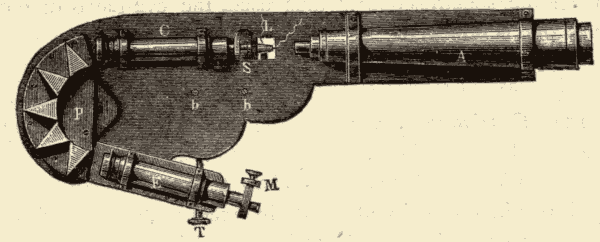
Fig. 172.
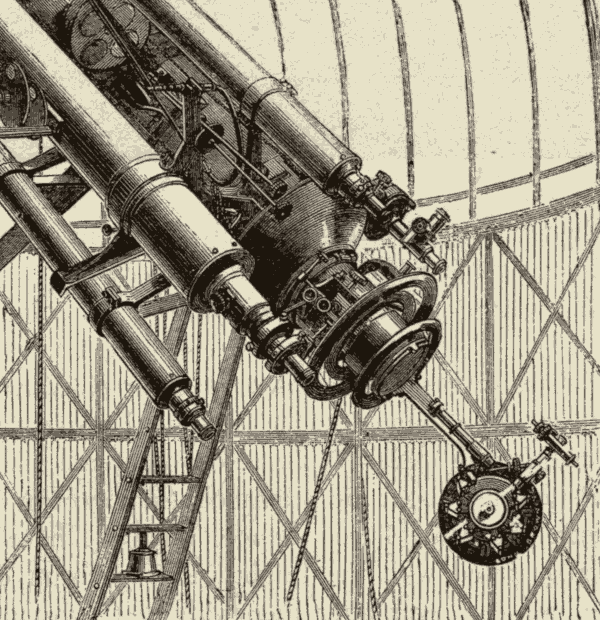
Fig. 173.
153. The Diffraction Spectroscope.—A diffraction spectroscope is one in which the spectrum is produced by reflection of the light from a finely ruled surface, or grating, as it is called, instead of by dispersion in passing through a prism. The essential parts of this instrument are shown in Fig 174. This spectroscope may be attached to the telescope in the same manner as the dispersion spectroscope. When the spectroscope is thus used, the eye-piece of the telescope is removed.
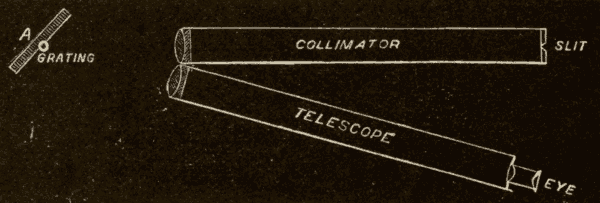
Fig. 174.
Spectra.
154. Continuous Spectra.—Light from an incandescent solid or liquid which has suffered no absorption in the medium which it has traversed gives a spectrum consisting of a continuous colored band, in which the colors, from the red to the violet, pass gradually and imperceptibly into one another. The spectrum is entirely free from either light or dark lines, and is called a continuous spectrum.
155. Bright-Lined Spectra.—Light from a luminous gas or vapor gives a spectrum composed of bright lines separated by dark spaces, and known as a bright-lined spectrum. It has been found that the lines in the spectrum of a substance in the state of a gas or vapor are the most characteristic thing about the substance, since no two vapors give exactly the same lines: hence, when we have once become acquainted with the bright-lined spectrum of any substance, we can ever after recognize that substance by the spectrum of its luminous vapor. Even when several substances are mixed, they may all be recognized by the bright-lined spectrum of the mixture, since the lines of all the substances will be present in the spectrum of the mixture. This method of identifying substances by their spectra is called spectrum analysis.
The bright-lined spectra of several substances are given in the frontispiece. The number of lines in the spectra of the elements varies greatly. The spectrum of sodium is one of the simplest, while that of iron is one of the most complex. The latter contains over six hundred lines. Though no two vapors give identical spectra, there are many cases in which one or more of the spectral lines of one element coincide in position with lines of other elements.
156. Methods of rendering Gases and Vapors Luminous.—In order to study the spectra of vapors and gases it is necessary to have some means of converting solids and liquids into vapor, and also of rendering the vapors and gases luminous. There are four methods of obtaining luminous vapors and gases in common use.
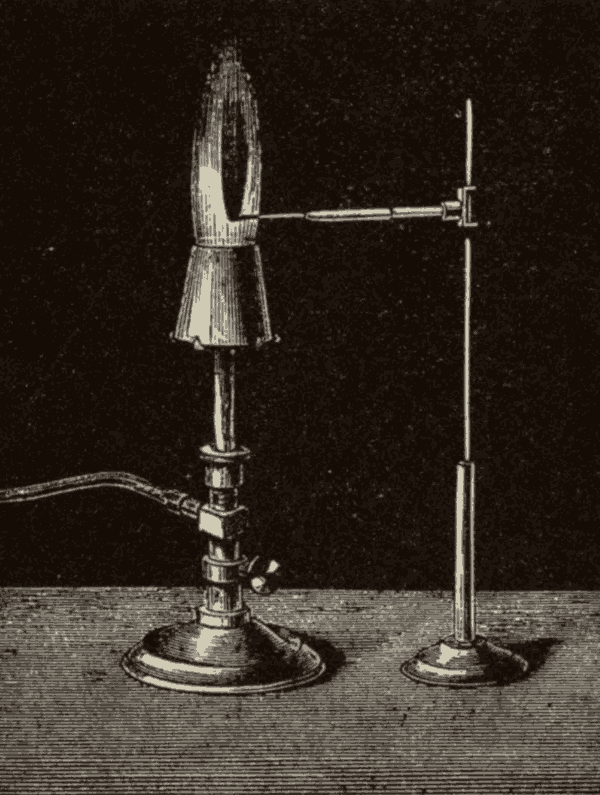
Fig. 175.
(1) By means of the Bunsen Flame.—This is a very hot but an almost non-luminous flame. If any readily volatilized substance, such as the compounds of sodium, calcium, strontium, etc., is introduced into this flame on a fine platinum wire, it is volatilized in the flame, and its vapor is rendered luminous, giving the flame its own peculiar color. The flame thus colored may be examined by the spectroscope. The arrangement of the flame is shown in Fig. 175.
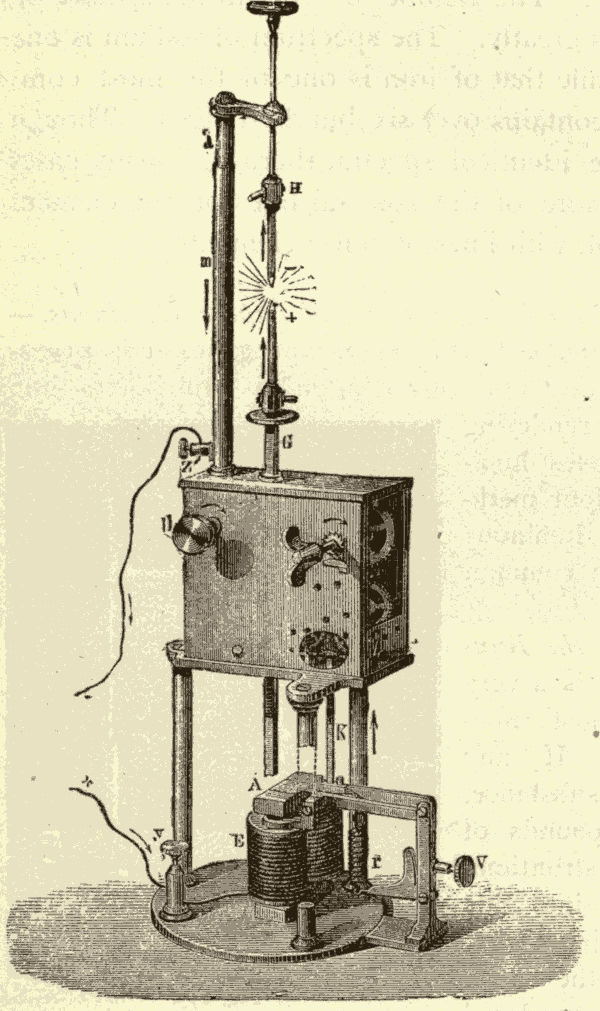
Fig. 176.
(2) By means of the Voltaic Arc.—An electric lamp is shown in Fig. 176. When this lamp is to be used for obtaining luminous vapors, the lower carbon is made larger than the upper one, and hollowed out at the top into a little cup. The substance to be volatilized is placed in this cup, and the current is allowed to pass. The heat of the voltaic arc is much more intense than that of the Bunsen flame: hence substances that cannot be volatilized in the flame are readily volatilized in the arc, and the vapor formed is raised to a very high temperature.
(3) By means of the Spark from an Induction Coil.—The arrangement of the coil for obtaining luminous vapors is shown in Fig. 177.
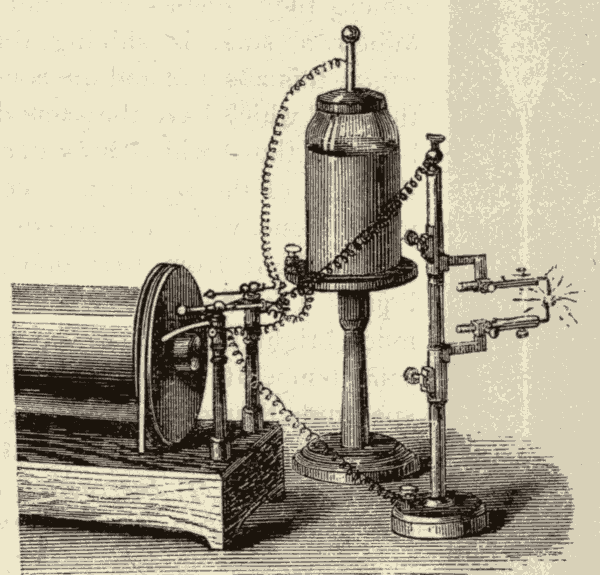
Fig. 177.
The terminals of the coil between which the spark is to pass are brought quite close together. When we wish to vaporize any metal, as iron, the terminals are made of iron. On the passage of the spark, a little of the iron at the ends of the terminals is evaporated; and the vapor is rendered luminous in the space traversed by the spark. A condenser is usually placed in the circuit. With the coil, the temperature may be varied at pleasure; and the vapor may be raised even to a higher temperature than with the electric lamp. To obtain a low temperature, the coil is used without the condenser. By using a larger and larger condenser, the temperature may be raised higher and higher.
By means of the induction coil we may also heat gases to incandescence. It is only necessary to allow the spark to pass through a space filled with the gas.

Fig. 178.
(4) By means of a Vacuum Tube.—The form of the vacuum tube commonly used for this purpose is shown in Fig. 178. The gas to be examined, and which is contained in the tube, has very slight density: but upon the passage of the discharge from an induction coil or a Holtz machine, through the tube, the gas in the capillary part of the tube becomes heated to a high temperature, and is then quite brilliant.
157. Reversed Spectra.—If the light from an incandescent cylinder of lime, or from the incandescent point of an electric lamp, is allowed to pass through luminous sodium vapor, and is then examined with a spectroscope, the spectrum will be found to be a bright spectrum crossed by a single dark line in the position of the yellow line of the sodium vapor. The spectrum of sodium vapor is reversed, its bright lines becoming dark and its dark spaces bright. With a spectroscope of any considerable power, the yellow line of sodium vapor is resolved into a double line. With a spectroscope of the same power, the dark sodium line of the reversed spectrum is seen to be a double line.
It is found to be generally true, that the spectrum of the light from an incandescent solid or liquid which has passed through a luminous vapor on its way to the spectroscope is made up of a bright ground crossed by dark lines; there being a dark line for every bright line that the vapor alone would give.
158. Explanation of Reversed Spectra.—It has been found that gases absorb and quench rays of the same degree of refrangibility as those which they themselves emit, and no others. When a solid is shining through a luminous vapor, this absorbs and quenches those rays from the solid which have the same degrees of refrangibility as those which it is itself emitting: hence the lines of the spectrum receive light from the vapor alone, while the spaces between the lines receive light from the solid. Now, solids and liquids, when heated to incandescence, give a very much brighter light than vapors and gases at the same temperature: hence the lines of a reversed spectrum, though receiving light from the vapor or gas, appear dark by contrast.
159. Effect of Increasing the Power of the Spectroscope upon the Brilliancy of a Spectrum.—An increase in the power of a spectroscope diminishes the brilliancy of a continuous spectrum, since it makes the colored band longer, and therefore spreads the light out over a greater extent of surface; but, in the case of a bright-lined spectrum, an increase of power in the spectroscope produces scarcely any alteration in the brilliancy of the lines, since it merely separates the lines farther without making the lines themselves any wider. In the case of a reversed spectrum, an increase of power in the spectroscope dilutes the light in the spaces between the lines without diluting that of the lines: hence lines which appear dark in a spectroscope of slight dispersive power may appear bright in an instrument of great dispersive power.
160. Change of the Spectrum with the Density of the Luminous Vapor.—It has been found, that, as the density of a luminous vapor is diminished, the lines in its spectrum become fewer and fewer, till they are finally reduced to one. On the other hand, an increase of density causes new lines to appear in the spectrum, and the old lines to become thicker.
161. Change of the Spectrum with the Temperature of the Luminous Vapor.—It has also been found that the appearance of a bright-lined spectrum changes considerably with the temperature of the luminous vapor. In some cases, an increase of temperature changes the relative intensities of the lines; in other cases, it causes new lines to appear, and old lines to disappear.
In the case of a compound vapor, an increase of temperature causes the colored bands (which are peculiar to the spectrum of the compound) to disappear, and to be replaced by the spectral lines of the elements of which the compound is made up. The heat appears to dissociate the compound; that is, to resolve it into its constituent elements. In this case, each elementary vapor would give its own spectral lines. As the compound is not completely dissociated at once, it is possible, of course, for one or more of the spectral lines of the elementary vapors to co-exist in the spectrum with the bands of the compound.
It has been found, that, in some cases, the spectra of the elementary gases change with the temperature of the gas; and Lockyer thinks he has discovered conclusive evidence, in the spectra of the sun and stars, that many of the substances regarded as elementary are really resolved into simpler substances by the intense heat of the sun; in other words, that our so-called elements are really compounds.
Chemical Constitution of the Sun.
162. The Solar Spectrum.—The solar spectrum is crossed transversely by a great number of fine dark lines, and hence it belongs to the class of reversed spectra.
These lines were first studied and mapped by Fraunhofer, and from him they have been called Fraunhofer's lines.
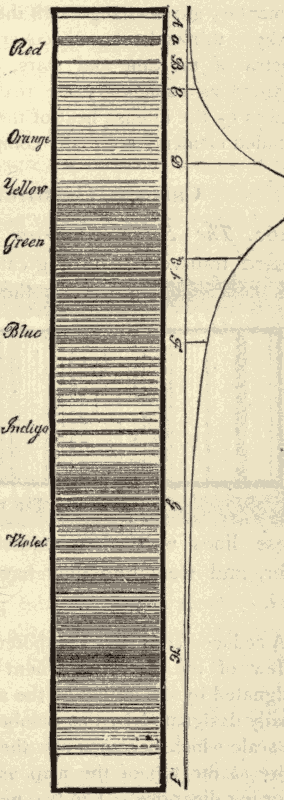
Fig. 179.
A reduced copy of Fraunhofer's map is shown in Fig. 179. A few of the most prominent of the dark solar lines are designated by the letters of the alphabet. The other lines are usually designated by the numbers at which they are found on the scale which accompanies the map. This scale is usually drawn at the top of the map, as will be seen in some of the following diagrams. The two most elaborate maps of the solar spectrum are those of Kirchhoff and Angström. The scale on Kirchhoff's map is an arbitrary one, while that of Angström is based upon the wave-lengths of the rays of light which would fall upon the lines in the spectrum.
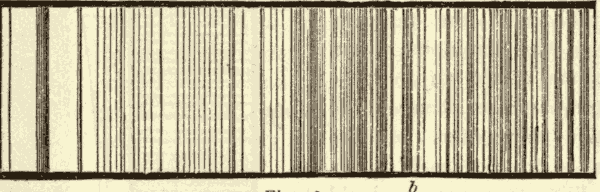
Fig. 180.
The appearance of the spectrum varies greatly with the power of the spectroscope employed. Fig. 180 shows a portion of the spectrum as it appears in a spectroscope of a single prism: while Fig. 181 shows the b group of lines alone, as they appear in a powerful diffraction spectroscope.

Fig. 181.
163. The Telluric Lines.—There are many lines of the solar spectrum which vary considerably in intensity as the sun passes from the horizon to the meridian, being most intense when the sun is nearest the horizon, and when his rays are obliged to pass through the greatest depth of the earth's atmosphere. These lines are of atmospheric origin, and are due to the absorption of the aqueous vapor in our atmosphere. They are the same lines that are obtained when a candle or other artificial light is examined with a spectroscope through a long tube filled with steam. Since these lines are due to the absorption of our own atmosphere, they are called telluric lines. A map of these lines is shown in Fig. 182.
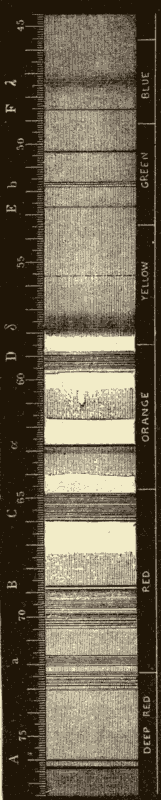
Fig. 182.
164. The Solar Lines.—After deducting the telluric lines, the remaining lines of the solar spectrum are of solar origin. They must be due to absorption which takes place in the sun's atmosphere. They are, in fact, the reversed spectra of the elements which exist in the solar atmosphere in the state of vapor: hence we conclude that the luminous surface of the sun is surrounded with an atmosphere of luminous vapors. The temperature of this atmosphere, at least near the surface of the sun, must be sufficient to enable all the elements known on the earth to exist in it as vapors.
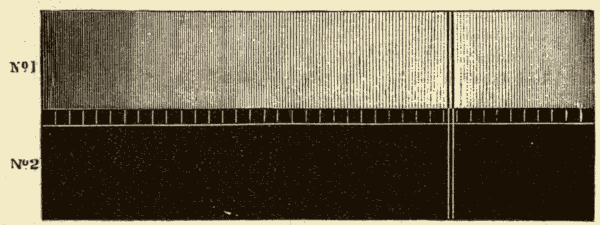
Fig. 183.
165. Chemical Constitution of the Sun's Atmosphere.—To find whether any element which exists on the earth is present in the solar atmosphere, we have merely to ascertain whether the bright lines of its gaseous spectrum are matched by dark lines in the solar spectrum when the two spectra are placed side by side. In Fig. 183, we have in No. 1 a portion of the red end of the solar spectra, and in No. 2 the spectrum of sodium vapor, both as obtained in the same spectroscope by means of the comparison prism. It will be seen that the double sodium line is exactly matched by a double dark line of the solar spectrum: hence we conclude that sodium vapor is present in the sun's atmosphere. Fig. 184 shows the matching of a great number of the bright lines of iron vapor by dark lines in the solar spectrum. This matching of the iron lines establishes the fact that iron vapor is present in the solar atmosphere.
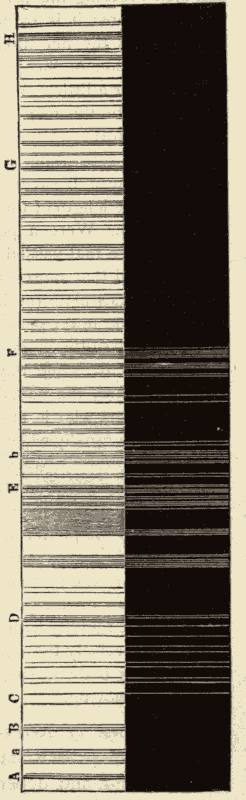
Fig. 184.
The following table (given by Professor Young) contains a list of all the elements which have, up to the present time, been detected with certainty in the sun's atmosphere. It also gives the number of bright lines in the spectrum of each element, and the number of those lines which have been matched by dark lines in the solar spectrum:—
Elements. Bright Lines. Lines Reversed. Observer.
1. Iron 600 460 Kirchhoff.
2. Titanium 206 118 Thalen.
3. Calcium 89 75 Kirchhoff.
4. Manganese 75 57 Angström.
5. Nickel 51 33 Kirchhoff.
6. Cobalt 86 19 Thalen.
7. Chromium 71 18 Kirchhoff.
8. Barium 26 11 Kirchhoff.
9. Sodium 9 9 Kirchhoff.
10. Magnesium 7 7 Kirchhoff.
11. Copper? 15 7? Kirchhoff.
12. Hydrogen 5 5 Angström.
13. Palladium 29 5 Lockyer.
14. Vanadium 54 4 Lockyer.
15. Molybdenum 27 4 Lockyer.
16. Strontium 74 4 Lockyer.
17. Lead 41 3 Lockyer.
18. Uranium 21 3 Lockyer.
19. Aluminium 14 2 Angström.
20. Cerium 64 2 Lockyer.
21. Cadmium 20 2 Lockyer.
22. Oxygen a 42 12 ± bright H. Draper.
Oxygen b 4 4? Schuster.
In addition to the above elements, it is probable that several other elements are present in the sun's atmosphere; since at least one of their bright lines has been found to coincide with dark lines of the solar spectrum. There are, however, a large number of elements, no traces of which have yet been detected; and, in the cases of the elements whose presence in the solar atmosphere has been established, the matching of the lines is far from complete in the majority of the cases, as will be seen from the above table. This want of complete coincidence of the lines is undoubtedly due to the very high temperature of the solar atmosphere. We have already seen that the lines of the spectrum change with the temperature; and, as the temperature of the sun is far higher than any that we can produce by artificial means, we might reasonably expect that it would cause the disappearance from the spectrum of many lines which we find to be present at our highest temperature.
Lockyer maintains that the reason why no trace of the spectral lines of certain of our so-called elements is found in the solar atmosphere is, that these substances are not really elementary, and that the intense heat of the sun resolves them into simpler constituents.
Motion at the Surface of the Sun.
166. Change of Pitch caused by Motion of Sounding Body.—When a sounding body is moving rapidly towards us, the pitch of its note becomes somewhat higher than when the body is stationary; and, when such a body is moving rapidly from us, the pitch of its note is lowered somewhat. We have a good illustration of this change of pitch at a country railway station on the passage of an express-train. The pitch of the locomotive whistle is considerably higher when the train is approaching the station than when it is leaving it.
167. Explanation of the Change of Pitch produced by Motion.—The pitch of sound depends upon the rapidity with which the pulsations of sound beat upon the drum of the ear. The more rapidly the pulsations follow each other, the higher is the pitch: hence the shorter the sound-waves (provided the sound is all the while travelling at the same rate), the higher the pitch of the sound. Any thing, then, which tends to shorten the waves of sound tends also to raise its pitch, and any thing which tends to lengthen these waves tends to lower its pitch.
When a sounding body is moving rapidly forward, the sound-waves are crowded together a little, and therefore shortened; when it is moving backward, the sound-waves are drawn out, or lengthened a little.
The effect of the motion of a sounding body upon the length of its sonorous waves will be readily seen from the following illustration: Suppose a number of persons stationed at equal intervals in a line on a long platform capable of moving backward and forward. Suppose the men are four feet apart, and all walking forward at the same rate, and that the platform is stationary, and that, as the men leave the platform, they keep on walking at the same rate: the men will evidently be four feet apart in the line in front of the platform, as well as on it. Suppose next, that the platform is moving forward at the rate of one foot in the interval between two men's leaving the platform, and that the men continue to walk as before: it is evident that the men will then be three feet apart in the line after they have left the platform. The forward motion of the platform has the effect of crowding the men together a little. Were the platform moving backward at the same rate, the men would be five feet apart after they had left the platform. The backward motion of the platform has the effect of separating the men from one another.
The distance between the men in this illustration corresponds to the length of the sound-wave, or the distance between its two ends. Were a person to stand beside the line, and count the men that passed him in the three cases given above, he would find that more persons would pass him in the same time when the platform is moving forward than when it is stationary, and fewer persons would pass him in the same time when the platform is moving backward than when it is stationary. In the same way, when a sounding body is moving rapidly forward, the sound-waves beat more rapidly upon the ear of a person who is standing still than when the body is at rest, and less rapidly when the sounding body is moving rapidly backward.
Were the platform stationary, and were the person who is counting the men to be walking along the line, either towards or away from the platform, the effect upon the number of men passing him in a given time would be precisely the same as it would be were the person stationary, and the platform moving either towards or away from him at the same rate. So the change in the rapidity with which pulsations of sound beat upon the ear is precisely the same whether the ear is stationary and the sounding body moving, or the sounding body is stationary and the ear moving.
168. Change of Refrangibility due to the Motion of a Luminous Body.—Refrangibility in light corresponds to pitch in sound, and depends upon the length of the luminous waves. The shorter the luminous waves, the greater the refrangibility of the waves. Very rapid motion of a luminous body has the same effect upon the length of the luminous waves that motion of a sounding body has upon the length of the sonorous waves. When a luminous body is moving very rapidly towards us, its luminous waves are shortened a little, and its light becomes a little more refrangible; when the luminous body is moving rapidly from us, its luminous waves are lengthened a little, and its light becomes a little less refrangible.
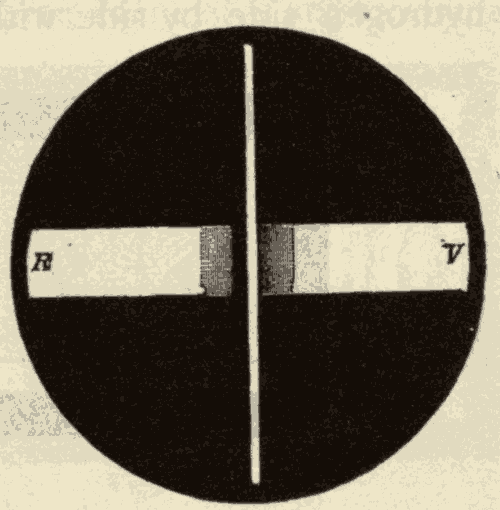
Fig. 185.
169. Displacement of Spectral Lines.—In examining the spectra of the stars, we often find that certain of the dark lines are displaced somewhat, either towards the red or the violet end of the spectrum. As the dark lines are in the same position as the bright lines of the absorbing vapor would be, a displacement of the lines towards the red end of the spectrum indicates a lowering of the refrangibility of the rays, due to a motion of the luminous vapor away from us; and a displacement of the lines towards the violet end of the spectrum indicates an increase of refrangibility, due to a motion of the luminous vapor towards us. From the amount of the displacement of the lines, it is possible to calculate the velocity at which the luminous gas is moving. In Fig. 185 is shown the displacement of the F line in the spectrum of Sirius. This is one of the hydrogen lines. RV is the spectrum, R being the red, and V the violet end. The long vertical line is the bright F line of hydrogen, and the short dark line to the left of it is the position of the F line in the spectrum of Sirius. It is seen that this line is displaced somewhat towards the red end of the spectrum. This indicates that Sirius must be moving from us; and the amount of the displacement indicates that the star must be moving at the rate of some twenty-five or thirty miles a second.
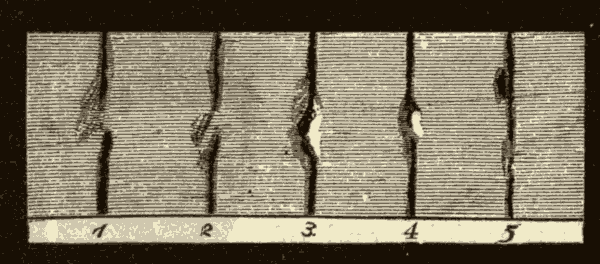
Fig. 186.
170. Contortion of Lines on the Disk of the Sun.—Certain of the dark lines seen on the centre of the sun's disk often appear more or less distorted, as shown in Fig. 186, which represents the contortion of the hydrogen line as seen at various times. 1 and 2 indicate a rapid motion of hydrogen away from us, or a down-rush at the sun; 3 and 4 (in which the line at the centre is dark on one side, and bent towards the red end of the spectrum, and bright on the other side with a distortion towards the violet end of the spectrum) indicate a down-rush of cool hydrogen side by side with an up-rush of hot and bright hydrogen; 5 indicates local down-rushes associated with quiescent hydrogen.
The contorted lines, which indicate a violently agitated state of the sun's atmosphere, appear in the midst of other lines which indicate a quiescent state. This is owing to the fact that the absorption which produces the dark lines takes place at various depths in the solar atmosphere. There may be violent commotion in the lower layers of the sun's atmosphere, and comparative quiet in the upper layers. In this case, the lines which are due to absorption in the lower layers would indicate this disturbance by their contortions; while the lines produced by absorption in the upper layers would be free from contortion.
It often happens, too, that the contortions are confined to one set of lines of an element, while other lines of the same element are entirely free from contortions. This is undoubtedly due to the fact that different layers of the solar atmosphere differ greatly in temperature; so that the same element would give one set of lines at one depth, and another set at another depth: hence commotion in the solar atmosphere at any particular depth would be indicated by the contortion of those lines of the element only which are produced by the temperature at that particular depth.
A remarkable case of contortion witnessed by Professor Young is shown in Fig. 187. Three successive appearances of the C line are shown. The second view was taken three minutes after the first, and the third five minutes after the second. The contortion in this case indicated a velocity ranging from two hundred to three hundred miles a second.
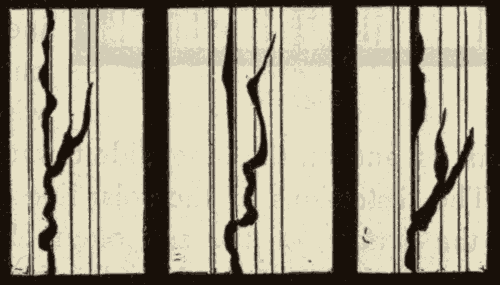
Fig. 187.
171. Contortion of Lines on the Sun's Limb.—When the spectroscope is directed to the centre of the sun's disk, the distortion of the lines indicates only vertical motion in the sun's atmosphere; but, when the spectroscope is directed to the limb of the sun, displacements of the lines indicate horizontal motions in the sun's atmosphere. When a powerful spectroscope is directed to the margin of the sun's disk, so that the slit of the collimator tube shall be perpendicular to the sun's limb, one or more of the dark lines on the disk are seen to be prolonged by a bright line, as shown in Fig. 188. But this prolongation, instead of being straight and narrow, as shown in the figure, is often widened and distorted in various ways, as shown in Fig. 189. In the left-hand portion of the diagram, the line is deflected towards the red end of the spectrum; this indicates a violent wind on the sun's surface blowing away from us. In the right-hand portion of the diagram, the line is deflected towards the violet end of the spectrum; this indicates a violent wind blowing towards us. In the middle portion of the figure, the line is seen to be bent both ways; this indicates a cyclone, on one side of which the wind would be blowing from us, and on the other side towards us.
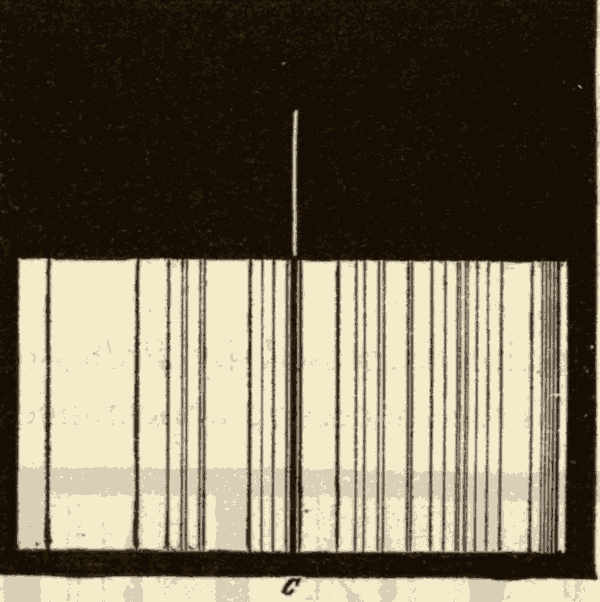
Fig. 188.
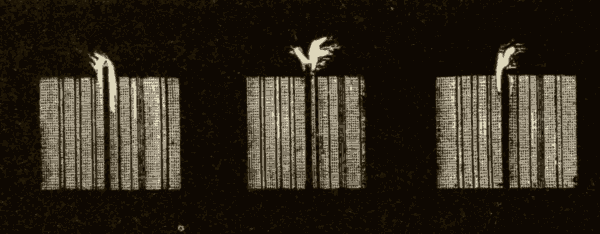
Fig. 189.
The distortions of the solar lines indicate that the wind at the surface of the sun often blows with a velocity of from one hundred to three hundred miles a second. The most violent wind known on the earth has velocity of a hundred miles an hour.
III. THE PHOTOSPHERE AND SUN SPOTS.
The Photosphere.
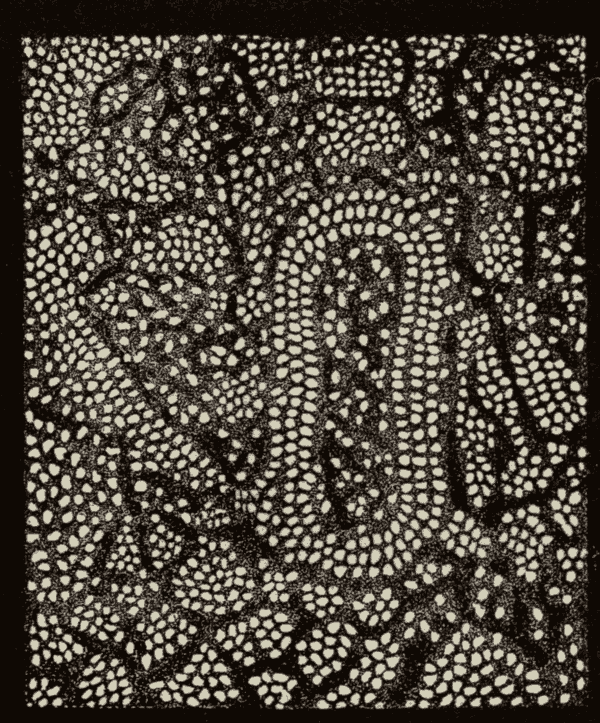
Fig. 190.
172. The Granulation of the Photosphere.—When the surface of the sun is examined with a good telescope under favorable atmospheric conditions, it is seen to be composed of minute grains of intense brilliancy and of irregular form, floating in a darker medium, and arranged in streaks and groups, as shown in Fig. 190. With a rather low power, the general effect of the surface is much like that of rough drawing-paper, or of curdled milk seen from a little distance. With a high power and excellent atmospheric conditions, the grains are seen to be irregular, rounded masses, some hundreds of miles in diameter, sprinkled upon a less brilliant background, and appearing somewhat like snow-flakes sparsely scattered over a grayish cloth. Fig. 191 is a representation of these grains according to Secchi.
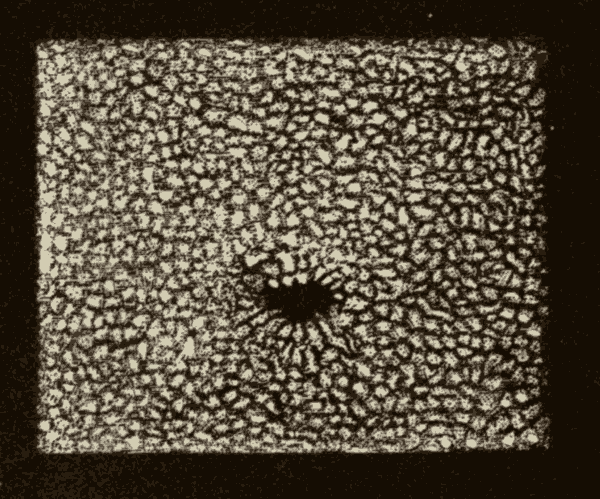
Fig. 191.
With a very powerful telescope and the very best atmospheric conditions, the grains themselves are resolved into granules, or little luminous dots, not more than a hundred miles or so in diameter, which, by their aggregation, make up the grains, just as they, in their turn, make up the coarser masses of the solar surface. Professor Langley estimates that these granules constitute about one-fifth of the sun's surface, while they emit at least three-fourths of its light.
173. Shape of the Grains.—The grains differ considerably in shape at different times and on different parts of the sun's surface. Nasmyth, in 1861, described them as willow-leaves in shape, several thousand miles in length, but narrow and with pointed ends. He figured the surface of the sun as a sort of basket-work formed by the interweaving of such filaments. To others they have appeared to have the form of rice-grains. On portions of the sun's disk the elementary structure is often composed of long, narrow, blunt-ended filaments, not so much like willow-leaves as like bits of straw lying roughly parallel to each other,—a thatch-straw formation, as it has been called. This is specially common in the immediate neighborhood of the spots.