THE HEART OF THE RED FIRS (continued 4)
Reading edition
When he recovered enough to see, he found her sitting up, dazed a little, trembling, but watching Thornton and Mose, who at last had turned the flood on the blazing brush pile. The spray of it drifted over them, and presently a cloud of steam. With Stratton's help she was able to rise, and they went up through the field towards the cabin. Sometimes he put his arm under her shoulders, holding her on her feet; and sometimes he stumbled apart and stood for an instant with his eyes closed, while his teeth gripped the nether lip. Neither spoke until they reached the balcony steps. Then they stopped and she looked back at the men with the hose. "They will save the trees," she said. "See, the fire is under control; they have saved the trees."
But Stratton was looking at her. The coolness and mockery had dropped from him in that hour, like a broken mask. The emotions and passions kept in leash through months fought in his face. He saw her rock unsteadily again on her feet, and new strength surged to his arms. "Damn the trees," he answered, and lifted her and carried her up to the door. "Damn Slocum and his pipe; damn—myself."
She did not hear him. Her body had yielded to complete collapse. He watched her still face, cradled in the curve of his arm, and once while he crossed the room he bent his lips to her cheek. But something, that indefinable something that had baffled him on the glacier, seemed to push him back. It was as though her white spirit cried "no," and again his own soul shrank.
He laid her on a couch. He brought water and bathed her face. One cheek, the right one, was blistered; her lips were scorched; and one hand, also the right one, was burned horribly. He found olive oil in a small cupboard and, with little further search, some cotton stuff which he tore into bandages. He wrapped the hand,—both of his own were smarting, miserably,—and fixed an oiled pad for her cheek; and he moistened her lips, pouring oil between them, generously.
At this she opened her eyes and smiled. "Don't trouble," she said, "I didn't inhale any fire. I remembered to cover my mouth." Her lids drooped again, but she added softly, "They are fine—old—trees."
"The finest in the world," he answered, "but the price—was too high."
He lifted her other hand to bandage a slighter burn, and his own fingers trembled. When he finished he did not release it directly, but sat looking down at the uncovered, gently hollowed palm. She had very nice hands; he had always noticed that; not too small but beautifully made. Then it came over him where, once before, he had seen their loveliness spoiled. It was that day on Mt. Rainier when she had rescued him from the crevasse. And now, at last, he had been able to square that debt. He bent suddenly and kissed the palm. "Keep your trees," he said; "stay here in the wilderness as long as you want to, but give me the right to be near you, always, and protect you."
Her eyelids fluttered open. She looked at him startled. He leaned nearer. His voice quickened; it became a sensitive, soft-toned instrument, vibrant with tenderness. "Marry me, Alice," he said, "and I will shape my whole life to yours. You shall never see a city or a crowd if you say so. I will create an Eden out of this homestead; and when the settlement grows too civilized, when there is nothing left to reclaim or build, I will take you to new solitudes; I will carry you away in that schooner of mine, up and up into the Alaska wilderness, and on some unknown fiord set up another Paradise."
"Oh," she said at last, "please, please don't say any more." She tried to rise but her lips went white and she sank back on her pillows. In her haste she had pressed on the maimed hand. "I shouldn't have allowed you to say this," she hurried on with great effort, "but—I am very—tired. I—I don't think clearly. Wait. Listen. We have just come through a desperate time together. You saved—me. How can I be angry with you—so soon? But you have no right to speak like this to me. I have no right to hear you. You know I am going to marry Judge Kingsley."
"You are not. Unless," his voice held a threat, "you believe that you love him."
She closed her eyes again; the lids quivered, her lips, her whole face. "If I had not," she answered, and the words were almost a whisper, "could I have promised to marry him?"
He was silent then. He leaned back in his chair. Presently he reached, groping, and found a strip of the cotton stuff, which he dipped in the basin of water, and laid on his eyes.
Finally she looked at him. "Oh," she said, "you were hurt. You should have told me. I should have seen. What can I do for you?"
"Nothing," he answered, "nothing, thank you. It is a pain in my head that takes me from time to time. Something struck me, I think, out there in that fiery lane."
"Oh, I'm so sorry," she said. "I'm so sorry—in both ways. Please don't think I'm ungrateful. I have always liked you, and believed in you, even when you seemed to lose faith in yourself. I knew, underneath, you were all right. And if it was friendliness you asked—"
"Friendliness?" He threw the bandage aside and started to his feet. "Friendliness? No. It's you I want—all of you—heart and body and soul—to have—to keep." He moved, stumbling a little to the door. He put his hand to his eyes and waited a moment, then he turned and came back half way. "I was wrong," he said, and his voice struck a lower key, "I was wrong, pardon me. And I accept that friendliness, yes, as long as you say so."
He swung on his heel then, and went out of the room. That night, in his lodge, he laid ink and stationery on his table and commenced a letter. He wrote the date, and under it, in a large firm hand:
"JUDGE SILAS KINGSLEY, "WASHINGTON, D.C. "MY DEAR SIR:—
Then he paused. He laid the pen down and leaned back in his chair for a long interval in thought. But when he resumed the task it was with quickness and decision and no further halt.
"I am addressing you, as Miss Hunter's guardian, to let you know that today I have asked her to be my wife. Though I had contemplated this for some time the matter was precipitated by a serious fire on her homestead, during which I was privileged to be of service. She was rescued from a dangerous position, painfully, though not deeply burned, and I trust will send you the particulars soon.
"It is natural you should wish to learn something further in regard to my financial circumstances and social standing, and I am enclosing the cards of several Seattle friends whom it is very possible you know; also the address of Sir McDonald of Victoria, who was my father's close friend and can tell you all about me. You will remember I have taken up my father's business of fur dealer, which he carried on so long and successfully, and, as soon as the construction of my new steam-schooner is completed, I expect to equip her for extensive operations northward in Alaska, making a specialty of sealskins and sable, with what can be secured of otter and silver fox. I believe I may be considered in a position to support a wife comfortably.
"As to the rest, I have every reason to think Miss Hunter is not indifferent to me, though she feels, in honor, bound by her promise to you. I trust you will understand it is most difficult for me to make this statement, but I am confident you will not care to longer hold her to an engagement, which she made in gratitude and through a conscientious sense of duty, and which I believe was urged on your part, simply through a desire to see her future secure.
"Most sincerely and respectfully yours, "MARK DOUGLAS STRATTON."
He folded this letter slowly and put it in the envelope, which he addressed carefully. The pain had returned to his head. The Judge's name seemed suddenly to be written in blood. It trailed from his pen. Still he finished, and groping in his pocketbook found a stamp.
Then he rose to his feet. He closed his eyes and clasped his hands at the back of his head. "My God," he groaned, "Oh, my—God!" He went over and threw himself face downward on his bed. But in a moment he was up again, stumbling across the floor, in agony. Finally he stopped and knelt near the inner wall and felt for the third board. It was of hewn cedar and heavy enough to go unnailed. He raised it, not without difficulty, and found a long narrow box set in the earth, underneath. He lifted the lid and took out one of several packages that filled it. He unrolled the wrapping of coarse flannel far enough to reach a small tin; then he laid the bundle aside and stood turning this in his hands. It was a five-tael opium can such as is used in transporting the crude drug. "Well," he told himself, "why not? The stuff is sold, daily, over every druggist's counter, for pain not half—as horrible—as this."
He took his knife and sprung the end of the tin enough to pour a little of the thick, sticky substance into a glass. "It is—strong—of course," he said; "a drop or two, diluted, ought to be sufficient." He added the water, stirred it, and drank it off.
In a very short time the relief came. He sat down on the edge of his bed and drew off one of his riding-boots; then he tried to pull the other and failed. He stretched himself, dressed, on the couch, and groping weakly, found a blanket and succeeded in covering his knees.
When he wakened it was daybreak and some one, a man, was working in the room. He was kneeling by that uncovered box and removing the packages to a canvas sack, open beside him on the hewn floor. Stratton watched him a silent moment, then, "Where is Slocum, Smith?" he asked.
The man turned on his knees. It was a writhing movement and he threw his head like a startled snake. "Slocum hyas scare," he answered. "He doan' come here today."
"Afraid of me, is he? Well, he has reason to be. I told him to keep away from that homestead. I told him, when I gave him that tobacco, to be careful where he smoked."
"Slocum hyas cultus," said the man. "Slocum no count." He resumed his work, but after a silent moment, he reared his head again to say, "Mose find some plas where Slocum ees sleep. He ees see Slocum's blanket by one beeg cedar log, an' some brush on top, nawitka, to mek roof. An' Mose ees know it ees Slocum's bed, for he ees fin under dat blanket, Yelm Jim's gun."
Stratton understood. He seemed to see Alice, now, with that bandaged hand, following Mose through the underbrush to see for herself that human lair. His glance moved from Smith and that stuff on the floor. A great revulsion suddenly came over him. The pain in his head was dull; it no longer troubled him, but he turned his face to the wall and set his teeth over a groan.
At last he heard Smith put the plank back in its place and start with the filled sack across the floor. He stopped him at the door. "It will be safer for Slocum, after this," he said, "to stay on the other side of the Pass. Let him help you through the mountains, this trip, Smith, but see that you leave him there."
CHAPTER XVII
THE MAN WHO BUNGLED
Early in the autumn Samantha and young Thornton were married. The teacher, in a letter to her sister, said it was a charming wedding. She told how the schoolhouse was converted into a bower for the occasion; how all the settlement was there, displaying heirlooms of finery, but nothing equalled Laramie's vest of blue and crimson satin brocade, which he wore over a new woolen shirt, and with an extra polish of the cowskin shoes. And she told how, when the old minister, imported from Olympia for the ceremony, stood waiting on the platform under a canopy of fern, and she, herself, commenced a bit of Mendelssohn's march on Eben's violin, the bridal couple in the doorway made a picture to remember; how Samantha was delightful in a crisp white muslin, and when she hung back shyly, Mill grasped her arm and dragged her up the aisle. How his face was red—possibly his stiff collar was a size too small—and his eyes flashed defiance, like a pirate convoying a risky prize. She told also how, when the ordeal was safely through, and Samantha rode the sorrel to her new home, Thornton walking at her side, all the district followed for the housewarming. But though she described minutely this cabin, and the improvements and values of the claim, of that other section almost adjoining, where lived their nearest neighbor, she still had nothing to say.
And it was an early autumn morning, a few days after the wedding, that the bars of the lower meadow fence were found down, and Mother Girard again discovered that one of the Jerseys, straying or driven out under cover of the timber, had been milked. The impressions were still fresh on the dew and the teacher joined Mose in search of the trespasser. This time the track skirted the jungle, and, rounding the slope, entered the canyon, where they met a beaten path leading from the upper end of Stratton's quarter-section. The river was bridged there by a fallen tree, below which it widened into a ford, and this new trail wound up the precipitous side of the gorge, some distance beyond the cliff that was capped by the leaning tower. The footprints took that direction.
Suddenly they both stopped and stood looking up at the stronghold. Then they turned to each other. A line of smoke, rising behind the tower, marked a camp-fire.
"But," she said at last, "if he wants milk he must ask me for it." And she started bravely up the side of the canyon.
Mose pressed after her closely. Finally he said, "It ees bes' you let me go firs', Mees. He ees have one good gun, for sure."
She swung around. "Isn't it Slocum?"
Mose shook his head. "No, Slocum doan' come roun' dis ranch some more. Monjee, he's too mooch 'fraid to stop roun' here. But Pete Smith, he doan' care, so long he ain' see Mill."
"Pete Smith." She paused, shivering a little, then she laughed. "It's funny, Mose, how creepy just his name makes me feel. I—I guess I will let you go first—if you aren't afraid. But wait, what makes you think it is Pete Smith?"
"For dat las' night, when A'm come back wid dose trout I catch down stream, I see heem by Mo'sieur's plas. Sacré, but he ees going fin' he ees lose some blankets, an' flour an' sugar, 'bout ev'ryt'ing, when he comes home."
"You mean Pete had broken into the lodge. Oh, you should have gone directly for Mill Thornton. But you tried to stop him, Mose? You at least warned him that you surely would get word to Mr. Stratton?"
Again Mose shook his head. "You mus' on'stan' it ees bes' I let Pete 'lone. He doan' want me talk to heem dare. Monjee, no. It ees lak I doan' see heem. Nawitka, I come straight 'way home."
He moved his rifle into the curve of his arm, and pushed by Alice, leading on up the bluff, through labyrinths of hazel and alder, up short sections of gullies. Just under the summit he stopped. "I doan' lak lose dis fine new gun," he said softly, and began to fondle the stock. "She's mooch more fine dan dat good gun of Pete Smith's. Nawitka, Mees, mebbe he ees watch us come 'cross de gorge. Mebbe he ees goin' have one drop on us. Den it ees bes' I leave dis gran' gun here; you think so, ya-as?
"Perhaps, Mose. I hadn't thought of—that. It seemed safe to have it along. He's the most hideous man. But he can't help that. And if he is on—guard—well, leave the gun, Mose. Of course he wouldn't harm us. He wouldn't dare."
Mose stood the rifle carefully in a hollow trunk, and moved on cautiously. She kept very close to him up to the top of the bluff, and there she laid her hand on his arm. "I'm frightened, Mose," she whispered. "I'm frightened."
He looked at her gravely. "Mebbe you doan' care so mooch 'bout dat milk now," he said.
She pulled herself straight. "It isn't the loss of the milk, Mose; you should understand that. It's the principle. He can't take anything of mine. It's wrong. Besides, if I let this go, unnoticed, we might wake up any morning to find greater things missing. We might even find Colonel gone."
She lifted her head higher and moved forward with new resolve. Mose kept pace with her, and presently they halted, screened by a mesh of young hemlock boughs, and looked out into the boulder-strewn open behind the tower.
Smith was there. He was removing from the fire a trout which he had cooked on a long sharpened stick. He worked with a noiseless, gliding motion, and even when he seated himself on the flat rock, which became at once both chair and table, and fell hurriedly to eating his breakfast, he kept up a ceaseless pantomime; beating the earth softly with his foot, starting up, subsiding, shivering, looking behind him, listening, and like an animal long hunted, again starting.
Two horses stood near him accoutered for the trail. One, his own, brought from Laramie's meadow, where at intervals it was pastured, carried saddle-bags and a snug blanket roll at the crupper; the other was an indifferent pack-animal laden with camp supplies.
"He ees tek de long trail, for sure," whispered Mose. "Monjee, how ees it he ees leave Colonel?"
"If those are Mr. Stratton's things he's got to take them back," she said. "Come, we must make him."
Mose shook his head. "We doan' be able."
"We must." Then she squared her shoulders and walked forward with a clear "Good-morning."
Instantly the man was on his feet, and grasping the rifle which stood at hand, against the tower wall, he dropped to his knee behind the improvised table. The gun rested across the rock and he took sight carefully.
The girl came on into the open. "Don't be afraid of me," she said and steadied her voice, "I only want to talk to you."
He lifted his head and looked at her in astonishment. She came a few steps further, and Mose, silent, alert, stalked after her and stood waiting. "I came to speak to you about milking my cow," she said, and ruffled her brows. "You should have asked me."
At this Smith laughed and rising from his knee, seated himself again on the rock. But he held his gun in readiness.
"I suppose," she went on, "it seems—to you—a very small matter, compared with breaking into Mr. Stratton's house."
He laughed again, loudly, insolently.
She watched him with the rising storm in her eyes. She was no longer afraid. Clearly the man was unashamed; the spark of good that she had been taught to believe was latent in the breast of the lowest man, was lacking here. He must be the exception that proved the rule. "You've got to take these things back," she said at last, decisively, yet holding her voice in check; "now, at once."
Smith lifted his gun higher, scowling. "You go home," he said gruffly. "Mose, you go. Be quick 'bout it."
She remembered suddenly the day at school when Lem had admitted that men in the settlement sometimes struck women, but she did not move. Then she was conscious that Mose was walking back towards the wood. "Mose," she said, and turning, stamped her foot, "stay here."
He stopped and looked over his shoulder. "It ees bes' dat you come right 'way," he said. "Mebbe Mill T'ornton ees able to do somet'ing, you spik to heem."
The man laughed still more insolently. "You go," he repeated.
The next instant he sprang to his feet and faced the wood on the other side of the open. There was a brief interval filled with the sounds of bodies moving through low boughs, the snapping of twigs, the striking of hoofs on loose rock, then Stratton's smooth, deliberate voice said, "Well, Smith, I think I have a horse now that won't refuse his pack, and I have tested him at a ford."
Smith put down his gun and hurried to take the led animal, and Stratton rode on past the clump of scrub firs, where the waiting horses were hitched, and saw suddenly the girl by the tower. A great wave of color surged over his face and left it white. His big frame rocked slowly as though he gathered himself from a heavy and unexpected blow; then he sat motionless.
"Oh," she said, and hurried to meet him, "I'm so glad you came this way, instead of going straight through to the bridge. This man has looted your lodge. I was just trying to make him take back your things."
Stratton drew a great breath. He shook himself like a man throwing off a weight, and swung himself down from the saddle. "You were? Well, thank you, Miss Hunter, but he should have told you that I gave him the key." He paused and his eyes moved to Smith, who had gone to an aperture in the tower, and was lifting from it other supplies for the fresh pack-horse. "In fact," he added, "I have engaged Pete to go over the Pass with me, to cook and look after my outfit."
Her glance moved to Sir Donald's full leather saddlebags and snug blanket roll, and returned to his master. "You have engaged this man," she said slowly, "to go over the mountains with you?"
"Yes, I am starting on a long hunting and trading trip, through the Palouse and Big Bend country, and Smith knows the plains and the Indians. He will be invaluable to me in that uncertain wilderness. But I shall probably go down the Columbia, when I strike the railroad, and come back to the Sound from Portland, by way of the Northern Pacific."
"You are going a long hunting trip," she repeated, and met his look steadily. "You have engaged this man, this outlaw, for your camp cook and guide. You know you are helping him to elude the Government. Oh, how can you, an intelligent, educated American, be so indifferent to the laws? I don't understand you. I don't understand you."
She turned away.
"Wait, just a moment," he said. "Is the case so different from your own? You took this other half-breed Indian into your house; you gave him a new start; yet the rascal had stolen our horses; he had left us high up, nine thousand feet, on Mt. Rainier in the face of a storm. He did even worse."
"Hush," she said. Mose stood, waiting, a few yards off. His face was turned to the lower gorge and she looked at him with apprehension. "There is no comparison," she went on softly. "You know it. He was just a boy, untaught, his character unformed, and he believed he was right. There was plenty of good in him, ready to be brought out by any one who cared to take the trouble. I have proved that; he has repaid me a hundred times. But this fellow—this desperado—think of his record. Look in his face."
She moved on with this, to join Mose, but her foot struck something that clinked against a stone, and she stopped to look down. Then she stooped and picked up the object, turning it curiously in her hands. It was a small tin receptacle, unlike anything she had ever seen before. There were some strange characters marked on it, presumably Chinese, and while she studied them she noticed that the can had sprung a little at the upper edge, and a sticky substance began to ooze into her palm. It emitted a sickish odor and she held the thing out to Stratton in sudden disgust. "What is it?" she asked. "Do you know? Did you drop it?"
Again he pulled himself together. He took the tin and hurled it over the cliff. Some distance down it struck a projecting ledge, and sent back, faintly, a clink. "I know what it is, yes," he said grimly. "The man who dropped it—bungled."
His glance moved again to Smith and the steel flashed in his eyes. But the outlaw had not heard. He was engrossed in a full canvas bag which he was adjusting to the pack saddle.
"Come, there is water here," Stratton went to the rock where Smith had breakfasted, and lifted a flask. "Hold out your hands."
She held them out, turning them under the stream he poured. "Rub them," he said; "it stains. Again, the odor clings. The stuff should never have touched your hands."
"What is it?" she repeated.
He was silent.
"What is it?" she persisted. "Can't you tell me?"
"Yes, yes, I can—if I must." He threw his head with a sudden reckless decision. "It stands for shame, ostracism, degradation, according to your code. The man who touches it takes his fate in his hands. It sticks, its slime covers him, sucks him down. Look in my face."
But at the look she gave him, that straight, searching look, which forever expected a best in him, the boldness went out of his face. A quiver swept it, as though he felt deep down the twist of a probe. "Once, up there below the Paradise," he said, "you promised your mercy. The time has come; I ask it—now."
"You mean it is"—but her voice failed. Her eyes widened with fear, and yet there rose in them an appeal. "You mean," she repeated, "you were going to—" But the word would not out; it died in her throat. Then, "Promise me you will not," she entreated. "Promise—no matter how desperate you may feel—you will always put the feeling down. I should blame myself; I should feel someway responsible. I couldn't help it. It would spoil my life."
He drew his hand slowly across his eyes and moved back, leaning on the tower wall. So she thought that. She believed that he had contemplated self-destruction, and in that crude, spectacular way. And of course she attributed his reason to her rejection of him. He could have laughed aloud at his escape. "I promise," he answered. "I promise. I will leave it to Nature. When the time comes she can provide a way."
"Thank you, I trust you." She gave him her hand. "Good-by."
She hesitated, glancing once more at the outlaw, but of him she had nothing further to say. Stratton stood watching her down the trail; when she disappeared he moved to the edge of the cliff and waited for a final glimpse of her, far below in the canyon.
At last he noticed that his guide was ready. "Ride on with the pack-horses," he said. "I will overtake you in time to make Nisqually ford. And the next time you find a leaking can, Smith, be careful where you throw it."
When the man was gone he sank down on a rock and dropped his face in his hands. Finally he lifted his head and sat for an interval looking down the gorge in the direction she had taken. "She is so bright and quick," he told himself, "and yet she could not see the truth. With all of her knowledge of smuggling, and opium and rings, she has never seen or had a description of the stuff. It is strange, strange—for I went all to pieces, there, for a minute. It must be, after all, because she is so ready to take a man on trust. She is so tremendously honest herself, she won't accept a man's own doubt of himself. But I—I—had a narrow escape. Strange, too, what a hold she has had on me from the start. I would have braved it out, lied to a man; I would have laughed it off with any other woman; but she lifted her eyes, probing for that everlasting best in me, and I babbled like a fool."
Presently he drew a letter from his pocket. It was an answer to the one he had written the Judge. It had miscarried at first, and he had travelled so much the last weeks, it had been forwarded and missed him repeatedly. He had received it that morning at the Station on the prairie below the Myers claim. He opened the sheet and re-read it slowly.
"WASHINGTON, D.C., July 20th, 18—.
"MY DEAR STRATTON:—In response to your letter I want to remind you that I knew your father, John Stratton, well. He was a strong and capable man and always a gentleman. I am certainly interested in the career of his son. I also satisfied myself somewhat as to your standing, before I came East, because it is my custom to know about my nephew Philip's friends. I learned nothing of a disparaging nature.
"But in regard to the initial point of your letter, I can only say that a release from a marriage engagement should depend altogether on the direct request of the lady.
"Very truly yours,
"SILAS KINGSLEY."
Stratton held the letter a thoughtful interval, then he rose and went over and laid it on Smith's smouldering fire. He stood watching it break into flame and curl up like a brown, dead leaf. "But it will influence him," he said. "He can't help it; it will raise a question."
He turned to untie his fretting horse. "So, Donald, old fellow, there is light ahead; we are almost out of the woods. A little more dishonor," he set his foot in the stirrup and swung himself up, "and we can afford to make a fresh start."
CHAPTER XVIII
WATER-LOGGED
At Freeport the following winter was severe. Snow lay for weeks, thawing, freezing, accumulating with every squall that came over from the mountains, and falling in small avalanches which started landslides all along the bluff. On some mornings the upper part of the harbor below Duwamish flats was covered with ice, which the rising tide lifted and broke into sheets. The logs taken from the water were glazed, and in still places inside the boom, ice packed solid. And with the unusual cold a lull in construction settled over the Northwest; there came a second drop in the prices of exported lumber. Many of the smaller mills closed under a subsidy. But the Judge, in answer to Forrest's statements of the situation, advised the cutting down of expenses to a minimum, and keeping things going, if only to give employment to the men. He had heard the Puget Sound country was flooded with idle mechanics, laborers, hundreds of construction hands discharged since the completion of the Northern Pacific. And of course the prevailing Eastern panic had in many instances caused the recall of invested capital. But he was confident that another half-year would see a pronounced revival; at any rate he would be able to make a trip home by that time, and he wanted to be on the ground and see conditions for himself before he came to a final decision.
At the close of January the men still received "reg'lar pay," to quote Mason, but the books showed that the manager's salary was accumulating to his credit. Other accounts indicated that the junior partner was overdrawing. He had his impulses of industry and economy when he tried to balance a considerable delinquency by spending an interval at the mills; but he always annulled the results by a yet deeper plunge, and his only systematic restriction was in deferring to take a house in town.
Forrest was thinking of Kingsley while he finished his rounds of the mills. It was at the close of a bleak day; there was an increasing wind; ragged cloud scurried overhead, the forerunner of the black masses driving up in the southwest. Philip was presumably in Victoria. He had not heard from him for a week. "But," he told himself, as he came down the steps from the landing to the walk, "it's useless to bother the Judge with this side of it, now. It's as he says, he can't understand things fully until he is on the ground."
He stopped at the branch to Kingsley's house to speak to the old watchman, who was stumping up from the lower dock. "Well, Mason," he said, "it's another blow."
"Ay, sir." The old sailor swung around to look at the running sea. He knew the ships over the harbor were taking precautions against the growing storm; stretching an extra hawser, dropping a second and third anchor, clearing decks. But there was no vessel at the Freeport wharves; the bark that had sailed that morning left no other receiving.
"Keep the slab-fire low, Mason, and have an eye to the boom."
"Ay, ay, sir."
"And, Mason, go back and put the signal out for the Success. Let me know when she's in sight."
"Ay, sir?" The old sailor's voice took a rising inflection; his unlovely features worked.
"Yes," said Forrest, "I'm going over to Seattle for the doctor. Little Si is worse."
He turned then, and went up to the gate. Louise heard him on the steps and met him at the door. He followed her silently in to that inner room where little Silas lay. His head was propped high with pillows and the place sounded with his labored breathing. Forrest stood for a moment watching him: the heaving of the breast under the loose white gown; the flutter of the half-closed eyelids; the milky whiteness of the forehead between the crayon-like brows and rings of tumbled hair. The child was very lovable; he had always shown his fondness for him in demonstrative, winning ways; and in the earlier stages of his illness he had called for him, begging to be carried or rocked, and Forrest had devoted late hours to him, sharing the mother's vigil; ready with the comfort and security of his strong arms. Now, while he looked at the unconscious face, this large-hearted, homeless, home-loving man seemed to feel a small hand on his heart-strings; the touch tightened when the baby coughed.
He turned to Louise. "I'm going over on the Success," he said. "The doctor will come back with me. Is there anything else I can do?"
"No, unless—you can find Philip."
"I am afraid he is still in Victoria. He would hardly have started to cross the Straits in this storm."
"No," she assented, "not in this storm." She lifted her hand to her head in a bewildered way, and turned to her baby with the mechanical effort of one long worn out with anxiety and watching. But when the child coughed again, a harder paroxysm, the motherhood leaped to her eyes. "Paul," she cried, "oh, Paul."
He did not try to answer that appeal; he could not look at her. But he took the child's medicine from the table and stood for a moment, thoughtful, irresolute. A man who has the charge of workmen in an isolated place, out of range of a physician, picks up the rudiments of medicine and surgery, and presently he went to a stand holding a few general remedies. He poured a little of the liquid from the bottle he carried, into an empty vial, and added several drops of ammonia. He gave the baby a potion from the mixture, lifting the blond head higher, rearranging the pillows gently, with a woman's touch. He waited a brief interval, watching the result. "It's a very strong stimulant," he said. "Only use it every alternate time, or—if the attack is bad. I won't be longer than I can help."
While he walked down to the store he saw Mason's signal-light on the wharf, but the little mail steamer, plying between Seattle and a near port, was not yet in sight, though nearly an hour late. Forrest unlocked the door and lighted his desk lamp. "There isn't a rowboat on this beach," he thought. "Nothing but Sing's dugout; and what could she do in this sea?"
He began to post his books, but the child's face drifted between him and the open page, and that appeal of the mother's rang an undernote to the rush and scream of the wind. He laid his pen down and sat staring, absent, harassed, up at the rafters. A timber creaked; the great building shook in a heavier gust, and the sea swept with a long hiss and swash on the beach under the piling. Then presently above all these noises there came the shrill toot of a whistle.
It was a sound that brought him to his feet. He threw his books into the safe, lifted his overcoat from the counter, and was about to extinguish the light, when the door opened and Mason entered with a rush of sharp air. "She's gone by, sir," he said. "Headlight stove in, sir; sea smashing on the wheel-house."
The manager's hand dropped from the burner.
"But she answered the signal, Mason; she whistled the landing."
"Ay, sir, an' wore away, sir, er rollin' like er porpoise."
"Well, Mason, it means the dugout. She's on the beach above the float."
Mason's watery eyes blinked. "Ay, sir, an' more'n half full, sir."
"Then we'll bail her."
He laid his top coat back on the counter and turned out the light, and while he led the way down to the float, he blamed himself and excused and blamed himself anew, for depending on that little steamer.
Sheltered though it was by the wharves and the headland, the small landing rose and dipped; breaking crests swept sheer over it. Mason set his lantern on a pile and the manager helped him turn and empty the beached canoe. Roughly hewn from a cedar log, with bow and stern cut square and hollowed slightly like a scow, it had a clumsy appearance even as dugouts go, and in mild weather two men together could hardly have risked passage in her. Launched, she swashed in the tide like a thing water-logged.
No one knew how the craft first drifted to Freeport, though Hop Sing had appropriated her, to use on still evenings during the salmon run, when he visited his friends employed at the cannery a mile up the coast. The paddle was not in its usual hiding-place, a niche under the flooring of the nearest dock, and Forrest hurried up to the cook-house.
"Give me the paddle to the dugout, Sing," he said, stopping on the threshold; "I'm going over to Seattle."
The Chinaman whirled on his cork soles and looked at him. Then he swung his towel over his shoulder and his face expanded in a smile. "What for you jokee me, Boss? Hully sit down. I bling supper belly click. Steak muchee cold."
"Never mind supper, Sing; or just give me some coffee right here, while you find that paddle."
He poured the steaming coffee, black and bitter from long waiting, and gave the cup to Forrest. "What for you takee dugout? He no good. Too muchee blow, blow." His voice shrilled incredulously, but something in the manager's face made him turn abruptly and trip across the kitchen to his own private closet, where, after a brief search under his bunk, he brought forth the missing paddle.
He had a catlike aversion to moisture and cold, but Forrest had eased him through many a buffeting from the mill crew, and presently he lighted his lantern and followed him down to the float. He found Mason steadying the lurching dugout while the young man took his place forward of the stern. And he waited silently, but with growing concern, until the old sailor cast off the painter and gave the great even push which propelled the craft out between docks, then he, too, held his light aloft, vying with the watchman to illuminate the way. The wind filled his wide, white sleeves, baring his arms above the jade bracelets; it played havoc with his unwound cue and set all his loose garments fluttering; but he stood there long, shivering, with teeth chattering, holding the lantern yet higher and straining his eyes to follow that small, receding shape.
As he swung clear of the wharves Forrest felt the strong ebb, and low as the dugout was, she careened to the wind when she drifted out of the protection of the headland. A wave broke, drenching him through. Far to the northward he saw the revolving light on West Point; then a smaller flame appeared on the opposite shore, and he knew by the position of these lamps when he had reached the open, where the gale had its fullest sweep of the Sound. Another crest broke over him; another; still he made headway and held his course quartering to the trough. The deep whistle of an ocean collier came to him, and off the point he saw her lamps; a tug passed close at hand. He heard plainly the noise of her screw, but she went by without heeding his hail, and he caught the counter motion of her wake. Presently he noticed water about his knees, and groping, found the can; and while he bailed he tried with one hand to keep the dugout under control, but she swung broadside, taking a sea. He dropped the can and grasped the paddle with a great dip that brought her slowly around. His muscles ached; his fingers cramped; how that year of confinement at the mills had unfitted him.
When the beacons disappeared he knew that he had made a little more than half the distance. But the dugout never headed for the city lamps; she drove before the wind, and the most he could do was to swing her out of the trough, and ease her northeast by north, hoping to strike the point which marked the harbor entrance above the town.
A passenger steamer rounded the Head behind him, her brilliant windows now thrown high, now showing a narrow rim as she rolled in the trough. She came rapidly and passed far to leeward. While he watched her, shouting repeatedly, against reason, the dugout shipped a sea that all but swamped her. He threw off his coat; loosened and kicked off his shoes. He bailed for a time, then, ceaselessly. The water was very cold; it swashed over his limbs, numbing him to the core. A cloud broke overhead, pelting him with a storm of hail. The stones cut the waves with a sharper swish, hiss; they stung his face, his hands. When he stopped a breathing space the thought of little Silas spurred him, and again and again Louise's voice seemed to reach him, audibly, in desperate appeal.
The hail passed. The city lights grew clearer, off the starboard but falling astern. Then at last he noticed that a deeper stroke of the paddle swung the dugout eastward and kept her headed so. The tide was running in. A black hulk loomed out of the darkness, showing a red lantern at her bow. Was it not the old collier that was burned at the coal bunkers, years ago, and towed here to beach north of town? This light, standing out in advance of all others, became an inspiration. The lines of a trestle detached from the gloom. His paddle struck something, presumably a sunken pile, and snapped at the handle, the blade whirling away in the darkness. He heard the sea breaking on a gravelly shore; felt the undertow. A crest swept over him, and another heavier comber lifted the dugout and hurled it full against the trestle. When the water receded he found himself clinging to a pile; the solid beach was under him, though the surge washed to his armpits. The next wave cast him on the gravel.
He dragged himself higher and rested briefly, pulling himself together, then he rose and made his way, in the teeth of the wind, down to the water-front of the town. He found a small tug, that sometimes did towing for the mills, under steam. He hailed her from the dock, sheltering his numb body behind a pile of cord-wood, while he waited for the master to answer him. Then, "I'm Forrest," he said, "of Freeport, and I want you to put me over at the mills as soon as you can. I came for a doctor and I'll have him down here in fifteen or twenty minutes."
"All right," the man replied, "I'm just starting for a run down to the Straits, but glad to accommodate you. Hell of a night."
Forrest was already out of hearing. He left a summons as brief at the doctor's door. "Tug's waiting," he called back. "Arlington Dock."
Then he hurried on to the hotel which Kingsley frequented. He glanced at the office clock as he entered the lighted room. It was a quarter past eleven. He had been over three hours making that trip across the harbor; a distance of two miles.
There was a stove near him and he put his numb hands out to the heat while he asked for Philip. It was as he had feared; the Captain had not come back from his last little run to Victoria. The sudden warmth made him faint, but he leaned on the desk, trying to shape a telegram.
His effort was manifest and the men around the stove watched him curiously. He was hatless, coatless, without shoes; and the steam rose from his remaining clothes; the water, dripping from them, formed in pools on the floor. The clerk went over to the bar and brought him a glass of brandy. "See here, Forrest," he said, "drink this; then tell us what happened to you. How did you come over from the mills?"
He drank a part of the liquor and set the glass down. "In a small boat," he answered briefly, "and I made a bad landing."
"Looks like it," the clerk said, dryly. "Come in here and get into some clothes of mine."
"No, thank you," replied Forrest, "I'm going right back; have a tug waiting. But lend me a coat, Charley, if you can, and some sort of a fit in shoes."
He wrote his telegram while the man brought the things, and he threw on the coat on his way to the door.
"Never saw such a man," said the clerk, addressing the group near the stove. "Ready to tell a story when it's another fellow, just spreads it on, but when it's himself won't say a blamed word. But he's got the nerve; yes, sir, he's all nerve and—backbone."
When Forrest reached the wharf he found the doctor waiting with the tug-master in the little pilot-house. They made a place for him, but he turned aside into the engine-room, and sinking down on a bench near the boiler, stretched his hands out again to the heat. The steam and odor of oil, the lurching of the boat, following that draught of brandy, affected him strangely. In the uncertain light the engineer seemed to expand into a figure foreign and grotesque. Once when he stooped to open the furnace door he paused, looking up at Forrest with a laugh. With the red glow on his grimy face it became an impish, insulting laugh, and the manager drew himself up to resent it; but he did not; he was too weak.
The next time he was roused was when the tug bumped the Freeport dock. The piles all seemed to be swaying and lifting when he stepped ashore, but the fresh air steadied him, and the sight of Mason's rugged face helped to clear his vision. Here also was Hop Sing out again with his lantern, and his smile rivalled the welcome of the old watchman. The sailor made fast the line with an extra flourish and thump of the wooden leg, and the cook demonstrated his satisfaction in a pigeonwing or two, as he lighted the way to the house.
Forrest was not the man to let these attentions go. "Well, Sing," he said, "I'm afraid you won't see that boat of yours again."
"Oh, I no clare, Boss, I no clare." He wheeled on his cork soles, showing his yellow teeth. "Mason, he makee belly good fire your loom. Byme by, plitty click, I bling supper; oyster soup, flied chicken, belly hot, nicee."
But Forrest was looking up across the gate and his steps quickened. The door had opened and Louise stood against the flood of light. She came forward to the edge of the piazza. "There has been a change," she said softly. "He seems to be in a quiet sleep."
Forrest waited in the parlor while the doctor followed her to that inner room. It seemed a long time before they returned, but he was rubbing his plump hands. "Mrs. Kingsley was right," he said, and smiled. "There has been a change, undoubtedly. And you should have a diploma, sir; that ammonia buoyed the child over a crisis. But it must be used sparingly; sparingly." He opened his medicine case and laid out a box of tablets and a vial with a few brief directions. Then he took up his hat and top coat,—the tug was waiting for him,—and went to the door. "Of course, he is still a very sick child, but, with careful nursing, and I see he has that, he will pull through. Good night; yes, your baby will pull through."
Forrest closed the door softly and came back to the fire. "Phil wasn't in town," he said, "but I left a telegram to be forwarded. He will be able to catch the mail steamer in the morning, if he isn't already on the way."
He lifted a piece of bark from the wood-basket and laid it on the fire. She watched him. Little clouds of steam began to curl up from his clothes. Suddenly she put her hand on his arm. "Paul," she said, "what happened? How did you cross the harbor?"
"Why, the Success went by without stopping, and I took a small boat. I'm going now to change my clothes. When I come back you must lie down; you need some sleep."
"But there wasn't a small boat; the Phantom is away with the tender; there isn't a ship's boat; not any kind of a rowboat on this beach. Unless—Paul, you didn't go in that dugout?"
"Yes," he said lightly, "that's what made me so long. She isn't fleet."
"Fleet." She knew what it meant. He had shared her anxiety and care; it had been one more responsibility thrust upon him; and now, in her extremity, he had risked himself for her child. She could not tell what peril the dugout had lumbered through, but it had been peril in the darkness and that sea. And Philip, her husband, who should have been the one to face it, was doubtless passing the night gaily, in some warm and brilliant room. Oh, the shame of it, the bitterness, the sting of it! A sob broke from her lips. She sank down on a sofa and dropped her face on her arm. "I cannot—bear it," she said. "I—cannot—bear—it."
She did not cry as another woman might; there was no easy rush of tears, but the long pent grief of months, borne silently through weary days and slower nights, welled and found vent to the search of a probe.
A glory from the crimson lamp-shade touched her hair, which was unbound for comfort, and held half its length in two loose braids, as she had worn it when they were children. The strained position of her arm, thrown up over the head of the sofa, pulled back her sleeve, showing its smooth whiteness from below the elbow; it tapered perfectly to the wrist. The slender, shaking figure, her whole attitude, was an unconscious appeal to him, and roused a tumult of feeling; not only resentment against Philip, but immeasurable pity, tenderness for her, out of which rose a sudden and overwhelming desire to take her in his arms and comfort her.
He turned and looked into the fire; the frowning line deepened between his level brows. "Don't make so much of it," he said. "I'm none the worse for a little wetting."
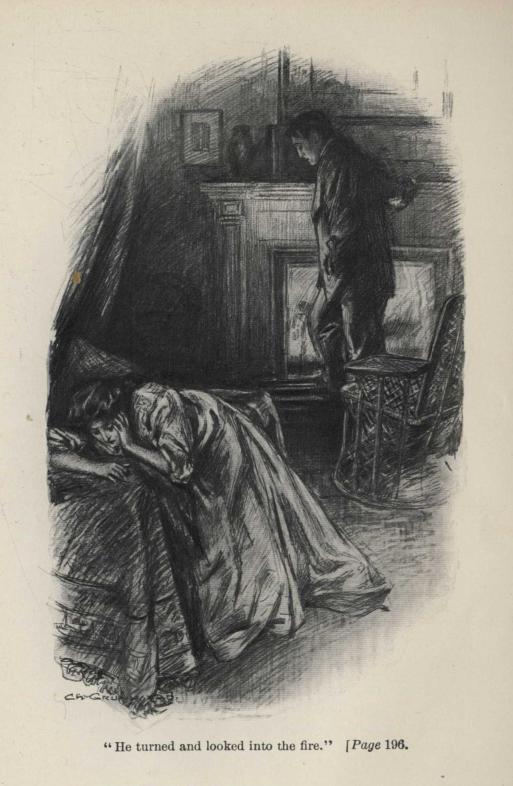
"He turned and looked into the fire."
"None the worse?" He started at the vibration in her voice. She rose to her feet. "Do you think I do not know you have done a desperate thing? Do you think I have no gratitude?"
"Oh, no," he answered smiling, "I couldn't think that."
She came a little nearer. "You have a bruise on your forehead; your hand—I noticed it when you lifted the wood—is cut—terribly." She took the hand in her own palm and examined the hurt, touching it gently with her handkerchief. "How was it, Paul? Tell me."
"Why, I hadn't noticed it, but it probably happened when I made a landing." He winced slightly under her soft dabs. "I ran the dugout in at that old trestle above town, and struck a pile. Now you know the worst; there's nothing left to imagine." He laughed and drew his hand away. "I'm going down to my room now, but I shall be back in a little while. Sing is bringing me a supper."
He opened the door and went out, closing it softly. "To have a wife like that," he thought, "and yet neglect her."
CHAPTER XIX
"ANDROMEDA HAS FOUND A PERSEUS"
The great boom which cleared Duwamish Head of its big timber and cut the cable car-track across the face of the promontory, created also frequent and heavy landslides that changed the gravelly beach at Freeport into the broad and sandy expanse which became Seattle's favorite bathing resort. In the earlier times, beyond the old hotel, the high tide washed sheer to the foot of the bluff, and the incomparable view of blue sea and wooded island, framed by the shining Olympic Mountains, was limited to the outlook from the balcony at the rear of the ruin.
Louise stood upon this balcony, facing the northwest. The bluff was on her left, so near she might have lifted her hand and touched the damp soil. It was midsummer and a resinous fragrance mingled with the salt air. The distant coast was veiled in smoke, and the sun, low in the west, barred the Sound blood red.
The swell broke with a long swash and gurgle under the floor; a passing gust set the door behind her creaking; the heavier one at the opposite end of the bar-room was also swinging, and between its widening crack Stratton appeared on the walk. At sight of her he started and paused, then he came on into the ruin. His glance swept the interior, from the threshold, and rested on the door behind the bar. It was closed and fitted with a new, strong lock.
At the sound of his tread she turned, and he came forward quickly, smiling and offering his hand. "Good afternoon," he said, in his conventional way, "it is rather nice here, isn't it? I hope I do not intrude?"
"No," she said, and answered his smile, "I am glad to share it. Did the Phantom bring you?"
"No, the Success left me." His gesture called her attention to the small mail steamer moving westward. "I ran over about a little matter of business. I saw young Silas on the dock with that old character Mason. The boy is growing."
"Yes, he lives out of doors so much. They are great playfellows, and I can trust Mason. He takes him rowing every afternoon, often twice, out of the shadow of the Head into the sunshine."
"But you,"—he paused with a light emphasis, looking down into her sweet, inscrutable face,—"you stay in the shadow. Do you know what I thought of just now, coming up the walk? It was Andromeda—chained."
"You had the sea," she looked about her thoughtfully, "and this bluff; Andromeda—perhaps—but without a Perseus."
"Are you sure of that?"
"Yes." She met the unmistakable admiration in his eyes with a clear look and a slight uplifting of her oval chin. "It is too bad, but the comparison is misapplied."
She moved towards the doorway. He waited a moment, watching her in mingled amusement and pique. "Another touch-me-not," he told himself; "I had not thought she could be so like her sister. Don't let me take you back," he said aloud, following a step; "it is pleasanter here, away from the interminable buzz of those saws."
But she moved on into the building. He joined her. "We are sailing over to Tacoma tonight," he said. "The yacht club is arranging a little hop. Come with us. Go over the harbor with me, when the Success picks me up on the return trip. I will give you a merry time, I promise you."
"It is always that on board the Phantom," she answered brightly. "And of course Philip would run in for me, if I could leave little Si. You see I have only Mason to depend on, and at night he is on duty."
"But bring the boy. We will tuck him away in a berth down below. He will like it. Why, he took that cruise among the islands last year like an old salt, and then he had just begun to toddle."
She shook her head. "He is better off at home. He couldn't sleep; not in that gay company."
Stratton wondered how far she meant to disregard that matter of his escort. He was not accustomed to indifference from a woman. And any other, in a like position, would grasp at the opportunity he offered. "My dear Mrs. Kingsley," he said, and his voice was no longer conventional, "throw aside those Puritan scruples, for once, and let me show you how easy it is to accomplish—what you desire. I know the Captain. Come, go with me on this moonlight excursion, tonight."
She met his gaze bravely, smiling a little, but there was in her eyes the look of one who has felt in a wound the quick turn of a probe. "Thank you, no," she said.
The child was coming up the walk and she hurried to meet him. "Muvver," he called excitedly, "Mason can take us to row, now." Then he stopped, looking at Stratton, and added doubtfully, "The boat is big 'nough for you, too."
Stratton laughed and took out his watch. "Thank you. I have over an hour to spare, but you must put me aboard the Success, sure, when she comes back."
Mason, who had waited at the branch walk, turned and stumped ahead to the landing. He held the boat steady and the young man stepped into the stern and lifted the boy in. But when he offered his hand to Louise she drew back and said, "Oh, I am not going; did you think so? Good-by, Silas. Take care of him, Mason."
"Ay, mum?" The old sailor's voice held a note of inquiry. He had lost his shyness, in a measure, at the time of the child's illness. And since then Forrest had seen that there was always a rowboat at the mills. He had made it Mason's duty, during the boy's convalescence, to take him and his mother out in search of the sunshine. She had rarely missed these little trips.
But whatever chagrin Stratton may have felt was not apparent. He settled into his place, lifted his hat to her, and taking a cigar from his case, occupied himself, while the boat was under shelter of the wharves, with getting a light.
She watched them out, waving her hand and smiling an answer to her baby's repeated "Good-by." Then she turned and went up from the landing. "If it was a way," she said under her breath, "then I have let it go."
She walked in the direction of the mills, on past the last cabins, to the beginning of a path that zigzagged up the side of the promontory. She pushed up quickly, finding in the tangible difficulty of the ascent relief for her hot thoughts. Sometimes the earth gave under her and she sprang to a spur of rock; she grasped the tough, springy boughs of young firs to ease her weight. She invited the touch of the prickly needles on her hands and face, and she drew full breaths of the fragrance exhaled from her palms.
She gained the summit moist and panting, and paused to look down on the rowboat, and on across the harbor to the infant city on her hills. There was no dwelling near; the trail took the contour of the bluff, which in places became a precipice, and everywhere around her stretched the forest or the sea. She crossed to the westward side and stopped where a fallen hemlock had cut a swathe through the timber, creating an unobstructed view. Out of the smoke film that shrouded the distant shore, rising columns parted in dun rolling clouds, showing where the forest fires burned; but the Olympics reared their giant heads from the pall, sometimes thrusting a shoulder through. And to this woman it was not solitude; she had come into the presence of old friends. She turned her eyes to that grand company of peaks and forgot the narrow limits of the life below the bluff; she stood above the drift and shadow and, for a moment, Philip.
Her hands were clasped loosely behind her; her lifted head exposed the beautiful lines of throat and chin; her breath came a little hard and quick and there was a soft color in her cheeks. The likeness to her sister had never seemed as marked to Forrest as it was then, when he came upon her unexpectedly, by the fallen hemlock, on his way to the mills. Was not this the trail to the headwaters? Had they not paused to choose a way through the windfall?
She did not see him, and he waited, mastered by that brief illusion. And while he watched her face she saw the heights of the Olympics change from rose to burnished brass; every peak and spur flamed a signal to the departing sun.
"'But breathe the air of mountains
And their unapproachable summits will lift thee
to the level of themselves.'"
She repeated the words softly with a clear modulation, deepening to a contralto note, and after a moment added a preceding line.
"'Assert thyself; rise up to thy full height.'"
But there she stopped, and lifting her arms with a little outward gesture, expressive of futile effort, let them drop, and turning her face, saw Forrest.
He came forward quickly to say, "I've only been here a moment, and I couldn't help listening; I'm fond of those lines. But, when did you ever assert yourself?" He looked down at her with his smile of the eyes. "It's there the resemblance stops."
"You mean to Alice?"
"Yes, sometimes you are very like her," and he turned his glance to the mountain-tops.
"You mean physically. I think, in other ways, I must often seem purposeless, even weak—to you."
"Ob, no," he said quickly, "I couldn't ever believe that. You are stronger than most women; strong to endure. But you lack her executive ability." Then he stopped, for he saw that she had given his words a personality he had not meant.
"What would you have me do?" The vibration in her voice hurt him; he could not meet the intensity of appeal in her eyes. "It had commenced before we came to Freeport. I felt that he was growing tired of me, but I believed, if I could be alone with him, in a dull place like this, I might win him back. It seemed the only chance; but—it has failed." The tears were streaming down her face; she reached out her hands to him. "What would you have me do?" she repeated. "Tell me."
Forrest had never known her to lose her self-control but once before; the night he had crossed the harbor in the dugout. Even then it was quickly over; she had not spoken of Kingsley's neglect; he had never heard her so much as breathe a reproach. His great heart ached for her, while he felt the futility of any sympathy he could offer her. He broke away some young growth in front of the fallen tree, and she allowed him, passively, to seat her in the crotch of a great branch. "You are pretty tired," he said gently. "It's a hard pull up the bluff. And this solitary life is telling on you; I feel the strain of it, myself, sometimes. We will both be glad to get away from Freeport."
She threw her arm up over the bole, and dropped her face on it, sobbing. He stood looking seaward. Far out the water was still barred blood-red. Presently he said, "You know the mills are about to shut down? We have been waiting for the Judge, but he will be here in another month, perhaps sooner. There isn't a doubt he will close. You know we are falling behind. Lumber has dropped to seven dollars a thousand; the San Francisco market is glutted; the bone-yard there has stopped receiving."
She knew that he had said all this to give her time, and she struggled with those crowding emotions, trying and failing, and trying again to beat them down. He waited, with his back towards her, his face to the painted sea. He was a resourceful man, quick to grasp a difficulty and its solution, for others as well as himself, but now he halted, baffled, like a man come to a blind wall. His mind ran through that first slow year at Freeport, and it flashed over him what an interminable blank it would have been without her. Confined as they were to the narrow limits of the mills, it had been as close as life on shipboard. They had taken their meals together; they had met, passed and repassed countless times daily on the short walks. He had been glad to show a helpful interest in little Silas. He had fallen easily into the way of spending his evenings, when he could, with her; she loved his violin. He saw now how those hours had dulled the poignancy of putting Alice out of his life. He remembered how he had commenced to watch in Louise for a repetition of those many little airs he liked; the lifting of the chin, the high pose of the head, the ready change of color; all modified, it was true, softened and blended with much that was not her sister's, but there, palpable, near, breathing, flesh and blood. And most of all he understood what she had done for him when that business depression laid a fatal hand on the mills. He had meant to do great things and he was one to take defeat hard; but she, this sweet, proud woman, with the courage in her voice and the heart-break in her eyes, had taught him by example how to fight a losing battle to the end, and—like a man.
The silence was broken by the neigh of a horse. It was unusual on that promontory; saddle-animals never took the foot-path over the bluff to the mills, and afterwards Forrest remembered the sound. Then, though he turned and looked in the direction of the neigh, he gave it small attention. His glance fell to her; and that attitude, the hidden face, the slender shaking figure, brought back an onrush of the tumult he had felt the night she so nearly lost her child; bitter resentment against Philip, immeasurable pity, tenderness for her, and a desire to take, and protect and comfort her.
"See here," he said, and his deep voice vibrated a a little, holding each word like a caress, "See here, don't make so much of it; he isn't worth it. No man on earth is."
She became suddenly still. Her hand clenched on a fold of her skirt, but she did not lift her face. Her head was uncovered and he stood regarding the blue and purple lights of that high, dark coil of her hair. "See here," he went on finally, "I can't let you be discouraged. You've done too much for me. Don't you know it? Of course you made a mistake; you should never have come to the mills. But it was my mistake, too, and I don't like to think what this life here would have meant without you. Why, you and little Si have stood for what I like best; you've made a home for me. Without you I should have lived like a miserable castaway."
She lifted her face with a supreme effort. Her eyes said, "Thank you," and her lips shaped an explanation he was not slow to grasp. "You were right, it's the solitude. I exaggerate—lately—I am annoyed by the—smallest things. Just now it was Mr. Stratton. He happened—to ask me to go—with him—on an excursion aboard the Phantom. As if—Philip—would not run in for me—any time—that I wished. But, Paul, if the mills close, what will you do?"
"I?" he answered and smiled, "why, there's a piece of land out on the upper Des Chutes that I've been anxious to secure for a long time. I'm going to homestead it and, incidentally, prospect the hills. You see this business depression is giving me an opportunity I've been waiting for."
"The upper Des Chutes," she repeated. "I see, you are going to take up a systematic search for the lost prospect, and make your headquarters on the ground."
"Yes," he said, "or pretty close to it. I can't tell you how I want to find myself in the thick of the timber again. You don't know how I hesitated between that homestead and this position at the mills. My inclinations, every fiber in me reached out to that section at the headwaters, but, of course, I needed a little more capital to start with; that is, to carry on the developments I had in view. I am afraid, though, it was Alice who turned the scales." He paused, smiling a little and shaking his head. "You see I hadn't learned, then, to take defeat, and I never could believe her refusal was final. I couldn't ask her to bury herself up there in the wilderness."
"You mean you asked Alice to be your wife, and she—refused. Oh, Paul, how could she?" She rose to her feet. Her voice was low and thrilling, and she looked at him again through springing tears. "How could she? To—to think we have always taken so much—your best—and in return have given you—worse than nothing."
She held out her hands once more, and this time he took them in his friendly grasp. "You forget," he said, with his smile of the eyes, "You forget all I've been saying. The debt is on my side. I never can do as much for you."
While he said this a workman came down the path. He was the sawyer at the mills. Her hands dropped and she stepped back to the seat she had left. The man looked at her and then at Forrest as he passed, turning his head slowly to prolong the stare.
"I didn't know the mill men ever came up here," she faltered.
"They don't, often." Forrest stood watching the curve where the man had disappeared. "A lighter grounded on Alki Point; he has been helping to float her. That's what took me up the trail." He began to walk in the direction the man had gone. Presently he looked back. "I must hurry on," he said. "Come with me, if you are ready; I would be glad to help you down."
She followed him in silence along the promontory. When they passed beyond the curve another man pushed out of the thicket into the trail. He ran with a gliding, half writhing motion to a point where a branch track, faint, little used, dipped over the Head. He took this course, twisting, swinging himself by low boughs, doubling where the path was lost in a precipitous gully, and so gained the beach. He crept under the bluff, rounding it and splashing ankle-deep in water, for the tide was running in, until he reached the rear balcony of the old hotel. He paused a moment, listening, with his beady eyes fixed on the walk stretching from the main entrance; then he laid the saddle-bags which he carried on the platform while he swung himself up. He waited another instant,—the sea broke with a gurgle among the piles; a passing gust set one of the doors creaking,—and picking up the empty bags he ran through the tap-room behind the bar. He found a key, strung on a cord around his neck, and fitted it in the new lock and opened the door. When he came out the saddle-bags were filled, and heavy, for he made his way up the promontory with difficulty. As he reached the summit the stillness was again broken by the neigh of a horse.
Forrest heard the sound faintly, while he helped Louise down the last pitch of the trail. But again he gave it little attention, for he noticed that the sawyer was the center of a small crowd at the corner of the cookhouse. The whole group turned to look at these two as they approached; curiously, as though they were strangers but just arrived.
She raised her face to Forrest with a mute question. He felt it, though his own gaze was directed straight ahead to the quiet harbor. The right hand at his side clenched, twice, and the line deepened to a great cleft between his brows. But he knew this crew and the futility of trying to put their rough conjectures down. To call the sawyer to account was to invite a wider notoriety, such as this woman could not endure. "I have been a fool," he told himself; "a blind fool. My God, the shame, the folly of it. And the most I can do is to keep it from her."
Aloud he said, and met that question in her face with his quiet smile, "I'm afraid that was a pretty steep grade for you; I hope the outlook up there paid you for the climb." His glance moved then over the stacked lumber of the mill yard, and he paused to say to a man in the crowd, "Dickman, that pile of scantling is listing; see to it in the morning, the first thing. And say, Johnson," he added, stopping again, "that new chain came today; I'll give it to you, now, at the store. You'll need it in the morning when you hoist that big red fir from the boom."
The rowboat was waiting for the Success outside the docks. The little steamer, veering from her course, slowed down to take Stratton aboard. He sprang lightly over the side and stood watching Mason pull away. Then he looked shoreward. He lifted his hat and smiled at the man and woman on the walk, and his lingering glance said, "Andromeda has found a Perseus."
CHAPTER XX
THE GRAND COUP
The Phantom was becalmed. The heated atmosphere was freighted with smoke that hung tissuelike along the shores of the Sound, showing only the ghostly lines of the forest. The deck and the white sails reflected, intensified the glare of the sky and the shimmering sea. The top of the cabin and the seats were sprinkled with fine white ashes, and flakes sifted slowly through the still air.
"Some rancher starts his brush pile burning, or a prospector fails to put out his camp-fire, and to pay for it, here is the whole country ablaze; it ought to be a state's prison crime." Kingsley pulled his cap over his cloudy brows and leaned back in his seat, tired and bored.
Stratton, to whom the remark was addressed, made no response. He was stretched full length on a blanket spread on a shady strip of the deck. Like the sea, he was motionless, and a silk handkerchief, laid over his face, outlined his features gruesomely.
Presently Philip started erect and took off his cap. He threw it on the seat beside him, and ran his fingers, defining wavy ridges, through his hair. "It's no use, Stratton," he said, "I'm in a hole. Come, wake up, I want to talk things over."
Stratton swept aside the handkerchief and rose on his elbow. "I am listening," he answered, "but I am afraid of this glare; it brings on this infernal pain in my head. I must get to New York or somewhere, and see an oculist. Anyway, what is the use of going all over the ground again, Captain? We discussed it thoroughly yesterday and the day before. It amounts to this,—you have plunged a little beyond your depth. You are afraid that the mills will be attached for your own personal debts, and when Judge Kingsley comes home, in a few weeks, he is going to find, well, not what he expects, unless—"
"He's going to find that I've made a tremendous mess of things," Philip broke in. "I've got to ask him, first of all, to put up for me, and he can't afford to. Why, he won't be able; he can't sell anything; real estate is dead, completely; he's land-poor, like everybody else these times. Besides, he's gone security for people; he's been ready to stake any one who voted for him—or says he did. They've got him all tied up in new town sites, fisheries, every sort of a scheme."
"If my schooner had made good," said Stratton, "I would be glad to tide you through. But that was pretty hard luck, Captain. I put my faith in her; I could have sworn by that master and crew. And she had picked up a fine lot of peltries, fifteen hundred prime sealskins, when she struck that rock off Unimak Pass and went down. She cost me a good deal of money; I was hard pressed to outfit her, and now—nothing to show for it."
"Too bad," answered Kingsley thoughtfully, "too bad. I guess, Mark, we're in the same hole, together."
There was a brief silence, then Stratton said, "There is just one way out, Captain."
"You mean—well, just what do you mean?"
"I mean with your standing, your family relations, above all to Judge Silas Kingsley, it would be perfectly safe; the Phantom could go unsuspected anywhere; carry anything. And you know every island, current, tide-rip, shoal from Seattle to British Columbia. Then—there is that lonely old ruin around the bluff at Freeport. Why, at high tide you could run almost under the walls."
Philip laughed unpleasantly. "You are reckoning without my wife. She's the sort of woman to make it a matter of conscience and give the whole thing away."
"She would, I have no doubt of it, if she knew." Stratton paused a moment, then said, "It is very unfortunate you never took that house you talked so much about taking, in town. But how is it you never bring her with us on a cruise, now? She used to like the water."
A wave of color crossed Philip's open face. "See here," he said, "leave my wife out."
"As you like." Stratton shrugged his shoulders. "But if you had set up that establishment in town it would have been the best thing for her, and—for Forrest."
"For Forrest?"
"Yes. When two are young, you know, and have practically no other companionship—"
"Oh, you don't know her," Kingsley interrupted lightly; "you don't know Forrest."
"I know that she is a very bright and pretty woman; one of the most interesting I ever met. The kind any man would look at twice. And Forrest is a well set up fellow; the sort all women like. Then, too, music is her passion, and you know what he can do with his violin; he makes it a voice; it speaks for him."
"Paul is a good fellow," answered Philip, growing annoyed; "one in a hundred; a man you can trust. I've known him all my life."
"Possibly," said Stratton, "possibly, but when you have a man to deal with, it is safer to appraise him as such and not as a saint. But, Captain, leaving Mrs. Kingsley out, there is some one I could put in charge of it—there at the ruin. He is familiar with the network of by-ways south and east to the Cascades; under pressure he can travel on his own trail. He could carry the stuff from the top of Duwamish Head by horse, directly to that lodge of mine up the Nisqually. The country there is so rough, so full of natural hiding-places, above all it is so far from the border, it could be cached indefinitely, until I was able to dispose of it in lots at Portland. Or, I had rather convey it in large amounts over the Pass to the Palouse wilderness, and board an east-bound train on the Columbia, somewhere, with a view to making a hunting trip to the Yellowstone. It could be easily forwarded in the camp outfit, and so on to Chicago—perhaps New York."
"You seem to have it pretty well planned," said Kingsley dryly.
Stratton met his look steadily. "I have," he answered.
"Great Scott. Great Scott, it's true, then. Forrest was right; Bates was right; you are connected with that ring."
Stratton smiled. "I admit I once served an apprenticeship."
"You once served an apprenticeship?" repeated Philip quickly. "You mean you are now able to conduct one of your own. And—you know a man who can take charge of the dope at that old hotel. See here, tell me this, have you tried the experiment there, already?"
Stratton nodded his head. "Several times. I had to, Captain. It was my only way to make the final payments on my schooner; she cost me more than I expected; and I had to outfit her."
"What I want to know is, did you smuggle any of the stuff over on my yacht?"
Again Stratton nodded. "You see how well the scheme worked. You never suspected it."
"I could inform on you," said Kingsley hotly. "I will do it, by George, the first time I see Bates."
"No,"—Stratton watched his victim's face,—"you will not, Captain, when you stop to think."
"Why not?"
"Because you yourself would be implicated."
Instantly Kingsley was on his feet. His brilliant eyes flashed. But while he expressed his indignation Stratton remained in his lounging position, smiling, mocking, almost indifferent. "I would like to know, though," said Philip at last, with tempered heat, "just how you would settle the question of the purchase price at Victoria."
Then Stratton rose and came over to the helm. "Leave that with me, Captain," he said. "Understand, all you've got to do is to run the Phantom; nothing else concerns you. And I promise to hurry the business through, and see you out of the hole, with firm ground to stand on, in one grand coup."
Kingsley was silent. Presently he went forward into the bows, and stood looking off to where the silver smoke film met the shining sea. Finally his lips breathed a whistle. Stratton had taken his place at the tiller. He lighted a cigar and settled himself comfortably, but his eyes were fixed watchfully on the man forward. It was the look of a gambler who has staked high, and is sure, yet not sure of his antagonist.
At last a shadow cut the Sound far out, northward; the streak broadened, the mainsail flapped loosely, and the Phantom heeled to the sudden flaw. Kingsley sprang to the sheets. The gust passed but was followed by another, veering westerly, and another still, that steadied to a freshening breeze.
Philip came back to the helm. "Well," he said, "it looks like Seattle to-night, after all; dinner, perhaps, at the Arlington."
But Stratton, looking in his companion's face, started a little, and with his hand still on the tiller, swung the Phantom slowly around, shaping a course for Victoria.
They did not dine in Seattle that night, but the next evening found them at table d'hote in the English city. Later, in the long northern twilight, the little yacht crept out of the winding harbor and coasted the island northward to an obscure, forest-girt cove, where she came to anchor.
CHAPTER XXI
HIDE AND SEEK
An hour after the Phantom left her moorings in Victoria harbor, Bates, of the United States Customs, reported to his superior officer on board the cutter at anchor in the stream. When he had finished with the matter on which he had been detailed, he stopped to state that on his way through Chinatown he had noticed Stratton entering the house of a certain merchant and highbinder. "And," he continued, "returning, probably two hours later, my attention was attracted to a coolie who came out of the same place. He carried the baskets of a vegetable vender, suspended from the usual shoulder pole, but it was singular that, at the close of the day, and so far from the Chinese garden tracts in the suburbs, from which he must have been supplied,—those baskets should be full. I was walking in the same direction, and, at the end of the second block, a second fellow came up the cross street and fell in behind. His baskets also were heaped, apparently with produce, to the brim. They moved away in their swinging trot, more and more rapidly, and so bent on a direct course, that I felt justified in taking a hansom and following. On the edge of the town they turned out of the main thoroughfare, which would have led them to the gardens, and entered a little used trail; what seemed to be a short cut through the forest to some obscure harbor on the coast. I could go no farther in the cab, but, coming back by the park road, I saw from a height of Beacon Hill, which overlooks the channel, a small yacht with the lines and rigging of the Phantom, stealing up the shore."
This self-imposed task had delayed Bates an extra hour, during which he had held the cutter, which was under steam and ready to make the run across the Straits to the American port of entry. But his commanding officer accepted the information without comment. However, when the revenue boat had steamed out of the Arm, headed for her home port, he remained on the bridge, searching with his binoculars, first the Vancouver coast astern, and then, slowly, the great reach of running sea, that stretched away to the distant and tawny pall which hung over the American side and showed the vast sweep of the forest fires.
There was a strong wind, drawing in from the Pacific, and the little steamer labored in an ugly trough. When she staggered, quartering, up a mother wave, she plunged down, and half seas over, in the next crest. She made her harbor, decks streaming, port light stove in, at midnight, and, after a brief stop and slight repairs, she was under way again, moving southward into the smoke. Finally, at the end of several hours, she was brought to, and, under slow bells, began to patrol a certain course.
The smoke gathered density. It was permeated with a lurid glare, and, driven by cross winds, it moved around a center, enfolding the cutter with the effect of a vast, brassy, electrical cloud. It was also a place of conflicting seas. The long, white, wicked fingers of a tide-rip reached out ceaselessly, and withdrew to the center of the whirlpool. The moon hung like a crimson lantern directly above and cast a red trail through the vortex. Then suddenly, while the little steamer skirted, listing to the maelstrom, a great gust tore the smoke asunder and Foulweather Bluff loomed through the rift. At the same moment a small yacht, under full sail bore down upon the headland.
The next instant she veered and coming around in the narrow space between the cutter and the cliff, raced out, all but grazing the side of the steamer, and heeled to the whirlpool. Her great mainsail dipped lower and lower; the white fingers of the tide-rip clutched at it, caught it, held it, dragged it slowly in. The decks were awash. Then the grip of the maelstrom relaxed; the little craft righted, shivering; her canvas filled with a big gust from the Straits and she swung away into the night.
It all happened very swiftly, and the smoke closed in, curtaining Foulweather, with a greater density. Bates, who was on the bridge, had seen that the yacht carried no headlight, and he had recognized clearly, one of the two men who sailed her. The face of the first was hidden, for he leaned, straining every muscle, on the stumbling helm; but the second stood on the slanting deck, bracing his back on the canting cabin, alert, watchful, like a man on guard. His glance was raised to the steamer's bridge, and fixing his eyes on the inspector, his right hand crept to his hip pocket. There was no doubt; he was Stratton. And even while the little vessel hovered on the edge of the maelstrom, the officer gave the command to back, turn, go ahead. The cutter was in hot pursuit. Directly the gun on her port bow boomed through the thick atmosphere. No response. Again the report rang peremptory, threatening. And still no answer.
At daybreak the steamer doubled back on her course and headed for the lower end of Whidby Island, which divides the Sound into two long broad channels. She patrolled this point for a long interval, and finally the lookout saw the bowsprit and rigging of a small yacht detach from the gray pall that shrouded the west passage. But instantly she swung away from the cutter and vanished like a phantom in the smoke. Once more the gun thundered a halt; and once more the silence was broken only by the noise of the ship's machinery, and the breaking of the sea on the cutwater. The revenue vessel steamed on under slow bells toward Seattle.
CHAPTER XXII
FOR LITTLE SILAS
The lamps across the harbor began to show red spots through the smoke; the nearer lights on the landings of the mills, and at the ends of the wharves, shone with pale rings around their disks. With twilight a fog was creeping in. The burning slab-pile sent up its great tongues of flame against the blackness of the bluff, and became a beacon for such craft as groped along the Head, feeling a way to the city. It illuminated the usual groups of workmen, and singled out the old watchman's square figure. He was seated on a block, shaping a miniature boat for little Silas, and the child, standing by his knee, with his hands clasped loosely behind him, awaited the results with grave interest.
The boy's mother had just left him, with permission to stay until the toy was finished. She felt the increasing dampness in the air, but she stopped at her gate, shrinking from the silence of the house, and looked back to the group at the fire. Presently she turned and walked slowly in the direction of the old hotel. The swell broke with a long tramp and swash at the foot of the bluff, for it was flood-tide. In dark places, where the water ruffled about the piers, there were flashes of phosphorous light. Louise watched it, leaning from the railing. It was a light she loved. She liked, too, those night voices of the sea. They intruded on her loneliness with a mild insistence; in sympathy, yet expostulation.
But it was at such times she most excused Philip. "Men seldom are as constant as women," she told herself. "Marriage to them can never mean as much. Our work, our whole living must hinge on it; every hour is shaped to it; but with them it is only a halt at the end of the day."
She lifted her glance and started erect. She brushed her clouding eyes and stood staring out into the thick atmosphere. Something loomed there from the sea. It was the bowsprit and forward rigging of a small vessel, close in beyond the walls of the ruin. There was a familiar dip in the lines of the loosely furled jib. "The Phantom," she exclaimed. "She has missed the landing in the smoke." And she hurried up the approach to the front entrance and on through the empty bar-room to the rear balcony.
But the hail that sprang to her lips failed, and she shrank back into the shadow of the interior. This craft carried no lights. There was no stir of landing; none of the excitement of going unintentionally aground. Instead there was a great hush, strange, sinister. Then, while Louise wavered, afraid of she knew not what, a tender pushed out from the side, and was pulled with muffled oars to the ruin. She heard the bow touch the piling, and the two men in her stood up, head and shoulders above the platform. But the light was too uncertain for her to determine whether or not one was Philip, and she withdrew farther into the room.
They lifted some bulky object, apparently a trunk, up to the balcony, She lacked the courage to stay and meet them, and she ran softly through to the walk, but there she wavered again. It flashed over her that if this were not Philip it might mean some peril to the mills; something that Forrest should know about. She went back and concealed herself behind the bar. It was very dark there, and she dropped to her knees, creeping under and drawing her skirts close.
The men brought their burden in, walking with the crunching sound made by rubber boots. They came behind the bar to the tap-room door and set the chest down, while one felt in his pocket for a key, and groping, found the lock. It seemed, in that strained silence, they must hear the thumping of her heart. They went in and left the chest and came out directly, closing and relocking the door. But as the key was withdrawn it fell with a muffled clink to the floor. She knew that it rested partly on the edge of her skirt but she dared not stir. She remained crouching, on her knees, another breathless interminable moment, then one said impatiently, "I've left my match-safe on board."