THE HEART OF THE RED FIRS (continued 2)
Reading edition
The boy regarded the trout which the squaw was turning. "Nawitka," he said.
"You are? Well then, Mose, I want you to guide us to Mt. Rainier." He paused, but the boy was silent and the old chief continued to draw deeply at his pipe. "You understand," he went on, "we are going to the mountain and want you to show us the way. If the weather stays fine I mean to try for the summit. Nika cumtux?" And he repeated in Chinook with an elaborate gesture, "Copa si-yah top."
Mose expressed his appreciation of the man's attempt at the language in a fleeting smile, but he made no reply. Yelm Jim also was silent, but he drew yet more furiously at his pipe.
"Let him go with us," continued Kingsley, addressing the chief, "and you shall have that pair of brown blankets you were so interested in yesterday, at the camp."
Still another pause. "If he goes with me up the mountain you can have all my blankets, the tents, the whole outfit, when we come back," added Kingsley.
Then Clak-la-sum-kah rose from her squatting posture by the fire and said in her vehement guttural, "Wake, wake. Mose wake clatawa. Wake clatawa copa si-yah illahee. Tyee Sahgalee hyas solleks. Hy-as solleks. Mose wake clatawa."
Kingsley looked from her to the boy, puzzled. "What is it she says?"
Mose rose from his lounging position and drew his blanket close. "Clak-la-sum-kah ees say 'no.' You mus' un'stan' Tyee Sahgalee ees same you all tam call God. Dat top of Rainier ees His plas. He doan' lak it for sure, we go dare. Sacré, dat mountain ees goin' shake an' smoke an' mek mooch fire we go dare, you can beli've it. But ya-as, Yelm Jim ees see it do dat long tam 'go. He ees say Tyee Sahgalee, ees be mad, because de firs' white man ees come."
Kingsley threw back his head and laughed. "I see," he said, "I see. And your Indian God wanted to reserve this country for his favorite people. But it's all foolishness, Mose; you ought to know it. That priest of your father's, who has been coming out here every month from Olympia, must have taught you different. You don't believe any such heathen nonsense. And you will show us over the trail. You aren't afraid to try the summit with me, though I doubt there's another boy in the settlement would dare."
"I ees hunt on dat mountain, si-yah, to de red snow," answered the boy slowly; "no Indian ees go pas' de red snow."
There was another silence. Kingsley ran his hand lightly down a tawny pelt that hung in the doorway. "Miss Hunter showed me that other cougar skin," he said. "She thinks you saved her life." He paused a grave moment, still stroking the fur. "And I know the story of this one. It's the pelt of the one you faced on that log crossing over the Des Chutes. You stopped to take careful aim, with the brute snarling, and the log dipping and heaving to the freshet underneath. And when he dropped no one else would have plunged into the flood as you did; not even to save this skin."
Mose's lips parted in his fleeting smile. "Dat ees not good plas to swim by Laramie's claim; monjee, no."
Yelm Jim shook his head slowly, and for the first time broke his silence with a profound, "Ugh."
"It was all the woods afloat that day," said Kingsley, "Myers told me,—and the drift tearing down a current gone mad." He paused again and his glance moved to a great shaggy trophy against the matting on the farther wall. "And that," he added, "must be the pelt of the cinnamon bear you met up in the hills, single-handed, with just your knife."
"Nawitka." A sudden fire leaped in the old chief's eyes. "Hy-as close peltry. Mose hy-as shookum tumtum. Hy-as skookum."
"Mose has the strong heart," interpreted Kingsley. "Strong heart, yes. I tell you I'd have paid a stiff price to see that encounter."
"It ees good skin," said Mose, simply. "Oh, ya-as, for sure."
"See here, Mose,—" the young man drew nearer,—"in the face of all this you can't make me believe you're afraid of Rainier."
"A'm not 'fraid anyt'ing dese woods; bear, cougar, hi-yu water, snow, doan' mek me 'fraid. But Tyee Sahgalee, ugh." Mose drew his shoulders high in eloquent conclusion, and resuming his place on the couch, turned his face.
Kingsley laughed once more. "Oh, well, think it over. We shall start for the mountain anyway, whether we have a guide or not. We shall break camp the day after to-morrow. Let me know if you make up your mind to go, Mose; and you had better look at those blankets. They are pretty fine."
He turned away then, taking the river trail, and, as he went, his lips shaped a gay whistle. Once, as he approached his camp, he turned from the path and stepped out on a fallen fir that served as a footbridge to a green island, and looking up-stream saw the splendor of a northern sunset on the mighty dome. "I don't wonder they believe it," he said. "I don't wonder."
Almost an hour later Mose also stopped at this crossing and lifted his eyes to the mountain. It loomed, vast, white, symmetrical against the darkening east, its consecrated summit touched with a holy fire. He waited while the glory paled to opal and to a cold silver. When he turned from the log his lips set in a thin line; his eyes narrowed; his face hinted of cruelty.
Laramie's hounds had followed him; they crept through the underbrush at heel. But suddenly, on the edge of the mam trail, he stopped and laid his hand on one of them. "Back, Pichou," he said. "Monjee, down, down, so."
He remained almost hidden by a tangle of alder, while two riders passed. Neither noticed him; the teacher was talking, and Stratton, though he might have lifted his arm and touched the boy, turned his head to watch her face. They moved slowly, at a walk, until the thoroughbred, sighting the waiting figure, started, and, dancing, crowding the black, circled suspiciously by. Then, directly, both horses broke into a light canter, taking advantage of the bit of wider track.
Mose stepped out into the trail and stood looking after them, but his gaze rested on Stratton's mount. He loved the thoroughbred, coveted him, every inch of the long sleek body, the slender limbs, the swelling chest, the dappled shading, that, like a reflection of leaves on a forest pool, ran through the shining, chestnut coat. Surely there was never another like him. Even among those fine herds of which Yelm Jim boasted this horse must stand the chief, the glory of the whole Palouse plains, the envy of the proudest Yakima.
He walked on towards the bend around which the horses had disappeared. The noise of the river was in his ears. After a while the air grew resinous with burning firboughs, and finally, through the trees, he caught the glow of Kingsley's camp-fire. He and his wife had chosen to pitch their tents here on the bank of the Nisqually, rather than to share the cramped quarters of the settler.
She was seated with the teacher on a log in the full light of the blazing boughs, when Mose stopped on the edge of the open to reconnoiter, and he saw instantly their resemblance to each other. The two men, resting a little apart, listened amusedly to their eager conversation, while nearer, but to the right, Mill Thornton stood with his hand at the bit of the young sorrel, waiting for a last word with Samantha Myers.
She had joined the camp to "help an' hev er little fun." And she was a slim, graceful girl,—"all tech an' go," Eben would have told you,—with the beautiful color that is as delicate as the tints of a seashell, and yet impervious to life out-of-doors. Her hair, as fine as corn silk, was pale red, and when she bent over the tin reflector, in which she was cooking some very light rolls, her head seemed to catch the vital charm of the flames.
"But," Thornton was saying, "kem to think of it, I never see er Myers yet that wasn't er good cook. Ther's your Uncle Eben, when he's driv to it, he kin stir up a flapjack, an' turn her at eggsactly ther minute. Beats all. Yes," he resumed in afterthought, "take 'em as er fambly, ther Myerses is er pretty smart crowd; but you, well, I don't keer how many's on ther tree, Samanthy, you're ther peach."
She stood erect and flashed him a look that startled the boldness from his young eyes. "Mebbe I am, Mill," she said, gently, "but I bet, even ef you do think so, you wouldn't spare the sorrel long 'nough fur me to ride ter Rainier."
"No," he answered, flushing, "no, I wouldn't. She ain't well 'nough broke. You oughter not ask me."
"I'd resk her," she urged still, sweetly, and smiled into his troubled face; "I'd love ter ride her, Mill. But," she went on after a pause, and shrugging her shoulders, drew herself aloof, "you're jest like Jake. He's turrible 'fraid I'd get Ketchem killed."
"And yourself, too," he said warmly.
"But Uncle Eben," she added, "he 'lows I kin ride. He ain't so powerful scared 'bout—Ginger."
With this she laughed, her hands on her hips, her elbows shaking, and Thornton, himself laughing deeply, in keen appreciation, turned to set his foot in the stirrup. "You're all right, Samanthy," he said. "You're all right, but I 'low it wa'n't a peach I meant; it was jest er sassy sweetbrier rose. It's so blame' innercent lookin' an' soft, but er feller can't tech it 'ithout feelin' ther thorns."
The horse started, but she tripped after him a step to say softly, "Say, Mill, why don't you call it eglantine?"
He wheeled. "Who calls it eglantine?"
She laid a warning finger on her lip. "Mr. Stratton. But I never sensed what he was talkin' 'bout tell he showed me that ther sweetbrier growin' ther by the table."
"Was he meanin' you?"
She started back to the reflector, but paused to nod her head over her shoulder; a hundred imps danced in her eyes. "I'd love ter hear you call me that, Mill. My stars—eglantine!"
Her lips bubbled laughter; it followed him, teasing, taunting, as he rode on through the wood.
Mose, passing him, stalked into the open and towards the farther group. Kingsley waved his hand in careless recognition, and rising, threw back his tent-fly and drew out the blankets. "Well, Mose," he said, "what do you think of these?"
The boy bent to feel their texture gravely. "Dey ess plent' good 'nough blankets, monjee, ya-as, an Yelm Jim ees tell me—go. But Tyee Sahgalee ees goin' be hy-as mad. Sacré, it ees pos'ble he ees keel you. Den, merci, some more white man doan' lak go Rainier."
He turned with this and stalked swiftly back into the gloom. Alice rose in astonishment. Kingsley laughed. "If I should lose myself over a precipice," he said, "or drop into a crevasse, I suppose he would believe it was all the vengeance of his Indian God."
"But," she answered, "his father is a devout Catholic. The priest is making an acolyte of Mose." She sank back, helplessly, into her place. "I—I suppose it's impossible for him to grasp everything"—she was thinking of Laramie and the globe—"at once."
Her sister leaned towards Kingsley. A sudden apprehension rose in her great, dark eyes, and her voice, in emotion, dropped to contralto notes. "I wish you would give up that idea of trying for the summit," she said.
He laughed again, tossing his fine head. "Oh, don't bother, Louise; I shall be safe enough with Stratton along. He never takes a risk."
Stratton smiled and adjusted the rolled blankets to his back, leaning on them comfortably. "The Captain's right," he said. "He knows me. I always ask myself first, 'Is it safe?' And then, 'Is it worth while?'"
The teacher looked at him a searching moment and arched her brows. Then she reached and lifted her sister's guitar from the end of the log. Her fingers trailed briefly over the strings and settled in a thread of tune. She repeated the accompaniment, singing softly, inviting Kingsley's tenor.
"She shone in the light of declining day,
Each sail was set, and each heart was gay."
And presently the other man hummed an undernote, but Louise was silent. She had changed her position a little, clasping her hands loosely around her knee, with her face slightly lifted and turned to the darkening wood. It was the face of a dreamer, rapt, sensitive, who peopled the shadows, and to whom the many voices of the night tuned in unbroken symphony.
In the interlude Kingsley turned to her. "Where is your voice, Louise? We need the contralto."
She started and looked at him, smiling. It was then she resembled Alice. The expression was there and the charm; but softened, finer, as the painting of a master may be reproduced in pastel.
Her voice was beautiful. She took up the song, subduing her notes to her sister's lighter compass, but the music, that had been simply pleasing, assumed, suddenly, the touch and finish of grand opera.
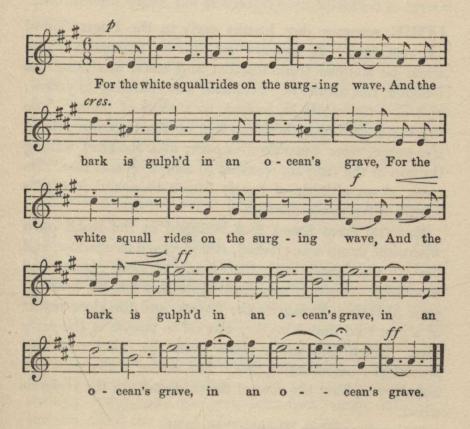
For the white squall rides on the surg-ing wave, And the
bark is gulph'd in an o-cean's grave, For the
white squall rides on the surg-ing wave, And the
bark is gulph'd in an o-cean's grave, in an
o-cean's grave, in an o - - ocan's grave.
Music fragment
CHAPTER VII
THE INSTRUMENT OF TYEE SAHGALEE
The summer day breaks early in the Puget Sound country. It was not yet four by Stratton's watch when he stepped from his tent and stood analyzing the weather, but all the sky overhead was changing to yellow, and directly, while he looked, to streaks of flame. The heights, towering a thousand feet on the opposite side of the gorge, were burnished copper, and Rainier, walling the top of the canyon, warmed to amethyst and rose. Its crest, at an altitude of nearly fifteen thousand feet, was hardly seven miles distant.
But the great forest that hemmed in the small open where the camp was pitched, still gloomed in shadow, and the air was sharp with the breath of near glacier and snowfield. Stratton saw that Mose had left his blanket, gone already to bring up the horses, and the close report of a gun told that Kingsley was off in search of the early bird. Then Samantha came from the other tent and stirred the smouldering fire. She added a dry hemlock bough, watching the roused flames fasten on the resinous wood.
"Good morning, Psyche," he said.
She lifted her glance, nodding. She had a mouth like a Cupid's bow and the short upper lip twitched with enforced gravity before the shaft sped. "Ef you hed er wife, I 'low she'd get er new name 'bout every day, an' mebbe twicet. Land, it 'ud keep her busy rememberin' who she was."
She tucked her sleeves up from her tapering arms, and kneeling, dipped them deep in a bubbling pool. Stratton laughed softly, enjoying her, and lifting his bag, crossed the open seeking a warm spring, which, screened in a network of young cedars, afforded a morning plunge. All along the valley iron and soda deposits discolored the earth, and mineral water, hot or sharply cold, sparkled in crystal basins.
An hour later the little cavalcade formed in line, with Kingsley leading on his big white horse, followed by Samantha, whose clear piping voice rose in alternate upbraiding or admonition, for she rode the indifferent Ginger. Mose, mounting Yelm Jim's piebald pony, crowded the cayuse with the two pack animals; then came Louise and the teacher, while Stratton closed the rear.
The trail became more and more precipitous, switch-backing across the face of a spur, taking the edge of a cliff, breaking into sharp pitches to a rushing ford. Trunks, logs, netlike boughs, shelving rock crowded close. The head of the Nisqually and its glacier were not far off. Then finally they turned up its beautiful tributary, the Paradise. Over the stream Eagle Peak, the first of the Tatoosh Mountains, lifted a tremendous front, and boulders, hurled from it, blocked the limpid current, creating innumerable cascades. The air was flooded with drifting spray, and the wet, luxuriant earth, reflecting the sun, filled the gorge with playing color.
At last Alice drew rein near the brink fronting a great cataract. Stratton dismounted and went to tighten her horse's girth. "Are you a little afraid?" he asked.
"Afraid? Of the trail? Oh, no. I love it; it's my element. And Colonel can go anywhere. He picks his way through bogs, pits, better than I could, and he runs straight up these rocky stairs. I have only to cling on," and she laughed.
"Well, you can trust him." Stratton's glance moved from her horse to his own mount and back to the black. "Sir Donald has found his match. But, how was it that Forrest gave up his horse?"
"He hasn't. I am only keeping Colonel for him, while he is at Freeport."
"I see," said Stratton slowly, "I see. I hope if the time comes when I must part with Sir Donald, I can leave him in the same hands."
At this she swept him with a swift, critical look, ruffling her brows. "I have known Paul Forrest all my life," she said, and turned her eyes again to the cataract.
"I understand." He smiled a little, both nettled and amused. "Before I can venture to ask a favor of you, you must know and like me better than you do now."
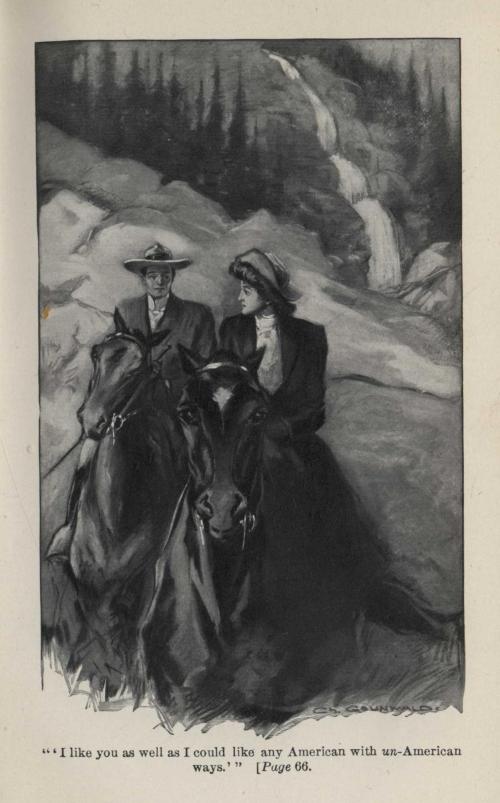
She flashed him another look, tilting her chin. "I like you as well as I could like any American with un-American ways."
"'I like you as well as I could like any American with un-American ways.'"
For an instant he betrayed his surprise, then, "Well, thank you," he said; "I appreciate your frankness; and perhaps you are right. My mother was more a French woman than an American; she was a Creole of the Mississippi. And my grandfather, on the other side, was a factor of the Hudson Bay Company. My father, I suppose, passed over with New Georgia into the hands of the United States. After all, it is hard for most any American to tell in just what generation he began. But I admit I have lived close to the border, Miss Hunter, often on the other side. In fact I haven't always been able to determine the line."
"And I," she answered, with a gathering storm in her eyes, "I have lived all of my life close to the boundary, but in a different way. The best patriot is he who fights for his home while he defends his country, and the sun for my family rose and set in 'Fifty-four, forty or fight.' We know the line; we never crossed to the other side. My grandfather died with Marcus Whitman."
She spoke then to her horse, starting him briskly. Stratton vaulted into his saddle. "You touch-me-not!" he said under his breath. "You touch-me-not!"
Far ahead Samantha approached a second cataract. It was a perilous place, for the trail, skirting a precipice, rose from a bog in rocky and winding stairs worn smooth and slippery by continuous spray.
Kingsley's horse cleared the morass; his iron shoes struck fire from the shelving granite and he set himself to the steps. His master looked back. "Make him leap," he shouted to Samantha, and while he spoke was carried beyond a turn.
But Ginger delayed. He snuffed the ooze with disfavor. The girl jerked his muzzle high. "Heft yourself, Ginger," she shrilled, and cut him sharply on the flank. "Now, now, Ginger, get up."
And against belief, Ginger gathered himself, but the effort fell short. His forefeet grappled the rock and he sank back floundering in the ooze. The trained pack horses halted, and Mose threw himself from his pony and pushed swiftly around the bog, through underbrush, to Ginger's head. But Samantha had already slipped from her saddle, and worked herself free of the struggling horse. She moved back coolly from the abyss and emerged from the mudhole, dripping, but unhurt.
She drew a full breath and looked about her. Stratton, who had arrival, grasped the situation and drew in his horse, humorously regarding her. "Ain't I a sight?" she asked.
"Yes, Aphrodite, you are. You are a vision to haunt a man's dreams."
"I jedge you're 'bout right." She paused and the imps danced in her eyes. "But I 'low it 'ud be er turrible nightmare."
She reached and broke a low branch of hemlock, with which she began hastily to brush the mud from her skirt. Beyond the bog, Mose, who had extricated the unfortunate pony, urged him up the granite stair. His flanks were slippery with ooze. "My stars," she said, "I'm glad Mill didn't kem this trip. I'd never hear ther last of it. He'd run er joke ter death."
The ax was brought, and the bog was hurriedly bridged with corduroy for the remaining horses. Then finally they trailed out of the heavy timber into the parks of Paradise. A succession of emerald slopes opened before them, broken by clumps of amabilis fir and mountain hemlock; where a higher top rose out of a shapely mass it became a cathedral spire. Sometimes the way wound through an area of blooming heliotrope or asters; banks of gorgeous snapdragon or flaming Indian paintbrush gave color, like landscape gardening, to whole hillsides. Then behind them, pinnacle on pinnacle, closed the Tatoosh Range; a last sharp ascent and they were on that small and lofty Plateau, at an altitude of five thousand feet, since called The Camp of Clouds, with the splendor of the great summit almost overhead.
The tents were pitched; horses picketed. It was hardly mid-afternoon. "By this time tomorrow," said Kingsley, "if this weather stays with us, we shall have made and I hope passed Gibraltar."
Stratton, lounging on a blanket, looked up to the black cliff, which, rising sheer fifteen hundred feet, stood like a mighty fortress against the whiteness of the dome. "I hope so," he answered, "but, Captain, I never saw anything look so tremendously like work."
Louise rested on a grassy knob, her hands clasped loosely on her knee, inspiration in her lifted face. She hardly heard her husband's remark, or the other man's reply, but Alice started from her place beside her. "Phil," she said, "take me with you. You can't understand what it means to me, to be so near, to see the summit shining there, and go no farther. I'm very strong, Phil, and clear-headed. I'm not afraid of things. I—oh, you don't understand, but the mountain seems to beckon."
Kingsley walked a restless turn. "I do understand," he said. "I feel it myself. But we don't know what we are going through, and we can't be sure of the weather an hour ahead; clouds are manufactured right here at a moment's notice. But wait, don't tease, and we'll compromise. I'm going off now to reconnoiter. I believe the most feasible start is from that ridge across this valley of the Paradise, but I want to be sure. There'll be no time to waste in doubling back for fresh starts to-morrow. And Mose has been up that way; he says, with care, we can use the horses as far as the old snow. A glacier cuts in there, probably the source of the Cowlitz, and he thinks we should be able to reach it in a couple of hours. I'll take you that far—to the glacier."
At this Mose started from his recumbent position on the earth. He threw out his arms in protest. "No, no, Mees," he said. "It ees bes' you doan' go dare. Sacré, no."
"I'm not afraid," she answered smiling, "and if I'm a trouble I'll turn back. I promise."
"You doan' be some tro'ble, Mees," he said quickly. "No, no, it ees dat Tyee Sahgalee ees goin' be mad. Mebbe he ees mek dis mountain burn an' break an' fall down. Monjee, monjee, Mees, you can' ride quick 'nough away."
She laughed, shaking her head. "I don't believe that, Mose," she said, "and you won't, after we have been there. Tyee Sahgalee don't care how many of us go creeping up there, any more than we care about the ants and spiders that crawl to the cabin door."
"You mean it is you who don't care," said Stratton. "You are ready to take the risks, whatever they are. And if you are determined to go on braving Providence, or Tyee Sahgalee, or whoever it is, the rest of the day, I'm going to join the expedition; that is, unless Mrs. Kingsley is afraid to stay here alone with Samantha."
"Oh," answered Louise, at last awake to the situation, "I want you to go."
"I thought so," and he smiled. "I've proved something of a mascot on occasion, and I'll look after the Captain."
The horses were brought and presently they were trailing away up the pathless slopes in the wake of the piebald pony; fording countless streams, leaping them, sinking in pitfalls through treacherous banks of bloom. When, switchbacking up a lofty rise, Alice ventured to look down, all the colored breadth of Paradise park unfolded like a map, and the dome gathered majesty at every turn. They gained a shoulder, rounded a curve, and before them stretched the levels of a plateau carpeted with snow. Then, as they moved across this field, mountain on mountain opened, shading to blue distance. Through a gap, out of a woolly cloud, shone the opal crown of Adams, and presently, far off St. Helens rose like a floating berg on an uptossed sea.
They dismounted at the foot of a knob flanked by loose rock. The red stain of old snow was under their feet and beyond the spur shone the clean, blue-green edge of the glacier. "We are higher than the treeline, now," said Philip, "and above the clouds."
She drew a breath of delight, lifting her glance to the near dome. "And it looks as though we could reach the summit in fifteen or twenty minutes. Oh, Phil, come, let's go."
Kingsley laughed. "We haven't climbed nine thousand feet; the hardest third of the ascent is above us. Don't you remember, the only two men who ever made that summit were half a day in just passing Gibraltar. We may find it no longer passable."
While his look rested on the grim fortress a thin cloud rose like smoke from its base. It covered the cliff swiftly and trailed across the dome. "Out of nothing, without notice," and he shook his head; "that's what I've heard."
He turned. Stratton was busy searching for a safe hitching-place for his horse; he never stood well. But Mose had stepped nearer Kingsley. The boy's shoulders were inclined forward, and his eyes, in that instant, were those of a crouching animal about to spring.
"Well, Mose," he said carelessly, "your Tyee Sahgalee is hiding his face. I suppose you think we've come far enough. But we'll show him."
He moved on with Alice up the knob, and Stratton joined them. But presently Mose stalked by leading the way to the glacier. His face had the gray look of fear, but his lips were set in the thin line that gave him an older, sinister touch, the shadow of cruelty.
He moved swiftly and surely. He did not once look back. He gave no direction or warning. They followed, slipping and stumbling through the moraine, and gaining the ragged brow of the knob, found themselves suddenly on the brink of a mighty precipice. Far, far down, the infant Cowlitz sprang into life and struggled out between stupendous columns and needles. Locked in the opposite pinnacled cliffs shone the sheer, blue-seamed front of the glacier, and the throes that gave the river birth resounded through the gorge.
Stratton uncoiled the spare lariat he carried, and taking an end, with Philip closing, and the girl between, drew slowly along the rim. Mose, curving far ahead, came out on the slippery incline of the glacier. Finally he stopped under a great upheaval of ice, and resting against a block, waited, with his back turned to them and his face lifted to the clouding dome.
Behind them another cloud formed over the Tatoosh Mountains, driving fast to meet the advancing column from Gibraltar; and, in a little while, when they had come out on the ice, and made slow headway up the tilting surface from the abyss, mist lifted swiftly, flooding, giving immensity to the darkening gorge. Kingsley walked a trifle in advance of Alice, with Stratton abreast of him. Suddenly Mose's tracks, on a recent light snowfall which had offered foothold, swerved, and both men stopped. They were on the brink of a narrow, deep, incredibly deep, crevasse.
Alice moved back, shivering. She looked, a mute question trembling on her lips, at Mose. But he continued to stand, oblivious, with his eyes fixed, expectantly, on the clouding dome.
"See here," called Philip, "see here; next time you let us know." Then his glance returned to the crevasse. "Reminds me of a tremendous white watermelon," he said, "with just one thin, clean slice gone."
"Yes?" questioned Stratton, smiling, "it strikes me differently. I thought right away of some curious metal, with just enough taken, by some nice process, to shape a gigantic blade."
"A blade, yes," said Alice, "for the hand of Tyee Sahgalee."
Stratton's eyes met hers amusedly. He wondered if she was capable of superstition. "Even then," he said, "it is only a surface impression, lost the moment you look down. It's an ice-crevasse; nothing else." He turned to Kingsley, who was already studying the glacier ahead. "Of course this will not delay us to-morrow, Captain, but it is time, now, to turn back."
"In a moment. There's a streak on there that bothers me. Looks like a more serious break. I want to see it at closer range. Wait here; I won't be fifteen minutes."
He moved back impetuously, and, giving himself short headway, took the crevasse in a leap. Showers of loosened ice clinked down from the rim. Most of the particles struck the sides that closed in twenty feet below, and rebounding, dropped again and sent back faint echoes from the last level of the abyss.
Stratton stood watching Philip up the glacier, but presently, Alice drew away from the crevasse and turned to look back down the gorge. The sun no longer shone. All that brilliant vista of opal peak and amethyst spur, shading to blue distance, was curtained in closing sheets of mist. There a great crag loomed an instant and was gone. Here an uptossed pile of ice-blocks flashed a sudden prismatic light and grew dim. Then they themselves were wrapped in a noiseless, drenching cloud.
At the same moment she was startled by Stratton's brief note of surprise and felt behind her a sudden jar. She turned. Mose was hurled sprawling at her feet, and, clutching her skirt, was up instantly, panting, with quivering nostril, eyes ablaze. Then, in the recoil, Stratton reeled on the brink of the crevasse, recovered, stumbled on breaking crust, and went down.
She stood for an interminable moment, waiting, listening, numbed, body and mind. Then she was conscious that Mose was going, and she went after him a few steps, calling his name. But his receding shape drifted faster and faster, a fading shadow in the mist. She turned back, lifting her voice in a great cry to Philip. And she was answered from the abyss.
She dropped to her knees and crept close to look down. Stratton was there, where the pale, green walls narrowed. He rested wedgelike, caught at the armpits. He looked up and saw her. "Be careful," he said, "I am all right."
Instantly the executive in her rose. "I have the lariat," she said.
"Fasten it to the ice where Mose stood," he called. "I can work along that far."
He remembered that the rope was new and strong, one he himself had selected as a reserve in picketing his own spirited horse. The question was whether the ice would take his weight. He worked carefully, laboriously along by shoulder and elbow, his body swinging from the waist, starting a rain of ice at every move. At last, where the wall crumbled, leaving a ledge, he was able to draw himself to his knees. He cut foothold with his knife, and other niches higher up for his hands, and pulled himself erect on the slippery shelf.
Beyond him the chasm widened between sheer walls, and it was in this shaft that the lowered rope hung. It swung for a moment, like a failing pendulum, and each oscillation, though he stood alert, missed his reach a little more. The girl, peering into the abyss, understood, and again disappeared. The line was drawn up, and presently it dropped almost at his shoulder. He caught the end and, looking up, met her eyes over the rim. "That's better," he said.
"Wait—one moment," she called and was gone once more. She did not return this time, but her voice came to him, "Now, now, all ready."
The lariat tightened. It creaked, ground on the edge of the chasm; ice chips fell ceaselessly. He swung out. He was a big fellow, heavy. Would the support hold? Would Mose, his fury cooled, be neutral? Why, yes, surely the boy was even setting himself to ease the strain. He could feel an unmistakable give and pull above on the rope, as he climbed, hand over hand.
He gained the top. He reached a palm around a slight pinnacle, for a final grasp on the line, and pulled himself slowly out on the surface of the glacier. He was a strong man, physically, a man of steady nerve, one accustomed to take risks with Nature, as in those times a man of the Northwest must, but what he saw, in that brief pause, sent a shiver through him. He closed his eyes like one brought suddenly into intense light.
The rope was fastened, as he had directed, to a thick column in the upheaval, but it stretched diagonally to the projection on the brink of the crevasse. And it was Alice, not Mose, who steadied it, throwing her weight on it, twisting it on her hands, digging her heels in a shallow cleft, straining back to ease the pressure on the knob. Suppose the support had given way; suppose he had dragged her—this brave girl, all life, charm, loveliness—down to destruction. It was horrible to think of. Horrible.
Seeing him safe, she relaxed her hold and drew back, making way for him. She breathed deeply, her chest heaving, and a moisture not of the cloud clung to her lip, her brow in drops.
He pulled himself together and got to his feet. He did not speak to her, then; he could not. But he put his hand to his mouth and lifted his voice in a great hail. Kingsley responded, but his "Hello," came faintly, through billows of mist. The calls were repeated. "We cannot wait," Stratton said. "We must follow that rascal's tracks down, while they last, to the horses."
"What made Mose do it?" she asked. "Oh, what made him?"
"Why, just Indian, I suppose; or say he was an instrument, self-appointed, of his Tyee Sahgalee. But he shall be punished." He closed his lips over the word, and a heat, like the flash of a blade, leaped in his eyes. But when he took her hands to help her to her feet the look changed. The light returned, yet softened, steady, and currents of tenderness, long pent in the man, surged to his face. Her palms were bruised, cut, cruelly. He lifted them, one, and then the other, swiftly, very gently, to his lips. "You did this—for me," he said. "You could do it—for me."
"Of course," she answered quickly, and drew the hands away, "I must have done my best for anyone—for Mose, if things had been reversed. But, if I hadn't been able, Phil would have come back in time; no doubt he could have seen a better way."
She met his look briefly, but long enough for him to fathom the clear depths of her eyes; and suddenly, before her dauntless white spirit, his own soul, for the first time, shrank. It was as though another unsounded abyss yawned between them, that the exigency of this hour could not bridge.
They hurried on then, groping and slipping down the glacier, taking Mose's trail. Sometimes they stopped while Stratton renewed his shout, waiting always for Kingsley's answer, and they knew when he had crossed the crevasse in safety, and that he followed on to the gorge.
They made the rocky knob and finally, out of obscurity, she caught Colonel's familiar neigh. The call shrilled again, inquiring, peremptory. But when they came to the end of the moraine where they had left the horses, they found them gone.
The neigh was repeated once more, coming back faintly, from far across the snowfield. "Mr. Stratton," she cried, "what has happened? Where is Mose going?"
"Over the mountains to the Palouse plains, I haven't a doubt," and the blade flashed again in his eyes. "It's the first thing a halfbreed does, and they always drive stolen horses over there; it is impossible to find them among those big, feeding bands of the Yakimas. He will stampede the rest in the valley, and Yelm Jim will probably meet him somewhere below the springs and help him take them through the Pass."
She stood for a moment with her head high, lips set, looking with storming eyes into the mist. Then, "There isn't any time to waste," she said. "We must take him this side of the springs." And she began to trail the horses on across the snow.
"I wish there was a chance of it," said Stratton, "but you will only spend yourself uselessly. You are miserably tired now. The horses will make the down grade to the springs very fast, and you must see that the trail through the timber, afoot, is simply impossible at night. We should bury ourselves in one of those mudholes or plunge over some cliff. We could never make the fords."
But she hurried on. There fell a long silence. It grew rapidly colder; the winds freshened, tearing the cloud-wrack, driving it this way and that, bringing the ragged ends together in bursts of hail or flurries of snow. The girl's drenched skirts hampered her, still she pressed resolutely on. Once she said, "An accident somewhere might delay the band." And Stratton caught at the hope. He told her Mose would probably try to mount Sir Donald, the fleetest horse, and that he had some unexpected tricks. He was as full of coquetry as—well—a pretty woman, though as easily managed, if a man knew him.
It was twilight and they were descending the final pitch into the park when Kingsley at last overtook them. The camp-fire, which Samantha had kindled with infinite difficulty on the plateau, burned like a beacon in the gloom. "You should have seen that second crevasse," he said. "It was tremendous. No way over, no way around; I tramped both directions to see. We've simply got to choose another route, to-morrow. But what became of the horses?"
"Mose took them." It was Alice who answered. "He took Colonel. But I shall find him. I've got to find him if I have to walk every step of the way over the mountains and through the Palouse. You know how much Paul thinks of his horse, Philip. Oh, I can never face him; I can never tell him—the truth."
She started on uncertainly, stumbled, and fell. Stratton lifted her, and carried her a few steps over a rough place. "You mustn't trouble so much," he said gently, "We are going to find that black if it takes a year. Yes, we are and punish that Klickitat."
CHAPTER VIII
"I'M GOING TO MAKE HIM WHITE"
The night was terrible. The wind became a gale. It assailed the tents; in the near hemlock grove it wrenched off great boughs; it lifted lighter brands from the fire and scattered them broadcast. There was a constant watch, which Samantha shared, to drag aside and beat out dangerous embers. The fire was enclosed in a circular windbreak of rocks, and other stones were brought to pin down the bellying canvas and ballast the working stakes. Up the mountain clouds clashed in thunder; the plateau was pelted by swift and furious storms of hail.
The final watch fell to Stratton. The wind was piercing and for warmth he tramped the earth. Once he stopped to lift a fresh log on the fire, and, drawing himself erect, his eyes rested on the women's tent. "She must be sleeping," he told himself. "I hope so; she was so unhappy about that black. That is her way—to take things hard—pleasure or sorrow. Jove, how she could love a man. But—she would hold him to his best, always, in every common move of every day." He shrugged his shoulders and swung on his heel to look out into the darkness of the valley. It was so dense that the flame-illumined plateau seemed to rim an abyss. "That was it—the reason I went so nearly to pieces for that minute, there on the glacier. I felt the Puritan in her all at once demanding the best in me. And there was no best; there never can be." He tramped another interval. "But," he said at last, and the steel flashed again in his eyes, "there is not a man living I am afraid to face; and if I ever loved a woman—or thought I did—sooner or later she was glad to have me tell her so. I never have failed to get what I wanted, all my life, and I am going to want—her."
At daybreak it was snowing on the plateau. He roused Kingsley. "Captain," he cried, shaking the sleeper, "Captain, wake up; we must hurry."
Philip rose, stretching himself, stiffly, and drew aside the tent-fly. "It doesn't look much like the summit to-day," he said.
"Summit?" repeated Stratton with disgust, "summit? What we have to think of, is the quickest way to get these women out of this."
A gust of wind rushed through the aperture, past Kingsley, and filled the tent. It lifted the canvas, balloon-wise, scattering the ballast, up-pulling the stakes, and carried it far afield. It led the men a chase, but they secured it and struggled with it back to the plateau. Truly it was not a day for mountain-tops.
Camp was broken hurriedly, each of the men taking the necessary shoulder pack, and leaving the bulk of the outfit to be sent for when they should find horses. They pushed quickly down from the snow, which became rain in the woods. And Alice led the way. She studied the trail continually, separating the tracks of the ponies, where they struck the path down the valley, from the deeper, water-filled impressions of the American horses. She set Stratton a pace, and kept it almost to the ford of the Paradise. Then suddenly she stopped an instant, listening, and ran on along the bank to an old log foot-crossing. There on the end of the bridge, sheltered by a trailing cedar, were her bridle and saddle; and picketed on a grassy knoll under some alders she saw the black.
"Oh," she said, and took his head in her arms, "you beauty! You heart's desire! But I knew—I knew Mose couldn't take you; I knew it."
Stratton stood for a moment watching her. "So," he said, "so the rascal was white enough to leave your horse. He brought him this far with the others to avoid pursuit last night."
Alice looked off a thoughtful moment, through the dripping trees. "I knew his white conscience would get to upbraiding him," she said. "But I can't help feeling glad he chose Colonel for the compromise."
Stratton laughed. "I hope it will upbraid him some more," he said, "and induce him to leave my horse."
She would not mount, but waited for Louise to take the black. She herself was not tired, and she moved lightly up the log, pausing fearlessly, mid-channel, to watch Colonel feel his steps through the ford and leading him up the bank and on some distance, until she was assured he would carry her sister quietly. The rain fell with renewed downpour, but she walked unmindful of boughs that drenched her shoulders, and dripping skirts that weighted her limbs. Delight shone in her eyes; whole face seemed to reflect some far illumination. She had recovered Forrest's horse; the day was faultless.
But at last she was in the saddle and descending to the ford of the Nisqually. The cloud-wrack was breaking then, and shafts of sunlight struck the wet, green earth. Stratton walked a trifle in advance, looking for a safe crossing over the rising channels. Suddenly he stopped, and the black also halted, tossing his mane and shrilling his ready, challenging neigh. There, moving out of the stream, up the opposite bank, was a riderless horse. It was Sir Donald.
Stratton whistled, a soft, imperative note. The chestnut wheeled. The man repeated the call, and the horse trotted gently back into the channel. He halted once more on a gravel bar, his head high, ears alert, then came on across to his master.
"So," said Stratton, slowly, "So, Donald, you showed the rascal your little trick. You see, Miss Hunter, it was as I thought. Mose chose the best horse. But he never mounted him. In his hurry he laid his hand on the bit, and Sir Donald never allows that; he was trained that way."
With this he vaulted into the saddle and led the way over from bar to bar. He returned bringing the black, and while the others made the crossing Alice waited, seating herself on a rock in the sun, and lifting her face to the upper canyon. Presently the clouds parted like a rent veil on the mountain. Once more Gibraltar menaced and the summit shone in splendor.
"After all," she said, when Stratton rejoined her, "I can't blame Mose for that belief. I felt it myself, for a moment, there on the glacier. It was the steps of the Great White Throne. You can't understand."
"No," he replied, "No, you are right, I cannot. I am outside the circle."
He bent and offered his hand to mount her on his horse, her sister having kept the black, and she sprang lightly up. "Then," she said, while he adjusted a stirrup, "you see no excuse for Mose?"
"No," and his face hardened, "No, I only see the half-breed threw me into that crevasse. He took me off guard. And he left us miles from anywhere, on that unknown mountain, in a storm, without horses. His motives do not count."
Sir Donald started, trailing after the black. The little company filed slowly down to the mineral springs. And there, in the open, unpicketed, ready for the long trail, they found the other horses quietly feeding in company with Ginger and the pack animals.
While Samantha made a fire and prepared the coffee the two men caught and picketed the herd, reserving the few horses necessary for a hurried trip back to the plateau for the outfit. And it was Alice, who, going for a drink from her favorite well, discovered Mose. He was lying semi-conscious on the wet earth, and over his black brows, branded with the tip of an iron shoe, Sir Donald had set his mark.
The teacher dipped her handkerchief in the basin and bathed the hurt. She went to ask Stratton's flask of him, and mixed the boy a draught, and, a little later, when the young man followed her to the spring, he found Mose able to recognize him. He stood a silent moment watching him with hard eyes, and the boy met the look steadily; his muscles stiffened as they had that day at school, when he braced himself to Laramie's blow. Stratton's lip curled in disgust. After all, he could not punish the fellow, down, helpless like that. He swung on his heel.
"Wait," said Alice, "it was just as you thought. The scheme to steal the horses was Yelm Jim's; he was to meet him at the branch to the Pass and help drive them over the mountains to the Palouse plains. But he meant to leave Colonel; he only brought him as far as the Paradise to avoid being overtaken. And that trouble at the crevasse was unpremeditated. He was terribly frightened by the gathering storm. He believed it was a judgment coming on us all, and he took the opportunity to—use you—for a propitiation. Afterwards, in the night, he crept back up the valley far enough to see the camp-fire, and you, safe—and keeping watch on the plateau."
There was another brief silence. Stratton stood, still hard, uncompromising, frowning down at the boy. "Be merciful," she said. "Think; you were not hurt; you have Sir Donald, unharmed. Be generous. Sometime,—who knows?—you yourself may ask it."
"No," he flashed, "No. I live my life; I do as I please. I ask nothing of anyone. And in the end—I take what I deserve. That is my creed. The boy must be punished."
He turned away, but she followed. In her earnestness she laid her hand on his sleeve. "He has been punished," she said. "Look. He will carry Sir Donald's brand all his life. He's just a boy, Mr. Stratton. He left home angry, outraged, and Yelm Jim took the opportunity to make him his tool. But he has good in him, I know. Remember, too, he saved my life. And I need him; I'll be responsible for him."
Her eyes were raised to Stratton eloquent with appeal; the hand on his arm trembled. "You need him; he saved your life." He paused and the hardness went out of his face. "And you saved mine—you saved mine; I do not forget that. And perhaps you were right just now; sometime I may ask that mercy. I may ask it of—you."
Her hand fell from his sleeve; she drew back a step. "I will be ready," she said slowly, "if you are good to Mose." She looked back at the boy. He was watching her. His lip quivered and his eyes filled with unaccustomed tears. "I'll be responsible for him," she repeated, "I'm going to make him white."
CHAPTER IX
UNCLE SILAS
It was the morning following his election and Judge Kingsley was taking a late breakfast in his dining room. He had laid aside the newspaper,—an interesting number, devoted chiefly to his final speech, a personal and flattering editorial, and the returns,—to conclude some business details with Forrest, who, seated near the open French window, overlooking the terraced orchard, made brief memoranda in his note-book.
The Judge, then, was a man in his first prime, with that commanding presence that does not challenge attention or respect, because he has long been sure of both. He carried with ease a suggestion of coming weight, and his voice, deliberate, sonorous, was that of a born orator. "There, Forrest, I believe that is all." He pushed back his chair and crossed his hands on his ample front. "Your father knew how to manage men, and, there at Tumwater, he gave you a thorough apprenticeship. He left you his executive ability and his knowledge of timber. But, if the Freeport mills pay expenses these first two years, and Philip learns something of business and the value of money, I shall have accomplished my purpose."
Forrest smiled, his smile of the eyes, shaking his head. "I'm not much of a diplomat; what I say is always just what I think. But I'll do my best." He put the notebook into his pocket, and looking at his watch, rose and took his hat. "I shall be able to catch the down steamer," he said.
"Better wait over a day or two; the young people would miss you tonight at the ball. And I want to speak to you about another matter." The Judge paused, stroking his blond beard. "I want to speak to you about—Alice."
Forrest returned to his chair. His eyes sought the window, avoiding the Judge's scrutiny. Louise was there, swinging her child in a hammock under the cherry trees. Her supple body swayed to the effort in unconscious grace; the loose sleeves of her house gown fell away from her uplifted, lovely arms, and the pose of her head brought out the beautiful lines of throat and oval chin, but he saw her absently.
After a moment the Judge added, "You never knew her mother."
"No." The young man turned in quick relief. "No, I never knew her. I was still a small boy when my father came to take charge of the Tumwater mills, and that tragedy of the Cowlitz had happened several months before. It has always seemed unaccountable to me; those old voyageurs understood a canoe; they must have made that trip down to the Columbia a good many times."
"True," answered the Judge, "but there was a strong spring chinook blowing, and the sudden melting of snows at the headwaters. The river was flooding; the current changed and the accident occurred at a shifting log jam."
There was a brief silence, then he went on, "She was on her way with Philip's mother to visit their early home in Oregon. There was something fine in that friendship of those two young women. Their lives had begun together in that small frontier settlement; they married at the same time men who were, themselves, warm friends, comrades in adventure and endurance; and they came that double wedding journey by canoe and trail, to start a social foundation here at the new capital of the young territory. And later, they faced their tragedy of the Indian war, when both husbands fell, fighting in the same skirmish. It softens the terror of that last journey to know they met the end together.
"But I shall always blame myself for letting them go down the Cowlitz without me;" and his voice vibrated a soft undernote. "I loved Alice Hunter. We were to have been married when she returned."
Forrest met the Judge's look; a sudden intelligence, sympathy, shone in his young eyes. "I understand," he said slowly, "I understand."
"I loved her always, from the first time I saw her, riding her little pony along the bluffs of the upper Columbia. It was the day I reached the river after my long journey overland, from New York. She was the first—the one woman. And—she had promised to be my wife—before John Hunter came."
"I understand," repeated Forrest, and his glance moved in delicacy to the window. "I understand."
He saw clearly, in that moment, this great man's devotion, through years, to that memory; the fineness of his solicitude for her children. They had shared the home he had established for his brother's boy. He had lavished benefits upon them; borne the expenses of their liberal education; made himself their natural protector, guardian, friend.
"And the new Alice is her reincarnation."
The Judge paused and Forrest gave him another look, swift, searching, and rose from his chair. He stood like a soldier at attention; or, like a man who sees certain danger, yet prepares himself for that inevitable of which he is afraid.
"She has the same bright face, the same quick intelligence, the dauntless spirit speaking in her eyes; the same decided uptilt of the chin; the same ruddy, shining hair." The Judge rose and moved a step towards him. "I was still a young man when I brought her home, Paul, and I have watched her grow. You cannot understand that. What it meant to see the child unfold; what it cost me later, to be her every-day companion, friend, to shape her pliant mind, and yet to—make no sign."
Forrest moved to the window, squaring his back to the room. He stood looking down across the orchard and the maple-lined streets of the town, to the shining sea; but his hand groped for the casing and held it with a steadying grip. The Judge drew nearer. He dropped his hand on the young man's shoulder, and the tender, insistent pleading that was the chief charm of the orator dominated his voice. "I know I am facing very possible defeat. It is natural that you two should think a good deal of each other, Paul, and there isn't another man on earth to whom I could better trust her. I am fond of you; I believe in you; I have called you the man of the future Northwest. Still she has chosen that hard life up in the wilderness, and you are leaving her there. If there is nothing between you, if you do not love her, I shall ask her to go to Washington with me—to be my wife."
Forrest turned. His face was gray; suddenly older. "I don't stand in your way," he said. "I am just her friend, the one she depends on. That's all. She refused me."
"She refused you?" The Judge laid both hands on the young man's shoulders, compelling his look. "She refused you? And you love her—like this."
Forrest drew away from his detaining grasp. "I must catch that steamer," he said. He went back to his chair and picked up his hat. "Good-by." He lifted his head, smiling a little, and offered his hand; but his glance moved beyond the Judge to the window once more, and he started. "She is here," he added unsteadily. "She is there with her sister on the terrace. Good-by and good luck."
He was gone and the Judge stood regarding the closed door. Then a light step on the threshold of the open window roused him and he turned.
"Good morning, Uncle Silas," she said, "I had to come right in and congratulate you on the election, though Louise told me you were talking business with Paul."
Her glance searched the room. Disappointment clouded her face.
"He was here," answered the Judge. "He hurried away to catch the steamer back to Freeport."
"Why," she said in surprise, "Louise told me he came over with them in the Phantom to hear the returns, and I thought—of course it was expected he would wait to go back with them after the ball. But," and she turned with recovered brightness to the small boy who stood waiting on the threshold, "this is Lem Myers, Uncle Silas. He came to see town and the salt water."
"Good morning," said the Judge, weighing this future voter with speculative eyes. "Good morning. You are just in time for a cruise. To-morrow my nephew will show you what the Phantom can do. I suppose you never have boarded a yacht?"
"Wal, no," Lem moved towards the chair the politician offered, stepping high in new and unaccustomed shoes. "No, I dunno's I hev."
"But of course the first thing, you want to try Olympia oysters. Hop Sing manages a good pan roast." He rang and gave the order to the Chinese cook, and Lem proceeded to adapt himself to the elegant appointments of the table.
The teacher had taken the opposite chair. "Oh," she said presently, "I know I have missed things; torchlight processions and rallies, and orations,—I shall read that last speech directly,—and I'm sure you have been serenaded by all the bands. I do love a band, Uncle Silas."
"They will play again," said the Judge, laughing, "and I hope one at a time, and tonight you can enjoy the ball. But no doubt that is what brought you all the way from Nisqually. You expect to lead that ball."
She shook her head. "Your first dance belongs to Mrs. Governor, Uncle Si; we can't choose. That's the penalty of greatness."
The Judge laughed again, a soft rumble. "My dear," he said, after a moment, "isn't it about time you left off calling me Uncle?"
She looked at him, flushing, with quick surprise. "I understand," she said softly, "I understand. I should have thought of it long ago. Of course I always speak of you differently to strangers, but among ourselves—why— It was you who taught me, at the first, when I was a little girl."
"Oh, but you don't understand," he replied hurriedly. "I mean—you see, my dear, when you were a child a young man seemed so much your senior; the years between us do not count so much since you are a woman. In short, it should be more natural to call me just Silas—or even Si."
"Call you—Si? Oh, how could I?" and she threw her head back and laughed and laughed. "Good morning—Si. I congratulate you on the election—Si—" the words came with difficulty, between trills of merriment. "I am very proud of you—Si. But it was what we expected; you are the one man big enough for the place—Si—and all the territory knew it. Oh, indeed, indeed, I cannot. It's so ridiculously familiar. But, yes, I will do it, I'll try if you—" she paused and looked away through the open window. "The truth is—of course I want to go to the ball, immensely, but I came from Nisqually really—because—to ask—"
The Judge laughed, his pleasant undernote. "I see," he said, "I see, you are ready to come home. I've expected it; I've waited for it, and I've missed you more than you can ever know. But things are changed. I am going East in a few months and the house here will be closed. You do not want to make your home with Louise at Freeport." He broke off and walked over to the window. Directly he turned, and, with his back to the light, his hands clasped loosely behind him, stood regarding her. "The home here was broken up when you went away," he added, "and I shall find it lonelier still at Washington—unless—"
"Oh," she interrupted brightly, "I'm sure you will be very gay there. Think what it means; to be the representative from the big new Northwest. A man distinguished, almost rich, and a bachelor. Why, you will never have a dull moment—Si."
He caught the swift look from under her lashes and smiled. "You are still laughing at me, yet that life at the capital would suit you well. You were meant for pleasant places, to hold your own among bright women and distinguished men. And I am eager to show what manner of woman the crude West can produce. My dear, you would outshine them all."
"Oh," she said, and clapped her hands an instant to her ears, "you need not practise those fine speeches on me, your success is assured; you will live in a whirl. And don't trouble about me, Uncle Silas; I'm not asking to come home. I—I only want you to go to the Land Office with me. I—I am going to—file a claim."
"You are what?"
"I am going to locate a homestead." And her voice tripped on the word.
"You are going to locate a homestead? You?"
"Oh, Uncle Silas,"—she rose and walked a few steps, then turned facing him with tilting chin and ruffled brows. "Why do you stand and frown like that at me? I'm not the first woman to take up Government land. Do you know of any reason why I shouldn't? I'm native born, and I'm twenty-one."
Lem cast an appreciative wink at the Judge, and, having reached familiar terms with the dish which Hop Sing had placed before him, he devoted himself to a second generous installment of Olympia oysters.
"But," said the Judge, "you are not going to improve that homestead like any settler? You do not intend to live there?"
"Yes," she answered, her voice again wavering, "I do. I am having the trail cut through to the schoolhouse now; Mose Laramie is doing it, and I have made a contract with him to cut the logs for my cabin. In payment he is to have the best gun I can find in Olympia. I want you to help me select it. But this is the piece,"—she paused to draw a township plat from her pocket. "It is all that's required; the soil is a good loam; a fairly level bottom-land at the foot of a great side-hill. And at the same time, I want to make a timber filing on the adjoining quarter up the slope. It is almost free of undergrowth except along the stream. There are some fine old trees. You see, too, the section is at the headwaters of the Des Chutes and I want to secure the water rights to these falls."
She was unmistakably in earnest and the incredulity in the Judge's face changed to dismay. He took the map and studied it. "I see," he said slowly, "I see." There was a brief silence, then his voice, that voice of the orator, took its pleading undernote. "Why will you do this thing? If you must create your own opportunities, there are other ways. Why, it is unbelievable. If ever there was a woman made for civilization, you are that one, yet you choose to bury yourself in the wilderness; to take up a claim in the heart of a jungle; to share the hardships of rough and ignorant pioneers."
"But I am a pioneer," and he saw the rising storm in her eyes, "the daughter of pioneers. You taught me to be proud of it, Uncle Silas; you loved to remind me my mother was born on the Columbia, and that her father, a New England missionary, followed Marcus Whitman to Oregon. You never let me forget that my other grandfather was among the first to enter the Straits of Fuca, and sailed his own ship a hundred miles, straight up Puget Sound, without chart or pilot. You called it a great record. And my father was the pioneer surveyor. You talked about those seasons you spent in camp with him, while he blazed the great military road through the forest, running his section lines over rocky spurs and through cedar swamps, until I should count it a triumph to have carried chain for him. You see it was born in me, Uncle Silas. I can't help it—and I've got to turn it to the best account. It was my only inheritance."
Her voice broke at the last, and the assurance dropped from her like a shell. She stood before him, lovely, irresistible, extenuating a weakness.
"Oh," he said in evident distress, "you have misunderstood me. I wouldn't have you any different. Surely you know it? To me you are the embodiment of all that is fine and sweet and best in this great Northwest that I love. You are the spirit of it all. And your people were above criticism, Alice. Only, the memory of their fortitude makes me tremble for you. Your father, that splendid young fellow with almost a lifetime before him, was cut off in ambush; and your mother—was drowned in the Cowlitz. I want to have you—safe."
He began to walk the floor, slowly, with his hands still clasped behind him, his head bent, a cloud on his face. And she waited in respectful silence, watching him with a sweet and regretful tenderness in her eyes. She believed she understood those memories from which had sprung all his great kindness to her. Finally he stopped at the table and again spread out the plat. "This must be near the section Forrest told me about," he said. "Why, it looks like the very one. He was debating on taking it up, himself, at the time I offered him the management at Freeport."
Her glance fell before his inquiring look, and the ready color flamed. "Paul doesn't know," she said. "Please say nothing about it to any one. You see, Uncle Silas,—you see—the country is being settled very fast, and if I don't make this entry, some one else will."
There was another brief silence, then the Judge said, "Poor Forrest! you are even bent on taking his chosen section of land."
The color leaped again in her face. She moved a few steps to the window and stood with her back to him, looking down through the orchard to the shimmering Sound. "He told you?" she said.
"Yes, he told me. I asked him. It had always seemed so natural you should care something for him; he is well worth caring for. It seems incredible that you should refuse a fine, interesting young fellow like him." He paused, and his voice took its soft undernote. "I asked him, Alice, because I want to take you to Washington. There is only one way I can ask you to go. My dear, you understand—I love you."
She moved, startled, and laid her hand on the casing, where Forrest's had been, waiting. It was the gesture of a woman who feels suddenly, without premonition, the foundations of her world shake. He saw her shoulders lift; her whole body trembled. His glance passed from her, through the window, and on down the slope to the shining sea, and slowly returned. "It is, then, impossible," he said. "I am impossible. Well, forget all about it, little girl; it's all right. It's all right. Your happiness first; nothing else counts."
"Dear Uncle Silas." She turned, smiling, though her lip quivered and she brushed her hand across her eyes. "You count. I owe all I am to you. And you—are not impossible. I—I'm very fond of you. Its true—Silas." She nodded her head brightly, and dashed her hand again across her eyes. "And I will go to Washington—I'll be—glad—proud—to be—your wife—as soon as the homestead is safe."
CHAPTER X
LEM AND THE PHANTOM
Lem never forgot that ball. The teacher found him a nook from which he overlooked the entire floor; and he never tired of recounting to the always newly impressed settlement, the glories of the pageant. How "ther Jedge led ther parade an' was ther biggest toad in ther hull puddle." How "two fiddles an' er pianer an' er horn kep er goin' all ter oncet. An' clothes—ther Nisqually hedn't never seed sech clothes. Why, ther schoolmarm herself was fixed ter beat ther band, in er dress as soft an' thin as tons o' tissue paper, an' er gold chain, fine as er thread, clamped 'ith shiny little stones; an' she hed er mighty fine an' sassy feather—he couldn't fur ther life of him tell off'n what bird—stuck in her hair. An' pretty, land, ther wa'n't a girl there could hold er candle to her. An' ther boys all knew it; some of 'em, Mr. Stratton fur one, 'lowed they wouldn't dance 'ith nobody ef it couldn't be her; an' ther minute ther fiddles struck up somebody was on hand ter streak her off. Gee, they'd orter seen her. She jest picked up er handful o' white goods, an' her little feet went chasin' in an' out like er couple o' chipmunks foolin' in er holler cedar stump."
But if the ball was unforgettable, the cruise on the Phantom, the following day, marked an epoch in Lem's life.
"I think," said the teacher, as they approached the water front, "we shall come back at flood-tide with a fine, choppy sea." Her eyes caught the sparkle of the waves, and she inhaled the salt air in deep, full breaths. There was the noise of running water about the piers, and the flat kerthug of the Phantom as she rose and dipped uneasily; but no whitecaps as yet, though the Sound, whipped by passing gusts, darkened and ruffled fitfully.
"Oh," said Stratton, who had joined the little party, "you will come back in the teeth of a gale, I promise you."
Philip stood regarding Lem with quizzical gravity. "I never knew it to fail with a new hand aboard, and this time I believe we're shipping a Jonah."
Stratton laughed softly, and handed the ladies aboard. Lem watched the feat with growing concern.
"There was once a man from Missouri," said Kingsley seriously, "who had to be lassoed the first time, and brought aboard."
"I'll resk it," and Lem pushed hastily forward, setting his feet on the gangplank and reaching for the Captain's hand.
"That's right, my boy; and it may encourage you to know that Missourian lived to be our mayor in time."
The Phantom swung out with a lurch, and, slipping into the seat next the teacher, Lem grasped firm hold. Stratton took the helm and Philip went to the shrouds. The sails swelled to a scurrying gust, then flapped loosely. They filled again from another quarter and the yacht careened to the swinging boom. Lem's clutch tightened. Alice covered his hand with her palm. "Isn't it fine?" she asked.
"I'd ruther be erstride o' Ginger." He met her smile with a sidelong glance and looked again with apprehension at the flapping canvas. "But Jake 'lowed I'd git used to it."
"Who is Jake?" inquired Stratton.
"Jake?" Lem relaxed his grip on the rail, for the Phantom settled steadily. "Jake? He's my cousin; Samanthy's brother. An' he's be'n clear ter British Columby. He went over oncet fur ther Queen o' Victory's birthday."
"And he had a great time, I'll wager," said Kingsley, coming back to the helm.
"Yes, but he counted on seeing ther Queen. He 'lowed she'd be to ther head o' ther parade, 'ith her gold crown on, an' ther rest o' her fine truck."
"And wasn't she?"
"Naw, she wa'n't ther. Aunt Lucindy 'lowed ther hull thing was er fizzle; but then she counted on bringin' back er lot o' goods; cloth an' hats an' shoes; I dunnot what all. You kin get 'em twice as cheap over to Victory ef you don't hev ter pay no duty. An' she made errangements 'ith ther neighbors ter do buyin' fur em."
"And," said Kingsley, "I suppose she made other arrangements to elude the Customs officers?"
"Ef you mean she laid out ter fool ther Gov'ment men, you're right. She made er mattress ter fit over ther one on the steamboat, an' she filled it 'ith ther goods. But they was too sharp fur her. Fust thing she knew ther boss was haulin' off ther covers, an' er rippin' open that ther tick. An' he poured ther stuff all out onter ther cabin floor, 'ith ther hull crowd lookin' on; an' Jake says they laughed like all purzest. An' he took the goods,—Jake 'lowed he kept ther pile,—'ith Aunt Lucindy er cryin' an' er takin' on."
"But it was smuggling, Lem," said the teacher in dismay. "I hadn't believed a Myers could do a dishonorable thing."
Lem threw back his head and narrowed his ferret eyes. "You kin jes' bet er Myers ain't er goin' ter let er good chancet slip; not ef he knows it; no, ma'am."
He thrust his hands into his pockets and leaned back comfortably in his seat. But if the temporary ease of the yacht had lulled his apprehensions they were speedily revived by a lurch that carried away his hat and enveloped his head in spume. He sprang to his feet, spluttering, clutching at the helm, losing his foothold on the slanting deck, while the Phantom raced down before the sudden flaw.
"Why, Lem, it's all right, there isn't a bit of danger. And you shall have a new hat." The teacher placed a dry cushion and drew him down into his seat. She wrapped him in a shawl, pulling it snugly over his head, and he cuddled in it like a frightened squirrel, making a peephole for his small, bright eyes.
Her own hat was gone and she bent to search a locker trying at the same time with one hand to secure a loosened mass of wet, curling, wind-roughened hair. Presently she brought to light an oilskin hat, which she drew over her head, tilting the brim so that the rollicking wind had still a chance at the shorter hair, tumbling it, twisting it into burnished spirals about her ears. She stood for a moment, catching easily the swing of the yacht, and looked far out across the stirring reach of blue. And surely the spirit of that dauntless explorer, her grandfather, dominated her; there was an exaltation in her face; delight in every breath she drew.
Stratton watched her in undisguised pleasure. "There is no other country as favorable to the traffic," he was saying. "It is utterly impossible to guard the whole border. A regiment of soldiers might be able to patrol the woods on the mainland, but it is easier to trail an Indian than to follow a fleet craft through the Archipelago de Haro."
"No doubt that's the way most smuggling is carried on," replied Kingsley. "And it's an open secret that there are men on Puget Sound, living right in Seattle, fine, well-established men, who wouldn't defraud each other or any business man out of a dollar, yet conduct a systematic and successful opium ring."
Louise turned to him in protest. "Oh, Philip, you don't know such men, personally. You ought not to repeat such an idle rumor. Of course, if you had grounds for the suspicion, knew certain circumstances, you would do all in your power to aid the Government to apprehend these men. To stand neutral is to connive in—crime."
"Oh, Mrs. Kingsley, that is a harsh word." The quick flush that leaped in Stratton's face as quickly died, leaving it pale. His glance moved seaward. "There are enormous duties on some things, for instance—opium." He paused and his look returned; he smiled. "You forget you, yourself, are descended from people who objected, strenuously, to the payment of exorbitant duty. But we should hardly say that those exemplary Bostonians, who appropriated a whole cargo of tea, committed a crime."
"Oh," she said, with growing indignation, "how can you draw such a comparison? How can you? We are a young territory, Mr. Stratton, with a wide, unsettled border. What will become of us if the few educated and able men among us fail? If they wilfully break established laws; sink to the level of common smugglers, thieves?"
She rose in fine scorn from the place beside him and took a distant seat. Stratton's look followed her and the flush again left his face pale. "But I forgive her," he said at last, softly, "I forgive her, she is so charming when she is angry. Where most any other woman's voice would shrill, hers always drops to that nice contralto note."
"And you know she is right," said Alice, taking the vacant place. "It's just what I should have said, if she hadn't."
"Yes?" And he smiled again. "That surprises me—after that experience on the mountain."
"That was different. Mose believed he was justified. He was true to his traditions. That summit was his holy of holies and we were vandals come to desecrate." Her eyes turned to the great crest of Mt. Rainier, looming out of the southeast, its crater hollowed gently, like a throne between its triple alabaster domes. "Whenever I try to shake that belief I feel guilty, Mr. Stratton. It's so much more beautiful than any I can offer in exchange. After all, the most I can do is to educate Mose in other ways, and give him an occupation. The rest may come."
"I am hopelessly dense," said Stratton. "I fail to see why you draw the line so sharply. You forgive that young rascal of a horse thief and help him. But you are uncompromising, exacting, if a man has the misfortune to be—well—a gentleman."
She gave him a level look. "I consider the motive; whether he knows better."
"Oh," said Philip, laughing, "you don't know her, Stratton. In her secret heart she'd love to be a smuggler and a pirate, and defying the Government, go sailing down among those purple islands of De Haro. And principle or no principle, it would be great fun, I confess, to match my little boat against a revenue cutter. Only give me the wind and a fair start, and I could set a pace for the best of them. There isn't a channel I haven't taken her through; and I'll wager I know every tide-rip and shoal the Sound over."
Kingsley said what he pleased; his life was an open sea. If sometimes he ran too close into the wind, he knew, or he thought that he knew, how to recover, but his glance moved to his wife and rested a moment.
But clearly Louise no longer listened. Her face, the face of a dreamer, rapt, sensitive, was turned to the Olympic Mountains, shining across the ruffled sea. It was as though she saw farther than other women, and beyond those amethyst peaks and shoulders, breaking through cloud, up at the source of those shafts of mellow light, that struck the gorges between the blue foothills, she found a higher country all her own.
He drew his frame erect and began to whistle, lifting his eyes to the swelling sails. Then Alice took the guitar from a sheltered place and caught the accompaniment. And presently they began to sing.
"'Twas a gallant bark, with a crew as brave
As ever launched on the seething wave."
The Phantom swung out from the old monastery on Priest Point, and coming around, raced back before the still freshening wind. They skirted the Olympia peninsula, and moved on up the narrowing arm. Here were the white walls of the capitol, rising from a grove of young firs, and across the channel opened the wooded capes off Cleale Place. Then came the promontory, breaking from Tumwater ridge; the Indian burial ground, where the blankets, which screened the canoes of the dead in the treetops, hung against the dark face of the bluff like gaily painted squares. And at last the yacht began to feel a back current and stalked gently up towards the white mills.
This was that "cradle" out of which Forrest had stepped, and there off the bow rose the glooming cliffs, where the lower Des Chutes hung a curtain of roped pearls, and the long pale lips of the rapids curled and menaced below.
Stratton took the guitar and repeated the tune, droning a pleasing undernote. And presently Louise awakened, and the receding promontory, catching the contralto, held the song a tragic moment and returned it transformed to a requiem.
"For the white squall rides on the surging wave,
And the bark is gulfed in an ocean's grave,
In an ocean's grave; in an ocean's grave."
But the soprano was silent.
CHAPTER XI
THE HOUSE-RAISING
"I've travelled all over ther country, prospectin'
an' diggin' fur gold;
I've tunnelled, hydraulicked an' cradled, an' I hev
be'n frequently sold.
An' I hev be'n frequently s-o-old, an' I hev be'n
frequently sold,
I've tunnelled, hydraulicked an' cradled, an' I hev
be'n frequently sold."
Mose rested on his ax and listened. It was a boy's voice, loud and clear, though it slurred over difficult notes, and filled in uncertain words with a whistle. And it startled the woods, rising above the thunder of the cataract, and rang a hundred echoes from cliff and spur.
"So rollin' my grub in my blanket, an' leavin' my
tools on ther ground,
I started one mornin' to shank it, fur a country
they call Puget Sound.
Fur a country they call Puget So-ou-ound—"
"Saprie, dat ees Lem Myers." Mose lifted his ax and lopped off a branch which trailed over the rustic table he had completed. All the space around him was filled with building material; straight logs cut into even lengths, rows of cedar shakes, piles of hewn flooring, posts and rafters, newly made by hand from the felled timber of the small clearing, and surrounded by a resinous litter of boughs and chips.
"'Arrivin' dead broke in mid-winter, I found it
enveloped in fog,
An' covered all over 'ith timber, thick as hair on
ther back of er dog.
Thick as hair on ther back of er do-o-g, thick as hair
on ther back of er dog,—'
Aw, git up ther, Ginger, git up, I tell you."
Lem rounded a fallen hemlock, tugging at the halter of the reluctant pony, who, heavily laden with hampers, tinware and sundries, sidled this way and that at the obstructions which culminated at the end of the new trail. He lunged back from the long table, and rolling his eyes, came to an immovable standstill.
Mose laid down his ax and walked over to the pony, "Saprie, it ees not'ing to tek dese t'ings 'cross." And he waved his hand with pardonable pride towards a small pavilion roofed in fir boughs.
"Guess we'll hev ter," answered Lem, surveying the scene with evident satisfaction. "This here no 'count cayuse knows he ain't erlowed in nobody's front room. No, sir, ther ain't no use tryin' ter make him budge." And he lifted his bare foot and gave the horse a resentful thrust, which was received with a slight flinching of the flanks, and increased exhibition of the whites of his eyes.
"Hams?" enquired Mose, inhaling a deep breath while he unbuckled the straps of a hamper.
"You bet," answered Lem. "Hams and chickuns. Ole Mother Girard cooked 'em."
"De ole madame ees be one good cook, for sure. It ees fine t'ing her Baptiste ees die, an' dat she ees able sell de ranch, for it ees pos'ble she can stay all tam to de cabane to work for de te'cher."
"This here," said Lem, lowering a second hamper to the ground, "is prince-pally cake. An' you kin jes' bet ther ain't never be'n no sech cake in ther hull deestrict. Ther schoolmarm made it herself, an' it's full o' ceetron, an' raisins; I dunno what all. She gimme this here knife fur takin' ther seeds out. I'd er done it fur nothin' but I wa'n't goin' ter refuse no sech whittler's that." He took the knife from his pocket and exhibited the blades. "I 'low it's ther same one I hed my eye on down ter Yelm Station."
"Nawitka," answered Mose, returning the knife after deliberate inspection, "it ees bran' new. But to me she ees give a'ready one piece gold monies, for dat I ees work on de trail. For dese logs an' shakes, an' dese posts dat I ees help Mill T'ornton mek, she ees lak give me one gran' new gun."
"Les see ther gold piece," said Lem.
"But no, it ees not here. It ees bury in ver' good plas to my fader's gardeen."
"I'll bet you was erfraid Mill er John Phiander'd git it erway from you."
Mose flushed under the taunt and began to turn up his denim sleeve. "It ees bes' you doan' say dat to me," he said slowly. "I am but 'fraid I lose dat gold monies for it ees be so small. Sacré, I t'ink I doan' have some trouble to trash dose boys." He doubled his arm, clinching his hand. "Feel dare, Lem Myers, and dare. Since I ees work to dose logs, Laramie, heemself doan' have so beeg muscle."
Lem laid his fingers on the tense cords with a gradually increasing pressure, while his glance moved from the splendid forearm to the boy's frowning face. "Oh, gee," he said reverently, "gee, but you've growed some, Mose. I'd like ter see you tackle 'em both. I 'low you could lick either one of 'em 'lone, 'ith jes' one hand, or mebbe 'ith your little finger."
Mose smiled his fleeting smile and relaxed his arm. "Saprie," he said, and turned again to the hamper, "I beli've A'm able, ya-as."
"She baked this here cake in ther cookstove down ter Yelm Station," said Lem, "an' it filled ther hull oven." He unfastened the lid of the basket and Mose came around and looked over his shoulder. The cake was wrapped in a piece of muslin. Lem brushed his hand across the seat of his jeans and lifted the end of the cloth with the tips of his thumb and finger. "It ain't white clear through," he added softly; "she made er kind o' whitewash out'n eggs an' reg'lar first class sugar."
"It ees ver' gre't, for sure," said Mose, and he raised a side of the hamper as though it was something holy, and helped Lem carry it across to the pavilion.
When the remainder of Ginger's pack had been stored they lingered in the arbor, making conjectures, and certifying them, as to the contents of various bags and bundles, until further investigation was stopped by the voice of the teacher in the clearing.
It was a bright day at the end of February, the Puget Sound spring, and she had found and fastened on her breast a first cluster of Oregon currant. The heart of the blossoms was reflected on her cheeks; the light of the early morning was in her eyes. "Oh," she said, "what a splendid table, Mose." And turning to the town carpenter, who accompanied her, "Isn't it fine? And this is the boy of whom I told you. He has split all of the shakes, hewn flooring, cut logs. He has done everything except what the young ranchers could do for me in a few odd days."
The carpenter admitted that Mose had done "uncommon well." Then while the boy, pleased and embarrassed, led away and picketed the horses, she showed the man the building site and talked over the material and plans. But, presently, there were voices on the trail, and here were the Laramies, the Phianders, with Eben Myers and Martha and Mother Girard, followed by the people from the prairie and many more. The men walking, bearing axes, saws, sometimes a rifle; the young folk afoot also, while the older women and children rode double and by threes on mules, draught horses, steers and Indian ponies. Then, were not those the hoof-beats of John Phiander's Baldy, timed by the rapid pace of Mill Thornton's sorrel? And the plodders in the trail must press quickly forward or crowd into the thicket, to give the young blood room.
But these gay fellows were capable of sobering down. They were ready to "match muscle," urging each other with dares and taunts to set their swelling chests and heaving shoulders to the heavy timbers. And surely the Nisqually had never seen another such raising; never so great a company. People from Yelm and Tenalquet were there, and from Tacoma, in Pierce County beyond the Puyallup. The walls went up apace; the huge fir rafters were swung into position, and then appeared a wondrous gable, its sloping eaves arching a roomy balcony. Surely the settlement had yet to see as fine a cabin. Wild things crept to cover. And the soughing of the chinook in the branches, the distant thunder of the falls, the falling of rock up the mountain, were not to be heard in this tumult of construction, the babel of voices, multiplied by the answering clamor of the speaking hills.
But while these experienced settlers, men who had themselves conducted raisings and superintended the building of a score of cabins, moved about, taking meekly the orders of the town carpenter, their wives followed the novel directions of the young teacher. Never before had the Nisqually looked on such a table. All the long board was fringed with cedar and twigs of flowering dogwood; turkeys and chickens placed on huge wooden platters were garnished with the glossy leaves of the Washington holly; hams in big trenchers, bearing yet the fragrance of pine, were decorated with crisp sprigs of salal; and there were haunches of venison and rounds of bear meat, or at intervals a wild goose, a brace of ducks, all decked with bright shoots of spruce or fir. But the center of the board was given to the great white cake, throned on a bank of moss and embellished, to Lem's delight, with small flags. Others, of a larger size, intermingled with Japanese lanterns, were fastened in groups and singly among the trees which bordered the clearing. The boughs over the table flamed with them.
"I give it up, but I 'low ther's 'bout five hundred." Lem cast a final calculating glance over the table and the surrounding decorations. He was seated on a lofty stump, his arms folded, his bare heels beating a slow tattoo on the bark. "Ther small ones down to Yelm sells fur ten cents er half dozen." He paused, then added speculatively, "I wonder what she's goin' ter do with 'em when she gits through?"
His reverie was broken by a summons to table, and in the general rush, he slipped from his perch and ferreted into a place at the foot of the board. Only the men were seated, while the women served; the children played or loitered about, watchful of the chance attention that sometimes fell to them. At last in her rounds the boy's mother detected him. "Wal, ef you don't beat all," she said, stopping short with a huge tray of carved venison in her hands. "You git right up an' make yourself scarce tell ther men's through."
Lem sat with his head bent, hands folded meekly; Ginger himself had never shown greater dejection, and, like Ginger, he did not move.
"Oh, let him erlone," said Mill Thornton, lifting his tankard and including the company with a bland smile. "He's goin' ter sing ther Ole Settler fur us."
"I ain't nuther; I dunno it. Ask Cousin Samanthy." Lem cast a sidelong glance at the young man, who blushed hotly and put down his embarrassment with a draught from the tankard. "She'd be mighty diserpointed ef you didn't ask her; she's be'n gittin' ready fur a week."
With this Lem helped himself liberally from the platter in his mother's hands, and cast another look at Samantha, who, also flushing pinkly, stood in amazement, while the coffee-pot which she carried poured a brown stream on the earth.
"Pshaw, 'tain't so," she said, drawing her breath quickly. "Lem 'lowed all along he'd sing it ef I'd learn him ther words. Fur ther land sakes," she added, addressing the coffee-pot, which she speedily righted; and at the same time she caught the skirt of her pink cotton frock out of range.
"I dunno 'em all," said Lem, and boldly held out his empty cup.
"Guess you'll hev ter, Samanthy," said Eben, laughing. "Come, now, tune up."
At this, a cry repeated warmly by a score of throats, the girl put down the coffee-pot and darted away. It then became Mill Thornton's office to pursue and bring her back. He was encouraged by shouts and laughter as the pink dress appeared and disappeared among the trees.
She stopped at length all flushed and panting, and turned her face shyly to her pursuer. "I guess I'll hev ter, Mill. I'm ready ter drop."