DR. GEORG SCHWEINFURTH.
Ellen E. (Ellen Elizabeth) Frewer translation
TRANSLATED BY ELLEN E. FREWER. WITH AN INTRODUCTION BY WINWOOD READE.
IN TWO VOLUMES. Vol. II.
WITH MAPS AND WOODCUT ILLUSTRATIONS.
LONDON: SAMPSON LOW, MARSTON, LOW, AND SEARLE. CROWN BUILDINGS, 188, FLEET STREET. 1873. All rights reserved.
LONDON: PRINTED BY WILLIAM CLOWES AND SONS, STAMFORD STREET AND CHARING CROSS.
CONTENTS.

CHAPTER XIII.
The Niam-niam—Signification of the name—General characteristics—Distinct nationality—Complexion and tattooing—Time spent on hair-dressing—Frisure à la gloire—Favourite adornments—Weapons—Soldierly bearing—A nation of hunters—Women agriculturists—The best beer in Africa—Cultivated plants—Domestic animals—Dogs—Preparation of maize—Cannibalism—Analogy with the Fans of the West Coast—Architecture—Power of the princes—Their households—Events during war—Immunity of the white man—Wanton destruction of elephants—Bait for wild-fowl—Arts and manufactures—Forms of greeting—Position of the women—An African pastime—Musical taste—Professional jesters and minstrels—Praying-machine—Auguries—Mourning for the dead—Disposal of the dead—Genealogical table of Niam-niam princes Page 1
CHAPTER XIV.
Mohammed’s friendship for Munza—Invitation to an audience—Solemn escort to the royal halls—Waiting for the king—Architecture of the halls—Grand display of ornamental weapons—Fantastic attire of the sovereign—Features and expression—Stolid composure—Offering gifts—Toilette of Munza’s wives—The king’s mode of smoking—Use of the cola-nut—Musical performances—Court fool—Court eunuch—Munza’s oration—Monbuttoo hymn—Munza’s gratitude—A present of a house—Curiosity of natives—Skull-market—Niam-niam envoys—Fair complexion of natives—Visit from Munza’s wives—Triumphal procession—A bath under surveillance—Discovery of the sword-bean—Munza’s castle and private apartments—Reserve on geographical subjects—Non-existence of Piaggia’s lake—My dog exchanged for a pygmy—Goats of the Momvoo—Extract of meat—Khartoomers’ stations in Monbuttoo country—Mohammed’s plan for proceeding southwards—Temptation to penetrate farther towards interior—Money and good fortune—Great festival—Cæsar dances—Munza’s visits—The Guinea-hog—My washing-tub 37
CHAPTER XV.
The Monbuttoo—Previous accounts of the Monbuttoo—Population—Surrounding nations—Neglect of agriculture—Products of the soil—Produce of the chase—Forms of greeting—Preparation of food—Universal cannibalism—National pride and warlike spirit—Power of the sovereign—His habits—The royal household—Advanced culture of the Monbuttoo—Peculiarities of race—Fair hair and complexion—Analogy to the Fulbe—Preparation of bark—Nudity of the women—Painting of the body—Coiffure of men and women—Mutilation not practised—Equipment of warriors—Manipulation of iron—Early knowledge of copper—Probable knowledge of platinum—Tools—Wood-carving—Stools and benches—Symmetry of water-bottles—Large halls—Love of ornamental trees—Conception of Supreme Being 80
CHAPTER XVI.
The Pygmies—Nubian stories—Ancient classical allusions—Homer, Herodotus, Aristotle—My introduction to Pygmies—Adimokoo the Akka—Close questioning—War-dance—Visits from many Akka—Mummery’s Pygmy corps—My adopted Pygmy—Nsewue’s life and death—Dwarf races of Africa—Accounts of previous authors: Battel, Dapper, Kölle—Analogy of Akka with Bushmen—Height and complexion—Hair and beards—Shape of the body—Awkward gait—Graceful hands—Form of skull—Size of eyes and ears—Lips—Gesticulations—Dialect inarticulate—Dexterity and cunning—Munza’s protection of the race 122
CHAPTER XVII.
Return to the North—Tikkitikki’s reluctance to start—Passage of the Gadda—Sounding the Keebaly—The river Kahpily—Cataracts of the Keebaly—Kubby’s refusal of boats—Our impatience—Crowds of hippopotamuses—Possibility of fording the river—Origin and connection of the Keebaly—Division of highland and lowland—Geographical expressions of Arabs and Nubians—Mohammedan perversions—Return to Nembey—Bivouac in the border-wilderness—Eating wax—The Niam-niam declare war—Parley with the enemy—My mistrust of the guides—Treacherous attack on Mohammed—Mohammed’s dangerous wound—Open war—Detruncated heads—Effect of arrows—Mohammed’s defiance—Attack on the abattis—Pursuit of the enemy—Inexplicable appearance of 10,000 men—Waudo’s unpropitious omen—My Niam-niam and their oracle—Mohammed’s speedy cure—Solar phenomenon—Dogs barbarously speared—Women captured—Niam-niam affection for their wives—Calamus—Upper course of the Mbrwole—Fresh captive—Her composure—Alteration in scenery—Arrival at the Nabambisso 147
CHAPTER XVIII.
Solitary days and short provisions—Productive ant-hill—Ideal plenty and actual necessity—Attempt at epicurism—Expedition to the east—Papyrus swamp—Disgusting food of the Niam-niam—Merdyan’s Seriba—Hyæna as beast of prey—Losing the way—Reception in Tuhamy’s Seriba—Scenery of Mondoo—Gyabir’s marriage—Discovery of the source of the Dyoor—Mount Baginze—Vegetation of mountain—Cyanite gneiss—Mohammed’s campaign against Mbeeoh—Three Bongo missing—Skulls Nos. 36, 37, and 38—Indifference of Nubians to cannibalism—Horrible scene—Change in mode of living—Invasion of ants—Peculiar method of crossing the Sway—Bad tidings—Successful chase—Extract of meat—Return of long absent friends—Adventures of Mohammed’s detachment—Route from Rikkete to Kanna—Disappointment with Niam-niam dog—Limited authority of Nganye—Suspension-bridge over the Tondy 194
CHAPTER XIX.
Division of the caravan—Trip to the east—African elk—Bamboo-forests—Seriba Mbomo on the Lehssy—Abundance of corn—Route between Kuddoo and Mbomo—Maize-culture—Harness-bushbock—Leopard carried in triumph—Leopards and panthers—The Babuckur—Lips of the Babuckur women—Surprised by buffaloes—Accident in crossing the Lehssy—Tracts of wilderness—Buffaloes in the bush—The Mashirr hills—Tamarinds again—Wild dates—Tikkitikki and the cows—The Viceroy’s scheme—Hunger on the march—Passage of the Tondy—Suggestion for a ferry—Prosperity of Ghattas’s establishments—Arrival of expected stores—A dream realised—Trip to Kurkur—Hyæna dogs—Dislike of the Nubians to pure water—Two soldiers killed by Dinka—Attempt to rear an elephant—My menagerie—Accident from an arrow—Cattle plagues—Meteorology—Trip to the Dyoor—Gyabir’s delusion—Bad news of Mohammed—Preparations for a second Niam-niam journey 246
CHAPTER XX.
A disastrous day—Failure to rescue my effects—Burnt Seriba by night—Comfortless bed—A wintry aspect—Rebuilding the Seriba—Cause of the fire—Idrees’s apathy—An exceptionally wet day—Bad news of Niam-niam expedition—Measuring distance by footsteps—Start to the Dyoor—Khalil’s kind reception—A restricted wardrobe—Temperature at its minimum—Corn requisitions of Egyptian troops—Slave trade carried on by soldiers—Suggestions for improved transport—Chinese hand-barrows—Defeat of Khartoomers by Ndoruma—Nubians’ fear of bullets—A lion shot—Nocturnal disturbance—Measurements of the river Dyoor—Hippopotamus hunt—Habits of hippopotamus—Hippopotamus fat—Nile whips—Recovery of a manuscript—Character of the Nubians—Nubian superstitions—Strife in the Egyptian camp 289
CHAPTER XXI.
Fresh wanderings—Dyoor remedy for wounds—Crocodiles in the Ghetty—Former residence of Miss Tinné—Dirt and disorder—The Baggara-Rizegat—An enraged fanatic—The Pongo—Frontiers of the Bongo and Golo—A buffalo-calf shot—Idrees Wod Defter’s Seriba—Golo dialect—Corn magazines of the Golo—The Kooroo—The goats’ brook—Increasing level of land—Seebehr’s Seriba Dehm Nduggoo—Discontent of the Turks—Visit to an invalid—Ibrahim Effendi—Establishment of the Dehms—Nubians rivals to the slave-dealers—Population of Dar Ferteet—The Kredy—Overland route to Kordofan—Shekka—Copper mines of Darfoor—Raw copper 332
CHAPTER XXII.
Underwood of Cycadeæ—Peculiar mills of the Kredy—Wanderings in the wilderness—Crossing the Beery—Inhospitable reception at Mangoor—Numerous brooks—Huge emporium of slave-trade—Highest point of my travels—Western limit—Gallery-woods near Dehm Gudyoo—Scorbutic attack—Dreams and their fulfilment—Courtesy of Yumma—Remnants of ancient mountain ridges—Upper course of the Pongo—Information about the far west—Great river of Dar Aboo Dinga—Barth’s investigations—Primogeniture of the Bahr-el-Arab—First giving of the weather—Elephant-hunters from Darfoor—The Sehre—Wild game around Dehm Adlan—Cultivated plants of the Sehre—Magic tuber—Deficiency of water—A night without a roof—Irrepressible good spirits of the Sehre—Lower level of the land—A miniature mountain-range—Norway rats—Gigantic fig-tree in Moody—The “evil eye”—Little steppe-burning—Return to Khalil’s quarters 373
CHAPTER XXIII.
Katherine II.’s villages—Goods bartered by slave-traders—Agents of slave-traders—Baseness of Fakis—Horrible scene—Enthusiasm of slave-dealers—Hospitality shown to slave-dealers—Three classes of Gellahbas—Intercourse with Mofio—Price of slaves—Relative value of races—Private slaves of the Nubians—Voluntary slaves—Slave-women—The murhaga—Agricultural slave-labour—Population of the district—Five sources of the slave-trade—Repressive measures of the Government—Slave-raids of Mehemet Ali—Slow progress of humanity—Accomplishment of half the work—Egypt’s mission—No co-operation from Islamism—Regeneration of the East—Depopulation of Africa—Indignation of the traveller—Means for suppressing the slave-trade—Commissioners of slaves—Chinese immigration—Foundation and protection of great States 410
CHAPTER XXIV.
Tidings of war—Two months’ hunting—Yolo antelopes—Reed-rats—Habits of the Aulacodus—River-oysters—Soliman’s arrival—Advancing season—Execution of a rebel—Return to Ghattas’s Seriba—Disgusting population—Allagabo—Alarm of fire—Strange evolutions of hartebeests—Nubian cattle-raids—Traitors among the natives—Remains of Shol’s huts—Lepers and slaves—Ambiguous slave-trading—Down the Gazelle—The Balæniceps again—Dying hippopotamus—Invocation of saints—Disturbance at night—False alarm—Taken in tow—The Mudir’s camp—Crowded boats—Confiscation of slaves—Surprise in Fashoda—Slave-caravans on the bank—Arrival in Khartoom—Telegram to Berlin—Seizure of my servants—Remonstrance with the Pasha—Mortality in the fever season—Tikkitikki’s death—Θάλαττα. θάλαττα. 443
LIST OF ILLUSTRATIONS.
(ENGRAVED BY J. D. COOPER.)
PAGE
King Munza in full dress Frontispiece
Remarkable head-dress of the Niam-niam 7
Knives, scimitars, trumbashes, and shield of the Niam-niam 10
Niam-niam warrior 11
Niam-niam warriors to face 12
Clay pipes of the Niam-niam 14
Niam-niam dog 15
Niam-niam granary 20
Bamogee: or hut for the boys 21
Niam-niam handicraft 26
Munza’s residence to face 63
Breed of cattle from the Maoggoo country 64
Goat of the Momvoo 69
King Munza dancing before his wives to face 74
King Munza’s dish 79
Monbuttoo warriors 103
Monbuttoo woman 105
Weapons of the Monbuttoo 107
Spear-heads 111
Hatchet, spade, and adze, of the Monbuttoo 112
Wooden kettle-drum 113
Single seat used by the women 114
Seat-rest 115
Water-bottles 116
Bomby the Akka 130
Nsewue the Akka 134
Dinka pipe 146
View on the Keebaly, near Kubby to face 158
A gallery-forest to face 166
Mohammed defies his enemies to face 177
Our daily life in camp to face 194
Suspension-bridge over the Tondy to face 244
Horns of Central African Eland 249
Golo woman 350
Corn-magazine of the Golo 352
Kredy hut 375
Interior of Kredy hut 376
“Karra,” the magic tuber 399
A Bongo concert 404
Slave-traders from Kordofan to face 410
Babuckur slave 420
Slave at work 424
Hunting reed-rats 447
Far-el-boos. (Aulacodus Swinderianus) 449
Bongo village, near Geer to face 461
[double-click image to enlarge]
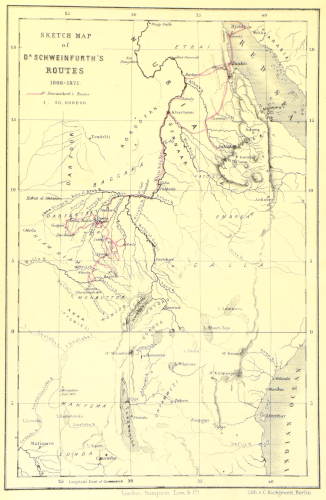
SKETCH MAP OF Dᴿ SCHWEINFURTH’S ROUTES 1868-1871. London. Sampson Low & Cᵒ. Lith. v. C. Korbgeweit, Berlin.