Chapter XVIII
Ellen E. (Ellen Elizabeth) Frewer translation
Solitary days and short provisions. Productive ant-hill. Ideal plenty and actual necessity. Attempt at epicurism. Expedition to the east. Papyrus swamp. Disgusting food of The Niam-niam. Merdyan’s Seriba. Hyæna as beast of prey. Losing the way. Reception in Tuhamy’s Seriba. Scenery of Mondoo. Gyabir’s marriage. Discovery of the source of the Dyoor. Mount Baginze. Vegetation of mountain. Cyanite gneiss. Mohammed’s campaign against Mbeeoh. Three Bongo missing. Skulls Nos. 36, 37, and 38. Indifference of Nubians to cannibalism. Horrible scene. Change in mode of living. Invasion of ants. Peculiar method of crossing the Sway. Bad tidings. Successful chase. Extract of meat. Return of long absent friends. Adventures of Mohammed’s detachment. Route from Rikkete to Kanna. Disappointment with Niam-niam dog. Limited authority of Nganye. Suspension-bridge over the Tondy.
After the fatigue and excitement of our previous journey we were glad to recruit ourselves by a comfortable camp life in the dense bush-forest on the Nabambisso. Spacious grass-huts had been erected for our accommodation until the new Seriba should be completed, and these, nestling amongst the massive foliage of the abundant vegetation, gave the spot an aspect that was almost home-like. A refreshing rain had moderated the temperature; and the air, mild and laden, with the fragrant odours of the wood, gave animation both to mind and body.
Three years previously all the land had been under cultivation; but nature had soon effaced well-nigh every trace of human labour, and the roots of the trees and shrubs that had only been partially destroyed by the tillage had sprouted forth with redoubled vigour and still more gigantic development of leaf; thus attesting the unfailing power of vitality in the wilderness and the impotency of man against the persistency of nature.
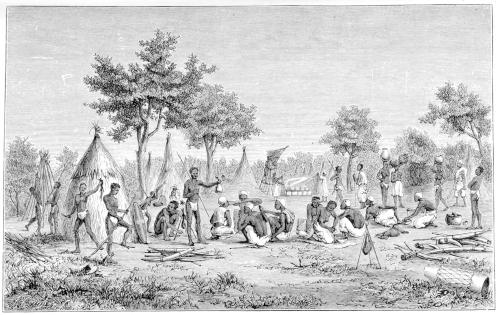
DAILY LIFE IN CAMP.
In this charming locality I passed the early days of May, a month which in these latitudes may truly be called a month of rapture, when the commencement of the rains has renewed the life and growth of all around. From morning to night I strolled leisurely about amongst the bushes, but without neglecting a chance of enriching my stores of botanical treasure by every novelty that presented itself.
A NEW SERIBA.
Meanwhile, Mohammed was occupied in the formation of his new Seriba. Hundreds of natives were employed in conveying the trunks of trees from the neighbouring forest, and these were erected side by side and close together in a deep trench; the trench was afterwards filled in with earth, and the palisaded Seriba, a hundred feet square, was all complete. So quickly was the work accomplished that on the fifth day after our arrival the invalided soldiers, by whom it was to be occupied, were removed into their new quarters. The other soldiers in the interval had vacated the old Seriba. Everything being ready, Mohammed, accompanied by his entire marching force, started off on his campaign against Mbeeoh and Wando; during his absence it had been arranged that I should make this quiet, lonely spot my temporary home.
Confined thus to a narrow area, I had now to look forward to a period of inactivity, in addition to which I had the prospect, by no means pleasant, of submitting to a scale of diet that was straitly limited. Our provisions were all but exhausted. Under the most favourable circumstances, Mohammed could not be expected back in less than twenty days, and the slender supply left for the maintenance of the few men who remained behind as my body-guard would have to be carefully doled out in daily rations to last out the time. Our cattle had all long since been slaughtered; goats were nowhere to be had; nor could any hunting-booty reasonably be expected. For myself the only animal food on which I could rely consisted of twenty tiny fowls of the diminutive Niam-niam breed, which Mohammed, from some unknown source, had procured for me, reckoning that he had thus provided me with one daily meal during the three weeks in which he would be absent. This valuable treasure was, however, a cause of some solicitude; in the first place a strong cage had to be constructed to secure them against the robbers of the night; and, secondly, we could not help begrudging them every grain that they consumed of our scanty stock of eleusine.
My daily allowance now consisted of a fowl, scarcely as large as a partridge, and one single slice of the coarse and bitter eleusine bread; but these, in the bracing air of the Niam-niam and in the cool stimulating temperature of the early rains, were far from being sufficient nourishment, and I began to be conscious of the pangs of downright hunger. The season was very unfavourable for hunting, but even if it had been otherwise I should have felt it undesirable, under the circumstances, to have wandered far from my quarters: the ruined condition of our palisade left us especially exposed to an attack, and with our small supply of firearms it was advisable to be constantly on the spot. It is to this day a mystery to me how the Bongo bearers who remained with us supported life during this period of privation; but somehow or other they had a wonderful knack of discovering all kinds of edibles in the forest, and stirred up by their example I eagerly grasped at anything the wilderness afforded to supply the deficiency of my meagre cuisine.
WHITE ANTS.
In the middle of the open space of the old Seriba there happened to be a huge white ant-bill of long standing, and this rendered some timely assistance in our need; every night after there had been heavy rain, myriads of white ants appeared on the red clods and might be gathered by the bushel; they belonged to the fat-bodied, winged class, and were what are known as “sexual males.” Immediately upon issuing from their dark retreat, and after a short swarming, they assemble in masses at the foot of their hill and proceed to divest themselves of their wings, leaving their heavy bodies helpless on the ground. This removal of their wings does not seem a matter of difficulty; the instinct of the insects seems to prompt them to throw the wings quite forward till they can be so mutilated by the front feet that they completely drop off. Any insects that remained upon the wing were soon brought to the ground by bundles of lighted straw being placed under them, so that it might literally be said to rain white ants. Baskets full were then readily collected for our table. Partly fried and partly boiled they helped to compensate for our lack of grease of any kind. Not unfrequently I mixed them with uncooked corn and ate them from the hollow of my hand; they made just the kind of food that would be good for birds, and, more avium, I took them. If the day only chanced to be rainy, the night was sure to be provided with a feast; there was not one of us who had not cause to be thankful for the strange abundance of the ant-hill.
Fortunately I found that I had a little reserve of the extract of meat which had been obtained from the Monbuttoo goats; with this and with a fair supply of bread and vegetables I could have managed for myself very well; but unluckily there were no vegetables in the district; the last of the tubers had been devoured and the gourd-season had not yet arrived. It was revolting to me to boil and eat the gourd leaves like the natives, and I therefore endeavoured to procure some of the Melochia of the Arabs, a species of Corchorus which is found both wild and cultivated throughout the entire district of the Nile. It was upon this plant alone, boiled like spinach, that (with the aid of thyme-tea) Sir Samuel Baker records that he subsisted for some weeks at the time when he was treacherously deserted by the natives on his way back from the lake. At this period, however, of my residence on the Nabambisso, the Melochia was only just beginning to sprout, and with all my diligence in looking for it I could never get more than the scantiest of platefuls at a time.
As the discomforts of our situation increased and became more and more trying, I was thrown upon my resources to seek enjoyment of a more ideal nature, and in the neighbouring woods I found the best of compensation for all my bodily privations. Whenever I was beginning to feel more than ordinarily disconsolate I would hurry off to the thickets, and there amongst the splendid and luxuriant vegetation I was sure to find an engagement which would, at least for a time, draw away my thoughts even from the appeal of hunger. In hardly any portion of the world ought an enthusiastic botanist to suffer ennui; wherever there exists a germ of life, there is also a stimulant to his spirit; but hardly a scene can be imagined calculated to enlist his whole interests more and to divert him better than the exuberance of bountiful nature such as was revealed upon the Nabambisso.
ON LOW RATIONS.
The few books that I had brought out with me I had read over and over again. The perusal of Speke’s journal and Baker’s accounts of his difficulties gave me great interest, and I realized very fully a situation which appeared to coincide so entirely with my own. During my forced solitary hours I was only too glad to get hold of any printed matter whatever that was new to me. My extensive store of grey blotting-paper, that served to protect the dried plants was silent enough; but the books into which every few pages of the paper were stitched were fastened on the backs by strips of paper which I carefully removed and found to be a source of occasional diversion. This paper, as being stout in quality, chanced to be cut from the Times; and the articles on the leading topics of the day, the correspondence with the editor, and even the concisest of advertisements, all supplied a peculiar interest. It was strange to sit here, in the very heart of Central Africa, and to read of the tropical wonders that graced the Crystal Palace, where the music that floated round might be the echoes of the voice of Titiens. Tantalizing it was to read of “Mountain port at twenty shillings a dozen,” and to learn that it was comparatively free from alcohol; it made us (involuntary abstainers as we were) thirstier than ever, and joyfully enough would my Bongo bearers have had some cases to convey. I wished myself back again in the days when we were fighting the A-Banga; for though they were days of peril, they were days of plenty, and the old Spanish proverb would ever and again force itself upon my recollection, “No misfortune comes amiss to a full stomach.” At night my dream was akin to Baker’s dream of pale ale and beef-steak. It seemed as though one only required a good meal’s victuals that he might die in peace, and be contented to have for his epitaph the saying of the warrior of the Roman Empire, “What I have eaten and what I have drunk is all that now remains to me.” Nothing could elevate the vision of the mind for long; tied down to material things, it was impotent to soar; and food and drink became the single and prevailing theme which we were capable of handling by day or dreaming of by night.
Reduced to this low and depressed condition were the feelings which I experienced during the later portion of those lonely weeks that I spent in the great shed, now half-ruined, that had formed the assembly hall of the old Seriba. The stipulated time of solitude was drawing rapidly to a close, but still nothing was heard from Mohammed. Our necessities became more and more urgent: to remain where we were became more and more impracticable; and to escape from the disasters that were threatening us I proposed to set off on an excursion to the nearest settlement of any Khartoomers. Forty miles to the west of our present quarters was a Seriba belonging to Tuhamy, and a lofty mountain situated in its vicinity offered special attractions for a visit; the journey would be safe, as the route led across Mohammed’s own territory, and on our way we should pass another Seriba upon the eastern frontiers of his district. Ten bearers would suffice to carry my baggage for this little trip, and I need hardly say how glad they were to accompany me under the prospect of ending, or at least gaining a respite from, their season of privation.
We started off on our march upon the 21st, and after crossing the Boddoh brook and two smaller rivulets we arrived at the Hoo. This little stream meandered through a wood remarkable for its diversity of trees, amongst which I was surprised to see the Sparmannia of Southern Africa. The banks themselves were enclosed by dense bushes of a new species of Stipularia, of which the numerous blossoms, half-hidden in their purple sheaths, gave a singular appearance to the plant. It belongs to the characteristic stream-vegetation of the spot.
Beyond the Hoo we came to a ravine of a hundred feet in depth with a charming hedge of zawa trees; and then crossing two more brooks, copiously supplied with water and both running to the north, we terminated our twelve miles’ march and found a hospitable reception in the huts of Ghitta, an overseer of some of the Niam-niam subject to my friend Mohammed. After our recent privations we seemed quite overpowered by the liberality of the entertainment offered us by Ghitta; he procured corn for the bearers, he brought out several flasks of eleusine-beer, and more than satisfied all reasonable claims upon his hospitality. To the great diversion of the assembled villagers I shot a great number of turtle-doves in the adjacent trees. This species, with the white ring round the throat, is found all through the year in well-nigh every part of Central Africa, although it appears to avoid certain localities, such for instance as the vicinity of our ruined Seriba, where we should have been most thankful for such an addition to our scanty stores; the birds, however, manifestly have a preference for particular places, but wherever they resort they are generally to be noticed amongst the foliage in immense flocks.
MADIKAMM.
The soil of this region was once more broken by deep clefts, and was alternately a series of gentle undulations and of deep-cut ravines. Beyond Ghitta’s village the road turned towards the south-east and crossed a brook; further on it passed through a district enlivened by numerous farmsteads and where some sorghum-fields testified to the influence of their neighbours on the east upon the industry of the inhabitants. The district was named Madikamm, being called so after the second brook to the east of Ghitta’s hamlets. The majority of men capable of bearing arms had accompanied Mohammed on his campaign; consequently the huts had hardly any other occupants but women and children, who retreated shyly as we advanced, and shut themselves up in their pretty dwellings.
The votive pillars adorned with many a variety of skulls demonstrated that at certain seasons the hunting booty must be very large; the diversity of antelopes, however, was far smaller than amongst the Bongo and Mittoo, a circumstance that recalled to my mind an observation made by many travellers in South Africa who have affirmed that wherever there are many elephants there is comparatively a scarceness in the number of antelopes: the greater beasts, doubtless, make too much commotion in the forests, and in their wanderings by night disturb the haunts and hiding-places of the more timid game.
Leaving the villages of Madikamm in our rear, we found ourselves on the edge of a great swamp a thousand feet wide, which moved its insidious course northwards in the direction of the adjacent territory of the Babuckur. It was covered in its entire width by a huge, half-floating mass of papyrus, which, called “Bodumoh” by the Niam-niam, gives its name to the marshy waters. This was the first specimen of the papyrus that I had seen in the depth of the interior at so great a distance from the two main affluents of the Upper Nile, and it gave a new character to the locality; it is, however, a characteristic of the swampy region on the upper course of the Sway, where the reduced and meagre remnant of Babuckur, sorely pressed on every side, drag out their miserable lives; their frontiers were only a league to the north of the spot where we crossed.
After leaving the Bodumoh, our road took an E.S.E. direction, which it retained as far as Tuhamy’s Seriba. At the first hamlets we reached, the inhabitants viewed us with considerable distrust, as the soldiers from the nearest Khartoom settlements, and those who intended to pass through Mohammed’s territory, had most arbitrarily levied some heavy taxes upon them.
Beyond the huts were open steppes covered with towering grass which shadowed many shrubs that were entirely new to me, and excited my liveliest interest. Not a few of them were in full bloom, and I walked along carrying a bouquet that it was no exaggeration to call magnificent. The natives might seem fully justified in reviving amongst themselves my name of “Mbarik-pah.”
I may mention that careful as was the method which I have described of our wading over the marshy swamps it was not uniformly attended with success. More than once in attempting to cross without assistance at the head of my little troop I had come to grief; and now once again, at the very next swamp we came to, it was my fate to have an involuntary bath. The dilemma caused us some delay. I was proceeding leisurely along, but coming to a deep hole concealed completely by the long swamp grass I suddenly fell in and was fished out again by my people thoroughly drenched and plastered over with an envelope of mud. It took an hour while I changed my clothes and while the filth was cleansed from the articles I was carrying.
Although the temperature was really as high as that of a July day in our northern clime, the sky nevertheless was overcast and the weather windy, so that it was with chattering teeth and an inward chill that I continued my march along the steppe. All prospect of the surrounding country was obstructed by the towering grass. There was no distant vision to fill the eye, and there was little to relieve the monotony but the radiant blossoms, red and blue, of the flowering shrubs.
A ROMANTIC BRIDGE.
After a while our course was interrupted by a brook fifteen feet in width called the Kishy. This was too deep to ford; the method therefore was adopted of bending down the boughs of the largest shrubs upon the banks, thus forming a fragile bridge, over which, by dint of caution, we contrived to make our tottering way without the misadventure, only too probable, of losing our balance. The Kishy speeds swiftly along over the level steppe in the Babuckur country, and, after receiving the Bodumoh, contributes materially to the volume of the Sway, which in that region has already assumed the dimensions of a considerable river.
The country beyond the Kishy retained the same character as that along which we had been passing. By the side of a little spring called Nambia, that went rippling between the bare gneiss flats, we made a halt for the purpose of following up some guinea-fowl, of which the notes could be heard at no great distance; the whole district teemed with these birds, and I could now again anticipate a daily meal such as I had not had for months.
Hidden deep amongst the long thick grass I here found an aloe, of which the blossoms were of a greenish cast; it was a plant that except to an eye keenly looking for botanical rarities would have been overlooked entirely.
Whilst we were making our halt, I was surprised by a visit from Merdyan, the local chief; he had heard of my arrival, and, accompanied by several natives, he had now come to give me welcome. Merdyan was one of Mohammed’s black body-guard, and had been entrusted with the supervision of the eastern frontier of his territory; with three guns at his disposal, he had been appointed to the command of a little Seriba surrounded with fine fields of maize, which were bounded by a ravine watered by a copious brook. To reach this settlement we had to retrace our steps for a full league along a road that gradually descended through a cultivated country. A fine prospect lay open before us; upon the south-eastern horizon rose the imposing mass of Mount Baginze, and a little to the north a pointed hill called Damvo. On this day’s march we accomplished a distance of about eight leagues; towards the close of it we came to one of the groves of Encephalartus, which are scattered about the district, and known amongst the Niam-niam as Mvooeh-piah.
NIAM-NIAM FOOD.
We enjoyed very comfortable accommodation in Merdyan’s Seriba; the huts were clean and well-built, and I had an opportunity of renewing my observations on the domestic arrangements of the Niam-niam. A delicacy to which I had long been unaccustomed was provided for me in some fresh ears of maize, and corn was not wanting for all my people. There were two things, however, which could not be obtained. We had neither salt nor any kind of oil or grease. Riharn, having lost his proficiency, seemed to be now losing his memory; he had quite forgotten to bring the salt that would be required on our way, and the little grease that could be procured had far too much the suspicion of being mixed with human fat to make it in any way a desirable adjunct to my dishes. Our own supply of butter had been left behind intentionally, as it would be required during our coming journey to the north. Whatever food the natives offered to my people, even to my negroes, only filled them with horror and disgust. Amongst many others who came to the Seriba to satisfy their curiosity about me, there was one fat old man who had his wallet full of victuals hanging to his side, without which no Niam-niam ever quits his home. My little Bongo, Allagabo, spying out two tempting little brown paws, like those of a roast sucking-pig, projecting from the bag, was inquisitive enough to peep in to make a closer investigation of the contents. He got a sharp cuffing for his pains, but he was not likely to have been much tempted, as the delicacy in question turned out to be a roast dog! At another time, my Niam-niam interpreter, Gyabir, who was here in the full enjoyment of his native food, offered Allagabo a dish of lugma (corn-pap), in which were some fragments of flesh that looked like the limbs of a little bird; but Allagabo’s disgust can be better imagined than described when he discovered he was eating the legs of a frog!
I spent one day with Merdyan for the purpose of inspecting the neighbourhood, and in the course of my rambles I bagged enough guinea-fowl to supply my whole retinue. For the first time, too, I killed a black rhinoceros-bird (Tetmoceras abyssinicus). I had previously seen these birds in the Seribas in Bongoland, where they are so far tamed that they strut about fearlessly amongst the other denizens of the poultry-yard.
As I was returning in the evening I was witness of a circumstance that I imagine very rarely could be seen. In the twilight two great forms rushed past us, and were so close upon us that we involuntarily started on one side; the pursuit was so hot that neither of the two animals seemed to be aware of our presence, as in a few seconds they doubled and rushed by us for a second time. My people persisted in saying that it was a hyæna chasing an antelope; but as I was aware that a hyæna seldom hunts down any living prey, I was unconvinced, and went early on the following morning to investigate the traces that were left. On arriving at the spot I found that the assertion of my attendants had been correct, and that the footmarks were undoubtedly those of a spotted hyæna and a hartebeest; the tracks were deep and multifold, and testified to the violence of the pursuit.
The spotted hyæna (H. crocuta) is somewhat rare so deep in the interior of the continent, and even in the cattle-countries of the Dinka it can hardly be said to be common. It is probably driven, through lack of carrion left by the lion, to seek for its subsistence by chasing living prey. This species is far more savage, as well as more powerful, than the striped hyæna of the northern deserts, and appears to be distributed over the whole of Africa below the latitude of 17° N. The skins are frequently used by the Niam-niam for aprons; they exhibit a great variety of markings and differ considerably in colour, the spots being sometimes light and indistinct, sometimes, on the contrary, dark and well-defined. The reports of the Niam-niam refer to two species, one large and one small, as being found in their land; the smaller kind being probably the variegated hyæna observed by Speke upon the eastern coast, and apparently a cross between the spotted and the striped.
BEWILDERING PATH.
The route from Merdyan’s Seriba to Tuhamy’s was through an uninhabited district, and was crossed by so many streams that it was quite a matter of difficulty to determine it. Merdyan undertook to provide me with guides, if I desired it; but as any intercourse between the two Seribas was exceedingly rare, and as I heard a long and loud discussion, before we started, as to which was the right direction, I could not place much reliance upon my conductors. The country through which we had to pass was perfectly flat; the trees, too, were frequently so high and the paths were so narrow that we were unable to get a glimpse of either of the two mountains which we had previously observed from the high ground on the west. Neither of these mountains could be much more than seven leagues distant. The ignorance of our guides caused us considerable embarrassment; We were in continual dread of encroaching upon the adjacent territory of the hostile Babuckur, where we should be entirely at the mercy of the cannibal tribe.
On leaving the Seriba we followed the eastward course of a little brook named the Nakemaka. We kept beside it until it reached the spot where it joined the larger stream called the Mahbodey, which we crossed by our previous method of bending down the pendant branches of the overhanging bushes, and then hopping like birds from branch to branch as best we could. All these affluents of the Upper Sway inclined to the north; all of them, moreover, had a marked descent. The next of them was known as the Meiwah, and about a league beyond we came to the actual mainstream of the Sway, which was here thirty feet in width, and really wider than the united measurements of the two streams above; such of them as we did not cross by our improvised bridges we had to pass by swimming.
After a while we came to a large forest of butter-trees, the first and last that I saw in the country of the Niam-niam. The underwood was so dense, and its foliage so fully developed, that we could not see more than ten paces in any direction; our guides completely lost their way, and, without a clue to our proper path, we wandered on. To add to our perplexity the sky became overcast with the tokens of an approaching storm, and we thus lost whatever aid we might have got from the direction of the shadows. With a vista contracted as ours the compass was of little service, and in a country like this it was very unadvisable to leave the beaten paths or to penetrate into any untried thickets. We were glad enough when we at last caught sight of two deserted huts in the middle of the wilderness. The floods of rain were beginning to descend, and we were thankful for any shelter. The storm that had burst upon us continued with such unremitted violence that we were compelled to resign ourselves to the necessity of passing the night in this wild spot. The interior of the huts swarmed with creeping things of the most revolting character, in comparison with which the most obnoxious vermin that are ever found in houses within the range of civilization would appear mere mild and insignificant domestic nuisances. By heaping up a pile of fresh leaves and grass, I contrived a sort of covering that protected me from actual contact with the crawling things, but the lullaby that buzzed and hummed around me was none of the pleasantest. There were the swarms of white ants that were incessantly gnawing and scratching at my leafy coverlet; there were snakes and lizards rustling in the cobwebbed thatch above: there were mice scampering and squeaking on the ground below. However, for the condition of things there was no help: the best must be made of it; so I shut my ears to the commotion, and resigned myself successfully to the blissful unconsciousness of slumber.
When I awoke at dawn the rain was still falling, the heavy drops pattering down like lead upon the leathery leaves of the butter-trees. Hungry and shivering, I sat upon my grass couch and peered out through the narrow doorway into the obscurity of the thickets, where I could see the broad backs of my negroes as they grubbed away with all their might, defiant of the storm, in the hopes of getting something from among the roots to appease their craving. Hunger at last compelled us to brave the weather, and to take our chance at proceeding. We directed our movements at starting towards some mounds of gneiss, that at a little distance we could see picturesquely rising above the trees. Our intention at first was to ascend these elevations, that we might make a better survey of the land around us; but we were spared the necessity of climbing up them, as on reaching their base we fell into a well-defined path which we did not hesitate to follow. It led us to the brook Shöby, and shortly afterwards to some human habitations.
TUHAMY’S SERIBA.
Our arrival made no little stir among the natives, who had received no intelligence of the presence of a white man in that part of the country, and at first they were inclined to suspect that we must have come with hostile intentions. My Niam-niam, however, soon reassured them, and induced them to provide us with guides for our route. They led us out in an easterly direction, passing through a country that was fairly cultivated, and along which the numbers of guinea-fowl were so large that they kept me fully employed during the march. We had now only one more brook to pass, which was called the Mossulongoo, and this we accomplished in such good time that it was still daylight when we reached the Seriba of Tuhamy. Amongst the inmates of the Seriba my servants recognised several of their former acquaintances at Khartoom, and very enthusiastic were the greetings that were mutually exchanged. The controller of the Seriba received me with the most cordial hospitality, and cleared out his best hut for my accommodation. The hut was enclosed with a high palisade, which gave it an additional protection. The controller’s superior and principal in Khartoom was a personage no less important than the chief writer of the Hokkumdarieh; and this influential authority had in the previous year given instructions to his subordinate that he was to show me every possible attention if I should chance to pay him a visit.
The Seriba was a halting-place for Tuhamy’s ivory expeditions from the Rohl to the Monbuttoo country. Situated as it was on the extreme eastern limit of the Niam-niam territory, it formed an outpost towards the Babuckur land, which Tuhamy’s companies were accustomed to consider as their corn magazines, and on which they relied for their supplies to carry them onwards to the south. But the Babuckur were already wearied by the depredations to which they were thus continually exposed; their impatience made them desperate and exasperated; and a very few days after my departure they made an attack upon the Seriba, burnt it to the ground, and compelled the inhabitants to evacuate the place. Many Nubians as well as many Niam-niam lost their lives in the engagement, and the few that escaped had to make their way to the nearest Seriba, which was that established in Mondoo, at the distance of a long day’s journey, situated amongst the Zileï mountains, of which the spurs and projecting terraces were visible on the eastern horizon. Subsequently to this, all Tuhamy’s settlements passed by a special contract into the hands of Ghattas’s son.
The brook upon which the Seriba was situated was called the Annighei. The chieftain in command of the Niam-niam in the district had formerly been independent, but had been deprived of his authority by Tuhamy’s companies. His name was Indimma, and he was one of the numerous sons of Renje, but not to be confounded with the powerful chief of the same name, who was a son of Keefa. He came now to offer me his welcome, and communicated to me many interesting details about the surrounding country.
I made a little excursion to an elevation of gneiss a few miles to the east of the Seriba, so as to gain a point from which I might survey the surrounding mountains and make some observations to verify the position of the various peaks. The detached ranges for the most part were situated from ten to fifteen leagues from the site I had chosen for my survey, and I should imagine their height to vary from 4000 to 5000 feet above the level of the sea. All those who were capable of giving me any information at all upon the subject agreed in representing that the entire district was distinguished as Mundo or Mondoo, and that the principal chain of hills was called Mbia Zileï; also that at the foot of the mountains was the village of Bedelly, the native local overseer, close to which was another Seriba belonging to Tuhamy. Between me and the mountains flowed the river Issoo, a stream which I was assured was at this season fifty feet broad, and so deep that whoever attempted to ford it would be immersed up to the neck. The entire region was rich in corn, especially in sorghum. Several hundred bearers laden with it arrived during my stay at the Seriba, and I took the opportunity of laying in a stock for myself; it is difficult to obtain sorghum in the Niam-niam countries, and it was long since I had had grain of such a superior quality.
All the Niam-niam of whom I was able to make inquiries assured me that the natives of Mundo are a distinct people, differing from themselves both in habits and in dialect; their precise ethnographical position I could never determine, but I should presume that they approximate most nearly to their Mittoo neighbours on the north, and more especially to the Loobah and Abakah.
MONDOO.
This Mundo or Mondoo is not to be confounded with the Mundo to the south of the Bongo, which Petherick reports that he visited in February 1858; it is the name of the western enclave of the scattered Babuckur. But the Mundo of which I am speaking is marked upon the map by Peney, who in 1861 penetrated westwards from Gondokoro as far as the Ayi or Yei; Petherick too has inserted the district upon his map,[53] under the name of the Makaraka mountains, and has assigned it to exactly the same locality as I have myself done. In spite of Petherick’s protestation, many geographers have made the two Mundos identical, and have thus fallen into the not unnatural conjecture that the Yei is the upper course of the Dyoor, a conjecture of which my journey has fully demonstrated the fallacy.
The Issoo, as the upper course of the Tondy is here called, forms the western boundary of this mountainous district; along the south and far to the east (probably as far as the source-regions of the Yei) there stretches an offshoot of the Niam-niam territory. This section of the Niam-niam is called Idderoh, and is subject to an independent chieftain, a brother of Indimma’s, named Bingio, who had formerly been an interpreter in Petherick’s station in Neangara. The river that waters his district is called the Nzoro. On all maps this territory of the Idderoh figures as Makkarakka; but, as I have observed, this is merely a collective name given to the Niam-niam by their neighbours on the east.
We had a day’s rest in the hospitable Seriba, and were well entertained with meat and vegetables. The neighbourhood was interesting, and yielded several novelties for my collection. One very brilliant ornament of the woods at this season, which I had never seen in greater abundance, was the Abyssinian Protea, a shrub about four or five feet high, with great rosy heads like our garden peony. Another plant, one of the Araliaceæ, the Cussonia, which is usually only a low shrub, here attained quite the dimensions of a tree, and its fan-shaped foliage crowned a stem little less than thirty feet in height. In the damp grass near the brooks flourished a number of ground orchids with remarkably fine blossoms.
A yet richer booty, however, was in store for me. A few miles to the south of the Seriba, jutting up like an island from the surrounding plain, and visible from afar, rose the massy heights of Mount Baginze. There I did not doubt I should realize the fruition of many expectations.
We started upon the 27th, under the escort of a small body of native soldiers, from the Seriba. Gyabir was in the best of spirits. He had just achieved a great object of his desire in attaining a wife. The controller of the Seriba had a large number of slaves, and as one more or one less made no appreciable difference to him, he had presented Gyabir with a young girl of the Loobah tribe. My interpreter had long been desirous of securing a partner of his lot, and had many times solicited both Mohammed and Surroor to procure him a consort, but hitherto his request had been made in vain. It is not an easy matter for a man without some means to get married in Africa: if he negotiates for himself he has to satisfy the demands of the bride’s father; but by applying to the controller or ruler of the district, who can exercise an absolute authority in these matters, he may succeed in obtaining a wife without previously paying down any sum by way of compensation.
MOUNT BAGINZE.
We marched for about two leagues in a west and south-west direction, and once again crossed the little brooks that the Sway receives on its right-hand bank; at length we reached the pointed gneiss mound called Damvo, which rises about 200 feet above the level of the plain. I mounted the eminence, so as to employ its summit as the second station for my observations of the mountain chains. The rugged rocks were clothed with Sanseviera, and to the very top charming shrubs made good their way from between their clefts. The view was magnificent. It was the first mountainous landscape that I had seen during my journey that exhibited the true characteristics of African orography. All around were elevations, more or less conspicuous, rising like bastions isolated on the plain; whilst high over all reared the crest of Mount Baginze. The western side of the mountain was precipitous, and might almost be described as perpendicular; towards the north, on the other hand, it sloped downwards in gradual ridges: in form it reminded me of many of the isolated mountains of Southern Nubia, and more especially of those in the province of Taka.
Mount Baginze is only four miles to the S.S.E. of Damvo, but this short distance had to be accomplished by a circuitous and troublesome route leading across deep fissures and masses of loose rock, and often through grass of enormous height; half-way we came to a rapid brook hastening along through a deep cleft, which we were able to leap across. This was the source of the Dyoor. It was the first actual source of any of the more important affluents of the White Nile to which any European traveller had ever penetrated. My Niam-niam escort, who were natives of the district, positively asserted that this brooklet was the Sway, and thus plainly demonstrated that, however insignificant this little vein of running water might appear, they were accustomed to consider it as the highest section of the waters that contributed to the formation of the Dyoor. The Sway, they said, was the largest and longest river of their land; Baginze was their loftiest mountain; and this was the most important stream that issued from its clefts.
Before actually setting foot upon Baginze we had still to make an ascent through a fine forest, but in due time we reached the mountain and made our encampment close beneath the perpendicular wall of the western flank. The halting-place was upon the edge of a deep ravine, where a bright thread of water rippled merrily along over rocks covered with moss and graceful ferns. It was too late in the day to attempt to ascend farther than to the summit of a sloping spur projecting towards the north-west from the southern side of the mountain, and which was about half the height of the mountain itself.
The first few steps that I took were quite enough to convince me of the entire accordance of the flora with that of the Abyssinian highlands. Masses of brilliant aloes, with their scarlet and yellow blossoms, grew luxuriantly upon the slopes of gneiss; the intervals between them were overspread with a mossy carpet of Selaginella rupestris, whilst clusters of blue lobelia reared themselves like violets, only of a brighter hue, from the surface of the soil. Here and there, in singular contrast to the tender foliage of the shady hollows, lending moreover a new and striking character to the vegetation, I found, cropping up from amidst the rocks, the thick fleshy leaves of that remarkable orchid, the Eulophia; and on the still higher declivities I met with yet another true representative of the Abyssinian flora in a new species of Hymenodictyon, a dwarf tree of the class of the Rubiaceæ, which in some form or other appear to embrace at least a tenth of all the plants of Africa in these regions.
WILD AFRICAN PLANTAINS.
Wherever one of the bright bubbling streams was seen, like a shining thread upon the grey monotony of the rocks, there I was pretty sure to find the Ensete, or wild African plantain. This is a plant which is never seen below an altitude of 3000 feet above the sea. It was now to be observed in every stage of its growth, sometimes being small like the head of a cabbage, and sometimes running out to a length of twenty feet with its fruit attached to a short thick stem in the form of an onion. The tender leaves were marked with a midrib of purple-red. It struck me that here in the wilderness this plant, which has become so common a favourite in our greenhouses, is distinguished by a much shorter leaf-stem and by a more compact appearance than it bears in its cultivated form when its growth is spreading and graceful. Not unfrequently the Ensete of the mountains bore a striking resemblance to young specimens of the Musa sapientium, though it exceeded it in the number of the leaves it bore, there being occasionally as many as forty on a single plant. I found it here in full bloom, but without any prospect of fruit; it differs from other representatives of its class by losing its leaves at the time of its flowering, and then has the appearance of an elongated onion on a shaft some six or eight feet in length, on the top of which rests a compact truss of bloom. Although I never observed any side sprouts from the wild Ensete, it by no means follows that they are never to be seen: a single authenticated instance of the kind would demonstrate almost beyond a doubt what is already in so many respects probable, namely, that the Ensete is the original stock of the cultivated African plantain.
We had quickly improvised some huts from the long grass at the foot of the mountain, and they afforded us secure and sufficiently comfortable shelter from the downpour of rain that lasted throughout the night. On the following morning I was disappointed to find that the sky was still burdened with storm-clouds, whilst a fine, drizzling mist obscured the greater part of the view that we had proved to be so lovely.
My sojourn in the neighbourhood was limited to a single day, since the Seriba was suffering from the general dearth of provisions, and could ill afford to entertain us: there was consequently no help for it, but if the ascent of the mountain were made at all it must be made in defiance of the heavy rain. I was quite aware that the adverse weather would make the task altogether uncongenial to my guides, and I was not very much surprised to find that they had made off during the night. I had thus to start off on my own responsibility. My Nubian servants remained behind to warm their shivering limbs over the camp-fires, so that, followed only by my two Niam-niam, carrying the portfolios for my plants, I set out upon my enterprise.
I turned towards the northern declivity, which slanted in almost an unbroken line from the summit to the base. At first my view was necessarily circumscribed, and it was only after a good deal of clambering and by a very circuitous route along rugged places, overhung with bushes, and across fissures full of water, that I succeeded in finding the correct path. The wind was so strong that although my broad hat was weighted with pebbles I was obliged to leave it below. The highest point of the ridge I found to be at the south of the summit, and thence I had a magnificent prospect, being able to see for fifty or sixty miles in an east and north-east direction. Not far short of a hundred different mountain-peaks were visible, and of these I took measurements of the angles between the more important, which I subsequently combined with the angles which I had already observed. I also made a drawing of the entire panorama around me.
The upper course of the Tondy was plainly visible, and beyond it were caught the terraced ridges of the country to the east. The northern and eastern spurs of Baginze were especially picturesque; the elevated level of the ground at the base was not apparent from above, so that they stood out like isolated eminences from a uniform plain: three more spurs a few miles to the south-east also appeared completely detached: they were in a straight line one behind another, the names of the two most northerly being Bonduppa and Nagongoh. Somewhere near them was a Seriba belonging to Poncet’s company, who had reduced the former independent chieftain Bendo (another of the many sons of Renje) to the same state of submission as Tuhamy’s company had brought his brother Indimma.
ALTITUDE OF MOUNT BAGINZE.
The measurement that I took upon the spot gave Baginze a relative height of 1350 feet; but the barometrical observations made at the base, which would have determined its exact altitude above the level of the sea, have unfortunately been lost; I believe, however, that I am not far wrong in estimating the entire height to be about 3900 feet.
The bulk of the rock of which the mountain was composed consisted of a gneiss that was so abundant in mica that in many places it had the appearance of being actual mica schist; a speciality in its formation being the immense number of cyanite crystals that pervaded it in all directions: a similar conglomeration of “cyanite gneiss” is very rare, but amongst other places it may be observed on Mount St. Gotthard in Switzerland. Wherever the springs issued at the foot of the mountain there were wide boulder-flats of broken stones, and here the sheets of mica and the prisms of cyanite, an inch or two in length, lay cleanly washed and strewn one upon another in such thick confusion that I had to wade through them as through a pile of rubbish. I collected several specimens of the rock, which I brought to Europe.
Massive in its grandeur, isolated, and worn by time, Mount Baginze thus stood before me as a witness of a former era in the world’s history and as a remnant of the lofty mountain-chain which must have once formed the southern boundary of the Nile district.
There was an entire absence of large trees everywhere, and the higher regions of the mountain bore but a very scanty vegetation. Contented, however, with the few botanical discoveries that the toilsome trip had yielded, I began to think of returning. It had taken me four hours to make the ascent of the mountain, but being now aware of the correct path, a single hour was all I spent in getting back to our encampment. In spite of the unpropitious weather I felt that I could have enjoyed myself for some days in exploring this enticing neighbourhood: the mountain air was even fresher and more invigorating than what I had been breathing in the Niam-niam country—and this is saying not a little; for, in spite of their meagre diet, the Nubian soldiers who came thither sickly and weakened by their idle Seriba-life always returned from their Niam-niam campaigns fat and healthy, and with renewed strength and vigour. My attendants unfortunately did not sympathise with my ideal enjoyments, but made such loud and bitter complaints at the increasing inclemency of the weather that I should not have dared to prolong my stay, even if I could.
On the third morning, then, after our arrival we began to return. Although continually in doubt as to our path, we were fortunate in hitting upon the route that was shortest, and, crossing the Shöby at a spot where it was contracted by gneiss walls and made a bend to the north, we reached the rocks in the forest of butter-trees at which so recently we had passed such a wretched night. Before it was dark we once more entered Merdyan’s Seriba. The long march of nine hours, made doubly arduous by the many watercourses that had intercepted it, had been one of the most fatiguing that I had experienced. I took a day’s rest, and amused myself by shooting guinea-fowl, the sport being so successful that I supplied my people with as many of the birds as they could eat in two days. We performed the rest of our journey through incessant rain, and on the evening of the 1st of June found ourselves reinstated in the old Seriba on the Nabambisso.
TIDINGS FROM MOHAMMED.
Here I received satisfactory intelligence from Mohammed. The condition of things had decidedly improved. Still the store of corn was small; but the gourds had ripened during our absence, fresh maize had been brought to the Seriba, and, best of all, the guinea-fowl had effected a lodgment in the neighbourhood, so that we had a constant supply of animal food ready at hand. As a consequence of the continual rains edible funguses had sprung up in such abundance that for days together I dined off guinea-fowl’s liver and mushrooms. In every respect the mushrooms resembled those which we use in Europe.
I may mention that a large buffalo-hunt, to which all the Bongo were invited, came in as a timely diversion, and that day after day, with my gun in my hand, I was up and doing.
Before many days had elapsed the main body of Mohammed’s corps returned from their campaign. Only a portion of the missing ivory had been recovered, for Wando, under a superstitious dread of the intimations of his augury, had persistently remained concealed in the most inaccessible places, and consequently the hostilities had been mainly directed against his brother Mbeeoh. Contrary to the general practice of the Niam-niam princes, Mbeeoh had been personally engaged in the conflict and had exhibited remarkable bravery. On one occasion it had been with the greatest difficulty that Mohammed had held his own against the hordes of his opponent, and in a raging storm had been obliged to erect a kind of rampart, made of straw, to afford a shelter from which anything like a steady fire might be opened upon the assailants. The chances were dead against Mohammed’s side, but it is notorious that the natives hardly ever follow up any advantages offered to them either by a downpour of rain or by the obscurity of night; and very frequently they lost the most promising of opportunities for crushing their Nubian oppressors.
MISSING MEN.
Just before Mohammed himself returned there was a considerable commotion amongst our Bongo bearers. A circumstance occurred that naturally excited some consternation. The bearers who had been left with me in the old Seriba were in the habit of scouring the neighbouring fields and forests every day in search of victuals for themselves. One evening three of the party who had gone out did not return, and their companions had no hesitation in avowing their belief that they had been captured, and that they would most certainly be killed and eaten by the inhabitants of the adjacent district. Early on the following morning all the Bongo and most of the Nubians who were with me started off in a body to explore the neighbourhood and to follow up as best they might the traces of the missing men. According to the statements of the Bongo, the crime had been committed in the district under the control of Maddah, to the north of the Seriba. In that direction the party bent their steps. Their supposition was apparently correct, for after following the tracks into a wood they found that they terminated in a ghastly pool of blood. Maddah was forthwith seized and hurried to the Seriba, where he was charged with being answerable for the disappearance of the men. In evident confusion and with much excitement he began a long and incoherent preamble; he declared that the blood was that of an animal which had been slaughtered on the previous day; he owned, indeed, about the three Bongo that he had seen them running across his territory and had had no doubt that they were making an escape to their own homes. This explanation was objected to on the ground that the obstacles on the way were far too great for them ever to have entertained such a design. Maddah then went on to say that some of his Niam-niam people had noticed the fugitives, and had shouted after them to know where they were rushing to, and why they were scampering along at such a pace, but they had received no answer; and deeming it wrong to stand idly by and let the fellows decamp from their owners they had not only pursued them, but had effected their capture and put them into safe custody. To complete his tale he affirmed that, somehow or other, during the night they had contrived to escape; and this was all he knew about them.
The settlement of the business had ultimately to be left to the surviving Bongo. They were not easily satisfied; they insisted most strenuously that, even allowing that there might be some truth in the statement that the Niam-niam had pursued the fugitives, they had only done so with the object of sacrificing them in order to indulge their appetites, and to convert their flesh into food. The representation which Maddah gave of the pool of blood was held to be especially unsatisfactory; the bones of the slaughtered animal were demanded as a proof of the fact, but nothing was forthcoming at the hands of the Niam-niam but a few fragments that could be recognised at a glance as belonging to some game that must have been killed months before. Everything, in fact, seemed to confirm the accusation. All agreed that there was nothing to exonerate either Maddah or his people from suspicion. It was consequently decided that as Surroor, the lieutenant in command, was absent, as well as Mohammed, on the campaign, Maddah should be reserved for judgment, and meanwhile must be kept in confinement and placed under the yoke of the sheyba to await his sentence.
But when Mohammed returned he professed to be occupied by more pressing and important business. It did not require much penetration to perceive that there were certain motives of policy which were prompting him to procrastinate the investigation of the affair. The truth was he was anxious, if he could, to keep on good terms with the Niam-niam, knowing that their services were indispensable to him for the usual raid against the Babuckur that had to be undertaken for the purpose of getting a supply of corn to avert the prospect of his caravan being starved. Without their co-operation it would be impossible for his soldiers to cross the marshy swamps. Had the disaster befallen any of the Nubians or Mussulmen at all, there can be no doubt that Mohammed would have acted very differently, and would not have suffered considerations of policy to deter him from making an example of the delinquents.
The raid upon the Babuckur was an expedition that Mohammed did not accompany in person. He entrusted it entirely to Surroor, who took the charge of as many of the subordinate Niam-niam as could be gathered. Just as might be expected, the most savage brutalities were practised on either side. Besides securing the store of corn, which was the main object of the incursion, the Nubians were on the look-out for a capture of female slaves, which they claimed as their special perquisite. The Niam-niam on their part followed the example and did some private kidnapping on their own account; the females that they entrapped they disposed of in the following way: the youngest were destined for their houses, the middle-aged for their agriculture, and the eldest for their caldrons!
The skulls in the Anatomical Museum of Berlin that are numbered 36, 37, and 38 might be supposed capable of unfolding a deplorable tale of these depredations. Some natives brought them to me fresh boiled, only a few days after the raid had been perpetrated; they had heard from the Monbuttoo that I was accustomed to give rings of copper in exchange for skulls, and as I was not able to bring the poor fellows to life again I saw no reason why I should not purchase their remains in the interests of science. Often I reproached the Nubians of my retinue with allowing such abuses to go on before their eyes, and under the sanction of the flag bearing the insignia of the Holy Prophet; but just as often I received the answer that the Faithful were incompetent to change anything, but must submit to the will of God; it was impressed upon me that the Niam-niam were heathen, and that if the heathen liked to eat each other up, it was no concern of theirs; they had no right to be lawgivers or teachers to cannibals.
MOHAMMEDAN CONVERSION.
I had repeated opportunities of observing that the ivory-expeditions of the Khartoomers, although actuated by a certain spirit of enterprise, did not at all contribute to any propagation of Islamism. Negro nations once converted to Mohammedanism are no longer considered as slaves, but are esteemed as brothers. For this reason it was inexplicable to me how Islamism had spread so far in other parts of Central Africa; for although, on the one hand, Islamism is a faith that puts a pressure upon its converts by compelling them to submit to its external prescriptions, such as circumcision; yet, on the other hand, the very conforming to the prescriptions exempts them for ever from all oppression: thus I could not understand why in other parts of the continent the more powerful party had not maintained its material interests by displaying the same indifference as was shown by the Mohammedans in the countries through which I travelled.
Some days after the raid on the Babuckur I was witness of a scene that can never be erased from my memory. During one of my rambles I found myself in one of the native farmsteads; before the door of the first hut I came to, an old woman was sitting surrounded by a group of boys and girls, all busily employed in cutting up gourds and preparing them for eating; at the door of the opposite hut a man was sitting composedly playing upon his mandolin. Midway between the two huts a mat was outspread; upon this mat, exposed to the full glare of the noon-day sun, feebly gasping, lay a new-born infant: I doubt whether it was more than a day old. In answer to my inquiries I learnt that the child was the offspring of one of the slaves who had been captured in the late raid, and who had now been driven off to a distant quarter, compelled to leave her infant behind, because its nurture would interfere with her properly fulfilling her domestic duties. The ill-fated little creature, doomed to so transient an existence, was destined to form a dainty dish; and the savage group was calmly engaged in their ordinary occupations until the poor little thing should have breathed its last and be ready to be consigned to the seething caldron! I profess that for a moment I was furious. I felt ready to shoot the old hag who sat by without displaying a particle of pity or concern. I was prompted to do something rash to give vent to my sensation of abhorrence; but I was swayed by the protestations of the Nubians ringing in my ears that they were powerless in the matter, and that they had not come to be lawgivers to the Niam-niam. I felt that I was as helpless as they were, and that it would be folly for me to forget how dependent I was upon them. What influence, I was constrained to ask, could my interference have exercised, what could any exhibition of my disgust and indignation avail to check the bias of an entire nation? Missionaries, in their enthusiasm, might find a fruitful field for their labours, but they must be very self-denying and very courageous.
The departure of the caravan for the north was delayed for several days in expectation of the return of the corps that had been sent to the west with Ghattas’s company, but as no tidings of it were forthcoming we determined, without further procrastination, to proceed upon our way.
Shut out from all prospect of this year making any farther progress to the south, and debarred from the hope of accomplishing any fresh explorations, I own that I began to long for the flesh-pots of Egypt; I confess that the stores that were on their way from Khartoom to await me in my old quarters at the Seriba in Bongoland had a wondrous fascination to my eager imagination. I was also now looking forward that I might make several excursions during the return journey, from which I was sanguine that I might not only make fresh botanical discoveries, but might enlarge my general knowledge of the country.
THE RIVER HOO.
Our first night-camp was made on the northern frontier of Aboo Sammat’s territory, on the banks of a brook near the hamlets of Kulenjo. Until we reached the Hoo we observed no alteration in the condition of the brooks; but the galleries which I was now traversing for the last time seemed in bidding me farewell to have donned their most festal covering, being resplendent with the luxuriant blooms of the Spathadeæ, one of the most imposing representatives of the African flora. The waters of the Hoo had risen to no inconsiderable degree, and they had so much increased in breadth that they filled the whole of the level bed, which was 35 feet in width. The current flowed at the rate of 150 feet a minute, the water being nowhere more than 3½ feet deep. Our second night-camp was pitched half-way between the Hoo and the Sway, at a spot where the bush-forest was densest and most luxuriant.
The advancing season brought several changes in our mode of living. I had become so far initiated into African habits, that I now very much preferred a grass hut to a tent. I was moreover getting somewhat out of patience with the ever-recurring necessity of holding up the tent-pole with all my strength during the storms of night, whilst I roused half the camp with my shouts for assistance. At the height of the rainy season the weather, by a beneficent arrangement of Nature, fortunately follows certain rules from which it deviates very exceptionally; the first few hours of the morning always decided the programme for the day; when once the sky had cleared, we knew that we might resume our march in perfect confidence, and I had the satisfaction of feeling that my papers and herbarium were in no danger of being spoilt by damp, and my companions had the same security for the preservation of their powder and provisions. Towards five in the afternoon, when the sun began to sink, and the distant thunder gave warning of the renewing of the storm, we made a halt, and directed our best attention to prepare our nightly lodging in the wilderness. The baggage was first piled together and protected by the waterproofs, and as soon as this was effected, a number of knives and hatchets were produced and distributed among the “builders.” Off they were sent with all despatch. “Now, you fellows, quick to your work. Four of you,” I should order my servants, “must be brisk, and get together the grass. You two must hack me down the branches, long and strong, and be sharp about it. No shirking now. And you have to get the bast. Quick, away! and quick back!” And with this hurrying and driving the work was soon done. Ten minutes, or a little more, brought the men back with the requisite materials. The framework was first erected, the forked boughs being driven into the ground and firmly fastened at the top with ligatures of bast; meanwhile the grass was being bandaged into a huge hollow sheaf, and this, when all was ready, was raised above the structure and fitted like a cap. Thus, in about half an hour, with alacrity, one of these grass huts could be reared, small indeed, and snug as a nest, but nevertheless perfectly waterproof; and thus a sufficient shelter against the nightly rains. The storm might rage and the thunder roll without, but here the weary traveller, in safe and reliable retreat, might enjoy his well-earned repose without misgiving. By the glimmer of a little oil-lamp of my own contrivance, in which I burnt some questionable-looking grease, of which the smell could not fail to rouse up one’s worst suspicions against the natives, I would sit and beguile the hours of the evening as best I could by writing down the experiences of the day. The negroes had no such protection: they would crouch round the camp-fire, which would make their faces glow again with its fitful light, while the rain would pelt pitilessly down upon their backs.
Such was the arrangement of our camp night after night throughout our return journey. But my recollections of the nights spent on the way between the Hoo and the Sway are altogether very unpleasant.
AN INVASION OF ANTS.
The rain on the following morning did not cease so soon as usual, and our departure was somewhat delayed. We were all of us intensely interested in keeping our own little dry spot free from the drenching force of the rain, when all at once I found my cosy quarters invaded by a whole army of ants. They had succeeded in discovering the driest and warmest place within a circuit of many miles, and now, in countless legions, they took up their quarters in my palliass, which was placed upon a lofty pile of leaves and grass. Their encroachments seemed to come from every side. For a long time I was in perplexity what to do; to leave my hut was impossible, the rain was falling almost in sheets. I endeavoured to protect myself with my clothes, but all in vain. Presently a stratagem suggested itself to my mind; by a happy thought I managed to divert the ants from myself. Dragging some bundles of grass from my bed, I threw them down in detached patches all over the floor, and by way of bait I sprinkled them over with the fragments of food that remained from the supper of the previous night. The scheme answered admirably, and I had the satisfaction of finding the unwelcome guests draw themselves away and give me no more personal annoyance.
Meanwhile a large portion of our caravan had gone on in advance to make the necessary preparations for crossing the Sway. I did not reach the banks myself until nearly noon, and by that time the people were busily employed in conveying the baggage across. The aspect of the Sway was entirely different to what it had been on the 13th of February. The water had risen to the very top of the banks, and was twenty feet deep, with a velocity of two hundred feet a minute. Although the stream was only thirty-five feet wide, the passage over it, in consequence of the entire absence of tree-stems and the small number of bushes on the banks, offered unusual difficulties. The men who had had experience in these Niam-niam expeditions had a method of effecting a transit over the river that I think was peculiar to themselves: they set all the bearers to work to gather as many different kinds of bark as they could, and to extract all the bast out of it, and then to twist it into long stout ropes, a handicraft in which the negroes are very skilful, as in Bongoland there is an unfailing demand for cordage for hunting-snares and fishing-nets. Having fabricated their ropes, the next thing was to get them stretched across the river. This was effected by practised swimmers, who attached one end firmly into the ground by means of pegs, and swam over with the other. The arrangement of the ropes was such that they were suspended in double rows, one precisely underneath the other, the upper rope being above the stream, the lower being some feet below its surface. Ten expert swimmers then took their stand upon the lower rope, and allowed the stream to force their weight against the upper rope, which supported their chests, but permitted them to have their arms perfectly free for action. Thus supported, in a half-standing, half-floating position, they contrived to keep their hands at liberty, and to pass the packages from one to another.
I confess that it was with a beating heart that I stood and watched my precious baggage thus handed along over the perilous flood; but the lank, lean arms of the Nubians were competent to their work, and everything was conveyed across in safety. This business of crossing occupied several hours of real exertion. The difficulties of the transit may be conceived, when it is remembered that three-fourths of the negroes are entirely ignorant of the art of swimming, and that there were elephant’s tusks being transported which weighed not less than 180 lbs., and consequently required two men to lift them.
We passed the night near Marra’s villages, and though it was only a league from the river, it was quite dark before we entered our quarters. The residents had all vacated the district, leaving their fields of half-ripe maize to the mercy of the new comers; although plunder was ostensibly forbidden, it was surreptitiously carried on by our bearers to a very gross extent under cover of the darkness.
The whole of the next day we halted to recruit our strength. I found my amusement in scouring the neighbourhood in search of game. Huts were dotted about here and there, but the country generally was covered with such a wonderful grass vegetation, that any deviation from the beaten paths would have involved the wanderer in great perplexity, and only too probably he would have rambled about for hours before he could recover his way.
As the caravan was on the point of starting on the succeeding morning, and I had just set out at the head of the procession, we were brought to a standstill by the arrival of some messengers bearing a letter to Mohammed from the commander of his corps, that had been sent towards the west. To judge from the date of the letter, the Niam-niam who brought it must have travelled at least forty miles, and perhaps considerably more, in a day.
EVIL TIDINGS.
The letter contained evil tidings. Ghattas’s agent and Badry, Aboo Sammat’s captain, wrote in the utmost despair. Three chieftains had combined to attack them as they were crossing a gallery on Malingde’s territory; three of their number had been slain, and out of their ninety-five soldiers, thirty-two had been so severely wounded as to be hors de combat. They had now been closely besieged for six days, and were with extreme difficulty defending themselves behind their abattis; provisions were fast failing; and even water could only be obtained at the risk of losing their lives. Ahmed, the other captain, had fallen at the first outset of the engagement, and his body had not been recovered for interment, but had fallen into the hands of the cannibals. The only means of rescuing the wounded soldiers would be to carry them away in litters, and this could only be effected at the cost of abandoning seventy loads of ivory that had been buried in a swamp. The letter concluded with an urgent appeal for speedy succour, and Mohammed determined to send it without delay; two-thirds of his armed men should be despatched to the relief of the sufferers.
The selection of this relieving-force had to be made at once, and it may be imagined that it was no easy matter for Mohammed to overcome the repugnance of those who had no relative or personal friend in jeopardy. It was naturally a bitter disappointment to those men who were thus marked off for this unexpected service to have to renounce the pleasant prospect of the toils of their expedition being so near its termination, and to be compelled to expose themselves anew to the dubious fortune of war. However, in spite of remonstrances and murmurings, the conscription was completed in a very summary fashion, and it was still early when the remnant of our party, with its undue proportion of bearers, continued our northward march.
It was a bright and lovely forenoon; the steppe was adorned with its summer verdure; what had before been bare red rock, was now covered with tender grass, which reminded one of our own fields of sprouting corn. Africa seemed like a universal playground, exciting our people to sport and merriment.
CHASE OF HARTEBEESTS.
We persevered in following our previous well-beaten track. The six meadow-waters that lay between Marra and the hill of Gumango had increased but little since we had last seen them. The lovely park-like country, with its numerous scattered bushes, offered unusual facilities for the chase, and small herds of antelopes, a long unwonted sight, appeared and as rapidly disappeared in the surrounding landscape. Once, however, five hartebeests, at a little distance from our road, made a stand, and eyed the caravan as intently as if they were rooted to the spot. I took deliberate aim at the breast of one of them, and although the whole five wheeled round and galloped off into the thickets, I felt sure that my shot had taken effect; on running up to the spot where the antelopes had been standing, we found enough blood to show us that one of them had certainly been wounded, how severely of course we could not tell. The dogs that I had were of no service for hunting, and had to be kept along with the caravan in the care of servants; but notwithstanding this want of sporting dogs, and in spite of the confusion caused by the multiplicity of tracks, we managed, by following the spots of blood, to make out the proper traces of the wounded hartebeest. As I was approaching one of the smaller thickets, I observed a couple of kites making their circling flight just above the trees; this was a manifest token that the wounded animal was not far off; in another few minutes, as I entered the grove, I caught sight of the yellow body of the beast skulking painfully away from me as best it might, a patch of blood-stained, trampled grass betraying the place where it had thrown itself down.
The arrival of the birds was to me very inexplicable: ten minutes had hardly elapsed since the shot had been fired, and yet here they were, awaiting their prey. The sportsman in Africa (and this is especially the case on bright, sunny days) has constant experiences of this kind. A few minutes after he has succeeded in bringing down his game he may see some black dots in the sky, which gradually, as they come nearer and nearer, will assume a definite shape and ultimately develop themselves into groups of kites, vultures, or other carrion birds, ever ready to arrest their flight and to appropriate to themselves whatever relics of his booty the hunter may leave behind. It might almost seem, according to the fiction of the ancients, that the sky above was divided into several storeys, and that the birds were ever ready, at the sight of a tempting meal below, to hurry downwards from their topmost region in the sevenfold heaven.
This, however, is mere digression. I return to my hartebeest. After a considerable search we came upon the creature lying lifeless in the grass. It proved to be an animal in suck, and my Niam-niam people, after the wild hunting-custom of the country, filled a small gourd-shell with milk expressed from the udder, and mutually drank to each other’s courage and good luck. I had not happened to see the fawn; probably it had not been with the hartebeests when we first caught sight of them.
It may be readily understood from these details, that without dogs, and over so bewildering a country, the capture of game, even after it has been shot, is very often a matter of no trifling difficulty. Moreover, time and distance have to be taken into consideration. Our caravan was often half a league in length, and it was important not to leave any gaps in the procession, as nothing would be easier than for the rear division to mistake the narrow path they had to follow. However fleet the huntsman may be, the antelope is fleeter still, and the impatience and excitement exhibited by the sportsman, hurried because he is travelling, have a tendency to increase the alarm of the animal of which he is in chase, and which is already terrified by the unwonted sight of man. On the level steppe, where the grass grows to a height of five or six feet; the pursuer can only get momentary glances of the creatures’ horns, and all along in his chase he is hardly conscious of making any more advance than if he were buffeting with the waves of the sea.
A LUCKY SHOT.
The animal I had killed was soon cut up, and I made a meal off its roasted liver. Leaving some of my people in charge of the carcase, I set out, designing to return at once to the caravan to despatch some bearers to bring in the spoil to the encampment; but I missed my road, and, notwithstanding the help of my compass, I lost an hour or more in wandering over the rugged paths of an extended elephant haunt. Coming to a depression that was partially under water I saw several leucotis antelopes turn off in front of me, and as the water obstructed my farther progress I made a venture and fired my last shot at a solitary buck that was standing at a distance of not much less than five hundred paces. The animal instantaneously disappeared, and the noise of the report caused several others, in a state of affright, to scamper across the swamp. My Niam-niam were soon at the place where the antelope seemed to have fallen into the earth; to my surprise they soon began to make signs of triumph, and I could hardly believe my eyes when I saw them dragging the victim along the ground. It was quite dead and the bullet was in its neck.
Wonderful good fortune had thus, at very slight cost to myself, thrown into my hands an ample supply of meat, which after their recent deprivations gave unbounded satisfaction to my people. But I will not weary the reader with further details of my hunting adventures. Lovers of the chase and admirers of good marksmanship will find a richer field for their entertainment in the record of Sir Samuel Baker’s exploits about the Albert Nyanza, which rivals Herodian’s description of the sports and prowess of the Emperor Commodus. My own hunting experience, however interesting to myself, was comparatively on a very limited scale.
Carrying with us the piece of meat that was designed for our supper, we entered the camp just as darkness was coming on. I found the people quartered on the slope of a ridge of hills near the frontier of Bendo’s district, a league and a half to the south of the residence of the behnky himself. For half the night I sat up making extract of meat from the best parts of the leucotis; a large copper vessel, originally a spirit-still, but now used for preparing the pap for Mohammed’s slaves, was a most serviceable utensil for the purpose. From about 70 lbs. of the meat, which was very tender, I obtained the unusually large proportion of 2½ lbs. of extract of excellent quality and of the consistency of firm honey, the whole produce being perfectly free from any glutinous matter. The product was altogether superior to what I had obtained from the Monbuttoo goats, not only being larger in quantity, but infinitely more palatable, thus demonstrating that the flesh of the leucotis justified the reputation for flavour with which it was generally credited. I had an opportunity subsequently of comparing it with what I received amongst my fresh stores from Khartoom, and am satisfied that it was in no way inferior to that from Fray Bentos. Only those who like myself have existed for months together upon an inadequate and monotonous diet, or those who on long desert journeys have been limited to farinaceous food, can estimate the strengthening effect produced by ever so small an addition of this preparation to other food which is not of itself sustaining. Extract of meat thus is not the mere seasoning which many consider it; not simply does it give a relish, and draw out nutritious properties from indifferent food, but it is in itself a nutritious substance of the highest rank.
The process of boiling the meat is very long; while it was being completed next morning I had time to explore the magnificent vegetation of the adjacent hill. The wild vine (Vitis Schimperi) was loaded with its ripe clusters and afforded me a refreshment to which I had been long unaccustomed. These grapes were less juicy than those that grow upon the vine-clad hills of Europe, and they left a somewhat harsh sensation upon the palate; but altogether, and especially in colour, they reminded me of our own growth. Towards the south-east I had a view of the hills of Babunga, about ten miles off on the frontier of the Babuckur territory.
BENDO.
All the huts in Bendo’s mbanga had been lately rebuilt in a style that displayed considerable taste, the tops of the straw-roofs being so much decorated that they looked like various specimens of ornamental basket-work. We were able to procure a good stock of maize, which made a welcome change from the uniformly bad bread which we had been eating previously for so long. Bendo himself was quite a character; his singularities amused me; he was a kind of fine gentleman, extremely particular about his toilette, and would never allow himself to be seen unless he had been carefully painted and adorned with his high-plumed hat.
I did some botanising on the hill of Gumango and found it full of interest. We next crossed the Rye, and proceeded to the adjacent villages of Gumba. Our camp was scarcely pitched there when a message was received from Mohammed instructing us to wait for him. On returning to his Seriba he had found that all the soldiers for whose fate he had been concerned, and whom he was hurrying off to rescue, had already arrived there safe and sound, having succeeded in breaking through the enemy and in carrying off their wounded. He was now returning to us with his full force. Pending his arrival we remained in Gumba’s villages for the two succeeding days.
He came back at the appointed time, and the recovery of the parted friends caused great joy and excitement in the caravan; innumerable were the questions asked, and no accumulation of answers seemed to allay the curiosity.
My own attention was very much engaged by the accounts given by Badry, the captain who had been appointed to the command of the corps in the place of Ahmed; I knew that his word was to be relied on, and his information was of great value to me as throwing light upon the geography of the country about the lower portions of rivers, some of which I had crossed only in their upper course and sometimes quite close to their fountain-heads.
I heard many details of the conflict between Mohammed’s party and the Niam-niam, the leading incidents of which I will now proceed briefly to relate.
It was while they were crossing one of the brooks overhung with the dense forests which now for so long I have designated as galleries that the fatal attack took place; the consternation of the defenceless bearers, and consequently the confusion of the whole party, would seem to have been very terrible. The first discharge of Niam-niam lances had strewn the ground with dead and wounded, the column of the unfortunate bearers furnishing the larger proportion of the victims. Previous to the attack not a native had been seen. Nothing could be more crafty than their ambush. Some of them had taken up their position behind the larger trees; some had concealed themselves in the middle of the bushes; whilst others, in order to get an aim from above, had ensconced themselves high up, contriving to lie full length upon the overhanging boughs where the network of creepers concealed them from the keenest vision. Badry’s recital brought vividly to my mind the battles with the Indians in the primeval forests of America, where similar stratagems have been continually resorted to.
The soldiers kept up their fire with energetic vigour; they are accustomed to carry a number of cartridges arranged like a girdle right round their waist, and having their ammunition thus conveniently at hand they kept up their discharges unintermittingly until they had collected their wounded; but the bodies of those who had been actually killed all fell into the hands of the assailants and were carried off without delay, all attempts at recovering them being utterly unavailing, because the irregularity of the ground prevented any organised plan of attack.
STANDING AN ASSAULT.
The bearers, meanwhile, had flung away their heavy loads, and in wild flight had retreated to an adjacent hill that rose above the steppe; here they were in a short time joined by the Nubians, who sought the eminence as commanding a view whence they might survey their position and concert measures for their future protection. Most of the deserted ivory, of course, had become the prey of the foe, but some of the Nubians had taken the precaution of burying the burdens in a swamp within the gallery, under the hope that they might recover it in the following year. Thus deprived of their proper occupation, the bearers were at liberty to carry the wounded, and a treaty was concluded with the enemy so that the party ventured to quit their quarters. The natives, however, were utterly treacherous; they were bent upon the annihilation of the intruders, and so, reinforced from the neighbouring district, they made a fresh and savage attack. In consequence of this the Nubians were compelled to come to a stand in the open plain, and lost no time in collecting whatever faggots they could get to make an abattis.
Behind this abattis they had to hold out for three entire days. The excited Niam-niam persevered in harassing them with unwearied assaults; and as three independent chieftains had summoned their entire forces for the attack, the combined action was unusually formidable; not until the store of lances and arrows was all used up were the furious sallies brought to an end and the Nubians permitted to go upon their way. The enemy, it was said, displayed such unabated energy that when all their ordinary lances had been spent they procured a supply of pointed sticks, which they proceeded to hurl with all their might against the Nubian band; it was, moreover, asserted that the quantity of shields and lances was so large that the besieged used no other fuel for their camp-fires during the entire period of their detention. Besides the weapons that were burnt, the negroes attached to the caravan brought away a considerable number of lance-heads, which they had tied up in bundles of nearly a hundred and designed for trophies to decorate their own huts.
Having thus spoken of the disasters of war that befell Aboo Sammat’s company, I will proceed to give a short outline of the route which they took, and which lay to the west and south-west of the districts through which I had myself travelled. It may be remembered that the corps had been detached from our caravan at Rikkete’s village on the Atazilly. It started off in a W.S.W. direction, which it followed during the greater part of the journey. A march of six leagues brought the men, in the first place, to the village of Garia, one of Wando’s brothers, who, like most of the sons of the wealthy Bazimbey, had after his father’s death, without recognising the hereditary claims of his elder brother, set himself up as an independent prince in his own district. From this locality it was described as “a good day’s march” of six leagues to the residence of Malingde or Malindo. This prince was the aforesaid eldest son of Bazimbey, and had consequently a more extensive territory than any of his brothers, with whom he was at that time on quite friendly terms.
A morning’s march of about four leagues brought the party onwards to one of the other brothers, named Moffi, who held office as a behnky in a district under the jurisdiction of Malingde; and between two and three leagues to the west again they found another behnky, also Malingde’s brother, called Bazia. Beyond this place was a wide tract of wilderness separating Malingde’s territory from that of Indimma. Shortly after reaching Bazia’s residence they had to cross a river, which they said was as large as the Rohl at Awoory, and joined the Mbrwole on its right-hand side: three other smaller streams flowed through this wilderness, all of them affluents of the Mbrwole. As it took them four days and a half to travel from Bazia to the residence of Indimma, the distance may probably be estimated at between twenty and thirty leagues.
INDIMMA.
Indimma was a son of Keefa, and one of the most influential Niam-niam princes of his time. He had taken up his abode on the summit of a lofty and isolated mass of granite or gneiss, which, according to some accounts, was as high as the hills near Awoory (relatively 300 feet); or, according to others, it stood even higher than the Wohba mountain near Deraggo (relatively 500 feet).
At the top of this eminence was an extensive plateau, laid out in cultivated tracts; in the centre, like a small town, stood the residence of the king, embracing, as my informants unanimously declared, more than a thousand houses.
The mountain must extend several miles, both in length and breadth, for the tedious ascent took many windings, and compelled the caravan to make repeated halts. At no great distance to the south was another smaller hill, and looking towards the west they had a view of numerous lofty ranges, amongst which was that of the Gangara mountains.
The population of Indimma’s territory is a mixed race, consisting partly of true Zandey-Niam-niam and partly of A-Madi, a tribe nearly related to the A-Banga, and corresponding in general features with the Monbuttoo.
After leaving Indimma, the caravan commenced the four days’ march which would carry them on to Kanna, who bore the surname of Bendy, the most powerful of all the reigning sons of Keefa. In the middle of the first day they had to cross a large river, which the travellers identified with Wando’s river, the Mbrwole, and compared for magnitude with the Blue Nile at Khartoom; they all persisted in saying that it was not the river that they had to cross in canoes on their way to Munza, and therefore not the Welle. They had still to march on for three days before reaching Kanna, so that there was no doubt that the entire distance between him and Indimma could not be much under thirty leagues. I asked one of Kanna’s Niam-niam, who had attached himself to the party on their wanderings, how far it was from Kanna’s to Munza’s residence, and he replied that, marching at the Niam-niam rate of eight or ten hours a day, the journey would occupy about five days; the direction, he added, was E.S.E. and S.E.; and his entire statement coincided very much with what Abderahman Aboo Guroon had told me when he affirmed that the journey with his heavily-laden caravan had required fifteen days to accomplish; this was the same length of time that it had taken us to travel a distance which I imagine is nearly the same, viz., that from the Nabambisso to Munza’s dwelling.