The HASTINGS ROAD (continued 3)
Reading edition
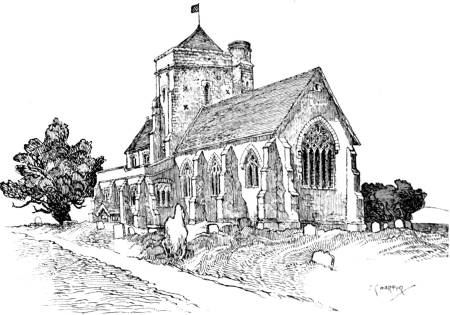
ETCHINGHAM CHURCH.
Although the call of nature may be attended to, and thirst and hunger handsomely appeased at Hurst Green, the æsthetic sense is unlikely to be full fed. Satisfaction of that kind—but none of the other—is amply obtained at Etchingham, one mile distant, down a bye-road.
Travellers to and from Hastings by South Eastern Railway are familiar with Etchingham, as a place with a station where no train appears ever to stop; and indeed to the ordinary mind there seems, not merely no reason for stopping, but none for a station at all. For Etchingham is just what you see from the passing train: a great, impressive church, and one or two ancient farmsteads. There was no village when the station was built, in 1847, and the place was, except for that beautiful church and those farms, a solitude. A solitude, too, it remained until 1904, when an entirely new village was begun. There it blooms to-day, in red brick, like a scarlet geranium, and the South Eastern Railway is at last, after close upon two generations, justified of its prescience.
There seems never to have been a village at Etchingham. Only a manor-house of the de Etchinghams; and that disappeared so long ago that little is known of it. Its last traces were erased when the railway came, and the station stands on the site. There is something so typical of the age in that circumstance that one cannot but stand and admire the dramatic completeness, the colossal audacity of it.
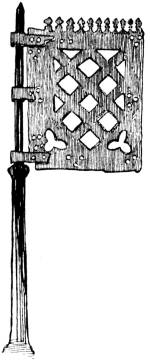
THE ANCIENT VANE, ETCHINGHAM.
But a something greater than the manor-house of those ancient lords remains; in the great church they built. It stands so near the railway that one might pitch a stone from the train into the churchyard; and, as it is one of the finest churches in Sussex, it never fails to hold the glance of those who pass this way. It was built, on the site of an earlier, by Sir William de Etchingham, in 1365, and is a cruciform building, with massive central tower, in the Late Decorated style—that large and bold phase of Gothic which comes between Early English and Perpendicular, and looks lovingly back upon the grace of the earlier and forward to the lofty emptiness of the later, with a richness of detail peculiar to itself. A special note of this church is the fine tracery of its east window, in the easy flowing style, common in France but comparatively rare in this country, known as Flamboyant. The low pyramidical spire of the tower still supports the original copper weathervane, in the form of a banneret displaying the fretty coat of arms of the de Etchinghams, and on the floor of the chancel are the almost life-sized figures, in engraved brass, of the founder himself, and his son and grandson. Sir William, the builder of the church, died in 1387. He still darkly, in obscure Norman-French and black-letter, begs the prayers of all: “I was made and formed of Earth; and now have I returned to Earth. William de Etchingham was my name. God have pity on my soul; and all you who pass by, pray to Him for me.”
If salvation be found in church-building—and there are yet those who seek it that way—then, in those many mansions beyond, William de Etchingham is well-housed, for he built not only a large church, but a beautiful.
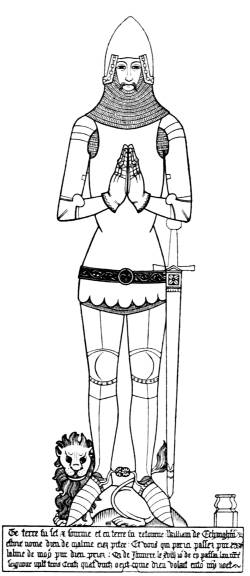
BRASS OF SIR WILLIAM DE ETCHINGHAM.
He endowed it, too, and the eighteen carved miserere stalls yet remain where the priests sang their office. If you turn up those hinged seats, you will find odd carvings on the under side; among them the biting satire, disloyal in such a place, of the fox in the habit of a priest, preaching to geese.
A tablet on the wall records in Latin that the chancel was restored at the expense of the rector, Dr. Hugh Totty, who died, aged 101, in 1857. In the south aisle hangs a tilting-helmet and the erminois banner of Sir George Strode; and a mural monument to Henry Corbould, artist and ancestor of artists, who died, aged 57, in 1844, is a a shocking example of “Gothic,” as understood towards the middle of the nineteenth century. Even this, however, is not so bad as the tablet, with marble profile portrait medallion, to one “John Snepp, gent,” 1823.
The churchyard was once surrounded by a moat, in which, according to an ancient legend, there lay a great bell. How it came there the story did not say; but it was never to be drawn from its hiding-place until six yoke of white oxen should be brought for the purpose. The moat was drained long since; but legend was for once at fault, for no bell was found.
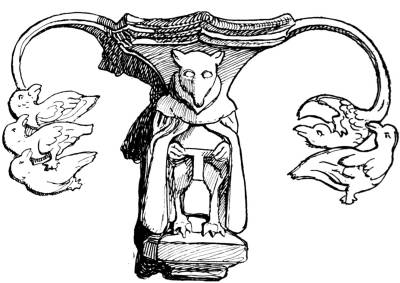
THE FOX PREACHING TO THE GEESE.
XXXV
Returning to Hurst Green, and resisting the temptation to turn aside for the purpose of seeing the farmhouse called “Squibs,” we come presently to Silver Hill, an eminence described by Horace Walpole, who in 1752 travelled Kent and Sussex with Mr. Chaloner Chute on antiquarian pilgrimage:
“The roads grew bad beyond all badness, the night dark beyond all darkness, our guide frightened beyond all frightfulness. However, without being at all killed, we got up, or down—I forget which, it was so dark—a famous precipice called Silver Hill, and about ten at night arrived at a wretched village called Rotherbridge.”
He forgot which! That is—like the hill—rather steep. But he must have known by the time they returned, for he speaks of the view from the crest, on the homeward journey, as “the richest blue prospect you ever saw.” It is indeed very beautiful, and the fact has been recognised by some enthusiastic person who, in a field beside the road to the left, has erected a tall staging, known as “The Beacon,” for sightseers.
The hill is steep: not too steep for a determined cyclist to ride up it on the return, but still a very respectable gradient. It looks by no means so terrible as Walpole’s description would prepare the stranger for; but the roadway is, in fact, not that which gave these tourists and their guide such qualms, for it was reconstructed about 1830. Occasional lengths of deserted hollow road at the side are surviving portions of the old road, and are quite steep and rugged enough to acquit Walpole of unnecessary alarm.
Robertsbridge is a long, long village of old-fashioned houses huddled together on either side of a narrow street in the flats that form the valley of the Rother. Although Robertsbridge is so undeniably old it is not an independent village, being in the parish of the much smaller Salehurst, seen across the levels, a mile away.
It has never been determined whether Robertsbridge acquired its name from Robert de Saint Martin, who founded the Cistercian Abbey “de Ponte Roberti” here in 1176, or from a corrupted version of “Rotherbridge.” “Much,” as Sir Roger de Coverley says in The Spectator, “might be said on both sides.”
At any rate, it is unquestionably a place of bridges. There are seven in all, in a line along the road; but no one of them is at all considerable, and only three span any water, save in seasons of flood.
The beginning of the village, officially styled “Northbridge Street,” is generally styled “the Bridges”; but was in turnpike days, when a gate existed here, “the Clapper.”
The Abbey, long since demolished, lay one mile from the village, beside the Rother. Fragments of it are picturesquely built into the Abbey Farm, and serve as substantial walls for oast-houses. The most perfect relic is the crypt, inside the house, forming an ideally cool dairy.
To this has come the Abbey that gave hospitality to Edward the First and his successor; whose Abbot in 1193, in company with the Abbot of Boxley, was of sufficient importance to be entrusted with the mission of discovering the whereabouts on the Continent of the imprisoned Richard Cœur de Lion. All that is left of it, beside these fragments, is a manuscript volume in the Bodleian Library at Oxford, inscribed: “This book belongs to St. Mary of Robertsbridge: whosoever shall steal it or sell it, or in any way alienate it from this house, let him be Anathema Maranatha.”
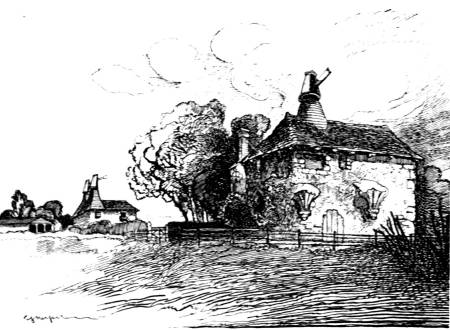
THE ABBEY FARM.
Notwithstanding this comprehensive curse, some one did steal it. A further inscription, written, it is thought, by John Grandison, Bishop of Exeter, 1327-1369, declares: “I, John, Bishop of Exeter, know not where the aforesaid house is; nor did I steal this book, but acquired it in a lawful way.” It is quite surprising to find the old Churchmen believing in the efficacy of their curses, and thus seeking to turn them aside.
The site of the Abbey was granted by Henry the Eighth to Sir William Sidney, and there are those who like to think that his grandson, Sir Philip, would not have been killed at Zutphen, nor Algernon Sidney beheaded, had it not been for the curse upon sacrilege, sleeping in one generation to work woe in another.
For over one hundred and fifty years Robertsbridge Abbey was an iron and steel foundry, where cannon and shot were cast. In the garden of the farmstead a heap of cannon-balls, found about the premises, reminds the visitor of this closed chapter.
When Horace Walpole and his companion, descending Silver Hill in the dark, came to “the wretched village called Rotherbridge,” they would have stayed the night, if they could have found any decent accommodation. “But alas! there, was only one bed to be had. All the rest were inhabited by smugglers, whom the people of the house called ‘mountebanks,’ and with one of whom the lady of the den told Mr. Chute he might lie.” That was rather too much for Mr. Chute, who was a very great person indeed when he was at home at his stately seat, “The Vyne,” near Basingstoke, and he declined the fellowship.
So, with links and lanthorns, they continued their journey, and arrived at Battle, hardly six miles away, at two o’clock in the morning, to a “still worse” inn, “and that crammed with excise officers, one of whom had just shot a smuggler. However, as we were neutral powers, we have passed safely through both armies hitherto.”
One would like to identify that “den.” The term would scarcely apply to the “George,” then, as now, the principal house, and a good specimen of the old English inn, whose proprietor, according to an advertisement in The General Evening Post of 1784, when the house was to let, had a “part-share” in the post-coach on the road to Hastings, described as a “favourite place for sea-bathing.” Was it the “Seven Stars”? Or was it not the “Stag’s Head” of other days, a shy-looking cottage lying low down on the right of the “George,” and well remembered locally to have been the haunt of the smugglers of Darvell Wood?
Robertsbridge is pure Sussex, and pronounces local place-names in a manner peculiar to itself. In the result those names do not appear any the more poetic—Udiham becoming “Udjem,” Bodiam “Bodjem,” Northiam “Norjem,” and Horsmonden “Ors’nd’n.” The story is even told of a stranger asking an inhabitant of Heathfield the way to that place, and of that unlettered person for long declaring he had “niver ’eared of sech a name in these parts.” At last a light broke in upon him. “You means Efful,” he said.
Robertsbridge has now two railway-stations—that of the South Eastern, opened in 1851, and a newer, on the Kent and East Sussex Light Railway, recently made; but it is as old-fashioned as ever, and the subject-matter of the inns at night is apt to be of such recollections as that of how, seventy years ago, there were only three pairs of top-boots in the parish, and how farmers going up to London to cut an occasional dash would borrow them for the jaunt.
XXXVI
It would be unthinkable to leave Robertsbridge without visiting its mother church of Salehurst; or, when there, to return without having seen Bodiam Castle, two miles onward.
Salehurst Church stands picturesquely above the Rother, on the opposite bank from the Abbey. On the north side of it there stands an aged stone recording the incredible age of one “Peter Sparkes, who died October 8th, 1683, aged 126 years.” He is referred to in the registers of Wadhurst as “being above 126 years old by his own computation.” Within the church there are several seventeenth-and eighteenth-century cast-iron slabs to Peckhams and Stevens: relics of the forgotten iron-founding industry of the district.
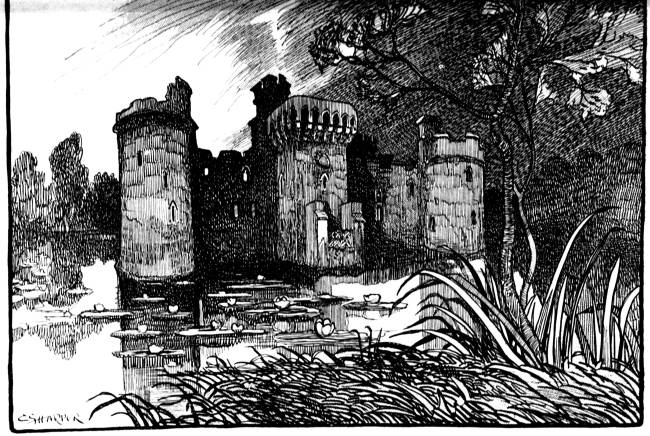
THE MOATED CASTLE OF BODIAM.
The contemplative person, for whom antiquity is not everything, who finds interest in things of the present as well as those of the past, may discover some entertainment in noticing how exquisitely the accommodation in the House of God shades off in fine distinctions, from the cushioned seats and carpeted floors in front, to the strips of carpet and the fibre matting of the intermediate, and lastly to the bare seats and naked boards of those nearest the door—and the draughts. He notices how things religious and things secular are all ordered in these beautiful gradations: the three classes on railways, and the more than three orders of seats in theatres; and he wonders—that contemplative person—whether the “many mansions” prepared in the Father’s house partake of the like subtleties.
The road to Bodiam—spelled “Bodiham” on old maps—is hilly and circuitous; but it brings you at last to that tiny village overlooking the Rother marshes, and to that castle which, more than any other ancient fortress in England, figures the fairy home of the Sleeping Beauty. Bodiam Castle stands on the hillside, beautifully rural, and is surrounded by a very broad and very clear moat of running water, fed from the never-failing springs that flow from the higher ground and are dammed at this point. The grey and lichened walls of the castle rise sheer from the water, amid a wealth of the loveliest water-lilies.
It is mediævalism incarnated. The walls and the eight towers, alternately round and square, are almost perfect, and the wooden gate yet hangs on its hinges across the bridge, where the portcullis grins and the holes in the masonry remain above, to show how, by flinging molten lead, boiling water, hot pitch, and domestic abominations upon the heads of the enemy, the garrison were prepared to hold their own.
But history tells us nothing of sieges or conflicts here. Possibly Sir Edward Dalyngruge, warrior of Crecy and Poictiers, who in the fourteenth century built it, was too strong a castellan, and his moated fortalice more than a thought too formidable. At any rate, it is a castle without a story.
XXXVII
The story is still told at Robertsbridge, and with appropriate awe, how a ploughman on Taylor’s Farm, Mountfield, ploughed up £1,100 worth of gold, and sold it for five shillings, as old brass. That happened so long ago as 1862 and the tale has lost nothing, since then, in the re-telling. Mountfield was long a place of pilgrimage after that event, and the ploughmen on its fields drove the share deeper than ever they had done before; but if they made any more discoveries they were wise enough to keep the fact to themselves.
Although it all happened so long ago, almost the first thing the stranger hears of in Robertsbridge to this day is that mystic gold. Reduced to plain facts, it seems that during his work in Barn Field, on Taylor’s Farm, January 12th, 1862, a ploughman suddenly drove his plough into an entangled mass of metal that brought him up with a jerk. He threw the pieces on the baulk, and when his day’s work was done showed them to his master, who thought they were brass, and gave them to him. They were really, from the description afterwards given of them, gold torques and other Early British ornaments, and had lain there two thousand years. The metal weighed no less than thirteen pounds.
After vainly endeavouring to sell the “old brass” to one dealer after another, a Hastings man more wideawake than the rest, suspecting it to be the more precious metal, gave the ploughman 6d. a pound for it—liberal man! He lost no time in travelling to London, where he sold it to a refiner, who melted it down and paid him £529 12s. 7d. for the resultant 153 oz. 12 gr. of fine gold. A piece had already been sold to a Hastings jeweller for £18.
Rumours of this extraordinary find soon spread, and in the end the ploughman and the sharp dealer were arraigned at the Winter Sessions at Lewes, December 1862, on the charge of illegally disposing of treasure-trove, the property of Her Majesty the Queen. They were each fined £265, half-value of the metal disposed of, or ordered to be imprisoned until the money was paid. Fairy gold has ever brought trouble upon those who find it.
It is useless to speculate upon the possible antiquarian value of the ancient ornaments thus destroyed; but it must have been many times that of the mere metal.
The other main staples of talk are cattle, hops, and wool. If you cannot talk wool, hops, or cattle at Robertsbridge without some knowledge of those subjects, you are self-condemned. There is a fortnightly cattle-market; “ship” browse in many flocks on the surrounding pastures, but everywhere are the hop-gardens and their inseparable oast-houses.
XXXVIII
Out of Robertsbridge and the Rother valley the road ascends steeply to John’s Cross, where the old coach-road bears to the left in a circuitous route to Battle, by Vine Hall and Whatlington, three-quarters of a mile longer than the absolutely straight modern highway.
The “John’s Cross” inn, the old toll-house, and a few cottages sum up the hamlet, and the rest of the way to Battle is of almost unbroken loneliness, except for the railway level-crossing, mid-way.
If, before we come into the town of Battle, we re-read the stirring story of the Norman invasion of 1066, and of the Battle of Senlac, known more generally to the world as the Battle of Hastings, fought on Saturday, October 14th, in that year, so fatal to English liberties, on the spot where Battle Abbey stands,—if, I say, before approaching Battle, we read anew the story of that history-making day of carnage, we shall come into the quiet town with highly exalted feelings, and shall find it a place of many and deep significances to us.
With the tale of that historic struggle thus freshened in our memories, it is not merely the quiet little Sussex country town to which we now come, but to the commanding hill of Senlac, overlooking the seven miles of wooded lesser hills and vales by which the Norman host advanced from Hastings.
The Norman invasion of England, the catastrophe of Senlac, and the woes that then befell the English may all be traced to the weak character and foolish policy of Edward the Confessor, a king whose reputation for piety has, during all these intervening centuries, glozed over his lack of the first qualities of kingship. Firm rule, wise and far-seeing policy at home and abroad—those are the qualities, above all others, we look for in a king, and mere saintliness of character in a ruler has never yet, nor ever will, serve the turn of any nation. Edward the Confessor has, time beyond the memory of man, been held up as a pattern of all the virtues. We are told how he founded the Abbey of St. Peter, which we now call Westminster Abbey, on Thorney Isle; we listen, with what faith we may, to the story of how successfully he prayed away the nightingales who were disturbing his orisons at Havering-atte-Bower. We know that Rome, in the fulness of time, canonised him; but we know also that, however fitted he was in life for the cloister, however unaffected his piety, however mild and urbane his rule, certainly, from the patriotic view-point, his métier was not d’être roi, for he it was who brought over the Normans to his court, and by his favours to them showed them how desirable a country was this England.
Edward was, in short, a Normanised Englishman. The long years of exile he had passed oversea in Normandy, before he was called upon to rule over Saxon England, had set their seal upon him, and his favourite courtiers were of Norman-French nationality. He had, certainly, married Editha, daughter of the great Saxon Earl Godwin, and sister of Harold; but his quarrels with her family go largely toward making up the story of his reign. The head and front of his offending is undoubtedly the alleged bequest, at a comparatively early period, of his crown to William, Duke of Normandy. Apart from the fact that the succession was not his to give, and would in any case have been the business of the Witan, this devising of crown and country to an alien whose ways were not those of the Saxons, and between whose people and Edward’s people the keenest jealousy and animosity already existed, was unpatriotic to the last degree; and had the “Confessor” been made to suffer the terrible fate that befell the second Edward, himself the patron of alien courtiers, that fate had been better deserved. Nay, were justice done the memory of that traitor to his country, his shrine in Westminster Abbey would be torn down and demolished.
But clearer and wiser views at last prevailed with the cloistered King, and in that clarified and enlarged vision, he, drawing towards his end, designated the Saxon Harold, his brother-in-law, his successor. Wisdom, however, was vouchsafed him too late: the mischief was done. The fates were working in those years against England and for Duke William of Normandy, whom history knows, ad nauseam, as “William the Conqueror.” That historic personage was a great captain, strong in battle and in strategy, but he had also the mind of an attorney, which could quirk you and quibble you, and chouse you as efficiently as the sharpest practitioner that ever misused the law. It was no matter to that acute and ambitious brain that the sanctimonious “Confessor” had revoked his bequest in favour of Harold; to him, at least, it held good. And events marvellously aided him. Somewhere about 1064, Earl Harold, already king-designate, was voyaging down channel, when his ships were driven ashore on the coast of Ponthieu, in territory tributary to William. Those were times when to be cast ashore was to suffer, not only the discomforts incidental to shipwreck, but to be seized and held to ransom by the scarce more than robber-lords of that age. Such an one was Count Guy of Ponthieu, who speedily seized Harold and imprisoned him in his castle of Beaurain, and would have held him there, over against the arrival of that ransom, had it not been for the Duke, who, hearing of this odd freak of fate, and with a keen eye to how the incident could be used to his own advantage, demanded his release. But Harold’s enlargement from an acknowledged and undisguised prison was merely an exchange for a gilded captivity. Nominally, he was now become the guest of the Duke, in his palace at Rouen, but in reality he was his prisoner, only to be released on terms. Those terms were soon disclosed, and the English Earl, already marked as the successor of Edward, was made to swear, at Bayeux, as the price of his liberty, to become the guardian of William’s supposed interests in England, and to receive him, on Edward’s death, as King. These oaths he took, with others, upon a chest which William had secretly filled with the choicest saintly relics that Normandy contained. It does not become us, with our later knowledge of the very unsaintly character of the old bones usually palmed off in those times as the relics of saints, to scoff at Harold turning pale when the tremendous character of the contents of that chest was revealed to him. The credulity of that age did not permit him the assumption that the alleged relics were probably no more than the mere ordinary unsanctified plebeian bones and teeth and fragments of skin we may readily presume them to have been, with the same relation to the genuine articles as that of a Bank of Engraving note to one issued by the Bank of England. Harold accepted them, as he could not choose but do, at their face value, so to speak, and trembled.
Such is the story handed down to us. The oath taken, Harold was free to return; and, as his own conscience later told him, and as ours must needs tell us, was free to disregard an oath, however solemn, taken under circumstances of compulsion.
In two years from that time, January 5th, 1066, the Confessor died, with his latest breath naming Harold his successor—a choice later ratified by the council of the English realm. Harold was elected and proclaimed King, and the warrior-lawyer over in Normandy was left out in the cold. William, however, could not have been surprised at this, and set to work upon the next step in his scheme, which was to obtain the support of the Pope against “the perjurer,” as he was pleased to style Harold. All these things had been thought out long in advance by that wily brain. William, as claimant to the English throne, could be effectively aided by William as champion of the Church’s might; and William had ever been concerned, from motives of policy, to figure as one of the Church’s most devout sons. If you consider it, religion has ever, from the earliest times, been made the stalking-horse of scoundrels: a fact so patent that your playwright or your novelist is commonly concerned to furnish forth his villain with a text or a psalm, and thus moral sentiments on the stage are the stigmata of the wrong-doer.
XXXIX
The Pope, Alexander the Second, placing his ghostly terrors at the disposal of William, declared Harold an usurper, and William the lawful heir. Thus early had Englishmen to remember Rome for a disservice. It then remained only for William to collect his forces for an invasion of England. He set about the work with business-like promptitude and a settled determination which, by comparison, make the great Napoleon’s projected invasion of over seven hundred years later seem like the wayward fancy of an infant. The forests of Normandy were felled and converted into timber, and all the summer of 1066 thousands of shipwrights were busily employed in Norman havens building the vast fleet designed to invade our shores. When we form a mind’s-eye picture of a fleet, we necessarily visualise nowadays something very different from the flotilla prepared by the Duke of Normandy for the invasion of England; but we must go far back, beyond even the small ships with which Edward the First waged war in foreign parts, if we would see what William’s navy, made of the green timber that had been growing six months before, was like. His “ships” numbered, according to the lowest computation, six hundred and ninety-six: according to the highest, there were over three thousand; but if we turn to the indisputable evidence of the famous Bayeux Tapestry it will be seen that they were craft more in the nature of galleys—open boats with one mast.
The same want of exact figures meets the inquirer who seeks to learn the number of that invading army. Contemporary chroniclers are at great variance, the numbers, by their accounts, ranging from 14,000 up to 60,000. From February onwards to September those craft were building and that army collecting. Meanwhile King Harold was not idle. He had long been skilled in warfare, and was as able a general as William himself, and by sea and land he was gathering a force together that in all human probability would have annihilated the Norman host had it not been for the happening that at this juncture divided his attention.
That happening was the invasion of northern England by the Norwegian king, Harald Hardrada, in conjunction with Harold’s own brother, the banished rebel Tostig, in September, at the very time when the Duke of Normandy’s expedition was lying ready to sail, only waiting upon a southern wind. The Norwegian host landed in the Ouse and the Humber, and the English had been defeated at Fulford and Hardrada received in York as a conqueror before the English Harold could march from London to the scene. But when he arrived victory attended him, and in the Battle of Stamford Bridge, September 25th, he not only defeated the invaders, and killed Hardrada and his brother, Tostig, but almost annihilated the foreigners. It was the supreme victory of a great military career, and the last ever gained by the Saxon English. In the midst of the rejoicings and the absolutely necessary rest at York, Harold received the tidings of the Norman landing at Pevensey, near Hastings.
Fate had indeed dealt hardly with that brave heart. He had marched full two hundred miles to meet one foe, and he was now to march back to face another, already established on the coast he had been so concerned to guard. For the south wind that had been denied William for near a month of waiting at the Dive and at St. Valery had, in this hour of his need, played Harold false and had wafted the Norman sails across the Channel. William landed unopposed on the deserted coast at Pevensey, twelve miles to the west of Hastings, in the early morning of September 28th, and the next day marched to Hastings, which he made the base of his operations. From that place he ravaged and laid waste all the surrounding country, with the intention of drawing Harold down to the sea-coast, to attack him in defence of his plundered and ill-treated subjects. He reasoned, as an invader even in these times must needs reason, that the chances were more in his favour if he could meet the English by the shore. Were he obliged to march inland to the attack, grave considerations of provisioning his army must be contended with, and in the event of defeat his difficulties would have increased with every mile he had advanced into the interior. He thus lay at Hastings, within reach of his ships, while Harold was marching southwards, and organising his army in London. There were not wanting those who at this time warned William earnestly against what they considered the folly of his enterprise. The might of the Saxons was no mere tale, and messengers, coming southward with news of how Harold had defeated the Norwegian invaders, and was now marching to repeat his victory upon the Norman host, might well have made even so tried and fearless a soldier as William retrace his steps. But he had come to victory or to death, and had staked all upon this one throw for that magnificent prize, the crown of England. Had he recrossed the Channel, it is certain that never again would the opportunity of landing on an unguarded coast be afforded him; and on all counts, now or never was his time. He had taken a high moral ground for his invasion, and was come, by his own claim, not as Conqueror, but as one claiming his legal rights, secured on the most sacred of oaths and hallowed by the blessing of the Church. Legal rights are the great standby of the plunderer and the spoiler, and the stirrup for William’s vaulting ambition was legality. It was, as we have seen, the kind of legality we associate rather with the pettifogging attorney than with justice; but he had wrung the blessing of Rome on it, and beside his banner floated the standard consecrated by the Pope.
XL
William “the Conqueror,” as history styles him, never so styled himself. His astute mind thrust such a warlike thing into the background. He had only come to claim his own, and was unfortunately obliged to fight for it against the perjurer! One can almost in imagination hear the pietistic snuffle of a Pecksniff in this mixture of legal and religious motives.
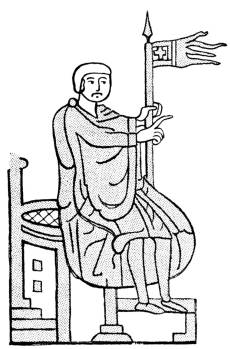
WILLIAM THE CONQUEROR.
Bayeux Tapestry.
It was about October 5th that Harold reached London. He lay there six days, awaiting the promised reinforcements from his northern Earls, which never came, and in the meanwhile calling in his levies from the near counties. But before he set out for Sussex he paid a last visit to his abbey of Waltham, which he had dedicated to the Holy Cross and had enriched with many gifts—evidences of his piety. For we must by no means believe that William, the self-constituted champion of sacred relics and the Church, alone practised, or professed, religion. Harold’s piety was at least as marked, and it is perhaps not altogether the Englishman’s sympathy for an Englishman, or his chivalrous regret for the vanquished, which sees in the ill-fated King’s abasement before the Holy Rood of Waltham on the eve of that fatal struggle a more sincere approach to the Most High. He lay prostrate upon the pavement in supplication, and the dark, wonder-loving legends of that time tell us that, as he did so, the hitherto raised head of the sacred image bowed itself upon the Cross, as though enacting again the tragedy of Calvary: in token, as the belief of that age ran, that the career of Harold was finished.
The English army set forth from London on Thursday, October 12th, and marched inevitably, it being the most direct route, by the line of country through which runs the Hastings Road of our own day. So speedily did the troops set out to meet their foe, that by Friday night Harold had pitched his camp on this hill of Senlac, eight miles from Hastings, on the site of this town of Battle.
A very ancient oak, known as the “Watch Oak,” stands in the private garden of a house on the bye-road to the right entering Battle. It is traditionally the spot whence Harold’s scouts watched for the approach of the invaders.
No one is skilled to tell us whence came this name of Senlac, nor what it meant. It was the “hill called Senlac.” Around it on three sides were hollows, marshy with the feeders of little streams. The Normans gave the name a French twist and called it “Sanglac” or “Sanguelac,” the Lake of Blood; but although their perversion of the name is ingenious, it will not serve our turn, since we see that the name of Senlac existed prior to the battle. Nor will yet another Gallicised version—that of Saintlache, or Holy Lake, do; and the meaning of the old name belonging to this place of battle must of necessity be left in obscurity.
Harold chose his own battle-ground, and chose it with the trained, unerring eye of one who had been the victor in many hard-fought campaigns. Electing to take up a defensive position in a spot where the menace of his presence must needs make William fight, or remain disastrously inactive on the coast, he ranged his army on the summit of this long spur of hill that then thrust out boldly from the wooded surroundings and commanded a view over gorse-covered folds of down, away to the sea. He had every reason for this plan of awaiting attack, chief among them the totally different characteristics of the two armies: the Norman army being strong in cavalry, the Saxons fighting wholly on foot, from King Harold and his two brothers, Gurth and Leofwin, down to the merest churl; while on the Norman side there was a strong force of archers, and on the Saxon none whatever. The Saxons, or the English, as we perhaps should more properly name them, were armed with javelins and with the two-handed battle-axe. The battle-axe, carried over the shoulder and wielded from it with a two-handed grasp and a swing of the whole body, was a terrible weapon in the hands of a body of men acting purely on the defensive, but it was ill-adapted for pursuit. A blow from it was easily capable of cleaving, not only through the helmet and head of a horseman, but of felling both him and his horse. Such was the weapon upon which the English chiefly relied in standing their ground and to withstand the onset of the Norman horse, which, owing to Harold’s strategy in seizing this commanding eminence, would be under the necessity of charging uphill.
To render the position additionally secure, opportunity was taken, ere night fell, to fortify the edge of the plateau with a palisade cut from the surrounding woodlands, and to wattle it with twigs and boughs so closely interwoven that it was impossible for a single person to creep through. Here, then, the English army lay athwart where now runs the road to the sea, but where at that time, beside a landmark named in the old English Chronicle “the hoar apple-tree,” there was apparently no other salient object save the rough track which must even then have existed, leading down to the port of Hastings.
The night before the battle seems to us, and must even have seemed to the opposing armies, a tremendously fateful interlude. Political and other considerations were such that all must have known the fate of England to depend, not upon a long campaign and a series of marches and fights, but solely upon the issue of the great contest now impending. How, then, did they pass the eve of battle? The Normans are our chief, and almost sole, authorities here, and were concerned, as inevitably they would be, to picture the Norman army as a host of Christian soldiers going forth to war with a dissolute, drink-sodden rabble. According to this partisan view, the Battle of Senlac, or Hastings, was lost by the English chiefly owing to the effects upon them of an all-night orgie of wassailing. When morning came, and with it the great struggle that was to decide the fate of England, the English host were still muzzy with their potations of the night before, and had not the clear vision and cool judgment that are as necessary on the battlefield as elsewhere. What a fine theme for a Temperance Lecturer, hot on the subject of “the cursed drink”! Such an one might fitly show by this instance how indulgence in it destroys not only the individual but the nation itself; but no one seems ever to have fastened upon this very eloquent illustration.
The Saxons certainly were mighty topers, and it is by no means too much to say that they were a nation of drunkards. Ancient chroniclers at all points fully support this sweeping statement; amongst them William of Malmesbury, who tells us that the Anglo-Saxon rule was bad, and the monks and nobility corrupt. “Drinking in parties,” he says, “was an universal practice, in which occupation they passed entire nights, as well as days.”
Coming to a description of the night before the battle, he tells us, in the original Latin in which he wrote: “Angli, ut accepimus, totam noctem insomnem cantibus potibusque ducentes.” That is to say, in plain English, they kept awake all night, singing, and drinking innumerable drinks—which is a very fine, fearless way of preparing to meet the foe, and one highly expressive of contempt for him; but it is not a wise way.
He then proceeds to expand his argument by saying: “The vices attendant on drunkenness which enervate the human mind followed; hence it arose that, engaging William more with rashness and precipitate fury than military skill, they doomed themselves and their country to slavery by one, and that an easy, victory.”
XLI
The Normans spent the night after a very different fashion—in prayer and in the confession of their sins—for they knew that many must fall on that eventful day. The Bishops of Coutances and Bayeux received their confessions, and recorded their vows on this Friday night that if they were spared on the morrow they would fast on Saturdays for the remainder of their lives. William, for his part, registered a solemn vow that if he gained the victory he would found a great church on the battlefield, in gratitude for the divine aid. The Normans, in short, made all due preparation; and as they prayed well, so did they fight, on that fatal morrow.
Another, and a highly picturesque, chronicler tells us delightfully of the alleged actual Saxon debauch on the battlefield, on the night before the fray. This account is by Wace, the author of several romances and narrative-poems in Norman-French. Wace wrote his jingling metrical narrative about 1170, more than a hundred years after the battle was fought, but probably incorporated the floating traditions of that great occasion, doubtless still plentiful in his time.
Here is his picture of the Saxon orgies:
Quant la bataille dut joster, La nuit avant, ço oï conter, Furent Engleiz forment haitiez, Mult riant è mult enveisiez; Tote nuit mangierent è burent Unkes la nuit et lit ne jurent. Mult les véissiez demener, Treper, è saillir è chanter.
The Norman-French in which Wace writes is somewhat puzzling, but the general sense of it is that “the night before the battle was fought, as I am told, the English were joyous, laughing much and skylarking. They ate and drank all night, refusing to take any repose, and skipped about, dancing and singing.”
Then he gives us the English shouts, as heard by the Normans:
Bublie crient è weissel, E laticome è drincheheil, Drinc Hindrewart è Drintome, Drinc Helf è drinc Tome.
or, as we may put it, “Bubble it up!” they cried, and “Wassail!” and “Let it come,” and “Drink hail!” “Drink hinderwards and drink to me, drink health and drink to me!” Modernised, and applied to beer, which is to our times what mead or metheglin was to the Saxons, “Bubble it up!” would appear to mean “Froth it up,” or “Put a good head on it”; while “Let it come” and “Drink hail!” are simply “Pass the bottle” and “Here’s your health!” But how you drink “hinderwards,” unless it means “Pass the bottle back again,” I cannot conceive.
At any rate, it is quite evident, by this account, that these English warriors had each a thoroughly good skinful of booze overnight. They seem to have almost wallowed in it, and were precisely the men who would have appreciated the bibulous spirit of that drinking ballad of modern times, which ran something after this style:
Beer, beer, glorious beer; Fill yourself right up to ’ere. Up with the sale of it, Down with a pail of it, Glorious, glorious beer. Up with the trade of it, Drink till you’re made of it,
and so forth, in a style eminently calculated to win the hearts of my lords Ardilaun, Iveagh, Hindlip, and Burton.
But the Saxon mead, which may still be discovered in remote parts of the country as the home-brewed “metheglin,” a sweet and sickly liquor made from honey, is a heady drink, a great deal more likely to result in a splitting headache the next morning than the clearer brew of the barley; and the Norman libellers would have us believe that, because of that matutinal headache, and an enlarged vision which led the English to see two, or three, Normans for every one—and to strike at the ones that were not there—they lost the Battle of Hastings.
The historical facts do not quite fit in with that view. Doubtless the English and the Norman methods of passing the battle-eve were different. For one thing, the Norman wolf was posing, until he almost deceived himself, as the injured party, and one fighting the battle of religion as well as of personal wrongs; and he acted fully up to those parts. The English, on the other hand, were elated with their recent victory in the north, and felt a not unnatural confidence in their ability to repeat it. Therefore, they went into battle with less solemnity than the Normans. But we nowhere read that the English battle-axes were swung with the less terrible effect because of the revels which may or may not have passed overnight in the English camp, and nothing seems more certain than that victory only fell to the Normans because of the mistaken warlike ardour of a portion of the English army, which broke its ranks in order to pursue a panic-stricken section of the Norman array, and thus afforded William’s cavalry a footing on that bitterly contested hill of Senlac.
XLII
The battle began about nine o’clock in the morning, the Norman army marching from Hastings by the spot where Crowhurst Park is now seen, to Telham Hill, the “Hetheland” of the chroniclers. Here the Norman knights put on their armour, and here William made his vow that if victory were given him he would build a great abbey on the spot where he saw the emblazoned English banner of the Fighting Man flung proudly upon the morning breeze. His army then advanced to the attack, the archers on foot in the front rank, the swordsmen behind them, and in the rear the cavalry. William himself was armed with an iron mace, the weapon also carried by his brother, Odo, Bishop of Bayeux.
The fight began with a discharge of arrows from the Norman ranks, followed by the singular interlude provided by Taillefer, the Norman jongleur, or minstrel, who rode forth from the ranks singing songs of chivalry, and of the knightly doings of Roland and Charlemagne. He had begged from William the privilege of striking the first blow, but as he went out into the space between the confronting armies he assumed first his character of a juggler, throwing his sword into the air, and then catching it, to the astonishment of the English, who doubtless wondered what manner of warrior was this. But, ceasing his tricks, he suddenly rushed upon the English ranks, and piercing one Englishman with his lance and striking down another with his sword, was thereupon himself slain. It was the bravest, or, if you will, the most foolhardy, act of the battle, for he went forth to certain death. But his action did this much: it heated the blood of both sides, and those who might have fought at the beginning without the full fury of enthusiasm, now fell to it in frenzy, fired by his example. It heartened William’s second line, the infantry, to their heavy task of advancing, under the showers of English stones and javelins, up the hill to the attempted destruction of the palisade; but although they strove, the effort was too great. All who approached within the reach of English arms and English axes were struck down, almost cleaved asunder, and although the rear ranks filled the air with Dieu aide! they wavered from that first onset, the English shouting “Out, out!” as they thrust back every one from their defences, varying that cry with the pious invocations, “Holy Rood,” “Holy Cross,” and “God Almighty!”
Wace tells us of those battle-cries in his quaint renderings of the English the Normans heard:
Olicrosse sovent crioent, E Godemite reclamoent; Olicrosse est en engliez Ke Sainte Croix est en franceiz, Et Godemite altretant Com en franceiz Dex tot poissant.
Or, translated:
Holy Cross they often cried, And shouted God Almighty; Holy Cross is in English What Sainte Croix is in French, And God Almighty is, otherwise, As they say in French, Dieu tout puissant.
If the English really did say “’Oly Cross,” it shows us that the letter “h” was as slighted in the eleventh century as it is in the twentieth.
The Norman infantry had now recoiled, and the turn of the cavalry was come. The choicest chivalry of Normandy, however, strove in vain uphill against the English defences, and many a horse and his mail-clad rider fell beneath the axes. Harold’s choice of a battle-ground and his defensive tactics were fully justified, and the Battle of Senlac would have been his but for the fatal impetuosity of a portion of his less disciplined troops, who, seeing the panic and headlong flight of the Norman army, broke their ranks in pursuit. The temptation was great, for everywhere the Normans were in flight, and the awful cry had been raised among them that William himself was dead. It was only by removing his helmet and disclosing his face that his men were assured of his existence. “Madmen!” he cried. “Why flee ye? Death is behind, victory before you. I live, and by God’s grace I will conquer,” and so saying he forced those immediately around him back into the fray.
This incident has been carefully pictured in the Bayeux Tapestry, where we see “the Duke comforting his young soldiers” by disclosing his face, while his standard-bearer draws attention to him. The impressiveness of the scene is perhaps a little marred by the grotesque drawing, and by the extraordinary likeness of “the Duke” to Mr. Arthur Roberts, and of one of the “young soldiers” to accepted caricatures of Mr. Austen Chamberlain.
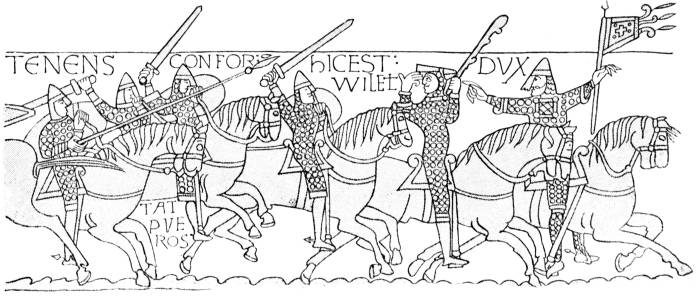
“DUKE WILLIAM COMFORTS HIS YOUNG SOLDIERS.”
Central incident of the Battle of Hastings. From the Bayeux Tapestry.
Meanwhile the flying Norman infantry had in other parts of the field turned upon their pursuers, and here the sword proved the better weapon, for the rash English were cut to pieces. Then, somewhere about three o’clock in the afternoon, began the most terrible attack of that dreadful day, in the desperate charge made by William, his brothers Odo and Robert, and their attendant knights, against the sturdy group around Harold and the English standard. William, on horseback, sought out the English King, and might have met him face to face, had not the King’s brother, Gurth, flung a spear at him, which, although it missed the greater mark, brought down his horse. Unlucky, ill-aimed blow! It brought Gurth and William face to face, afoot, and presently the English Earl was lying dead from a blow of the Duke’s mace. Near by, and almost at the same time, fell Harold’s other brother, Leofwin. The English fortunes were indeed running low, but the battle was not yet decided. Still that devoted phalanx of axemen hewed down most of those who approached, and the day was neither lost nor won. It was then that the ill-judged pursuit made by the English a little earlier bore bitter fruit—the sorrow of it! William had noted its effect, and now that his direct attacks were like to fail, he had recourse to the wily trick of a feigned flight. Accordingly, to his instructions, a wing of his army turned tail and fled, as though in panic; and immediately, learning nothing from that earlier disaster, a portion of the English came down after them. It was the turning-point of the day, for the ground the English had left was just the one end of the hill where the rise was appreciably less steep, and more easily to be charged up by the Norman cavalry. The fight down in the valley between the pretended fugitives and their pursuers meanwhile went forward with varying fortunes. The flying Frenchmen turned, as before, but this time the English seized on an outlying hill, and although they fell, they fell in company with their foes. In their turn, they inveigled the French horsemen into charging upon them into an unsuspected ravine, where they fell in a mass and were despatched to the last man, so that the old chroniclers tell us, and the Bayeux Tapestry shows, how the hollow was filled with the dead.
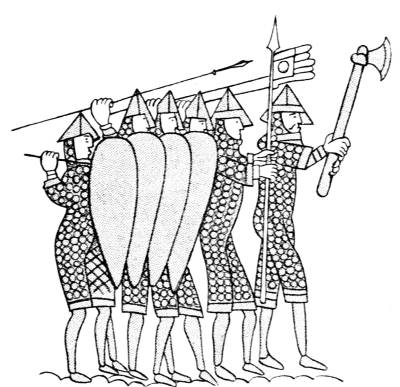
LAST STAND OF THE ENGLISH.
Bayeux Tapestry.
William and the pick of his army now beset the hill from its western slope, thus left open by the descent of the pursuing English, and here, and along the ridge to the very spot where Harold stood, wielding his axe with the best of them beneath his standard, the fight stubbornly continued. The autumn day was now fast drawing to its close, and the battle might have been still undecided that night, had it not been for an inspiration that seized William. His archers had hitherto not made any great impression. He now ordered them to shoot their arrows into the air, so that they might descend with terrific force upon the heads of the English; and this done, the execution was dreadful. Many were struck in the eye by the falling shafts, among them Harold, the English King himself. An arrow pierced his right eye, and as he agonisedly strove to withdraw it, the shaft broke. Let us not enlarge upon this dreadful end of the patriot King, who was presently discovered and slain by the Norman knights as he lay upon the ground at the foot of his royal banner.
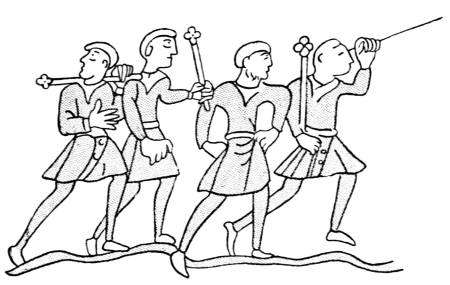
FLIGHT OF THE ENGLISH CHURLS.
Bayeux Tapestry.
Thus fell Harold, in his prime, for he was but forty-four years of age. It happened long, long ago; but although much else has turned to dry-as-dust in that vast interval, and although many historical figures and the deeds they wrought are mere vacuities, emptinesses, and parchment-like bogles, the heroic death of Harold in defence of his country still calls up bitter sorrow in those of us to whom history is not merely the printed page, or a glass-covered case in a museum.
When Harold fell England fell with him. All who fought with him that day knew it must be so, yet the fight, although it was by now a hopeless cause, went on until the evening deepened into night; and although those of meaner estate may have fled when the fortunes of the day were obviously lost, those of higher sort plied their axes to the death. Few of them escaped, or sought to do so. Yet, even as the last streaks of waning day faded into night the defeated and fleeing English turned once more upon their foes, and in the marshy hollow in the rear of the battle-ground, then eloquently called “Malfosse,” slew in great numbers the Norman horsemen who incautiously pursued them. It was the last expiring effort of the day, but so sturdy an one that the Normans were for awhile stricken again with a temporary panic, thinking that English reinforcements had arrived. But no fresh troops were come to save that situation; and not even at this last moment had the northern Earls, Edwin and Morcar, sent aid to redeem their characters. They live in history in company with Judas and many another perjured traitor. By their treachery England was lost.
XLIII
The battle was over, after more than nine hours’ continued fighting; and now William’s tent was pitched upon the spot where the English standard had been planted. There he supped, and there, amid the thousands of dead and dying, he slept. On the morrow the mutilated body of Harold was found; but neither the bribes nor the entreaties of his aged mother, Gytha, who had now lost all her sons in battle, could induce William to yield it to her or any other. The perjurer, the excommunicate, he swore, should not have religious sepulture. Harold’s body should rest in unhallowed ground, beneath a cairn of stones on the rocks of Hastings, and should thus in death guard the Saxon shore he had guarded in life. And so to the shore at Hastings, wrapped in a purple robe, his body was borne. And truly, no other burial could be so fitting for the hero whose life was given for his trust. The Duke of Normandy was no sentimentalist, and to the minds of that age unconsecrated interment was a thing to be thought of only with a shudder; but he was chivalrously poetic here, without a suspicion of it himself, for no hero was ever laid in more fitting place than Harold, by the salt selvedge of the coast he had sworn to protect, and did protect to his last moment: and as for consecration—why, there be those who dare to think that the laying there of this man’s body, who shed his life-blood for the land that gave him birth, was itself hallowing and consecration transcendent for that rocky marge.
But the epic fitness of Harold’s resting-place was not perceived by that age, or was thought a thing of lesser moment than that he should be accorded religious burial; and thus it happened that, when the fury of the Conqueror’s first rage had died down, permission was accorded for Harold’s body to be translated to Waltham Abbey, the great minster himself had founded in Essex. The last days of the terrible year of 1066 were drawing in when that re-interment took place, and Sussex lost the bones of her patriot.
This is pre-eminently the era of national memorials, when heroes of to-day and of yesterday and other personages whom we are not all agreed to call heroes are honoured in effigies of bronze. ’Tis but yester-year since Alfred the Great was duly, and properly, commemorated in this shape, in his city of Winchester, and a statue of William of Orange—our William the Third—was erected, not so long since, on the spot where he landed, at Brixham, in Tor Bay; but Harold yet awaits his turn. For the why of it, I know not; unless indeed it be that we English are ever a thought too practical, and honour, not so much endeavour, as success. Alfred was successful; Harold in the end was crushed, and his England broken. Yet it was not himself was lacking; it was his rash irregulars, who, by their headlong zeal, lost him the day. He strove his utmost, and that utmost was, beyond rivalry, noble.
To say, “He did his best,” is the noblest epitaph we can give any man, and none should grudge Harold posthumous honour. We “Englishmen,” as we may still call ourselves, are not yet so indisputably the masters of the world that we can afford to disregard our national heroes, and Harold’s statue, of appropriate heroic size, surely should stand prominently over Hastings, to show newer generations how we can honour even endeavour that has won to no position, and that we can remember even our defeated heroes.
The Conqueror, as we must call him, despite his studied avoidance of that title, inimical to his “legal” claim, fully redeemed his vow to build a great abbey upon the field of battle. He built the Abbey, which he dedicated to St. Martin of the Place of Battle, on the place where so many had been slain to satisfy his ambition, rearing the High Altar, the holiest spot, on the exact position where Harold had fallen. William Faber, that Fabricius, or smith, turned monk, who was present at the great battle, and had been at the Duke’s side when he vowed the Abbey here, would, when it came to the actual building of it, have chosen another site; for here, he urged, on the hill-top, water was lacking. Let him and his brethren from the Abbey of Marmoutiers build in the valley, where the springs were never dry. But this suggestion outraged the Conqueror’s sense of the dramatic fitness of things, which, as we have already seen in his selection of Harold’s seashore resting-place, was a very keen sense indeed. No: he would build upon the actual field of battle, or not at all; and if the Almighty spared his life, wine should be more plentiful in that Abbey than water elsewhere.
Battle Abbey very soon began to rise on that field of blood. The King of England, as he was now become, spent money freely on it from his treasury; ship-loads of the fine building-stone of Caen came continually across Channel from Normandy, until, by one of those miraculous dreams dreamt at need in those times, a bed of stone was discovered, and a quarry opened, in the neighbourhood. The rising Abbey was richly endowed with manors far and near, and was made the centre of a three miles’ circuit exempted from all other jurisdictions, ecclesiastical or civil. Its abbots, moreover, were mitred and seated in the councils of the realm, and beside holding the privilege of sanctuary, theirs were the rights of free warren, inquest, and treasure-trove. Were they merciful men and pitiful, then those dispositions could be humoured to the full, for they were given the prerogative of pardoning any criminal they met on his way to execution: a prerogative that meant much in those days, when execution was done upon criminals for a large variety of offences.
More interesting than all others among William’s gifts to the Abbey were his sword and his coronation robes, which, stripped of their gold and silver chains and amulets in the reign of Rufus, for centuries remained objects of the greatest curiosity. But the Abbey was long a-building, and twenty-eight years had flown since the battle and William himself had been seven years in his grave, before it was completed and finally consecrated.
XLIV
And then it stood in this noble situation for well over four hundred and fifty years, growing in architectural splendour and worldly wealth, but decaying in religious life and morals, in common with all other monasteries. Its income was equal to £10,000 per annum of our money: the Abbot entertained guests of the noblest, and the brethren’s indiscriminate charity made Battle a centre for all the “mighty beggaris, sturdye vagrantes, idle mychers, and foule cozeners” in Sussex. It was rotten-ripe and full fit to be plucked when Henry the Eighth ended the monasteries and when his Commissioners appeared before its doors on May 27th, 1538.
To sentimentalise over the suppression of places like Battle Abbey would be excusable in the ignorant; in those fully informed it would be criminal. It cannot be too often repeated that the work undertaken by Henry the Eighth was no mere capricious act of tyranny, was no unwarrantable or unprovoked attack upon the religious houses. Wyclif had long before, at the close of the fourteenth century, declared that the rotting trunk of the monastic establishments cumbered the ground. In 1414 over one hundred alien priories were suppressed. In 1489 Pope Innocent the Eighth issued to the Archbishop of Canterbury a commission for a general investigation. Parliament itself had petitioned Henry the Fourth for seizure of the possessions they administered so ill. Wolsey had from within the Church seen the decadence of the Abbeys and Priories, and himself suppressed a number of the smaller houses and devoted their property to the better use of education.
It is a cloud of witness to the general and cumulative disgust of the times with the enclosed life.
The Commissioners came to Battle, dressed fantastically in the plunder of other religious houses they had ransacked on their way, “decked in the spoils of the desecrated chapels, with copes for doublets, tunics for saddle-cloths, and the silver relic-cases hammered into sheaths for their daggers.” They, in short, committed on their side almost as many excesses as the foul-living, blasphemous monastic brethren had on theirs; but they had this excuse: that if they indeed made a mockery of religion, it was the monks themselves first showed them the way of it.
The report of Dr. Layton, Chief Commissioner, described the conduct of Battle as “the worst that ever I see in all other places, whereat I see specially the blake sort of dyvellyshe monks.” Their doings, however, had not been so bad as those of establishments subsequently visited, whose sins will scarce bear mention.
But the monks of Battle had always been prepared to go considerable lengths for money. In the monastery was hung the famous “Roll of Battle Abbey,” purporting to be the roll-call of the Norman knights on the morning of the Battle of Hastings, to which they answered “Here,” or “Ici,” or “Adsum,” as might be. This historical parchment is reported to have been removed to Cowdray, where it perished in the fire of 1793, but it had, centuries before, been so tampered with by the monks that all its value had been destroyed. It early became a foible among noble or wealthy families to declare that their ancestors “came over with the Conqueror,” and Battle Abbey was always ready to oblige a liberal patron by adding his name to the Roll. In the words of Dugdale: “Such hath been the subtility of some Monks of old, that, finding it acceptable unto most to be reputed descendants to those who were companions with Duke William in that memorable Expedition whereby he became Conqueror of this Realm, as that, to gratify them (but not without their own advantage) they inserted their Names into this antient Catalogue”; and Camden repeats the charge. “Whosoever,” he says, “considers well shall find them always to be forged, and those names inserted which were never mentioned in that authenticated record.”
On the surrender of Battle Abbey, it and its lands were granted by the King to Sir Anthony Browne, in 1538. The knight did not come into his property with the good will of the neighbourhood, which, pauperised by and dependent on the monks, with anger saw them thrust forth into the world, and loved to tell how the last of the brethren to issue from the gate turned and cursed him with the doom of the sacrilegious. “By fire and water,” he declared, his line should end. We are not told whether Sir Anthony Browne quailed—as on the stage he certainly would have done—or if he merely laughed; but there can be no doubt that the people of Battle awaited the issue with great interest, and that, when nothing happened, they were disappointed. Instead of Sir Anthony Browne or any of his family being cut off untimely, they flourished exceedingly, and his son became a peer, under the title of Viscount Montagu.
The estates of Battle passed from the family in the time of the sixth Viscount, who in 1719 sold them to Sir Thomas Webster, the first of a long line of Baronets who (with an interval from 1857 to 1901) have held them ever since. In all that time the curse slept, and possibly when the sixth Viscount Montagu parted with Battle and retired wholly to his great mansion and beautiful park of Cowdray, he thought the spell had been effectually broken by this severance.
But the long-dormant curse woke up and worked itself out in 1793, when the beautiful mansion of Cowdray was destroyed by fire. In the following month the eighth Lord Montagu, while yet ignorant of this disaster, met his death by drowning in the Falls of Lauffen, near Schaffhausen, when attempting to shoot the rapids in a boat. He was but twenty-four years of age.
The next heir to the estates of Cowdray, the ninth and last Viscount, was a Roman Catholic priest, who died childless, in 1797, in spite of the fact that he was dispensed from his vows in order that he might marry and continue the line. The property was then inherited by his sister, Mrs. Stephen Poyntz, whose two sons were shortly afterwards drowned at Bognor. Her husband then sold Cowdray.
All this proves how very careful it behoves those to be who launch curses on roving commissions. Even the Websters seem to have shared to some degree in this malediction, for the fourth Baronet committed suicide, June 3rd, 1800, by shooting himself with a pistol at his London house in Tenterden Street, Hanover Square. He had been embarrassed by heavy losses at cards. This eccentric and unfortunate man, Sir Godfrey Webster, married Elizabeth Vassall, a great Jamaican heiress, who in 1795, at Florence, while her husband was away in England on business, left him and her two children for the third Lord Holland. Lord Stavordale, in his memoir, skates cautiously over the thin ice of this affair. He says the meeting of that guilty pair “was destined to alter the whole course of their lives. They became deeply attached to one another, and after many months spent in various parts of the Continent, returned to England in 1796.”
Sir Godfrey obtained a divorce in July, 1797, and two days later Lord Holland married the lady, known to diarists and writers of memoirs as “the celebrated Lady Holland.” Had she been less rich she would doubtless have been merely “the notorious.” Her entertainments and her biting wit (she was a kind of female Douglas Jerrold) absolved her from the ostracism that would have been the lot of one less wealthy, less acid, and less hospitable. She lived a long life in the centre of political and social functions, and died in 1845.
This Sir Godfrey Webster is “the very worthy Baronet” referred to by “Thomas Ingoldsby” in the preface to the second edition of the “Ingoldsby Legends” as “protesting against a defamatory placard at a general election”:
Who steals my purse steals stuff!— ’Twas mine—’tisn’t his—nor nobody else’s! But he who runs away with my Good Name, Robs me of what does not do him any good, And makes me deuced poor:
a novel reading of Iago’s passionate declaration, Othello, Act iii., Scene 3:
Who steals my purse steals trash; ’tis something, nothing; ’Twas mine, ’tis his, and has been slave to thousands; But he, that filches from me my good name, Robs me of that, which not enriches him, And makes me poor indeed.
His also was the reading:
Pray, who can hold a fire in his hand By thinking on the frosty cock-horses?—
a new version of Bolingbroke’s speech in Richard the Second:
Oh, who can hold a fire in his hand By thinking on the frosty Caucasus?
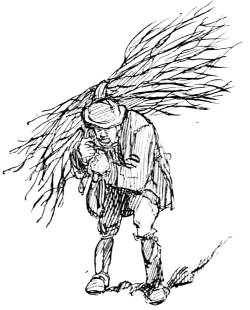
A DESCENDANT OF THE SAXON CHURLS.
Sir Godfrey Webster, sixth Baronet, in 1857 sold Battle Abbey to Lord Harry Vane, afterwards Duke of Cleveland, chiefly because of the extraordinary situation brought about by there being at that time no fewer than five dowager Lady Websters drawing jointures from the already impoverished property. It had long been a cherished dream of the Websters to repurchase their old home, and this was realised in 1901 by Sir Augustus Webster, the present and eighth Baronet, on the death of the Duchess of Cleveland. But although he effected that aim, he could not maintain the Abbey itself, and accordingly let it to Mr. Grace, the wealthy American who resides there now and lords it over this historic spot and this beautiful park occupied by English gentlemen when the place whence he came was the primeval forest roamed by the North American redskin. It is a picturesque example of the newer conquering of England by the dollar, over eight hundred years after the famous battle that won it with the sword.
It is in a remote and picturesque corner of the park, in Powder Mill House, that Sir Augustus Webster resides; in a house which, as indicated by its name, was one of those gunpowder factories whose numerous accidents, according to Horsfield, historian of Sussex, “it would be harrowing to relate and uncharitable to publish.”
The manufacture is a thing of the past at Battle, but the great pond, used in the work, remains, and so do those brushwood thickets that contributed charcoal to the industry. Brushwood coppices are still one of the character-touches of the place, and those “leather-legged chaps, the clay and coppice people,” as Cobbett names them, are, as they have been from Saxon times, the greater proportion of the inhabitants. Any day their rustic and toil-worn figures, bent under huge faggots, may be seen in Battle street, and they serve to show how, although the Normans and the monks in turn have gone, the rural Saxon people remain.
When Sir Anthony Browne came into possession of Battle, he lost no time in demolishing the church of the Abbey and many of its domestic surroundings. The Abbot’s great hall and apartments he converted into a mansion, and with a portion of the stones from the demolished church added other rooms.
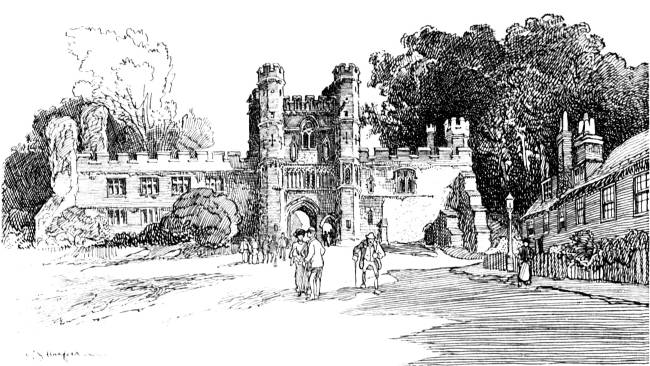
BATTLE ABBEY.
XLV
All these things are enclosed within the massive walls and the great Gateway that face the open market-place of Battle town as though the Abbey itself were still perfect behind them. Once a week great crowds of visitors come from Hastings, by rail, by waggonette, or a-foot, and pay their sixpences to be conducted over the place. They see the wooden beam projecting from the walls of the Gatehouse, and learn that it was a gallows; they are bidden look through the windows of the modern drawing-room that was the monastic “locutorium,” or parlour, for the reception of strangers; they stand on the terrace, and look down upon the valley of Senlac and the corresponding heights of Telham, the way the Conqueror’s army advanced to the attack. Then the guide conducts to the site of the High Altar, the spot where Harold fell, to the gardens, once the Cloisters; then to the great roofless Refectory. Beneath it are the three fine crypts. One of them the guide calls the Scriptorium, but the name has little meaning for him. If you ask him to point out the site of the Œsophagus, the Pericardium, or the Cerebellum, he will look puzzled for a moment; but, rallying, will declare them to have been destroyed so long ago that their sites are uncertain. At last, with evident relief, he conducts the crowd to the gate, and saying, “That’s all I can show you to-day, ladies and gentlemen,” dismisses them.
A relic of more savage times than these of ours still exists in the market-place, in the iron ring to which the bull was tethered when bull-baiting was a popular sport. It has recently been covered over with earth.
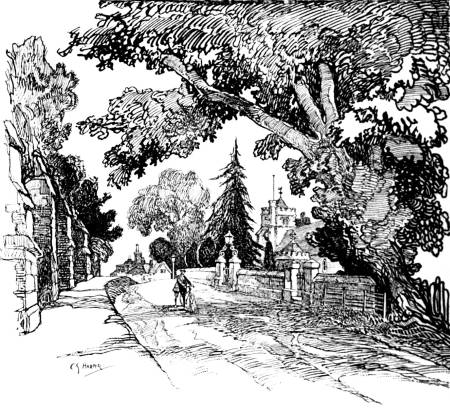
BATTLE CHURCH.
The parish church of Battle, standing beside the road on the way out of the town, was a “peculiar,” i.e. independent of ecclesiastical control. Its incumbent is not merely a vicar or a rector, but a dean, and is appointed by the owner of Battle Abbey, still the lay Abbot. In the chancel lie Sir Anthony Browne and his wife, with a magnificent tomb over them, and in the churchyard is the humble stone to Isaac Ingall, who died after ninety years’ service at the Abbey, in 1798, aged 120. Beginning as postilion, he ended as major-domo. At the age of 107, resentful of some indignity—perhaps some one had called him “old”—he went off in quest of another situation.
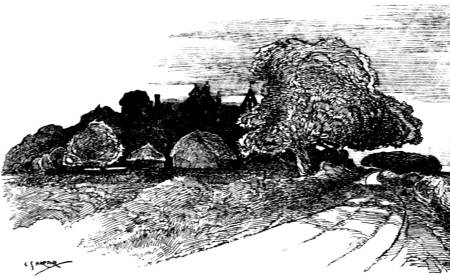
A BYE-ROAD AT BATTLE.
Beneath the town and the church, the road crosses the railway. The allotment gardens, squalid with little sheds, after their kind, stand below Harold’s centre, on the spot where the fight raged fiercest. But the finest idea of the battlefield is to be obtained from the bye-road that here turns to the right, and, skirting the park, runs to the site of the old Powder Mills. It is far better than looking down, with the crowd, from the terrace of the Abbey, and hearing the parrot-talk of a guide. Here you are in the spirit-company of the invaders, and can appreciate better their task of charging up to that ridge where Harold and his warriors stood then, where the Abbey buildings stand now.
It is magnificent. The park-like landscape, dotted with clumps of trees in the uplands; a line of oaks and undergrowth following the course of the stream in the bottom; the town nested in woods, and Caldbeck windmill on the right, where, the rustics say, William “called ’em back.” Away down by Powder Mill House, in the coppices, one may still see the rocky ravine in whose depths the Norman cavalry fell in the fierce rally after their pretended flight. The ledges still drip red, as they needs must do, for the ground is rich in iron; but, although the explanation of the old legend that the soil weeps blood is prosaic enough, yet the sight is not without its impressiveness, and vividly recalls the magnificent opening lines of Maud:
I hate the dreadful hollow behind the little wood, Its lips in the field above are dabbled with blood-red heath; The red-ribb’d ledges drip with a silent horror of blood, And Echo there, whatever is ask’d her, answers “Death.”
XLVI
Over Telham Hill to Starr’s Green, past Crowhurst Park, where an ancient tumulus peeps over the palings, lies the way to Hastings. On the left-hand is the beautiful, but neglected, Beauport Park, fast going back to wildness. Here a fork in the road is furnished with a signpost directing both ways to Hastings. This puzzler for strangers is explained by the right-hand and shorter route being the “New London Road,” made when St. Leonards came into existence, and that to the left the “Old London Road,” in exclusive use in days before St. Leonards was thought of.
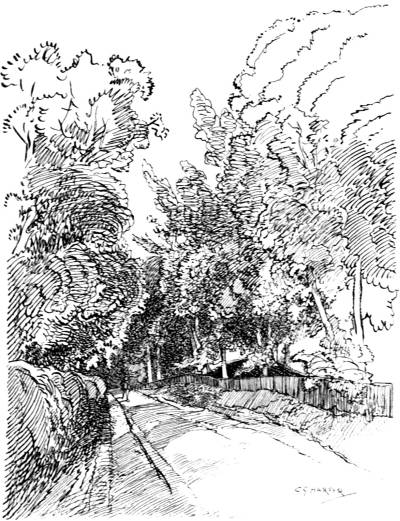
THE ROAD PAST CROWHURST PARK.
The “new” road leads down to Hollington, a suburban village almost entirely swallowed up by expansion of the town. One of the old-established sights of Hastings is, or was, Old Roar, half a mile or so to the left-hand of it.
Old Roar was a waterfall, and the ravine through which it roared exists to this day, as those who seek it, after tracing several fields and pathways hemmed in between villas, shall find. Even so far back as 1827 it was described as “not so considerable as thirty years ago,” and sceptical writers of that time declared there never had been a period when it was not said of Old Roar that “he is not so good as last season.” In 1841 Mrs. Mozley, sister of Cardinal Newman, wrote a novel called “The Lost Brooch,” which no one has ever succeeded in reading, and in it she describes Old Roar as possessing “all the points necessary for a very good cataract, except one—water: rather a serious want in a waterfall.” Yet there was a time when its hoarse voice was to be distinctly heard a mile away. Pause to-day on the wooden bridge that spans the gorge, and only a dampness that discolours the stones is seen through the trees that spring from the sides.
This is typical of much else around Hastings or any other town that has equally expanded. To the right of the road lies Hollington church: the “Church in the Wood,” famous in all this country-side as a romantic solitude. There are woods here now, but not so extensive as before, and the church is no longer in them, but on the fringe of what remains. The church itself, restored and practically rebuilt, is utterly and absolutely without interest; and the churchyard is now nothing but a cemetery filled with costly and pretentious monuments. Yet, such is the force of habit and tradition, it will be found, on examining the huge, ledger-like visitors’ book kept in the porch, that an average of five hundred people make pilgrimage to the spot daily in the holiday season. They see nothing worth the trouble, and having seen it go away again not displeased, for to visit the “Church in the Wood” is a duty laid upon the holiday-maker, and will be, even when there is no wood remaining. The way to and from it is by “Old Church Road,” where you find houses named with even more than the usual want of propriety. Thus “Sea View” does not look upon the sea, “Fair View” is opposite a manure-heap, and from “Old Church View” you cannot view the church.
It is not worth the while exploring the New London Road. It is dispiriting, and those electric tramways that are the tyrants of the roads for miles around Hastings and St. Leonards render the way of the cyclist down Silverhill hazardous in the extreme. It is true the map shows the attractive name of “Bohemia” here, but it is only a mean—the meanest and miserablest—suburb. Henri Murger, Bohemian of that artistic and literary Bohemia that is not mapped, died, disillusioned, exclaiming against his wasted life in that land of rosy visions, “pas de Bohème,” and we may adopt his saying and, appropriating it to this drab purlieu, turn back and make for Hastings by the Old London Road, itself not particularly attractive in these times.
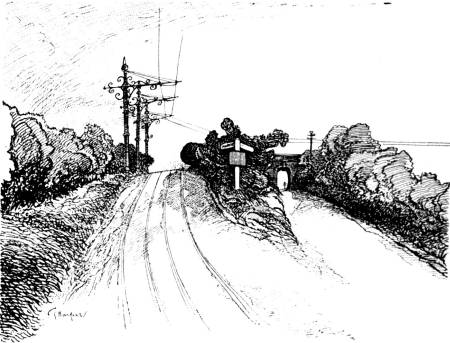
JUNCTION OF ROADS SPOILED BY TRAMWAYS, BALDSLOW.
You come along it, at the beginning of Baldslow, to a weird corner where a road comes up from Sedlescomb and, cutting under the Old London Road in an archway, makes for St. Leonards. Here the tramway poles and wires are insistently ugly, and the village or hamlet of Baldslow itself is scarce prepossessing. A roadside public-house, a gaunt windmill, a few ugly cottages, and a tin tabernacle church are its component parts. But immediately beyond that corrugated and galvanised ecclesiastical horror the road grows beautiful, overhung with trees. Here, at the entrance to a country house in the domestic-gothic sort, are two very fine clipped yew-trees. It is Holmhurst, and the trees are those christened by Mr. Hare “Huz and Buz.”
Holmhurst is not historic, in the larger way, but to those who are familiar with the literary work of Augustus J. C. Hare, it is a place to be regarded with interest and affection. Augustus Hare wrote many books. His “Walks in Rome” and “Walks in London” are the best known of them, but his “Story of my Life” is of course the most intimate, and it is the most endearing. His own half-humorous declaration that it is “a ponderous autobiography of a nobody” was heartily and unkindly endorsed by reviewers, but, at any rate, no one can read those six volumes without conceiving an affection for the author of them. He was a lovable man.
Augustus Hare, born 1834, died January 22nd, 1903, never married. He came of the family of Hares of Hurstmonceaux, a family at one time so numerous and so abundantly intermarried with the titled and landed classes that he could claim cousinship in different degrees with a very large circle in Society. But to call him a Society man would be as unjust as it would be to style him a dilettante in literature and the arts, for he had no vices, was no idler, and earned a very excellent literary repute. The “Story of my Life,” made up, as it is, largely from letters and journals, recounting his visits and the people he met, earned him with some sour critics of his work, the opprobrious title of “literary valet,” but it is so sincere and without artifice that the reproach is most undeserved, although his artistic, friendly, and family sympathies certainly often led him into praises which amusingly remind one of the famous epitaph on that Lady Jones who was “bland, passionate, and deeply religious. She was a niece of Horace Walpole and painted in water-colours, and of such is the Kingdom of Heaven.”
A welcome guest at country-house parties, he generally figured at them as a family connection, as a literary man and artist, and as an accomplished narrator of ghost stories. He indeed “called cousins” with so many people of note that the Crown Prince of Sweden, to whom he became bear-leader for a time, when asked what astonished him most in England, replied “the number of Mr. Hare’s cousins.” He was, in fact, the human exemplar of the fabled “hare with many friends.”
XLVII
The story of his life is a strange one. He tells how, as the third son, and most unwelcome addition to his parents’ growing family, he was, at the age of eighteen months, given away by his father and mother to a recently widowed and childless aunt, as eager to adopt, as his unnatural parents were keen to be rid of him. The aunt was Maria (Leycester) Hare, widow of his uncle Augustus; and thus, in the similarity of Christian names at least, there was a peculiar appropriateness in this adoption, which was undertaken in what seems a very cold-blooded way: the parents to have no claim upon their son and the aunt to be called “mother”; as indeed, throughout the story of his life, she is styled. She brought him up and sent him to Oxford, and for thirty years they lived together, as mother and son. He wrote a panegyric on her, in the “Memorials of a Quiet Life,” and in the long story of his own is seen to have been very much more affectionate than many real sons are. Yet the reader of his pages cannot help coming to the conclusion that the “sweet mother,” as he constantly styles her, was not only afflicted with a very dour religiosity, but was a tyrant in his infancy, and an exacting invalid, and an incredibly mean, parsimonious and suspicious creature during his youth and early manhood. But, for all that, no real mother ever had so good a son, so tender and constant a nurse in sickness, as he.
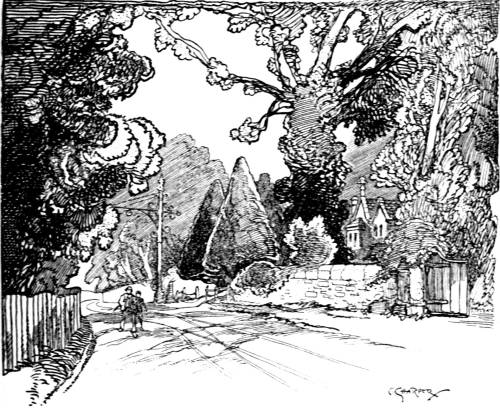
“HUZ AND BUZ”: ENTRANCE TO HOLMHURST.
When, in 1860, it became necessary for his adopted mother to leave Lime and seek a new home, they long sought the ideal home of their fancy, which they named, in advance, “Holmhurst.” All through that summer they inspected innumerable small estates in the south of England, but none were in the least like that ideal “Holmhurst,” and they were on the point of abandoning the quest for awhile, and going abroad, when a neighbour sent a Hastings paper with the humble advertisement, “At Ore, a house with thirty-six acres of land, to be let or sold.”
“What a horrible place this must be,” I said, “for they cannot find one word of description”; for the very ugliest places we had seen had often been described in the advertisements as “picturesque manorial residences,” “beautiful villas with hanging woods,” &c. But my mother rightly thought that the very simple description was perhaps in itself a reason why we should see it.... Long before we could arrive at Ore, we passed under a grey wall overhung by trees. “It looks almost as if there might be a Holmhurst inside that wall,” I said. Then we reached a gate between two clipped yew-trees, and a board announced, “This house is to be let or sold.” We drove in. It was a lovely day. An arched gateway was open towards the garden, showing a terrace, vases of scarlet geraniums, and a background of blue sea. My mother and I clasped each other’s hands and simultaneously exclaimed—“This is Holmhurst!”
We found that the name of the place was Little Ridge. There were six places called Ridge in the neighbourhood, and it was very desirable to change the name, to prevent confusion at the post-office and elsewhere. Could we call it anything but Holmhurst? Afterwards we discovered that Holmhurst meant an ilex wood, and our great tree is an ilex.
And here they made their home. Ten years later his adopted mother died here, and here he passed out of these shadows and unrealities, suddenly and painlessly, when another thirty-two years had gone, little more than two years after he had, in writing the concluding words of the story of his life, said:
When I look at the dates of births and deaths in our family in the Family Bible, I see that I have already exceeded the age which has usually been allotted to the Hares. Can it be that, while I still feel so young, the evening of life is closing in? Perhaps it may not be so; perhaps long years may still be before me. I hope so; but the lesson should be the same, for “man can do no better than live in eternity’s sunrise.”
It would be unpardonable to leave unmentioned the additions to the house he loved so well and the gardens and shrubberies he delighted in. Still stands the sundial on the lawn, that sundial which had been placed by his great-great-grandfather, Bishop Hare, on his house of the Vatche, at Chalfont St. Giles, Buckinghamshire, and was presented to him in 1859 by the then owners of the Vatche. Still one looks delightfully across these uplands down to the sea, where the craggy ruins of Hastings Castle cut across the horizon, and the streets of Hastings come crawling dimly up out of the vale; but the Hospice in the grounds, where he continually housed and entertained his pensioners, is empty, and the garden-paths have lost their trimness and become overgrown with grass since strangers have come and reduced the staff.
Even Queen Anne, whom he brought down from London and set up in the meadow, looks neglected.
Every Londoner is familiar with the white marble group of figures in front of St. Paul’s Cathedral, representing Queen Anne (now, alas! deceased) presiding over four seated effigies, emblematic of England, France, Ireland, and the North American Colonies of her days; but few recollect that this group is not the original of the one sculptured by Bird in 1712. Bird’s work had for many years fallen into a disgraceful state of neglect. Her Majesty’s nose had long been chipped off and her forearms had disappeared, while the four seated figures, with scarce a complete set of limbs among them, more nearly resembled the victims of a railway accident than the highly respectable allegorical group they really were. The whole composition was therefore cleared away, and an entirely new and scrupulously exact replica was made by the afterwards notorious Richard Belt, and placed in its stead.
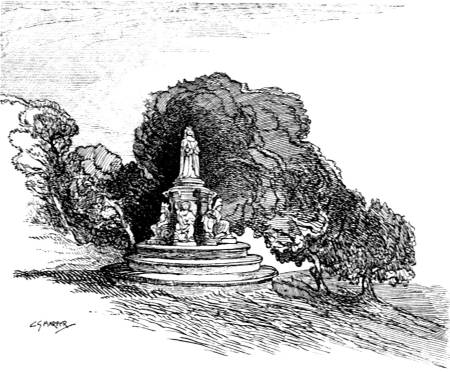
QUEEN ANNE, AT HOLMHURST.
The battered and grimy original disappeared from public ken, and was wholly forgotten, when Mr. Hare in 1893 discovered its component parts lying in a heap in the City of London stoneyard, on the point of being broken up, and greatly coveted them for the embellishment of Holmhurst. He found that the poor relics were jointly owned by the Archbishop of Canterbury, the Bishop of London, and the Lord Mayor, and eventually persuaded all those eminent personages to make him a present of the remains, which were removed by road to Holmhurst, “at great expense,” as he says, with the aid of twenty-eight horses, four trucks, four trollies, and sixteen men. He re-erected them in his grounds, at a still greater expense, on a circular stone pedestal, similar to the original, which he had quarried from the outcroppings of stone on this little estate.
XLVIII
Beyond Holmhurst comes the long-drawn parish of Ore, heralded by its modern church, rather overloaded with ornament. It replaces the old church of St. Helen, lying hidden away to the right, across a field and within a belt of trees.
Augustus Hare thought the ruins of the old church “rather picturesque”: an instance of how an everyday familiarity may blunt appreciation, for they are picturesque without any minimising qualification. To the active and enterprising it is no difficult matter to climb the tall locked gate of the enclosure that keeps out the swarming mischievous children that come destructively up out of Hastings, and easy to avoid the plentiful nails and savage barbed wire that would induce others to seek the keys at Ore Place.
It is a melancholy ruin of a fine church in the Perpendicular style, built over five hundred years ago, and left to moulder away because the neighbourhood lusted for the brand new building beside the road, yonder. The roof is entirely gone, and part of the walls, covered in places with ivy. Neglect is the note of the place. A curious relic is fixed on the wall in the tower in the shape of a “pitch-pipe,” an instrument used by parish clerks in the old days to give the key of tunes to congregations. The unusual name of “Lavender” is seen on one of the old tombstones.
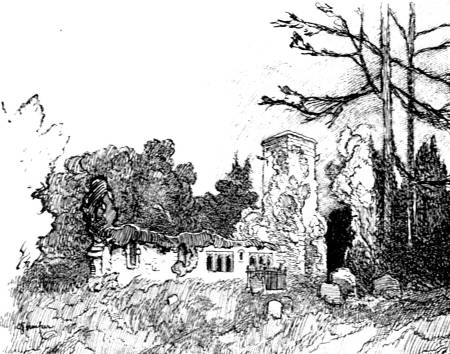
RUINS OF THE OLD CHURCH, ORE.
Ore is a scattered parish: neither good town nor decent country. The road passes the Hastings cemetery and the isolated suburb of St. Helen’s Down, and comes to the enclosing wall and gates of Coghurst Park, where an elaborately sculptured coat of arms, surmounted by the crest of a hare and hound, looks down with contempt upon the poor specimens of houses that have sprung up opposite.
And then you come to Ore itself, that used to be, not so very long ago, a pleasant place—half village, half suburb. It is now a good deal more like a slum, and the incursion of the electric tramways has not improved it. The tram-lines are to be avoided by bearing to the right, down the long and steeply descending Harold Road, which, like too many of the modern developments of Hastings, is a road of mean and paltry houses, built cheaply and faced with stucco that seems to have been made of dirt, rather than of honest materials. There is a woeful “respectability” about these roads that desolates the stranger. He sees it clinging, ineffectual on insufficient means, to the bayed windows and to the doors, painted and grained to resemble good woods, that will insist upon warping. It resides in the long flights of steps up to those doors, and is on outpost duty at the little brick entrance-piers, too flimsy to hold up the not very great weight of the iron gates that scream dismally on their hinges.
The Old London Road, however, continues down through Halton, and, although it does not get rid of the tram-lines, comes, at the beginning of Hastings, to a very pleasant hollow where the old elms still make an avenue introductory to the town.
This is the most striking part of that valley between the east and west hills in which the Old Town of Hastings lies. It was in the coaching days a supremely beautiful entrance to the town, and travellers of that time never tired of praising it. In front of them, in the V-like cleft, sparkled the sea, with the trees surrounding the hoary red-capped roof of All Saints’ in the foreground, and on either side steep grassy slopes, as yet but thinly built upon. On the left-hand rose the Minnis Rock (“Minnis” is Cantise for a rough, stony common), a stony outcrop on the hillside that was the site of a hermitage until about 1436, when the “new church of All Saints’ of Hastynges” was built, and gave the death-blow to the hermits who had lived there upon the charity of passers-by. The Rock is there to this day, and the rough chambers in it, but they are choked with rubbish. The last occupants were very much post-Reformation anchorites. They were an old couple who left the local workhouse in 1783, and, in a secular way, subsisted upon alms which the original hermits received for religion’s sake.
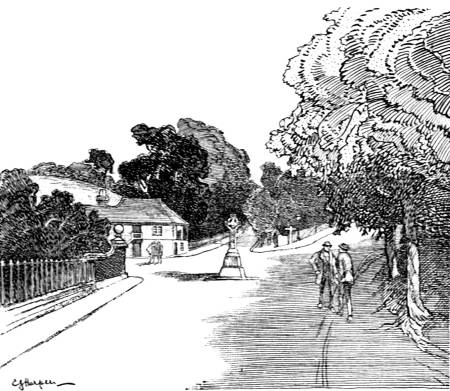
THE OLD LONDON ROAD.
The modern terrace of High Wickham crowns the Minnis heights at this day, and great masses of houses have encroached upon the natural beauty of the scene; but still there is a very special charm in it.
It is the old town you see there before you, for whose sake we have come these last three miles by the Old London Road: the only Hastings there was, until the beginning of the nineteenth century.
The site selected for the town was sheltered, as the traveller viewing it from this point may see. It lay in the deep and not very broad ravine between the East and West Hills, and while the one protected it from the winds of one quarter, the other served the like office in the opposite direction. And through the centuries, the Castle crowning the West Hill kept watch and ward over it against other foes. There you see the few shattered walls of it, against the sky-line, and down in the hollow St. Clement’s, the mother-church of Hastings.