The HASTINGS ROAD (continued 2)
Reading edition
But to return to William Sevenoke. He became a grocer, and eventually, in 1418, Lord Mayor of London, became Member of Parliament, was knighted, and was granted for coat of arms seven acorns. To him Sevenoaks owes its endowed Grammar School and almshouses. Whether they were descendants of his whose name became corrupted into Sennocke is not quite clear, but it is quite certain that the unlovely name of Snooks derives from a further debasement of it.
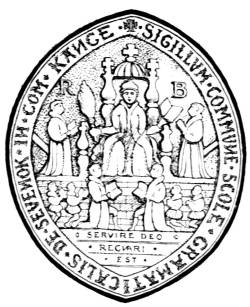
SEAL OF SEVENOAKS GRAMMAR SCHOOL.
The schools and almshouses were rebuilt in 1727, and are generally thought by passing strangers to be a workhouse or a penitentiary. It will thus be gathered that they are not beautiful. If strict discipline may be read into the ancient seal of the school, then it was in old times governed on the principle of Winchester, “learn or be whopped,” for that device exhibits a gigantic, Jove-like master presiding over a number of scholars, evidently in fear of the immense birch he holds in his right hand. A resolute application of the weapon represented here would undoubtedly result in abolishing laziness in the scholar given a taste of it.
XVII
When you know Sevenoaks well, have learned its geographical situation, and have inquired into its surroundings, you will begin to perceive that it was once very humbly dependent upon the great historic residence of Knole, whose park it on one side fringes. Knole divides with the not far distant Penshurst the reputation of being the finest baronial pile in England. If their ancient lords could return to Penshurst and Knole they would still find there many of the buildings and appointments they knew; and if the less ancient Elizabethans and Jacobeans were permitted to revisit their homes they would see them very much as they were, and so come back without any sense of strangeness.
Knole, of course, takes its name from its hilly situation. There are dim and fragmentary records of a former house, away back in the reign of King John. At that time it belonged to a great historical personage, William Mareschal, Earl of Pembroke, to whom it came as part of his wife’s dowry. Eventually it fell to the family of de Say, who for more than a hundred years ruled the estate, when for an interval it passed into other hands, only to be repurchased by a Fiennes, who was on his mother’s side a de Say. This unfortunate Fiennes had the ill luck to live in the troubled time of Henry the Sixth, and was further unfortunate in attracting the favour of that ill-starred King, who heaped many distinctions upon him, all to his undoing. He was created Lord Saye and Sele, Lord Warden of the Cinque Ports, Constable of Dover Castle, member of the King’s Council, Lord Chamberlain, and Lord Treasurer of England; and, in fact, closely resembled in real life Pooh Bah, the “Lord High Everything Else” of The Mikado.
The title of Lord Saye and Sele, which still exists as a barony, re-created in 1603, in the Fiennes family, has a fine sound of irrevocability about it—a kind of “do and dare,” “what I have said I have said” connotation—to which it has really no sort of right. Saye, as we have seen, was a family name, and Sele has in this connection nothing to do with sealing, signing, and delivering as act and deed. It comes from the village of Seal, on the other side of Knole Park.
The amazing prosperity and court favour shown to Lord Saye and Sele raised up many enemies for him, and the King was obliged, first to sequester him from the office of Lord Treasurer, and then to commit him to the Tower of London, merely to secure him from the violence of the discontented people, then seething in the rebellion of Jack Cade, in 1450. That insurrection brought an exciting moment to Sevenoaks, for Cade and his army, pursued by some twenty thousand of the King’s troops from their riotous place of assemblage on Blackheath, turned at bay upon them, and in the disastrous skirmish of Sole Fields, within sight of Knole, slew the King’s commander, Sir Humphrey Stafford. Cade, assuming the armour of the fallen knight, marched to London, where, according to Shakespeare, he struck the historic London Stone with his sword and proclaimed himself “lord of this city.” He did more than that, for he brought the unhappy Lord Saye and Sele forth from his hiding-hole in the Tower, and hacked his head off at the Standard in Cornhill, afterwards offering revolting barbarities to his body.
It was the son of this victim of popular revolt who, six years later, reduced to extremities in the troubles of the time, sold Knole to Bourchier, Archbishop of Canterbury, for a sum representing £2,500 at the present day. The manor-house of that time was old and dilapidated, and Bourchier pulled it down and built the gatehouse and the principal front of the present group of buildings. Thirty years later he died and left Knole to the See; and, with all other archbishops, was ex officio, so to speak, collated to the Realms of the Blest. He was succeeded by Archbishop Morton, who reigned fourteen years; by Henry Dene (two years), by Warham for thirty years; and then by Cranmer, who in 1537, from motives of policy, surrendered it to the Crown.
Politic indeed, for the Archbishops of Canterbury at that time owned no fewer than sixteen palaces, and men were beginning to inquire by what right lords spiritual were so gorged with things temporal; just as in these times of ours the phenomenal wealth of great landowners is beginning to arouse an inconvenient criticism.
Knole came to the Sackvilles, whose collateral descendants still own it, from Queen Elizabeth, who in 1567 gave it to Thomas Sackville, a cousin on her mother’s side. He already owned Buckhurst, and she created him therefore Baron Buckhurst; which is, as every one will acknowledge, a fruity-flavoured title. “Baron Buckhurst:” how finely it trips off the tongue! The Queen gave as a reason for her gift the “keeping him near her court and councils, that he might repair thither on any emergency with more expedition than he could from his seat of Buckhurst in Sussex, the roads to which county were at times impassable.”
Lord Buckhurst was, in fact, a persona grata at court: a man of wit, a poet, a dramatist. Also a man of tact and management, for in his old age, in 1603, he was created Earl of Dorset by Gloriana’s successor, James the First.
And so the descent continued from first to seventh earl, who succeeded like chapters in a history, of which a new volume opened with the seventh earl being created a duke.
The fourth duke, George John Frederick Sackville, came to a tragic end in 1815, in his twenty-second year. He was an adventurous horseman, and on a visit to Lord Powerscourt, in Ireland, fell with his horse in the hunting-field at Killiney. The horse fell on him and crushed in his chest.
They brought his body home with every circumstance of mortuary pomp, as befitted a duke; he lay in state at many inns on the several stages of the Holyhead Road, from Ireland to London, and finally was laid to rest with his fathers in the Sackville vault at Withyham, in Sussex.
With the widow of his cousin and successor in the title, the fifth and last duke, another volume ended, in 1825.
The ownership of Knole devolved upon Lady Elizabeth Sackville, sister of the unfortunate fourth duke. She married the fifth Earl De La Warr, and thus changed the name of the lords of Knole to that of Sackville-West. Her eldest son became in due course Lord De La Warr: to the younger sons she left Knole, and in their favour the barony of Sackville was created, in 1876.
XVIII
The long street of Sevenoaks acts, as it were, the office of screen to the leafy glades, the hills and dells of Knole Park, to which you come along an alley between the houses. It is an extremely large park, and in many places peculiarly beautiful. To set down in this place its acreage and its circumference of six miles would convey a very dim impression of its proportions, but if we say it is two-thirds the size of Richmond Park its extent will be more generally understood. The house itself—if it be no derogation to style Knole merely a house—stands quite half a mile within the park, on a height, and looks, with its ranges of gables, towers, roofs, and chimney-pots, like some mediæval town. Great herds of red and fallow deer browse amid the bracken, or shelter under the great beeches, and regard the many visitors with an amiable and fearless expression, except in the “fence months,” October and November, when they are quite ferocious, and bellow day and night like the bulls of Bashan.
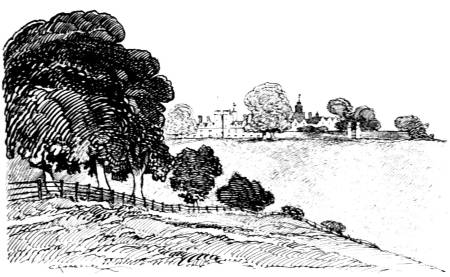
KNOLE, FROM THE ROAD.
Knole is a “show place.” You may roam where you please in the park, and on most days, within easily ascertainable hours, you can be shown over the vast place on payment of two shillings. You would not be permitted so much in the millionaires’ palaces of democratic America.
In this gigantic place Lord Sackville and his family occupy a small suite of rooms furnished in modern style, and, if you consider it closely, are practically the caretakers of a vast museum of antiquities maintained at their own expense. The place is so extensive, and the maintenance and repairs so costly, that it would require the revenue of one of the great landlords of London to keep it up, and, in addition, to live in fitting state, and the Sackville-Wests have not those resources.
Some day a paternal Government will come to the rescue of owners of historic houses of public interest. There is a widely prevalent idea that all governments are paternal to one class, and act in a dominie and minatory manner to the others. Conservatives, in this belief, play the beneficent father to the aristocracy and their fringe, and waggle weapons of punishment at the lower classes; while the Liberals (in the accepted idea) pat the middle classes and the working men on the head and give them something to go away and play with; and then, turning up their sleeves and selecting a fine birch-rod, bid dukes and earls to come here this instant moment and take their trousers down. It is not really precisely like that, but Sir William Harcourt did something of the kind with his Death Duties. At any rate, those are the respective aspirations of free and enlightened voters on either side.
A fatherly Conservative Government may, therefore, some day be expected to come handsomely to the rescue of the owners of historic mansions: owners with acres of reception-rooms, picture-galleries, and baronial halls; owners with long pedigrees but slim purses, who can scarcely afford even to keep their many windows cleaned, let alone maintain floors and roofs and keep the moth out of priceless ancient tapestries and silken hangings. Such a Government will allocate grants annually to those proprietors who habitually admit sightseers, and who make application for aid; and surely the principle would be just, for it certainly is scarcely fair to the proprietors of such places as Knole, if witness to their good nature, that they should expend their substance chiefly for the delight of the tourist and sightseer.
The next step would be a competitive measure introduced by the inevitable Liberal Government ordained by the well-known fickleness of the electorate, by which all historic mansions would be scheduled and administered as to their “show” parts by a Department responsible for the safe and careful keeping of artistic and historic treasures, endangered by the carelessness, the poverty, or even the uninstructed enthusiasm of their owners. It will all some day come to pass.
It is obvious that a great range of buildings like Knole, covering nearly four acres, dating back, in part, four hundred years, and filled to overcrowding with things precious intrinsically and by association, must involve the existence of a large staff; and it must be at least equally obvious that no lord of Knole could without great physical effort use even a respectable proportion of his three hundred and sixty-five rooms, traverse his fifty-two staircases, or look forth daily from more than ten per cent. of his five hundred and forty windows.
The house stands in what is probably the least attractive portion of the park, where the grass is tough and wiry, and like that of some untended prairie. The long, dark-grey, stone front, pierced with mullioned windows, is like that of an ancient Oxford college. You are personally struck with the resemblance, and, reading the impressions of bygone visitors, you find they have all been impressed in the same way. Every gable is surmounted by the leopard “sejant affronté” of the Sackville coat of arms, looking like so many tomcats obeying the instruction of some unseen drill-master: “Eyes right.”
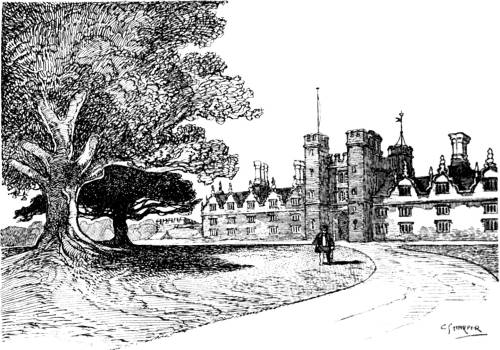
THE GATEWAY, KNOLE.
The sternly walled-in character of Knole would discourage a burglar, just as it was intended to give pause to any hostile visitor; for the times when it was built were halting between the necessity for fortresses and the liking for magnificence and display. Thus Knole partakes of the character of both castle and palace.
XIX
No armed guard meets you now: only a porter. There are many kinds of porters. There is the fish-porter of Billingsgate; there are also the railway-porter and the warehouse-porter, to name none others; but it is unthinkable to class the porter of Knole with these. Porters, I should suppose, by the etymology of their name, to be bearers of burdens, carriers, humpers of grievous loads; but this dignified person is rather of the bank-porter variety, own brother to those of the Bank of England, and carries nothing but a highly respectable suit of clothes and an aristocratic air. I am quite sure he is more dignified than even Lord Sackville himself, and his portly presence, his black swallow-tailed coat, his silk hat, and his red waistcoat give a more soothing effect of the permanence of things than even the grey walls of Knole can manage to impart.
The porter’s lodge itself is a little museum of antiquities. There are the flint-lock muskets, the torch-holders, the brass-bound leather skullcaps, the cartridge-boxes, halberds, and other weapons of offence and defence belonging to the Earls and Dukes of Dorset from Jacobean to Mid-Georgian times: necessary equipments for the bodyguard of my lords and their visitors in those “good” old days. Here, too, you see the ancient horn-lanterns and the silver maces that were part of the display and the feeble illumination of those trains; and on the whole you are very glad that this is the twentieth century, and that these are outworn relics whose use has long since passed.
The gatehouse tower and porter’s lodge lead into the first, or Green Court, one of the seven quadrangles included within the group of buildings, and so called from its lawns and to distinguish it from the next, flagged with pavement, and styled the Stone Court. The first is graced by two classic bronze statues: the “Venus Anadyomene” and the “Gladiator Repellens.” The Stone Court leads by an insignificant loggia, supported on Jacobean pillars, to the Great Hall, built between the years 1603-8 by that magnificent person the first Earl of Dorset, who in all those years gave constant employment to two hundred men, in his alterations and repairs, and spent £20,000 on furnishing a bedroom for the expected visit of James the First to him.
The Great Hall was the banqueting-room. It has a boldly carved oak screen, in the characteristic Jacobean taste, but painted and grained, in some barbaric period, to resemble oak! Oak, you will observe, painted to resemble itself! To paint the lily and to gild refined gold were no greater works of supererogation. It is difficult to understand why it was done, here and elsewhere.
Ascending by the Painted Staircase, you come, in succession, to the Ball-room, the Reynolds Room, the Cartoon Gallery, the King’s Bedroom, the Chapel Room, Organ Room, Brown Gallery, Lady Betty Germaine’s rooms, old Billiard-room, Spangled Bedroom, Crimson Drawing-room, and so forth; seventeen in all, filled with the most wonderful old furniture, gigantic bedsteads, priceless china, paintings by the most revered masters, and portraits of a long dignified line of Sackvilles, Earls and Dukes of Dorset: great gentlemen and great patrons of the arts.
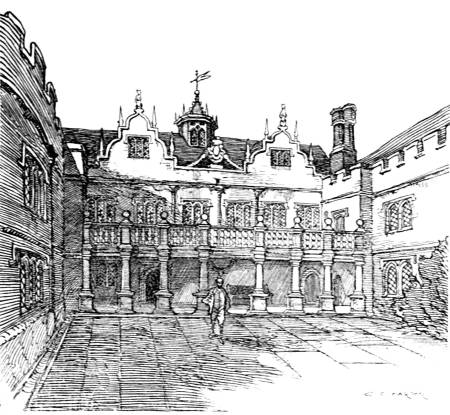
THE STONE COURT, KNOLE.
There they hang; rows of them. Grave-faced, dignified personages, whom not all the feminine frippery that characterised masculine costume in Elizabethan, Carolean, and Jacobean times can make look foolish. They look responsible persons, weighted with the mellow gravity that could not well be absent in times when the headsman’s axe was an institution. But they could not all be so wise as they look; something—and that not in small or grudging measure—must be due to courtly palettes. The thought is treason towards the Muse of History, of course; but surely we of this day, rich as we are in the little tin gods of politics, have not the monopoly of them, and may find an invertebrate Balfour or so amid these reverend seigneurs who look so inscrutably wise.
XX
The Dukes of Dorset were not merely men with titles; they were ducal Dukes, who lived up to their strawberry-leaves, and had a ducal way with them; were dukes first and men a very long way after. There are none such now. The mould is broken, the recipe forgotten, the pattern mislaid. How sad! That must be a degenerate age whose dukes are so uncharacteristic of their order; whose aldermen, who macerate on charcoal biscuits, are lean dyspeptics, talk art criticism, and shudder at the idea of a banquet; who are no longer those rotund, well-larded figures of convention that drank incredible quantities of fruity port and turtle-soup. That must be an effete generation whose new-rich no longer strew their way with dropped aitches; whose paupers, instead of skilly, dine royally off the best joints, and eat the finest bread, and when they ask for more—get it. In short, your typical pauper, millionaire, alderman, or duke no longer exists in real life. Even the novelists have learned their lesson and know better. Only on the stage shall you find those outmoded figures still strutting, and even there they are on their last legs. The stage is the last ditch of convention; but the time is at hand when some dramatist will give us a stout and haughty workhouse inmate, a humble and cringing duke, and an alderman virtuoso; and he will be quite as loudly hailed for an emancipator as ever was Robertson.
The Dukes of Dorset lived up to the fine alliteration of their title, and when that became impossible, they died out, like the oxyrhincus and the mastodon, who could not survive their environment. There is scarce a modern duke who, in the spectacular way, is worthy his title. Some are bored men and commonplace; most of them “splendidly null,” as Tennyson might say. I know an undersized duke with a limp and a falsetto voice, who takes photographs with a hand-camera and an apologetic manner; and another with the appearance and carriage of an unsuccessful commercial traveller. They would be ashamed to be ducal in their behaviour; and it is quite certain that their forbears would be ashamed of them.
To view Knole intimately is not given to the many. What are seventeen rooms out of three hundred and sixty-five, even though they be rooms of State! In fact it is rather in the more ordinary rooms, if any of those at Knole can so be styled, that you read its everyday story of old. After all, the Lords of Knole were not always entertaining kings and great nobles. Sometimes they had a “day off,” no less than the British workman of this era of ours, and then they were a thought more easy and less splendid, and occupied the second-best rooms, just as the ordinary Briton of to-day does, when he is not wanting to “show off.”
I am afraid we all want to impress the visitor with a magnificence that is not kept up when he is gone. The lower-class parlour, the drawing-room of the upper strata, are the superstitions not only of to-day, or of one or two classes. They probably go back to the beginning of things, when even Prehistoric Man had his ordinary cave to live in and his extraordinary, in which his wife “received.”
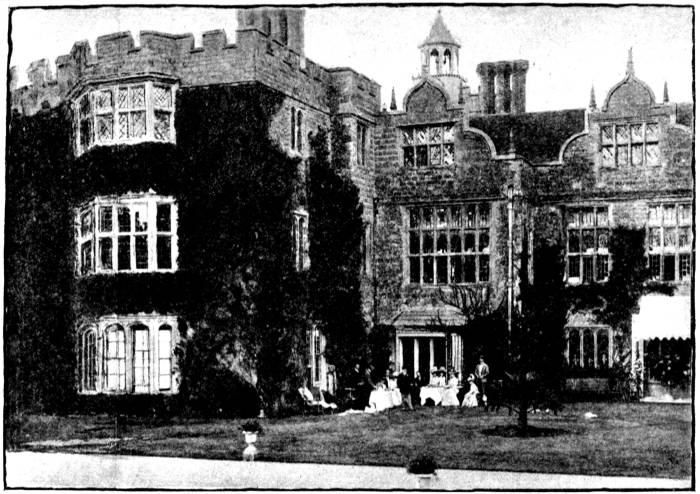
THE SOUTH FRONT, KNOLE.
Photo by C. Essenhigh Corke & Co.
There are thus whole suites of ancient rooms at Knole, now silent and deserted; and overhead, above the long galleries of stately magnificence, are interminable attics, called “wardrobes,” not because of being storerooms of clothes, old or new; but presumably the playrooms of the boys and lads of good family who, after the old English custom, were sent to Knole under wardship of the noble owners, to learn the usages of good society and the duties of chivalrous knights. In short, Knole, and every other castle or stately mansion, was, as it were, a training-college, a seminary of deportment and knightly devoirs; and in them one learned that good form whose inculcation is supposed to be the only value of Oxford and Cambridge at this day.
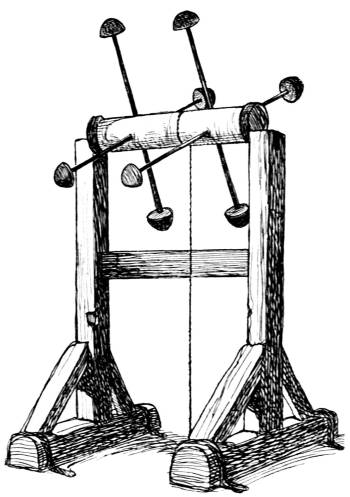
THE “DUMB BELL.”
An odd surviving relic of Knole as a College of Good Manners is the curious contrivance known as the “Dumb Bell,” in that one of these wardrobes styled the “Dumb Bell Gallery.” It very closely resembles the windlass seen over old country wells, with a roller on which is wound a rope that descends through a hole cut in the floor, into the billiard-room. The arms projecting from the roller are iron, tipped with lead. This machine, which appears to date back to about the beginning of the seventeenth century, is thought to have been in the nature of a “home exerciser,” and to have been suggested by the bell-ropes and the exercise of bell-ringing in church towers. Here, however, the athlete could bring up his muscles without being a nuisance to every one within earshot. From this originated the name of those very different objects, used however for the same purpose of exercising—the modern “dumb-bells.”
XXI
And so, farewell Knole, mausoleum of a departed condition of things, treasure-house of art and tradition, puppet-show for the summer throng. One looks for it, topping the sky-line, expectantly, and leaves it with regret; unlike those two tramps seen and heard on this very road by the present writer. One of them listlessly noticed its towers and gables. “Wot’s thet?” he asked his mate: not that he was interested, but for the sake of something to say. How can you be interested in anything when you are footsore but your feet?
“Corsel,” replied the other, shortly; “carm on.” But he need not have bidden his fellow “come on,” for he had not given the “castle” another glance, and had never halted a moment.
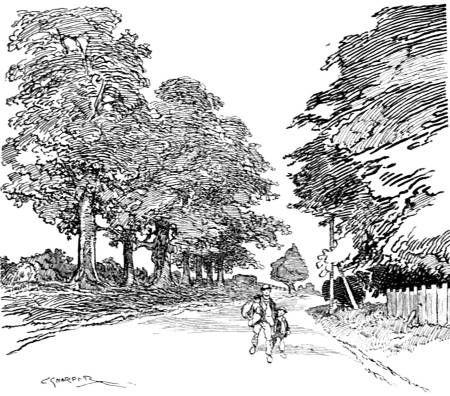
THE SEVEN OAKS.
The road descending steeply from Sevenoaks and having Knole Park on its left is the coaching highway, improved upon the ancient road. It is steep now, but how much steeper, how rugged and how narrow may be seen towards the bottom of the dip, where a little gate admits through the oaken palings of the park, and leads down a hollow lane whose banks are thickly set with ancient thorns and other trees. It is, or was before the embanked road was made, known locally by the names of “Shangden,” “Shand End,” or “Chene Dene,” in delightful incertitude.
This is the original road, preserved for the last seventy years or so in the bottom, where the modern highway was slightly deviated and constructed at a higher level. It is a surviving portion of that road Archbishop Islip, travelling horseback to Tonbridge in 1362, found so extremely bad. He struggled persistently, but at last fell from his horse and became “wet through all over.” In that pitiable condition he mounted again and rode on, without any change of clothes, and so was seized with paralysis.
An archway under the modern road, seen even more distinctly from a bye-road branching off to the right, was made for the especial purpose of maintaining unbroken the old line of an even more ancient cross-road—a pack-horse way—which crossed the old road from Sevenoaks to Tonbridge in the hollow, at right angles. The arch, however, has long been blocked up with timbering, and the pack-horse route is scarcely discernible in the park and the meadows.
Coming to the next rise, crowned by the “White Hart” inn, a line of seven trees is seen in the hedgerow on the right hand. These are the comparatively modern seven oaks planted at some uncertain time to commemorate those that are supposed to have originated the name of the neighbouring town. There is considerable difference in the size of the trees, and it is thus to be presumed that some of the seven were, from some cause or other, destroyed, and replaced later. The oldest may date back two centuries, the others sixty years or so later. No information exists as to who planted them, or when; even the site of the old original seven oaks that gave the town of Sevenoaks its name, away back in the dark ages, is unknown.
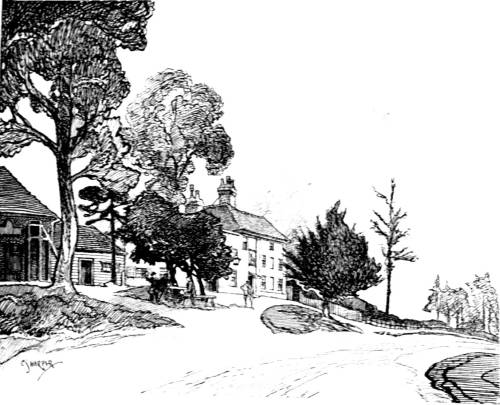
THE “WHITE HART” INN.
This is the summit of River Hill: a place which figures in an early sixteenth-century trust-fund that offers some entertaining history.
XXII
The road to Hastings, or to Rye, was the beneficiary of a bequest left in 1526 by James Wilford, a successor of those “pious benefactors” who from the earliest times, for the good of their souls less than for love of their kind, had been wont to repair highways, build bridges and causeways, and perform the like services, either by direct gifts or through the intermediary of the Church.
Of the practical piety of James Wilford I think there can be little doubt. In the times when he lived, Reformation was in the air. The religious houses were moribund, and had Henry the Eighth not disestablished and suppressed them, another would have done so. People rather scoffed at the idea of purchasing salvation by bequests, just as you in modern times insure against fire. Wilford, therefore, in that he does not appear to have left his money with any ulterior object of saving his soul, was really more pious than he knew, and perhaps saved it the more certainly. Let us trust he is enjoying the full credit of his good deed.
This public benefactor, a “rippier” of Rye, and said to have been an alderman of London, in his will of 1526 stated that he had actually made the road from River Hill to Northiam church, a length of some twenty-six miles; and for the perpetual repair of the ruinous parts he left an annuity of £7, charged upon the “Saracen’s Head,” Friday Street, Cheapside, belonging to the Merchant Taylors’ Company.
There had been sufficient reasons in his lifetime for him to make or amend this road; for by the term “rippier” a fish-carrier was meant, and James Wilford would appear to constantly have travelled it in his business of supplying London with fish, carried on horseback in panniers. That it should have been possible to convey fish this distance in the early part of the sixteenth century so expeditiously that it arrived in good condition is a somewhat striking testimony to the enterprise of an age commonly thought to have been ignorant of speedy communications.
The Merchant Taylors were by the terms of this will to pay the £7 annually to the executors and relatives bearing the name of Wilford, and after their death were to make payment to the vicar and churchwardens of Rye. In the event of those authorities neglecting their duty of applying the money for the benefit of the road, the annuity was to be paid to the vicar and churchwardens of Northiam; and, should they default, was then to devolve upon Newenden.
These cautious provisions seem to have been prophetic, for Rye did actually at some uncertain time lose the money, which was then received by Northiam until Midsummer, 1799, when, from some dereliction of duty, it passed, as directed, to Newenden. Disputes then appear to have arisen, for in 1804 the Merchant Taylors, not quite sure of their position, refused any longer to pay the amount until a legal decision was arrived at. The whole matter then remained in abeyance, as probably being too small a sum to worry about, until 1819. By that time the twenty years’ accumulation was worth having, and the inhabitants of Rye, Northiam, and Newenden accordingly joined forces and petitioned the Merchant Taylors, praying them to disburse the money to Rye, which was done, the vicar and churchwardens of that town in turn handing it over to the commissioners of the turnpike road from Flimwell to Rye. The sum of £140 was then paid over, from which the Land Tax authorities sweated £28, twenty years’ land-tax, at 28s. a year.
Flimwell is the point where the road to Rye branches from the Hastings Road. Nineteen and a half miles of road, therefore, appear by this decision to have been cut off from these small mercies.
The trifling sum now trickles into the revenue of the Kent County Council.
River Hill was once—in the days of inefficient brake-power—a terror to cyclists. A terror with reason, for it is three-quarters of a mile long, and not straight; and it has notoriously been the scene of many accidents at the two sharp turns in its course—one left and one right. A joint C.T.C. and N.C.U. danger-board at the beginning is supplemented by the notice that it is unrideable without a brake; but that is as may be. When the first chapter of cycling was being enacted, an early wheelman rode it, quite inadvertently, and lived to tell the tale, in picturesque fashion.
In the ancient days of cycling, when it had not long ceased to he “velocipeding” and was still in the intermediate stage of “bicycling,” this greatly daring person decided to ride from Greenwich to Burwash—some fifty miles—on what was then, with the most exquisite appropriateness, called a “bone-shaker.” It was so unusual and adventurous a thing to do that he wrote an account of it, and it duly appears in the records of that time. He thought how splendid a thing it would be to run hundreds of miles about the country at “a speed of from ten to fourteen miles an hour,” as in the advertisements, and so purchased what he thought to be a very camelopard of a machine, with 45-in. wheels.
In two days he had so mastered this fearsome contrivance that he decided to start, and did so, in the evening. He had not gone more than a mile or two when he met a butcher standing in the middle of the road, who continued to stand there until he was run into, when both were upset. The bicyclist was pitched over the handles and cut his knee, and the butcher abused him until the cyclist—I mean the bicyclist—showed fight, when he made off.
By the time this early wheelman had reached Bromley he was almost exhausted, and realised that he, at any rate, was not a fourteen-mile-an-hour rider. There was also, he discovered, an undue proportion of hills to be climbed—a discovery still being re-discovered daily by thousands of his descendants in straddling two wheels.
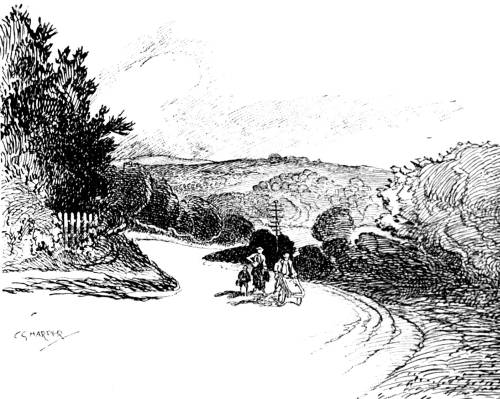
RIVER HILL AND THE KENTISH WEALD
At Bromley he rested and refreshed; and again, at 9 p.m. at Sevenoaks, where his exertions had given him such an appetite that, when he had finished discussing the cold beef, he dared not look at the waiter. At River Hill—even in these days to be descended with extra caution—the rough road broke his primitive brake, and then at last—oh, happiness!—he found himself going fourteen miles an hour—and a bit over. There was no stopping, and the only thing to be done was to keep in the middle of the road, continually shouting, and in the hope nothing was in the way. Not even nowadays would a cyclist care to descend River Hill in this manner, in the dark, brakeless; but this adventurous one found the level, and, passing through Tunbridge Wells, at last reached his destination with only an incidental attack upon him by a foxhound on the way.
The view from River Hill is delightful, ranging across the wooded valley of the Medway to the heights where Tunbridge Wells is situated. So wooded is it that even Tonbridge itself, near at hand, is invisible, and the little village of Hildenborough—with scarcely more houses to it than there are letters in its name—might be non-existent.
A green, smiling woodland vale: just that. Not a profound, romantic depth, but a widespread, all-embracing view of meadows, corn-fields, parks, and hop-gardens: suave, well-ordered, appealing even more to the farmer than to the landscape-painter. Such is the Weald of Kent. Remote from the vulgar herd, who—
“Gawblimee!”
“What was that? Hark! there it is again.”
“’Strewth! ’Fyaint leff me blooming pipe beyine.”
“Leavyer bloomined beyine nex’ time, fatted.”
“Garn, fatted yer bloomin’ self.”
Hop-pickers, tramping and quarrelling their way down to the Kentish hop-gardens. And not always quarrelling, for their moods are even as those of an April day, wherein sunshine and clouds are for ever alternating. Listen to them as they go “piping down the valley wild, singing songs of pleasant glee”:
Skoylork, skoylork, upin ther skoy so oi, If ermong ther aingils muvver you should see, Awsk ‘er if she’ll come dahn agine To pussy, daddy, an’ me.
Here are your true sentimentalists.
At the foot of the hill lies Hildenborough, a tiny hamlet with a modern church, until comparatively recent years figuring merely as Hilden, or Hilden Green. The meaning of “Hilden” is obvious here. It is simply descriptive of the situation of the place: in the dene, or valley, beneath River Hill.
Borough, as commonly understood, is a ridiculous misnomer in this place, but it appears to have been brought into use as some way of indicating the existence here of a manor separate from, and independent of, Tonbridge, whose suburban houses now begin to mingle with it.
XXIII
The town of Tonbridge lies in the valley of the Medway, and the river itself runs through what is now the centre of the borough. Originally, however, the town was situated on the north bank only; and all that portion—now an intimate part of the place—over the bridge was in the open country.
There are but two bridges across the Medway nowadays, one large and one other very small; but in the early days of Tonbridge there were no fewer than five, for if you look at the maps you will perceive the Medway spreading out from Yalding into five tributaries, like the fingers of your hand, over the two miles’ breadth of flat country between River Hill and the foothills of Hildenborough and the heights of Somerhill and Quarry Hill, on the way to Tunbridge Wells.
According to some authorities, it was to these bridges that Tonbridge owed its name, but it seems probable that those channels were not bridged, but were merely fords, at the time when the town was baptized; and we must seek for the origin of the name rather in “Ton-burig”—the great Saxon “burh” or artificial mound on which the keep of Tonbridge Castle stood from the earliest times, guarding the passage of the river. Thus the place-name should properly have become “Tonbury,” but the bridges in the meanwhile got themselves built and, becoming the most striking feature of the place, crept illegitimately, at a very early period, into the name of it. In this way we find “Tonebridge” mentioned in 1088, and afterwards meet such variants as “Tunebricgia,” “Tunebregge,” “Tunebrugge,” and “Tonebryge.”
Mediæval Tonbridge was a walled town and moated, both as to town in general and castle in particular. It was, accordingly, in its own special way, as strongly defensible as though situated on some craggy height. You could not come into it save by water, and not then except by favour and permission of those who guarded the gates.
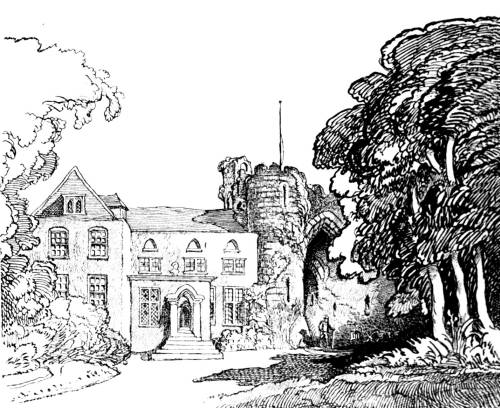
TONBRIDGE CASTLE.
This stronghold was successively the lordship of the Fitz Gilberts, the great Earls of Clare, the Earls of Gloucester, and the Staffords and Dukes of Buckingham: all of whom were, in respect of it, chief butlers and stewards of his Grace the Right Reverend Father in God, the Archbishop of Canterbury for the time being. Of those prelates they held the place by the grand sergeantry of serving in those capacities at the enthronisation of their Graces.
Those great earls left nothing to chance. They not only walled and embattled their town, and moated it, but on the prehistoric mound by the river they reared a keep and around it built a high wall with towers, and moated that as well. This was their castle; and although the ditches they dug are dried up and filled in, and the walls are for the most part gone, there yet remains the great Gateway of their hold to tell us something of its strength. It is a most worshipful Gateway: strong and tall and massive, so that one cannot, in naming it, do else than give it a capital G. There is scarce a more impressive Gateway in England. It was built somewhere about 1290, in the reign of Edward the First, as the architecture of its great drum-towers shows, and was the last word in massive fortification of that time: the walls ten feet thick and fifty-three feet high, the gloomy entrance arch ribbed with immense ribs of stone, the outer face of the towers relieved only by narrow slits for arrows. The workmanship was superb, and although more than six hundred years have passed since these stones were wrought so well and jointed so neatly, they remain perfect to this day.
There are dungeons in those towers; there is a hidden watergate to the river; there is, in fact, every circumstance of romance. Little wonder that in their Castle the lords of Tonbridge felt sometimes defiant. There was, indeed, one lord, Roger de Clare, who, even before this grim Gateway was built, and before his position could be so secure, felt strong enough to defy his liege, to defy even the great Archbishop, Thomas à Becket himself, and to treat his messenger with contempt. His Grace’s pursuivant came with archiepiscopal parchments, formidably engrossed and alarmingly sealed, but what did that haughty castellan do? He made the unhappy man eat the documents, “especially,” we are told, “the seals.” Well for that miserable man that he came merely from the Archbishop, and not with deeds from the King, given under the Great Seal! He survived the light repast, but he could scarce have stomached such a banquet as that would have made.
It would be an unprofitable exercise to trace the ownership of the Castle through the centuries; “suffice it to say,” as the Early Victorian novelists were wont to remark—that it came in course of time to one John Hooker. In 1797, that worthy demolished most of it, and with the materials thus obtained built the curious house that now adjoins the Gateway, which he probably would have destroyed as well, but that the work would have been very costly.
Later, the house was a school, to which period, doubtless, the bust of the anonymous tutelary genius over the porch belongs. Quite recently, the Castle has been acquired by the town, and in the beautiful gardens there are flower-shows, and, I believe, even a band-stand and penny-in-the-slot machines.
From the Castle the pilgrim naturally seeks the church, expecting to see many and stately memorials of those ancient lords. But he will find no trace of them. At some remote period, even before the church was “thoroughly restored” in 1870, improving besoms came and swept them out of existence. We may well pause here and consider with what astonishing completeness things venerable have vanished from Tonbridge. There was once, for example, south of the town, the Augustinian Priory founded by the de Clares. Wolsey seized its revenues and squelched it, on behalf of his proposed “Cardinal College” at Oxford, and the last few remains were abolished in 1839, when the South Eastern Railway came. The goods-station stands on the site.
Tonbridge church is disappointing, and it is not improved by the large churchyard, filled with dense files of tombstones, around it. They are so many that it is impossible to verify the existence of the scandalous epitaph alleged to be there, on a drunkard:
Hail! This stone marks the spot Where a notorious sot Doth lie; Whether at rest or not It matters not To you or I. Oft to the “Lion” he went, to fill his horn, Now to the grave he’s gone, to get it warm.
Beered by public subscription by his hail and stout companions, who deeply lament his absence.
The presumption is that it is a sheer invention, like a very large proportion of such things printed in collections of epitaphs.
XXIV
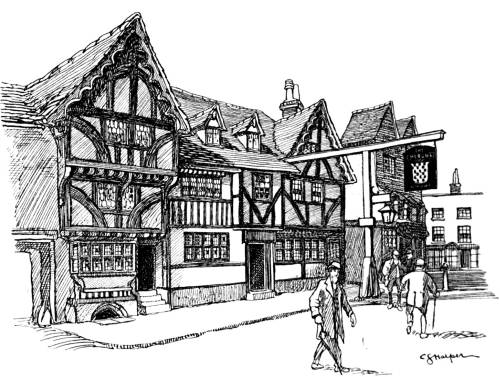
THE “CHEQUERS,” TONBRIDGE.
The general impression of Tonbridge (which elects to spell its “ton” with an “o,” in contradistinction from the “u” of Tunbridge Wells) is one of meanness and squalor. There is the fine Grammar School at the entrance to it, and handsome estates surround the town, but that impression lasts, and seems rather to be intensified by the gradual widening of the High Street and the replacing of the picturesque old houses by flashy modern buildings. That highly sketchable old inn, the “Chequers,” remains, and so does the so-styled “Old Ivy House,” or “Old Toll House,” in East Street, a fine gabled timber-and-plaster building of the fifteenth century, where the Portreeve’s duties, or tolls on cattle and goods entering the town, were paid.
Very observant persons, too, may notice the queer weathervane over the old shop of a firm of furnishing ironmongers, representing an old-fashioned sportsman out with his dog, partridge-shooting. I will not swear it is partridge; it may be grouse, or perhaps even pigeon; but any one will declare it is not a pheasant.
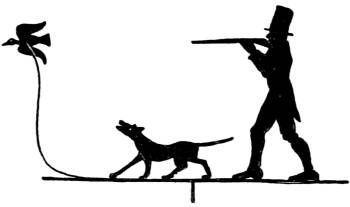
A SPORTING WEATHER-VANE.
The way out of Tonbridge lies over the railway bridge, past the station, where the banging of trucks and the screaming of whistles are continuous, and South-Eastern trains are, like practical jokers, for ever pretending to go off, just to flurry and excite nervous passengers, and then coming back and casually shunting up and down the sidings when they ought to be miles distant on their journeys; so while away the hours.
Contemplative persons will notice with delight as they pass that the lamp over the station door says “Railway-station.” It is a lesson in the obvious, information for the already fully informed, as little needed as a label on the parish church.
At a very acute angle right and left the roads respectively to Pembury and Tunbridge Wells leave Tonbridge and proceed immediately to climb steep hills out of the Vale of Medway. On the right goes the road to “the Wells,” up Quarry Hill, and to the left, up Somerhill, ascends the Hastings Road. At the summit of this very considerable eminence, where a road on the right-hand leads to Tunbridge Wells, once stood the toll-house, known (incorrectly) as Wood’s Gate. Its real name was Woodgate, the spot where that early traveller, Mr. Samuel Jeake, lost himself so effectually on that January night of long ago.
Tunbridge Wells is not on the direct road to Hastings, but it gave so distinctive a feature to the first half of the road, and lies so near at hand, that it will simply not be disregarded.
XXV
The father of Tunbridge Wells was Dudley, Lord North, a dissolute young nobleman, who in 1605 “fell into a consumption,” and was advised by his doctors to try the country air and that remedy at the present moment so much talked of but little practised, unless empty pockets and the lack of credit compel—the “simple life.”
Suffering from “the pleasures of town,” as to whose nature we need not inquire too closely lest we be shocked, my lord resorted to Eridge, on a visit to Lord Abergavenny. But the bracing air did him little good, and he was returning, despondent, to London in his carriage across the then lonely woods and heaths, when he noticed a pool of water by the way, covered with a slimy mineral scum. The idea occurred to him that here was his remedy. He drank of the water, felt better, and returned as soon as possible, to drink again and be well. He clearly did not deserve his good fortune, for he had no sooner recovered his tone than he “again gave himself up to all the gallantries of the age.” But medicinal waters—fortunately—make no discrimination between the deserving and others, and so, by carefully alternating his debaucheries with spells of fresh air and “taking the waters,” Lord North lived to the age of eighty-five, and died in 1666, an example to his fellows of how much you can dare and do if only you do and dare with discretion.
He published a work to show the advantages of the place to his brother libertines, and in this curious book, entitled “A Forest Promiscuous of Several Seasons’ Production,” he in this manner claims their discovery: “The use of Tunbridge and Epsom waters for health and cure I first made known to London and the King’s people. The Spaw,” that is, the Spa in Belgium, “is a chargeable and inconvenient journey to sick bodies, besides the money it carries out of the kingdom and inconvenience to religion. Much more I could say, but I rather hint than handle—rather open the door to a large prospect than give it.”
Already, in 1630, twenty-four years after his discovery, he had seen the place stamped with the approval of royalty, when Henrietta Maria, Queen of Charles the First, stayed six weeks here under canvas. It was then quite uncertain what name would find favour among all those proposed for it. “Queen’s Wells” was suggested, “Frant Wells,” “Speldhurst Wells”; but the circumstances of travel finally resolved the choice. Visitors from London not only approached the health-giving springs by way of Tonbridge, but were originally, in the absolute lack of accommodation, obliged to lodge in that town, nearly six miles distant. Thus the springs, by dint of association, became “Tunbridge Wells,” the spot being actually in the three separate parishes of Speldhurst, Frant, and Tonbridge.
That famous promenade afterwards known as the Pantiles was first made in 1638, when the sloping side of a meadow was levelled and embanked to afford a recreative walk for those who took the waters. Two buildings only stood on the spot, the Ladies’ and the Gentlemen’s Coffee-houses. Things remained very much the same through the long years of the Commonwealth. The “wells” were not deserted, for there were ailing bodies even among the elect; but the coffee-houses were not so gay, and the religious cast that came over the scene was reflected in the names then first given to the encircling hills. The Puritans named them after some fancied resemblance to Jerusalem, and thus Mount Ephraim and Mount Sion were christened, and the neighbouring Calverley is in like manner supposed to derive from “Calvary.”
With the Restoration “the happy springs of Tonbridge” began to grow merry again, and the card-playing, the dicing, the dancing that were all ended under Puritan rule grew again furious. There was still no town, and the men and women of fashion who did not choose to lodge at Tonbridge had to find rustic accommodation in the cottages of Speldhurst. Presently wooden huts on wheels appeared on the common, and were moved from place to place, as the fancy of the fashionables, playing at rustics, dictated.
To add to the Arcadian delights of that most primitive and pleasant period in the existence of Tunbridge Wells, a daily fair went forward at the spring-head. Rosy-cheeked farmers’ daughters brought chickens, cherries, and cream and sold them with great profit to town gallants, much too taken with the unspoiled graces of those rustic beauties to be able to drive bargains; and soon a bazaar became established under the trees, where milliners designed “rustic” dresses at town prices for ruralising London fair ladies. You might lose or win a fortune at basset under those innocent trees, and wind up the summer evening with open-air dances on the green. It was the “open-air life,” if not the simple one, that then prevailed, and for at least a century that was the especial note of Tunbridge Wells. Evelyn describes it as “a very sweet place, private and refreshing,” but that privacy may be questioned, for when houses were so few it was impossible to be other than public, and at a later period, when the town came into existence around the spring, it was especially ordained by the autocratic Nash that “every visitor should live in public.”
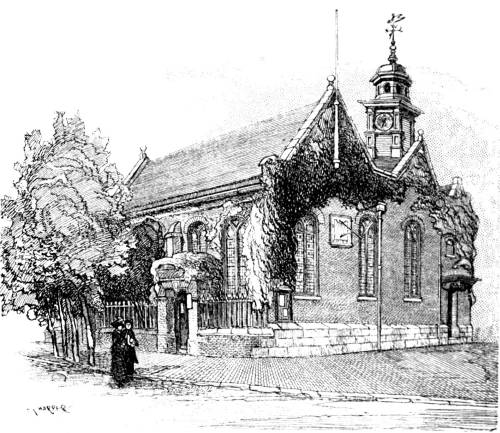
CHURCH OF KING CHARLES THE MARTYR.
One of the earliest evidences of the permanence of this settlement was the building of a chapel, in 1684. This is the existing church, dedicated by the then ascendant Royalists to “King Charles the Martyr.” It and the Pantiles—and of course the Common—are the only vestiges of the Tunbridge Wells of that time.
It is to Queen Anne that we owe the name of the Pantiles. She had come here while still the Princess Anne, for the health of herself and her ailing son, the Duke of Gloucester, and gave a hundred pounds for paving the walk, so that no other little boy, duke or commoner, should stumble there, as hers had done. When she returned, the next season, her hundred pounds had been expended in some mysterious way totally unconnected with pavements, and so, very rightly offended, she left the place, never to revisit it, even though the authorities at last hastened to lay the walk with those pantiles that gave it so distinctive a title. Stone slabs, in 1793, replaced those red tiles, and for a lengthy period the stupidity of the local governing body rechristened the famous walk “the Parade,” but it has now reverted to its original style.
XXVI
Tunbridge Wells of to-day bears not the slightest resemblance, apart from these three landmarks of Church, Common, and Pantiles, to the resort of long ago. It is unlike in appearance and manners. To-day you see an overgrown town with suburban roads climbing up all the hillsides, and continued, if you explore them, on the corresponding descent. It is an effect of grey sobriety, for the greatest period of its expansion was in the ’60’s and ’70’s, when plaster was prevalent; and its chief hotel was built in the days before architects could be made to understand that comfort is desired by guests more than grandeur. To climb up flights of stairs to enter the front door is a weariness, and bedrooms twice as lofty as they are broad or long outrage one’s sense of proportion.
Socially, too, Tunbridge Wells of to-day is the antipodes of what it was. The traveller of old who “took the waters,” presently arriving “by the grace of God,” in his chariot, or by public coach, did no sooner come up from Tonbridge within sight of the Spa, than he was assailed by a swarm of touts who thrust their heads into the windows, eager to bespeak his custom:
Soon as they set eyes on you, off flies the hat: Does your honour want this? does your honour want that?
To-day you enter from the railway-station, and the only people who take any interest in you are the cabmen. That is distinctly a gain, for touts are an abomination; but the public life once insisted upon by Nash is as distinctly a loss. The fact is that the English have no genius for it, and the climate really forbids. Moreover the local conditions are different. It is a great residential town now, and visitors are in the minority.
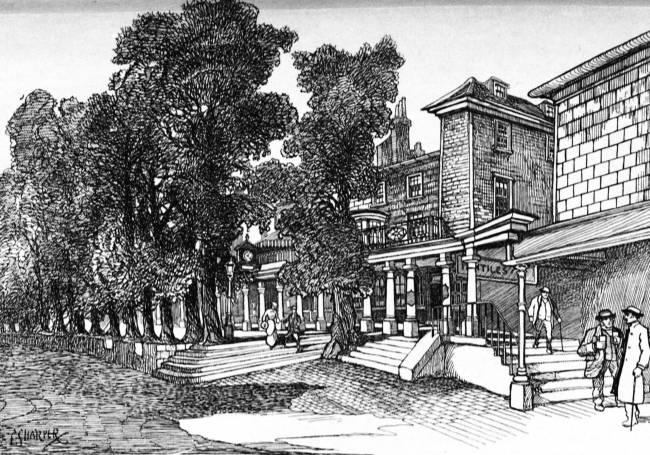
THE PANTILES, TUNBRIDGE WELLS.
Still you see the Pantiles, with the quaint colonnade and the overshadowing limes, now grown very reverend trees indeed, but it is not a scene of gaiety, and when on summer nights the place is beautifully illuminated with coloured electric lights, and open-air concerts are held there, it is a crowd of servants and of shopkeepers’ assistants that listens.
Alas! for the red-heeled, red-faced voluptuaries, the patched and powdered beauties, the morris-dancers, the fiddlers! They have all danced or hobbled off, and have been long since ferried over to the other side of Styx. And where they leered and ogled and minced, “protested,” and “stopped their vitals,” in their eighteenth-century way, there are a few inquisitive tourists peering about in corners, and really wondering if all those tales of eld are so much moonshine.
The waters of Tunbridge Wells and the Roman Catholic clergy have, according to Mrs. Malaprop, one quality in common: both are “chalybeate.” Perhaps they owed much of their old-time popularity to being described as “salutiferous,” and certainly they were likely to impress people more, and to do more imaginary good, under that title than if merely “health-giving.”
But the good wrought by the water is undoubted. It will not mend broken bones, nor set up an altogether shattered constitution; it is not Lethean, and at a draught you do not forget sorrows; but it is an excellent tonic, and—experto crede—good for incipient dyspepsia. Modern scepticism looks upon the fine air of Tunbridge Wells, rather than the water, as author of the beneficial effects upon visitors, and so it is less taken than formerly. It is safe to say that the majority of those who taste it are impelled by curiosity, and to all the taste suggests ink.
You come past the Church of King Charles, with its sundial inscribed, “You may Waste but cannot Stop me,” to the Pantiles and the spring. The water is, by an old Act of Parliament, free to all, but there are two granite basins: one, with a gigantic utensil like a pantomime soup-ladle, with which, bending down, you scoop up the water, in company with Lazarus and the vulgar herd; another where, in more genteel fashion, you pay a penny and are handed a glassful by one of the two old ladies known as “Dippers.” If you please, you can commute your payments by subscribing 2s. a week, 3s. 6d. for two weeks, or 30s. for a year. By that time the three grains of iron contained in every gallon of the water should have strung the participant up to concert-pitch, and have plated his teeth with a coating of iron, unless he adopts the old custom of cleaning them with sage-leaves, after drinking.
XXVII
No one would dream of describing Tunbridge Wells as a “manufacturing town,” but it has, and has had for considerably over two hundred years, a peculiar industry. Few are those who have not heard of “Tunbridge ware,” a species of delicate inlay work in coloured woods, which may be described as mosaic work, something in the nature of tesselated pavement reduced to terms of wood; the tesseræ in this case being very thin strips, fillets, and roundels applied in patterns to work-boxes, inkstands, backs of brushes, and a large variety of fancy articles.
Any attempt to describe the ware, or the process of its manufacture, seems at the first blush a rather hopeless enterprise. We may, however, give another analogy, and compare it with parquetry flooring in miniature and in many colours.
That it is no mushroom fashion may be discovered by the visitor to South Kensington, who in the Museum will discover a backgammon-board designed by the Comte de Grammont and made for him in 1664. He presented it to Mary Kirke, Maid of Honour to the Queen of Charles the Second, during a royal visit to “the Welles.” This interesting evidence of the antiquity of the ware is decorated with forget-me-nots, interlacing the Count’s initials and those of Mary Kirke, and shows that the art was even then fully developed.
Fashions change, and in all those years Tunbridge ware has had many vicissitudes. In the beginning of Queen Victoria’s reign a very large trade was done in a cheap line of articles in light woods—commonly sycamore—printed upon from transfers, not inlaid in any way, and thus, strictly speaking, not the true ware at all. Examples of this period are still to be met with in curiosity shops, with views, not only of Tunbridge Wells, but of every other place then of popular resort, and the sight of them brings faint reminiscences of times when girls wore bonnets and book-muslin dresses and gentlemen still dared to appear in public in white duck trousers. The ware of that age was, in fact, as popular then as the little fancy china articles with local armorial bearings are now.
That fashion passed, and the true manufacture regained its vogue. The prominent makers for generations had been Fenner & Nye, established on Mount Ephraim in 1720, succeeded in turn by Edmund Nye, and finally by Thomas Barton, in 1863. Barton’s showrooms were in the Pantiles until recent years, but the business, conducted on the old time-honoured lines of making the best possible article and charging for it accordingly, could not survive the modern rage for cheapness at the sacrifice of excellence, and as Barton grew old the business declined with him and finally gave place to another, where you can still purchase Tunbridge ware in innumerable forms at popular prices, and be perfectly satisfied, until it is compared with that of sixty years ago. The public has no cause for complaint. It pays only for what it gets; but there is, and can only be, the most superficial resemblance between the costly work of a bygone age and that of the present era.
A partial knowledge of these things has led some writers to describe this manufacture as a “doomed industry”; but, like so many “doomed” people, institutions, and trades, it maintains an astonishing vitality, and there is probably more Tunbridge ware made now than in the times when an article cost twice as much.
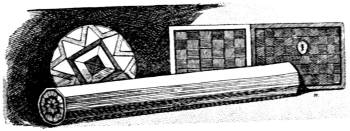
TUNBRIDGE WARE.
The methods employed are of some interest. Radiating, star-like patterns are produced ingeniously by building up in long sticks glued together around a central core, afterwards to be sawn off in veneer-like strips: a hundred to a stick. These are then mounted on to the articles to be decorated. In the case of more ambitious and pictorial efforts, such as a view of the Pantiles (a favourite subject) in coloured woods, the craftsman works to a coloured sketch, divided up like a Berlin wool pattern. In such cases the little wooden cubes are of necessity extremely minute. Mounted on to the wooden surface of workbox or other article, the work has then to undergo many sandpaper scrubbings, with sandpaper of increasing fineness, and is at last polished to an exquisite finish.
To the true artistic eye these ingenious imitations of drawings or paintings scarcely commend themselves, and Tunbridge ware finds its best exposition in the boxes inlaid with squares of various woods, in which you can see the grain and colour natural to each.
Great expense and care were formerly taken to secure beautiful varieties of wood, and no fewer than eighty, English and foreign, were in constant use. It was found that no wood naturally gave green or silver-grey, and it was therefore necessary to procure those colours artificially. Green was obtained from “decayed oak,” the fallen boughs of oak-trees stained green by fungoid growths. To get grey, bird’s-eye maple and Hungarian ash were steeped in the chalybeate waters of “the wells”; and a beautiful white was produced by boiling holly.
XXVIII
The fine upland Common of Tunbridge Wells is one of the town’s greatest assets. Extraordinary outcrops of rock occur on it, and away to where it merges into Rusthall Common is that bourne of many a pilgrimage—the famous Toad Rock: an immense mass of sandstone really very like a toad squatting on its haunches, and not by any means of so uncertain a shape as that of so many of those queer rocks in which you see just what you please, like Hamlet’s cloud, “almost in shape of a camel,” “like a weasel,” and finally “very like a whale.” The Toad Rock has not so many imaginary incarnations, and looks only like a toad. In these days it has been found necessary to protect it with a defensive iron railing, but this precaution has not served to exclude the usual fools who carve their folly deeply into everything capable of being marked with a penknife.
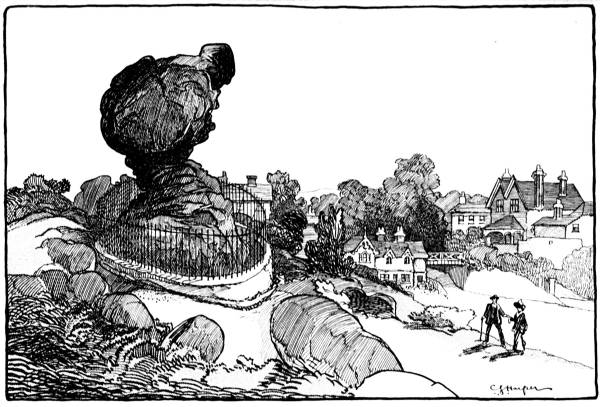
THE TOAD ROCK.
The natural gorge close by, known as Gibraltar Rocks, still is marked by one of the houses built on the Common by a sentimental English Government for the French priests exiled from France at the Revolution. In addition, the Government made them an allowance for their maintenance.
The population of Rusthall, to judge from the language and behaviour of its boys and young men, must be in a very primitive stage of civilisation. The stupid foulness and vileness of their conduct in the neighbourhood of that public resort, the Toad Rock, any day and every day deserve the attention of the police.
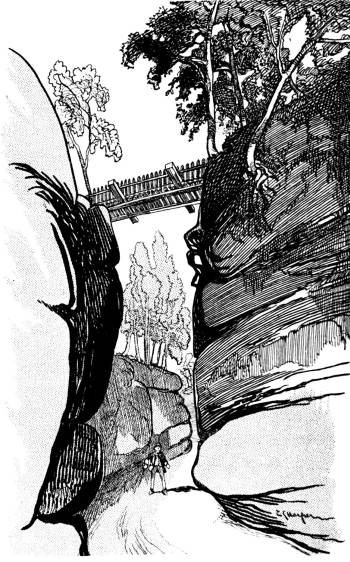
SCENE AT “HIGH ROCKS.”
Tunbridge Wells is a neighbourhood of rocks, but none others approach the weird scene at the spot appropriately called High Rocks, less than two miles distant, on the way to Groombridge. It is not the “Finest Scenery in England,” as claimed by Mr. Thomas Coster, proprietor of the “High Rocks Hotel,” who charges sixpence to enter; but it is highly curious. Many ingenious and enterprising sightseers, chiefly active cyclists, resenting the being clicked through a turnstile at sixpence a head, take Mr. Coster and his encircling fences in the rear, and, entering a little wood, insinuate themselves into his domain and see his rocks for nothing. His rocks! On the whole, their enterprise has my respectful admiration, for it seems absurd to treat Nature as if she had made this scene in the infancy of the world for the purpose of providing a showman with an income.
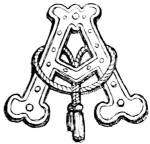
THE MARQUIS OF ABERGAVENNY’S “A.”
The writer of a guide-book published in 1810 describes the “High Rocks” as “romantic scenery,” and says that, “combining with the wish to please and be pleased,” the spot “tended to create an agreeable relief to that tædium which will frequently encroach on a place of public resort.” There is a specious plausibility about this which leads the reader at first to idly agree; but the muzziness of thought and woolliness of expression very soon lead one to the opinion that the writer, although he may have had an inkling of what he meant when he set out, very soon lost himself on the way.
The High Rocks cover a space of about two acres, and consist of a great wooded bluff hanging, cliff-like, over the road, and intersected in innumerable directions with fissures, gullies, and ravines from fifty to seventy feet deep. These ravines are crossed by numerous wooden bridges, and ascended or descended by rustic stairs. There is the Bell Rock, which gives forth a metallic sound when struck; the Warning Rock, and all sorts of other rocks, fantastically named; and there are swings and brake-loads of excursionists, and mazes. Altogether, the place is pretty well exploited, and the penknife has been busy on every spot within reach.
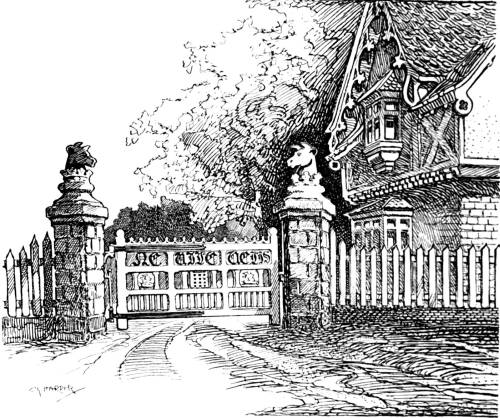
THE NEVILLE GATE, FRANT.
A way to Hastings by Tunbridge Wells lay in coaching days through Frant, Wadhurst, and Ticehurst, emerging upon the direct road again at Stone Crouch. It is a wildly beautiful wooded district, passing through a line of country where an immense upholstered letter A is noticeable on almost every cottage, sometimes in company with the Neville portcullis, indicating the ownership of the Marquis of Abergavenny in the country-side. Near Frant an extraordinary gateway into the park of Eridge abuts upon the wayside, flanked by his Bull’s Head crest and adorned with the punning motto, Ne vile celis: “Wish nothing base.” A proud motto, woefully smirched by Lord William Neville in recent years, when he was sentenced to a term of imprisonment for forgery.
XXIX
The main road is more quickly regained at Pembury Green, where the last suburbs of Tunbridge Wells end.
Pembury Green is an old hamlet reared in modern times up to the status of a separate parish, with a tall-spired church built where it has no business to be—on the green that gives the place its distinguishing name. There are plenteous evidences, in the number of inns and Cyclists’ Rests, that Pembury Green is a favourite resort in the long days of summer.
The number of refreshment places along the Hastings Road catering for cyclists is more marked than even on that very much exploited highway, the road to Brighton. Perhaps on a road so hilly as this those pushers of the reluctant pedal require more frequent halts and more sustenance.
Most wayside inns nowadays express their readiness to entertain wheelmen by exhibiting the modest announcement, “Accommodation for Cyclists,” hinged on to their old signs; but, apart from these, the keeping of “Cyclists’ Rests” along the main roads has become an industry as congested as the close professions.
The natural history of Cyclists’ Rests affords interest to the peripatetic philosopher. They range from the cheap boudoir-like kind, a couple or so miles out from a town, where the articles most in demand are weak tea and hairpins, down to the sometimes bare, sometimes grubby little dens in remoter places, labelled in illiterate fashion,
“CYCLIƧT REƧT”
designed to suit the shallow pockets of the long-distance-riding club cyclist; where, in discomfort, you eat off delf plates laid on tables covered with slimy “American cloth,” and get a good “blow-out” and a shakedown in an attic with precipitous floor and sloping roof for an incredibly small sum.
The first variety are fully furnished for feminine cyclists with materials for tea, with the hairpins already mentioned, with chocolates, a carafe of weary-looking home-made lemonade with a lemon stuck in the neck of it, the usual fizzy “minerals,” and sixpennyworth of buns. Wonders may be wrought on a basis so slight.
The other kind is of sterner stuff. Who rides far must feed well. Tea for the hard rider, no less than for the ambling lady cyclist, is essential, but it must be tea with a tang to it, and plenty of it; and it gets mixed, in course of feeding, with such meats as the “Rest” affords, with the result—a medical expert would say—that the interior of that cyclist is converted into a tannery, and his food turned to leather by the tannic acid of his drink. And yet I never heard of a healthy, active cyclist being inconvenienced, much less laid low, by such immoral feeding.
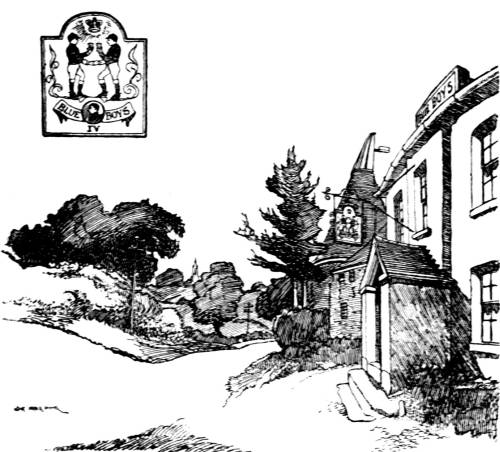
THE “BLUE BOYS” INN.
It is a solitary road beyond Pembury Green, varied only by a few scattered houses, all the way to Lamberhurst. Kipping’s Cross is the first of these intervals, and there stands the “Blue Boys” inn, with an oast-house for only neighbour. The “Blue Boys” is practically dated by its odd picture sign, showing two blue-jacketed postboys shaking hands and lifting each a convivial glass, whether to their noble selves or to George the Fourth, whose medallion portrait is below, cannot be said.
Beyond the inn is the cross-road leading to Goudhurst, scene of many incidents in the history of smuggling. Between this point and Lamberhurst, four miles distant, there were, in the once-upon-a-time of coaching days, two turnpike-gates. The pikeman’s house remains at both places.
The level tract of land at this point was known to old road-books as “Lindridge Causeway,” and owed its name, according to John Harris, who wrote a “History of Kent” in 1719, to one Lindridge, who was born in 1560, lived in a house adjacent to Lamberhurst, and “built a handsome causeway here, called after him.” At that time there was still a stone to his memory in the porch of Lamberhurst church.
The name of “Lamberhurst Quarter,” given to the district on this hill-top above Lamberhurst village, is one of those many mysteries of place-names that now can never be authoritatively explained; but it is supposed to derive from some ancient partition of the manor into four parts—quarters of a knight’s fee.
Down below, on the right hand, are spread out the many-serried ranks of the hop-gardens. You look down upon them as a commanding officer might upon his phalanxed battalions.
XXX
Hops are grown in the neighbourhood of Lamberhurst almost as extensively as around Maidstone itself, which every one knows to be the metropolis of the cultivation. The hop-gardens are the vineyards of England, and so marked a feature that it surprises the inquirer who learns that the brewer’s hop was not introduced to this country until the reign of Henry the Eighth. “Hops and heresy came in together,” the Roman Catholics were wont to remark.
There is no certainty about hops, and a hop-grower will readily admit that his trade is little better than gambling. Knowledge, capital, industry are all insufficient to arm him against fate in the shape of red spider, mould, fly, or bad markets, and he is commonly content if he can secure one good crop at average prices in three years. It is a costly cultivation, coming, with rent, rates, taxes, materials, and labour, to an average of £25 per acre.
Only land “just so” will serve. A little too heavy, a little too light, or not being drained to perfection, will spell failure, and a hop-garden must be drained, with pipes or tiles, at least as well as a house.
The hop-grower’s year begins in March, when the “hills,” or stools, are uncovered and dressed by pruning. Then the poles are set up: from two to four to each “hill.” The “hills” being six feet apart, it is a simple calculation to arrive at the number of poles to the acre. There are 3,600, forming a considerable item in the grower’s accounts. Made of ash, alder, chestnut, larch, or oak, of from ten to twelve years’ growth, the great and constant demand for them has given their characteristic appearance to large tracts of land in Kent and Sussex, where the young woodlands are as much a feature as the hop-gardens and the oast-houses themselves. Poles are from thirteen to fourteen feet long, and cost from twelve shillings to a guinea a hundred, larch being the most lasting. To preserve them as long as possible, they are often dipped in creosote.
Early in May the hop-gardens begin to give employment to the women. The young shoots are tied with rushes to the poles, and constantly thinned out, and the poles themselves tied together with a maze of interlacing string for the support of the climbing bine.
All through the summer the alleys between the plants must be kept well weeded, and only when August ends does the grower begin to see his reward in sight; but then rain may bring the “mould,” or the “fly” may come, and all his toil be wasted. Only one thing will cure the “fly,” and that is something utterly beyond control—the coming of the “ladybird.”
Most people know the ladybird or “lady-cow,” as it is sometimes called: the little winged insect with the hard shell of a post-office red, subject of the old rustic rhyme, in which, placing it on the tip of the finger, it would be addressed in this wise:
Ladybird, ladybird, fly away home: Your house is all burnt, and your children all gone. Little pop-pop sits on the cold stone, Crying for mammy, and mammy don’t come.
I heard that rhyme very early, and shall never quite lose the forlorn sense of tragedy in it.
The ladybird is the deadly foe of the “fly,” and seems by some extraordinary instinct to know when and where that pest is rampant; for there is nothing more certain than that a plague of “fly” will be followed by an incursion of ladybirds in countless millions, coming even across the Channel, as steamboat passengers, plentifully covered with them, have testified. The sky rains ladybirds, come vengefully to exterminate the hop-grower’s enemy and to ensure that British beer shall be properly bittered.
If the hops survive all these dangers and chances and are a generally abundant crop, the grower is sometimes in almost as bad a case as if they had been a failure, for prices then rule so ruinously low that they do not pay the cost of growing. Hops have been so high as £25 a hundredweight in times of scarcity, when those fortunate enough to be favoured with a good crop, while their neighbours’ were failures, have retired with fortunes. On the other hand, they have been so low as fifty shillings.
A less anxious, but infinitely more busy time has come when the picking arrives. Responsible gangers have to be employed, and hop-cutters. The hop-cutter cuts through the bines, pulls up the poles, and lays them across the bins of sacking into which the pickers strip the flowers of the hop. The ganger measures out the stripped hops, and in his note-book credits each picker with the amount of his picking, at the rate of eight bushels a shilling.
The hopper’s hut is not the last word in convenience, although for the occasion, and by way of change from the hopper’s native slum, it may be comfortable enough. It is usually one of a long row of little brick dens, not altogether unlike some of the wild animals’ lairs at the Zoological Gardens, and is whitewashed inside in the manner of a cattle-pen. There are—is it necessary to add?—no pictures on the walls and no domestic knick-knacks. There is not even any furniture, nor a bed. If you are a hopper you doss on the floor, luxuriating in clean straw provided by the hop-grower, and wrapped in the not over-clean blankets brought by yourself; and you and yours “clean yourselves”—in these circles you do not merely “wash”—in the open, at buckets and tins. In the open, too, you dress and get shaved, and cook and eat; and if the August and September days be kind, there is enjoyment rather than discomfort in it. Sometimes barns and tents supplement the huts: sometimes, too, it rains, and then, on a really wet day, when work is at a standstill and the women and the children are miserable and sulky and cry, the male hopper—who, although as a rule he uses dreadful language, is not a bad fellow at heart—goes off to the nearest pub. and soaks on four-ale, and there is trouble.
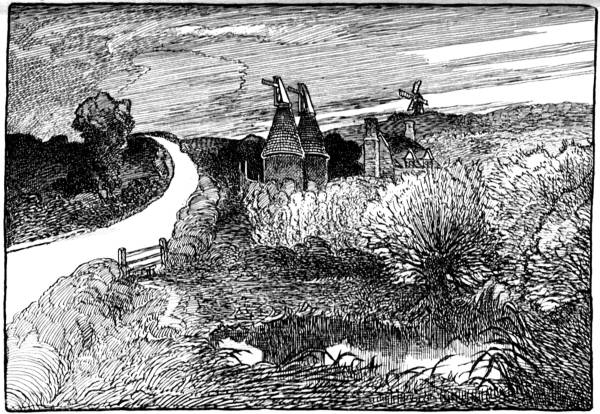
KENT.
There are, every year, some 50,000 hop-pickers, picking from 35,000 to 40,000 acres of hop-gardens. Of these the larger proportion is contributed by the villagers; but the railways convey about 20,000 from London by the “hopper specials” at very low rates, and many, who cannot afford even those very cheap fares, tramp down.
The special trains would make the patrons of the Continental expresses stare. They set out at midnight, or thereabouts, and are filled with a motley crowd, bringing mattresses, blankets, frying-pans, kettles, and a host of small domestic requirements for a fortnight or three weeks.
They book to whatever station they fancy as the likeliest point whence to seek a job; for while some hop-pickers, during a steady succession of years, know where they will be welcome, many of them go on sheer speculation, and tramp from village to village until they find vacancies. In later years, and in bad or wet seasons, the number of the unsuccessful claiming admission at the casual wards, especially at Maidstone, has seriously embarrassed the workhouse authorities and those good folk who not only missionise the hoppers with Bible and Prayer Book, but feed and clothe their bodies in this world as well as showing anxiety for their souls in the next.
Hop-picking is for many poor Londoners the only holiday they get throughout the year. It is that best of holidays, change of work and of scene. Its chief merits are that it requires no skill, and that the whole family can take part in it, except the baby, who is at any rate brought into the hop-garden to look on, and left to amuse himself or to sleep under an umbrella, while grandfather, grandmother, father, mother, uncles and aunts, and brothers and sisters are all busily filling the bins and earning, according to their degrees of “slippiness,” a shilling to two shillings the day.
Each hop-grower is his own dryer: hence the kilns, the strangely cowled “oast-houses” attached to every hop-garden. To these the hops are taken, to be dried. Most oast-houses are circular, that form being considered to distribute the heat more evenly than the square. The interior is instructive, and would not be at all unwelcome on one of those wet and chilly days that are not unknown to the English summer, were it not for the universal practice of mixing sulphur with the coke fires, which, to a stranger, results in an inconvenient hoarseness and sore throat. The reason for the sulphur is that the fumes it throws off give a yellowish colour to the dried hops, a tint conventionally required by the factors, although it makes them neither better nor worse.
The fires are on the ground level. Above, the hops are spread on the drying-floor, formed of wire-netting, covered with hair-cloth. Through this the warm air ascends, and in twelve hours some 1,050 lb. weight of hops are dried, and incidentally reduced by the evaporation of the moisture in them to 200 lb. The heat ascends and leaves the oast-house by the cowl, which turns on bearings, according to the direction of the wind.
From the drying-floor to the cooling-floor the hops are transferred with a wooden shovel, and then packed into the “pockets.” “Pockets” are sacks, and are nowadays filled by being suspended from a hole in the floor, and filled with the light feathery dried hops; and then repeatedly pressed down, re-filled and re-pressed by a heavy iron screw-press. In the result, a pocket of hops is as hard and unyielding to the touch as a mass of iron, and samples cut from it hold together like so much cake-tobacco. The older method of packing was for a “jumper” to press the hops down by his own unaided efforts.
XXXI
Those who would find Lamberhurst church must diligently seek it, for it lies quite away from the village, on the hill-top, beside the manor-house, which you approach past a long line of pyramidical yew-trees, so like those of toy Noah’s Arks that you look instinctively for their wooden stands.
Like most manor-houses in Kent, this is styled the “Court Lodge.” The Court Lodge itself is a stone building of considerable age, with the desolating gaunt exterior of a workhouse; and the church, standing behind it, is in appearance—and in some sort in fact—an appanage of the lord of the manor, for it stands, with the residence, in the middle of his park.
It is a very charming old church, with a shingled spire, and deeply embowered in dark heavy trees, as though Nature herself had put on a solemn mood, in deference to the spirit of the place. Most prominent in the approach is a fine eighteenth-century monument, like a tea-caddy, with an epitaph starting off suddenly in this wise:
Virgil Pomfret, Gent
Livd so Respected
That when the Sable Train of Mourning Friends
Attended his breathless Corps
Here to be Entombd
Each tear ful Eye seem’d thus to Say
There Goes an Honest Man
1765 Aged 77
This is followed by an inscription stating how Virgil Pomfret’s wife was “Virtuous and Discreet,” and this by another that tells us how, in the same year, Virgil Pomfret, junior, was “snatch’d away By the Small Pox,” aged 28.
I think it gives that dreadful disease an added terror to personify it in this larcenous way.
At the foot of the hill lies quiet, beautiful Lamberhurst. Mr. Rudyard Kipling has not inaptly named it “Slumberhurst,” and Cobbett, not given to indiscriminate praise, spoke of it as “a very pretty place, lying in a valley with beautiful hills round it.”
Old writers gave it as their opinion that the place-name came from “the Anglo-Saxon Lam, meaning ‘loam,’” and supported their contention by referring to the sticky clay of the neighbourhood; but Lamberhurst probably took the first part of its name from the Saxon genitive plural for lambs. The second part means, of course, a wood. Most surrounding places take their names, in this manner, from natural objects.
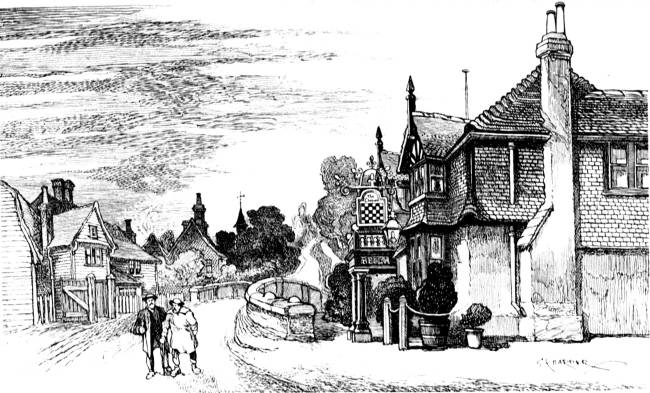
LAMBERHURST.
Kent and Sussex here march together, and the village was, until 1894, in both counties, the dividing-line being the little river Teise that flows under the picturesque and narrow bridge in the village street. In that year, however, Lamberhurst was transferred wholly to Kent. The old “Chequers” inn, type of an old English hostelry, has lately been neighboured by an upstart hotel, disturbing with its raw newness the ancient peace of this Sleepy Hollow.
It was once a busy enough place, and black and smoky, for close by were the famous furnaces, or “bloomeries,” where iron-ore was smelted and cannon cast, and where the famous iron railings that now partly, and once wholly, surrounded St. Paul’s Cathedral, were made. Great outcry was made when the railings were removed from the west front of the cathedral in 1873, but we need not lack in admiration of them to realise that the open space thus created is a better sight than the strictly enclosed approach to London’s chief place of worship. The railings originally weighed 200 tons, cost £11,202, and were considered to be the finest, as they certainly were the heaviest, in the world.
The site of the furnace is half a mile from Lamberhurst, on the way to Bayham Abbey. It is distinguished by a hammer-pond and a mouldy old house almost smothered in trees and creepers.
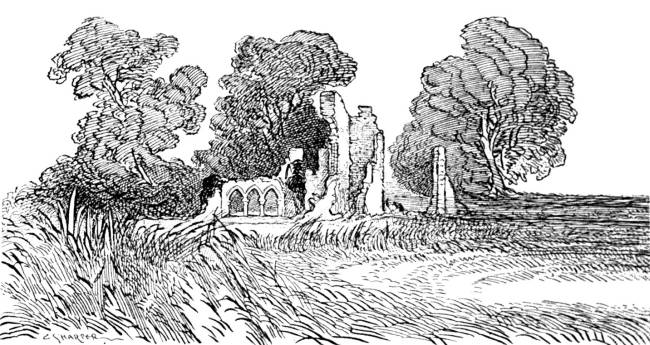
BAYHAM ABBEY: ACROSS THE WATER-MEADOWS.
Along the valley of the stream that feeds this pond lie the ruins of Bayham Abbey, a remote home of Premonstratensian Canons, whose simple life was to the last in great contrast with the dissolute conduct of the great majority of the religious houses rightly abolished in the time of Henry the Eighth. But they had to suffer for the sins of the many, and although a crowd of rustics and others of better estate assembled in disguise and reinstated the canons, after they had been expelled by the Commissioners, it was only a temporary victory. Abbey and estates fell to Sir Anthony Browne, of whom we shall hear more at Battle; but what became of the wonderful bed upon which the blessed St. Richard of Chichester had slept, history sayeth not. It should have been presented to the most deserving hospital, for it wrought cures upon all who slept in it, no matter what the disease. But the Age of Faith was past, and the Blessed Bed was doubtless chopped up for firewood and its bedding dispersed: an inestimable loss to an ailing world. Imagine a bed sovran for every ill! How compute the value of it?
If the curse upon sacrilege were not such a chancy and fortuitous thing, one might look confidently for terrible happenings to the owners of the Bayham Abbey lands, the Pratts, Marquises Camden, who bought the estates from Viscount Montagu in 1714. But their elephant’s-head crest remains on all the cottages for miles around, and they continue to “live long and brosber.”
The ruins are visible from the road, lying amid rich water-meadows, and they are to be seen more intimately at the end of a phenomenally muddy lane. But you may not view them from within the enclosure except on one day of the week and at a fee of sixpence.
XXXII
Restrictions upon sight-seeing in this neighbourhood are particularly severe. On the rising ground out of Lamberhurst, for example, lies Scotney Castle, a lovely, sequestered ruin partly surrounded by a great, lake-like moat, and only a little less romantic than Bodiam itself. To reach it you go past a very modern lodge and along a half-mile of wooded drive, chiefly of laurels and sweet chestnuts. But permission is granted on only one day of the week, doubtless in the hope that the precise day will not be remembered. On any summer’s day numerous vehicles and parties, some of them come from long distances, may be seen turned back by the lodge-keeper.
Scotney was ever the home of romance, for one of its earliest owners, Walter de Scotney, was executed at Winchester in 1259 for administering poison to the Earl of Gloucester and others. The humour of it is that Walter de Scotney was probably quite innocent. The Earl recovered, but his brother, William de Clare, died, as also did the Abbot of Westminster. The Earl himself seems to have had a narrow escape, for he lost hair, nails, teeth, and skin, and must have been one vast comprehensive ache, and in a more painful condition than that of a chicken plucked alive.
Scotney then passed to the Darrells, who led a finely dramatic life here until they ended, to an effective and tragical “curtain.”
The old castle lies in a watery hollow beneath the modern Gothic mansion, and itself consists of two distinct portions: the castellated building erected about 1418 by Archbishop Chicheley, and the later manor-house of the Darrells, who in Queen Elizabeth’s time were Roman Catholics, maintaining their religion and its observances in spite of the laws, ordinances, and penalties levelled against Papist recusants.
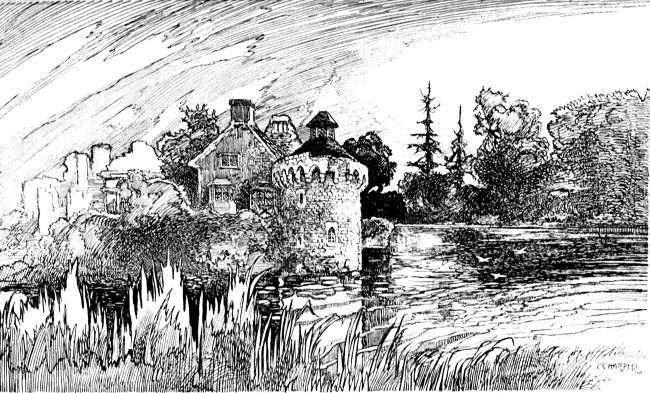
SCOTNEY CASTLE.
To secure their officiating priests against arrest the Darrells contrived a highly ingenious hiding-hole in their mansion, and it was speedily found useful. It was the Christmas night of 1598, towards the end of Elizabeth’s long reign, and Father Blount, a well-known and keenly sought priest, was in the house with his servant when the party were surprised by a search-expedition, who, having got wind of Blount’s presence, were bent on capturing him.
While the enemy were demanding admittance, Blount and his servant were hurried into the courtyard, where a huge stone in the wall, turning upon a pivot, gave entrance to the hiding-place. Unluckily for them, a portion of a girdle-strap was caught between the stone and the rest of the wall, and showed plainly. Meanwhile the search-party had been admitted, and, securing the inmates of the house in one room, proceeded to search the place.
While they were thus engaged an outside servant of the family chanced to see the girdle, and promptly cut it off, calling as loudly as he dared to the fugitives to pull in the fragment that was still visible. The sharp-eared search-party, hearing a voice in the courtyard, rushed out and sounded the walls all round, without making any discovery, but kept it up until the rain, which had set in, disgusted them, when they retired, intending to resume the search on the morrow.
As Blount’s own record of the adventure tells us, he and his servant were concealed for days under a staircase. At last, afraid to risk the result of another day’s proceedings, they escaped under cover of night. Barefooted they crossed the courtyard, climbed the walls and swam the moat, then covered with thin ice. They did well to fly, for next day their hiding-place was discovered.
In later years the castle and manor-house, by that time ruined, was the haunt of smugglers, among whom the Darrells themselves were reputed to be prominent. To-day the beautiful spot is surrounded not only by the moat, but by exquisite gardens. The two remaining towers of the mediæval castle rise picturesquely from the still waters, and within the wreck of the Elizabethan mansion there are rooms contrived for the gamekeeper.
XXXIII
Weird oast-houses of a gigantic size raise their lofty cowls against the sky-line outside Lamberhurst, and, with their vanes decorated with images of the Kentish Horse, look like the architecture of Nightmare.
Half a mile onwards, an old toll-house, added to in later years, has the appearance of a lodge. Beyond it, the road has at some distant period been raised from a very deep dingle, as may be judged from the farm in the neighbouring hollow, and from the Bewl Bridge, under whose arch the little Bewl stream rushes, with a hoarse voice, far below.
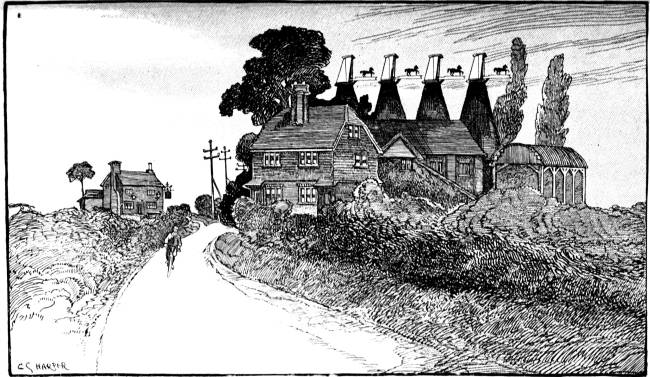
WEIRD OAST-HOUSES, LAMBERHURST.
In another mile is Stone Crouch, whose name of “crouch,” meaning merely a cross—probably a cross-road—prepares one for that most solitary and most rustic hamlet, with a farmhouse and its dependent cottages and barns, all in the old Kentish style. The farmhouse was once a coaching inn, and appears to have borne the sign of the “Postboy,” now taken by a house on the way from Lamberhurst, half a mile before the hamlet is reached.
On the left is the great park of Bedgebury, the seat until 1887, when he died, of A. J. B. Beresford-Hope, once prominent in the House of Commons. He was the descendant of one John Hope, a Hollander, of Amsterdam, whose son settled in England about 1800. That origin was the subject of a curious allusion in Parliament, during the debate of April 12th, 1867, on the Representation of the People Bill: a measure vehemently opposed by Beresford-Hope, whose clumsy, burly form and grotesque mannerisms in speaking were often commented upon. He spoke with emphasis of voice and gesture against that proposal of Disraeli’s, and declared, rather offensively, that he “would vote with whole heart and conscience against the Asian mystery.”
To this the “Asian mystery” himself rejoined that “all the honourable member’s exhibitions in the House are distinguished by a prudery which charms me, and when he talks of Asian mysteries, I may, perhaps, by way of reply, remark that there is a Batavian grace about his exhibition which takes the sting out of what he has said.”
He might even have said batrachian grace, for Beresford-Hope on his legs in the House was something froglike.
The house at Bedgebury, originally built in 1688 by Sir James Hayes, from sources romantically drawn out of treasure recovered from a sunken Spanish galleon, has been twice remodelled, lastly in the ’60’s, and is typical of the taste then prevailing for French architecture of what we may term the Alexandra Palace, Grosvenor Place, and Buckingham Palace Hotel type: which is to a Londoner an easier method of comparison than by naming it the “Louis the Fourteenth style.” It is a type distinguished by scaly Mansard roofs and spiky crestings, and has long been outmoded.
Beresford-Hope was a connoisseur of sorts, with a ready purse for church-restoration, conducted sometimes with that “zeal not according to knowledge” St. Paul laments, and exemplified in the little church of Kilndown, outside Bedgebury Park.
At Flimwell, which is merely a hamlet at the cross-roads, formed into a parish in 1839 by annexing portions of the neighbouring parishes of Etchingham, Ticehurst, and Hawkhurst, the road finally enters Sussex. “Flimwell Vent” is the style by which the place is known to old Turnpike Acts. The name sounds mysterious, but is only a strangely perverted version of “went,” the old rustic word for a cross-road. This, where roads go in four different directions, would be a “four-went way.” The draughtsmen who drew up those acts simply did not understand the term, and spelled it, as Mr. Tony Weller did his name, with a “we.”
The place is not unknown to history. In 1265, Henry the Third having, after a short siege, seized Tonbridge Castle, marched south, and, passing Combwell, a nunnery in the parish of Goudhurst, found the dead body of his cook, Master Thomas, who had incautiously strayed from the main body. According to contemporary records, the enraged King ordered three hundred and fifteen archers to be beheaded “at the place which is called Flimerwelle,” and here accordingly “they were surrounded like so many innocent lambs in a field, and butchered.”
The Angevin kings had no sense of proportion, and a perverted one of justice.
The left-hand road at Flimwell is the way to Rye, leading over what was once the wild and lonely region of Seacox Heath, haunt of the desperate smugglers then infesting this part of the country. The heath is now a thing of the past. Enclosure and farming have abolished it, and perhaps the only fragment of it left is a delightful little patch of brilliant heather preserved in the gardens of Lord Goschen’s mansion of “Seacox Heath.” Portions remain of old buildings once belonging to a house traditionally said to have been used as a warehouse by the half-mythical smuggler, Arthur Grey, but the present house was built in 1871 by Mr. (afterwards Lord) Goschen. It is a rather severe and formal Renaissance building, in a pale yellow sandstone quarried on the estate, and defies the canons of proportion suited to a country house, running to height rather than ground-space—a fashion imposed in streets where houses are built shoulder to shoulder, but unnecessary and undesirable on sites such as this.
It is a beautiful site; a lofty ridge facing south and overlooking many miles of lovely country. Ornate gardens, in which the most brilliant flowers predominate, surround the house, and beyond them are dense plantations of the choicest conifers, collected from all parts of the world.
Between Flimwell and Hastings, a distance of 18¾ miles, there were no fewer than six turnpike-gates levying tribute upon road-users, but in spite of these heavy exactions—perhaps even because of them—the expenditure of the Flimwell and Hastings Turnpike Trust largely exceeded its income, and in 1835 it was £11,000 in debt. In the end Parliament abolished turnpikes, and the bondholders who had lent money on the security of the tolls and the good faith of the Government lost their capital, not only here but all over the country.
A farmhouse one mile on the road beyond Flimwell, with brick-and-tile front and weather-boarded back, and with oast-houses and hop-gardens attached to it, is known, for some inscrutable reason, as “Mountpumps.” In another two miles the road comes to Hurst (i.e. Wood) Green.
XXXIV
Hurst Green is a large hamlet, and an offshoot of Etchingham; created by the road travel of the last hundred years. It is in two most distinct parts: one unmistakably Georgian, the other just as distinctly Late Victorian, shading off into Early Edwardian. Although one continuous street, divided only by a cross-road, the two parts of Hurst Green are very different in appearance, and look so antagonistic that it would not be surprising to learn that the inhabitants of either will have no dealings with those of the other.
The traveller comes first to the more recent portion: very red and raw, and there he finds a reason for much of these developments, in a large and highly ornate Police-station, which is not merely that, but a Court-house as well. Hurst Green, it seems, is the headquarters of a Petty Sessional division of the county of Sussex: much to the advantage of the great neighbouring “George” inn and its rival over the way, the “Queen’s Head.” When the railway came, and the custom fell off and the great stables were deserted, the two old inns were in grave danger of extinction. Only the Petty Sessions saved the situation. To-day, when the awful majesty of the Bench has dealt with the crimes and misdemeanours of the district—awarding fine or imprisonment for poaching or the juvenile rifling of orchards—the upholders of law and order and the rights of property in ground-game adjourn for refreshment, and in the “George” drink confusion to the illegal midnight sportsman and the youthful apple-stealers, while the friends and relations of those hardened criminals drown their sorrows at the “Queen’s Head.”