Situations of the Grotesque Ornament in Church Art.
Reading edition
The places chosen for the execution of the work which, by reason of its intention or its want of conformity with what we now consider a true taste in art, may be styled Grotesque, do not seem to be in any marked degree different from the situations selected for other ornamental work. It may, however, be permitted to glance at those situations, and enquire as to such comparisons as they afford, though the conclusions to be arrived at must necessarily be loose and general.
In Norman work the chief iconographical interest is to be found in the capitals of pilasters and pillars, for here is often told a story of some completeness. Other places are the arches, chiefly of doorways; bosses of groining, and the horizontal corners of pillar plinths; exteriorly, the gargoyles are most full of meaning, seconded by the corbels of the corbel-table. We may expect in Norman grotesque some reference to ancient mystics; the forms are bold and rugged, such appearance of delicacy as exists being attained by interlacing lines in conventional patterns, with, also, the effect of distance upon repeating ornament.
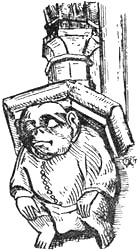
APE CORBEL, CARRYING ROOF TIMBER, EWELME.
Transitional Norman retained all the characteristic ornament of the purer style, but with the development of Early English the grotesque for a time somewhat passed out of vogue, slight but eminently graceful modifications of the Corinthian acanthus supplying most of the places where strange beasts had formerly presented their bewildering shapes. It might not be impossible to connect this partial purification of ornament with a phase of church history.
But in some portions of structure, as the gargoyles, and in the woodwork of the choirs, the grotesque still held its own. As Early English grew distinctly into the Decorated, every available spot was enriched with carving. The collections (called “portfolios” elsewhere) of the old carvers would seem to have been ransacked and exhausted, all that had gone before receiving fresh rendering in wood and stone, while life and nature were now often called upon to furnish new material. The pointed arch remained, however, an undecorated sweep of mouldings, and the plinth corners were rarely touched; in fact there was here scarcely now the same squareness of space which before had asked for ornament. All the other places ornamented in Norman work were filled up in Decorated with the new designs of old subjects. The resting-places of ornament were multiplied; the dripstones of every kind of arch, and the capitals of every kind of pillar, whether in the arcading of the walls, the heaped-up richness of the reredos, or the single subject of the piscina, became nests of the grotesque. In a single group of sedilia all the architecture of a great cathedral may be seen in miniature, in arch, column, groined roof, boss, window-tracery, pinnacle, and finial, each part with its share of ornament, of grotesque. In the choirs the carvers had busied themselves with summoning odd forms from out the hard oak, till the croches or elbow-rests, the bench ends, the stall canopies, and below all, and above all, the misericordes, swarmed with all the ideas of Asia and Europe past and present. Musicians are everywhere, but most persistently on the intersections of the choir arches, and somewhat less so on those of the nave.
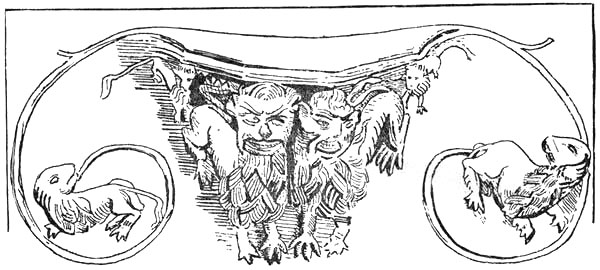
MISERICORDE—LION COMPOSITION, WELLINGBOROUGH.
A favourite place for humourous figures was on the stone brackets or corbels which bear up timber roofs; examples are in the ape corbel in this article, and the responsible yet happy-looking saint at the end of the list of Contents.
When the Perpendicular style came with other arts from Italy, and the lavish spread of the Decorated was chastened and over-chastened into regularity, there came for the second or third time the same ideas from the never-dying mythologies, their concrete embodiments sometimes with eloquence rendered, nearly always with vigour. They came to the old places, but in most fulness to that most full place, the dark recess where lurks the misericorde.
Upon the whole it would appear that the grotesque, be it in the relics of a long-forgotten symbolism, in crude attempts at realism, or in the fantastic whimseys of irresponsibility, is chiefly met in the portions of the church where would occur, in the development of architecture, the problems and difficulties. They occur, so to speak, at the joints of construction. It may be that the pluteresques (grotesque and other ornaments made of metal) employed in many Spanish churches are to be accounted for in this way on the score of the facility of attachment. Where it may be questioned that the ornament was to conceal juncture, it is often to be acknowledged that it was to give external apparent lightness to masses which are in themselves joints or centres of weight. To conclude—to whatever extent we may carry our inquiries into the meaning of the grotesques in church art, we have in them undoubtedly objects whose associations are among the most ancient of the human race; whatever our opinion of their fitness for a place in the temple, it is plain that practically they could be nowhere else.
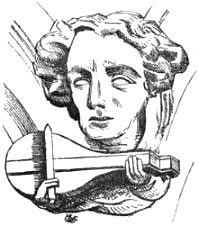
MUSICIAN ON THE INTERSECTION OF NAVE ARCHES, ST. HELEN’S, ABINGDON, BERKSHIRE.
Index.
Abdominal Mask, 91 Abingdon, 18, 72, 218, and Preface Aboo-Simbel Trinity, 177 Abydos Trinity, 177 Acanthus, 149-50, 214 Adam, 61, 62, 74; and Eve, 112, 120 Adam Clarke, 74 Adel, Yorkshire, 127 Adonai, 168 Adonis, 168 Adoration, the, 113-5 Ælian, 50 Æsculapius, 42 Æsop’s Fables, 196 Africa, 66 Agni, 178 Aix-la-Chapelle, 46 Akori, 178 Alcock, Bishop, 10, 92, 173 Ale and the Alewife, 99-105 Alewife, 97 Alehouses, 99 Ale-taster, 100 Alexander, 71 Alexandria, 34 All Souls, Oxford, 71, 76, 104-5, 150-1 Alraun images, 28 Altar of the Sun, 37-39 Ambarvalia, 48 American Arms, 179 American-Indian mythology, 159 American-Indian Trinity, 177 Amman, Justus, 188 Ammon, 42, 72, 158 Amun-Ra, 177 Ancient Mysteries described, 180 Ancient Worships, 27-59, 64-77, 152-3, 157-168, 175-183 Angel Choir, Lincoln, 3, 9 Angel (coin), 47 Angels, 63 Animal Musicians, 152-6 Animal symbolism, 35 Anthony pig, the, 154 Anuka, 178 Archers, 205, 209-10 Ape, the, 59, 28-9, 145, 152, 156, 192-4, 198, 201, 203, 207-10, 214 Aphrodite, 168 Apocryphal New Testament, the, 60, 112 Apollo, 21, 46, 162, 165 April, 141 Apuleius, 41 Architectural Museum, Tufton Street, the, 12, 167, 169, 174 Arimanes, 176 Arles, the Council of, 29 Arma palantes, 173 Arthur, King, 69 Artistic quality of Church grotesques, 19-23, 61 Art Journal, the, 66 Asir, 45 Assyrian myth, 34, 157, 181 Assyrians, no record of their humour, 6 Astronomical symbols a source of Gothic design, 4, 27-8, 37-59, 73, 157-68, 177 Atahuata, 177 Aten, 168 Athor, 111, 157, 167, 177-8 Athyr, 167 Attic figurines, 28 Auckland Castle, 155 Augsburgh, (?) Council of, 30 “Auld Clootie,” 70 “Auld Hornie,” 70 Aurva, 53 Avarice, 87, 91-95 Averus (Horus), 50 Baalim, 28 Babylonian myth, 34 Bacon, 142, 154 Bacchus, 69, 73, 158 Backbiter, 82-84 Badger Grimbart, 189, 191-3 Bagpipes, 103, 152, 155 Ba-it, 178 Baker, 105 Bakewell, Derbyshire, 130-1 Baldini and Boticelli, 84 Baptism of John, the, 117-8 Barton, Lincs., 174 Basketsful of Children, 63 Bayle, a kind of dance, 147 Beakheads, 125-6 Bear Bruno, 190-3 Bear, the, 152-156 Beard, the, 72 Bedford, 175 Beehive of the Romishe Church, 180 Bellin the Ram, 192 Berkshire, 18, 72, 125, 129, 218 Bestiaries, the, 73 Beverley, Percy Shrine at, 3; Carvings at, 13, 39, 40, 54, 57, 63, 87, 112, 120-3, 130, 133-6, 144, 152, 154-5, 159, 173, 182, 195-6, 198-9, 201-2, 208-11 Bhu, 42 Bible (as Old and New Testaments), 176 Biblia Pauperum, 113 Birch, Dr., 158 Birds, 4, 9, 22, 38, 39 Bishop Foxes, 199, 203 Bishops Stortford, 109 Blashill, Mr. Thomas, 106 Bo, Bo-tree. Bod, Bog, Boggart, Boivani, Bolay, Boo, Bouders, Boudons, Boroon, Bormania, Borr, Borvo, Bouljanus, Brog, Bug, Bugbear, Buggaboo, Buka, 66, 69 Boar, 139-40, 152 Boar’s Head, 69, 139 Bodleian Library, 16, 63 Bolton, Bishop, 173 Boston, Lincolnshire, 195, 196, 202, 208 Boutell, Rev. C., 25 Bow and arrow, 162-5 Boy (Bog), 69 Brahma, 178 Brahminic Trinity, 178 Breast, removal of, 165 Bridge, Kent, 75 Bridlington Priory Church, Yorks, 15, 210-1 Bristol, 196, 208 British Museum, 62 Bruno the Bear, 190-3 Buckle Mask, 125 Bull, the, 41-2, 72-3, 85, 88-9, 91, 159 Bur, 45 Byzantine ideas, 127 Byzantium, 35 Caimis, 50 Calendarum Romanorum Magnum, 141 Calf, 73 Cama, 50 Cambridge, 10, 92, 133 Cambridgeshire, 74 Candlemas, 42, 140 Canterbury, 139 Canting heraldry, 173 Caricature in part explained, 3 Carpenter, Mr. Edward, 186 Cartmel, 180, 196 Carvers, 9-18 Cat, the, 156, 189, 191, 209 Cat and Fiddle, the, 39-43 Cat-heads, 126 Caxton, 170, 188 Cedranus, 143-4 Centaur, 161-6 Cerealia, 48 Ceres, 72, 153, 158 Cestus, 165 Chairs, 141 Châlons, Council of, 143 Chandra, Chandri, 43 Cherubim, 73, 159, 161 Chester, 60, 77, 103, 207, 210 Chichester, 72, 75, 124, 141, 157, 181, 182, 203 Chiron the Centaur, 162 Chnoumis, 178 Chonso, 177 Christ, 30, 48, 60-62, 104, 114-20 Christchurch (Hants), 21, 33, 172, 184, 202 Christmas, 139-40, 144 Chronicles, the Book of, 176 Church symbolism, expediency, etc., 31 Ciaran (St.), 162 Clergy, the, 97, 111 Cneph, 177 Cock, the, 184, 197-8, 202-3 Compound Forms, 37, 111, 157-168 Coney, the, 193, 204-5 Conscience, 170-1 Constantinople, Council of, 30; Byzantium, 35 Continuous group, 149 Conventional form a matter of development, 3 Corinthian Acanthus, 149-50, 214 Corpus Christi Play, 142-3 Cosmographiæ Universalis, 172 Cotton MSS., 82, 147 Councils, Arles, 29; Augsburgh (?), 30; Constantinople, 30; Frankfurt, 30, 99; Narbonne, 30; Nicea, 30; Orleans, 29; Tours, 30; Nice, 36; Milan, 36 Coventry, 60, 142 Cow, the, 41 Creators, Mythological, 176-8 Crescent, the, 41, 42 Cripple, 145, 147 Crocodile, 44-5 Crórásura, 153 Cross, the, 43 Crow and his wife, the, 193, 204-5 Croziers, 198, 202 Crusaders, 47 Culham, Berkshire, 125 Cupid, 50, 51, 53-55 Dance, 40, 43, 144, 147 David, King, 62 Decorated Carvings, 214-217 Deer, 140 Definitions of the Grotesque, 5-8 De la Wich, Bishop, 181 Delft, 188 Derbyshire, 130-1 Design, Continuity of Gothic, 4 Detractors, 82-3 Devil and the Vices, the, 78-98 Devil, the, 47, 69, 70, 77, 103-5 Devils, 63, 119 Diana, 32, 40-43, 73 Diapason, the, 41 Dillin pig, the, 154 Disc of the Sun, 167-8 Distaff, 195 Dog, 5, 19, 21, 40, 42, 142, 159-60, 189 Domestic and Popular, the, 134-151 Donnington, Thomas (1520), 174 Dorchester Abbey, Oxon., 60, 64-5, 121-2, 133, 159-60 Dragons, 26, 37, 44-57, 60, 64-66, 84, 127, 165, 177, 211 Drake (dragon), 47 Druidical Tau, 43-4 Drum (Tabor), 97 Durer, Albert, 61 Durham, 155 Eagle, the, 22, 37, 148, 158-9, 202 Early English Carvings, 214 Eastern ideas, 9-10, 34-5 Eden, 73, 76 Edgeware, 102 Edward the Confessor, 9 Edward III., 17 Edward IV., 49 Egypt, 34, 43-45 Egyptians, little record of their humour, 6 Egyptian myth, etc., 34, 41-5, 47-8, 50-6, 157-8, 177-8 Egyptian Trinities, 177-8 Eicton, 177 Elephantine Trinity, 178 Ely, 74, 80-1, 84, 105, 166, 195-6 Equinoxes, the, 175 Eschol, 171 Esculapius, 178 Etchingham, 196 Evans, Mr. E. P., 35, 85 Evil, Images of, 1, 26, 33 Eve, 62, 74 Ewelme, Oxon., Carvings at, 1, 65, 67 (not Dorchester), 76, 127-8, 214 Exeter, 4, 39, 165, 168, 181 Ezekiel, 159 Fable, 186 Fafnir the Dragon, 46 Fairford, 195 Fairies, 66 Falx, the, 57 Farnsham, 65 Fates, the, 178 Fauns, 69 Faversham, Kent, 180, 195, 210 Feast of Fools, the, 143-7 Feathered Angels, 75-7 Fecundity, Goddess of, 66, 72 Fiddle, 40, 41, 153 Figurines as lares, 28 Finedon, Northamptonshire, 125 Fire, 178 Fish, 182 Flagellation, 134 Flanders, a church workshop, 9, 15 Flesh hook, 63, 87, 182 Fleur-de-lys, 39, 179 Flora, 158 Fools, 130 Fools, the Feast of, 143-7 Foreign carvers, 9-18 Fox, the, 58-9, 184-212 Fox and Grapes, the, 210 Fox and Stork, the, 210-1 France, 48 Frankfort, Council of, 30, 99 Fredegarius, 197 Freemasonry, 16, 17 French work for Saxons, 9 Frigga, 53 Freyr, 153 Furies, the, 178 Gallows, the, 207-9 Ganges, the, 172 Gargonilles, 46, 129 Gaul, 66 Gaul, Bishops of, 30 Gauri, 43 Gautier de Coinsi, 36 Gayton, Northants, 81, 86, 87 Geese, Reynard’s theft of, etc., 191, 195, 198, 203 Gehul, 153 George IV., 17 German “teraphim,” 28; paganism, 30 Germany, Bishops of, 30 Ghent, 188 Gild, continuity the explanation of continuity of design, 4, 35, 196 (see Freemasonry) Gilds, 70 Glasgow, 65, 66, 77 Gloucester, 195 Gluttony, 88 Goat, the, 69, 71-3, 187 Goethe, 189 Golden Bristle, 153 Gorgon, 127 Gothic ornament, uses of, etc., 2, 3; some characteristics of, 2, 3, 4, 6, 7, 8, 10, 19-23, 24-26, 35-39, 49, 54; not didactic, 24-26; situations of, 213, 218 Gouda, 188 Graces, the, 178 Gravio, Count, 30 Great Malvern, 172, 209 Grecian Trinity, 177 Greek wit, 6; star-worship, 28; myth, 34, 41, 177-8; art, 36-37; symbolism 74; dances, 147 Grimace-makers, 130, 133 Grimbart, the Badger, 189, 191-3 Grimm, 186 Gryphon, 125, 158 Guildford, Surrey, 117-8 Gullinbrusti, 153 Hades, 42, 161 Hænir, 177 Hak, 178 Hampshire, 21, 33, 172 Hanging of the Cat, 209 Hanging of the Fox, 207-8 Hare, the, 106-7, 182, 189, 192, 194, 203 Harleian MSS., 104 Harmachis, 158 Harp, the, 140-1, 153, 154, 155 Harpy, the, 4, 111, 166, 181 Hebrew Teraphim, 28 Hecate, 41, 42 Heliopolis, Trinity of, 178 Hell, 48, 84, 104 Hell’s Mouth, 60-63, 103, 196 Hen, the, 195, 203 Henning the Cock, 190 Henry VI., 16, 62 Henry VII.’s Chapel, 10, 91, 95, 148, 156, 173 Henry VIII., 16, 49 Hera, 177 Heraldry, canting, 173 Heraldry and three-fold repetitions, 179 Hercules, 148, 177 Hereford, 195 Herodotus, 28, 50 Hertfordshire, 109 Het-her, 167 Hexagon, symbolic, 179 Hezekiah, 74 Hindoo myth, 28, 42-45, 50, 53, 153, 178 Hinge the Cat, 191 Hippocampus, Lincoln, 26 Hippo-centaurs, 161 Hobgoblins, 66 Hogarth, 20, 21 Holy Cross, Stratford-on-Avon, 60 Holy Trinity, Hull, 139-40 Holderness, 106 Homer, 160 Hone, 180 Hopton, 174 Horace, 157 Horns, 70; Horn, 73 Horse, the, 162, 139 Horse-leech, 110-1 Horus, 45, 48, 50-56, 57, 72, 177, 178 Hull, 10, 100, 139-40 Humour, of nations, 6, 7; defined, 20 Hunting, 140 Huntsman, 139 Husterlo, 192 Hypocrisy, 98 Ibis, 167 Iceland, 153 Idun, 76 Iffley, 49, 126, 162, 163 Imagery in Architecture and Language compared, 1-3 Impudence, 109 Indecency in church, 143-7, 150-1 India, 172 Indian mask, 123-4 Indian mythology, East, 66, 69, 178 Indian Trinity, American, 177 Indra, 178 Irenæus, 73 Irreverence in art explained in part, 8 Isaiah, 74 Isengrinus, 187 Isis, 41, 42, 45, 50, 177 Islip, Bishop, 173 Italian workers in England, 9, 10, 13 Italy, 41 Italy, Bishops of, 30 Janus, 180 Japanese (crocodile), 45 Jesus College, Cambridge, 92 Joke, the, 6 Jonah, 112-3, 197 Jörmungard, 45 Jove (Jupiter), 11 July, 183 Juno, 177 Jupiter, 21, 57, 148, 158, 177, 178, 181 Jurassic reptiles, 145 Keltic dragons, 49 Kent, 75, 180, 182 Khum, 178 King Arthur, 69 King Edward the Confessor, 9 King Edward III., 17 King Edward IV., 49 King George IV., 17 King Henry VI., 16, 62 King Henry VII., 147 King Henry VII. Chapel, 10, 173 King Henry VIII., 16, 49 King’s College, Cambridge, 10, 133 Lampe the Hare, 192, 194 Lares, 43 Laughter of nations, 6-7; defined, 20 Lectern, 202 Leicester, 196 Leland, John, 16 Lemon, 139-40 Leo, 158 Leopard, The, 189 Lincoln Cathedral, 3, 9, 38, 51, 54, 63, 128, 133 Lincolnshire, 11, 174 Lind-drake, 47 Linden worm, 47 Linden tree, 47 Line of Beauty, 20 Lion, 5, 158, 183, 187, 189-90, 210-1, 215 Lioness, The, 193 Little-trust, Lettice, 101 Lodur, 177 Loki, 76, 77 Love, 53 Lubeck, 188 Lucifer, 53, 76 Ludlow, 99, 102, 103 Luna, 41, 43 Lunar calculations of Mosaic system, 176 Lunus, 43 Lydda, 47 Lynn, 11, 174 Macrobius, 32 Magdalen College, Oxford, 195 Magi, Adoration of the, 113-5 Maidstone, 182 Maimonides, the Rabbi, 27 Malepart, 190, 193 Malvern, Great, 172, 209 Manchester, 54, 55, 203-4, 195, 196 Mandragora images, 28 Mann, Mr. Robert, 66 Mant, 177 Mare and foal, the story of, 193 Mars, 21 Marks, sculptors’, ignored; an example is on p. 103 Martinmas, 139, 154 Martin the Ape, 192-3 Mary, the Virgin, 34, 42, 82, 83 Masks and Faces, 121-133 Meaux Abbey, Yorkshire, 10 Memphis, Trinity of, 178 Mendes, 72 Mentu, 177 Merchant mark, 174 Mercury, 21, 49, 78, 153, 158, 167 Merenphtah, 178 Mermaid, 160 Messon, 177 Mexican myth, 157 Mice, 40, 43, 209 Michael Angelo, 10, 13 Midsummer Watch, 77 Milan, Council of, 36 Minerva, 21, 74, 177 Miracle Plays, 70 Mirror of Human Salvation, the, 113 Misericordes, 24-5, 181, 215, 217 Mithras, 176 Monstrosity, 147 Montflaucon, 197 Moon worship, 32, 40, 43 Morris Dance, 144, 147 Mosaic system, 31; Ark, 159, 175; not the original of pagan myth, 175-6 Moses, 62, 74, 175 Mouth of Hell, 60, 63 Mowers, 182 Mumming, 70, 168 Music, 140, 152 Monograms, 12 Mystery Plays, 32, 48, 70, 82, 103, 112, 142-3 Mythic origin of Church carvings, 34-59 Nachasch, 73 Nantwich, Cheshire, 196, 204-5, 208 Narbonne, the Council of, 30 Nebhetp, 178 Nefer-Atum, 178 Neptune, 21, 178 Nerites, 50 Nessus the Centaur, 162 New College, Oxford, 58-9, 81, 84-5, 98, 106, 149 Nice, 36 Nicea, the Council of, 30 Nicodemus, the Gospel of, 60 Nile, the River, 45, 71, 158 Nilus, 45, 158; St. Nilus, see Saints Nobodies, 171 Non-descripts, 169-172 Norfolk, 48, 75, 195 Norman carvings, 49, 125, 127, 129, 163, 211, 213; fonts 15 North Stoke, 119 Northamptonshire, 14, 22, 81, 84, 86-7, 101, 125 Norwich, 48, 75, 195 Notch-heads, 124-5 Nouvel the Lion, 189 Numbers, the Book of, 176 Nuns, 106-7 Nursery Rhymes, 39 Oak, the, 148, 181 Odin, 45, 53, 69, 177 Opas, 177 Orleans, the Council of, 143 Ornament, the use of Gothic, 2 Oromasdes, 176 Orus (see Horus), 50, 72 Osiris, 41, 45, 50, 57, 158, 177 Otkon, 177 Ox, 71, 73, 160 Oxford, 58, 59, 71, 76, 81, 84, 85, 97, 104-6, 149, 151, 195 Oxfordshire, 49, 60, 64-5, 67, 105, 121-2, 133, 159 Paganism, ingrained among nations, 27 Pallas, 177 Palmer Fox, 58 Pan, 21, 72-3, 105 Pantheism, 32 Panther, the, 159 Paris, Paulin, 197 Parody, a characteristic of Greek wit, 7 Pátála, 42 Pastoral staves, 49 Pausanius, 44 Pegasus, 162 Pepin, 30 Percy Shrine, 3 Perpendicular Ornament, 217 Persephone, 41 Perseus, 46, 57 Persian Trinity, 176 Peterborough, 195 Philæan Trinity, 176 Philippians, the Epistle to the, 196 Phipson, Miss, 14, 109, and preface Phyrric Dance, the, 147 Picture Bible, the, 113, 197 Pig and Whistle, 155, 156 Pig, and other Animal Musicians, the, 110, 152-6 Piggy-widdy, 154 Pilgremage of the Sowle, the, 170 Pipes, Double, 155 Planet symbols, 28 Plato, 28 Plutarch, 41 Pluteresques, 218 Pluto, 42, 177-8 Poor Man’s Bible, the, 113, 197 Poppy, Assyrian, 182 Pottery, 35 Preaching Fox, the, 184, 196-204 Priapus, 73 Prideaux, Bishop, 30 Priest sleeping, 106, 110-1 Prosperine, 32, 41-2, 177 Protevan, 82 Psyche, 176 Pta, 177-8 Pulpits, 184, 197-8, 201 Puránas, 43 Python, the, 46 Ra, 168, 177 Rabbi Maimonides, 27 Ráhu, 44 Ram, the, 72, 187, 192 Ram Bellin, 192-3 Ram’s Head, 19 Ram, the Hindoo deity, 28 Rebuses, 12, 173-4 Recording Imps, 78-9, 81, 84-5, 103 Red Sea, the, 50 Reinche Bos, 188 Renart le Contrefet, 188 Reynard the Fox, 184 Reynard the Fox, the most delectable history of, 188 Ripon, 5, 112-3, 124, 136-7, 155, 171, 195-8, 211 Rochester, 127 Rogation, 48 Roman de Renart, 188 Roman Trinity, 177 Roman, Wit bitter and low, 6-7; myth, 42-3 Roman work for Saxons, 9 Roscommon, the Poet, 157 Roslyn Chapel, 128-9 Rostock, 188 Rothwell, Northants, 84 Sabean Idolatry, 28 Sackville the Poet, 63 Sacred Marks, 103 (block), 179 Sæhrimnir, 153 Sagittarius, 162-5 Saints—Adrian, 99 Anthony, 154 Augustine, 31 Bartholomew’s, Smithfield, 173 Bernard of Clairvaux, 23, 27, 36-7 Britius, 81 Ciaran, 162 Cross, Hospital of, Winchester, 100 George, 47-8, 57 George’s Chapel, Windsor, 10, 167, 195-6, 203 Gertrude, 43 Helen’s, Abingdon, 218 John, 49, 118 Katherine’s, Regent’s Park, 78, 81, 83, 86, 169 Keyne, 46 Lucy, 134-5 Luke, 73 Martha, 46 Michael, 47, 76 Martin’s, Leicester, 196 Martin, 81 Mary’s, Beverley, 123 (see Beverley) Mary’s, Faversham, 180 Mary’s Minster, Thanet, 97, 122-3, 130-1, 195 Nessan, 162 Nicholas’s, Lynn, 11-2, 174 Nicholas, 179 Nilus, 36 Paul’s, Bedford, 175 Paul’s, London, 32, 109 Peter’s-in-the-East, Oxford, 126 Romain, 46 Salus, 178 Sambar, 50 Samson, 198 Sani, 53 Satan, 48, 62, 70, 104-6, 170 Satanic Representations, 64-77, 78-105 Sathanus, 170 Satire, 185 Satires without Satan, 106-11 Satyrs, 69 Saturn, 21, 57 Saturnalia, 143 Saxon work, 9 Scandinavian mythology, 45, 76, 153, 157; Trinity, 177 Scarabæus, 178 Scriptural Illustrations, 112-120 Scylla, 160 Scythes, 182 Sea-horse (hippocampus), 26 Seals, 8, and end of Index September, 140, 154 Seraphim, 74 Serapis, 42 Serpent, the, 44-5, 60-1, 73-5, 77 Sex of the Moon, 43 Sheep, 72, 142 Shell, 50-1, 54-5, 57-9, 159 Shell Child, the, 50-9, 159 Shepherd, 72, 142 Sherborne, 134-5, 208 Shiva, 66 Sigurd, 46 Sin series of carvings, 78-111 Sirius, 42 Sismondi, 31 Sistrum, 41, 43 Situations of Church Grotesques, 213-8 Siva, 178 Slanderers, 82 Sledges, 63 Smu, 50 Snail, 57-8 Solomon, King, 62 Sources of material for Gothic grotesques, General, 4 Southleigh, 63 Speculum Humanæ Salvationis, 113 Sperke, John (1520), 174 Spinx, the, 158-9 Springs, 66 SS., the letter, and Collar of, 57 Stanford, Berkshire, 18 Star Worship, 27-8 Stars and Stripes, 179 Statute of Labourers, 17 Stoeffler, 141 Stowlangcroft, 196 Stratford-on-Avon, 60, 129 Suffolk, Duchess of (ob. 1475), 76 Sun, 167 Sun Feast, 153 Sun Worship, 32, 37, 42, 44-59, 71, 153, 158, 162, 175, 210-1 Superstition, Horn, 73 Supreme Intellect, the, 74 Surya, 53, 178 Sutton Courtney, 128-9 Sutton-in-Holderness, 106 Swan, 167 Swar, 42 Swathing of Infants, 114 Swarhánu, 53 Sweden, 153 Swine, Yorkshire, 106-7, 109, 129-30 Symbolism and Fable, 186 Symbols of worship a general source of Gothic ornament, 4, 27 Syderesys, 170 Syria, 47 Tabor (drum), 97 Tarasque, 46 Tau Cross, the, 34, 43-4 Taurus, 73 Telephorus, 178 Teraphim, 28 Teutonic appreciation of humour, 7 Thanet, Isle of, 97, 122, 130-1, 195 Theban Trinity, 177 Theophylact, 143 Thirlwall, 33 Thoth, 78, 167 Three, the number, 162 (see Trinities) Three branched rod, 103 (block), 162, 181-2 Time, Father, 57 Titian, 42 Topsey-turveyism, 149 Torregiano, 10 Tree of Knowledge, the, 74 Trefoil, the, 162, 178-9 Trial of Mary and Joseph, 82 Trigla, 180 Trinities, 168, 175-183 Tufton Street Architectural Museum, 12 Tum, the Setting Sun, 178 Typhon, 44-57, 64-5 Unseen Witness, the, 79, 85, 86, 87 Vali, 114 Vanity, 97 Vedie Trinity, 178 Venus, 21, 53, 111, 148 Veximiel, 62 Virgil, the, 160-1 Virgin Mary, the, 30, 42, 82-3 Virgo, 158 Vishnu, 53, 153, 178 Vulcan, 148, 177 Wall paintings compared with carvings, 114-117, 119-20 Wake Knot, 207-8 Wellingborough, 14, 15, 22, 34, 101, 195, 215 Wells, 65, 77, 150 Westminster Abbey, 9, 10, 91-95, 97, 109-110, 123-4, 156, 173 Wheelbarrows, 135-7, 196 Whistling Maid, the, 104-5 Whistling while drawing ale, 105 White, Wm. (1520), 173-4 Wich, Bishop de la, 124, 181 Winchester, 64, 100, 111, 145, 154, 166, 195 Windsor, 10, 167, 195, 203, 208 Winking Nun, the, 106-7 Wolf, the, 187, 189, 192; story of the wolf’s head, 187 Wolfius, 196 Worcester, 113-5, 142, 160, 161, 182-3, 203 Worm of conscience, the, 170 Wright, Thomas, 197 Wyvern, the, 47 York, 63, 65, 77, 129-30, 140, 148 Yorkshire, 10, 63, 65, 77, 106-7, 109, 127 (see Beverley) Yule, 153 Zeus, 177 Zither, 166 Zodiac, 45, 53
Footnotes:
[1] Early in the thirteenth century unruly converts of the Abbey of Meaux, Yorkshire, were, to humble their pride, made stonemasons, etc.
[2] Of Christ, the Virgin, and saints only. It is here quoted as evidence of a tendency. It is plain that the council protected itself, for the following distich is attributed to it, which sums up the original intent of all images—
“Id Deus est, quod Imago docet, sed non deus ipse; Hanc Videas, sed mente colas; quod cemis in ipse.”
which Prideaux, Bishop of Worcester, translates (1681):
“A God the Image represents, But is no God in kind; That’s the eye’s object, what it shews The object of the mind.”
[3] Yet the Hindoo signification of Typhon is “the power of destruction by heat.” In this we have another piece of evidence that both the good and the bad of the fable are referrable to the sun as his varying attributes, and probably describe his particular effects at various portions of the zodiacal year. The true, or rather the close, meaning of the various accounts is obscured and confused; firstly, by imperfect knowledge as to the geographical situations where the idea of the zodiac was conceived and developed; secondly, by the gradual precession of the Equinoxes during the ages which have elapsed since such conception.
[4] Mr. Robert Mann.
[5] “Sutton-in-Holderness.”
[6] Roscommon.
[7] Hone.
[8] The Church Treasury, by William Andrews, 1898, p. 193.