Preface.
Reading edition
he designs of which this book treats have vast fields outside the English church works to which it has been thought good to limit it. Books and buildings undoubtedly mutually interchanged some forms of their ornaments, yet the temple was the earlier repository of man’s ideas expressed in art, and the proper home of the religious symbolism which forms so large a proportion of my subject. In view also of the ground I have ventured to hint may be taken up as to the derivation, of a larger number than is generally supposed, of church designs from heathen prototypes by the hands of apprenticed masons, it is fitting that the evidences should be from their chisels. The only exceptions are a few wall-paintings, which serve to point a difference in style and origin.
In every case the examples are from churches in our own land. The conclusions do not nearly approach a complete study of the questions, the research to the present, great as it is, chiefly shewing how much has yet to be learned in order to accurately compare the extant with the long-forgotten. The endeavour has been to present sufficient to enable general inferences to be drawn in the right direction.
Of the numerous works consulted in the course of this essay, the most useful has been “Choir Stalls and their Carvings,” sketched by Miss Emma Phipson. While tendering my acknowledgments for much assistance obtained from that lady’s book, I would add that the ‘second series’ suggested cannot but equal the first as a service to the cause of comparative mythology and folk-lore.
This place may be taken to dispose of two kinds of grotesques in church art which belong to my title, though not to my intention.
The memorial erections put into so many churches after the middle of the sixteenth century are to be placed in the same category as the less often ludicrous effigies of earlier times, and may be dismissed as “ugly monumental vanities, miscalled sculpture.” The grotesqueness of some of these sepulchral excrescences may in future centuries be still more apparent, though to many even time cannot supply interest. Not all are like the imposing monument to a doctor in Southwark Cathedral, on which, by the way, the epitaph is mainly devoted to laudation of his pills. Yet, though the grotesque is not entirely wanting in even these monuments, it is chiefly through errors of taste. The worst of them are more pathetic than anything else. The grotesque proper implies a proportion of levity, whereas the earnestness evinced by these effigies are more in keeping with the solemnity of the church’s purpose than the infinitely more artistic and unobtrusive ornament of the fabric. The other class of grotesque is the modern imitation of mediæval carving, with original design. Luckily, it is somewhat rare to find the spirit of the old sculptors animating a modern chisel. One of the best series of modern antiques of this kind is a set of gargoyles at St. Nicholas’s, Abingdon, executed about 1881, of which I think it worth while to append a warning sample.
These two classes are left out of account in the following pages.
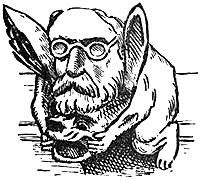
MODERN GARGOYLE, ABINGDON, 1881.
Contents.
PAGE
Preface v
Introduction 1
Definitions of the Grotesque 5
The Carvers 9
The Artistic Qualities of Church Grotesques 19
Gothic Ornament not Didactic 24
Ingrained Paganism 27
Mythic Origin 34
Hell’s Mouth 60
Satanic Representations 64
The Devil and the Vices 78
Ale and the Alewife 99
Satires without Satan 106
Scriptural Illustrations 112
Masks and Faces 121
The Domestic and Popular 134
The Pig and other Animal Musicians 152
Compound Forms 157
Nondescripts 169
Rebuses 173
Trinities 175
The Fox in Church Art 184
Situations of Grotesque Ornament in Church Art 213
Index 219
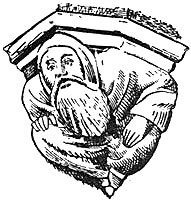
A ROOF SUPPORTER, EWELME, OXON.
The Grotesque in Church Art.