List of Officers who took Part in the Operations October 20-22
Reading edition
Major the Hon. W. R. Bailey, D.S.O. Commanding Officer.
2nd Lieut. J. C. Blunt Acting Adjutant.
Lieut. R. F. W. Echlin Transport Officer.
Lieut. R. G. Buchanan Act.-Quartermaster.
Capt. P. M. Spence, M.C. King's Company.
Lieut. A. M. Brown " "
2nd Lieut. L. E. G. Wall " "
Lieut. C. G. Kennaway No. 2 Company.
2nd Lieut. R. B. Osborne " "
2nd Lieut. M. G. Farquharson " "
Capt. J. H. C. Simpson No. 3 Company.
2nd Lieut. G. S. Lamont " "
2nd Lieut. L. F. A. d'Erlanger " "
2nd Lieut. N. P. Andrews " "
Lieut. A. E. D. Bliss No. 4 Company.
Lieut. R. S. Challands " "
2nd Lieut. C. B. Hall " "
Capt. W. Lindsay, R.A.M.C. Medical Officer.
Capt. the Rev. C. Venables Chaplain.
The night was dark and it was pouring with rain, when the Battalion formed up along the line of railway between Haussy and St. Vaast. It is impossible adequately to describe the absolute wretchedness of forming up on a pitch-dark night in pouring rain. An operation seemed hopeless, and was only possible by giving careful instructions to every single man in the Battalion. Plenty of time was allowed to prepare for this fight, but the Battalion was only just ready when the time came to advance. No. 4 Company, under Lieutenant Bliss, was on the left; No. 3 Company, under Lieutenant Challands, in the centre; and No. 2 Company, under Lieutenant Kennaway, on the right. Touch was obtained with the 8th Battalion Gloucester Regiment in the Nineteenth Division on the left, and with the Irish Guards on the right. The Royal Engineeers had arranged to lay tapes from the railway to the eight temporary bridges, which they had put over the River Selle, but these tapes were not laid until shortly before zero hour, and one tape did not lead to a bridge, with the result that the platoon which followed it had to wade across the river.
Oct. 20.
From the very start everything went well, and the barrage moved with perfect precision. Chasing the Germans in the dark in this way was not without excitement, as no one knew whether they would remain and fight, or retire as soon as they were threatened. It was a great relief to Major Bailey to find that the enemy had no intention of disputing the crossing of the river, as this would have entailed the loss of a number of men at the start. As it was, the Battalion proceeded in artillery formation as far as the Haussy—Solesmes road, passing over five or six lines of rifle-pits wonderfully well made in concrete. When the creeping barrage began to move forward, the Battalion moved with it, but there was little or no opposition, and the objective was gained according to scheduled time. The few prisoners that were captured said that the garrisons of their posts had fled as soon as the barrage began. Direction was admirably kept, and the men advanced close up to the barrage, in spite of the heavy plough on the side of the hill on which they had to advance. The 2nd Battalion Scots Guards and 1st Battalion Welsh Guards then came through, and continued the advance. In the evening the German artillery put down a very heavy barrage on the railway, shifting it later to the road, and then covering the objective and the reverse slope of the hill, but in spite of the shelling the casualties were not heavy.
Oct. 21.
The shelling continued all the next day, but the 3rd Guards Brigade was not required. In the evening the Battalion took over the whole Brigade front from the Scots Guards and Welsh Guards; the King's and No. 3 Companies were placed in the outpost line; and Nos. 2 and 4 Companies took over the main line of resistance on the high ground east of the Solesmes—Vendegies road.
Oct. 22.
The line of the Solesmes road was shelled all day, but the Battalion was very lucky, although No. 4 Company was rather seriously gassed. Lieutenant E. A. D. Bliss and Second Lieutenant C. B. Hall and ten men were all gassed. In the evening the Highland Light Infantry relieved the Battalion, which marched back to billets in St. Vaast. These operations on the whole had been easy, as the Germans had put up very little resistance, but the rain and mud had made everything very miserable, and the men were soaked to the skin before the attack commenced.
In all the villages round about civilians emerged from cellars, having hidden there for five days in order to avoid being evacuated by the Germans. Among the German prisoners, who had been captured during the advance, were several regimental commanders of the true Prussian type, with florid faces and bristling moustaches. They presented a sorry spectacle in the cages, and seemed to feel their position acutely.
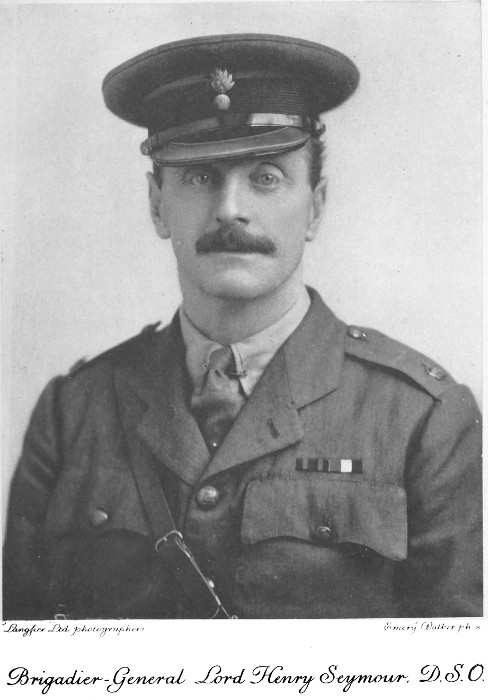
Langfier Ltd photographers Emery Walker ph. sc.
Brigadier-General Lord Henry Seymour, D.S.O.
On the 23rd the following special order was issued:
The Commanding Officer congratulates all ranks on the way in which the attack of the 20th was carried out. The difficulties of a night attack are always great, but in this case they were almost entirely eliminated by the obvious care with which the officers and N.C.O.'s had made their preparations and explained the scheme of attack to their men. No one lost direction, and the orders given out beforehand were carried out almost to the letter.
The conditions have been very bad, but as always you have made the best of things and have kept up the Grenadier tradition of invariable cheerfulness under hardships. You are now out for a short time to reorganise and refit. In a day's time the Battalion will be as keen and smart as it was before, and I am confident that that spirit which has carried you through this attack so well will be as good and keen in any other operation which you may be called upon to perform in future.
I congratulate all ranks, and I sympathise with you for not having found more Germans to kill, which would have made up in some small degree for all the worry and anxiety of the preliminary preparations.
(Signed) W. R. Bailey, Lt.-Col.
Commanding 1st Batt. Gren. Gds.
While the Second Division continued the attack, the 3rd Guards Brigade remained in billets in St. Vaast. On the 25th Lieutenant H. Freeman-Greene and Lieutenant W. A. Pembroke joined the Battalion.
The 2nd Battalion
2nd Batt.
After the operations at the end of September the Battalion bivouacked close to the village of Demicourt for ten days' training. Meanwhile Lieut.-Colonel Rasch, having been appointed to command the 1st Provisional Battalion at Aldershot, left for England, and Major C. F. A. Walker, M.C., took over the 2nd Battalion.
The following officers took part in the fighting on October 9:
Major C. F. A. Walker, M.C. Commanding Officer.
Capt. R. G. Briscoe, M.C. Adjutant.
Lieut. W. H. S. Dent. Intelligence Officer.
Lieut. L. Holbech, M.C. No. 1 Company.
Lieut. C. L. F. Boughey " "
2nd Lieut. E. M. Neill " "
Capt. G. B. Wilson No. 2 Company.
2nd Lieut. D. L. King " "
2nd Lieut. C. J. N. Adams " "
Capt. J. C. Cornforth, M.C. No. 3 Company.
2nd Lieut. K. B. Bibby " "
2nd Lieut. E. G. Harcourt-Vernon " "
Lieut. R. H. R. Palmer No. 4 Company.
Lieut. C. C. Cubitt " "
2nd Lieut. B. R. Osborne " "
Lieut. E. L. Coffin Medical Officer.
During the night of the 7th the Battalion moved into some trenches near Marcoing, and next morning it crossed the St. Quentin Canal at Masnières. The canal was being shelled at the time, but the Battalion escaped without any casualties. Orders were now received for the Battalion to take part in an attack, the first objective being the La Targette—Forenville road, and the second the railway running north-east of Wambaix. In view of the possibility of the enemy being forced to retire, the instructions were that the leading companies were to push on in the general direction of Cattenières.
Oct. 9.
Zero was 6 o'clock on the morning of October 9, and the assembly area for the 1st Guards Brigade was on the line of old German trenches, south-west of Seranvillers. Taking up its position on the left of the line, the Battalion had the 2nd Battalion Coldstream Guards on its right, with the 1st Battalion Irish Guards in reserve. In conjunction with this force, the 2nd Guards Brigade was to advance on the left and the New Zealand Division on the right, and the boundary between the two leading battalions was the main road through Seranvillers and Wambaix.
It had been arranged for the barrage to descend on the first objective, and so the 2nd Battalion Grenadiers and 2nd Battalion Coldstream were able to start moving slowly forward ten minutes before zero hour. No. 3 Company of the Battalion, under Captain Cornforth, was on the right and No. 4 Company, under Lieutenant Palmer, on the left, while No. 2 Company, under Captain Wilson, was in support, and No. 1 Company, under Lieutenant Holbech, in reserve. The foremost companies advanced in waves, and the supports and reserves in artillery formation, preceded by strong patrols, Captain Wilson's company being responsible for clearing the village of Seranvillers. Two howitzers, a field-gun, several machine-guns, and a few prisoners were captured without any real opposition, and the Battalion pushed on very rapidly to within a short distance of Cattenières, where the patrols were sent ahead through the village.
But as soon as they emerged from Cattenières, and came on to the ridge to the north they were held up by heavy machine-gun fire from the wood surrounding the factory at Ignies-le-Petit. There was a considerable stretch of open ground in front of the wood, and progress became very difficult. Lieutenant Palmer, commanding No. 4 Company, ordered Second Lieutenant Osborne to try and advance with his platoon on the left in order to enfilade the enemy in the south-east corner of the wood. A certain amount of ground was gained by sectional rushes under extremely heavy machine-gun fire, but the complete lack of "dead" ground made real success impossible, and Major Walker decided to postpone any farther move until it could be made under cover of darkness.
A wonderfully gallant piece of work during this part of the fighting was done by No. 16796 Private Edgar Holmes, and won for him the Victoria Cross, which unfortunately he did not live to receive. He was acting as a stretcher-bearer, and calmly and fearlessly went on with his errands of mercy to the wounded under a withering machine-gun fire. He succeeded in getting two men in, and, quite regardless of the intense fire at close range, was attending to a third when he was himself hit in the stomach. He did not falter for a moment, and, paying no attention to his own wound, went forward once more to rescue yet another of the fallen. He had covered thirty yards in the direction of the enemy when he was hit again, this time fatally.
At 1 A.M. on October 10 Major Walker brought up the support and reserve companies, and directed them to attack the wood and factory at Ignies-le-Petit. They rushed the factory, encountering little resistance, and then took up a line and dug in on the farther edge of the wood, beyond the main road. The whole advance was a complete success, and the casualties of the Battalion were only one man killed and 12 wounded. Four hours after the attack began, the 1st Battalion Irish Guards passed through the Battalion, and went in pursuit of the retreating Germans.
For the week that followed the Battalion was in Brigade Reserve, and moved slowly forward through Fresnoy Farm, Bévillers, Quiévy, Boussières to St. Hilaire, when it prepared for the forthcoming attack.
In the operations on the 20th the officers engaged were:
Major C. F. A. Walker, M.C. Commanding Officer.
Lieut. S. T. S. Clarke, M.C. Adjutant.
2nd Lieut. A. F. Alington Intelligence Officer.
Lieut. L. Holbech, M.C. No. 1 Company.
Lieut. C. L. F. Boughey " "
2nd Lieut. E. M. Neill " "
Capt. G. B. Wilson No. 2 Company.
2nd Lieut. D. L. King " "
2nd Lieut. C. J. N. Adams " "
Capt. L. St. L. Hermon-Hodge No. 3 Company.
2nd Lieut. K. B. Bibby " "
2nd Lieut. E. G. Harcourt-Vernon " "
Lieut. H. B. G. Morgan, M.C. No. 4 Company.
Lieut. C. C. Cubitt " "
2nd Lieut. B. R. Osborne " "
Lieut. E. L. Coffin Medical Officer.
This attack was only part of a very extensive movement on the whole of the Third Army front. The Sixty-first Division was ordered to advance on the right of the Guards Division, and the Nineteenth Division, under Major-General Jefferies, on the left. Acting as the leading battalion on the right of the Guards Division, the 2nd Battalion Grenadier Guards had the Valenciennes—Solesmes road as its first objective, and, for its second, a line about a quarter of a mile west of the villages of Vertain and Romeries. The capture of Solesmes, which was known to be full of civilians, and strongly held by the enemy, was entrusted to the Sixty-first Division, while the Guards Division was to push right on to its final objective. This gave the Battalion the delicate and dangerous task of advancing the whole way with an exposed flank. Two other features added to the difficulty of the manœuvre. The long distance to the final objective had to be traversed under cover of darkness, and before it could reach the outskirts of Solesmes, known as St. Python, the Battalion had to cross the River Selle.
Oct. 19.
Leaving St. Hilaire at 9.30 P.M. on the 19th inst., the Battalion followed the 1st Battalion Irish Guards until it reached its assembly position, which was the railway running from Haussy to Solesmes. No. 1 Company under Lieutenant Holbech was on the right, No. 2 Company on the left under Captain Wilson, No. 3 under Captain Hermon-Hodge in support, and No. 4 under Lieutenant Morgan in reserve. A drizzling rain fell incessantly, and though the moon was full it was a very dark night.
Oct. 20.
At zero hour, 2 A.M., under a heavy and very effective barrage, the Battalion advanced to the river in artillery formation, guided by tapes. Very indifferent bridges had been erected by the Royal Engineers and the Pioneer Battalion of the Coldstream Guards, and it was no easy matter getting all the men across in single file on two extremely narrow planks. However, there were very few casualties, and the leading companies deployed into waves, and went forward, followed by the supports and reserves in artillery formation. Very soon after the start No. 1 Company got to St. Python, but as it was entering it came under heavy machine-gun fire from the houses. Some useful bombing work was carried out at this juncture, especially by No. 1 platoon, led by Corporal Hunter. As the barrage was moving forward, Lieutenant Holbech decided to leave one platoon to complete the capture of St. Python, supported by No. 3 Company, while the rest of the leading companies went on to their first objective, which they reached almost to schedule time. About 50 prisoners and several machine-guns were captured in this stage of the attack.
There was an hour's halt at this point, in the course of which the remaining platoon of No. 1 Company joined up with the leading troops. It had been uphill work all the way, with a good deal of wire to get through, and it had been found necessary to constitute No. 3 Company a defensive flank. Just before another move was due, a party of the enemy was seen on the right rear of the Battalion, firing lights towards Solesmes. One platoon under Lieutenant Holbech wheeled about, and charged it from the rear, "getting home" with the bayonet and capturing several machine-guns.
The final objective was reached soon after 4 o'clock. But the Germans were inclined to hold on to their positions, and all the way the two leading companies met with resistance. This was partly owing to machine-gun fire from the right flank, as up to this time Solesmes had not yet been cleared by the Sixty-first Division. On the line of the final objective No. 1 Company took a field-gun with its garrison of one officer and 25 men—which brought the total captures of the Battalion in the attack up to 200 prisoners, two field-guns, and a large number of machine-guns and trench mortars.
By daylight the leading companies had consolidated their line of outposts, and in order to protect the right rear of the Battalion, No. 3 Company dug in in échelon to the right flank, with No. 4 Company in rear of it. About 9 A.M. the Sixty-first Division continued its advance from Solesmes, and came up into line with the Battalion. Soon after dawn heavy enemy machine-gun fire had been brought to bear upon the leading companies, and continued for several hours, while the German artillery, which up to this time had taken little part in the operations, began to assert itself, and shells of every sort fell round the battalion. Lieutenant E. M. Neill, who had been conspicuous for his work and bravery during the advance, was wounded by shell-fire, and the total casualties were one officer and 52 other ranks. On the evening of the 22nd the Battalion was relieved by the 24th Royal Fusiliers, and marched back to St. Vaast, where it "embussed" for Carnières. There it remained until the end of the month, when it moved on to St. Hilaire, proceeding the following day to Capelle.
The 3rd Battalion
3rd Batt.
In the first week in October the Battalion remained at Doignies, where during a practice attack a barrage from a smoke rifle grenade was tried, and on the 8th moved to Premy Chapel. An attack was being made by the Sixty-second Division, and the Battalion, which was not called upon, moved on later to Masnières. Cambrai could be seen in the distance burning fiercely throughout the night.
On the 9th the orders were not received until the Battalion was in its assembly position.
The following officers took part in these operations:
Lieut.-Colonel the Viscount Lascelles, D.S.O. Commanding Officer.
Capt. E. G. A. Fitzgerald, D.S.O. Adjutant.
Lieut. R. C. G. de Reuter Intelligence Officer.
Capt. E. R. M. Fryer, M.C. No. 1 Company.
Lieut. K. A. Campbell, D.S.O. " "
2nd Lieut. G. R. Gunther, M.C. " "
Capt. A. H. S. Adair, M.C. No. 2 Company.
Lieut. S. G. Fairbairn, M.C. " "
Lieut. C. B. Hollins " "
Lieut. F. Anson, M.C. No. 3 Company.
2nd Lieut. H. J. Gibbon, M.C. " "
Capt. E. J. Bunbury, M.C. No. 4 Company.
2nd Lieut. A. E. F. F. Strangways-Rogers " "
2nd Lieut. H. I'B. Smith " "
2nd Lieut. R. P. Papillon " "
Capt. J. H. Graff, U.S.A.M.O.R.C. Medical Officer.
Capt. the Rev. S. Phillimore, M.C. Chaplain.
Oct. 9.
In the early part of the attack one of our guns appears to have been badly laid, with the result that it continued to shoot short, causing several casualties among the leading companies of the Battalion. This was particularly irritating, since only a short time before these companies had been mistaken for the enemy, and had been fired at by one of our own aeroplanes. The first objective was taken by 6.30, and no Germans were encountered, the only casualties being caused by our barrage.
The Battalion started off with No. 1 Company under Captain Fryer on the right, No. 2 under Captain Adair on the left, No. 3 under Lieutenant Anson in support, and No. 4 under Captain Bunbury in reserve. As there seemed every possibility of the Germans retiring rapidly, the scheme of attack was ambitious, with a large extent of ground to be covered. The first objective was a trench running from Niergnies to Seranvillers; the second objective the road running from Cambrai to La Targette; and after that there were four "bounds," ending up with the Cambrai—Beauvois road. There was no sign of the enemy, not even any hostile shelling at first, and no difficulty was experienced in securing the objectives. In the second bound, Wambaix Copse, which might possibly have been held by the enemy, was also taken without opposition. At 10.30 the capture of Estourmel was effected, and still the enemy had shown no sign of fighting. Lord Lascelles decided that the dinners should be eaten now, and as the 1st Guards Brigade had not come up there was plenty of time for the men to dine before resuming the advance. It was not until the Battalion reached the Cambrai—Beauvois road and Igniel-dit-les-Frisettes that the enemy's resistance stiffened, and it suffered casualties. Captain Adair with No. 2 Company occupied Igniel, but reported that casualties were occurring from machine-gun fire on his right, and from the enemy's heavy guns at long range. This village was in a clump of trees on the crest of a hill on the farther side of the Cambrai—Beauvois road, and was approached by a sunken road, on each side of which the ground rose in a gentle slope, and formed an ideal position for machine-guns. Captain Adair advanced up the sunken road, and as soon as his company appeared on the hill it was subjected to a harassing machine-gun fire. He at first ordered his men to dig themselves in, but later he decided to move up into Igniel-dit-les-Frisettes. When No. 2 Company moved into the trees and buildings, it was so heavily shelled that Lord Lascelles, who had come up to see how the situation was developing, told him his men would be safer out in the open. There seems little doubt that the German ammunition was already deteriorating, for when their shells burst the pieces did not scatter so well as before. But for this the casualties would certainly have been very heavy, and in all probability it would have been found necessary to retire from the hill altogether. At 4.30 P.M. Lord Lascelles received instructions to support a cavalry patrol of the Oxfordshire Hussars, which had been sent out through the 1st Battalion Coldstream on the left. He was surprised at this message, for he knew that no cavalry patrol could possibly go out in the face of this machine-gun fire, and when the officer commanding the patrol appeared at the Battalion Headquarters to say that it had been unable to go forward at all, he was able to disregard the order, and send in a report asking for confirmation of his action. In the evening orders were received to establish an outpost line with two companies over the Cambrai—Beauvois road, with two companies in support near Estourmel. That night a warning order was received for a farther advance the next morning, and the Battalion Headquarters moved up to Grand Chanfemel.
Oct. 10.
The next morning the 1st Battalion Scots Guards passed through the outpost line, and continued the advance by bounds, while the Battalion moved forward in support. No. 3 Company on the right, under Lieutenant Anson, and No. 4, under Captain Bunbury, formed the support, with the other two companies in reserve. In the afternoon the Scots Guards were held up west of St. Hilaire, and were ordered to establish an outpost line for the night. Nos. 3 and 4 Companies were placed under the orders of the Officer Commanding the 1st Battalion Scots Guards, while two companies of the 1st Battalion Coldstream were sent up to take their place.
On the 11th the 1st Guards Brigade passed through the outpost line, and continued the advance, while the Battalion went into very comfortable billets in St. Hilaire, where the German baths were used. On the 13th the 2nd Guards Brigade passed through with the 3rd Battalion Grenadiers on the right, the 1st Battalion Coldstream on the left, and the 1st Battalion Scots Guards in reserve. These Battalions were ordered to be at immediate notice to move in case the 3rd Guards Brigade, which was crossing the Selle River, should require assistance, but the warning orders were later cancelled; and that night the Battalion relieved the 2nd Battalion Scots Guards in the front line along the Selle River. Second Lieutenant Gunther with a patrol of eight men crossed the river, and surprised a German whom he gagged and brought back. He reported that the enemy seemed in a sleepy and disorganised state, and Lord Lascelles accordingly asked for permission to push a company across the river that night, but was told instead to establish a bridgehead on the following night north of St. Python.
The erection of a bridgehead so near to so many houses was a matter of some difficulty, since it was obvious that the crossing could not be held if the enemy occupied houses within 300 yards of it. Lord Lascelles therefore ordered Lieutenant H. I'B. Smith to occupy the nearest house to the bridgehead and Lieutenant F. Donnison to search the four or five houses near it and make sure they were empty. Second Lieutenant Smith had no difficulty in occupying the house, but found that the walls on the enemy's side were so full of large holes that the house was untenable. Lieutenant Donnison moved forward to reconnoitre but ran into the Germans in some force in the streets beyond, and was forced by machine-gun fire and bombs to fall back on Lieutenant Smith's party, leaving behind two men who were too badly wounded to move.
The alternatives open to Lord Lascelles were first, to hold the bridge with trenches dug practically on it, but this was dismissed as being strategically unsound; secondly, to dig trenches beyond the bridge, which was difficult, because the men would have to be on the top of the river bank, and overlooked by the houses 300 yards away; thirdly, to occupy one house and strongly fortify it. This seemed at first to be the best solution of the difficulty, but when Second Lieutenant Smith and Second Lieutenant Donnison, who had behaved with great gallantry and coolness, reported that it was impossible to hold the nearest house, and that all the neighbouring houses would have to be cleared of the enemy, Lord Lascelles came to the conclusion that this would involve him in endless operations in the town. He therefore decided to have the bridgehead dug in on the banks of the river.
Captain Bunbury, who commanded No. 4 Company, from which the two platoons had been sent to secure the houses on the farther side of the river, was placed in a difficult position. He brought up the remainder of his company, and held a quarter of the village of St. Python, the houses on the other side of the stream being held entirely by the Germans. It was impossible to get to him in daylight, and by night all the streets were swept with machine-gun fire. He handled his men under circumstances of exceptional difficulty with some skill during the days he was there. Throughout these operations some five hundred civilians lived in the cellars and performed many acts of kindness to the men of the Battalion who visited them. It was impossible for them to move out of their retreat without being shot at. One little girl, eleven years old, quite unconscious of the danger she ran, walked out in the streets in broad daylight, and was brutally shot by a German; at great risk one of the men of the Battalion went out and carried her back, but she died.
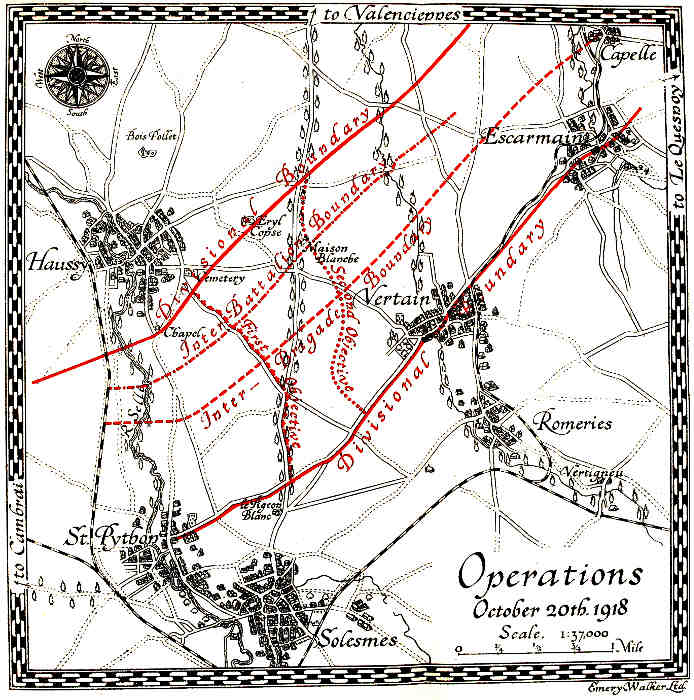
Operations
October 20th, 1918
Emery Walker Ltd.
This was the beginning of the period when the Germans seemed to spare all the buildings, and to concentrate their fire chiefly on the exits from villages.
On the 16th the enemy was reported to be massing men on the St. Python—Haussy road, and our artillery shelled the area indicated for two hours, but no counter-attack developed. The following day the Battalion was relieved, and went into billets at St. Vaast. On the 20th the 1st and 3rd Guards Brigades attacked, and captured the high ground east of Solesmes and St. Python, but the 2nd Guards Brigade was not wanted. On the 22nd the whole of the Guards Division was taken out of the line for a week's rest.