List of Officers who took Part in the Operations in October
Reading edition
Major the Hon. W. R. Bailey, D.S.O. Commanding Officer.
Lieut. J. A. Lloyd Acting Adjutant.
2nd Lieut. J. C. Blunt Intelligence Officer.
Capt. P. M. Spence, M.C. King's Company.
2nd Lieut. D. H. Clarke " "
Lieut. C. G. Kennaway No. 2 Company.
2nd Lieut. R. B. Osborne " "
2nd Lieut. M. G. Farquharson " "
Capt. J. H. C. Simpson No. 3 Company.
2nd Lieut. N. P. Andrews " "
Lieut. E. A. D. Bliss No. 4 Company.
2nd Lieut. C. B. Hall " "
2nd Lieut. R. S. Challands " "
Capt. W. Lindsay, R.A.M.C. Medical Officer.
Capt. the Rev. C. Venables Chaplain.
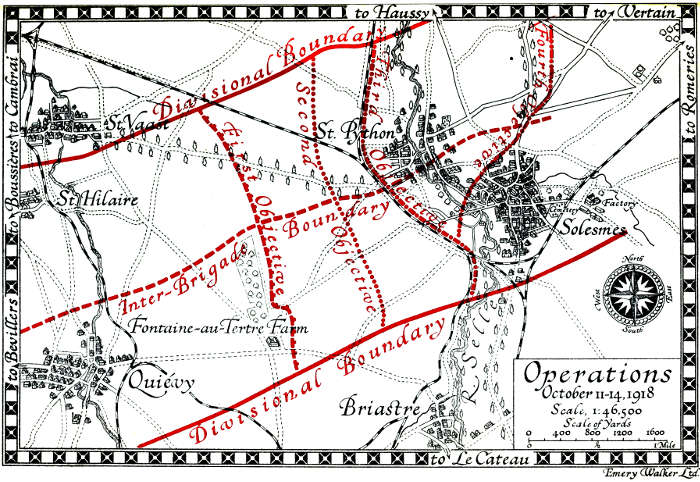
Operations
October 11-14, 1918
Emery Walker Ltd.
Oct. 11.
On the 11th the Battalion moved off at 1 A.M., and reached the rendezvous just east of Bévillers at 4 A.M. It was a very dark night, drizzling with rain, and the marching was difficult owing to the mine craters, with which the enemy had endeavoured to destroy the road, transport wagons constantly falling in, and delaying the march. The Battalion had been allotted a front of about 2000 yards, which was covered by the King's Company under Captain Spence on the right, and No. 2 Company under Lieutenant Kennaway on the left, each with two platoons in the front line acting as fighting patrols, and two platoons in the second line with the Company Commanders. No. 3 Company under Captain Simpson was in support, and No. 4 under Lieutenant Bliss in Brigade Reserve. The country was quite open with no cover at all, and consisted of grass and stubble fields. The gently undulating ground was particularly favourable to the Germans, who were past-masters in the art of fighting rear-guard actions. At 5 A.M. the advance began. The first bound was to the railway east of the village of Quiévy, but no halt was made here, as it was found that the advanced troops of the 1st Guards Brigade had pushed farther on during the night. When the leading patrols reached the high ground immediately east of Quiévy, they were met by heavy machine-gun fire from the orchard north of Fontaine-au-terre Farm, and were enfiladed by numerous machine-guns along the St. Vaast—Solesmes road. The leading companies deployed here. The King's and No. 2 Companies, covered by their own fire, continued to advance by rushes, and captured the orchard, from which the Germans hastily retired. Captain Simpson halted No. 3 Company on the high ground west of the farm, while south of the farm touch was gained with the 2nd Battalion Auckland Regiment from the New Zealand Division. The machine-gun fire from the left flank, where the Scots Guards were checked, continued to be very severe, and completely held up No. 2 Company. Captain Spence decided to push forward with the King's Company to try and outflank the enemy's posts, and sent forward one platoon down the slope. Although this had the desired effect, and the German infantry retired, they left their machine-guns, which kept up a sweeping fire along the crest, and prevented the Scots Guards from advancing. It was thought that, if a demonstration was made straight towards them, it might perhaps force them to retire, but when No. 2 Company attempted this the German machine-guns never moved. Meanwhile the King's Company, with that dogged determination which has characterised all its movements during the war, drove away the Germans from the spur of the hill south of Solesmes, and working round in the area occupied by the New Zealand Division, pushed forward, and gained the spur itself. The ground over which the King's Company passed, consisted of a deep and broad valley quite devoid of cover, and the slightest movement could be observed from the opposite slope, where German field-guns and machine-guns were posted. The manner in which Captain Spence directed his company and surmounted all the difficulties, was specially mentioned by Lieut.-Colonel Bailey, and this advance undoubtedly made a considerable difference to the centre of the Guards Division. But the forward position, which the King's Company had gained, was by no means easy to retain, for the men were subjected to a heavy machine-gun fire from the north, whilst the enemy's 5·9 guns registered on them. These men remained unable to move a muscle until dark, when they dug themselves in. No. 3 Company was moved up to an orchard in close support, and, as there seemed no reasonable prospect of success during daylight without heavy loss, it was not pushed up into the attack. The German machine-guns were wonderfully well placed, commanding the flat plateaus on the top of the ridges, with no possibility of their being approached under cover, and our artillery was unable to help, as it was practically impossible to locate these machine-gun nests. The men were anxious to push on, and had to be restrained. All this time the shelling was heavy but promiscuous, and several men were hit by fragments. Captain Simpson, Second Lieutenant Clarke, and Second Lieutenant Osborne were wounded in this way, but the Battalion was really very fortunate in not having suffered more than it did. Although patrols were sent out during the night, they were unable to get very far on account of the enemy's machine-guns, which had evidently been pushed forward to hinder reconnaissance.
Oct. 12.
The next morning it was found that the Germans had retired, and that the machine-guns had all been withdrawn, the emplacements being full of empty cartridge cases. Except for some shelling the morning proved uneventful, and in the afternoon the 2nd Battalion Scots Guards and 1st Battalion Welsh Guards were ordered to attack on the left. Two platoons from No. 2 Company of the 1st Battalion were ordered to co-operate with them and guard their right flank. The advance was successfully carried out with little opposition, although the German artillery put down a heavy barrage on the west line. The company runners in this fight behaved with great gallantry, and throughout the day carried their lives in their hands, continually running great risks. Posts were ordered to be pushed down to the railway, and small reconnoitring patrols were sent out as soon as it was dark. Except at the commencement of the operations the Battalion saw few Germans, and the men realised they were fighting a very cleverly hidden enemy. Each machine-gun nest had to be located, and shot out in turn. During that night the King's Company was relieved by No. 4, and No. 3 by No. 2. Lieutenant Challands, who took over command of No. 3 Company, was knocked out temporarily by the bursting of a shell during the relief. The Battalion was the only one in the Division to reach its objective, and this was entirely due to the dash displayed by both officers and men in this entirely new form of open warfare.
The 2nd Battalion Scots Guards and 1st Battalion Welsh Guards advanced up to the same line, held by the 1st Battalion Grenadiers. The rest of the day was very trying for all troops in the forward area on account of the continual shelling, as the Germans had excellent observation, and were very accurate in their shooting. The line from Solesmes to St. Python was very strongly held, and the two posts on the right held by the Battalion were in dangerous proximity to the enemy. One of these was rushed by a party of eighty Germans under cover of an intense Minenwerfer barrage, and only one man escaped. In the evening the Battalion was relieved by the 2nd Battalion Coldstream Guards, and marched by companies to Quiévy. The casualties during the three days' operations were 3 officers wounded, and of other ranks 11 were killed, 3 died of wounds, 45 wounded and 17 missing.
The next day Major Bailey received the following message from Brigadier-General C. P. Heywood, Commanding the 3rd Guards Brigade:
I should like to put on record my appreciation of the good work done by you and your Battalion during the past three days. I was particularly impressed with the initiative and determined action of the King's Company in pushing forward on the afternoon of the 11th to the advanced position in D 12 central.
On the 15th Major-General T. G. Matheson, Commanding the Guards Division, addressed the following message to Brigadier-General Heywood:
I wish to congratulate the Brigadier and all ranks of the 3rd Guards Brigade on the manner in which they carried out the task assigned to them from October 11th to 14th.
The advance of the 1st Batt. Grenadier Guards towards Solesmes and of the 2nd Batt. Scots Guards to St. Python were carried out with very much gallantry and produced very valuable results in securing us command of the crossings of the River Selle. The hard fighting of the 1st Batt. Welsh Guards on the left flank contributed largely to the success of the other two Battalions.
I am much pleased with the performance of the Brigade and should like my appreciation to be conveyed to all ranks.
Two days, the 14th and 15th, were spent at Quiévy cleaning up and reorganising, but on the evening of the second day the enemy bombarded the billeting area with 8-inch shells, when two men were killed and nine were wounded. On the 17th the Battalion marched to Carmières, where Major Bailey attended a Brigade conference. On the 19th the Battalion marched by companies with intervals of 200 yards to St. Vaast, and sheltered in houses and cellars until 10.15 P.M., when they moved up to the assembly area, directed by guides from the 1st Battalion Coldstream Guards.