Chapter XIX
Reading edition
THE BATTLE OF THE SOMME
A new stage, and a very distinct and important stage, in the Allied operations in the West was marked by the battle of the Somme.
It was at last understood, in the summer of 1916, that spasmodic attacks on the German trenches did little to gain any real and comprehensive success, and that, in order to prevent the enemy moving his reserves from one front to another, a simultaneous assault by all the Allies was necessary.
In accord with this view the Allies at the beginning of the year accepted the principle of an offensive campaign, and as the objective for the British and French advance Sir Douglas Haig and General Joffre selected the Somme area. All idea of “breaking through” had by now been abandoned. Such a thing was no longer regarded as possible in the West, and the plan adopted was one more suited to modern conditions of war and more economical of human life. The objects of the offensive were to relieve Verdun, to prevent the transfer of German troops elsewhere, and to wear down the resistance of the enemy on the Western front.
28 Conditions had changed, too, in other ways. The British Army had been slowly gaining strength, and the old Army had given place to the new. There were now fifty divisions in the field. At the same time, the supply of ammunition had been steadily increasing, and, thanks to the patriotism of the trade unions and the splendid performances of the workers, immense quantities of guns and shells were pouring into France. Consequently there was no reason why a general attack should not be made on the Western front, although, as Sir Douglas Haig pointed out in his despatch, he considered it advisable to postpone it as long as possible.
During the gigantic battle, which began on July 1 and lasted till November 18, the fighting was continuous. The German positions were amazingly strong. First came a network of trenches, well provided with bomb-proof shelters and protected in front by wire entanglements, many of which were in two belts forty yards broad and built of iron stakes, interlaced with barbed wire, often as thick as a man’s finger. Behind these lines the enemy’s strongholds had been reinforced with every device of military ingenuity—woods and villages turned into fortresses, cellars filled with machine-guns and trench mortars, dug-outs connected by elaborate passages. The enormous power of modern weapons of defence had been used to the utmost. In fact, the whole line was as nearly impregnable as Nature, art, and the unstinted labour of close on two years could make it. And undoubtedly the Germans believed it impregnable.
29 The first phase of the battle took place at the beginning of July, and although the attacks in the northern sector were unsuccessful, the armour was pierced; while in the south our troops secured Mametz, Montauban, Fricourt, Contalmaison, and Trônes Wood. On July 14 and the three following days, the capture of the enemy’s second line on a front of three miles gave us possession of the main plateau between Delville Wood and Bazentin-le-Petit.
The long and severe struggle, which was the second phase, began on July 18 and culminated on September 15 with the fall of Ginchy, after Pozières, Delville Wood, Guillemont, Falfemont Farm, and Leuze Wood had been taken in succession. But although the main ridge from Delville Wood to the road above Mouquet Farm was secured, Morval on the right and Thiepval on the left remained in German hands.
In the third phase Flers, High Wood, Martinpuich, Courcelette, and the Quadrilateral came into our hands one after another, and on September 25 Morval, Lesbœufs, and Gueudecourt were secured by the British Army, while the French took Combles. During October Thiepval was taken, and also Eaucourt l’Abbaye and Le Sars, while in November, as the outcome of an advance on both sides of the Ancre, we captured St. Pierre Divion, Beaucourt, and Beaumont-Hamel.
Thus all our principal objects were achieved, in spite of the fact that the Germans were able to mass more than half their army upon this part of their front. The British Army took 38,000 prisoners, including over 800 officers; also 30 29 heavy guns, 96 field-guns and field-howitzers, 136 trench mortars, and 514 machine-guns.
The battle was marked by the sudden appearance of the Tanks. So well had their secret been kept that until they came upon the battlefield the Germans had no idea of their existence. “The Machine-gun Corps, Heavy Section” was the official title of these heavy armoured cars which could move anywhere, over trenches and through wire entanglements, pushing down walls and even houses; they contained a garrison of six men with machine-guns and 6-pdr. guns. So many legends had grown up of their supernatural powers that their actual début caused a certain disappointment. But although in some parts of the battlefield they failed us, some of them did wonders, and many of the strongholds in the German line could never have been taken without their help.
The net result of the battle was a brilliant victory for the British Army, for not only was a large tract of ground captured from the enemy, but the three objects which we had set out to gain were fully attained. Verdun was relieved of pressure, the main portion of the German Army was detained on the Western front, and a crippling blow was struck at the enemy forces. It was clearly shown that, on anything like equal terms, the British could drive back the German Army, sheltered even by the strongest entrenchments.
As the area and duration of modern battles are immense, a long time naturally elapses before their effects are felt by the losing side. 31 Formerly battles lasted only a few days, and their results were seen immediately in the retirement of the beaten army. After the battle of the Somme, however, nothing happened at first, and it was not until six months later that the Germans found that their positions had become untenable, and a general retirement was advisable.
The Guards Division at the Somme
Sept.
Nothing has ever been done by battalions of the Guards finer than the part they took in the battle of the Somme. It was not until the beginning of September that the Guards Division arrived in the Somme area, so it was not present at the first two phases of the battle. But in the attacks of September 15 and 25 the men covered themselves with glory; their discipline and coolness under fire were magnificent, and they captured lines which had up to then been considered impregnable. The final assault of Lesbœufs was one of the most successful operations of the war.
Not only were the staff arrangements admirable, but the co-operation between infantry and artillery proved in every way perfect. Against the unflinching attack of the Division nothing could stand; the mass of shells poured over by the German artillery, the hail of bullets from their machine-guns, and the rifle-fire of their infantry in the trenches, were all powerless to check it. The men were splendid: it made not a scrap of difference whether they had officers or not, whether they were with their own units or 32 mixed up with other regiments. Nothing could stop them. When the 3rd Brigade went up, the battle had already been raging for over two months; and the Germans were then busily but vainly carrying out counter-attacks, in the hope of re-taking some of the ground that had been wrested from them. Consequently the two battalions sent forward came in for some very stiff fighting, especially the Welsh Guards, who went through some anxious moments owing to the advanced position they were occupying. They were fiercely attacked by large bodies of the enemy, but, with the help of one company of the 1st Battalion Grenadiers, managed to hold their own. Meanwhile the 4th Battalion Grenadiers—the other battalion sent up from the 3rd Brigade—held an uncomfortable position near the Quadrilateral, to the right and in rear of the Welsh Guards.
Parts of the line had also to be straightened, and “pockets” of Germans to be cleared away before the general attack of the 15th; and for this task were detailed those battalions from the 1st and 2nd Brigades which would not be in the front line on the 15th. There were some closely-contested bombing fights, supported by artillery, in the parts of the line that needed straightening, and these operations were all successfully carried out.
On the 12th Major-General G. Feilding issued the following orders:
The Guards Division Order, No. 76
1. The Fourth Army will attack the enemy’s defences between Combles Ravine and Martinpuich on Z day 33 with the object of seizing Morval, Lesbœufs, Gueudecourt, and Flers, and to break through the enemy’s system of defence.
The French are undertaking an offensive simultaneously on the South and the Reserve Army on the North.
2. The attack will be pushed with the utmost vigour all along the line until the most distant objectives are reached. The failure of one unit on the flank is not to prevent other units pushing on to their final objective, as it is by such means that those units who have failed will be assisted to advance.
3. Preliminary Bombardment.—(a) Commencing on the 12th September a bombardment and wire-cutting on the hostile defensive system will take place from 6 A.M. to 6.30 daily.
(b) The preliminary bombardment on the day of the attack will be similar to that of previous days, there being no further increase of fire previous to zero.
(c) At 6.30 each evening from the 12th September inclusive night firing will commence, and continue till 6 A.M., lethal shells being used.
4. (a) The Sixth Division is to attack on the right and the Fourteenth Division on the left.
(b) The 2nd Guards Brigade will attack on the right of the Division, the 1st Guards Brigade on the left. The 3rd Guards Brigade will be in Divisional Reserve.
5. Forming-up Areas.—Forming-up areas are shown on attached maps. The 1st and 2nd Guards Brigades will allot a forming-up area for the 75th and 76th Field Companies R.E. respectively in their forming-up areas.
Instructions as to movements of troops to their forming-up areas will be issued separately.
6. The objectives allotted to the Guards Division and neighbouring divisions are shown on attached map.
First objective is marked Green.
Second ” ” Brown.
Third ” ” Blue.
Fourth ” ” Red.
34 7. (a) 50 per cent Field Artillery covering the Division will be used for creeping barrage, and 50 per cent for stationary barrage.
(b) Details of the stationary barrages will be issued later. In all cases the stationary barrage will lift back when the creeping barrage reaches it.
(c) At zero the creeping barrage will open 100 yards in front of our front trenches, and will advance at the rate of 50 yards per minute until it is 200 yards beyond the first objective, when it will become stationary. At zero + 1 hour the creeping barrage will become intense on the line 200 yards in front of first objective, and will creep forward at the rate of 50 yards per minute in front of that portion of the 1st Guards Brigade which is to advance to the second objective.
(d) At zero + 1 hour and 10 minutes the creeping barrage will become intense on a line 200 yards in front of the first objective as far north as T.86.4.6, thence on a line 200 yards in front of the second objective, and will advance at the rate of 30 yards per minute until it has passed 200 yards beyond the third objective, when it will become stationary.
This barrage is to cover the advance of the tanks. There will be no creeping barrage in front of infantry during their advance to third objective, which commences at zero + 2 hours.
(e) At zero + 3 hours and 30 minutes the creeping barrage will become intense on a line 200 yards in front of third objective, and will advance at the rate of 30 yards per minute until it has passed 200 yards beyond fourth objective, when it will become stationary. This barrage is to cover the advance of the tanks. There will be no creeping barrage in front of the infantry during the advance on the fourth objective, which commences at zero + 4 hours and 30 minutes.
(f) In the attack on the first and second objectives gaps of 100 yards wide will be left in the creeping barrage for the routes of the tanks.
35 8. The flow of troops to the 2nd Guards Brigade and 1st Guards Brigade must be maintained so as to ensure a strong attack being pressed against each successive objective. Sufficient men will be left in each line captured to clear it of the enemy. No troops of the 2nd and 1st Guards Brigades will be detailed to remain behind in objectives after they have been passed for purposes of consolidation.
The task of the two leading Brigades is to press the attack through to their ultimate objectives with every means at their disposal.
9. The 3rd Guards Brigade will advance at zero + 1 hour and 30 minutes until its leading troops reach the south-western outskirts of Ginchy, when the Brigade will halt and await orders.
Special instructions as to action of Reserve Brigade will be issued.
10. Tanks will be employed to operate with the attack; instructions as to their movements are attached.
(Remainder of orders related to R.E., R.A., Aircraft and Transport.)
C. Heywood, Lieut.-Col.,
General Staff, Guards Division.
September 12, 1916.
So great was the danger of battalions being practically annihilated in an attack that orders had been issued for a certain nucleus of officers and N.C.O.’s to be left with the Transport, whenever a battalion went into action, so as to make sure of a sufficient number surviving to carry on the work. Accordingly on this occasion the Second in Command, the junior Captains of companies, the Battalion and Company Sergeant-Majors and Quartermaster-Sergeants in each battalion were left behind.
At 6.20 on the morning of the 15th the artillery 36 bombardment ceased, and the Guards Division advanced, preceded by a creeping barrage, with Pereira’s Brigade on the left and Ponsonby’s Brigade on the right, while Corkran’s Brigade remained in reserve. In the front line were the 1st, 2nd, and 3rd Battalions of the Coldstream and the 3rd Battalion Grenadiers. The advance of the three Coldstream battalions was a wonderful sight, and they carried everything before them, but in their eagerness to reach the enemy lost direction and went too far to the left. Meanwhile the 3rd Battalion Grenadiers on the right kept straight on, so there was a considerable gap between it and the three battalions of Coldstream. Coming up through the German barrage, the 2nd Battalion Grenadiers, which was in support of the 2nd Coldstream, completely lost sight of the Coldstream battalions. In accordance with its orders it advanced with its right on the Ginchy—Lesbœufs road, but on reaching the first objective it found it occupied by the enemy instead of by the Coldstream, as it expected, and suffered heavy loss. Under the impression that it was following in the wake of the 2nd Battalion Coldstream, it was advancing in artillery formation, and had to form line when within a few yards of the enemy’s trench, which was untouched, as the Coldstream battalions had passed farther to the left.
When the first objective was secured, the order from right to left was as follows: the 3rd Battalion Grenadiers, the 2nd Battalion Grenadiers, the 1st, 2nd, and 3rd Battalion Coldstream. Between the first two objectives there were 37 several intermediate lines of trenches, all of which were most confusing for the battalions in front. The Coldstream battalions mistook these intermediate lines for objectives, and thought that they had reached the third objective when they were really between the first and second objectives. Their real position, however, was correctly reported by the air scouts.
Meantime the Quadrilateral—a powerful system of redoubts—on the right had made any advance by the Sixth Division impossible, and on the left also the Fourteenth Division had been held up by some strong points in the enemy’s line. The result was that the Guards Division had both flanks in the air, and was subjected to a withering fire almost from the start. The 3rd Battalion Grenadiers on the right and the 3rd Battalion Coldstream on the left were obliged to throw out protective flanks, and so had some difficulty in keeping pace with the battalions in the centre.
It was some time before the two brigades were firmly established in the first objective, as there were parts of the line in which some Germans had been left, more especially in the space reserved for the tanks, which unfortunately never arrived. However, the 1st and 2nd Battalions Coldstream in the centre pushed on and gained the second objective, while the battalions right and left threw back protective flanks. The second objective was a trench running into the first objective, and only concerned the Coldstream battalions on the left.
On the next day, the 16th, Corkran’s Brigade was ordered to advance through the leading 38 brigades and continue the attack. But it did not start till the middle of the day, and after having gone some distance was held up by machine-gun fire and the men were told to dig themselves in where they were.
The whole Division was taken out of the line on the night of the 18th and remained resting in bivouacs until the 20th, when each brigade sent battalions into the front line to dig assembly trenches and straighten parts of the line. On the 22nd Major-General G. Feilding issued the following orders:
Guards Division Order, No. 82
1. (a) The Fourth Army will renew the attack on Z day in combination with attacks by the French to the South and the Reserve Army to the North.
(b) The objectives of the Fourteenth Corps include Morval and Lesbœufs, and those of the Fifteenth Corps Gueudecourt.
(c) The attack of the Fourteenth Corps will be carried out by the Fifth Division on the right, the Sixth Division in the centre, and the Guards Division on the left. The Fifty-eighth Division will form a defensive flank to the south of the Fifth Division. The Twenty-first Division will be attacking on our left.
2. The 1st Guards Brigade will attack on the right and the 3rd Guards Brigade on the left.
The 2nd Guards Brigade (less one Battalion) will be in Divisional Reserve.
1st Battalion 2nd Guards Brigade will be in Corps Reserve; 2nd Guards Brigade will notify Divisional Headquarters the name of the Battalion detailed.
3. Preliminary Bombardment.—A steady bombardment of hostile positions will be commenced at 7 A.M. on Z day, and will be continued to 6.30 P.M.; it will recommence at 6.30 A.M. on Z day.
39 The ground in front and rear of the German trenches which are being bombarded will be searched occasionally with 18-pdr. shrapnel and H.E. shell.
There will be no intensive fire previous to the hour of zero. Night firing will be carried out nightly between the hours of 6.30 P.M. and 6.30 A.M.
4. Forming-up areas are shown on the attached map. The 1st and 3rd Guards Brigades will allot forming-up areas to the 75th and 55th Field Companies R.E. respectively, within their areas.
Instructions for movements to forming-up areas will be issued separately.
5. Objectives allotted to the Guards Brigades and neighbouring Divisions, also the dividing lines, are shown on attached map.
First objective is marked Green.
Second ” ” Brown.
Third ” ” Blue.
6. The infantry will advance to the attack on the Green line at zero; to the attack on the Brown line at zero + 1 hour, and to the attack on the Blue line at zero + 2 hours.
7. Barrages—
(a) 50 per cent of the Field Artillery covering the Division will be used for the creeping barrage and 50 per cent for stationary barrage.
(b) In all cases the stationary barrage will lift when the creeping barrage meets it.
8. (a) At zero the creeping barrage will commence 100 yards in front of our front trenches. It will advance at the rate of 50 yards per minute until it is 200 yards beyond the Green line, when it will become stationary.
(b) At zero + 1 hour the creeping barrage will commence 200 yards in front of the Green line and will advance at the rate of 50 yards per minute until it has passed 200 yards beyond the Brown line, when it will become stationary.
40 (c) At zero + 2 hours the creeping barrage will commence 200 yards in front of the Brown line, and will advance at the rate of 50 yards per minute until it has passed 200 yards beyond the Blue line, when it will become stationary.
9. (a) The task of the two leading Guards Brigades is to press the attack through to the Blue line. A sufficient flow of troops must be maintained by the 1st and 2nd Guards Brigades from zero onwards to ensure that the attack made from the Brown line is strong and well supported.
(b) Special arrangements must be made to deal with resistance in Lesbœufs and thus prevent any possibility of the enemy getting round our troops who have gained the Blue line.
(c) The 1st and 3rd Guards Brigades will garrison and consolidate the Brown line with a portion of their reserves when the attack goes forward to the Blue line.
(d) On gaining the Blue line, Battalions will be sent forward to any ground from which observation can be gained; such points will be consolidated and eventually joined up with our line.
On the 24th the Battalions that were to lead the attack took their place in the line ready for the next day. The order of attack was for the Fifty-sixth Division to form the right flank guarding Combles, the Fifth Division to capture Morval, the Sixth Division to occupy the southern end of Lesbœufs, and the Guards Division to take Lesbœufs.
In Pereira’s Brigade, which attacked on the right, the 2nd Battalion Grenadiers and 1st Battalion Irish Guards were in the front line, and were supported by the 2nd and 3rd Battalions Coldstream. In Corkran’s Brigade on the left the 4th Battalion Grenadiers and 2nd Battalion 41 Scots Guards led, supported by the 1st Battalion Grenadiers and 1st Battalion Welsh Guards. The orders of the two brigades differed. In the 1st Guards Brigade the leading battalions were to take all the objectives, and when they passed on the battalions in support were to consolidate each line. In the 3rd Brigade the two leading battalions were to take the first two objectives and then throw out a defensive flank; the battalions in support were then to advance through them and secure the third objective, one of these again throwing out a defensive flank.
At 12.35 P.M. on the 25th the attack started, and in spite of the wire, in some places intact, the first objective was secured. At 1.30 the advance to the second objective began. The battalions in front suffered heavily, especially in officers, but by 1.45 the second objective was in our hands. All this time the Twenty-first Division on the left had been held up, and the left flank of the Guards Division was consequently in the air. The 4th Grenadiers had therefore to throw out a defensive flank to the left, which eventually became so long that not only that battalion but also the Welsh Guards were employed to guard it. Major-General Feilding regarded this defensive flank as of the utmost importance, since it was from this quarter that a counter-attack was expected. In some parts of the line the wire was uncut, and the advance was retarded, but this did not prevent the objectives being secured by the times specified in the orders.
As soon as we had gained the second objective, the 1st Battalion Grenadiers and 1st Battalion 42 Welsh Guards passed through the leading battalions of Corkran’s Brigade and attacked Lesbœufs, while the 2nd Battalion Grenadiers and 1st Battalion Irish Guards continued their advance.
Thus with the 4th Battalion Grenadiers on the defensive flank there were three Grenadier battalions engaged in the attack on the third objective. The capture of Lesbœufs itself fell to the lot of the 1st Battalion, and news was at once sent back that all the objectives had been secured. The battalions in front appear to have been so elated by their success that they asked for the cavalry to be allowed to go through. But Lord Cavan, the Corps Commander, realised that it would be madness to employ cavalry on such a limited front, and gave orders that the leading battalions were to consolidate their position.
The 2nd Battalion
2nd Batt.
Detached from the 1st Guards Brigade on August 31 the 2nd Battalion Grenadiers had been sent up to Carnoy to dig in rear of the Twentieth Division. It returned on September 3rd to Méaulte, where it underwent a thorough course of training, something in the nature of a dress rehearsal. Expert bombing officers gave instruction to every company in the Brigade, so that each man had an opportunity of learning the latest developments in bombing. All the battalions practised deploying in artillery formation, attacking an imaginary line of trenches, and then moving on immediately to a second 43 objective. A great deal was learned in the way of signalling, and trials were made of a system of organising a single main trunk line, as central as possible, so as to avoid having a number of defective lines to each unit. This line was to consist of telephone or visual or relay posts—or, if possible, of all three. Careful consideration was given to the difficult task of getting the men across No Man’s Land, and every detail was rehearsed. Later the whole Brigade was practised in the attack, and in maintaining constant communication during an advance.
Sept. 9.
After a week the 1st Brigade received orders to proceed to Carnoy, and all surplus kit and equipment were left behind in store. The 2nd Battalion Grenadiers marched to Carnoy, and bivouacked not far from the place where it had been at the beginning of the month.
Sept. 11.
On the 11th orders were received for the 1st Brigade to relieve the left half of the 3rd Guards Brigade, while the 2nd Guards Brigade was to take the place of the other half. These orders (given below) were communicated to commanding officers at a conference held at Brigade Headquarters.
Brigadier-General Pereira issued the following orders:
1st Guards Brigade Order, No. 73
1. The Fourth Army will attack the enemy’s defences between Combles Ravine and Martinpuich on Z day with the object of seizing Morval, Lesbœufs, Gueudecourt, and Flers, breaking through the enemy’s system of defence.
The French are undertaking an offensive simultaneously 44 on the south and the Reserve Army on the north.
2. The attack will be pushed with the utmost vigour, all along the line, until the most distant objectives are reached.
The failure of a unit on a flank is not to prevent other units pushing on to their final objectives, as it is by such means that these units, which have failed, will be assisted to advance.
3. Preliminary Bombardment.—(a) Commencing on the 12th September bombardment and wire-cutting on hostile defensive system will take place from 6 A.M. to 6.30 P.M. daily.
(b) The preliminary bombardment on the day of the attack will be similar to that on previous days, there being no increase of fire previous to zero.
(c) At 6.30 P.M. each evening from the 12th September inclusive, night firing will commence and continue till 6 A.M. Lethal shells will be used.
4. (a) The 2nd Guards Brigade will attack on the right of the Division—the 1st Guards Brigade the left, and the 3rd Guards Brigade will be in divisional reserve.
(b) The 4th Brigade of the Fourteenth Division will attack on the left of the 1st Guards Brigade.
(c) Boundaries are shown on attached map.
5. Forming-up Areas.—Forming-up areas are shown on attached maps.
Instructions as to movement of troops to their forming-up areas will be issued separately.
6. Objectives allotted to Guards Brigades and neighbouring Divisions are shown on attached map.
First objective is marked Green.
Second ” ” Brown.
Third ” ” Blue.
Fourth ” ” Red.
7. The infantry will advance to the attack of the Green line at zero.
45 To the attack of the Brown line at zero + 1 hour.
To the attack of the Blue line at zero + 2 hours.
To the attack of the Red line at zero + 4 hours and 30 minutes.
8. Artillery Barrages—
(a) 50 per cent of Field Artillery covering the Division will be used for creeping barrage, and 50 per cent for stationary barrage.
(b) Details of stationary barrages will be issued later. In all cases the stationary barrages will lift back when the creeping barrage reaches it.
(c) At zero the creeping barrage will open 100 yards in front of our trenches, and will advance at rate of 50 yards per minute until it is 200 yards beyond the first objective, when it will become stationary.
At zero + 1 hour the creeping barrage will become intense on a line 200 yards in front of the first objective, and will creep forward at rate of 50 yards per minute in front of that portion of the 1st Guards Brigade which is to advance to the second objective.
(d) At zero + 1 hour and 10 minutes the creeping barrage will become intense on a line 200 yards in front of the first objective as far north as T.8.b.4.6, thence on a line 200 yards in front of second objective, and will advance at rate of 30 yards per minute until it has passed 200 yards beyond the third objective—when it will become stationary.
This barrage is to cover the advance of the tanks.
There will be no creeping barrage in front of the infantry during their advance to third objective, which commences at zero + 2 hours.
(e) At zero + 3 hours 30 minutes, the creeping barrage will become intense on a line 200 yards in front of the third objective—and will advance at rate of 30 yards per minute until it has passed 200 yards beyond fourth objective, when it will become stationary. This barrage is to cover the advance of the tanks.
There will be no creeping barrage in front of the 46 infantry during the advance to the fourth objective, which commences at zero + 4 hours 30 minutes.
(f) In the attack on first and second objectives gaps of 100 yards wide will be left in the creeping barrage for the routes of the tanks.
9. The attack will be carried out as follows:
(a) The 2nd and 3rd Battalions Coldstream Guards will attack and capture the first, second, and third objectives. The dividing line between these battalions is shown on attached maps.
(b) The 2nd Battalion Grenadier Guards will move in rear of the 2nd and 3rd Battalions Coldstream Guards. When the latter advance to the assault of the second objective the 2nd Battalion Grenadier Guards will occupy the first objective until the 1st Battalion Irish Guards have passed through them; they will then follow and support them in their attack on the fourth objective.
The rôle of the 1st Battalion Grenadier Guards is to form a defensive flank, if necessary, and to support the attack of the 1st Battalion Irish Guards in their attack on the fourth objective, with such troops as are not required for a defensive flank.
(c) 1st Battalion Irish Guards will attack the fourth objective.
(d) Machine-gun Coy. One section will accompany each battalion in the assault, and will be under the orders of the O.C. Battalion.
(e) Stokes T.M. Battery. Four guns will accompany the 2nd Battalion Grenadier Guards in case it is necessary to form a defensive flank. They will not go farther than the second objective. They will act under the orders of the O.C. Battalion.
The remaining four guns will be in the trench in which advanced Brigade Headquarters is situated, S.24.b.6.2.
(f) The 75th Field Coy. and the four work platoons will remain in their forming-up area until further orders are received.
47 10. Formation of Attack.—The formation for the carrying out of the attack is shown on attached sketch.
The 2nd Battalion Grenadier Guards and 1st Battalion Irish Guards will move into line or small columns according as to whether they are under rifle-fire or not.
11. The flow of troops will be continuous. This is to ensure a strong attack being pressed against each successive objective.
Officers commanding battalions will call for support, if necessary, from the battalions immediately in rear of them. If necessary, men will be left in each line captured to clear it of the enemy, but troops will not be detailed to remain behind in objectives for purposes of consolidation, except that the 2nd and 3rd Battalions Coldstream Guards will remain in the third objective ready to support the troops attacking the fourth objective.
The task of the Brigade is to press the attack through to their ultimate objectives with every means at our disposal.
12. Tanks will be employed to co-operate with the attack. Instructions as to their employment are attached.
Instructions will be issued as to movement of tanks to their departure positions, and as to time of their advance to the various objectives.
13. Royal Flying Corps—
(a) 9th Squadron, Royal Flying Corps will have one Contact aeroplane in the air from zero to dark on Z day, and again from 6.30 A.M. to 9 A.M. on Z + 1 days.
(b) Flares will be lit as follows:
(1) On obtaining each objective.
(2) At 12 noon and 5 P.M. on Z day by leading troops.
(3) At 6.30 A.M. on Z + 1 day by leading troops.
Red flares will be used by infantry, Green flares by Cavalry.
48 14. An orderly with a watch will visit all Battalion H.Q. about 1 P.M. and 7 P.M. on Y day, so that time may be checked.
15. Special instructions will be issued on the following subjects:
(a) Medical arrangement.
(b) Supply of rations, water, S.A.A., Light T.M. ammunition and hand grenades.
(c) Communications.
16. All transport will be packed up and ready to move forward at one hour’s notice after zero + 4 hours.
The Brigade Transport officer will remain at Divisional Headquarters, Minden Post, from zero + 2 hours onwards.
On Y day after 7.30 P.M. the road running north from cross-roads S.28.d.4.2 will be clear of all wheeled traffic.
17. As soon as the final objectives have been captured by the infantry the cavalry will advance and seize the high ground Rocquigny—Villers-au-Flos—Riencourt-les-Bapaume—Bapaume.
The Fourteenth Corps will be prepared to support the cavalry on the above line at the earliest possible moment.
18. Prisoners will be sent via Brigade Headquarters to Divisional Collecting Station at Crater Post A.8.a.6.3, where they will be taken over and searched under A.P.M. arrangements.
Receipts will be given for prisoners and escorts will return to their units.
All captured documents should be sent with prisoners to Divisional Collecting Station, whence they will be forwarded under Divisional arrangements.
19. Dumps.—R.E. dumps of sand-bags and wire have been established along the Guillemont—Waterlot Farm road in the Brigade area. A water dump is being established at Advanced Brigade Headquarters at S.24.b.6.1½.
49 Dumps of bombs and S.A.A. are also being established along the Guillemont—Waterlot Farm road in the Brigade area.
20. Brigade Headquarters will be established at S.24.b.6.1½ from 9 P.M. to-night.
M. B. Smith, Captain,
Brigade-Major, 1st Guards Brigade.
September 13, 1916.
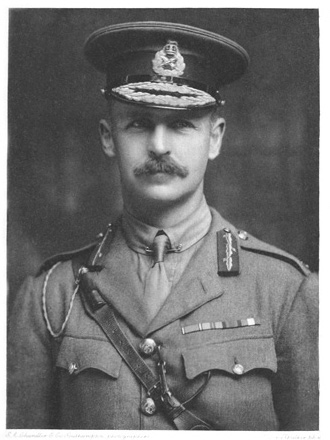
S.A. Chandler & Co. Southampton, photographers Emery Walker ph. sc.
Lieutenant-General The Earl of Cavan. K.P., K.C.B.
Sept. 12.
By September 12 the whole Brigade was fully equipped. To every battalion had been issued bombs, sand-bags, distinguishing arm-bands, rockets, flares, wire-cutters, etc., and all that remained to be done was to fix the hour and the day of attack.
The 2nd Battalion Grenadiers took over the left half of the line occupied by the 3rd Guards Brigade on the night of the 12th, while the 1st Battalion Irish Guards moved up in support to Trônes Wood and Bernafay Wood. The 2nd and 3rd Battalions Coldstream, which were to carry out the assault, remained resting at Carnoy till the last moment, and the Brigade Headquarters moved up to a dummy trench between Trônes and Bernafay Woods.
The following message from Lieut.-General Lord Cavan was circulated:
The Corps Commander knows that there are difficulties to be cleared up on the left and in front of the 1st Guards Brigade, and on the right of the 2nd Guards Brigade, but the Commander-in-Chief is of opinion that the general situation is so favourable that every effort must be made to take advantage of it and that tanks should carry out a special programme before zero to deal with these unsatisfactory positions. The Commander-in-chief states that there were only two German divisions in reserve on a large front, and that one of 50 them had recently had enormous casualties, and the other heavy casualties.
The French operations yesterday have been most successful, and they have captured Bouchavesnes, which was their objective.
Sept. 13.
Next night the 2nd Battalion Grenadiers, which was holding the northern sector of the Ginchy line, was instructed to go out and straighten the line, so that the battalions which were to attack on the following day should not be held up at the very start. Lieut.-Colonel C. de Crespigny issued these orders:
1. In order to have a good “jumping-off” place for X day it is essential to gain ground forward and dig a trench running from T.13.b.4.9. to T.14.a.2½.2½. It will be necessary to establish a post at the top of the cutting at T.13.b.4.9 and to drive the Germans from the trench T.13.b.6.4. point of orchard T.14.a.5.5.
2. No. 4 will carry this out to-night. Time given later.
3. Two Stokes guns and one Lewis gun will report to you about 9 P.M. to-night. The Stokes gun will be used previous to the attack. If possible a position will be chosen by O.C. No. 4 in readiness.
4. No. 3 Company will be in readiness to move up to No. 4 Company’s present position, and the route should be reconnoitred by daylight if possible. No. 2 Company will watch the left flank of No. 4.
5. No. 3 Company will detail small parties after dark to carry up fifty boxes of bombs from H.Q. to No. 4. A party will also be required to carry up S.A.A., but this will be called for when S.A.A. is available.
6. No. 2 Company will be prepared to dig through the sunken road and join up with the new left of No. 4.
7. O.C. No. 2 Company will send up one Lewis gun after dark to report to O.C. No. 4.
51 8. All companies will detail two men to report at H.Q. as guides for ration parties after dark.
9. O.C. Nos. 2 and 3 Companies will meet C.O. at H.Q. of No. 4 Company at 8.0. P.M.
W. R. Bailey, Captain and Adjutant,
2nd Battalion Grenadier Guards.
As it was known that the enemy held the point of the Ginchy orchard, and that they had machine-guns in the Ginchy—Flers sunken road, about four hundred yards north of that village, Captain G. Harcourt-Vernon, who commanded No. 4 Company, detailed two platoons under Second Lieutenant T. W. Minchin for the operation, while No. 2 was to protect their left flank and keep touch with them. Lieutenant M. H. Macmillan was ordered to bring up two platoons from No. 3 Company to support No. 4 Company and take over the line evacuated by Lieutenant Minchin’s platoons.
The enterprise was difficult, as the left flank had to advance farther than the right in order to form a line facing north-east. By way of artillery preparation, thirty or forty shrapnel shells were fired at the German trench just north of the orchard, but this had the effect only of putting the enemy on his guard. Unfortunately, too, it was a bright moonlight night, and the attacking party showed up distinctly.
The two platoons under Second Lieutenant Minchin advanced, and cleared the orchard of all Germans, in spite of a heavy rifle and machine-gun fire, which caused several casualties. Not content with this, they tried to push on farther, but were fiercely resisted by the Germans, and 52 failed to make good any more ground. As it was imperatively necessary to have a trench dug before daylight, Second Lieutenant Minchin decided to hold a line on the edge of the orchard, and the trench was completed by the next morning. The task assigned to the party had been carried out, and there seemed no necessity to attempt anything further.
That evening the following confidential message was received:
Day of attack (Z day) will be 15th Sept. Zero hours will probably be in the early morning.
Sept. 14.
All next day the 2nd Battalion remained in the front trenches, where it was very heavily shelled. One shell pitched on the headquarters of No. 1 Company; Company Sergeant-Major Percival was mortally wounded and died later, and Captain A. F. R. Wiggins was so severely shaken that he retired suffering from shell shock. Company Sergeant-Major Gudgeon of No. 3 Company was buried by another shell, and had to be sent back. These losses were particularly regrettable, just as the Battalion was going into action.
The Battalion was relieved in the evening by the 2nd and 3rd Battalions Coldstream, and went into bivouac just behind Ginchy, where rations and rum were served out. The men had been three days in the trenches, and Lieut.-Colonel de Crespigny and the Adjutant, Captain Bailey, hardly had a moment’s sleep during that time. It was bitterly cold at night, and the men, who had no greatcoats, suffered very much.
The time appointed for the attack was revealed 53 during the afternoon, in this message: “Zero hour to-morrow, September 15, will be at 6.20 A.M.” As shown in the above orders, four successive objectives had been allotted to the Brigade. The first was about 1200 yards distant, and the second 1500—but this concerned only the left battalion of the Brigade. The third was 2500 yards off, while the fourth or final objective, which included the northern outskirts of Lesbœufs, was no less than 3500 yards away. The infantry were to advance to attack the first objective at 6.20 A.M., to the second at 7.20, the third at 8.20, and the final objective at 10.50. The front allotted to the Brigade was 500 yards.
The 2nd and 3rd Battalions Coldstream were to assault the first, second, and third objectives. The 2nd Battalion Grenadiers was to follow them, and form a defensive flank to either side, if required. On reaching the first objective the 2nd Battalion Grenadiers was to remain there until the Irish Guards passed through them, and if the flanks were all secure was to follow on and support them. The 1st Battalion Irish Guards was to pass through the 2nd and 3rd Battalions Coldstream at the third objective, and take and consolidate the fourth objective.
Each battalion had a section of machine-guns attached to it, and was told to place two guns on the flanks of the battalion and two at the Battalion Headquarters. The 2nd Battalion Grenadiers had four Stokes guns, while four more were kept in reserve. Three tanks were to start on the left outside the Brigade area, and were to 54 pass into it north of the cutting, which was known to be a troublesome place, on the left flank.
Detailed instructions for the attack were issued in the following operation orders by Lieut.-Colonel C. R. C. de Crespigny, Commanding 2nd Battalion Grenadier Guards:
1. The Battalion will be relieved to-night by the 2nd and 3rd Battalions Coldstream Guards and part of the 41st Brigade on the left, and will form up on the assembly area S.W. of Ginchy.
2. Companies will detail guides as follows to be at H.Q. at 7.30 P.M.:
No. 1 Company, 4 guides.
No. 2 Company, 4 guides.
No. 4 Company, 8 guides.
No. 3 Company will not wait to be relieved, but will move off to place of assembly east of the Waterlot—Guillemont road. On relief, Nos. 1, 2, and 4 Companies will march to H.Q. of No. 3 Company, where they will draw rations and water. They will then move on to their positions in assembly area, where fresh meat, sandwiches, and rum will be issued.
3. The assembly march will be carried out in absolute silence, and there must be no smoking, and no lights shown. Between dawn and zero (about 6 A.M.) there will be no movement.
4. Companies will each detail one N.C.O. to report at H.Q. of No. 3 Company at 6 P.M. to get rations ready for issue, also one officer to be at H.Q. No. 3 Company at 4 P.M. to be shown forming-up positions. Companies are responsible for reconnoitring the route to H.Q. No. 3 from their present positions.
5. Dress.—All men will carry two bandoliers S.A.A. and two Mills bombs. This must be made up before leaving the trenches. Every third man will carry a shovel, every fourth man a pick. Two days’ rations will be carried.
55 6. Forming-up.—Companies will form up as under on the assembly:
350 Yards Frontage
No. 1 Coy.No. 2 Coy.A.
100 yards.
No. 3 Coy.No. 4 Coy.B.
Line of platoons at forty yards’ intervals. 3/G.G. lines are A and B. Lateral pegs on the company frontage at ten yards apart. Forward direction time boards are five yards apart, one central line and two on tanks.
7. The Brigade will attack at zero on the morning of 15th on the left of the Division. Six tanks will co-operate on this Divisional front.
First objective T.8.a.2.5—T.8.d.3.7.
Second objective T.2.a.9.4—T.8.b.2.3.
Third objective T.3.a.5.9—T.3.L.2.6.
Fourth objective N.3.a.0.9—N.34.C.9.0.
8. Infantry will advance to the attack of—
The first objective at zero.
The second objective at zero + 1 hour.
The third objective at zero + 2 hours.
The fourth objective at zero + 4 hours 30 minutes.
9. The attack will be carried out as follows:
The 2nd and 3rd Battalions Coldstream will attack and capture the first, second, and third objectives. The 2nd Battalion Grenadier Guards will move in rear of the two Coldstream battalions. When the latter advance to the assault of the second objective this battalion will occupy the first objective until the 1st Battalion Irish Guards has passed through them. They will then follow and support the Irish Guards in their attack on the fourth objective. The rôle of this Battalion is to form a defensive flank, if necessary, and to support the attack of the Irish Guards. The Irish Guards will attack the fourth objective.
10. The Battalion will advance in the same formation as it forms up (two lines at 100 yards’ distance of two 56 companies each in lines of platoons at 40 yards’ interval). If it comes under rifle or machine-gun fire it will deploy into extended order.
11. When the Coldstream have captured the first objective the Battalion will halt until zero + 1 hour, probably in the old British front line.
12. Battalion Headquarters will move about the centre of the two rear companies. A dressing-station will probably be established in the old British front line.
13. As soon as the final objectives have been captured by the infantry, the cavalry will advance and seize the high ground ahead.
14. The first line transport will be packed up and ready to move forward at one hour’s notice after zero + 4 hours.
W. R. Bailey, Capt. Adjt.,
2nd Battalion Grenadier Guards.
September 14, 1916.
The officers of the 2nd Battalion who took part in the operations from September 15 to 17 were:
Lieut.-Colonel C. R. C. de Crespigny, D.S.O. Commanding Officer.
Capt. Viscount Lascelles Second in Command.
Capt. the Hon. W. R. Bailey Adjutant.
Capt. C. N. Newton No. 1 Company.
Lieut. P. M. Walker ” ”
Lieut. A. T. A. Ritchie, M.C. ” ”
2nd Lieut. C. C. Cubitt ” ”
Capt. A. K. S. Cunninghame No. 2 Company.
Capt. M. K. A. Lloyd ” ”
Lieut. T. Parker Jervis (Pioneer Platoon) ” ”
Lieut. N. McK. Jesper ” ”
Capt. W. H. Beaumont-Nesbitt No. 3 Company.
Lieut. H. F. C. Crookshank (Lewis Guns) ” ”
Lieut. M. H. Macmillan ” ”
2nd Lieut. J. Arbuthnott No. 3 Company. 57
2nd Lieut. A. Hasler ” ”
Capt. G. C. FitzH. Harcourt-Vernon No. 4 Company.
2nd Lieut. T. W. Minchin ” ”
2nd Lieut. D. Harvey ” ”
Capt. J. Andrews, R.A.M.C. Medical Officer.
Sept. 15.
At 5 A.M. on the 15th the tanks were seen moving slowly forward on the left flank of the Brigade, but they apparently aroused no suspicion, and did not attract any fire. Punctually at 6.20, the zero hour, the two Coldstream battalions started off, and immediately came under a terrific fire from the enemy’s machine-guns. The unevenness of the “jumping-off line,” and the total absence of any recognisable landmarks in that desert of shell-holes, made a certain loss of direction inevitable. The leaders of the assault were mown down, but the remainder, undeterred by losses, pushed on until they were within twenty yards of the sunken road. It was a red-letter day in the history of the Coldstream, for with the 1st Battalion Coldstream from the 2nd Brigade there were three battalions of Coldstream all in line.
When they reached the sunken road there was a momentary check, as the leading companies had lost a large number of officers or non-commissioned officers. Lieut.-Colonel J. Campbell saw that to pause for a moment in the attack would mean failure, and dashed forward. Knowing that in the infernal roar of rifle and machine-gun fire no commands could possibly be heard, he had provided himself with a hunting-horn, which he now blew. The familiar sound, piercing the din, 58 instantly arrested the attention of the men, and they at once followed their Colonel. Straight into the midst of the enemy they went with an irresistible rush, and got to work with the bayonet.
Large numbers of Germans were killed or taken prisoner, and four machine-guns were captured, in addition to a number of trench mortars. The casualties in the 2nd Battalion were considerably increased by the fact that the tank, which should have passed over the place where the machine-guns were posted, never reached its objective, and consequently a gap of 100 yards was left where it should have gone.
On reaching the road the Coldstream battalions did not halt, but swept on down the valley, where they found another entirely unexpected German line. Their losses had been very heavy, especially among the officers; in the 2nd Battalion Coldstream there were only two officers left besides the Commanding Officer. Yet so splendid were the rank and file that they “carried on” as if they still had officers at their head. The fact that the whole Coldstream Regiment was in line leading the Guards Division undoubtedly lent an additional impetus to the whole attack. When they reached what they thought the third objective, Lieut.-Colonel Campbell reported their position to General Feilding, but Lord Cavan, who had received reports from aeroplanes, discovered that it was not the third but the first objective that the Coldstream were occupying, and sent back at once to say so.
Again the three Coldstream battalions had to go forward in the face of a withering fire, and 59 were joined soon after they started by No. 2 Company 2nd Battalion Grenadiers under Captain Cunninghame and parties from the Irish Guards. But with a heavy barrage from the enemy’s artillery, in addition to the machine-gun and rifle fire, an advance was no easy matter. It was asking a great deal even of a regiment like the Coldstream to face such a terrible ordeal a second time, but when they were clear of the German barrage the note of the hunting-horn once more rang out and warned them that Lieut.-Colonel Campbell was in front, calling upon them to follow. Without hesitation the line again swept forward, and the second objective was reached.
Meanwhile, the 2nd Battalion Grenadiers started off, moving forward by platoons in artillery formation some 350 yards in rear of the Coldstream. With it came Lieut.-Colonel de Crespigny, who was easily distinguished as he marched along, for he wore a forage cap in place of a helmet. When the Battalion reached Ginchy a heavy German barrage came down on the men, who were almost blinded by the shells. Fortunately, the bulk of the barrage was chiefly on the south side of the village, but huge shells, bursting at the appalling rate of one a second, were shooting up showers of mud in every direction, and the noise was deafening. All this in addition to a fierce rifle fire, which came from the right rear. Though the softness of the ground prevented many shells from exploding, there were naturally a considerable number of casualties. Captain M. K. A. Lloyd was killed as he came along with his half company through the barrage, 60 and Lieutenant Macmillan was slightly wounded in the knee, but was able to go on. Lieutenant Hasler, who was severely wounded in the stomach, never recovered from his wound, and about the same time Second Lieutenant J. Arbuthnott was also fatally wounded.
Twenty minutes later Lieut.-Colonel de Crespigny decided to push on, and the Battalion emerged from the barrage with its right on the Ginchy—Lesbœufs road, but nothing could be seen of the two Coldstream battalions. It turned out afterwards that the leading battalions of the 2nd Guards Brigade, which were on the right, had started off in the wrong direction, and had consequently pushed the Coldstream battalions in the 1st Guards Brigade too far to the left, so that they were no longer in front of their support. The orders given to the Grenadiers were to keep their right on the Ginchy—Lesbœufs road, and this they had managed to do in spite of the barrage. Lieut.-Colonel de Crespigny knew he was in his right place, but was totally unable to understand what had happened to the Coldstream battalions.
He sent a message to General Pereira and received the following reply:
Your pigeon message timed 7.45 A.M. not quite clear. Irish Guards reported their Headquarters in Green line (first objective) and in touch with 41st Brigade on left at 8.45 A.M. You state no signs of Coldstream. Presume they are pushing on to next objective. Am sending bombs up.
Throughout the day it appears to have been assumed that the 2nd Battalion Grenadiers was in touch with the two Coldstream battalions, but 61 although the Coldstream were fully aware of the position of the Grenadiers, the Grenadiers had no knowledge of the whereabouts of the Coldstream.
Almost immediately after the 2nd Battalion Grenadiers cleared the barrage it came under machine-gun fire from the left front and rifle fire from the right rear. Instead of finding itself, as it expected, in rear of the Coldstream, it was suddenly confronted by a trench full of the enemy. This was the first objective, which the men naturally imagined had been taken by the Coldstream. Here they were in artillery formation instead of in line, marching forward under the impression that the two battalions of Coldstream were in front of them. To approach the trench with any prospect of success it was necessary to deploy into line, and in doing this they lost very heavily. Our creeping barrage had, so to speak, run away, and there was now no artillery support of any kind.
The companies on the right pushed on into the Green line, the first objective, and there gained touch with the 3rd Battalion Grenadiers in Ponsonby’s Brigade, which was attempting to stop the Germans turning its right flank. Here Lieutenant Jesper was wounded, and Lieutenant Macmillan, who had gone on in spite of the wound in his knee, was struck a second time in the left thigh. The attack of the Division on the right had failed, with the result that the right flank of the Guards Division was dangerously in the air. On the left there was a considerable gap, which caused great trouble, as it happened to be opposite one of the enemy’s strong points. Lieutenant 62 A. T. A. Ritchie was wounded as he was trying to deal with this difficult situation, and Sergeant Lyon, who took charge of his platoon, was soon afterwards shot through the head.
One platoon of No. 1 Company with a machine-gun went out and succeeded in forming a defensive flank, thus preventing the Germans, who were in considerable strength, from working behind us. The greater part of the casualties in the 2nd Battalion occurred about this time. Although three of our machine-guns reached the first objective, two were instantly required on the right flank, as the Sixth Division had failed to take the Quadrilateral; this left only one to deal with the Germans on the left. The centre of the Battalion then rushed a part of the Green line and bayoneted all the Germans who did not surrender, making prisoners of the rest. One German soldier who was taken in this way thought it too dangerous to wait for an escort and ran off towards our supports, holding up his hands as he went.
Meanwhile the left of the Battalion was still held up outside the wire of the first objective, as the two Coldstream battalions had apparently passed still farther to the left. As soon as the companies in the centre entered the trench which was the first objective, the enemy started bombing down it from the left. The Grenadier bombers ran short of bombs and were powerless to stop the rush. The situation looked ugly, when Company Sergeant-Major J. Norton, who was lying outside the wire, gathered some men together and led a bayonet attack against the German bombers. This momentarily relieved the situation.
63 All available bombs were then collected, and a party began to work up the trench, but on reaching the enemy they were driven back with great loss. The situation again became critical, as the Germans were slowly driving our men back. Captain Harcourt-Vernon, finding that the supply of bombs had given out, determined not to waste any more men’s lives in what must necessarily be a one-sided contest, and organised a bayonet charge over the top.
Calling on the Adjutant, Captain Bailey, to come with him, he led the charge and took the German bombers completely by surprise. Many of them were killed before they realised what had happened, and forty to fifty more in rear all surrendered. Captain Harcourt-Vernon himself, on arrival at the enemy’s trench, was confronted by a stalwart German who immediately held up both hands and was made a prisoner, but Captain Bailey’s man proved a fighter although, happily, a bad shot. Captain Bailey missed him with the first three shots of his automatic pistol, but despatched him with the fourth.
The Grenadier bombers, having managed to find some more bombs, now worked along the trench to the left, and the Germans who had escaped from Captain Harcourt-Vernon’s bayonet attack broke and ran across the open to their support trench. Having cleared the line for some distance, the Grenadiers began to consolidate. Two small parties of the enemy tried to return but were dealt with by Lewis guns. Lieutenant Crookshank, who was in charge of these guns, was wounded by a H.E. shell which exploded a few 64 yards in front of him, and Captain Lord Lascelles, who was explaining to Captain Beaumont-Nesbitt what he wanted him to do, and had just sent for a runner, was hit by a bullet and had his arm broken.
Meanwhile No. 2 Company under Captain Cunninghame had pushed forward, and got into line with the 3rd Coldstream, some 500 yards to the left front of the remainder of the Grenadiers, who were in the first objective, with the 3rd Grenadiers on their right and a mixture of men from the Guards Division on their left. The Irish Guards had followed the Coldstream, and had been able to send up some platoons to support them.
When the aeroplanes reported that the two Coldstream battalions were not at the third but between the first and second objectives, General Feilding despatched the 2nd Battalion Scots Guards from the 3rd Brigade, which was in reserve, to support them. But their position was not accurately known, and only one company with two Lewis guns reached them.
During the afternoon Lord Cavan had issued orders for the third objective to be bombarded by heavy artillery. On hearing this, General Pereira strongly protested, as he believed that two of his battalions were already occupying that position. But Lord Cavan was so well satisfied that the aeroplane reports were correct that he overruled the protests, and the bombardment took place.
Further and costly attempts to retake the lost ground were made by the enemy during the 65 evening, but all their counter-attacks were easily repulsed. The position in the evening was this: the remnants of the 2nd and 3rd Battalions Coldstream and the Irish Guards, with one company of the 2nd Battalion Grenadiers and one company of the 2nd Battalion Scots Guards, were holding the second objective. The 2nd Battalion Grenadiers was holding the first objective to the right, with its right flank on the Ginchy—Lesbœufs road and in touch with the 3rd Battalion Grenadiers.
Sept. 16.
Nothing of importance happened during the night of the 15th, and the 1st Guards Brigade remained in the same position throughout the 16th, when it was subjected to a terrific shelling. That evening the troops in the first objective were relieved by the 59th Brigade, and those in the second objective by the 62nd Brigade. The 2nd Battalion Grenadiers was relieved by the 15th King’s Royal Rifles and retired about five miles to bivouacs, where it arrived dead-beat, having had practically no sleep for five days. It slept through the whole day on the 17th.
The casualties throughout the 13th, 14th, and 15th were: killed and died of wounds 108, 235 wounded, and 12 missing—total 365, excluding officers. Amongst the officers, Captain M. K. A. Lloyd was killed, and Lieutenant H. Hasler and Second Lieutenant J. Arbuthnott were seriously wounded and died a few days later, while the following were wounded: Captain Lord Lascelles, Lieutenant T. Parker Jervis, Lieutenant M. H. Macmillan, Lieutenant A. T. A. Ritchie, Lieutenant H. F. C. Crookshank, Second Lieutenant 66 T. W. Minchin, Second Lieutenant N. McK. Jesper, Second Lieutenant D. Harvey, and Second Lieutenant C. C. Cubitt.
Captain J. Andrews, R.A.M.C., was also wounded, but insisted on remaining at duty. His gallant conduct throughout these three days elicited much praise from the Commanding Officer.
General Pereira addressed the following message to the 2nd Battalion:
2nd Battalion Grenadier Guards.
As your Brigadier I wish to say in a few words how deeply I appreciate the gallant work done by you in the recent operations at Ginchy.
On the 12th September you took over Ginchy trenches, and the following night you drove the German out of Ginchy Orchard; this work caused you one hundred casualties, but by your fine work you cleared the ground for the advance on September 15, and ensured that it would not be held up at the very beginning.
On September 15 your first advance was through a heavy artillery barrage, but owing to the splendid discipline of your Regiment, you went through it as if on parade.
Your opportunity came later on when you cleared trenches at the point of the bayonet, having run out of bombs, and when you charged a trench strongly held and in the face of machine-gun fire.
You have shown the Germans what they have to expect when they meet the pick of the British Army.
In the near future you may be called upon to do as much again, and I know that you will not fail.
C. E. Pereira, Brigadier-General,
Commanding 1st Guards Brigade.
In the Field, September 18, 1916.
67
Sept. 17-20.
The 2nd Battalion remained at the Citadel from September 17 to 20 with the rest of Pereira’s Brigade. The weather was wet and cold, and the Brigade was busily employed in absorbing drafts. On the 19th a conference of Commanding Officers was held at Brigade Headquarters, when the frontage and objectives for the attack which was to take place on the 25th were outlined. As the front allotted to the Brigade was 700 yards, it was decided to attack with three battalions in front and one in support; but when this scheme was subsequently changed, and the frontage decreased to 500 yards, it was proposed to entrust the next attack to the 2nd Battalion Grenadiers and 1st Battalion Irish Guards, with the 2nd and 3rd Battalions Coldstream in support.
On the 20th the Brigade began moving in companies from the Citadel to relieve the 61st Brigade. It was still very wet, and the roads were blocked by transport in a sea of mud. The weather had now broken, and owing to the cold nights the men took their greatcoats with them, though the rest of their spare equipment was stored as before.
Sept. 20-24.
The two Coldstream battalions remained in the front line from the 20th to the 24th, while the 2nd Battalion Grenadiers and 1st Battalion Irish Guards, who were to undertake the attack, were bivouacked in Bernafay and Trônes Woods. The 3rd Guards Brigade was employed in digging an assembly trench about 150 yards in rear of our front line. The fact that the trench was completed only the night before the attack accounted for the Germans being, apparently, ignorant of 68 its exact situation, for although they shelled all the other trenches this one escaped their notice. The 2nd Battalion Grenadiers was put on to salvage work and carrying during the days that preceded the attack.
On the 21st the following orders were issued by Brigadier-General Pereira:
SECRET.
1st Guards Brigade Order, No. 77
21st September 1916.
1. The Fourth Army will renew the attack on Z day, in combination with the attacks by the French to the south and Reserve Army to the north.
2. (a) The Guards Division will form part of the attack of the Fourteenth Corps.
(b) 1st Guards Brigade will attack on the right and 3rd Guards Brigade on left of Guards Division.
(c) 18th Infantry Brigade of Sixth Division will be attacking on the right of 1st Guards Brigade.
Attacking Troops—
3. The attack of 1st Guards Brigade will be carried out by 2nd Bn. Grenadier Guards on the right and 1st Bn. Irish Guards on the left.
The 2nd Bn. Coldstream Guards will be in support on the right and 3rd Bn. Coldstream Guards in support on the left.
Preliminary Bombardment—
4. A steady bombardment of hostile positions will begin at 7 A.M. on Y day and will be continued to 6.30 P.M. It will begin again at 6.30 A.M. on Z day.
Night firing will be carried out nightly from 6.30 P.M. to 6.30 A.M.
There will be no intensive fire previous to zero hour.
Forming-up Areas—
5. Forming-up areas, boundaries, and objectives are shown on the attached map.
69
The first objective is marked Green.
The second objective is marked Brown.
The third objective is marked Blue.
Formation for Attack—
6. The 2nd Bn. Grenadier Guards and 1st Bn. Irish Guards will form up in two lines—one in the firing line and one in the support line.
The 2nd Bn. Coldstream Guards will form up in the communication trench from T.8.a.9.4 to T.3.c.3.8.
The 3rd Bn. Coldstream Guards will form up in the trench from T.8.a.9.4 to T.8.d.5.5.
The 1st Guards Brigade Machine-gun Coy. will assemble with one section at the head of 2nd Bn. Coldstream Guards—one section in rear of 2nd Bn. Coldstream Guards and one section on right of 3rd Bn. Coldstream Guards.
The 1st Guards Brigade Trench Mortar Battery will form up with two guns on right of front line and two guns on right of support line.
The 75th Field R.E. and work platoons will form up in trenches T.8.d.
7. The infantry will advance to the attack of the Green line at zero—to the attack of the Brown line at zero + 1 hour. To the attack of the Blue line at zero + 2 hours.
Barrages—
8. (a) 50 per cent of Field Artillery barrage will be used for creeping barrage, and 50 per cent for stationary barrage.
(b) In all cases the stationary barrage will lift back when the creeping barrage meets it.
9. (a) At zero the creeping barrage will start 100 yards in front of our front-line trenches. It will advance at the rate of 50 yards a minute until it is 200 yards beyond the Green line, when it will become stationary.
(b) At zero + 1 hour, the creeping barrage will start 200 yards in front of the Green line, and will advance at the rate of 50 yards a minute until it has passed 70 200 yards beyond the Brown line, when it will become stationary.
(c) At zero + 2 hours the creeping barrage will start 100 yards in front of the Brown line, and will advance at the rate of 50 yards a minute until it has passed 100 yards beyond the Blue line, when it will become stationary.
(d) Other permanent barrages are being arranged along certain sunken roads.
Tasks—
10. (a) The task of the Division is to press the attack through to the Blue line. A sufficient flow of troops will be maintained from zero onwards to ensure that the Brown line is strong and well supported.
(b) The attack on all objectives will be carried out by 2nd Bn. Grenadier Guards on the right and 1st Bn. Irish Guards on the left.
The 2nd and 3rd Bns. Coldstream Guards will be in support under command of Lieut.-Colonel J. V. Campbell, D.S.O.
Method of Assault—
11. The assault will be carried out by leading battalions in two waves of 75 yards’ distance.
Action of Support Battalions—
12. As soon as the front and support lines are vacated by 2nd Bn. Grenadier Guards and 1st Bn. Irish Guards the 2nd Bn. Coldstream Guards and 3rd Bn. Coldstream Guards will occupy them.
All movement to these lines by supporting units should be by the communication trench from T.8.a.9.4 to T.8.c.3.8.
Similarly 2nd and 3rd Bns. Coldstream Guards will occupy the Green and Brown lines as soon as they are vacated by 2nd Bn. Grenadier Guards and 1st Bn. Irish Guards.
As soon as the 2nd Bn. Grenadier Guards and 1st Bn. Irish Guards have gained the Brown line, 2nd and 71 3rd Bns. Coldstream Guards will each send a company as clearing-up parties in Lesbœufs. These two companies must shelter in shell-holes behind the Brown line during the pause on that line. They must on no account be mixed up with 2nd Bn. Grenadier Guards and 1st Bn. Irish Guards. They will carry a special supply of P. bombs and Mills grenades for dealing with cellars.
The 2nd and 3rd Bns. Coldstream Guards are responsible for making good each objective as captured, and for guarding either flank if threatened, paying special attention to the right flank.
Lieut.-Colonel J. V. Campbell, D.S.O., commanding supporting battalions, will be prepared to give such additional support as may be required to carry out the attack on the final objective—bearing in mind the necessity for holding positions already captured.
Machine-guns—
13. (a) At the first favourable opportunity after the Green line has been captured, O.C. Machine-gun Coy. will send one section forward to it. In this line and in his subsequent move to the Brown line two guns will always be on the right flank, ready to assist in the formation of a defensive flank.
(b) Similarly, when the Brown and Blue lines have been captured, one section will be sent forward to help in the consolidation of each of these lines.
Thus when the final objective has been captured there should be four guns in the Blue line and eight in reserve in the Brown line.
Stokes T.M. —
14. (a) Previous to the assault two guns will be established on the right of the Brigade area. These two guns will move forward at the first favourable opportunity and establish themselves on the right of the Green line.
(b) Two other guns will be in reserve in the front line, and will only move forward to the Green line if ordered 72 to do so by Lieut.-Colonel J. V. Campbell, D.S.O., or by the Brigadier.
R.E. and Work Platoons—
15. 75th Field Coy. R.E. and Work Platoons will move forward from their assembly area to the trench about T.8.b.3.0, as soon as this trench is clear of 3rd Bn. Coldstream Guards. They will be ready to move forward on receipt of orders from Brigade H.Q. and consolidate ground gained. O.C. 75th Field Coy. R.E. will detail one officer and three orderlies in liaison with O.C. supporting battalions.
Patrols—
16. When the Blue line has been gained, patrols will be sent forward, and any ground from which good observation can be gained will be occupied.
Such points will be consolidated and eventually joined up with our line.
Contact Patrol and Flares—
17. One contact aeroplane will be in the air from zero till 6.30 P.M. on Z day. Flares will be lit by leading infantry lines on obtaining each objective and also at 6 P.M. on Z day.
18. Watches will be synchronised at 7 P.M. on Y day and at 9 A.M. on Z day.
First Line Transport—
19. Ammunition portions of first line Transport will be collected on the south-west side of Bernafay Wood to the south of the Guillemont—Montauban Road, and remainder of first line Transport in the neighbourhood of Minden Post by 12 noon on Z day.
Brigade Transport Officer will detail an orderly to be in waiting at Advanced Divisional H.Q. Bernafay Wood, and will himself be at Minden Post from 12 noon on Z day to receive instructions.
Prisoners—
20. Prisoners will be sent back to the Corps Cage at the Craters A.8.a under escort. In future correspondence 73 will not be taken off prisoners except off officers. Officers’ documents will be removed as soon as they are captured and sent to the Corps Cage with their escort.
Dumps—
21. An advanced Brigade Dump of bombs—S.A.A.—Stokes mortar ammunition—R.E. material and rations has been established about T.8.c central.
Equipment—
22. The equipment to be carried by assaulting troops will be the same as that laid down for the attack on September 15.
23. Arrangements have been made for the Brigade on our right to open enfilade machine-gun and trench-mortar fire on the Green line from about T.9.d.3.9 at zero. This fire will be continued until the creeping barrage passes beyond the Green line.
Medical Arrangements—
24. Medical arrangements will be notified later.
Brigade Headquarters—
25. Brigade Headquarters will be at T.19.a.½.3½. An advanced Brigade Report Centre will be established in the communication trench T.8.b—T.3.c on September 22.
Pigeons will be supplied to the battalions on Z day as follows:
3 to 2nd Bn. Grenadier Guards.
3 to 1st Bn. Irish Guards.
6 to 3rd Bn. Coldstream Guards.
As soon as all pigeons have been released pigeon men must return at once to Brigade Headquarters.
26. Z day will be September 23. Zero hour will be notified later. It will probably be in the afternoon.
Acknowledge.
M. B. Smith, Captain,
Brigade-Major, 1st Guards Brigade.
74 A Memorandum from the Brigade-Major on the lie of the land followed.
1st Guards Brigade, No. 262
2nd Batt. Grenadier Guards—
The forthcoming attack differs from the last in that the whole scheme is not such an ambitious one. The distance to the first objective is about 300 yards, to the second objective 800 yards, and to the last objective about 1300 yards. In each case the objective is a clearly defined one, and not merely a line drawn across the map.
Between our present front line and the first objective there is only “No Man’s Land.” During the next two nights this should be actively patrolled to ensure that our attack is not taken by surprise by some unknown trench, and in order that Officers and N.C.O.’s may have a knowledge of the ground.
It would also be of great assistance to the Artillery if reports as to the actual distance to the Green line were sent in.
The ground slopes down to Lesbœufs, beyond which there is a distinct hollow with a plateau the same level as Lesbœufs beyond. On reaching the final objective Officers and N.C.O.’s should understand the necessity for pushing patrols out to command this hollow and give warning or prevent counter-attacks forming up here.
Large-scale maps of Lesbœufs have been sent to all battalions. These should be carefully studied by all Officers and N.C.O.’s, and especially by those of the companies detailed for the cleaning up of Lesbœufs.
All runners and signallers should know the position of the advanced Brigade Report Centre, and that the best means of approach to it will probably be down the communication trench T.3.c and T.8.b.
Finally, it cannot be too much impressed on assaulting troops the necessity for clinging to our own barrage. 75 It will be an attack in which this should be comparatively easy and on which the success of the whole operation may depend.
M. B. Smith, Captain,
Brigade-Major, 1st Guards Brigade.
September 22, 1916.
The Operation Order by Lieut.-Colonel de Crespigny, Commanding 2nd Battalion Grenadier Guards, was as follows:
22/9/16.
Map Ref. 57.c.S.W.
1. Intention.—The Fourth Army will renew the attack on Z day in combination with the attacks by the French to the south and Reserve Army to the north.
1st Guards Brigade will attack on the right of the Division.
3rd Guards Brigade will attack on our left.
18th Infantry Brigade will attack on our right.
2. This Battalion will be on the right of the 1st Guards Brigade.
1st Bn. Irish Guards will be on the left.
2nd Bn. Coldstream Guards will be in support on the right.
3rd Bn. Coldstream Guards will be in support on the left.
3. Formation of Attack.—The Battalion will form up in two lines, one in the firing line and one in the support line, care being taken that bayonets do not show on the top of the trenches before zero.
Front Line.—No. 1 Coy. on left, No. 2 Coy. on the right.
Support Line.—No. 3 Coy. on left, No. 4 Coy. on the right.
Forming-up areas, boundaries, and objective as shown on map at Headquarters, to be copied in.
4. First objective is marked Green. Second objective Brown. Third objective Blue.
76 5. Task.—To press the attack through to the Blue line, a sufficient flow of troops being maintained to ensure that the Brown line is strong and well supported.
6. (a) At zero the creeping barrage will start 100 yards in front of our front-line trenches. It will advance at the rate of 50 yards a minute until it is 200 yards beyond the Green line, when it will become stationary.
At zero Nos. 1 and 2 Coys. will advance to the attack of the Green line, followed at 75 yards’ distance by Nos. 3 and 4 Coys., who will not stop at our old front line but will push on into the Green line. On reaching the Green line companies will at once reorganise.
(b) At zero + 1 hour the creeping barrage will start 200 yards in front of the Green line, and will advance at the rate of 50 yards a minute until it is 200 yards beyond the Brown line, when it will become stationary. At zero + 1 hour Nos. 3 and 4 Coys. will advance to the attack of the Brown line, followed by Nos. 1 and 2 Coys. at 75 yards’ interval.
(c) At zero + 2 hours the creeping barrage will start 100 yards in front of the Brown line and will advance at the rate of 50 yards a minute until it has passed 100 yards beyond the Blue line.
At zero + 2 hours Nos. 1 and 2 Coys. will attack the Blue line, followed by Nos. 3 and 4 Coys. at 75 yards’ distance. The Battalion will consolidate on the Blue line and hold it at all costs.
(d) Other permanent barrages are being arranged along certain sunken roads.
When the Blue line has been gained, patrols will be pushed forward at once to seize and hold any point from which good observation can be obtained.
7. Lewis Guns.—Each company will have one Lewis gun: the remainder (four) under Lieut. Knatchbull-Hugessen will move up with the second wave and be prepared to act against hostile machine-guns in the village or forward objectives or against counter-attacks. 77 They will also be ready to form a defensive flank to the right or left.
8. Mopping Up.—The dug-outs in the first and second objectives will be promptly dealt with by Nos. 3 and 4 Coys. As soon as the Battalion has gained the Brown line, the 2nd and 3rd Batts. Coldstream will occupy the Green line, and will each send clearing parties of 1 Coy. to clear the village of Lesbœufs.
9. Dress and Equipment.—Greatcoats will not be carried, and arrangements will be made for them to be collected before moving up.
Following will be carried: Per man—three sand-bags, two bandoliers, two Mills bombs, one day’s rations, one iron ration. A large percentage of each company will carry slung shovels. Flares will be carried by every officer and platoon sergeant, and the remainder of the flares and rockets will be distributed among the companies. V.P. lights should be distributed among companies, men carrying one or two in their pockets.
Water-bottles must be filled before starting, and men must be very sparing in their drinking.
10. All S.A.A. and bombs to be taken off casualties, whenever possible, and dumped in the nearest objective.
11. One contact aeroplane will be in the air from zero till 6.30 P.M. on Z day. Flares will be lit by leading troops on obtaining each objective, and also at 6 P.M. on Z day.
12. Communication.—A party of signallers will accompany the second wave and lay a telephone line from the jumping-off place to the Green line, afterwards extending it to Brown and Blue lines.
Battalion Headquarters will not move from the jumping-off place until the Green line has been captured.
13. Watches will be synchronised at 7 P.M. on Y day and at 9 A.M. on Z day.
14. Prisoners.—If prisoners are taken they must be sent out of the way, to prevent blockage in the trenches.
The Corps Cage is at the Crater A.8.a.
78 In future correspondence will not be taken off prisoners except off officers. Officers’ documents will be removed as soon as they are captured, and sent to the Corps Cage with their escort.
15. Dumps.—An advanced Brigade Dump is at T.8.c central.
16. The Brigade on our right will open enfilade machine-gun and mortar fire on the Green line from about T.9.d.3.9 at zero, and continue until the creeping barrage has passed Green line.
17. Z day and zero will be notified later, but zero will probably be in the afternoon.
18. Miscellaneous.—(a) Assaulting troops should keep as close behind our creeping barrage as possible.
(b) There will be no intense artillery fire before zero.
(c) All troops should watch for any messages which aeroplanes may drop.
W. R. Bailey, Capt. and Adjt.,
2nd Batt. Grenadier Guards.
Sept. 25.
The following officers of the 2nd Battalion took part in the attack on the 25th:
Lieut.-Colonel C. R. C. de Crespigny, D.S.O. Commanding Officer.
Capt. the Hon. W. R. Bailey Adjutant.
Lieut. M. A. Knatchbull-Hugessen Lewis Gun Officer.
Lieut. A. F. Irvine No. 1 Company.
2nd Lieut. G. A. Arbuthnot ” ”
Capt. A. K. S. Cunninghame No. 2 Company.
Lieut. H. G. Wiggins ” ”
2nd Lieut. F. H. G. Layland-Barratt ” ”
Capt. W. H. Beaumont-Nesbitt No. 3 Company.
Lieut. A. McW. Lawson-Johnston ” ”
Capt. G. C. FitzH. Harcourt-Vernon No. 4 Company.
Lieutenant the Hon. W. A. D. Parnell ” ”
Lieut. R. B. B. Wright ” ”
Capt. J. Andrews, R.A.M.C. Medical Officer.
The remainder of the officers remained with the transport.
79 Late on the night of the 24th the Brigade was informed that zero hour would be 12.35 P.M. the next day. The 2nd Battalion Grenadiers moved up that night from Bernafay Wood to relieve the 2nd Battalion Coldstream in the trenches preparatory to the attack, with its right on the Ginchy—Lesbœufs road. On arrival at the assembly trench No. 1 Company was placed on the right and No. 2 on the left, with No. 3 and No. 4 in support. The trenches were so narrow that the men were unable to sit or lie down, and had to remain standing all the next morning, shoulder to shoulder.
Punctually at 12.35 P.M. the attack was launched, and immediately the creeping barrage was put down by our artillery with great accuracy 200 yards in front of the attacking force. The necessity of getting men across No Man’s Land as promptly as possible after zero had been found from experience to be of paramount importance, and the Grenadier and Irish Guards therefore did not hesitate for a moment, but dashed forward in two waves. The enemy must have had some very accurate information about our intentions, for the attackers had hardly left their trench (it was three-quarters of a minute after zero) when they put down a heavy barrage on our front trenches, as well as on the support and communication trenches.
The leading wave of men was able to get close up under our creeping barrage, and the Irish Guards found no difficulty in capturing the first objective at the point of the bayonet. The 2nd Battalion Grenadiers would have had an equally 80 simple task but for the fact that the wire in front of them, which was in standing crops and therefore hidden, had been very little damaged by our artillery fire. There seemed no possibility of getting through it, with the Germans so close, and for the moment the whole advance of the Grenadiers was held up.
Captain A. Cunninghame, Second Lieutenant G. A. Arbuthnot, Lieutenant W. Parnell, and Lieutenant Irvine at once ordered their men to lie down, and the four gallantly advancing by themselves proceeded with the utmost coolness to cut gaps in the wire. Their one thought seems to have been that the attack must not be checked on any account, and as the task of cutting the wire meant almost certain death, they never thought of sending on any of their men, but decided to do it themselves. Captain Cunninghame, Second Lieutenant G. Arbuthnot, and Lieutenant Parnell were killed, and Lieutenant Irvine was wounded, but sufficient room was made for the men to go through, and the Grenadiers swept forward into the first objective.
Apparently the line was strongly held by the enemy, and a large number were killed and one man taken prisoner, while three machine-guns fell into our hands. Lieutenant H. Wiggins, who was on the extreme right, was trying to creep down the fire-swept sunken road when he was struck by a fragment of a shell which burst near him. Lieutenant Knatchbull-Hugessen brought up the Lewis guns by the sunken road and did great execution with them. He was still directing the fire of his guns, although wounded and covered 81 with blood, when a shell pitched on the road near him and killed him.
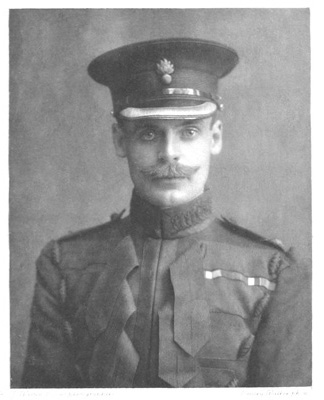
J. Weston & Sons photographers Emery Walker ph. sc.
Major-General G. D. Jeffreys, C.M.G.
By 1.30 the first objective was entirely in our hands, and five minutes later the advance to the second objective began, close up under our barrage. This was a complete success, as the barrage kept the enemy in their trenches, and they had not even shown themselves when the Grenadiers and Irish Guards were on them with the bayonet.
After the capture of the first objective there were only two company officers left, Lieutenant A. Lawson-Johnston and Second Lieutenant Layland-Barratt, and the attack on the second objective was practically carried out by the non-commissioned officers. Never have the sergeants of the regiment showed to better advantage. The skill with which they handled their companies or platoons, their quick grasp of an order conveyed to them, and the intelligent way in which they carried out their instructions elicited the warmest praise from the Commanding Officer.
By 1.45 P.M. the second objective was secured, and many of the enemy killed. The dug-outs in the sunken road on the right of the Grenadiers were all searched, and a large number of prisoners taken. The following message was received from Brigade Headquarters:
Prisoner you sent down states that the rest of his Company are in dug-outs or subterranean passages about 250 yards east of Lesbœufs and south of the sunken road. He appears to think they are anxious to surrender, but gives no reasons. In thinking this he seems to be more talkative than reliable.
82 The prisoner proved to be right, though, by the time the search of these dug-outs started, all their occupants had already run out, holding up their hands. During this second phase of the attack, the enemy appear to have offered little resistance, and many more were captured than killed.
Meanwhile the company of Coldstream under Captain Verelst which had been detailed for clearing Lesbœufs closed up in rear of the Grenadiers, according to the programme, and at 2.35 P.M. the advance on the third objective began. To this also there was little resistance, and soon the Grenadiers and Irish Guards were established in a line 100 yards east of Lesbœufs village. During the whole of their advance the Grenadiers had kept in perfect touch with the Irish Guards on their left and the 1st West Yorks on their right, and the orders were carried out almost to the minute. However, the situation on the left of the 1st Guards Brigade seemed doubtful, and General Pereira therefore sent up a company from the 3rd Battalion Coldstream to strengthen that flank.
Thus Lesbœufs passed into our hands, and these positions, which had been considered quite impregnable, were taken by the combination of the creeping barrage and a simultaneous infantry attack.
It was about this time that the only real hitch in the attack occurred. Arrangements had been made for the artillery barrage to be put down 200 yards east of the final objective, but the position of the trench was marked differently on the artillery and infantry maps, 83 and the shells fell short. This not only caused a good many casualties amongst the men who were digging in, but also prevented the attacking force from pushing forward patrols and occupying the best ground for observation. A furious message was sent back by Captain Bailey: ”Our artillery are blowing us out. Please stop it at once,” but whether the messages miscarried or whether the maps were so inaccurate that the orders were not understood, the shelling continued for nearly two hours.
Meanwhile the 2nd and 3rd Battalions Coldstream moved up by the new communication trench to the support line and thence across the open to the first objective, where they remained in support.
When the barrage eventually cleared away it was found that there were practically no Germans in front, although a good many of them could be seen running towards Le Transloy without rifles or equipment, and the enemy were not shelling us at all, no doubt because they had been obliged to move their guns. It seemed to Lieut.-Colonel de Crespigny that some advantage should be taken of this situation, and he sent a message back that it was a splendid opportunity for the cavalry to go through. Lord Cavan, however, decided that the circumstances did not permit of such a move, as the front was too narrow.
Lord Cavan sent the following message to General Pereira:
Hearty thanks and sincere congratulations to you all. A very fine achievement, splendidly executed.
84 To which General Pereira replied:
Your old Brigade very proud to be able to present you with Lesbœufs. All ranks most gratified by your kind congratulations.
Later this message was received from General Ponsonby, commanding the 2nd Guards Brigade:
G.O.C. and all ranks wish to congratulate the 1st and 3rd Guards Brigades on their splendid success to-day.
The men were in the highest spirits, and that evening they had a quiet time even in the front trench, so quiet that there was no difficulty in getting supplies up. During the night each battalion was ordered to thin out the front line, as there were far too many men in the trench; this order was carried out, but next morning it was found that still further thinning had to be done.
Sept. 26.
On the 26th the 2nd Battalion Grenadiers and Irish Guards received orders to try and push patrols on to the ridge which ran 800 yards east of Lesbœufs; but, although this might have been possible the night before, it was found to be impracticable now as the Germans had had time to recover, and had established a strong line of posts with machine-guns, so that our patrols were unable to advance more than 300 yards.
That night the 2nd Battalion Grenadiers was relieved by the 2nd Battalion Irish Guards from the 2nd Guards Brigade, and marched back to the Citadel Camp, where it arrived at 4 A.M. on the 27th, after stopping on the way at the south end of Bernafay Wood for hot food provided by the cookers.
85 The casualties in the Battalion were 108 killed, 222 wounded, and 12 missing, making a total of 312 excluding officers. Considering what had been accomplished this was surprisingly little, but the percentage of officers was very high, the result, no doubt, of the fact that the wire had not been cut at the first objective. Captain A. K. S. Cunninghame, Lieutenant the Hon. W. A. D. Parnell, Lieutenant M. A. Knatchbull-Hugessen, and Lieutenant G. A. Arbuthnot were killed, and Captain Harcourt-Vernon, Captain Beaumont-Nesbitt, Lieutenant A. F. Irvine, Lieutenant H. G. Wiggins, and Lieutenant R. B. B. Wright were wounded.
The following order was issued by General Pereira to the 1st Guards Brigade:
2nd Batt. Grenadier Guards—
You have again maintained the high traditions of the 1st Guards Brigade when called upon a second time in the battle of the Somme. For five days previous to the assault the 2nd and 3rd Battalions Coldstream Guards held the trenches under constant heavy shell-fire and dug many hundred yards of assembly and communication trenches, this work being constantly interrupted by the enemy’s artillery. The 2nd Battalion Grenadier Guards and 1st Battalion Irish Guards, though under shell-fire in their bivouacs, were kept clear of the trenches until the evening of 24th September, and were given the task of carrying by assault all the objectives to be carried by this Brigade. Nothing deterred them in this attack, not even the fact that in places the enemy wire was cut in the face of rifle and machine-gun fire, and in spite of all resistance and heavy losses the entire main enemy defensive line was captured.