Chapter XIX · (continued 2)
Reading edition
86 Every battalion in the Brigade carried out its task to the full.
The German Reserve Division, which includes the 238th, 239th, and 240th Regiments, and which opposed you for many weeks at Ypres, left the salient on the 18th September. You have now met them in the open, a worthy foe, but you have filled their trenches with their dead and have driven them before you in headlong flight.
I cannot say how proud I am to have had the honour of commanding the 1st Guards Brigade in this battle, a Brigade which has proved itself to be the finest in the British Army.
The Brigade is now under orders for rest and training, and it must now be our object to keep up the high standard of efficiency, and those who have come to fill our depleted ranks will strive their utmost to fill worthily the place of those gallant officers and men who have laid down their lives for a great cause.
C. E. Pereira, Brigadier-General,
Commanding 1st Guards Brigade.
September 28, 1916.
The 3rd Battalion
3rd Batt.
At the beginning of September the 3rd Battalion Grenadiers was at Morlancourt, being trained with the rest of the 2nd Guards Brigade. On the 9th the Brigade moved into camp at Happy Valley and on the 12th it marched to Carnoy.
The following officers of the 3rd Battalion took part in the attack of September 15, 1916:
Lieut.-Colonel B. N. Sergison-Brooke, D.S.O. Commanding Officer.
Capt. O. Lyttelton Adjutant.
Capt. G. G. Gunnis Bombing Officer. 87
Lieut. A. O. Whitehead Asst. ” ”
Capt. R. Wolrige-Gordon No. 1 Company.
Lieut. C. G. Gardner ” ”
Lieut. W. A. Stainton ” ”
Lieut. E. H. J. Wynne ” ”
Capt. the Hon, R. P. Stanhope No. 2 Company.
Lieut. G. F. R. Hirst ” ”
2nd Lieut. M. Thrupp ” ”
2nd Lieut. D. W. Cassy ” ”
Capt. F. J. V. B. Hopley No. 3 Company.
Lieut. W. Champneys ” ”
2nd Lieut. J. F. Worsley ” ”
2nd Lieut. G. M. Cornish ” ”
Capt. A. K. Mackenzie No. 4 Company.
Lieut. R. Asquith ” ”
2nd Lieut. G. D. Jackson ” ”
2nd Lieut. H. St. J. Williams ” ”
Lieut. A. T. Logan, R.A.M.C. Medical Officer.
Sept. 12-13.
On the night of the 12th the 2nd Guards Brigade was ordered to relieve the right subsection of the 3rd Guards Brigade. In the front line was placed the 2nd Battalion Irish Guards, with the 1st Battalion Scots Guards in support, while the two battalions which were eventually to undertake the attack, the 3rd Battalion Grenadiers and 1st Battalion Coldstream, remained behind in reserve. Orders were given to the 2nd Battalion Irish Guards to clear away isolated posts in front, where it was reported that some Germans were lurking, and this was successfully done; but an attack that was afterwards organised with the 71st and 16th Infantry Brigades was not quite so successful.
Sept. 14.
Up to this point the 3rd Battalion Grenadiers had stayed in reserve. Its packs, greatcoats, and surplus kit were now sent into the Divisional 88 store at Méaulte, and bombs, sand-bags, tools, flares, etc., issued to the men for the attack on the following day. The Battalion marched off by companies at 9 P.M. to take up its position.
The following orders were issued by Brigadier-General J. Ponsonby, commanding the 2nd Guards Brigade:
2nd Guards Brigade
1. The Fourth Army will attack the enemy’s defences between Combles Ravine and Martinpuich on Z day with the object of seizing Morval, Lesbœufs, Gueudecourt, Flers.
The French will attack simultaneously on the right, and the Reserve Army on the left.
The attack is to be pushed with the utmost vigour all along the line until the most distant objectives are reached. The failure of a unit on the flank is not to prevent other units from pushing on to their final objective.
As soon as the final objectives have been captured by the infantry, the cavalry will advance and will seize the high ground Rocquigny—Villers-au-Flos—Riencourt-les-Bapaume—Bapaume.
The Guards Division is to be prepared to support the cavalry on the above line at the earliest possible moment.
2. The objectives allotted to Guards Brigades are marked on the attached map as follows:
First objective, Green (X line).
Second ” Brown (Xa line).
Third ” Blue (Y line).
Fourth ” Red (Z line).
2nd Guards Brigade will be on the right. 1st Guards Brigade will be on the left. 3rd Guards Brigade will be in reserve. 71st Infantry Brigade will be on the right of 2nd Guards Brigade.
89 3. The Brigade will attack with two battalions in front and two battalions in support.
3rd Battalion Grenadier Guards will be right front battalion.
1st Battalion Coldstream Guards will be left front battalion.
1st Battalion Scots Guards will be right support battalion.
2nd Battalion Irish Guards will be left support battalion.
4. Battalions will be formed up on a company front in column of half-companies. Troops will be in single rank. Each battalion will therefore advance in four waves.
5. 2nd Guards Brigade Machine-gun Company will detail guns as follows:
I. Two guns to advance with 3/G.G. and two guns with 1/C.G. These guns will take position in the third wave on the inner flank of the right and left flank platoons respectively.
II. Four guns to advance with 1/S.G., and four guns with 2/I.G. Four of these guns will take position in the sixth wave on the inner flank of the right and left platoons respectively. The other four will take the same position in the eighth wave.
The remaining three guns will advance in the centre of the ninth wave.
6. Four Stokes guns will be detailed to advance on the flanks of the ninth wave.
1/S.G. and 2/I.G. will find carrying parties of one officer and fifty men each to advance with these guns.
Remaining guns will be in Brigade Reserve, with 76th Field Company, R.E.
7. The formation for attack will accordingly be as follows:
1/C.G. 3/G.G.
B Coy. A Coy. B Coy. A Coy.
First Wave 6 5 2 1 6 5 2 1
Second Wave 8 7 4 3 8 7 4 3
D Coy. C Coy. D Coy. C Coy. 90
Third Wave 14 13 10 9 14 13 10 9
2 M.G.’s 2 M.G.’s
Fourth Wave 16 15 12 11 16 15 12 11
2/I.G. 1/S.G.
B Coy. A Coy. B Coy. A Coy.
Fifth Wave 6 5 2 1 6 5 2 1
Sixth Wave 8 7 4 3 8 7 4 3
2 M.G.’s 2 M.G.’s
D Coy. C Coy. D Coy. C Coy.
Seventh Wave 14 13 10 9 14 13 10 9
Eighth Wave 16 15 12 11 16 15 12 11
2 M.G.’s 2 M.G.’s
Ninth Wave S.G. S.G. 4 M.G.’s S.G. S.G.
Carrying Parties.
Sapping platoons will be formed up in rear of Battalion H.Q., which will move in the centre of the fourth and eighth waves. The distance between waves will be 50 yards.
8. Details of artillery barrage are given in Appendix A.
9. Nine tanks will advance from Guards Division front. They will probably start from each successive line well in advance of the attacking troops.
The action of the troops will be entirely independent of the action of the tanks, and will be carried out as ordered, whether the tanks are held up or not.
10. The assaults on successive objectives will be delivered at the following times:
Attack on X line at zero.
Attack on Xa line at zero + 1 hour.
(This second assault is limited to 1st Guards Brigade. 2nd Guards Brigade will not move till time for third assault.)
Attack on Y line at zero + 2 hours.
Attack on Z line at zero + 4 hours and 30 minutes.
91 11. The action of the waves of attack will be as follows:
(a) First four waves will pass over X line and lie down close in rear of the barrage, which will halt till zero + 1 hour and 10 minutes at X + 200 yards.
Fifth and sixth waves will clear up X line.
Seventh and eighth waves will clear up X line and lie down in rear of fourth wave.
Ninth wave will lie down short of X line.
(b) At zero + 2 hours all waves will advance to the Y line. Seventh and eighth waves will advance in front of fifth and sixth waves. Ninth wave will be in rear as before.
(c) On reaching Y line, first four waves will pass over Y line and lie down close in rear of barrage as before.
Seventh and eighth waves will clear up Y line.
Fifth and sixth waves will pass over Y line and lie down in rear of fourth wave.
Ninth wave will lie down short of Y line.
(d) Half an hour after reaching Y line all Commanding Officers will meet at Battalion Headquarters of 3rd Bn. Grenadier Guards, and will confer on attack on Z line.
Lieutenant-Colonel Brooke, D.S.O., 3rd Bn. Grenadier Guards, if present, will command the attack on the Y line.
In the absence of Lieut.-Colonel Brooke, senior officer present will command.
Stokes Gun Sections will act in accordance with orders of O.C. attack.
12. It is the object of these dispositions to ensure a steady flow of troops so as to press the strongest possible attack against each successive objective.
Rear lines will reinforce leading lines wherever they appear thin.
No troops will be left in any objective when the attack goes on.
The task of the two leading Guards Brigades is to 92 drive the attack through Lesbœufs to the ultimate objective by every means in their power.
3rd Guards Brigade will be in close reserve to carry out any of the following duties, as may be required:
(a) To pass through Z and press the attack behind the cavalry.
(b) To make a defensive flank, if the attack on our flanks is held up.
(c) To support the attack of the leading Guards Brigades, if held up anywhere.
13. 76th Field Company, R.E., will be in Brigade Reserve. It will be formed up in a place to be notified later, and will await orders from the Brigade.
14. Ninth Squadron, R.F.C., will have two contact aeroplanes in the air from zero to dark on Z day, and again from 6.30 A.M. to 9 A.M. on Z + 1 day.
Flares will be lit as follows:
(i.) On obtaining each objective.
(ii.) At 12 noon and 5 P.M. on Z day.
(iii.) At 6.30 A.M. on Z + 1 day.
Red flares will be used by infantry, Green flares by cavalry.
15. All transport will be packed up and ready to move forward at 1 hour’s notice after zero + 4 hours.
Brigade Transport Officer will report at Divisional Headquarters, Minden Post, at zero + 2 hours, and await orders there.
16. Separate orders will be issued regarding—
I. Supply of rations.
” ” water.
” ” S.A.A.
” ” Stokes ammunition.
” ” bombs.
II. Disposal of prisoners.
III. Medical arrangements.
17. Watches will be synchronised at 12.30 P.M. and 6.30 P.M. on Y day by telephone from this Office.
93 18. Brigade Headquarters will close at Bernafay Wood at 5 P.M. to-morrow and open at T.19.a.1/2.3½ at the same hour.
Acknowledge.
E. W. M. Grigg, Captain,
Brigade-Major.
13/9/16.
The following orders are supplementary to this Office No. 129/G. The latter will be amended, where required, accordingly.
1. 3/G.G., 1/C.G. will relieve 2/I.G. in the line to-night. 2/I.G. will move back to its assembling area on relief, and remain there till zero hour.
3/G.G. will march off at 9 P.M.
1/C.G. will march off at 9.30 P.M.
1/S.G. will march off at 10.45 P.M.
T.M.B. will march in rear of 1/C.G.
Company guides from 2/I.G. will be at Brigade Headquarters, Bernafay Wood, for relieving battalions at the following hours:
3/G.G. 9.45 P.M.
1/C.G. 10.15 P.M.
1/S.G. 11 P.M.
2. Forming-up will be carried out as follows:
(a) Every battalion is provided with printed boards to mark the waves and the flanks of platoons.
3/G.G., 1/C.G. and 1/S.G. will detail marking parties of 1 officer and 12 O.R. each to put these out before relief to-night. Brigade Signal Officer will provide three guides for this party to be at Brigade Headquarters, Bernafay Wood, at 7 P.M.
(b) In order to avoid the enemy barrage, all battalions will form east of the road from G of Ginchy (1/20,000 Sheet 57 C., S.W.) and the southern end of the Sunken Road in T.14.a. In order to make room, battalions will feel their right in forming up as far as a line running parallel to the direction of the attack through Ginchy Telegraph.
94 On starting at zero hour, battalions will incline left until the left flank is in touch with the right flank of 1st Guards Brigade.
(c) The direction of the attack is 58 degrees magnetic from the cross-roads in T.14.a.
Marking boards will be put out on a line 148 degrees magnetic from left flank mark, or 328 degrees magnetic from the right flank mark. Right and left flanks have been marked in advance by 2/I.G.
3. The dividing line between battalions in attack on X and Y lines is as follows:
X line. T.8.d.9.4.
Y line. Road junction T.3.d.5.2.
4. 2/I.G. will be formed up in two waves. First wave will clear up second German trench in X line.
Second wave will clear up first German trench in X line. Both these waves will clear up Y line.
Officer commanding 1st Bn. Scots Guards will make arrangements for clearing the part of these two trenches in his area.
5. The creeping barrage will open at zero hour on a line at right angles to the direction of the attack through cross-roads in T.14.a.
It will advance and halt thereafter as laid down in Appendix A to this Office No. 129/G.
6. Prisoners will be collected at Battalion Headquarters under Battalion arrangements, and sent back to Divisional Collecting Station, Crater Post, A.8.a.6.3, when possible.
They should be made to carry wounded when practicable.
(Signed)
E. W. M. Grigg, Captain,
Brigade-Major.
14/9/16.
The first phase of the attack of the Guards Division was to be carried out with Pereira’s Brigade on the left and Ponsonby’s Brigade on 95 the right, while Corkran’s Brigade would be in reserve. To the 2nd Brigade was allotted a front of 500 yards, north-east of Ginchy, and the attack was to be carried out by the 3rd Battalion Grenadiers on the right with the 1st Battalion Scots Guards in support, and the 1st Battalion Coldstream on the left with the 2nd Battalion Irish Guards in support. In order to evade the heavy barrage which the Germans usually put down along the east of Ginchy and Guillemont villages, it was decided to assemble the whole Brigade east of Ginchy.
This precaution had the advantage that the assembly trench was not shelled, but there were certain disadvantages. In the first place, the assembly ground was not square with the line of attack, so that a change of direction was necessary after the attack had started, and, in the second place, it was by no means easy to keep the 2nd Guards Brigade in immediate touch with the 1st Guards Brigade. It had been intended to align the Brigade on painted boards showing the waves and the flanks of the platoons, but these showed up so bright in the clear moonlight that they were thrown away and men were put out as markers instead.
Sept. 15.
The 3rd Battalion Grenadiers was formed up in four waves, all the men being in single rank, and companies in columns of half-companies, with fifty yards’ distance between platoons. Their distribution was as follows:
No. 4 Company. No. 3 Company.
No. 14 Platoon. No. 13 Platoon. No. 10 Platoon. No. 9 Platoon.
” 16 ” ” 15 ” ” 12 ” ” 11 ”
No. 2 Company. No. 1 Company. 96
No. 6 Platoon. No. 5 Platoon. No. 2 Platoon. No. 1 Platoon.
” 8 ” ” 7 ” ” 4 ” ” 3 ”
At 4 A.M. the Battalion was in position and everything was ready. Sandwiches and an issue of rum were served out to the men, who then tried to snatch a little sleep. Complete silence reigned, except for the sound of the tanks making their way slowly to their places. At 6 A.M. exactly our heavy guns started, and fired about forty shells apiece in quick succession. This immediately woke up the enemy and brought down their barrage in exactly the place where it was expected, but of course there were no troops there. Orders were passed down at 6.15 to fix bayonets and get ready, and five minutes later the attack started.
The first objective or Green line lay over the ridge about 600 yards away, and it was hoped that this would be reached without any serious opposition. The ground in and around Ginchy was a battered mass of irregular ridges and shell-holes, which overlapped and stretched away into the early morning mist. Direction became a matter of the greatest difficulty, as there were absolutely no landmarks to go by. No one except the Irish Guards had seen the ground before, as it had been found impossible to send officers up during the heavy fighting of the last days. On the map it seemed a simple matter to pick out the Lesbœufs road and the church of Lesbœufs, either of which would have served as a guide, but on the actual ground, which was just a great desert of shell-holes, with our own 97 barrage ahead and the enemy’s shells falling all round, it was practically impossible to distinguish anything.
Soon after it started off the 3rd Battalion Grenadiers came on unexpected intermediate lines. These were no more than connected shell-holes, but had served to shelter a number of Germans, who fought with the utmost bravery. The guns had not bombarded them, while the creeping barrage had passed over too quickly to do much harm. Though the men holding them were all shot or bayoneted, and the delay thus caused was very slight, it had the effect of breaking the regularity of the formation and telescoping up the men in the rear.
Almost at the outset Captain A. K. Mackenzie was hit and fell, as he led his company to the attack. Though mortally wounded, he got up again and struggled on, still waving his men forward. Once more he fell, and this time was unable to rise, but even then he managed to raise himself on one knee and cheer the company on. Afterwards he was carried down on a stretcher, but never recovered and died in the ambulance on the way. About the same time Lieutenant Raymond Asquith was shot through the chest and killed as he led the first half of No. 4 Company. He had endeared himself to both officers and men in an extraordinary degree since he joined the regiment at the beginning of the war, and his preference of service with his Battalion to the good staff appointment which he had just given up had won the admiration of all ranks. Lieutenant E. H. J. Wynne was mortally 98 wounded by a German officer in one of the intermediate lines, and Lieutenant C. G. Gardner was killed soon afterwards. Captain G. G. Gunnis, Lieutenant A. Whitehead, Second Lieutenant H. Williams, and Second Lieutenant J. Worsley were wounded.
While these intermediate lines were being cleared, an extremely heavy machine-gun fire was opened from the right flank, where the Sixth Division had been held up at the start. The tanks which were to have flattened out the wire and helped the advance never appeared, and so it came about that, from the moment it crossed over the Ginchy ridge and came within view of the enemy’s lines, the 2nd Guards Brigade was committed to hard and continuous fighting in a position of much difficulty.
By now the Brigade had got very much mixed up, and, though still all together, continued its advance as a brigade rather than as four battalions. Whenever the leading wave met with any check, those in rear, impatient to get at the enemy, closed in on them, and thus companies and even battalions became intermingled. As an inevitable result of this quick advance the right flank of the Brigade was completely exposed, and Lieut.-Colonel Sergison-Brooke deciding that some protection was essential, threw out a company as a defensive flank to within 200 yards of the enemy’s flanking trench, to keep down the fire, while the rest of the 3rd Battalion Grenadiers pressed on to the main assault.
It had been arranged that after the first objective had been captured our artillery should 99 bombard the second objective and prepare it for attack, so when these lines were carried there was some uncertainty as to whether the advance should be continued or not. In spite of the casualties the 3rd Battalion Grenadiers, with the 1st Battalion Scots Guards, continued to push on till it reached the first objective, and was able to secure it according to the specified time, though the task was no easy one. In some parts between the right and left columns of the assault, and also on the extreme right, the wire had been untouched, but as soon as any man gained a foothold in the trench he at once proceeded to clear the way by bombing. Curiously enough, though the Germans had fought with such tenacity in the intermediate lines, the garrison of the first objective offered comparatively little resistance, and surrendered in large numbers.
The men were out of breath, as the pace had been hot, and they were carrying a good weight, so a pause in this first objective was not unwelcome. The prisoners were grouped together, and sent back in batches; in one part of the line the German machine-gunners caught sight of them and turned their guns on them, but the prisoners scurried off and ran as fast as they could back through our lines.
On the right Captain Wolrige-Gordon with No. 1 Company was attempting to keep touch with the Sixth Division, and as the Battalion advanced he started firing down the enemy’s trench where the machine-guns were holding it up. At first the Germans were puzzled, but 100 when they grasped where the fire came from their snipers got to work and accounted for many men before Captain Wolrige-Gordon could join the rest of the Battalion.
In the meantime the three battalions of Coldstream advanced in a splendid manner, carrying all before them. When men in line are going forward with no reliable landmarks to guide them, small incidents, quite insignificant in themselves, will often cause a slight change of direction without their being aware of it. On starting off the 1st Battalion Coldstream met with little resistance, and in its endeavour to rush the foremost German trenches the left flank of the Battalion moved ahead faster than our creeping barrage. Quickly realising what had happened, the men checked the pace and hung back for a little, while the right flank of the Battalion still pressed on. The check was momentary, but caused the whole Battalion to swing slightly to the left. This led the 2nd and 3rd Battalions Coldstream in the 1st Guards Brigade also to ease off slightly to the left, and, as often happens, the slight deviation was exaggerated as the advance continued, and soon all the Coldstream battalions were moving in a northerly instead of a north-easterly direction. A switch trench running at an angle into the German main line gave them the impression that they were going in the right direction, as it seemed square with their advance. The 2nd Battalion Irish Guards swung with the 1st Battalion Coldstream, but the 1st Battalion Scots Guards followed the 3rd Battalion Grenadiers.
101 While this was happening the 2nd Battalion Grenadiers from the 1st Guards Brigade, having completely lost sight of the 2nd and 3rd Battalions Coldstream as it passed through the enemy’s barrage, continued to advance according to its orders, and eventually forced its way to the first objective, where to its surprise it found itself between the 3rd Battalion Grenadiers and the 1st Battalion Irish Guards.
The situation was most complicated, and yet all was well. The Division, as a Division, had swept everything in front of it, although not quite in the order in which it should have moved. But parts of the German trenches remained untouched, and these had to be dealt with before any farther progress could be made. When the 1st Battalion Coldstream began to swing to the left, a gap was made between the two front battalions of the 2nd Guards Brigade, which widened out as the advance progressed. Observing this, Captain Oliver Lyttelton pushed up 100 men of the 3rd Battalion Grenadiers to fill the intermediate space, but as the gap gradually extended, and the smoke and dust made it impossible for them to see where they were going, these hundred men were able to keep touch with the 1st Battalion Coldstream only, and became detached from the rest of the Battalion.
Progress towards the first objective was made very difficult by the failure of the Sixth Division to take the Quadrilateral. As soon as the attacking lines showed themselves they were met by a sweeping fire from the enemy’s machine-guns 102 on the right flank, and were mown down. After the first objective had been entered, and Lieut.-Colonel Campbell, Coldstream Guards, was organising an attack upon the second objective, it was discovered that the whole of the first objective was not entirely secured. An attack was immediately made on that portion of the line still occupied by the enemy, and Lieut.-Colonel Guy Baring, who commanded the 1st Battalion Coldstream, in attempting to gain touch with the remainder of the Brigade from which he had, for the moment, been separated, left the trench to advance over the top of the ground when he was struck by a bullet in the head and instantly killed.
Lieut.-Colonel Campbell then ordered Captain Lyttelton to bomb down the trench together with a party of the 2nd Irish Guards under Lieutenant Mylne. But hardly had they started when the Germans came running down the trench, holding up their hands. They were being pursued by another bombing party, composed, not of the 3rd Battalion Grenadiers as might have been expected, but the 2nd Battalion Grenadiers.
Now that the whole of the first objective was in our hands the advance towards the second objective at once took place. On the extreme right no ground could be gained, but farther towards the centre the 3rd Battalion Grenadiers reached a position which it assumed to be the second objective, but was in fact, according to the report from the aeroplanes, half-way between the first and second objectives.
103 During this last advance Captain Stanhope and Second Lieutenant Jackson were killed. Lieutenant W. Stainton was reported missing, and there were several conflicting stories as to what had happened to him. Second Lieutenants Thrupp and Cassy were wounded, as well as Second Lieutenant Cornish, who behaved with great gallantry and was recommended for a Military Cross.
As to whether it would have been possible to push on at once into Lesbœufs, accounts vary. Certainly those in front thought that had reinforcements come up the town would have fallen into our hands without further opposition. It was not known, however, that the right flank of the Division was absolutely unprotected, and that the farther the Division advanced the more perilous its position was bound to become. Even if Lesbœufs had been taken, it is difficult to believe that it could have been held against counter-attacks with the right flank thus in the air.
The sight of the Germans retiring hastily towards Bapaume and withdrawing their field-guns proved too tempting for some adventurous spirits, and patrols were organised to press on towards Lesbœufs. After consulting their maps, Captain Sir Ian Colquhoun, 1st Battalion Scots Guards, and Captain Lyttelton, 3rd Battalion Grenadiers, determined to keep the Germans in front of them on the move, and they were joined soon after by Major Rocke, Captain Alexander, and Lieutenant Mylne of the Irish Guards. Sir Ian Colquhoun had already won 104 a reputation as the bravest of the brave, and was credited with having killed a large number of Germans in personal combat. The others were very much of the same type—officers who were never content with simply carrying out their orders, but would instantly take advantage of any weakness in the German defence to drive a success home.
Having collected about twenty men, Sir Ian Colquhoun pushed forward to reconnoitre towards Lesbœufs, followed soon after by Major Rocke and Captain Alexander with some men of the Irish Guards. Captain Lyttelton called on the men of the 3rd Battalion Grenadiers who were near, and brought the whole party up to about 120. This party pushed on, and met with no opposition for 800 yards. At this stage they found themselves in an unoccupied trench running along the bottom of a little gully, with standing crops in front of them. They could have pushed on into Lesbœufs, but owing to their small numbers and, as they expressed it, the ”draughtiness of their flanks,” they decided to hold on where they were and send back for reinforcements. Messages were accordingly despatched to the Brigade Headquarters, and were marked, “To be read by all officers on the way.”
This daring attempt to capture more ground from the enemy was quite a feasible operation, but its success undoubtedly depended on whether reinforcements could reach them before the Germans returned. For so small a party to try and do anything more than hold the trench until an adequate force arrived would 105 have been madness. Every possible precaution was taken against surprise, and Lewis guns were placed on each flank. From 1 P.M. onwards this gallant little band waited and waited for the reinforcements which never arrived. Meanwhile, finding that the British attack had spent itself, the Germans began returning in small bodies, and soon after 5 P.M. a whole battalion was seen advancing. The position of this party was now becoming serious. Gradually the Germans were moving round each flank, and even getting to their rear.
At 6 P.M. they were still doggedly holding on to their trench, being fired at from all sides, when suddenly a company of the enemy, 250 strong, charged them in front. The surprise was complete, as the standing crops hid the Germans till the last moment. With 250 of the enemy rushing a trench occupied by less than 100 British troops, one might have thought it only a matter of time before our men were all killed or taken prisoners. But the men who had followed Major Rocke, Sir Ian Colquhoun, and Captain Lyttelton were naturally stout fighters, and when the order to retire was given they actually contrived to disengage themselves and get away, after killing a good number of the enemy. Captain Lyttelton, finding himself surrounded, threw his empty revolver at the Germans; thinking it was a Mills bomb, they ducked, and gave him time to scramble out of the trench and escape.
Even then, had the Germans only stayed where they were and fired at the retreating party, they 106 might have inflicted considerable losses, but they came running on, firing from the shoulder, and so allowed these gallant men to rejoin the main British line with astonishingly few casualties. When once they were safe, the pursuers were greeted by such a deadly fire from our trenches that numbers of them were killed, and the rest scattered in all directions.
Meanwhile General Ponsonby pressed for the 3rd Guards Brigade to be sent up, but the reports which reached General Feilding from the air showed that the troops in front were not in the positions ascribed to them, and as the situation on both flanks of the Division was unsatisfactory, and the Germans were reported to be massing between Morval and Lesbœufs, he considered that it would be impossible to throw forward all his reserves. However, the 4th Battalion Grenadiers was ordered to reinforce the 2nd Guards Brigade, and told by General Ponsonby to strengthen the right flank.
Sept. 16.
All that night the right flank of the 2nd Guards Brigade was being bombed, and Captain J. Hopley, who behaved with great gallantry, at one time had his men standing back to back and firing both ways. The next day, September 16, the 2nd Guards Brigade was relieved by the 61st Infantry Brigade, who continued the attack, and secured the next objective.
The percentage of officers killed and wounded in the 3rd Battalion Grenadiers was exceptionally high; out of 22 officers who went into action, 17 were killed or wounded. Lieut.-Colonel Sergison-Brooke was wounded almost at the start. Captain 107 A. K. Mackenzie, Captain the Hon. R. P. Stanhope, Lieutenant E. H. J. Wynne, Lieutenant Raymond Asquith, Lieutenant W. A. Stainton, Lieutenant C. G. Gardner, Second Lieutenant G. D. Jackson were killed; Captain G. G. Gunnis and Second Lieutenant E. G. Worsley were mortally wounded, and subsequently died; Captain F. J. V. B. Hopley, Lieutenant W. Champneys, Lieutenant A. O. Whitehead, Second Lieutenant M. Thrupp, Second Lieutenant D. W. Cassy, Second Lieutenant G. M. Cornish, Second Lieutenant H. St. J. Williams, and Second Lieutenant J. F. Worsley were wounded.
Amongst other ranks the casualties were 395 killed and wounded.
On September 20 the 3rd Battalion moved into bivouacs at Carnoy, where it remained until the second attack of the Guards Division on the 25th. The 2nd Guards Brigade was then, however, in reserve, and, owing to the complete success of the attack, its services were not required. The 3rd Battalion Grenadiers was in Corps Reserve during the attack, but returned to the Brigade in the evening. On the 26th Lieutenant C. C. Carstairs and Second Lieutenant C. F. Johnston joined.
The 1st Battalion
1st Batt.
At the end of August the 3rd Guards Brigade went through a period of training which lasted until September 7; during this time it stayed in billets at Ville-sous-Corbie. Captain E. Sheppard joined the 1st Battalion Grenadiers on 108 September 3. On the 8th the Brigade moved up into the line and took over Ginchy, which had just been captured by the Sixteenth Division. The 4th Battalion Grenadiers and 1st Battalion Welsh Guards were placed in the front trenches, while the 1st Battalion Grenadiers and 2nd Battalion Scots Guards were in reserve.
The officers who went up with the 1st Battalion were:
Lieut.-Colonel M. E. Makgill-Crichton-Maitland Commanding Officer.
Capt. E. H. J. Duberly Adjutant.
Lieut. R. P. le P. Trench, M.C. Bombing Officer.
Lieut. A. V. L. Corry, M.C. Lewis Gun Officer.
Capt. W. D. Drury-Lowe, D.S.O. King’s Company.
Lieut. G. F. Pauling ” ”
2nd Lieut. B. G. Samuelson ” ”
Capt. A. C. Graham No. 2 Company.
Lieut. E. B. Shelley ” ”
2nd Lieut. E. G. L. King ” ”
Capt. E. N. E. M. Vaughan No. 3 Company.
2nd Lieut. O. F. Stein ” ”
2nd Lieut. C. C. T. Sharp ” ”
Capt. L. G. Fisher-Rowe No. 4 Company.
2nd Lieut. R. H. P. J. Stourton ” ”
2nd Lieut. W. H. Lovell ” ”
2nd Lieut. L. de J. Harvard Sapping Platoon.
The rest of the officers, as well as the Sergeant-Major, Senior Drill-Sergeant, and Company Sergeant-Majors, remained behind with the Transport.
Sept. 10-11.
At 3.30 A.M. on the 10th the 1st Battalion Welsh Guards reported that it had completed the relief of the 48th Brigade, and was digging in on a line 200 yards east of the south-east corner of Delville Wood to 100 yards north of 109 Ginchy on the Flers road, and 250 yards east of the Lesbœufs road. Its left was in touch with the 164th Brigade, but its right was in the air. Meanwhile the 4th Battalion Grenadiers was relieving the 47th Brigade between Guillemont and Leuze Wood. But although both these battalions were carrying out their orders correctly, there was a gap of at least 600 yards between them, owing doubtless to the fact that the troops they had to relieve were not quite in the positions they had been reported as occupying. The 47th Brigade had been held up by the Quadrilateral, while the 48th Brigade on its left had advanced some distance.
On learning this, Brigadier-General Corkran decided to employ some companies from the battalions in reserve to fill up the gap, and accordingly instructed Lieut.-Colonel Maitland to send one company to support the 4th Battalion Grenadiers and another company to the Welsh Guards. No. 2 Company, under Captain Graham, was despatched to Arrow Head Copse in support of the 4th Battalion Grenadiers on the right of the Brigade, and while going on ahead to find Lieut.-Colonel Lord Henry Seymour, Lieutenant E. King was hit by a rifle bullet in the leg, and Lieutenant E. B. Shelley and Lieutenant Llewellyn were wounded shortly afterwards. Captain Vaughan, with No. 3 Company, was instructed to place himself under the orders of Lieut.-Colonel W. Murray-Threipland, while the rest of the Battalion remained a little distance behind in case of emergency.
Hardly had the Welsh Guards finished their 110 relief, when they were attacked, and had to fight hard to maintain their position. Coming on in great force as early as 3 A.M., the Germans began to press back the right of their line from the sunken road. Every available man had been hurried to the front line, where the casualties were thinning out the ranks to an alarming extent, and even the 100 Grenadiers who had been sent up as ammunition carriers had to be put in as supports. The Welsh Guards had lost a good many officers and N.C.O.’s, and matters were beginning to look serious when Captain Vaughan arrived with No. 3 Company of the 1st Battalion Grenadiers, having passed through a barrage of 5·9 shells near Trônes Wood in artillery formation. He was at once sent off by Lieut.-Colonel Murray-Threipland to take over the line on the right of the Welsh Guards and relieve the Munster Fusiliers, who had had some very heavy fighting and were much shaken. Second Lieutenant Stein went on with the leading platoon, and the relief was carried out by sections and completed by noon.
It was anything but a pleasant position, as both flanks were in the air, and the Company was occupying an extended front at right angles to the trench occupied by the Welsh Guards. Captain Vaughan was told that the attack would probably come from the left, and made his dispositions accordingly. He placed two sections in shell-holes in échelon on the left, and established a double block at that end of the trench with a strong bombing section, supported by a Lewis gun; the other Lewis gun he stationed on the right flank. Second Lieutenant Sharp was in 111 charge of the left of the Company and Second Lieutenant Stein of the right.
The day proved quiet and uneventful, the enemy showing no inclination to advance, but at 10 P.M. their attack began. Coming on in four waves, they not only succeeded in getting between No. 3 Company and the Welsh Guards, but even gained a footing in the front trench. The Lewis gun on the left did excellent work, but the men in the bombing post were all knocked out. At the same time the Welsh Guards were heavily attacked all down their line, and Lieut.-Colonel Murray-Threipland sent a message to Captain Vaughan to say that his front line was falling back somewhere to the centre of Ginchy, and asking him to fill up the gap between them until reinforcements could be brought up. Captain Vaughan replied that his left flank was in contact with the enemy, and he could not, therefore, throw back that flank, but that he had double-locked the trench on that side; if reinforcements did not reach him soon, he would endeavour to protect his flanks as best he could.
This Company’s situation was now becoming precarious. It had the enemy at each end of a very long trench; enemy in front of it and enemy behind it. It was short of bombs and practically out of ammunition. At one time it had some of the enemy actually in the trench, but fortunately their bayonets were still left to them, and not a German survived to dispute possession with them. Apparently the enemy did not know that this was an advanced trench, thinly held; probably he thought it was 112 his old line 100 yards farther back. In any case he found it a hard nut to crack, in spite of his superior numbers and obvious advantages. The men of No. 3 understood that if they gave way it would go hard with the Welsh Guards, and refused to yield an inch. Sergeant Whittaker showed great courage and skill with the bombing party, and was responsible for killing a large number of Germans, as well as holding up the enemy’s attack on the left.
Both Second Lieutenant Sharp and Second Lieutenant Stein were wounded, in addition to many N.C.O.’s, and 56 men in all were killed, but the rest fought on and made it plain to the enemy that they had no intention of retiring. When the ground was afterwards cleared, over 100 Germans were found dead in front of the trench, amongst them being a captain named von Hahen and two other officers. Throughout this difficult operation Captain Vaughan directed the proceedings with great coolness, and his messages were clear, precise, and cheerful. His stubborn defence of his trench undoubtedly saved the Welsh Guards from being surrounded.
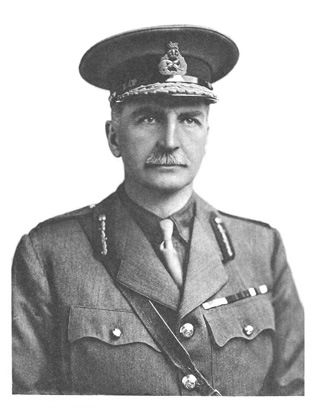
Speaight Ltd. photographersEmery Walker ph. sc.
Brigadier-General C. E. Corkran, C.M.G.
113 General Corkran in the meantime sent up two companies of the 2nd Battalion Scots Guards to the assistance of the Welsh Guards, and they arrived at 3.30 P.M. The remaining companies of the 1st Battalion Grenadiers were despatched to Guillemont, while the rest of the Scots Guards took their place near Bernafay Wood. After continuous fighting the Welsh Guards had managed to straighten their line, and Captain Ashton of that regiment organised some bombing attacks, and regained all the ground lost during the day. About midnight on the 11th the Welsh Guards were relieved by the 2nd Battalion Scots Guards.
Meanwhile the King’s Company 1st Battalion Grenadiers, under Captain Drury-Lowe, moved into the line to fill up the gap between the left of No. 3 Company and the 2nd Battalion Scots Guards, which now occupied the line originally held by the Welsh Guards. In carrying out this operation the King’s Company captured fifty German prisoners. No. 4 Company, under Captain L. G. Fisher-Rowe, moved into the line on the left of the Scots Guards to fill up another gap there. Second Lieutenant Stourton was wounded in the shoulder while in charge of the carrying party of 100 men that went into the line early that afternoon.
Sept. 12.
At 2 A.M. No. 2 Company, under Captain A. C. Graham, was ordered to bomb along a trench running east from the right of No. 3 Company along the south side of the Ginchy Telegraph Road, and attack the Quadrilateral. At that time it was not known how strongly this point was held. The formation of the bombing attack was:
Bombing party 10 men and 1 N.C.O.
Blocking party 4 ” 1 ”
Bombing party 10 ” 1 ”
One platoon under a subaltern.
Bombing party 10 men and 1 N.C.O.
Blocking party 4 ” 1 ”
Lewis gun 6 ” 1 ”
One platoon.
The Company Commander.
Two platoons.
114 Each bombing party was composed as follows:
2 bayonet men carrying 6 bombs each.
1 thrower carrying 6 bombs.
2 carriers carrying 12 bombs each.
1 N.C.O. carrying 6 bombs.
1 Mills adapter firer carrying 6 Mills adapters.
2 Mills adapter carriers carrying 10 Mills adapters.
2 bomb carriers carrying 12 bombs each.
Each blocking party was composed of four privates and one N.C.O., carrying 25 sand-bags and 1 shovel each.
Every man in the Company carried 4 Mills bombs, 4 sand-bags, and 225 rounds S.A.A., while every alternate man carried a shovel. Six men and 1 N.C.O. were left in the old line, with a Lewis gun to cover the right flank, while No. 3 found the Lewis gun to cover the left.
All the ground had been obliterated by shells, and No. 2 Company found its line with some difficulty and advanced to within 100 yards of the Quadrilateral, where it was held up by machine-gun fire. Captain Graham was killed by a shell during the advance, and Captain Fisher-Rowe took his place, but among other ranks the casualties were not heavy. There was nothing more to be done but to block the trench as far as they had got and consolidate the line. At 6 A.M. the whole Battalion made another attack, and attempted to seize the Quadrilateral in conjunction with the Fifty-sixth Division, but the place proved too strong. This time the Battalion lost heavily; Lieutenant A. V. L. Corry was killed, and there was a large number of casualties among the other ranks.
115 Sept. 13.
Next day the 1st Battalion Grenadiers was relieved at 2 A.M. by the 2nd Battalion Irish Guards, and went into camp at Happy Valley.
That afternoon there was a conference of Commanding Officers, when General Corkran explained the dispositions for the impending attack. The 1st and 2nd Guards Brigades were to attack on the 15th, while the 3rd Guards Brigade would be in reserve. The orders issued by Brigadier-General Corkran are given below.
3rd Guards Brigade
Operation Order, No. 59
1. The Fourth Army will attack the enemy’s defences between Combles Ravine and Martinpuich on the 15th September, with the object of seizing Morval, Lesbœufs, Gueudecourt, and Flers, and breaking through the enemy’s system of defence.
The French are attacking simultaneously on the south and the Reserve Army on the north.
The Eighth Division are attacking on the right of the Guards Division and the Fourteenth on the left. The Division is attacking with the 2nd Guards Brigade on the right and the 1st Guards Brigade on the left. The forming-up areas are shown on the map issued to the C.O.’s. Tanks will be employed to co-operate with the attack. Information regarding their employment is forwarded separately.
2. The 3rd Guards Brigade will be in Divisional Reserve, and will be formed up on the night of the 14/15th Sept. in and east of Trônes Wood as follows:
4th Batt. Grenadier Guards, east of wood between railway and Montauban—Guillemont road.
2nd Batt. Scots Guards, north of railway in S.24.C.
1st Batt. Grenadier Guards, about the trench 116 running north and south through the centre of the wood.
1st Batt. Welsh Guards and Machine-gun Company, less four guns, along the edge of the wood.
Trench Mortar Battery in the vicinity of Copse S.24.C.50. A separate order is issued regarding the move to these positions.
3. At zero hour plus 1 hour and 30 minutes the Brigade will advance in the following order:
The 4th Batt. Grenadier Guards to T.19.b astride the Guillemont—Ginchy road.
The 2nd Batt. Scots Guards to T.13.c.
These two Battalions will halt when leading troops reach S.W. outskirts of Ginchy.
1st Batt. Grenadier Guards to the vicinity of Guillemont Station.
1st Batt. Welsh Guards to N.W. of 1st Batt. Grenadier Guards with their left on Waterlot Farm.
Brigade H.Q. Company to S.24.a.
Brigade T.M. Battery will not move.
The Battalions will be formed up in depth.
4. (a) If the attack is completely successful, the rôle of the Brigade will be to pass through the 1st and 2nd Guards Brigades and support the cavalry beyond the fourth objective. The cavalry will not enter villages.
(b) Should the attack be partially successful and the fourth objective reached in the face of determined resistance, the Brigade might be required to relieve the 1st and 2nd Guards Brigades in the line of the fourth objective, and move into position in reserve in T.8.c and T.7.d.
As soon as the situation permits, the O.C. 4th Batt. Grenadiers and 2nd Batt. Scots Guards will send forward officers to reconnoitre these reserve positions and lines of approach to them. Reports from these officers will be at once forwarded to Brigade Headquarters.
(c) Should the advance be held up, the Brigade might 117 be ordered to press home a fresh attack, passing through the 1st and 2nd Brigades.
(d) If the attack on either flank be held up, the Brigade might be required to secure the flank of the Division, probably by offensive action.
(e) Detailed information regarding artillery support will form part of the orders for any of these movements.
(f) The direction of the attack is N.E. Officers must know the compass bearings to prominent points.
[The remainder of the orders referred to artillery and transport, etc.]
E. C. Warner, Captain,
Brigade-Major, 3rd Guards Brigade.
14/9/16.
Sept. 14-15.
On the 14th the 1st Battalion Grenadiers marched to Carnoy and then to Trônes Wood, where it spent the night huddled together in shell-holes. It was so bitterly cold that it was difficult to get any sleep, and next morning every one was chilled to the bone. The ”wood” consisted of trunks of trees blackened by shell-fire, the upper parts having been shot away; they were quite leafless, and the splintered branches lay all tangled over the shell craters. Amongst the wreckage were shapeless bodies in khaki and grey; some almost skeletons, and others with the skin stretched over the bones and tanned like leather. Flying about among the bare trees were half-a-dozen magpies, the only occupants of the wood. All was quiet, when suddenly our barrage began, followed by the German one, and soon the noise was terrific.
With the rest of the 3rd Guards Brigade, the 1st Battalion Grenadiers advanced to a position south-west of Ginchy in artillery formation, and 118 proceeded to strengthen the line of trenches there. The Brigade was to support the attack of the other two brigades, or to counter any hostile movements against the right flank of the Division, which was in the air, as the Sixth Division had been held up by the Quadrilateral. The 4th Battalion Grenadiers and 2nd Battalion Scots Guards accordingly moved up to a position about half-a-mile north of Ginchy, while the 1st Battalion Grenadiers and 1st Battalion Welsh Guards took their places south-west of that village, and were employed most of the day in supplying carrying parties for the other two brigades.
Second Lieutenant L. G. E. Sim and 100 men of No. 3 Company did particularly good work in carrying up ammunition and materials under fire to the battalions in the front line of trenches.
Lieutenant Samuelson was sent forward that night by Lieut.-Colonel Maitland to ascertain where the leading line had got to, so that he might know exactly the position occupied by the 1st and 2nd Guards Brigades. After stumbling about for three-quarters of an hour he reached the trench indicated by the guides, but it was deserted except for a few wounded. So he had to push on still farther, and eventually found the front trench occupied by a mixed mass of men of the Guards Division.
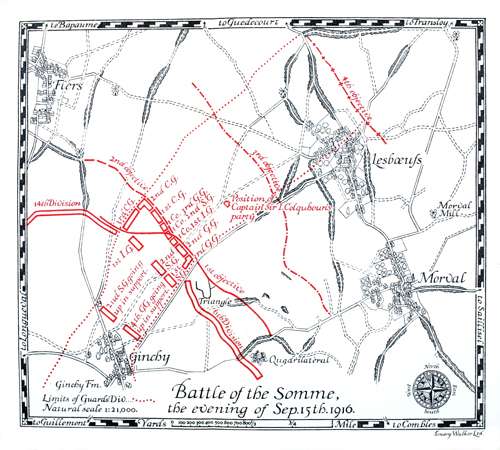
Emery Walker Ltd.
Battle of the Somme, the evening of Sep. 15th, 1916.
119 Sept. 16.
He reported this to Lieut.-Colonel Maitland, who gave orders for the King’s Company under Captain Drury-Lowe, and No. 4 Company under Captain Fisher-Rowe, to advance through Ginchy. There were apparently no guides, and after passing south of Ginchy these two companies advanced towards the front line until they met Lieut.-Colonel Murray-Threipland, who told them there were no unoccupied trenches in front. They therefore returned to their original position, having unluckily lost five N.C.O.’s, who were killed or wounded by a single shell that pitched in their midst.
At 9 A.M. the order came for the 1st Battalion to move up so as to be ready to attack with the rest of the 3rd Guards Brigade. Having joined the other battalion, the 1st Battalion Grenadiers reached a position just behind the starting-point at 11.15 A.M. The 3rd Guards Brigade, with the 1st Battalion Grenadiers on the right, the 1st Battalion Welsh Guards on the left, and the 4th Battalion Grenadiers in support, was ordered to pass through the battalions in the front line and attack the previous day’s third objective, or Blue line, but all the Commanding Officers raised a protest against an advance unsupported in any way by artillery fire, and General Corkran reported this back to the Divisional Headquarters. The protest was overruled, and the attack was ordered to begin at once. The 1st Battalion Grenadiers reached the high ground west of Lesbœufs, but was met with heavy machine-gun fire, opened on it from the church tower and other strong points. Second Lieutenant Sim was killed, and Second Lieutenant Samuelson wounded, in addition to some casualties among other ranks.
Sept. 17-19.
Orders were given to consolidate the position which had been reached, and the 1st Battalion, having been relieved by the 59th Infantry 120 Brigade, returned to bivouacs in Carnoy. On the 18th Major A. F. A. N. Thorne, D.S.O., left to take command of the 3rd Battalion, and Lieutenant C. H. C. Healy and Lieutenant W. J. Dashwood joined.
Sept. 19-24.
On the 20th the 1st Battalion Grenadiers marched to the trenches west of Lesbœufs and remained there till the next day, when it was relieved by the 3rd Battalion Coldstream. Lieutenant Dashwood was wounded while his Company was going into the front line. On the 24th the 1st Battalion left Trônes Wood and marched to the assembly trenches in preparation for the attack next day, for which Brigadier-General Corkran issued the following orders:
3rd Guards Brigade
Operation Order, No. 66
1. The Fourth Army will renew the attack on the 25th Sept. in combination with the attacks by the French in the south and the Reserve Army in the north. The Guards Division will capture Lesbœufs. The 1st Guards Brigade will attack on the right and the 3rd Guards Brigade on the left. The Fifth Division will attack Morval on the right and the Twenty-first Division (62nd Brigade) will attack Gueudecourt on the left of the Guards Division.
2. Objectives.—The objectives, assembly trenches, and dividing line between brigades and divisions are marked on attached map.
The first objective Green.
The second objective Brown.
The third objective Blue.
The 2nd Batt. Scots Guards and the 4th Batt. Grenadiers will capture the first and second objectives, 121 and will advance in two waves on a front of two companies each. The 2nd Batt. Scots Guards will attack on the right and the 4th Batt. Grenadiers on the left.
The 1st Batt. Grenadiers will pass through the two leading battalions and capture the third objective. The 1st Batt. Welsh Guards, less two companies, will be held in Brigade Reserve in T.8.a.
3. The Assault.—The 2nd Batt. Scots Guards and 4th Batt. Grenadiers will be formed up in X and Y trenches, and will advance to the attack of the first objective at zero hour close up to their barrage. There are two hostile lines to cross before the objective is reached, the first being from T.2.b.97 to T.8.b.3.10, and the second in the main German Brown line.
These two battalions will reorganise in the first objective and advance to the attack of the second objective at zero + 1 hour.
The left of the 2nd Batt. Scots Guards will direct. The 1st Batt. Grenadiers will be formed up in Z trench and will advance so as to reach the first objective at zero hour + 1 hour. The Battalion will advance to the attack of the third objective so as to reach their barrage 200 yards beyond the second objective at zero + 2 hours.
Two companies of the 1st Batt. Welsh Guards will be formed up in T.8.a, and will move into X line so as to be ready to occupy the first objective as soon as the 1st Batt. Grenadiers leave that line. In timing their advance to the X line these two companies will seize opportunities offered by any slackening of the hostile barrage.
4. Consolidation.—The 4th Batt. Grenadiers and 2nd Batt. Scots Guards will consolidate the second objective. At zero hour + 2 hours the 4th Grenadiers will push a unit forward by the sunken road in N.33.b and d and consolidate a strong point at the northern end, obtaining touch with the 62nd Infantry Brigade. The Battalion will also consolidate a strong point on 122 the left of the second objective. The O.C. 2nd Batt. Scots Guards will detail one company to push forward at zero hour + 2 hours on his right flank and consolidate a strong point to protect the right rear of the 1st Batt. Grenadiers against attack from the south.
Two companies of the 1st Batt. Welsh Guards will consolidate the first objective, making a strong point on the left flank of that objective and at N.32.d.8.3, and maintaining touch with the 62nd Infantry Brigade.
In the event of the Brigades on our right and left being held up, defensive flanks will be formed. As soon as the situation demands, half a battalion will be advanced to the sunken road in R.34.a and d.
5. Preliminary Movement.—Battalions will be moved up to the assembly positions on the night of the 24/25th September. The 1st Batt. Grenadiers will not move before 10 P.M.
Assaulting battalions will cut any wire in front of our trenches on the night of the 24/25th September. Wire-cutters can be drawn at Guillemont station if required. Units will report when they have reached their assembly positions as detailed above on the night of the 24/25th September; special relief of 1st Batt. Welsh Guards will be arranged direct between O.C. 4th Batt. Grenadiers, 2nd Batt. Scots Guards, and 1st Batt. Welsh Guards.
[The remainder of the orders referred to artillery and transport.]
E. C. Warner, Captain,
Brigade-Major, 3rd Guards Brigade.
The Z line referred to in these orders was a narrow trench about five feet deep, a little way behind the British front line.
Sept. 25.
The first objective or Green line was the last German trench running north and south, well in front of the villages. The second or Brown line was a sunken road with dug-outs about 800 yards 123 in rear of the first, and the third or Blue line was another sunken road some 600 yards farther back still. Zero hour was fixed for 12.35 P.M.
The following officers took part in the attack on September 25:
Lieut.-Colonel M. E. Makgill-Crichton-Maitland Commanding Officer.
Capt. E. H. J. Duberly Adjutant.
Lieut. G. F. Pauling Bombing Officer.
Capt. W. D. Drury-Lowe, D.S.O. King’s Company.
Lieut. P. M. Spence ” ”
Capt. E. Sheppard, M.C. No. 2 Company.
Lieut. R. F. W. Echlin ” ”
Lieut. C. H. C. Healy ” ”
Lieut. C. T. Swift No. 3 Company.
Lieut. K. O’G. Harvard ” ”
Lieut. R. D. Lawford No. 4 Company.
Lieut. R. P. le P. Trench, M.C. ” ”
Lieut. N. A. C. Flower Sapping Platoon.
The other officers, and the Sergeant-Major, Drill-Sergeants, Company Sergeant-Majors, and Company Quartermaster-Sergeants remained with the Transport.
Exactly at 12.35 P.M. the assault began, and the 3rd Guards Brigade advanced to the attack with the 2nd Battalion Scots Guards on the right and the 4th Battalion Grenadiers on the left. The first and second objectives were secured with comparatively little loss, considering the strength of the German lines.
With mathematical precision the 1st Battalion started off, and advanced in column of platoons in fours, so as to be close up when the moment arrived for it to pass through the leading battalions at the second objective. The order from 124 right to left was—the King’s Company, No. 2, No. 4, and No. 3. The German artillery at once directed a barrage on them with considerable accuracy, causing a number of casualties. Necessarily the advance was slow, but the military precision with which every order was carried out under this shell-fire was truly remarkable. It might have been a Wimbledon field-day, judging by the cool way in which the non-commissioned officers gave their orders, interposed with cautions such as “Steady by the right,” etc. And all the while the shells were falling and exploding hideously.
On arrival at the Green line the 1st Battalion had to wait for some time, and spent it in digging itself farther in, pressing into the service some remaining terrified Germans who had been found alive. The men were all eager to get on, and fretted at being left so long in this trench. At last the moment arrived for the Battalion to continue the advance, and again it moved on in a line.
The first two objectives had been taken by the Battalions in front, and the moment had arrived for the 1st Battalion Grenadiers, to which had been entrusted the attack on the third objective and the capture of Lesbœufs, to pass through the front line and continue the advance. It was faced with the usual problem in such attacks—how to guard the flanks of a successful attacking force when the neighbouring division is held up. In this case it was the left flank which remained in the air, and although the 1st Battalion Welsh Guards was forming a protective flank, the 1st 125 Battalion Grenadiers was subjected to a cruel enfilade fire. Simultaneously on the right the leading battalion of the 1st Guards Brigade was advancing towards the third objective.
The order in which the 1st Battalion attacked was now slightly changed: the King’s Company under Captain Drury-Lowe was still on the right, but No. 2 came under Captain Sheppard next, with No. 4 under Lieutenant Lawford in support. No. 3 Company under Lieutenant Swift was nearest to the enfilade fire, and found it necessary to swing to the left, in order to face the machine-guns which were causing so many casualties. Both Lieutenant Swift and Lieutenant Harvard, the only two officers with this company, were wounded, in addition to Lieutenant Flower, and the casualties among other ranks were very heavy.
With the forward progress of the Battalion the menace to the left flank increased, and Captain Sheppard threw back his left flank to protect the advance, but this naturally made it difficult for him to keep pace with the King’s Company. No. 4 Company under Lieutenant Lawford was therefore ordered to come up between the King’s and No. 2 Companies, and the advance continued in perfect lines, never hesitating for a moment in the face of a terrific fire. Lieutenant Healy was wounded, and Sergeant Brooks, who led No. 14 Platoon, behaved with great coolness and gallantry, although all his men but two were killed or wounded. He himself was not touched in the morning, but later in the afternoon had his right hand and wrist blown off by a shell. Sergeant Martin, who was in charge of a Lewis gun, had all his team knocked 126 out, but borrowed some men from No. 2 Company, and kept his gun in action for the rest of the day. He was afterwards awarded the D.C.M.
As the King’s Company advanced and took the third objective, its Commander, Captain Drury-Lowe, was killed by a shell, while he was consulting Captain Hargreaves of the Irish Guards. He had already gained the D.S.O. in the artillery battery, in which he had fought all through the first years of the war, and would no doubt have earned further distinction had he lived, for he was a man without fear and a worthy commander of the King’s Company. Lieutenant P. M. Spence took command, and directly the Blue line had been secured, ordered the men to dig themselves in, which they did, in a narrow and deep trench.
In order to protect the left flank. General Corkran sent up two companies of the Welsh Guards to watch the left of the Division, and as soon as these arrived No. 3 Company of the 1st Battalion Grenadiers under Lieutenant Pauling, who had been sent up to take charge of this Company, now without officers, was once more free to join the rest of the Battalion. When it reached the front line it was ordered to form a strong point 400 yards in front of the junction of No. 2 and No. 4 Companies. Strong patrols were sent out to deal with any of the enemy’s snipers who might still be lurking about in front, and they continued their search well into the night. One patrol under Sergeant Carter did particularly well, and managed to secure a German map showing all their dispositions. Application was 127 made that evening to the Guards Division Headquarters for the cavalry to come through, but this was refused on reference to Lord Cavan, on the ground that the situation on the flanks of the Division was still very uncertain.
Sept. 26.
On the 26th the Germans shelled Lesbœufs with their heavy guns, but the trenches that had been dug were good and little harm was done. No counter-attack was made by the enemy, and that night the 1st Battalion Grenadiers was relieved by the 1st Battalion Scots Guards, and returned to bivouacs at Carnoy.
The total casualties in the 1st Battalion during the consolidation of Ginchy and the two attacks were: officers, killed 4, wounded 12, total 16; other ranks, killed 80, wounded 431, missing 84, total 595.
The 4th Battalion
4th Batt.
After a course of training with the other battalions of the 3rd Guards Brigade, the 4th Battalion Grenadiers moved up in omnibuses to the neighbourhood of Carnoy, where it was employed in repairing a road running from Carnoy to Wedge Wood. When this work was finished, it bivouacked in shelters near Talus Boise, about two and a half miles west of Leuze Wood. On September 9 Captain Mitchell left to take up an appointment at the Central Training School at Havre.
Sept. 9.
On the evening of the 9th the 4th Battalion was sent up to relieve the 47th Brigade, which had just attacked, while the Welsh Guards 128 took the place of the 48th Brigade. As the attack had succeeded in some places and failed in others, the front line ran in an irregular pattern; in some parts large dents had been knocked in the German line, but in others we had made no progress at all. In the particular section of the line which the 3rd Guards Brigade was to relieve, the 48th Brigade, on the left, had secured all its objectives, but the 47th Brigade, in the centre, had the misfortune to find itself opposite the Quadrilateral. It could not be blamed for failing to advance, for the Quadrilateral was one of the strongest points in the enemy’s line, and contained eight machine-guns. Hence its losses were very heavy and it was quite unable to make any headway. On the other hand, the 167th Brigade on its right had been completely successful, and had gone well forward. So at the close of this attack the left of the 167th Brigade and the right of the 48th Brigade were in the air, with a space of 600 yards between the two still in the hands of the enemy.
About midnight the 4th Battalion made its way slowly towards Trônes Wood, and took over the line occupied by what was left of the 47th Brigade between Guillemont and Leuze Wood, with its left on the Wedge Wood Road, 500 yards south of Ginchy. The Battalion advanced across country under a light shell-fire, leaving Guillemont immediately on its left, and heading direct for Ginchy. On reaching its destination No. 1 Company got touch with the supports of the 167th Brigade on the right; No. 2 came next, and No. 3 was on the left, while No. 4 129 remained in support with the Battalion Headquarters.
Sept. 10.
The relief was complete by 5 A.M., and patrols were sent out in the thick morning mist to try and locate the enemy. In the trenches that were taken over lay heaps of wounded and dying men, some of whom had been there for five days. There was constant sniping by the enemy in front, and patrols from both sides continually met in No Man’s Land (which varied from 80 to 200 yards in width); often neither party knew whether the others were friends or foes. It was difficult for officers commanding companies to send in any clear report of the situation, as whole trenches had been obliterated and the position on both flanks was most obscure. Meanwhile the incessant sniping and shell-fire made any movement almost impossible.
Sept. 11.
As will have been seen in the account of the 1st Battalion, General Corkran tried to remedy this very unsatisfactory state of things by sending up No. 3 Company from the 1st Battalion Grenadiers to support the Welsh Guards, and No. 2 Company to the 4th Battalion Grenadiers. It was reported at the time that the Quadrilateral was thinly held by a small garrison, which was only waiting for a suitable opportunity to surrender. Nothing further from the truth could well have been imagined, as the 4th Battalion soon discovered. Orders had been sent from Brigade Headquarters for the 4th Battalion to push up north and get touch with the 1st Battalion Welsh Guards, the impression being that these two battalions were in line; but since the Welsh 130 Guards were 600 yards in front of the Grenadiers’ position, it was impossible to carry out these instructions.
Lieut.-Colonel Lord Henry Seymour did his best, and ordered No. 3 Company under Captain Stewart to move off to the left, its place in the line being taken by No. 4 under Captain E. Spencer-Churchill. Captain Stewart eventually got touch with a company of the 2nd Battalion Scots Guards, which had been sent up in support of the Welsh Guards. Noticing this movement of troops, the enemy imagined that an attack was in preparation, and sent up a succession of lights, presumably to call for a barrage. In answer to these signals the German artillery despatched a regular flow of 5·9 shells, and one pitched in the trench occupied by the 4th Battalion Grenadiers; Second Lieutenant R. F. C. Tompson and Sergeant Todd of No. 4 Company were killed, and Captain C. G. Goschen of No. 1 Company was wounded very slightly in the face. All that day the Welsh Guards in their advanced position were very heavily attacked, but managed to retain their trenches with the help of a company from the 1st Battalion Grenadiers.
Sept. 12.
An attempt was made at 1 o’clock next morning to secure the Quadrilateral, and No. 2 Company from the 1st Battalion carried out a bombing attack; this proved unsuccessful, and Captain Graham, Lieutenant Corry, and a number of other ranks were killed. No. 4 Company from the 4th Battalion went up in support, but as it was found impossible to advance beyond 131 a certain point, its services were not required. At 3 A.M. the 4th Battalion was relieved by a battalion of the Suffolk Regiment, and No. 2 and No. 4 Companies were placed at the disposal of the officer commanding the 1st Battalion Welsh Guards, while No. 1 and No. 3 Companies retired to Bernafay Wood, which they reached at 5.30 A.M. While No. 2 Company was moving up to support the Welsh Guards, Lieutenant R. Y. T. Kendall was wounded, being shot through the lungs.
In the course of the day efforts were made to connect the various parts of the line, and the 1st Battalion Grenadiers and 2nd Battalion Scots Guards were sent up by companies to strengthen the weaker portions. By the evening the line, though not by any means straight, had been joined together in one continuous trench. Even when No. 2 and No. 4 Companies got to Trônes Wood they were still under very heavy shell-fire. Captain Spencer-Churchill reported this by telephone to the Brigade-Major, who inquired whether he wanted any retaliation. “Very much,” replied Captain Spencer-Churchill, and instructions were accordingly given. The effect was wonderful, and after a few minutes the German artillery turned their attention to another part of the line. Later on No. 3 Company was sent up and placed at the disposal of the O.C. 1st Battalion Grenadiers. At 10 P.M. the 4th Battalion Grenadiers was relieved by the 1st Battalion Scots Guards and marched back to Happy Valley Camp, remaining there until the 14th.
During the evening of the 14th the Battalion 132 moved to Carnoy, and afterwards to a small copse east of Trônes Wood, where it stayed till the following morning.
The officers of the 4th Battalion who took part in the attack of the 15th were:
Major (temp. Lieut.-Colonel) Lord Henry Seymour, D.S.O. Commanding Officer.
Lieut. (temp. Captain) R. S. Lambert Adjutant.
2nd Lieut. R. A. Gault Sapping Platoon.
2nd Lieut. A. F. Newey No. 1 Company.
2nd Lieut. B. Burman ” ”
2nd Lieut. A. C. Flower ” ”
Lieut. (temp. Captain) C. R. Britten No. 2 Company.
2nd Lieut. G. H. T. Paton ” ”
2nd Lieut. C. G. Keith ” ”
Capt. W. A. L. Stewart No. 3 Company.
Lieut. R. Farquhar ” ”
Lieut. M. H. F. Payne-Gallwey ” ”
Capt. E. G. Spencer-Churchill No. 4 Company.
Lieut. L. Abel-Smith ” ”
2nd Lieut. J. W. F. Selby-Lowndes ” ”
Capt. N. Grellier, M.C., R.A.M.C. Medical Officer.
Sept. 15.
The attack started at 6.20 A.M., and the 1st and 2nd Guards Brigades advanced with the 3rd Guards Brigade in reserve. After some waiting news was brought down to the 3rd Brigade by the wounded that the first objective had been secured, and about 9 A.M. the Brigade received orders to move up to a position north of Ginchy, and be prepared to support the attack or counter any hostile movement against the right flank of the Division. Originally it had been intended that the 4th Battalion Grenadiers should pass through the rows of massed field-guns, but when the guns began an intense fire this was obviously impossible, and orders were therefore issued for the Battalion 133 to move by platoons at 100 yards’ interval along the old railway. The advance was made with the 4th Battalion Grenadiers on the right and the 2nd Battalion Scots Guards on the left, and they reached trenches near Ginchy in comparative safety, as the German barrage did not extend so far back.
Second Lieutenant Keith from No. 2 Company and Second Lieutenant Farquhar from No. 3 were sent on to locate and report on a position on the other side of Ginchy, to which the Battalion was to move later. On their return the two battalions moved forward, and passed over what had been the first objective of the two leading brigades, where heaps of dead Germans remained as evidence of the recent fighting. On arrival at their destination 500 yards north of Ginchy, the two battalions dug in in a defensive position, with a support line facing half right. In the line was a stranded tank whose commander claimed to have destroyed two of the enemy’s machine-guns. It was hopelessly stuck, and, after the crew had spent most of the day vainly trying to move it, was eventually used to provide excellent cover for a dug-out which was constructed underneath it. At 5 P.M., by order of General Feilding, the 4th Battalion Grenadiers was placed under the command of the G.O.C. 1st Guards Brigade, and the 2nd Battalion Scots Guards under the G.O.C. 2nd Guards Brigade. It was rather disappointing for the 3rd Guards Brigade to be split up in this way instead of going in as a brigade, but of course the situation in front was not known to those who were in reserve.
134 At this moment No. 3 Company under Captain Stewart and No. 4 under Captain Spencer-Churchill were sent forward through the German barrage to protect the flanks of the 2nd Battalion Grenadiers in the 1st Brigade. No. 4 Company moved up to an empty trench which it explored as far as it went to the right, and there found a company of the Durham Light Infantry, led by a most gallant officer, a captain, who was killed soon afterwards by a German bomb. In order to expedite matters, Captain Spencer-Churchill sent twenty to thirty men over the top to co-operate with the party working down the trench, and the Germans were soon driven back some distance. Meanwhile No. 3 Company had gone to strengthen the left of the line held by the 2nd Battalion. These two companies remained in their position during the night of the 15th, while No. 1 and No. 2 stayed near Ginchy with the Battalion Headquarters.
Sept. 16.
Next morning Lieut.-Colonel Lord Henry Seymour was ordered to withdraw one company from the line, and sent a message to Lieut.-Colonel de Crespigny, asking him whether he would prefer to keep No. 4 Company on his right or No. 3 on his left. He decided to keep No. 3, and Captain Spencer-Churchill accordingly brought his Company back to Headquarters. While moving back through the barrage with No. 4 Company, Lieutenant Abel-Smith was wounded in the arm, and there were about seventy casualties among other ranks. Second Lieutenant R. Gault, in charge of the sapping platoon, went up to help the 2nd Battalion, and while putting 135 out posts in front of the line was shot through the head. Instructions were given for Corkran’s Brigade to pass through the leading brigades and continue the attack on the third objective, but owing to a protest having been referred back to the Corps Commander, the actual attack did not start until 1.15. The 1st Battalion Grenadiers and 1st Battalion Welsh Guards carried it out, with Nos. 2 and 3 Companies from the 4th Battalion Grenadiers in support. But this advance was soon held up by the enemy’s machine-guns, and the battalions were told to dig in where they were. No. 3 Company from the 4th Battalion took part in the operation, and Sergeant Higgins particularly distinguished himself by clearing the Germans out of a trench and killing several single-handed.
That night Corkran’s Brigade was relieved by the Twentieth Division and returned to Carnoy. There it remained in bivouacs until the 20th, when it returned to the line just north of Ginchy. On the 18th Second Lieutenant H. C. S. Maine joined from the entrenching battalion, and on the 19th Second Lieutenant A. R. Ellice and a draft of thirty men arrived.
Sept. 20.
Going up to the trenches in front of Lesbœufs at 7 P.M. on the 20th to dig communication and assembly trenches for the attack of the 25th, the 4th Battalion had what seemed an interminable march, owing to the congestion of the traffic and the bad state of the ground. The only available road was one mass of transport, guns, etc., and so deep was the mud in some places that it was difficult to cover more than half-a-mile an hour. 136 To make matters worse the guides who had been supplied lost their way, and it was not till three o’clock next morning that the relief was complete. The front-line trench was very shallow, and not by any means bullet-proof, while the communication trench called Gas Alley was filled with British and German corpses.
Captain Spencer-Churchill was ordered to go with his company to Gas Alley and dig a trench connecting it with the one on the right, the exact position of which was not known. He was told that the shell-holes round the block in Gas Alley were strongly held by the enemy’s snipers, and that he could call for artillery support if he thought it advisable. He decided that it would be useless to send out patrols at night, and determined to find the other trench himself. This he accomplished by going a long way round by the sunken road, and on reaching the block in the other trench he came across a small post with a Lewis gun which had attracted a good deal of attention from the Germans. Having located the other trench he returned to Gas Alley and organised a bombing party, which Lieutenant J. F. J. Joicey-Cecil was to lead.
Sept. 22-24.
Just as the attack was about to start next morning the Germans hurled a succession of bombs at the trench, but they exploded some distance off and no one was hurt. Then the Grenadier party broke down the block and advanced, but discovered that the Germans had retired 100 yards towards their main line, where another block had been made by filling in the trench for 40 yards. Captain Spencer-Churchill 137 followed on and established a bombing post there. On returning to the sunken road, he received orders to take over Gas Alley and the 80 yards of the trench leading into it.
Being told by the guide that it was quite safe to go over the top, he did so, with Sergeant Roberts and his runner, Private Woolridge, but hardly had they emerged when they found themselves in full view of the enemy, who fired at them from all directions. One bullet passed through Captain Spencer-Churchill’s steel helmet, scratching his face and knocking a piece of the helmet into his eye, while another grazed Sergeant Roberts’s ear. It was obvious, therefore, that any attempt to connect the two trenches would have to be made below the surface; as a preliminary, two long sticks with an empty sand-bag on top were put up in the farther trench, and proved to be easily visible from Gas Alley. In the meantime Lieutenant the Hon. E. W. Tennant, who had been left in Gas Alley, had occupied his time shooting at the enemy. Apparently there was some movement by the Germans which led him to shoot with his revolver, and a moment later he fell dead, shot through the head by one of the enemy’s snipers. The men of No. 4 Company now set to work to connect the two trenches, and managed to complete the work, though in the gathering dusk they had at first some difficulty in hitting off the exact spot.
That night the 4th Battalion was relieved by the 1st Battalion Welsh Guards and retired to Bernafay Wood. Captain Spencer-Churchill’s eyes were now giving him great trouble, and his sight 138 became so much affected that he had to be led by his orderly. At Bernafay Wood the surgeon insisted on giving him a tetanus injection and sending him down to hospital. The command of the Company therefore devolved on Second Lieutenant D. O. Constable. During the next two nights the 4th Battalion was again engaged in digging communication and assembly trenches, and had some casualties. On the 24th the orders for next day’s attack were issued, and at night the 4th Battalion took up its position in the line.
The officers of the 4th Battalion who took part in the attack of the 25th were:
Major (temp. Lieut.-Colonel) Lord Henry Seymour, D.S.O. Commanding Officer.
Lieut. (temp. Captain) R. S. Lambert Adjutant.
Capt. C. G. Goschen No. 1 Company.
Lieut. A. C. Flower ” ”
Lieut. A. R. Ellice ” ”
Lieut. (temp. Captain) C. R. Britten No. 2 Company.
2nd Lieut. C. G. Keith ” ”
2nd Lieut. H. C. S. Maine ” ”
Capt. W. A. L. Stewart No. 3 Company.
Lieut. R. Farquhar ” ”
Lieut. J. F. J. Joicey-Cecil ” ”
2nd Lieut. M. H. F. Payne-Gallwey ” ”
Lieut. D. O. Constable No. 4 Company.
2nd Lieut. J. W. F. Selby-Lowndes ” ”
Capt. N. Grellier, M.C., R.A.M.C. Medical Officer.
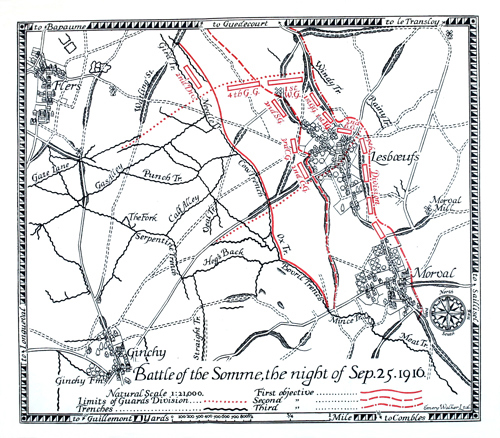
Emery Walker Ltd.
Battle of the Somme, the night of Sep. 25. 1916.
139 Sept. 25.
The attack on the 25th, with the subsequent capture of Lesbœufs, formed one of the most successful operations in which the Guards Division was engaged in the war. The preparation seems to have been complete, and every possible contingency foreseen. In the first attack on the 15th the 4th Grenadiers had been in reserve, and so had not seen so much of the fighting as the other battalions in the Division, but it was now to take a leading part, and to go through some of the toughest fighting of the whole battle of the Somme. Orders were given for the attack to be carried out by Pereira’s Brigade on the right and Corkran’s on the left, while Ponsonby’s Brigade remained in reserve. In Corkran’s Brigade, the 2nd Battalion Scots Guards were to take the right and the 4th Battalion Grenadiers the left.
When the 4th Grenadiers moved up on the night of the 24th, No. 4 Company under Second Lieutenant Constable on the right and No. 2 Company under Captain Britten were sent to the support trenches in front of Ginchy, while No. 1 Company under Captain Goschen and No. 3 under Captain Stewart remained in Trônes Wood. On the left of the Grenadiers was a battalion of the King’s Own Yorkshire Light Infantry, but it was to start from a line quite 100 yards in front of the assembly trench occupied by No. 2 Company, which made communication difficult. Captain Britten, realising that it was essential to keep touch with the battalion on the left, made his men deepen a shallow communication trench which ran in that direction. For the last five nights the 4th Grenadiers had been constantly employed in digging, and had been obliged to get what sleep they could during the day—not at all the same thing as a good night’s rest.
From 10 to 12 noon the artillery bombardment continued, and was supplemented by the Stokes mortars in the support trenches. During these preliminaries Second Lieutenant Maine was wounded 140 in the foot, and sent down to the dressing station. As zero time approached the men fixed bayonets and remained motionless, waiting for the whistle which was to be the signal to advance. The officers in each company had carefully explained to the platoon and section commanders exactly what was expected of them, and each non-commissioned officer therefore knew as much as the captain.
At 12.35 P.M. the line advanced, preceded by a creeping barrage, which moved 150 yards ahead at the rate of 50 yards per minute. In perfect order, with not a man out of his place, the line swept on until it came to the two intermediate lines, which the officers had been warned to expect somewhere in front of the first objective. These had only recently been discovered, and no one quite knew how strongly they were held. Although the leading companies closed up as near as they could to the creeping barrage, they were met by a terrific machine-gun and rifle fire from the intermediate lines, and terrible gaps were made in the ranks. But the companies pressed on, and made short work of the Germans in these lines. Over 150 were killed there with the bayonet. Re-forming again, the Grenadiers rushed the first objective, which, to their surprise, offered comparatively little resistance. Our guns, however, had dealt effectively with the first objective, and forced the occupants into dug-outs, whereas the intermediate lines had only been passed over by the creeping barrage. On the right the Scots Guards met with little opposition, and easily secured their first objective with no serious loss.
141 An hour later, at 1.35 P.M., the attack on the second objective started, and the 4th Battalion Grenadiers moved forward, preceded as before by a creeping barrage. Although there was some stiff fighting at the end, the second objective was secured up to time. The brigade on the left had been held up, and the usual difficulty arose of one brigade pressing on while another was kept back. The right of the 4th Battalion under Sergeant Pitt had managed without difficulty to keep touch with the Scots Guards and had reached the second objective, but on the left, which was in the air, Second Lieutenant Keith was unable to advance while he had the Germans on the left in the same trench as his Company. In fact, the situation on the left had resolved itself into a bombing fight, and while the right got forward the left had always to form a defensive flank.
At 2.35 P.M. the 1st Battalion Grenadiers passed through the leading battalions and attacked the third objective; but, as the left flank was still exposed, the result was the same—the right got well forward while the left écheloned back and dug in. To fill the gaps the Welsh Guards were sent up, and thus a continuous line, nearly 1400 yards long, was made, protecting the left flank of the Division. That night the position was as follows: the 1st Grenadiers on the right in the third objective, facing east; the 2nd Battalion Scots Guards in the centre, facing east and north-east; the 1st Battalion Welsh Guards and 4th Battalion Grenadiers on the left, facing north. The 1st Battalion Grenadiers were in 142 touch with the 1st Guards Brigade on the northern outskirts of Lesbœufs, and although the enemy made counter-attacks in several places, the situation remained unchanged during the night. In spite of their heavy fighting, the men were in very good spirits and made a hearty meal off the German rations which they found, ending up with German cigars. Water was the difficulty at first, but parties soon came up with this, as well as food and ammunition. The only company officers now left with the Battalion were Lieutenant Farquhar, Second Lieutenant Keith, and Second Lieutenant J. W. F. Selby-Lowndes, and the untiring energy they displayed elicited the highest praise from the Commanding Officer.
A tank made its appearance at 6 A.M., and slowly crawled along on the left of the Division towards the Gird trench, where the brigade on the left had been checked. This trench was very strongly held by the enemy, but when the tank arrived and fired into it 300 Germans surrendered, and the Durham Light Infantry moved up and took possession of it. The Leicester Regiment continued the line to the left towards Gueudecourt. At noon a large number of Germans were seen to leave their trenches between Gueudecourt and Le Transloy and retire across the open in great disorder, dropping their rifles and equipment as they went. Frantic messages were sent back by telephone to our artillery, which opened fire on them and inflicted heavy losses.
A squadron of our cavalry rode up towards Gueudecourt, and a cavalry patrol from the 143 5th Lancers went towards Lesbœufs, but Lord Cavan decided that the situation did not permit of cavalry going through, and they retired. Between 8 A.M. and noon the enemy ceased shelling, but between 12 noon and 2 P.M. a barrage was sent over by the enemy’s artillery on our two front support lines. Subsequently this died down, and the evening was comparatively quiet. Throughout the day the companies in the front line suffered a good deal from small parties of snipers concealed in shell-holes, but the patrols eventually cleared the ground. At 10 P.M. the 4th Battalion was relieved by the 2nd Guards Brigade, and went into bivouacs at Carnoy.
From the 18th to the 26th the casualties in the 4th Battalion were 445, exclusive of officers. Among the officers Captain C. G. Goschen, Captain W. A. L. Stewart, Lieutenant the Hon. E. W. Tennant, Lieutenant J. F. J. Joicey-Cecil, Second Lieutenant D. O. Constable, Second Lieutenant M. H. F. Payne-Gallwey, and Second Lieutenant A. C. Flower were killed, and Captain E. G. Spencer-Churchill, Captain C. R. Britten, Second Lieutenant A. R. Ellice, and Lieutenant H. C. S. Maine were wounded. Second Lieutenant A. R. Ellice died of wounds three days later.
The King, on hearing the result of the attack on the 15th, sent the following telegram:
September 16.
General Sir Douglas Haig,
Commander-in-Chief, British Armies in France.
I congratulate you and my brave troops on the brilliant success just achieved. I have never doubted 144 that complete victory will ultimately crown our efforts, and the splendid results of the fighting yesterday confirmed this view.
George R.I.
To which the Commander-in-Chief sent the following reply:
September 16.
His Majesty the King,
Windsor Castle.
I have communicated to the troops your Majesty’s gracious and inspiriting message, for which all ranks respectfully offer grateful thanks.
Sir Douglas Haig.
General Sir Douglas Haig also congratulated the Fourth Army in the following terms:
O.A.D.151, September 17.
General Sir H. Rawlinson,
Commanding Fourth Army.
The great successes won by the Fourth Army on the 15th are most satisfactory, and have brought us another long step forward towards the final victory. The further advance yesterday after such severe fighting was also a fine performance highly creditable to the troops and to Corps, Divisional, and Brigade Staffs. Our new engine of war, the Heavy Section Machine-gun Corps, acquitted itself splendidly on its first trial, and has proved itself a very valuable addition to the Army. My warmest congratulations to you and the Fourth Army on a very fine achievement.
D. Haig, General,
Commanding-in-Chief, British Armies in France.
The following letters passed between the Commanders-in-Chief of the British and French Armies:
145 G.H.Q. of French Armies,
September 17, 1916.
To General Sir Douglas Haig.
My dear General—I desire to convey to you my most sincere congratulations on the brilliant successes gained by the British troops under your command during the hard-fought battles of the 15th and 16th of September. Following on the continuous progress made by your Armies since the beginning of the Somme offensive, these fresh successes are a sure guarantee of final victory over our common enemy, whose physical and moral forces are already severely shaken.
Permit me, my dear General, to take this opportunity of saying that the combined offensive which we have carried on now for more than two months has, if it were possible, drawn still closer the ties which unite our two Armies—our adversary will find therein proof of our firm determination to combine our efforts until the end, to ensure the complete triumph of our cause.
I bow before those of your soldiers by whose bravery these successes have been achieved, but who have fallen before the completion of our task; and I ask you to convey, in my name and in the name of the whole French Army, to those who stand ready for the fights still to come, a greeting of comradeship and confidence.
(Signed) J. Joffre.
General Headquarters,
British Armies in France,
September 19, 1916.
To General Joffre.
My dear General—I thank you most sincerely for the kind message of congratulation and goodwill that you have addressed to me and to the troops under my command on their recent successes. This fresh expression of the good wishes of yourself and of your gallant Army, without whose close co-operation and support those successes could scarcely have been 146 achieved, will be very warmly appreciated by all ranks of the British Armies.
I thank you, too, for your noble tribute to those who have fallen. Our brave dead, whose blood has been shed together on the soil of your great country, will prove a bond to unite our two peoples long after the combined action of our Armies has carried the common cause for which they have fought to its ultimate triumph.