THE ADORATION OF THE MAGI.
Reading edition
Now when Jesus was born there came wise men from the east, guided by a star, which went before them till it stood over the place where the young child was. . . . And when they were come into the house they saw Jesus and Mary his mother, and fell down and worshipped him; and when they had opened their treasures they presented unto him gifts; gold, frankincense and myrrh. (Matt. 2:9-11.)
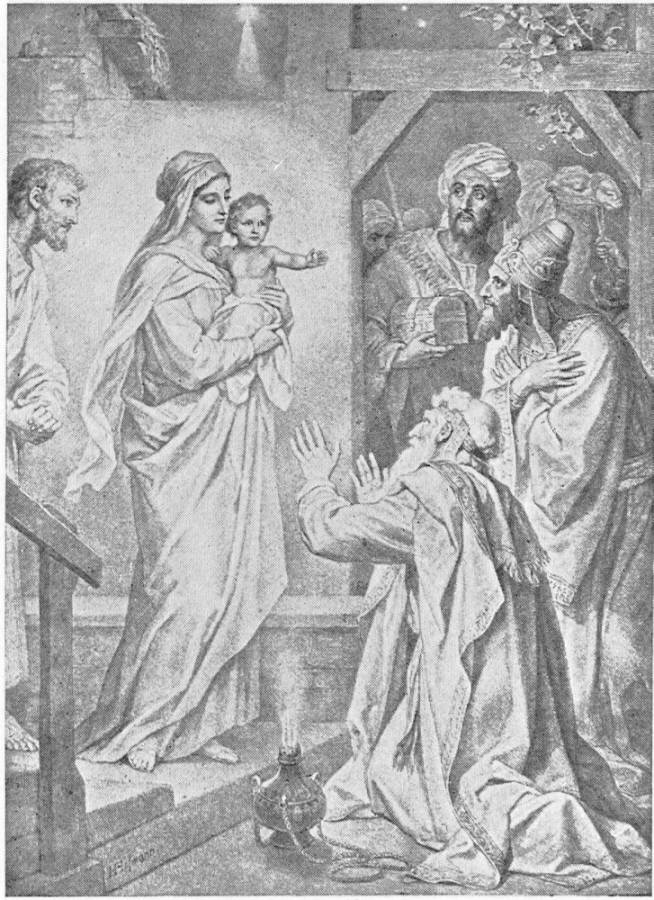
Hofmann, Plate 20, represents the arrival. The star stands above the head of the child. The tradition is that one wise man came from Europe, one from Asia and one from Africa (See Ben-Hur, Book I.); hence Hofmann has represented one with the oriental turban, one with a helmet having hanging side pieces like an Egyptian head dress, and one with the simple band, the white hair and flowing beard of the Druid.
Plate 20. Worship of the Magi. H. Hofmann. 1824-
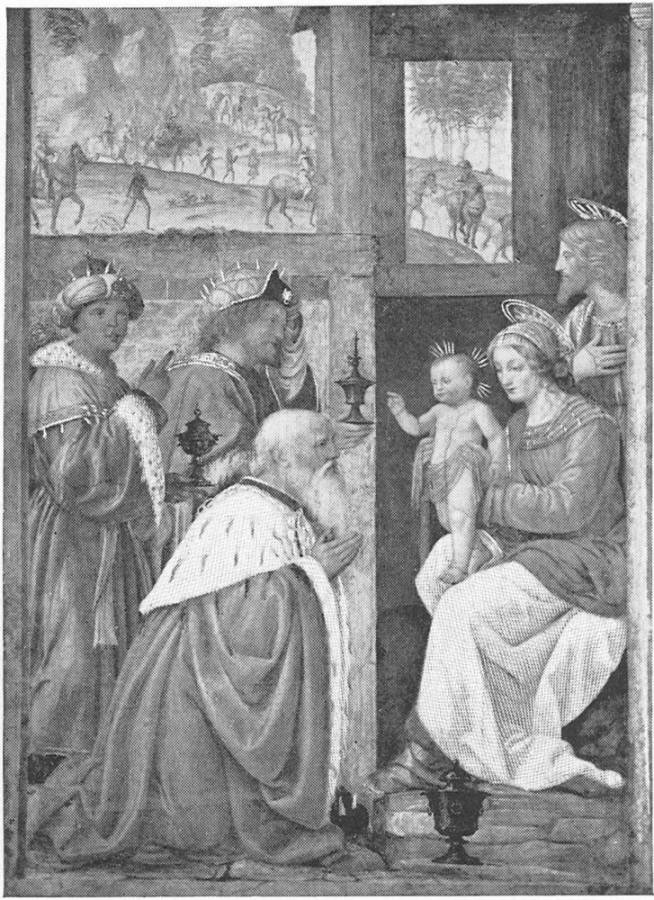
Luini, Plate 21, following the same tradition, gives the African a dark complexion.
Plate 21. Adoration of the Magi. Luini. 1460-1530.
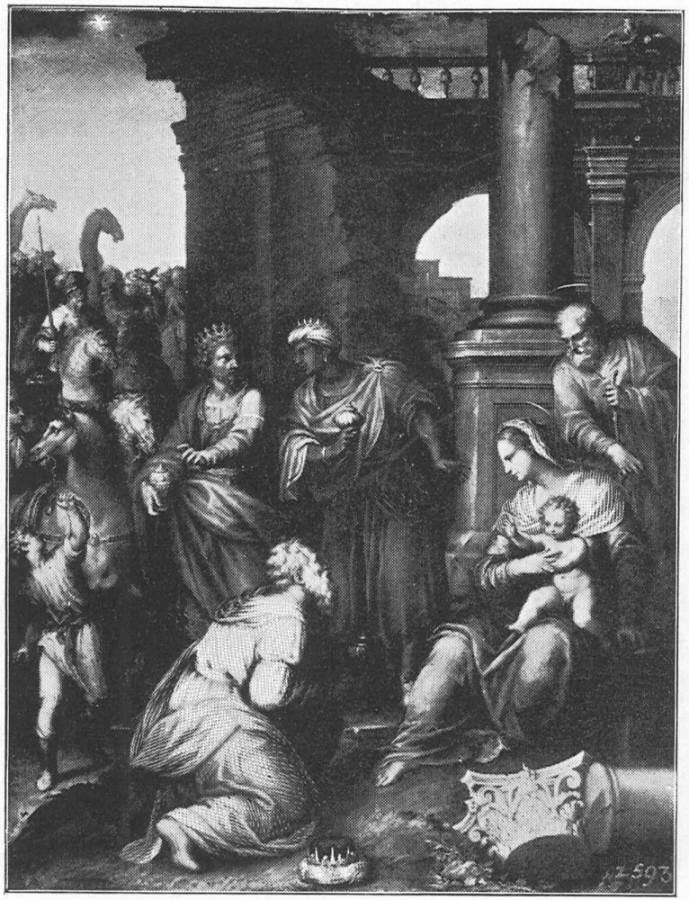
Maldini, Plate 23, also makes one of the Magi very dark, and adds an earring as a barbaric touch. Moreover he gives each a crown (as does Luini) because the Magi were supposed to have been Kings, in fulfilment of Is. 60:3.
Plate 23. Adoration of the Kings. Battista Maldini. 1537-1590.
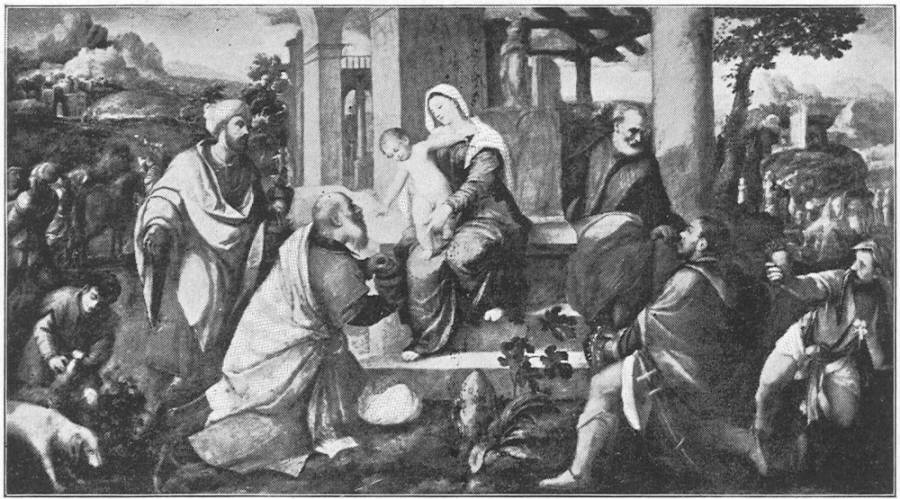
Bonifazio, Plate 22, like Luini and Maldini, represents a large company of servants to show the importance of the Magi, and perhaps because of Is. 60:4-6.
Plate 22. Adoration of the Magi. Bonifazio Veronese. 1494-1563.