THE DIVINING ROD: OR, HOW TO TELL WHERE TO DIG FOR WATER AND ALL KINDS OF METALS.
Reading edition
So early as Agricola, a celebrated conjuror who lived in ancient times, the divining rod was in much request, and has obtained great credit for its discovering where to dig for metals and springs of water; for some years past its reputation has been upon the decline, but lately it has been revived, and with great success, as I have myself found from numerous experiments that its effects are more than imagination, and to enable others to do the like, I have laid down some short rules, as follows:
Directions for choosing Rods. The hazel and willow rods, I have by experience found, will actually answer with all persons who are in a good state of health, if they are used with moderation, and at some distance of time, after meals, when the operator is in good spirits. The hazel, willow, and elm are all attracted by springs of water. Some persons have the virtue intermittently; the rod in their hands will attract one half hour, and repel the next. The rod is attracted by water, all metals, coals, amber, and lime-stone, but with different degrees of strength.
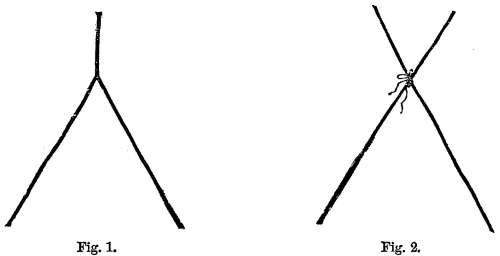
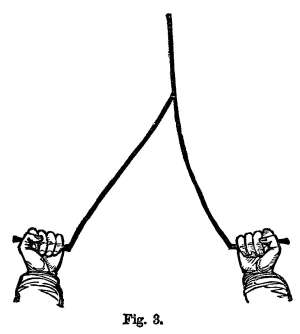
The best rods are those from the hazel, or nut-tree, as they are pliant and rough, and are best cut in the winter months; a shoot that terminates equally forked is to be preferred, (See Fig. 1,) about two feet and a half long; but as such a fork is rarely to be met with, two single ones of a length, and size may be tied together with thread, and they will answer as well as the others. (See Fig. 2.)
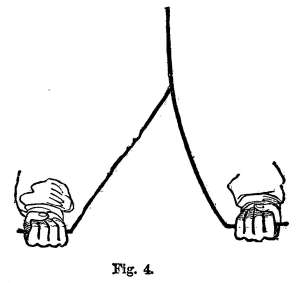
The most convenient and handy method of holding the rod is with the palms of the hands turned upward, and the two ends of the rod coming outward; the palms should be held horizontally as nearly as possible; the part of the rod in the hands ought to be straight, and not bent either backward or forward; the upper part of the arm should be kept pretty close to the sides, and the elbows resting on them, the lower part of the arm making nearly a right angle with the upper, though rather a little more acute; the rod ought to be so held that, in its working, the sides may move clear of the little fingers. The position of the rod, when properly held, is much like the following figure, (see Fig. 3,) where the distance between the four downward lines is the part supposed to be held in the hand.
The best manner of carrying the rod is with the end prolaided in an angle of about eighty degrees from the horizon, as by this method of carrying, the repulsion is more plainly perceived than if it was held perpendicularly. But after all the directions that can be given, the adroit use of it can only be attained by practice. It is necessary that the grasp should be steady, for if, when the rod is going, there should be the least succession or counteraction in the hands, though ever so small, it will greatly impair, and generally totally prevent its activity, which is not to be done by the mere strength of the grasp, for provided this be steady, no strength can stop it.
As soon as the person’s foremost foot comes near the attracting body, the end of the rod is repelled toward the face. (See Fig. 4.) Then open the hands a little, replace the rod, and approach nearer, and the repulsion will be continued until the foot is on or over the attracting body. When this is the case, the rod will first be repelled a little, viz., two or three inches, and then be attracted toward it.
When it hath been drawn down, it must not be thrown back without opening the hands, a fresh grasp being necessary to every attraction, but the least opening of the hand is sufficient. As long as the person stands over the attracting body, the rod continues to be attracted, but as soon as the fore foot is beyond it, then the rod is drawn down backward to the face. Metals have different degrees of attraction: gold is strongest, next copper, then iron, silver, tin, lead, bones, coals, springs of water and lime-stone. To make common experiments, set the foot on a piece or coin of any of these metals, having the rod in your hands as before directed. In using the rod to discover springs and metals, let the person hold the rod as already directed, and then advancing north or south with a slow pace, just one foot before the other, at first the rod may be repelled, but as the person advances slowly, and comes over the spring, or vein of ore, the rod will be strongly attracted. The divining rod is sometimes called Divina Virgula, and sometimes The Luck Rod.