FORTUNE-TELLING WITH A PACK OF EUCHRE CARDS.
Reading edition
Take a pack of thirty two cards, such as is used for the game of Euchre. Each one of these cards has its own particular signification. But when taken in connection with other cards its signification is termed conditional.
PARTICULAR SIGNIFICATION OF THE CARDS.
♠ (Spades.)
Ace: Disagreeable tidings—perhaps news of a death.
Seven: Dangerous illness, or something very unpleasant.
Eight: Sorrow, vexation.
Nine: Quarrels, law-suits, high words, blows.
Ten: Non-fulfilment of a wish—disappointment of a cherished hope, unforeseen accidents.
♣(Clubs.)
Ace: A present, a testimonial of honor and distinction.
Seven: An inheritance, gain, profit.
Eight: Prosperity, wealth, success in business.
Nine: Proposals of marriage.
Ten: Good fortune in games of chance, in lottery speculations, finding a treasure.
♦(Diamonds.)
Ace: A letter, news—whether good or bad is determined by the nearest cards.
Seven: Travels, a campaign.
Eight: A ball, company.
Nine: Illness—if a knave lies on the right side, you will soon stand godfather.
Ten: A joyful meeting—a long lost friend returned. Of the picture cards we will speak hereafter.
♥(Hearts.)
Ace: Quiet domestic life—tranquillity.
Seven: Falling in Love—Love.
Eight: A Surprise.
Nine: Betrothal.
Ten: A Wedding.
In explaining the cards, my dear readers, to any one, shuffle the pack three times, and let the person who wishes to know his fortune cut it three times in succession. Then take up the cards, and let the person in question draw one. This drawn card you place first upon the table. Then spread out the pack in four rows, each containing eight cards. (See Engraving.)
The first card is of the highest significance. In the first place it indicates the character of the person inquiring, and according to the following rule:
♠ Choleric, passionate, violent.
♣ Sanguine, cheerful, mirthful, witty.
♦ Phlegmatic, practical, unexcitable.
♥ Melancholic, sentimental, poetical, talented.
As, however, the human character is never without more than one of the above named characteristics, the first card signifies the most prominent one, and the cards which lie on the right side and below it are reckoned with it, by which the meaning of the first card is either modified or corroborated.
If the person in question is a lady, and she has, for example, drawn a club, the queen of clubs is herself, the knave of clubs is her intended, the king her father, or uncle, as the case may be. The picture cards of the other black suit are her friends and relations. It is the same if she has drawn hearts or diamonds, only that in this case the picture cards of the other red suit signify her friends and relations. If the person inquiring is a gentleman, it is the same, except that he is the knave of the suit which he has drawn, and his intended the queen.
From this first card, also, you form a judgment of one’s whole future course in life. If its signification is joyful, the person’s life will be a happy one. If, for example, it is the ace of hearts, it indicates that the person will never be without a home, a dear and pleasant home to him; if it is the ace of clubs, he will pass through life enjoying honor and fame; if it is the ten of hearts with a female figure on either side, it signifies two wives; if with a male figure on either side, and the person inquiring is a female, two husbands.
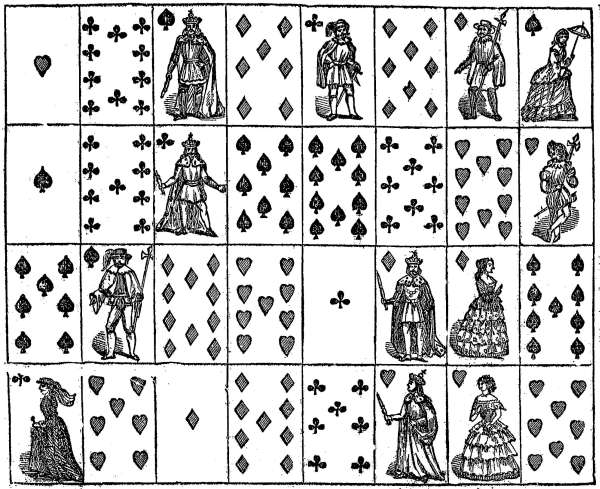
Example of Fortune-Telling with an Euchre Pack of Cards.
Thus much as to general rules. We will now instruct the reader how to explain the cards in detail. We will suppose that it is a lady who inquires of the cards, and endeavor, by means of an example, to give an accurate explanation of the method to be pursued. Spread out the cards before you, and observe carefully the different cards while you read the fortune I shall predict from them. (See Engraving, page 96.)
Ace of Hearts.—The young lady’s character, it seems, is sentimental, melancholic, poetical, which three qualities are found more or less together. If the next card were a heart, it would indicate a temperament inclined to love. As, however, the adjacent cards are clubs and spades, of which two indeed are clubs, we conclude that the lady often displays a cheerful, sanguine disposition, yet can, at times, be very passionate. The main feature of her character, however, is the melancholic.
We will now look around for the lady herself—she is found to be the seventh card on the last row. Her lover, on the other hand, is the eighth card in the second row. As he precedes her, this signifies that she is already acquainted with him, and they seem already to love one another, as a love card lies at his side, and also one at hers; no card, however, lies between them to connect them, except the queen of diamonds. This, however, is not altogether favorable, for a queen between a loving pair signifies a rival (for a gentleman, the knave signifies the same), and can as well indicate a separation as a union, notwithstanding its similarity of color. The general rule is as follows:—If the card which connects the queen and knave is of the same color with them, it indicates a future union between the persons. (Hearts and diamonds form one color, as do clubs and spades.)
One thing more: from the cards which lie next to the knave, we are enabled to judge of the character and occupation of the lady’s intended. In the present case, the cards next to the knave of hearts are two spades, two diamonds, and one heart; his character, therefore, according to the rules already given, is choleric, yet at times melancholic and sentimental. In his daily conduct he is practical and considerate.
As to his occupation, the different colors have the following signification:
♠ A student, probably a clergyman.
♣ A lawyer—jurist.
♦ A mechanic, merchant, or a person who has chosen for himself some practical career.
♥ A capitalist, a genius who devotes himself to some favorite pursuit, also a military man.
The card at the right hand is commonly the decisive one, but as, in the present case, there is no right hand card, the one at the left takes its place; according to this, the lady’s intended is a capitalist, a genius, or a military man.
We now proceed to tell the lady’s fortune in its particulars.
We commence from the ace of hearts, thus: a considerable windfall will happen in your family, young lady. Either you or your parents will draw a prize in the lottery, or heaven will drop some other nice morsel into your mouth (ten of clubs).
This will give occasion to a journey, which you will take with an acquaintance (king of spades and seven of diamonds). This journey will be very agreeable to you, and especially will you enjoy yourself at a ball, to which you will be invited by a friend of your travelling companion (knave of clubs and eight of diamonds). You will then dance a cotillion with a relative of your intended, perhaps with your own brother-in-law that is to be (knave of diamonds).
When you return home, you will find a letter, at the sight of which you will be disturbed, the hand-writing being that of a person unfriendly to you (queen of spades, ace of spades). You open it, and behold it is a proposal of marriage (nine of clubs), and from a relative of the gentleman who invited you to the ball (king of clubs), which touches the (nine of clubs).
As, however, you promise yourself nothing but vexation (eight of spades) from this marriage, you refuse him (ten of spades), and it will soon appear that a better fortune lies before you (eight of clubs). Soon after, a wedding takes place (ten of hearts), namely, that of your sister or friend (queen of diamonds), who, therefore, does not stand between you and your intended to separate you, but to unite you. The bridegroom is the gentleman who was your partner in the cotillion at that ball (knave of diamonds). At this wedding you will among others see your intended (knave of hearts), with whom you are already acquainted. You will also meet there a gentleman, who, when you last saw him, was dangerously ill (seven of spades, knave of spades, and ten of diamonds). Your intended seizes the opportunity to offer himself to you, and you become betrothed to him (nine of hearts). You will receive a present from a relative or friend, perhaps from your brother (ace of clubs, and king of diamonds).
Something now occurs to separate you from your betrothed (nine of spades). It almost seems as if you were jealous of a lady whom he formerly loved (queen of clubs, seven of hearts). A very tender letter which he writes to you, from a bed of sickness upon which his grief has prostrated him (ace of diamonds, nine of diamonds), soon reconciles you again, and as not long after something occurs which places him in a position to support a wife in comfort (seven of clubs), the happy marriage is celebrated. Dear relatives (king of hearts, king of diamonds, and queen of diamonds) prepare for you joyful surprises, which combine to render this day an infinitely happy one.
One thing more: if the ten of hearts is the last card in the last row, the person in question will never marry; otherwise, each row counts a year. You first count the rows until you come to the nine of hearts (the betrothal), you then begin again and count to the ten of hearts (the wedding), that is, in case the nine comes after the ten. If the nine comes before the ten, you continue to count without recommencing.
The young lady in question will therefore be betrothed in from two to three years, and will be married in about two years after, for the nine of hearts lies in the third row, and the ten in the second row. She has then almost five years to enjoy her single life before she becomes a wife.
TO FIND OUT WHOM ONE IS TO HAVE FOR A HUSBAND.
You select the four kings from a pack, and lay them side by side in a row upon the table.
The lady who wishes to know her fortune gives to each of these cards the name of some gentleman of her acquaintance who might be likely to woo her in marriage. It is usual to pronounce these names aloud before the company. The name given to the king of hearts is, however, an exception. This secret the lady keeps to herself. To these four kings, you can also add a queen, which then denotes the old maid.
Now, take the rest of the pack, shuffle it thoroughly, let the person in question cut three times and commence. Under each of the above named picture cards you lay a card in turn, and as often as a spade is placed under a spade, a heart under a heart, &c., that is, as often as a card of the same suit is placed under one of these picture cards, the picture card is turned from its position.
The first time it takes a direction from left to right, the second time it lies upside down, the third time it is raised again to a position from right to left, and the fourth and last time it regains its former upright position.
That one of the four kings, who, after these different changes, first resumes his upright position, is to be the happy husband. If it should happen to be the old maid, you can imagine what is in store for you.
After having learned from the cards who is to be the husband, the questions next asked are, usually: How much will he love his wife, why he marries her, and what is his profession. These questions are answered in the following manner:
Gather up the cards, shuffle them thoroughly, and let the person cut them three times. Then tell off the cards upon the table, as you recite the following sentence:
Heartily, painfully, Beyond all measure, By fits and starts, Not a bit in the world.
You repeat this sentence until the king of hearts makes his appearance. If it happens that, as you lay this upon the table, you pronounce the word “heartily,” he will love his future wife heartily, and so on.
Now, as to why he marries her. Count off the cards upon the table, while you repeat the following sentence:
For love, for her beauty, For his parents’ command, For her bright, golden dollars, For counsel of friends.
The sentence by which you discover what is his profession is the following:
Gentleman, alderman, clergyman, doctor, Merchant, broker, professor, major, Mechanic, lawyer, shipmaster, tailor.
This method of telling fortunes is very entertaining in society, when you have not the book to find more particular answers.
A METHOD BY WHICH TO DISCOVER IF YOUR WISH WILL BE FULFILLED.
Take a pack of cards, shuffle it, and let the person inquiring cut three times; then place singly five cards upon the table, and upon each of these cards another, taken from the top, and so on, until the pack is exhausted, and the cards are divided into five nearly equal heaps.
The person in question now selects a suit, spades or clubs, &c.—or a card may previously be drawn to determine the suit.
Suppose diamonds is the chosen suit: you take up the first heap, and throw away all the cards until you come to a matadore of diamonds. (The matadores are the ace, king, queen, knave and ten.) You do the same with the other heaps. If any one of the heaps does not contain a matadore, you cast it entirely aside.
The heaps which are left you now place one upon another in order, beginning at the left hand, and, without shuffling them, you lay them in five heaps, and proceed as before. This time there are, of course, fewer cards, beside matadores, than before. After having cast aside the cards which you meet with before finding a matadore, you take up the heaps, and, without shuffling them, lay them in five heaps, for the third time. This third and last time, you must, if your wish is to be fulfilled, be able to discard all the cards except the matadores. If any other cards are left in the heaps, your wish will not be granted.