The Gist of Japan (continued 4)
Reading edition
It seems to me that churches and friends can do much toward preventing this, and toward brightening the lives of their missionaries, if they will. Let pastors and friends throughout the church take special pains to write interesting personal letters to the missionary. It will do him good just to be remembered in this way. It is natural that the same kindness, attention, and love that are shown to the home pastor should not be shown to the missionary, because he is so far away and the strong personal element is wanting. But if the churches would make an effort to share their kindness and beneficence between the home pastor and the foreign one it would be highly appreciated by the latter.
Especially does this seem but fair in a case where a church supports its own missionary and where most of its members are personally acquainted with him. Such churches speak of having two pastors; one at home ministering to them, and one abroad, in their stead, preaching the gospel to the heathen. Why should not these pastors have equal place in their hearts and receive equally their kindness and their gifts? If any preference is shown, it would seem that it should be to the foreign pastor, for he has much the harder work. But the foreign pastor is generally forgotten, while the home pastor, with whom living is much cheaper, is paid a larger salary; he is given a vacation, and a purse to enable him to spend it pleasantly; at Christmas he is substantially remembered, and all through the year he is presented with numerous gifts and shown many favors. The poor lonely missionary is paid a moderate salary and is given no further thought. Imagine the feelings of a man in a mission field, supported by one church which always speaks of him as its foreign pastor, as he takes up a church paper and reads of the favors shown the home pastor; among them such items as "a nice purse of fifty dollars," "a three months' leave of absence, and expenses to ——." He cannot help thinking with a sigh of that unpaid doctor's bill of fifty dollars incurred by his wife's ill health last summer, or of the money needed to send his boy home to be educated.
A church should try to remember its pastor abroad as well as the one at home. The home pastor himself could see to it that this is done. If he should simply say, when handed a present for some purpose, "Our foreign pastor has not been remembered by us, and he needs it more than I, therefore we will send this to him," the result would probably be that he and the foreign pastor would both be remembered. If little expressions of appreciation and kindness, such as this, were occasionally shown the missionaries, it would do much to brighten and cheer their hard lives. These are little things, but the little things have much to do with our happiness.
If the missionary life has its sorrows and disappointments, it has its pleasures and joys as well. It is with great pleasure that I turn from the dark to the bright side of our lives.
First I would mention that sweet peace and joy that come from the consciousness of doing one's duty. The true missionary feels that God has called him into the work, and that he is fulfilling the divine will. This knowledge brings with it much pleasure. The joy is all the sweeter because of the sacrifices that must be undergone in answer to the divine call. He feels not only that he is in the field by the call of God, but also that God is with him in his work, leading, guiding, blessing, helping him. He hears the words of his Master, "Lo, I am with you alway," and he gladly responds, "In Thy presence is fullness of joy." The brooding Spirit of God is especially near the Christian worker in foreign lands, and imparts to him much joy and peace.
Another of the missionary's joys is to see the gospel gradually taking hold of the hearts of the people and renewing and transforming them. It is passing pleasant to tell the gospel story, so full of hope and joy, to these people whose religious ideas and aspirations are only dark and gloomy. Who could desire sweeter joy than to watch the transforming power of the gospel in the heart of some poor heathen, changing him from an idol-worshiping, immoral creature into a pure, consistent Christian? It is the good fortune of the missionary to see such changes taking place in the people to whom he ministers. And what a change it is! For gloom and dejection it gives joy and hope; for blind, irresistible fate it gives a loving providence. The change is so great that every feature of the face expresses it.
Lastly, the crown of the missionary's life is to see a strong, vigorous native church springing up around him, the direct result of his labors; to see it gradually and silently spreading itself throughout the whole nation as the leaven through the meal, permeating every form of its life and impressing itself upon every phase of its character. To this native church he confidently looks for the evangelization of the masses and the accomplishment of all that for which he has labored so long and so earnestly. When the missionary can look upon such a native church with the feeling that it will be faithful to its Lord and do His work; when he can sit in its pews and hear soul-nourishing gospel sermons from his own pupils, now grown strong in the Lord—then indeed his cup of joy is full. The trials and sorrows that were endured in connection with the work are all forgotten, and his only emotion is one of glad thanksgiving.
In some lands many missionaries have already received this crown to their labors; it has been partially received in Japan, and if we are but faithful to our trust shall yet be received in all lands.
XIII
METHODS OF WORK
Missionaries attempt in various ways to evangelize the nations to which they are sent. The extent and variety of the work which the missionary is called upon to perform are much greater than the people at home are apt to think. He must be at the same time a preacher, a teacher, a translator, a financier, a judge, an author, an editor, an architect, a musician. The great variety of the work necessitates a well-rounded man.
All of these offices are, in an indirect sense, ways of doing mission work; but we will here confine ourselves to the consideration of the more direct and positive methods in vogue in Japan. These are direct evangelization, educational work, literary work, and medical work.
Direct Evangelization
By this I mean the actual propagation of the gospel, by word of mouth, to the people to whom we are sent. I mention this first because I regard it as the most important of all methods. The supreme vocation of the missionary is, not to educate, not to heal, but to preach the gospel. It is well for mission boards and missionaries to remember this, for there is danger in many places of making this primary method secondary to education. While it is probably true that the evangelization of the masses will depend ultimately upon the efforts of the native ministry, this should not therefore be construed to mean that the foreign missionary has nothing to do with this department of the work. He should personally engage in this evangelistic work, should himself come into actual contact with the unevangelized masses, and should proclaim the gospel directly to them. In this way only can he understand thoroughly the nature of the work in which he is engaged, and be enabled to sympathize with and advise his evangelists. He should not only train native evangelists, but should be an evangelist himself, teaching his helpers, by earnest, zealous example as well as by precept, right methods of the proclamation of the gospel. Such work must also bear direct fruit in the conversion of souls; for even in this land, in spite of the great nationalism and strong prejudice against foreigners, a foreigner will draw larger congregations and be listened to with more attention than a native. And this is not simply because of curiosity; the people have more confidence in his ability properly to represent the foreign religion. For these reasons, then, viz., for the sake of the souls he may win, for the sake of the example he may set to his helpers, and for his own sake, that he may rightly understand and appreciate the work, every missionary should, as far as possible, be an evangelist. This is emphasized here because in many places the evangelistic work is in danger of being subordinated to the educational, and missionaries are not lacking who take the strange ground that it is neither necessary nor profitable for the missionary personally to come into contact with the unevangelized masses. This seems to me to be a very mistaken view of the sphere of the foreign worker. He should not only train helpers, support and advise them, but he should also go with them among the people and preach to them himself.
The direct propagation of the gospel may be either local or itinerating. The missionary may reside in one place, have a fixed chapel, and there teach all who come to him; or he may go on long tours through the country, preaching from town to town and from village to village. In general these methods are combined in Japan. The missionary is located in one town and to the work there gives most of his attention; but he also at stated intervals visits the surrounding towns and country, doing evangelistic work wherever he can.
LOCAL EVANGELISM.—For obvious reasons, local evangelistic work yields the greatest returns. To it the missionary gives his constant care and attention, while his visits to the country are only periodical. Local evangelistic work in Japan is carried on somewhat in the following manner:
A house, as centrally located in the town as possible, is rented and fitted up as a chapel. The only furnishings needed are a small table and some lamps. Japanese houses are so constructed that the whole wall on the street side can be removed, and people standing in the street can see and hear all that is going on within. In this new chapel, one or two evenings a week, the gospel will be preached. In China there is preaching in such chapels every day, but in Japan the people will not come oftener than once or twice a week. In all probability both the missionary and the native evangelist will preach the same evening, one after the other. At first very few people will come into the house, but numbers will congregate in the street and will listen to what is said. After the service is over an opportunity is given for personal conversation on religious topics. By and by a little interest is manifested, and some begin to come into the house. A great deal has been gained when people will go so far as to come up into the Christian chapel, in plain view of the multitudes, and hear the sermon.
In many cases the native evangelist lives in the chapel (in the same building, but occupying different rooms) and daily meets and talks with people about religion. In this way he hears of those who are interested, and he and the missionary visit such in their homes and converse privately with them. In my own mission, as soon as any are interested, they are organized into a catechetical class, which meets weekly, and are thoroughly instructed in Luther's Small Catechism. But I find that unless this is preceded by more elementary instruction this excellent little manual will not be well understood. Real inquirers are glad to come and study the catechism and the Bible, and they study them well. Some of the most satisfactory work I have done in Japan has been along the line of catechetical instruction. Some of the larger missions working here have not been sufficiently careful about giving their converts sound elementary instruction in Christian doctrine, but have left them to gather all the necessary knowledge from the sermons they hear and the instruction given in the Sunday-schools. One of the desiderata of most missions in Japan is more systematic catechetical instruction.
Among the first things a missionary does in beginning work in a town is to open a Sunday-school. The children are generally more accessible than the older people, and many of them will come to the school. They cannot at first be organized into classes, as their interest is not sufficiently great to induce them to attend regularly and to study. The first instruction is usually by means of large Bible pictures that catch the eye and teach a religious truth. By and by, when the work becomes more substantial and the interest more developed, the pupils can be organized into classes and more systematic instruction given. If there are any Christians in connection with the chapel their children form the backbone of the Sunday-school.
A considerable part of the time of the missionary doing local evangelistic work, if he is wise, will be occupied in house-to-house visitation. The Japanese are a very social people, and it is wonderful how a little personal kindness and interest in them will break down the prejudice against us and our work. As a rule, the missionary who goes into a native home with humility, simplicity, and love will gain the good will of the whole household. Men feel freer to talk about religious subjects in the privacy of their own homes. In a discourse to a promiscuous audience the truth is scattered broadcast, and each one catches what he can; but in a private conversation in the home the truth especially adapted to the hearer can be given. It is like a man trying to fill a bottle with water; he will get it full much quicker by taking it up in his hand and pouring the water into it than by throwing a whole bowlful at it from a distance.
It is a very pleasant experience to enter a friendly home in the evening, to sit around the social hibachi (fire-box), sip tea, and talk about the great questions of time and eternity. One is generally received with cordiality and made to feel at home. He is listened to attentively and respectfully, and the questions asked are intelligent, appreciative ones. If the missionary expects his host immediately to be convinced by his eloquence, to agree to all he says, to discard at once his old religion and embrace the new, he will be disappointed. But if he is content to seek an opportunity to present the truth under most favorable circumstances, leaving it to do its own work silently and gradually, he will be sure to find it.
House-to-house visitation and personal talks with the people are of great importance in local evangelistic work. But in doing such work great care should be taken to comply strictly with Japanese etiquette and rules of propriety, and especially to avoid a haughty bearing. The ordinary native home is much smaller, simpler, and frequently dirtier, than the missionary's, and the people are constantly watching for any recognition of this fact on his part. He should carefully guard himself against any look or expression which might imply his superiority, or his dissatisfaction with things around him.
I have been both amused and pained by overhearing Japanese imitate the sayings and actions of two visiting missionaries. According to the imitation, the one bears himself haughtily and proudly; as soon as he comes near the door he instinctively draws back as though fearing bad odors; when he comes in he bows stiffly, seats himself on the best mat, carefully draws up his clothes as though fearing contamination, casts a scornful look at the bare walls, utters a few commonplace sentiments, and hastily departs. The other one comes with a cheery greeting, a smiling countenance, and a humble demeanor. He never notices the lowly house and bare walls, but quietly and unconcernedly takes the place assigned him, freely and appreciatively partakes of the tea and cakes set before him, and kindly and sympathetically talks with the people as one of them. It is very evident which one of these two will do the most good.
As soon as the work grows and a small company of believers has been gathered the duties of the missionary increase. There now rests upon him that burden which so oppressed Paul—the care of the churches. He must look after the regular worship of the church, must develop in his people a church-going sentiment, and must instruct them in the observance of all Christian duties. In this work he will need much patience, wisdom, and zeal. The native converts, not having generations of Christian ancestors as we have, will need oft to be exhorted, oft rebuked, and loved much. Christian duties that are with us almost habitual must be urged upon these people time and again. The church must be organized and developed into an harmonious working body. In all of this the missionary is fortunate if he has the assistance of a wise, godly native helper.
Perhaps the most attractive and interesting feature of all mission work is this forming and molding, under one's own hand, of the theology, the life, and the activities of a young church. The one who is privileged to do this occupies a position of responsibility than which none could be greater. May God give us grace to do it aright.
ITINERATING EVANGELISM.—No true missionary living in a non-Christian land will confine his labors to the town in which he resides. His heart will be constantly yearning over the people in the surrounding towns and country, and he will gladly take advantage of every opportunity to make them occasional visits, telling to them also the old, old story.
But there are other workers whose sole business it is to visit these outlying points and carry a knowledge of the gospel to those who cannot have regular gospel ministrations. Perhaps this feature of missionary work is the one most prominent in the minds of the people at home, who are fond of picturing their missionary as a man who goes about from town to town and from village to village, proclaiming the gospel to all who will hear.
Christianity is by nature diffusive. It spreads itself as naturally as the leaven spreads in the meal. Confucius taught: "The philosopher need not go about to proclaim his doctrines; if he has the truth the people will come to him." In striking contrast to this Christ taught: "Go ye into all the world, and preach the gospel to every creature." We are not only to teach those who come to us, but we are also to go out in search of hearers, to carry our message to the people.
When our Saviour was upon earth the work He did was largely itinerating; going about from place to place, teaching in the synagogue, by the wayside, or on the sea-shore. The disciples were all itinerating evangelists, carrying their message from city to city and from land to land. St. Paul was an itinerating missionary on a large scale. Not content to abide long in any one place, but looking out continually to the regions beyond, his life was one ceaseless activity in itinerating evangelism. The missionaries through whom northern Europe and England were converted were itinerants. And those who to-day in mission fields take their valises well stocked with tracts and sermons and go out into the country on long evangelistic tours can feel that they are following in the footsteps of worthy exemplars.
We can hardly overestimate the importance of this work. The word of mouth is still the most effective means of conveying a message to the masses, and a knowledge of Christian principles that could else hardly be given is in this way spread abroad throughout the land.
Jinrikishas.
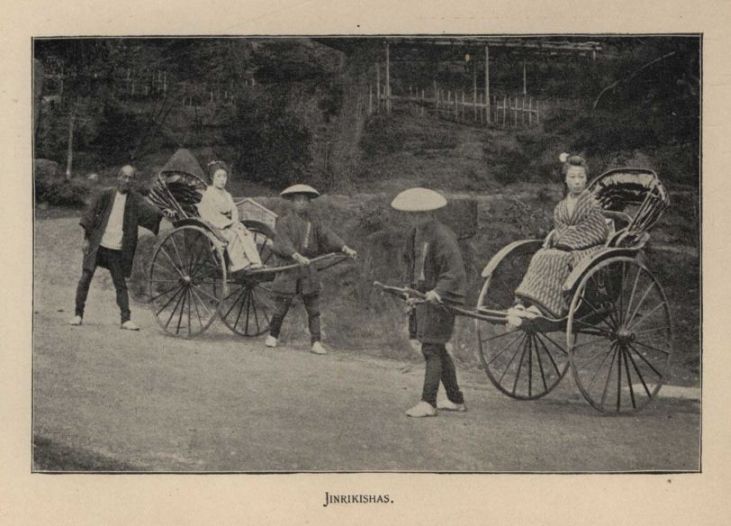
The facilities for itinerating in Japan are excellent. Most of the important points are easily reached by rail or water. But in general, on an itinerating tour, the missionary has little use for the steamers and railways. The points he wants to visit are not on the great thoroughfares, but are in out-of-the-way places. There is, however, a good system of roads, and the jinrikisha, which is everywhere found, is easily capable of carrying one 40 or 50 miles a day. This little cart resembles a buggy, except that it has only two wheels and is much smaller. The seat is just large enough to accommodate one person. A small Japanese coolie between the shafts furnishes all the necessary motive power. These are very convenient and comfortable little conveyances, and are the ones in ordinary use by missionaries in their itinerating work.
In recent years the bicycle has become popular for this purpose. As the "wheel" has been made to serve almost every other interest, it is but fair that it should also serve the gospel. Perhaps to-day one half of all the male missionaries in Japan ride wheels. They have decided advantages over the jinrikisha, chiefly in the way of speed, personal comfort, and pleasure. I wish my readers could see their representatives in Japan just starting on their wheels for a tour in the interior. Dressed in negligée shirts, caps, and knickerbockers, with a large bundle tied upon the wheel in front of each one, they present a comical appearance. Many sermons have been preached in Japan in negligée shirts and knickerbockers.
There are nice, clean little inns in all the villages and towns, and the missionary is not put to such straits for a place in which to rest and sleep as he is sometimes in other mission fields. But as the food offered him is unpalatable to most foreigners, he carries with him a few things, such as bread, canned meats, and condensed milk.
The splendid telegraph system extending over all Japan keeps him in communication with his family and friends, no matter where he may go, and he need not hesitate to go into the interior on that score. A good daily mail system is also at hand to carry his letters.
Formerly the greatest hindrance to itinerating in Japan was the difficulty of obtaining passports to travel in the interior. No one was permitted to go outside of certain limits without a special passport, and such passports were only given for two purposes: for health, and for scientific observation. The government did not intend by this restriction to prohibit mission work in the interior, but aimed simply to prohibit foreigners from engaging in interior trade. As the missionaries were not going for purposes of trade, many of them availed themselves of these passports; but there were some whose consciences would not permit them so to do. Several high officials were directly spoken to about the matter by missionaries; and they replied that, in the eyes of the law, a man could want to travel for only three purposes: for health, for trade, or for scientific observation. As this restriction was simply to prevent foreigners from engaging in interior trade, and as the missionaries were not going for that purpose, they were told that they should go on with their work. The government knew well the purpose for which they were going, and permitted it; hence their consciences might be at rest. These explanations on the part of the officials removed the difficulty in the minds of some, but not of all. Fortunately, since the revision of the treaties, passports are granted without any question as to the purpose for which they are wanted, and all who ask it are freely given permission to travel where they will. Since this restriction has been removed more itinerating is being done, and it is probable that it will still increase.
The missionary does two kinds of itinerating in Japan: (1) he visits periodically a large number of outstations, where are native evangelists; (2) he goes into regions where there are no evangelists and heralds the gospel.
Itinerating among stations where native workers are located and regular work kept up is by far the most frequent. These tours are generally made about every two or three months, one missionary visiting perhaps a dozen stations. The local evangelist makes all preparations for the meetings, which are generally of a special character. There will probably be a special preaching service for non-believers, and a communion service with the Christians. If there are any baptisms the sacrament is then administered. The visit of the missionary is intended to be as much a stimulus and encouragement to the evangelist as anything else. These men, living in out-of-the-way places where there are few, if any, Christians, are apt to get despondent and discouraged, and they need occasionally the sympathy and advice of a fellow-worker. The missionary who has charge of this kind of work is a sort of bishop, with an extended parish.
When fields where no regular work is carried on are visited the work is necessarily different. In this case the missionary must take his helper with him. He seldom goes alone, for various reasons. When on one of these tours he will spend one or two days in a village, talking personally with all who will come to him. Very likely he will rent a room in the inn in which he is stopping, and he and his helper will there preach one or two evenings. Sometimes, if the weather is good, he obtains permission of the authorities to hold the meeting in the open air, and preaches on the street or in the public squares. Wherever an audience can be gathered the message is told. After one or two days spent in this manner they move on to the next town, and there do as they did before, thus going their whole round. The most that is accomplished by this method of preaching is to spread abroad a general knowledge of Christianity among the people and break down their prejudice against it. Not many conversions result from it.
Some may ask what kind of sermons one preaches on these itinerating tours. They should be of the plainest, simplest character. It is profitable to consume a good deal of time in disproving the false ideas which prevail concerning Christianity, and in giving the people correct views of its nature. The nature of God must be carefully explained, both because the word we use for God is in Japanese applicable to an earthly hero as well as to a divine being, and because the divinities of Japan differ very much in nature from the Christian conception of God. One can preach a long time on sin before getting the people properly to understand it. The Japanese are really without any sense of sin, and have no word in their language to express the idea exactly. We use the word which means crime or offense against the laws of the land. Then the old story of Christ simply told always commands a hearing everywhere.
The kind of itinerating last described is open to serious objection. It is uncertain and fitful. One visit may be made to a town each year, or some years not even one. No provision is made for carrying on the work, or for keeping alive any interest that may have been aroused. To be made very profitable such itinerating should be regular and systematic; the visits should not be too far apart; and as soon as some inquirers are found, a native evangelist should be stationed there to care for them. When conducted in this way it is conducive of great good.
Educational Work
The educational department of mission work has in recent years been coming more and more into prominence. This feature of the work attracts the attention of the visitor from the home lands more than any other, because it makes more show. The imposing buildings that are erected, and the large number of students that can be gathered into them, make a favorable impression.
Educational work is generally more attractive than evangelistic. The former is regular, while the latter is desultory. The former is continuous, occupying one's time and attention every day; the latter is intermittent. The former can be pursued at home, and the missionary can enjoy the constant society of his family; the latter takes him away from his family and occupies him abroad. Educational work is usually carried on in the open ports and large cities, where one enjoys all the conveniences of life, with sympathetic society; evangelistic work takes the missionary into the interior, where there are few conveniences and no society. Lastly, educational work is more or less welcomed by the natives, while evangelistic work is unwelcome.
Japan possesses a large number of mission schools. Their imposing buildings are seen in almost every city of the empire. Every mission of large size has its schools for both boys and girls. The annual support of these schools costs the various boards more money than all the evangelistic work that is done in Japan. More missionaries are engaged in educational than in evangelistic work.
A certain amount of educational work seems necessary to the success of every mission. First in importance is theological training. A body of well-trained native pastors is absolutely essential. Especially in this land, where there are many educated people and where all forms of rationalism and skepticism are rife, is it necessary that the evangelist have a liberal education, that he be well rooted and grounded in Christian doctrine, and able to answer the philosophical objections to Christianity that meet him on every side. An educated ministry is just as necessary in Japan as it is in the West, and the schools that are providing such a ministry are doing a good work.
But some of the methods used by them are open to criticism. Heretofore most theological training has been in the English language, and the language alone has taken up a great deal of the student's time and strength. And again, very few Japanese young men gain a sufficient knowledge of English to appreciate or derive full benefit from a theological course in that language. Against this is urged the paucity of Christian literature in Japanese, and the wide field of religious thought which a knowledge of the English language opens to the student. This is very true; but if the same amount of time and energy that has been expended in instruction in English had been given to the creation of a native Christian literature the evil would not exist. I am glad to note that recently nearly all the theological schools have introduced courses in the vernacular for those who cannot take the English course. It would be well if the English course were dispensed with entirely and all instruction were given in the vernacular.
Many of the missions operating in Japan have sent worthy young men to America and England for theological training. In nearly every instance this has proved an unwise investment. The good people at home take up these young men and nurse and pet them until they are completely spoiled. They come back to Japan unfitted by taste and education for the position they must occupy and the work they must do. Most of them become dissatisfied in the work after a few years. Foreign education largely denationalizes them and removes them from the sympathies of their own people. Of course there have been some exceptions to this rule; but, in general, experience has proved that locally trained evangelists are best suited for the work and give most satisfaction in it.
By this it is not intended to imply that Japanese pastors and teachers should not have the advantages offered by the Western seminaries when they desire them and are able to obtain them for themselves. They are as capable of receiving advanced instruction as we are, and have the same right to it. But the money which foreign boards spend for training evangelists should be spent in the field.
Besides the theological schools there are large numbers of academical schools for young men, in which a great deal of mission money is spent. In justification of these it is argued that they are necessary for the preparatory training of evangelists. It is said that the education of these future pastors of the church should be Christian from the beginning, and this is true. But more than half the evangelists now laboring in Japan have not received such training. The education they received from government and private schools answers very well in their case. Actual experience has proved that, whatever may be the aim of these academies, as a matter of fact they do not train evangelists. Most of the men who take their full course enter other professions. One of the oldest missions in Japan, employing about twenty evangelists, has among them only one man who has taken the full academical course in its mission college; but many men have been educated at the church's expense for other professions.
Again, it is said in justification of these academies and their large expenditure of mission money that a Christian education must be provided for the children of the constituency of the mission. The church provides a Christian education for her sons and daughters at home; why should she not do it for her wards abroad? Far be it from me to attempt to minimize the importance of Christian education; but will it not be time enough for such education when the constituency of the native church feels its need to such an extent that it will demand this education itself, support the schools with its money, and send its sons and daughters to them? At present even the Christian people frequently prefer a government school to a mission school; and they often send their children to the latter, when they do send them, because they will there be given financial aid.
There was a time when Christian schools did a good work in Japan. Before the government schools were brought up to their present standard the mission schools were well patronized, and they considerably benefited the cause of missions. But to-day the government has schools of every grade, and frequently they are better than the mission schools. The students who formerly flocked to the mission schools now flock to those of the government, and the former have but few pupils. The times have changed, and these large, expensive schools are now hardly needed. In so far as they are needed for the preparatory training of a native ministry, and can be made to serve that end, they may be all right, but certainly as an evangelizing agency they are not justified. The native church should be encouraged and stimulated to educate its own children; it might even be assisted in the attempt, when it has shown an honest effort to do this; but its children should not be educated for it by the mission free of charge. To spend so large an amount of the people's money in purely secular education seems to me a misappropriation of funds.
More than half the mission schools in Japan are boarding-schools for girls. Nearly all the unmarried women engaged in mission work are in these schools, and there are many of them. Some of these schools have very fine locations and buildings, about as good as those of the average girls' college at home. That they are more popular and better patronized than those for boys is because the government does not provide for the higher education of girls as it does for boys.
The purpose of these girls' boarding-schools is to train up earnest Christian women, who will be the wives and mothers of the new Japan. It is said that if the mothers of the nation are made Christian the evangelization of the whole people will speedily follow. This purpose is a worthy one. Most of the girls who enter these mission schools become Christians, and the training given them seems to be good. I recently attended the closing exercises of one of the largest of these, and was surprised at the progress made by the girls. They could paint and draw, and recite classical music as well as the young ladies of the seminaries at home; and I have no doubt that the graduates leave the schools pure-minded, earnest Christians, with worthy aims and aspirations, and with a full intention to exert their influence for God and His church.
But alas! when they go back to their homes the position Japanese etiquette assigns them so effectually ties their hands that the results are bitterly disappointing. I will mention one case which came under my own observation. A young lady was educated by a mission school in a certain city, who was noted for her piety and earnest Christian spirit. Her teachers had most extravagant hopes as to the strong positive influence she would exert for Christianity. After her graduation she spent several years in the same school as a teacher, and her Christian life was broadened and deepened by longer and more intimate contact with the foreign teachers. She finally married and removed to her new home, in a distant city. There she attended church once or twice and then stopped entirely. Neither the urgent personal request of the native pastor nor the oft-repeated invitation of the Christian congregation could induce her to come any more. Instead of exerting an influence for good upon others she herself became a fit subject for mission work. I have known several cases of this kind, and all missionaries have had the same experience. Social conditions in Japan are such that a girl marrying into a non-Christian home can exert little Christian influence.
But admitting for the moment the utility of this Christian training for the girls, these large schools are open to serious objections on other grounds. The course is too long, and the instruction given too advanced. In many of these schools the girls are kept for twelve or fourteen years. During all this time they are more or less supported by mission funds, even down to pin-money. They are taught all kinds of abstract sciences and advanced ideas that can be of no possible use to them. Latin and Greek, biology, geology, psychology, and many other things are taught them that they neither need nor can appreciate. Painting, drawing, vocal and instrumental music form a prominent part of the curriculum. Girls are made to practise on the piano for ten years or more who will in all probability never see a piano after they leave school. Of course these are not the only subjects taught; more useful ones are taught as well.
If mission schools for the education of girls should exist at all the instruction should be much more elementary and practical. A course of two or three years, teaching them how wisely to fill their position as wives and mothers, would amply suffice.
It is claimed by the Japanese with great reason that these schools unfit the girls for the sphere they must occupy in after life. A life of ten, twelve, or fourteen years in constant association with foreign teachers, in a foreign building, with all necessaries and conveniences supplied, pursuing a pleasant course of study, does not fit the pupil for life in her humble home. No wonder she loves the school and dreads to see the day approaching when she must leave it. Having lived so long under much better circumstances, her home, with its thatched roof, narrow walls, and homely duties, becomes distasteful to her. Of what use now are her music and painting, her Latin and Greek, when her time must be spent in boiling rice and mending old, worn-out clothes? There is such a thing as educating people above their sphere in life, and such education is more hurtful than otherwise.
But it is said, "We are training future Bible-women who will go out and teach the gospel to their country-women." In reply to this it can be answered that not a great many graduates of girls' schools become Bible-women; and it is the experience of nearly every missionary that the best Bible-women are middle-aged women, who may never have been in a mission school.
Again, it is said that it is worth while to have these schools if only to train educated Christian wives for the native evangelists. But many of the evangelists, even among those who themselves have received a more or less foreign training, prefer wives who have never been in a mission school, saying that these girls who have lived so long under better surroundings will not be contented and happy in the homes they can provide. It is also true that many of the young ladies who graduate from these schools object to marrying at all, feeling that they have been unfitted for the life they would have to lead.
A very serious objection to the present educational method in use by many missions in Japan is that it hinders self-support in the native churches. These large foreign plants, with their costly appliances, can never be supported by the native churches, and the evident futility of the effort so discourages them that they will not even do what they can. The day when the churches of Japan can become self-supporting is very much postponed by the existence of these costly schools. At present the native churches could hardly keep the school buildings in repair.
The whole work of missions in Japan was in the beginning projected on too high a plane. To many it seems a great mistake that such large and costly buildings were erected and the schools started on a foreign basis. Should not the buildings have been entirely of native architecture from the beginning, and the educational work projected on a plane corresponding to Japanese life? If small wooden houses, with straw roofs and no furniture, are good enough for these people to live in and to transact all kinds of business in, then they are good enough for them to study in and to worship God in. If from the very beginning the schools and churches had been built on a plane corresponding with ordinary Japanese houses and life the day would much sooner have come when the Japanese themselves could undertake their support. When, in the providence of God, the native church shall have been sufficiently developed, materially and spiritually, to undertake the education of her children and the training of her own pastors, the manner in which she will do it will be very different from that in which it is now done by the mission boards.
I am aware that many missionaries in Japan, for whose opinions I have all respect, will not agree with these views. But, after most careful thought and investigation, the above are the conclusions to which I have arrived; and I am glad to know that my views are shared by many of my fellow-missionaries. It is my sincere conviction that most of the money now being used for educational purposes in Japan is misapplied, and would yield far greater results if used in other ways.
Literary Work
One of the most important and fruitful branches of missionary work is the literary. The creation of a sound Christian literature is one of the first and most imperative duties pressing upon the missionary to the heathen.
This is an exceedingly difficult task. When we think of how much labor and how many precious lives our own Christian literature has cost us, we begin to have some conception of the immensity of the task of creating a Christian literature in a heathen land. In the first place, the missionary must have a complete mastery of the language,—in Japan an appalling task,—and then he must create the terms to express so many ideas. Many of our Christian ideas have no counterpart in non-Christian lands, and the very words to express them must be coined. A common device is to take words of kindred meaning and to make them serve the purpose, endeavoring to attach our own meaning to them by gradual processes of instruction and use. Thus with the words for God and sin in use by most missions in Japan. These words are kami and tsumi. Now kami is the word used for numerous mythological divinities, with natures very different from our God, and is also applied to the ancient heroes of Japan. As it expresses the idea better than any other word we have, we use it for God; but we must be careful always to explain the sense in which we use it. The word tsumi means crime, or offense against the laws of the land. Our idea of sin is lacking in the Japanese mind, and hence there is no word that exactly expresses it. We take the word tsumi as being nearest it, and endeavor to impart to it our own meaning. In this way we have not only to translate the ideas, but also to coin or modify the words to express them.
This work of the missionary is very different from that of translating English books into a European language which has a circle of ideas similar to our own, for there the words are found ready-made to express the ideas.
Generally the first literary work to be done by missionaries is the translation and publication of portions of Scripture and of tracts. As soon as their knowledge of the language is sufficiently advanced, they translate the whole Bible and some good hymns. Then follow apologetical and evidential works, and treatises on theology and morality. Afterward biographical and devotional books, magazines, and Christian newspapers are published. We cannot overestimate the value of a good Christian newspaper. It will carry gospel truth to people whom the missionary and the native evangelist cannot reach, and it will help much to nourish and strengthen the life of the native converts. In such a paper the latter will probably see their religion set forth in all its relations to the questions of practical life in a way they seldom hear it done in sermons. I think parish papers, which are becoming so common at home, would also exert a splendid influence in Japan.
In this field a considerable Christian literature has already been created. Among the most important books translated so far might be mentioned the Bible, the Book of Common Prayer, Luther's Small Catechism, the Heidelberg Catechism, Bynyan's "Pilgrim's Progress." A considerable number of books on apologetical, evidential, dogmatic, and historical theology have been published, besides biographical, ethical, and devotional books. There are also several Christian newspapers, and recently the missionaries of the American Board have begun the publication of a Christian magazine.
A Christian literature which will be a powerful auxiliary to our work is at present forming rapidly in Japan.
Medical Work
Medical work is one of the youngest departments of missionary labor. Christ healed the body as well as the soul, and it is peculiarly fitting that the missionary be able to heal the body likewise. Medical missions have done more in some countries toward breaking down the prejudice against Christianity than any other one thing. Doors effectually closed to the evangelist have been opened wide to the doctor. The power for good of a consecrated physician in many mission fields is boundless. The mission boards have fully recognized this fact, and have wisely used large numbers of medical missionaries.
In former times medical missionaries accomplished much good in Japan. They helped greatly to break down the prejudice and opposition to Christianity. Many who came to the hospitals to have their bodies healed went away having their ears filled with words from the great Physician, and their hearts moved by the kindness and love of these Christian doctors. Not only was much direct mission work accomplished in this way, but the principles of physiology and medicine were also taught to large numbers of native physicians and students. Among the men who did most in this work were Drs. Hepburn, Berry, and Taylor.
Although they have accomplished much good, medical missions are no longer needed in Japan. The Japanese themselves have become adepts in medical science, and especially in surgery. Every town and city has one or more hospitals where competent medical consultation and treatment can be had, and these now occupy the position formerly filled only partially by the mission hospitals. A few hospitals and dispensaries are still kept in operation by some missions, but most of them were years ago dispensed with as no longer profitable. We rejoice that Japan has so far progressed as to be well able to care for the health of her own people, and we adapt ourselves to the changed circumstances, diverting into more fruitful channels the energies formerly expended in this way.
XIV
HINDRANCES
Many of the hindrances that oppose the progress of Christianity in Japan have already been indirectly suggested in other portions of this book. But that they may be more clearly apprehended by the friends of missions at home, and that the effect of their militating influence may be fully felt, we will endeavor in this chapter to arrange them in order and show just how they oppose our work. For the sake of clearness and logical order we will consider the subject under two divisions: 1. Hindrances in Japan common to all mission fields; 2. Hindrances peculiar to Japan.
1. There are certain things inherent in the very nature of Christianity that impede her progress. They are necessities of her being, and cannot be gotten rid of. These things may be either a part of Christianity herself, belonging to her nature, or they may be necessary results of her acceptance by non-Christian peoples. For this reason they are encountered wherever the gospel is propagated; they are common hindrances to the advance of our faith alike in China, India, Africa, and Japan.
Although not peculiar to Japan, it seems to me wise briefly to refer to these universal hindrances, because often they are not realized in their full force and power either by the people of our home churches or even by our pastors. To appreciate fully their militating influence one must go to the mission field, and there observe them actually hindering the rapid progress of evangelization. There they are seen in a new light, and are impressed upon the mind as they can hardly be otherwise. If I can succeed in causing the constituency of the churches at home to realize the number, magnitude, and power of these hindrances I will have done good service for the cause of missions.
As the first one of these universal militating influences, inherent in the very nature of missions, opposing the progress of Christianity wherever its teachings are newly propagated, I would mention its revolutionizing tendency. Christian missions are in their nature revolutionizing. The result is inevitable and unavoidable. The advance of Christianity in a heathen land necessitates the revolutionizing of many institutions that have obtained for centuries. Not only must the religious ideas undergo a revolution, but all moral ideas, and manners and customs as well. The reasons for this are very evident.
Religion is intimately connected with the life of man. It furnishes the motive power of his life, controls his actions, creates his morality, determines his manners and customs, and shapes his laws. The ethnic religions are just as intimately interwoven with the lives of their adherents as Christianity is with the lives of Christians; and Buddhism, Confucianism, and Brahmanism have shaped and determined the lives and actions of their adherents.
The connection between religion and morality is a necessary and indissoluble one. The two are united in their growth and development, and the form of morality is necessarily colored by the dominant religion. Wherever the Buddhist faith has been accepted there has sprung up a system of morality peculiar to it; so that we speak of a Buddhistic in opposition to a Christian morality. This morality is dependent upon the religion, and a change of religion must bring about a change of morality.
Christianity, having necessarily developed a morality in accord with its principles, must, as it advances, destroy the existing systems and create widely different ones. While the better element in heathen nations has more or less outgrown its religious ideas and superstitions, and can calmly contemplate a change of religion, yet its moral system has a stronger hold, and anything which antagonizes it is severely condemned. This necessary revolutionizing of moral ideas very much opposes the progress of Christianity.
The acceptance of Christianity necessitates also a revolution in manners and customs. These are partially an expression of the faith that is in us, their nature being determined by it. A change of religion, therefore, means a change in all of these.
People have great respect for time-honored customs, and that which antagonizes these brings upon itself condemnation. Christianity changes the manners and customs, and therefore the people do all they can to oppose it.
In these ways the work of missions is revolutionizing, and must expect to encounter the opposition of the spirit of conservatism, which is much stronger in the East than in the West.
A second principle inherent in the very nature of Christianity which hinders its progress in heathen lands is its exclusiveness. Our religion is among the most intolerant in its attitude toward other faiths. We believe and teach that "there is none other name under heaven given among men, whereby we must be saved," than the name of Christ. While acknowledging that other religions contain grains of truth, we must affirm that, as religious systems, they are false. Christ sent forth His apostles to make disciples of all, winning them to the Christian faith. And the aim of the church to-day is, not to cultivate brotherly love and communion with other religions, but rather to exterminate them and make Christians of all. She can brook no rival. Her adherents must give their allegiance to her alone.
Christianity not only claims to be the only religion, but she can offer no hope to those outside of her pale. While the Bible does not demand that I teach the Japanese that their ancestors are surely lost, it certainly gives me no ground for assuring them of their salvation. We all revere our forefathers, but none so much as the Oriental. He pays periodical visits to the tombs of his ancestors; he worships his father and commemorates the day of his death by mourning. A heaven from which his ancestors are excluded has little attractions for him. Often does the Shintoist say, "I would rather be in hell with my ancestors than in heaven without them."
If Christianity could be less exclusive and more tolerant of other faiths she would find a much more ready acceptance at the hands of non-Christian peoples. But she cannot be so and be true to her own nature and mission. In ancient Rome, when the church was called to pass through fire, the manifestation of a more tolerant spirit would have saved her from that awful persecution. The Romans had many gods and did not object to one more. They adopted those of all the conquered peoples, and were ready to adopt the Christians', and erect an altar to Him, if the Christians would acknowledge Him as simply one among the other gods. And from that day to this the exclusive claims of Christianity have brought upon her trials and persecutions, and have hindered her progress throughout the earth. Especially is this religious exclusiveness unpopular in Japan, because there the native religions are very tolerant of one another.
These are some of the strongest hindrances to the rapid progress of Christianity in pagan lands. They belong to the very nature of our faith, and cannot be avoided. Their antagonizing influence is encountered wherever the gospel is preached.
2. But I think that the greatest hindrances to mission work in Japan to-day are those which are peculiar to this field. Many circumstances conspire to make Japan stand alone among mission fields. She has been pronounced at once the most promising and the most difficult of all fields for evangelistic work: the most promising because of the life, force, and ability of her people; the most difficult because of the host of peculiar hindrances under which the evangelist must labor there. I will proceed to point out some of these.
(1) Perhaps the most potent at present is the extreme nationalistic feeling, which has brought into disrepute everything of foreign origin. The Christian religion, being a foreign institution, is therefore unpopular, and is thought to be less adapted to the people and less liable to nourish a strong national feeling than the native Shinto.
It is hard for us to realize the fanatical intensity of their patriotism. Having been taught for so many centuries that this is the first virtue, the people have exalted it above everything else. "Japan first, forever, and always," is the universal motto. There is hardly a man, woman, or child in the empire to-day who would not be perfectly willing to lay down his life for the good of the country.
This extreme patriotism operates in several ways to hinder the progress of Christianity. It prevents the ready acceptance of the new religion. There are a great many so ignorant and inconsistent as to hate Christianity just because it is of foreign origin, thinking that nothing good can originate outside of Japan. Such people adhere to the native religion, in spite of its inferiority, simply because they think that to do so is patriotic. But there is a much larger and more influential class that is led to antagonize Christianity from patriotic motives other than this. They hold that a belief in the native religions is necessary to preserve their darling patriotic spirit, and that the adoption of any foreign religion would gradually destroy all patriotism and loyalty. Christianity is not national, but cosmopolitan. It teaches the Fatherhood of God and the brotherhood of man, both of which great ideas are repugnant to most Japanese, because they do not harmonize with their ideas of the divine origin of the imperial family, and their national superiority to the other races of the world. They want a religion which exalts Japan above everything and inculcates patriotism and loyalty to her alone.
But the most hurtful influence of this extreme nationalism is felt within the pale of the church herself. Actuated by it, many of the native Christians, both clerical and lay, want to do away with everything foreign in connection with the churches. The more strictly national they can make their work the better satisfied are they. Not only do they antagonize the missionary and try to push him off the field, but they also antagonize foreign theology, and want to build up a native system with no foreign taint. The result is great friction between the native and foreign workers, strained relations, and in many instances open antagonism. This want of cordiality and harmony, for which the national feeling is largely responsible, is very hurtful to the best interests of our work.
But the desire for a purely native theology, which this strong, benighted patriotism begets, is even more hurtful than its sowing seeds of discord among the workers. Many of the leading native ministers and laymen say that it is folly for their churches to perpetuate the theological divisions and creeds of the West, and they propose to develop a theology peculiarly their own. Now Christianity cannot be kept pure and sound without paying due regard to its historical development; and the Japanese, in cutting loose from this, have already run into heresy. The danger is that a Christianity may be developed which is lacking in all that is distinctively Christian, and which will be harder to overcome than the old heathenism.
(2) Another hindrance which has operated with great power throughout the whole history of Protestant missions in Japan is the past record of Christianity. In a former chapter upon the "First Introduction of Christianity" I have told how Christianity was first introduced, how it grew to magnificent proportions, and how finally it was crushed by the secular arm. The fact that the government once felt constrained to extirpate Christianity, at whatever cost, and especially the fact that the Christians dared oppose the government, have brought our religion into disrepute. Since, according to native morality, whatever government does is right and whatever government opposes is wrong, the mere fact of this opposition on the part of the government is enough to condemn Christianity in the eyes of many. Then the fact that the Christians at last rebelled gives color to the idea already formed that Christianity is disloyal to Japan. That idea prevails widely, and in many quarters Christians are regarded with suspicion.
A memory of the past bitter persecutions and of the hated rebellion still lingers. The old people talk of them around the hibachi, as they sip their tea and smoke their pipes; the young read of them in the histories, and thus their memory is kept alive. Many are still living who saw and read the rigid prohibitions of Christianity on the sign-boards over all the country, and they cannot forget them. There are not a few people in the empire who to this day have hardly learned that the changed attitude of the government toward Christianity is more than outward; and these still regard the foreign faith as the chief of all evils. It is really pathetic sometimes to hear them talk of it. There was an old man living near a Christian chapel not far from here, who one day was complaining of his woes and wishing to die. He said it had been a bad year, and none of his crops had done well, two of his children had died, his country had been insulted by a foreign power, and, to cap the climax, Christianity had come and taken up its abode next door to him. This last evil was too much, and he wanted to die. He still regarded our faith as the worst of evils. I once gave a few tracts to some old men in a mountain village near Saga, and they remarked that they remembered the time when it would have meant certain death to be seen with one of those little books.
(3) The character of the education prevalent in Japan to-day is also antagonistic to Christianity. The Japanese are a studious race and are capable of high mental development. The country is so well supplied with schools—nearly all of them government institutions—that no one is too poor to receive some education. There is, on the part of the school authorities, no open antagonism to Christianity as such. According to the regulations, no one religion is to be favored more than another in the schools, and complete religious liberty is to be allowed. But the general tenor of the education given is unchristian—an exaltation of reason above faith, of science above religion. Especially is the tendency of the higher education against any form of religion. The educators of Japan are training a nation of atheists and agnostics. The scientific schools of the West that have no room for religion are studied earnestly and copied by educated Japan. In philosophy Herbert Spencer and his school have been acknowledged masters. Indeed, it never seems to have occurred to the minds of thinking Japanese that there are systems of philosophy other than the materialistic. All religious sentiment is crushed in the schools, other things being substituted. Science, learning, is thought to be all that is necessary, and religion is left for old women and children. Men who still believe in religion are thought superstitious and uneducated, and are regarded with a sort of lordly contempt. In a conversation some time ago with a graduate of the Imperial University I was dogmatically told that Christianity was acknowledged to be absurd by all thinking men everywhere, that all religions are only for the infancy of the race, and that full-grown men can dispense with them. This man's views are the usual product of the higher education, of Japan to-day. Hence it happens that few students of the higher schools are Christian, and frequently men go there with Christian sentiments, only to lose them before they leave.
(4) The old religions of Japan strongly oppose the march of Christianity. Men often speak as though the old heathen faiths had lost their power and were no longer really believed. Their power is on the wane, but they lack much of being dead. They still possess enough vitality strongly to oppose the evangelization of this land. The old Shinto faith, having the decided advantage of national origin, and fitting in exactly with Japanese ideas of their relative national importance and the nature of their emperor, is a strong opposing influence. Buddhism still possesses a strong hold upon the masses of the people. It has the recommendation of age, has played a prominent part in the national history, and is dear to the hearts of the people. It occupies a decided vantage-ground from which it opposes us and our work. To some in the West it seems almost incredible that these people should really believe and trust in these faiths. And yet be assured that they do believe and trust in them. There are about the same sincerity, the same confidence, and the same faith placed in Buddhism by its adherents as are placed in Christianity by its. The religious cravings and instincts of the people are, on the whole, satisfied by their native religions.
The opposition of Buddhism to Christianity does not consist solely in misrepresentation, nor is it founded on ignorance, but is an intelligent opposition. Some of the Buddhist priests study carefully our language for the purpose of reading our theology and informing themselves as to our faith. It is said that one of the very best collections of books of Christian evidences and apologetics to be found in all Japan is in the Buddhist library in Kyoto. Buddhism has learned some useful lessons from Christianity. She is now learning the value of stated preaching for the information of her people in Buddhist doctrine, and the value of organized, systematic effort. A Young Men's Buddhist Association has been formed, after the model of the Young Men's Christian Association, which is doing much toward holding the young men to the Buddhist faith. Buddhism is on the alert, is quick and active, antagonizes us at every turn, and is one of the very strongest hindrances to the progress of Christianity.
(5) The social ostracism visited upon those who become Christians very much hinders our progress. Most of our converts, unless their relatives and friends are Christians, are ostracized; in many cases they are entirely cut off from their families and are disinherited. In America, when one becomes a Christian, he has the encouragement and sympathy of all good people, and his family and friends rejoice with him. In Japan for a member of a family to become a Christian is considered a disgrace, and the united influence of family and friends is powerfully exerted to prevent such a calamity. Influential men in our city have told me that perhaps the greatest hindrance to my work is that by becoming a Christian a man shuts himself off from his family and friends. I am convinced that many would take a stand for Christ much more readily if the home influence were not so antagonistic. A student in the Normal School of our city, who came to me for many months to study Christianity, told me that his family bitterly hated the Christian religion, and that he could not return home if he became a believer. In spite of this he was led by the Spirit to ask for baptism, and I baptized him. Afterward he wrote very dutiful letters to his home, trying to explain that he felt impelled by duty to take this step, and that Christianity was not so heinous a thing as they supposed; but no answers came. In course of time, being compelled to return to his own town on business, he went to his home to spend the night; but his mother and brothers would not recognize him, and he had to go away to a hotel. His father was dead, and his mother tried to disinherit him, but was by the law prevented. His family and friends have never forgiven him, and now he never sees them. Similar cases could be cited without number proving the same thing. Is it not natural, then, for a man to hesitate to take this step?
(6) Another obstacle to the progress of missions in Japan is that the church is too much divided. Almost every small religious body known has felt it incumbent upon itself to undertake work here. It may be true that denominations working separately are no hindrance to the cause of Christ in the home field, but I think they are surely a hindrance in the foreign work. It is a fine rhetorical figure to liken the various denominations and sects to different divisions of one vast army, all engaged under the same general, in the same work; but the figure does not represent the facts. We do not have one vast Christian army, each division occupying only its own field, directed by one mind, and moving in unison. The most optimistic cannot so regard the different denominations and sects of Christendom. Like other oft-used figures, this one is entirely at variance with the facts. Oftener is it true that these sects oppose one another, and much prefer their own welfare to that of the whole body of Christ.
You cannot satisfactorily explain to non-Christian people the reasons why you must have a Lutheran, a Methodist, a Presbyterian, and a Baptist church; and if they could be brought to understand our differences this would in no way recommend us or our creed to them. It is a great pity that each mission field is not allotted to some one denomination and left alone by all the others. If this cannot be, at least only one body should work in one town. Then these complications would be partially avoided, and Christianity would more recommend itself to the thoughtful citizen.
We suffer in Japan more from a superfluity of sects than of denominations. The Universalists and Unitarians are here with their heresies, and are poisoning many minds. Many other bodies are here, antagonizing the established order of things and teaching religious anarchy. I suppose there is no mission field in the world that has a larger number of sects and divisions.
But the regular orthodox denominations work more harmoniously in Japan than in the home lands. Strifes and jealousies between them are rare, while expressions of mutual appreciation and of Christian courtesy are common.
(7) I think the foreign communities in the open ports of Japan are a hindrance to the work of evangelization. In the seven treaty ports there are regular concessions for foreign residence and trade, and thousands of foreigners live in them. These communities are largely composed of merchants and of those connected with the various consulates, most of whom have come here for purposes of gain, and are interested in nothing besides money-getting. A large per cent. of this population is very undesirable. As representatives of Western civilization (the product of Christianity) the foreign settlements should be model Christian communities, and were they such they could exert a powerful influence for good. But as it is, their example does not recommend itself to the Japanese.
To say nothing whatever of the charges of immorality and dissoluteness preferred against these men, they are certainly not Christians. One would think, to observe them, that they had not come from Christian lands at all. Many who are here only temporarily, being away from all home influences and restraints, set a most ungodly example. They will not attend church; they take no interest in religious work; they speak disparagingly of religion in general, and of the Christian religion in particular; and to them a missionary is an eyesore. While we are laboring to Christianize the people, our own countrymen, the representatives of Christian lands and the exponents of a Christian civilization, are in the foreign ports setting a most ungodly example. The natives are quick to notice these things, and they reason that, if our faith is as good as we represent it to be, why have our countrymen not profited better by it? The presence of these antichristian representatives of Christendom is a great hindrance.
But not all of the foreigners in the open ports of Japan are of this character. There are some good Christian men and women among the business classes, who are interested in all kinds of Christian work. And yet the prevailing tendency of the foreign business communities is against Christian work.
(8) The last but not the least hindrance I will mention is the language. It has been said of both Chinese and Japanese that they were invented by the devil to keep Christian missionaries from speaking freely with the natives. Whether that be true or not, it certainly is true that Japanese is one of the most difficult languages on the globe. To know it well, three different languages must be acquired: spoken Japanese, written Japanese, and Chinese. The colloquial and the book language are quite different, the literary being partly Chinese. The latter is written by ideographs, and you must have a sign for each idea. About five thousand of these characters will enable one to get along, although there are probably fifty thousand in all. By a sheer act of memory to learn five thousand hideous characters is no little task. The colloquial itself is exceedingly difficult to use aright. My readers may be surprised to learn that of the missionaries laboring in Japan one third cannot speak the language intelligibly to the natives. It seems that many Occidentals, laboring never so hard, really cannot acquire the language. One never feels sure in this language that he is saying just what he wants to say. If it were less difficult, so that missionaries could acquire complete command of it and use it as readily as they do their mother tongue, the work of evangelization would go on more rapidly.
These, as I understand them, are the principal things which at present hinder the progress of Christianity in Japan. Some of them are inherent in the very nature of the work, and will be encountered to the end. Others, I believe, are transient, and will by and by pass away.
XV
SPECIAL PROBLEMS
In the broad sphere of labor which the missionary must fill he daily meets most difficult problems, whose solution requires the exercise of consummate judgment, skill, and patience. Although these problems are not given a prominent place in mission reports, and are not therefore very well known at home, they loom up mountain-high before every missionary. They have a practical importance in the field surpassed by none other. Men differ so widely in regard to their solution that they not infrequently work division in a mission.
A brief presentation of some of these problems will enable the home churches better to understand our work and to sympathize with us, and will be of practical worth to those who contemplate coming to work in this field.
The first problem to meet the missionary is, how to deal with inquirers.
In Japan not one in three at first comes with sincere motives and good intentions. On the contrary, he comes seeking some material advantage, hoping in some way to profit by his association with the missionary, or vaguely expecting to be benefited by an alliance with what appears to be a stronger and more living cause. Those who from the first are impelled to come by real spiritual motives are indeed rare. How to deal with such inquirers is the question. To turn them away would be to send them back into heathenism. Manifestly we must hold them until they have more spiritual motives.
I suppose all missionaries would agree that, no matter how material and selfish their motives, inquirers should be encouraged to continue coming, with the hope of gradually leading them into the truth. We could hardly expect them at first to have pure motives, as such are practically unknown to them. Heathenism, with its degrading idolatries and immoralities, does not beget these, and we cannot expect to discover them until the old religions have been discarded and the inquirers have been brought under the instruction and care of the church. Therefore, whatever the motive, we should receive them, and after a long period of Christian teaching and discipline look for a change of heart. But the length of this probation before they are received into the church, and whether it shall be required—those are matters upon which the practice of missions differs widely. Some have a prescribed time which must elapse before candidates are admitted to membership; others leave it to the judgment of the local evangelist or missionary. The latter seems the better plan.
Another question is, Just how much shall candidates for church-membership be required to give up? As to strictly heathen practices, such as idolatry and gross immorality, there can be no question. But what of practices about which the judgment of men differs? Some missions require total abstinence from all intoxicating drinks. Some, like the Methodist, require abstinence from the use of tobacco, especially on the part of pastors and evangelists. These churches urge in favor of their position the comparative ease with which such restrictions may be applied in the young churches of Japan. Shall we follow the lead of these more conservative churches, or shall we adopt a more liberal policy? Shall we require converts who are engaged in any way in the manufacture or sale of tobacco or liquor to change their business? The practice of our own mission (the Lutheran) is, except in the manufacture, sale, or inordinate use of intoxicants, to allow liberty of conscience.
Another and a very perplexing problem we find to be, what to do with honest inquirers who have no means of support. This class is numerous. There are a great many poor in Japan—in fact, nearly all are poor. As Japanese custom—even more in ancient times than at present—made the poorer classes look to the rich for their maintenance and support, many converts look to the missionary, not to support them outright, but to help them into positions where they can earn a living. Not a few have their means of support cut off by the very act of becoming Christians. In such cases it seems but fair that the mission should do what it can to assist them. But how? To support them is too expensive, besides being demoralizing to them and the community. In some mission fields industrial schools, mission farms, and various other enterprises are established to provide employment for such, and in this way they are helped to support themselves. But in a country like Japan, where industrial and commercial life is highly organized and developed, it is almost impossible for the missions to do such work. We have neither the means nor the skill to compete with the industries around us. This question of support for the poor of the churches is a pressing one, and causes the missionary much anxiety and thought. The native church can do much more toward its solution than the missionary, and as the church grows in influence and resources the problem may solve itself.
After a body of converts has been gathered, and the time has come for organizing a church, the greatest problem of all arises—the problem of the native church.
This is not one problem, but is rather a combination of problems, some of which are the following: What shall be the form of its organization? How shall its ministry be supplied? How shall it be supported? What is the relation of the missionary to the native church? What shall be its attitude toward national customs? These are important and difficult problems, and on their right solution will depend in no small measure the prosperity and success of the native church.
Some missions do not seem thoroughly to grasp and give due prominence to this idea of the native church. They interpret their commission to mean the evangelization of the masses rather than the building up of a strong native church. But the Christianization of any land will ultimately depend upon the native church, and not upon the foreign missionary. Therefore the first and chief aim of the missionary should be to call out and develop a strong, self-supporting, and self-propagating native church, in whose hands the evangelization of the masses of the people can ultimately be left.
In the organization of the native church, what polity shall be given it? Shall it be organized exactly as the home church which the mission represents, or shall it be free to develop its own form of organization? Both of these plans are unsatisfactory. Most churches are agreed that no special form of church polity has divine sanction, this being merely a question of expediency; and that therefore the new churches should, as far as possible, be left free to adopt a constitution in harmony with the national character and habits.
At the same time, forms of church government that have been tried at home and approved should not be ignored. What has stood the test of time, and proved its worth in many lands, doubtless will in its main features be of substantial value in the mission field. It is but natural that Presbyterian societies should organize native churches under their own form of government, Methodist under theirs, and Episcopal under theirs. But, in the very nature of the case, a first organization will only be tentative. As the church develops it will probably develop a polity of its own. In view of this, the polity imposed upon the native church by the mission at its first organization should be as flexible as possible.
It would be folly for the Lutheran Church, for instance, which has one polity in Germany, another in Sweden, another in Iceland, and still another in America, to attempt permanently to impose any one of those special forms upon the Japanese Lutheran Church; it will have its own special polity, but this should not cause us any anxiety or concern. If the faith and life of the church are right, it matters but little about its polity. We should be more concerned for the broader interests of the kingdom than for the perpetuation of our special form of the church, for the promise of final triumph is only to the kingdom.
Experience has settled certain points in regard to the native church, which Dr. Lawrence, in his admirable book on "Modern Missions in the East," denominates "axioms of missions." My own experience and judgment lead me to give them my hearty indorsement. Three are named:
1. "The native church in each country should be organized as a distinct church, ecclesiastically independent of the church in any other country."
2. "The pastorate of the native church should be a native pastorate. Whatever else the missionary is, he should not be pastor."
3. "The principles of self-control, self-help, and self-extension should be recognized in the very organization of the church. To postpone them to days of strength is to postpone both strength and blessing."
The question of self-support and independence is one of the gravest in connection with the native church. All are agreed as to its desirableness, and all aim ultimately to attain it; but the success hitherto attained in Japan is not what might be expected. There are perhaps a larger number of self-supporting churches in Japan than in most mission fields, but not so many as there should be. The native churches, as a rule, do not contribute what they should or could toward their own support. In this regard the statistics usually given are very deceptive. Many of those churches put down as self-supporting either are so largely through the private contributions of the missionaries of the station, or are churches in connection with mission schools, where the expense is small because one of the professors, who draws a salary from the board, acts as pastor. I have heard of one church marked "self-supporting" that was composed of only one man and his family. This man was the evangelist, who, having some private means, supported himself.
While the annual statistics show fairly good contributions "by the native churches," it should be borne in mind that the contributions of a large body of missionaries, who are liberal givers, are included. At most stations they give more than the whole native church combined.
Native Christians do not contribute as much toward the support of the gospel as they formerly did toward the support of their false religions. The reasons for this are, first, that heathenism induced larger gifts by teaching that every one who makes a contribution for religious purposes is thereby heaping up merit for himself in the life to come. And, second, that the native churches have from the beginning leaned on the missionaries and societies, until independent giving and self-sacrifice have been discouraged. The mission board is looked upon as an institution of limitless resources, whose business it is to provide money for the work. And, third, that in many instances the native evangelists do not heartily second the efforts of the missionaries to bring the churches to a self-supporting basis. They would much rather draw their salaries from the mission treasurer than from the members of their churches. The reasons for this are obvious: they could not conscientiously urge their flocks to support them on a better scale than they themselves live, but they can ask the mission to do this; again, when their salaries come from the mission they are prompt and sure, while if they come from the churches they are irregular and uncertain. But in justice to Japanese pastors it should be said that, while the above is true of many of them, there are others who have willingly made personal sacrifices, living on much smaller salaries than formerly, in order to assist their churches to self-support.
How to overcome all these obstacles and develop a liberal, self-supporting spirit in the native church is a difficult problem with which the mission boards are at present grappling. The Congregational Church has more nearly solved it than any other, yet its number of independent churches fell off considerably during the past year.
The native church must not be judged too harshly for its failure in self-support. It has not yet been educated in giving as the home churches have, and its resources are very limited. Most of its members are exceedingly poor and have all they can do to provide for the support of themselves and families. Our proper attitude toward them in this matter is one of patience, sympathy, and help.
How shall the native church be provided with a competent ministry? This is a perplexing question to the churches in the home lands; how much more so in a mission field! It is necessary to provide pastors, evangelists, catechists, teachers, Bible-women, etc.—a whole army of workers.
The first question in this connection is, How is the material to be provided? Shall bright, active boys who seem adapted to the work be selected out of the mission schools and especially trained for this work at the expense of the mission, without waiting for a divine call? This is the usual method, but it is far from satisfactory. Such, not having sought the ministerial office, do not feel its dignity and responsibility as much as those who are brought into it by a personal call. Some of the brightest and most promising, after having been educated at the expense of the mission, are easily enticed into other callings. Men so chosen and educated are very apt to consider themselves, and to be considered by others, as simply paid agents of the mission. Often their labors are performed in a mere routine and perfunctory manner, they evidently caring more for employment than for conversions. These are serious objections, and yet many good and noble men have been so trained; it does seem that in the early stages of mission work there is hardly any other way of providing a native ministry.
So soon as a native church is developed, with its accompanying Christian sentiment, the personal call to the ministry can be relied upon to furnish the material. An effort is then made by most of the larger missionary bodies to give a broad training to many men, and to rely upon a certain number, in answer to a divine call, seeking the ministerial office. In this way the mission schools supply a portion of the theological students, but in Japan the larger portion are not graduates of the mission schools.
After the men are supplied, how shall they be trained for work? Shall instruction be given in Japanese only, or shall English be taught also? (For full discussion of this question see Chapter XIII.) Shall Greek and Hebrew be studied? How far shall the native religions be taught? Shall the curriculum in other respects be about what it is at home, or shall it be modified and especial stress laid upon certain subjects? Shall students study privately with the missionaries, or shall theological seminaries be erected? Shall students be encouraged to complete their theological training in Europe and America? Space does not permit a discussion of each of these questions, but only a bare statement of the consensus of judgment and practice in Japan after years of experience.
Shall instruction in the original languages of Scripture be given? As to the desirability of this there can be no question; but as the whole science of theology is entirely new here, and a study of its more important branches requires a long time, it has not been customary to give instruction in either of these languages. In recent years some seminaries have been trying to introduce primary courses in Greek and Hebrew, and as the schools grow older, and their equipment improves, these languages will gradually be added to the curriculum.
Shall the religious systems and books of Japan be taught in theological schools? It is highly desirable that native ministers clearly understand and be able intelligently to combat the false religions around them; and to this end some seminaries give instruction in the doctrines of Buddhism and Shinto as well as Christianity. In one or two instances Buddhism is taught in Christian theological schools by Buddhist priests, but it is usually taught by Christian teachers in connection with dogmatic theology. As a rule, the native ministry desires more thorough instruction in the native religions, while the missionaries oppose any extension of the curriculum in that direction.
In general the same branches of theology are taught here that are taught at home. It is especially desirable that instruction in dogmatics and apologetics be thorough and sound, and these branches should perhaps be emphasized more than others.
Experience has proved that it is much better to have theological schools where the native ministry may be instructed than for the missionary to undertake such instruction in private. All the larger missions have fairly well-equipped theological schools, and private instruction is only given by a few men whose missions have not yet been able to establish these. It is unfortunate, both for the student and for the missionary, when theological instruction must be given in private.
Many Japanese have been sent abroad to complete their theological course, but the experiment has not been satisfactory. The consensus of opinion now is that for the main body of pastors and evangelists a local training is much better than a foreign one. A few men of exceptional ability may be educated abroad as teachers and leaders, but great care must be taken not to denationalize them.
Another perplexing question in connection with the native church is its relation to the missionaries. On this subject there is great diversity of opinion. Shall the missionary retain any control over the native church, or shall he have only advisory power? Can he take an active part in its deliberations, or shall he be excluded from them?
As the church grows and develops it will come more and more to rely upon itself and to act independently of the mission. The majority of Japanese Christians take the ground that the missionary has nothing to do with the organized native church, but that his sphere is with the unevangelized masses and unorganized chapels. In the Congregational churches the missionaries have no voice or vote in the meetings and councils, and are recognized only as advisory members. In contrast to this policy is that of the Episcopal and Methodist bodies, in whose councils natives and foreigners meet together and deliberate in harmony. The meetings are presided over by the foreigners, and they have a controlling voice in all legislation. The Presbyterians also take part in presbytery and synod, but the Japanese usually preside and are in the majority.
Certainly the missionary should not be pastor of the native church and should not exercise lordly control over it; but it "does seem that he should retain some influence, or at least should have veto power against unwise legislation.
What shall be the attitude of the native church toward certain national habits and customs? Here is a problem that often perplexes missionaries and evangelists. It is recognized by all that anything squarely in contradiction to Christianity must be opposed. On the other hand, it is recognized that national customs should be carefully observed when they are not antichristian or immoral. There are some customs in Japan about the nature of which great difference of opinion prevails, such as the honors shown dead ancestors, bowing before the emperor's picture, contributing to certain religious festivals, etc.
When a parent dies it is customary for the children to pay regular visits to the tomb, to make offerings there, and to reverence or worship the departed. In the eyes of some this act involves real worship; to others it is merely an expression of reverence and respect. It seems that Paul's principle of not eating meat for his weak brother's sake should be applied here. The act in itself may be performed without compromising a Christian's conscience; but for the sake of the common people, to whom it means worship, it should be omitted by Christians, and the churches generally forbid it.
In all the schools, at certain festivals, the emperor's picture is brought out, and all teachers and pupils are required to bow before it. This is a national custom very dear to the hearts of the people, and any one failing to comply with it is severely censured. Much has been said and written as to the religious significance of the act. To the more enlightened of the Japanese this prostration before the emperor's picture may be only an act of deep reverence and respect, such as is shown to royalty in the West by the lifting of the hat, but to the masses it doubtless is real worship, in so far as they know what worship is. This is not strange when we remember the almost universally accepted belief as to the divine origin of the mikado. The government itself virtually acknowledged the religious significance of the act when it passed a law permitting foreign teachers in the various schools to absent themselves on the day of the exaltation of the imperial picture, if they so desired.