The Gist of Japan (continued 2)
Reading edition
The most conspicuous thing in a Japanese room is the hibachi—a little wooden or china box about one foot square. This is kept half full of ashes, and on top of the ashes is a handful of burning charcoal. On this usually sits a little tea-kettle, filled with boiling water used in making the tea, which is drunk without milk or sugar at every hour of the day. When one first enters a Japanese house, politeness requires that the host or hostess immediately offer the guest a small cup of this tea. There is no other provision than this hibachi for heating a room; and, as one would imagine, it gives out but little heat Japanese houses are very cold in winter. They would not at all answer in a cold climate, and even here the people suffer from the cold.
Japanese food is unpalatable to most foreigners, and the eating of it is an art which must be acquired gradually. After repeated experiments we learn to like it, and can live on it fairly well; but most foreign residents usually take more or less European food with them every time they go into the interior.
From of old Buddhism forbade the eating of anything that had animal life, and hence it came about that the Japanese are probably as vegetarian in their diet as any people on earth. Even such animal food as butter and milk is not used. Butter is very unpalatable to them, but many are beginning to use a little milk. Bread, so necessary to a Western table, forms no part of a Japanese bill of fare. The staple here is rice, not boiled and mashed to pieces, with milk and butter, but simply boiled in water sufficiently to cook it well without breaking the grains. When it is cooked each grain remains intact, and it is snowy white and perfectly dry. No salt or seasoning of any kind is put into it, as it is thought to spoil the flavor.
The rivers, lakes, and seas of Japan are teeming with splendid fish, which form an important part of the native diet. It seems that Buddhism, while forbidding the use of meats generally, permitted the eating of fish. Certain kinds of fish, cut into thin slices and eaten raw with a kind of sauce, are considered a great delicacy. The idea of eating raw fish seems very repugnant, but many of my readers would eat it without realizing what it is unless they were told. I often eat it. But only a few of the fish consumed are eaten raw; most are boiled or fried.
Foreign vegetables are rare, and are not much liked by the natives. But there is an abundance of native vegetables. The most common one is a large, coarse radish called daikon, which is pickled, and eaten at nearly every meal. This daikon is very cheap, and is a chief part of the diet of that small portion of the population that cannot afford rice. Sweet potatoes are abundant and cheap. They are considered the poor man's food, and the well-to-do people are ashamed to eat them. Often at hotels, when I have asked for sweet potatoes, the servant has replied in astonishment, "Why, do you eat sweet potatoes? They are for coolies." A mountain-potato and the roots of the lotus and bamboo are also eaten. Since the country has been opened to foreign trade and foreigners have settled here it is possible to get meats and flour and some foreign vegetables at most places.
Japanese clothing is frequently conspicuous by its absence. Many of the people do not realize the necessity of burdening themselves with clothing on a hot summer day, and wear very little. The government has been constrained to make laws against nudity, but these are enforced only in the cities. The usual summer garment of many of the children in my city is simply the dark-brown one given them by nature. Most of the coolies wear nothing but a little loin-cloth when at work.
The real native costume is both pretty and becoming. It consists usually of a single robe reaching from the shoulders to the ankles, and tied round the waist with a heavy girdle. Tight-fitting undergarments, in foreign style, are sometimes worn now, but they form no part of the original native costume. A black outer garment, reaching only to the knees, is placed over the ordinary robe on state occasions. Formerly the Japanese did not wear hats, and even now half of the men one meets on the street are bareheaded. The women wear neither hats nor bonnets.
It is not considered improper to go barefooted in Japan, but generally the better classes are shod when they go out of doors. If anything resembling a stocking is worn, it is what they call tabi, a sort of foot-glove, made of either white or black cloth, with a separate inclosure for the great toe. A block of wood called geta corresponds to our shoes. It has two cords attached to the same place in front, and then dividing, one being fastened on each side at the back. These cords slip in between the great toe and the others, and, passing over the foot, secure the geta.
Japanese bathing customs are peculiar. Perhaps there are no other people on earth that bathe as often as they. It is customary for every one, even the coolies, to bathe well the whole body every day. The baths are taken very hot—about 110°F. Each private house has a large bath-tub, which in many instances is capacious enough to accommodate the whole family at once. Besides these private baths each city and town has its public ones, where a good hot bath, in a place large enough for you to swim round, can be had for one cent. Men, women, and children go into them at the same time, indiscriminately. Japan is a land of hot springs, so that almost every district has its natural hot baths. Most of them have medicinal value, and the people flock to them by thousands.
The funeral customs are very different from ours. It is a strange feature of the native character that when one is deeply moved he is very likely to cover up his emotion with a laugh. If a man announces to you the death of his child, he will probably laugh as he does so. At funerals there is not that solemn silence which we expect, but frequently loud talking and laughter. The coffin is a square, upright box with considerable ornamentation. The corpse is placed in it in a sitting posture. In Japan are found the hired mourners of whom we read in the Bible. Anciently they were employed to follow the corpse, mourning in a loud voice; but that has become obsolete, and now they simply follow in the procession, wearing the white garments. The usual manner of disposing of dead bodies is by interment, but cremation is rapidly growing in favor. The government will not permit a body to be buried until it has been dead twenty-four hours.
For several weeks after a body has been interred it is customary for the members of the bereaved family to make daily visits to the tomb and present offerings to the departed spirit in the temple. Each year, on the anniversary of the death, the children are expected to visit the tomb and worship the spirit of the departed. This custom of ancestor-worship is forbidden by Christianity, and hence the people charge us with teaching disrespect to parents and ancestors.
Hara-kiri.
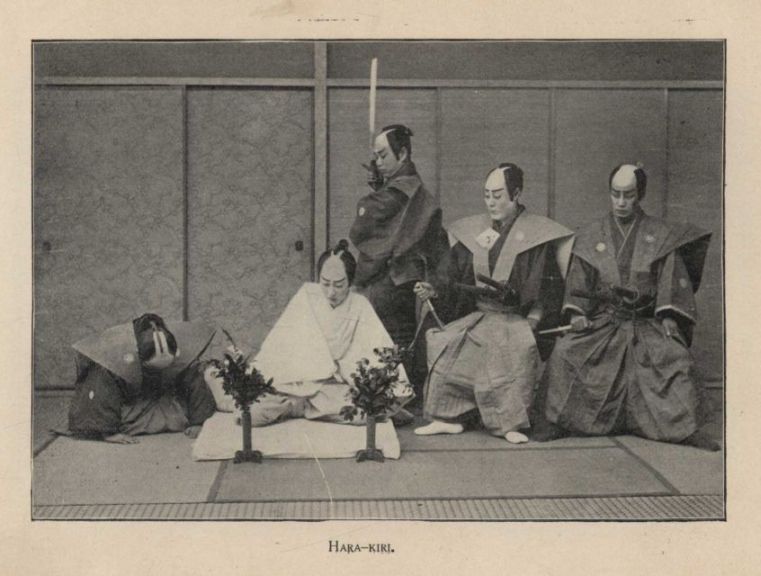
A custom peculiar to Japan is a form of suicide known as hara-kiri, or "belly-cutting." From time immemorial, to take one's own life in this manner has been considered very honorable and has expiated all crimes and offenses. In olden times, if the life of any one of noble blood became hurtful to the state, he was simply sent a certain kind of short sword. This meant that he was to take his own life by the favorite national method. So the recipient quietly ate his last meal, bade his family farewell, and, seating himself squarely on the mat, deliberately thrust the sword into the left side of his abdomen, and drew it across to the right side. As this cut does not kill immediately, a retainer, from behind, placed there for that purpose, struck off his master's head with one blow of a heavy sword. In the eyes of the law this death atoned for all sins and offenses; hence it was often practised in old Japan. It is almost obsolete now.
The Japanese are an exceedingly polite people. They have been called the Frenchmen of the Orient in recognition of this national characteristic. Politeness is exalted above everything, above even truth and honor. If you ask an ordinary Japanese which is better, to tell a falsehood or be impolite, he will at once reply, "To tell a falsehood." But while the people are exceedingly polite, a large part of this politeness is merely surface, without any meaning. Etiquette requires that you always address and treat your equals as though they were your superiors. There is a separate form of address for each step in the social scale. I have seen Japanese men stand at a door for five minutes, and blush, and beg each other to pass through first, each hesitating to precede the other. A Japanese gentleman never stops to converse with a friend, be he only a child, without taking off his hat.
To look down upon one from a superior elevation is considered very impolite. Thus if the emperor or any one of especial distinction passes through a city, all the upper stories of the houses must be vacated. Under no circumstances are any permitted to observe the procession from an upper window. I was out walking one day in our good city of Saga with a foreign friend who was leading his little boy by the hand. It happened that a countess was passing through the city. The policemen had cleared the street for the procession, and a large crowd was standing at the corner. We joined this crowd. The little boy could not see, so his father held him up that he might look over the people's heads. At once the police forbade it and made him put the child down.
In many instances forms of politeness are carried to a ridiculous extreme. When you give a present, no matter how nice, you must apologize by saying that it is so cheap and insignificant that you are ashamed to lift it up to the honorable person, but if he will condescend to accept it he will make you very happy. If you receive a present you must elevate it toward the top of the head (as that is considered the most honorable part of the body) and at the same time say that it is the most beautiful thing on earth. When you are invited to a dinner the invitation will carefully state that no special preparation will be made for the occasion. At the beginning of the meal the hostess will apologize for presuming to set before you such mean, dirty food, and will declare that she has nothing whatever for you to eat, although she will doubtless have a feast fit for a king. Even if it should not be good, you must say that it is and praise it extravagantly.
The greetings between friends are sometimes right funny. I have often overheard such conversations as the following. Two men meet in the street, and, taking off their hats, bow very low, and begin as follows:
A. "I have not had the pleasure of hanging myself in your honorable eyes for a long time."
B. "I was exceedingly rude the last time I saw you."
A. "No; it was surely I who was rude. Please excuse me."
B. "How is your august health?"
A. "Very good, thanks to your kind assistance."
B. "Is the august lady, your honorable wife, well?"
A. "Yes, thank you; the lazy old woman is quite well."
B. "And how are your princely children?"
A. "A thousand thanks for your kind interest. The noisy, dirty little brats are well too."
B. "I am now living on a little back street, and my house is awfully small and dirty; but if you can endure it, please honor me by a visit."
A. "I am overcome with thanks, and will early ascend to your honorable residence, and impose my uninteresting self upon your hospitality."
B. "I will now be very impolite and leave you."
A. "If that is so, excuse me. Sayonara."
V
JAPANESE CIVILIZATION
The question is often asked, Are the Japanese a civilized people? The answer will entirely depend upon our definition of civilization. If civilization consists in a highly organized commercial and industrial life, in the construction and use of huge, towering piles of manufactories and commercial houses, such as are seen in New York and Chicago, in amassing enormous capital, controlling the trade of the country by monopolies, and doing the work of the world by machinery that moves with the precision of clockwork, then Japan is not yet civilized. But if civilization consists in a courteous, refined manner, in a calm enjoyment of literature and the arts, in an ability to live easily and comfortably with a due regard to all the amenities of life, then the Japanese are a civilized people.
A very brilliant writer on Japanese subjects[1] has said that the Japanese have been a civilized people for at least a thousand years. Chinese civilization was brought to Japan early in the Christian era, and flourished for more than fifteen hundred years. While it differs much from European civilization, it is a highly organized and developed system, venerable with age. When people of the West speak of civilized countries they are apt to think of Europe and America, to the exclusion of all the rest of the world. This is unfair. Chinese civilization is much older than our own. Long before the dark ages of Europe the Chinese were living under a regular system of laws and were engaged in all peaceful pursuits. Systematic methods of agriculture, the art of printing, gunpowder, and the mariners' compass were all known and used. While our own forefathers in northern Europe roamed the forests as wild men and dressed in skins, the Chinese were living quietly in cities and towns, dressed in silks. This venerable Chinese civilization was readily adopted in Japan, and prevailed down to the time of the Restoration, in 1868. Since that time the adoption and assimilation of Western civilization have been progressing with a rapidity and success which have no precedent in the history of the world. The old immobile, crystallized Chinese civilization has been thrown off, and the vigorous, elastic forms of the West have been successfully adopted. Japanese civilization of to-day is European, only with a national coloring.
On the advice of an American missionary,[2] who was then president of the Imperial University, and who arranged the program for the expedition, in 1872 a committee of seventy intelligent Japanese gentlemen, many of them from the noble families, was sent to the West to visit the capitals of the several countries, examine into their forms of government and civilization, and, of all that they found, to choose and bring back with them what was best adapted to Japan. This committee, after visiting Washington, London, Berlin, and other places, and carefully examining into their different institutions, returned and reported to the government. From this time began the rapid adoption of Western civilization, which is still in progress.
Foreign employees have played an important part in this peaceful revolution. At first nearly everything that was adopted was under foreign superintendence; but the Japanese are such apt learners that they are now capable of managing this new civilization for themselves, and the foreign employees have been mostly dispensed with.
With this brief history of Japanese progress before us, let us now examine into the present condition of Japanese civilization.
One of the best indicators of the civilization of a country is its literature. No writers of world-wide fame have arisen in Japan, yet the country has a literature of which she is not ashamed. In ancient times the Chinese classics were alone studied, and all literature was molded by Confucian ideas; to-day these models have been cast aside, and a school of young, independent writers has arisen, by whom history, political and moral science, botany, sociology, belles-lettres, and numerous other subjects are discussed with vigor and originality.
In the number of newspapers and magazines published Japan can compare favorably with any country of equal size. The great dailies have not yet grown to such importance as those of America or England, but they already wield a mighty influence. Nearly every small town has its morning and its evening sheet. Even in our backward old town of Saga we have two very good dailies. There are a large number of able magazines published. Nearly every branch of learning has a magazine devoted exclusively to its interests, as is frequently the case in the West. The very existence of this innumerable multitude of newspapers and magazines shows that the Japanese are great readers.
The educational system in vogue is a good index of a nation's civilization. Perhaps no nation of the West has a better organized and developed free-school system than has Japan. Schools are found in every village and hamlet, and as all children of a prescribed age are required to attend, they are full to overflowing. The little round-faced, sleek-headed Japanese children swarm round them like bees. There are four grades of schools: the primary lower, the advanced lower, the lower middle, and the higher middle. The lower schools are found everywhere; the higher ones only in the large towns and cities. Of the higher middle schools (which correspond to our American colleges of middle grade) there are seven, distributed at various points over the empire. At the head of this whole system stands the Imperial University in Tokyo, which is itself the outgrowth of several colleges, and is largely modeled after the German universities. The lower schools are modeled after our American schools. Unfortunately, so large a part of the time of the school-children must be spent in studying Chinese characters that it takes about eight years to learn to read. What a pity that the awkward, antiquated system of Chinese writing is not abandoned! It seems that the native kana, of which there are about forty-eight, with a few of the more common Chinese characters, would answer all purposes; then the long years spent in studying Chinese could be devoted to other things, to the immense advantage of the student. In the lower schools very little is studied except Chinese. In the middle schools the branches studied are just about what American youths study in the academies. Formerly considerable stress was laid upon the study of modern languages, and all students of the middle schools were required to study English and either French or German. But in recent years only English has been required, and it, even, is not studied so carefully as it was. Since the revision of the treaties the study of foreign languages seems to be on the increase.
The Imperial University compares very favorably with Western universities of the middle class. It has six faculties, namely, law, medicine, literature, science, engineering, and agriculture. The medical department is under German influence; the others have professors of various nationalities, mostly English, German, and Japanese. The students number over 1000. The government has recently undertaken the establishment of another university in Kyoto. It also supports two higher normal schools, a higher commercial school, naval and military academies, fine-arts school, technical school, the nobles' school, the musical academy, and the blind and dumb school. Professor Chamberlain, of the Imperial University, says the leading idea of the Japanese government in all its educational improvements is the desire to assimilate the national ways of thinking to those of European countries. In view of the difference between the East and the West, this is an enormous task; and great credit is due that brave body of educators who, fighting against fearful odds, are gradually accomplishing their purpose.
The Japanese are a nation of artists. Life in one of the most beautiful countries in the world has, to a rare degree, developed in them the love of the beautiful; and this has expressed itself in the various phases of national art. In general, Japanese art is pretty, but small, isolated, and lacking in breadth of view. Its chief use in former times was largely decorative, to paint a screen or a piece of porcelain, and the artists did this to perfection. As a nation the Japanese are very skilful with the pencil. Long writing of Chinese characters has given them a control of the pencil or crayon not commonly found among the people of the West. Drawing is taught in the schools, and every school-boy can draw pretty pictures. But in art, as in other things, the Japanese are frequently inconsistent, and show a haughty disregard of details. They excel in portraying nature.
The government of Japan is progressive and enlightened. In reality it is an absolute monarchy, ruled by the "heaven-descended mikado." The empire belongs to him by divine right, and none has ever disputed this. Unquestioning, implicit obedience is the duty of all subjects. But the present emperor, who is a liberal-minded monarch, has graciously given his people a voice in the government. In 1889 the constitution was promulgated, which laid the foundation for a new order of things. It established the Diet, consisting of two houses, and gave many rights to the people, including local self-government, within certain limits. The franchise is so limited in Japan that a man must annually pay a stipulated amount of tax before he can either vote or run for office.
Japanese laws have for years been gradually approaching Western standards. The transition has been difficult and necessarily slow, but praise-worthy progress has been made. A code somewhat resembling the Code Napoleon is now the law of the land, and is being applied in the courts as fast as circumstances will permit. People coming from Europe or America will find that, in the main, the laws are not very different from those they have been accustomed to.
Nearly all the material expressions of an advanced civilization found at home are likewise met with in Japan—good railways, steamboats, telegraphs, mails, electric lights, etc. It is often a surprise to the traveler from the West who has read little about the country, and who expects only the rudest form of civilization, to find instead nearly all the conveniences to which he has been accustomed.
RAILWAYS.—Japanese railways are narrow gauge, and while in recent years the question of changing them to standard gauge has been agitated, nothing definite has been done. The narrow-gauge system seems fairly adequate to the present demand. The railways are modeled after those of England, and are miniature as compared with those thundering monsters that make the American valleys tremble with their tread. The coaches are much smaller than the American and are differently arranged, opening on the side instead of the end, passage from one coach to another being precluded. There is no conductor to come around and disturb one with the continual cry of "Tickets!" The punch, punch, punch, so annoying to sensitive people, is not heard. As the passenger leaves the station to enter the train his ticket is examined, and this ends the matter until he reaches his destination, when he must pass out through the station, where his ticket is taken by a polite official. One of the things that have most impressed me about the railroad service is the kindness and politeness of the officials, in striking contrast with the gruffness and incivility one often encounters in America.
The average Japanese train has three classes of coaches. The first class corresponds to the ordinary first-class day-coach at home; second class corresponds to our smoking-cars; while third class is poorer still. The fares are just about one half what they are in America, and one can travel in first-class style for a cent and a half per mile. Third-class fare is only a little over half a cent, and most of the people travel in this class. The trains do not have the conveniences to which my readers are accustomed. There are no sleeping- and dining-cars, no provision for heating in winter, and no water. The average running speed is about 20 miles per hour—a rate which would not at all suffice for the high-tensioned, nervous, always-in-a-hurry civilization of the West, but which meets all the demands of the slower, quieter life of the East. Running at this rate, accidents are comparatively rare, and the trains easily make their scheduled time.
There is one main trunk-line running throughout the length of the land, besides numerous shorter lines. All of the more prominent towns and cities are connected by rail. At present a railroad-construction craze has seized Japan. Many are being constructed, others are being surveyed, and the papers daily contain accounts of new ones projected. So far, Japanese railway stocks have yielded good dividends. That the more important lines are owned and operated by the government is not the result of any political or economic theory, but simply because at first private individuals had neither the means nor the energy to inaugurate such huge and hitherto untried enterprises. Many of the smaller roads are now owned and controlled by private corporations, and most of those in process of construction are private enterprises. Some months ago a private corporation made a proposition to the government to buy its main railway, but the offer was rejected.
STEAMERS.—Steamboat service in Japan is good. As the country is only a range of islands, the largest of which are very narrow, and as all the more important towns are on the sea-coast or only a short distance inland, it is possible to go nearly everywhere by boat. Travel by water is very popular. There are fairly good steamers plying daily between the most important ports, but foreigners generally prefer to travel only on those officered by Europeans or Americans. There are a number of native steamers, comfortable and speedy, which are officered by foreigners, and differ but little from the transpacific liners. These were nearly all built in England, but in recent years they are building very good ones in Japan. The facilities for travel in this empire leave little to be desired.
TELEGRAPHS.—The Japanese telegraph system is excellent. It extends to all towns of any size in the empire, and by cable to all parts of the world. From the old city of Saga, in which I live, I can send a cablegram to any point in Europe or America. A telegraph code on the basis of the Morse code has been made in Japan, which admits of internal telegrams being transmitted in the native syllabary. In this respect the Japanese system is unique among Eastern countries. For instance, in India or China telegrams can be transmitted only in Roman letters or Arabic figures. By the formation of a vernacular code the telegraph was brought within the reach of the masses of the people, and it soon became familiar and popular.
The tariff for messages is perhaps lower than any other in the world. A message of ten kana, equaling about five English words, together with name and address of sender and receiver, can be sent to any part of the empire for eight or nine cents. Telegrams in foreign languages are sent within the empire for five sen per word, with a minimum charge of twenty-five sen for five words or a fraction thereof. No charge is made for delivery within a radius of 2-½ miles of the telegraph office.
There are no private telegraph corporations. The government builds, owns, and operates the lines just as it does the mails. The postal and telegraph systems are intimately connected, and the same office does service for both.
The first telegraph line in Japan was opened in 1869. The venture proving a success, the following year the line was extended and a general telegraphic system for the whole country decided upon. The rapid construction of telegraph lines began in 1872, from which year it has gone forward uninterruptedly. At present the lines extend to every corner of the empire. The first lines were surveyed, built, and operated under foreign experts; but the natives have learned so rapidly that they have been enabled to do away with all foreign employees. All of the materials and instruments in use, with the exception of submarine cables and the most delicate electrical measuring apparatus, are made in Japan.
MAILS.—The Japanese mail system was modeled after the American in 1871. At first it was limited to postal service between the three large cities of Tokyo, Kyoto, and Osaka; but in 1872 it was extended to the whole country, with the exception of a certain part of the Hokkaido, which was without roads and almost without population. To-day there is no village or hamlet in the whole land which does not enjoy the convenience of a good postal system. The mails are sent with promptness and despatch, and it requires only a few days to communicate with any part of the empire. The postal rates are very low. Postal cards cost one sen and letters two sen—about five eighths and one and two eighths of a cent, respectively.
All mail is delivered free of charge. Not only is this so in the cities and larger towns, but in the villages and rural districts as well. There is no place where the dapper little postman does not go. Another convenience of the mail system is its excellent parcel-post department. Very large parcels, containing almost anything, can be sent for a small charge. Still another praiseworthy feature is that each office is a savings-bank, where the people can deposit small sums of money at any time and receive a good rate of interest. This money can be withdrawn without previous notice. The government has established these savings-banks in connection with the post-offices to encourage the people to lay up small sums of money, and they accomplish their purpose well.
Japan was admitted into the International Postal Union in 1879, with full management of all her postal affairs. As all her rates are now based on a silver standard, postage to foreign countries is much cheaper than from them to Japan. To the United States or to China we pay five sen (about two and a half cents) per letter; to all other countries within the Postal Union ten sen per letter.
LIGHTS.—The system of lighting is an index of the civilization of a country. In this respect Japan is not yet so far advanced as the leading countries of the West, yet she is well lighted. In all the large cities there are good electric plants, and electricity is extensively used. The streets and many of the best stores and shops are very well lighted with it. However, electric lights are seldom found in interior cities of less than 40,000 people. I think electricity is too costly to come into general use, except in the centers. Illuminating gas is very little used.
The only oil used in former times was extracted from whales and large fish, and chiefly from the seed of a certain tree. Since the opening of the country, kerosene has come into general use, immense quantities being imported from the United States and from Russia. Oil has been found in several places in Japan, but as yet has never been developed.
BANKING.—One of the most useful products of the introduction of our modern civilization is the present system of banking. This system will compare favorably with those of the West. There are a number of national banks distributed over all the land, together with many substantial private banking corporations. All forms of banking business are transacted, and good interest is given on deposits. The great popularity of the banks is shown by the fact that to-day in Tokyo, only eight years after bank-checks have come into use, the amount annually drawn exceeds $100,000,000.
Having taken this rapid view of Japanese civilization, we are in a position to judge as to whether or not this is a civilized land; and we answer that it is. But although modeled after that of the West, it in many respects differs from Western civilization. Japan has shown herself capable of doing great things, but she does not do them in the same way that they are done in Europe or America. For example, consider her manufactories, which now threaten to compete with those of our own country. In America manufactories mean enormous capital invested. Costly factories must be erected, the most approved machinery provided, and the completed plant operated at great expense. Here almost no capital is used. The buildings are low, one-story sheds, not more costly than a row of stables at home. It is true that Japan has a few large, substantial buildings for manufacturing purposes; but such are rare, and, when found, look out of harmony with their surroundings. Even nature seems to protest against huge piles of brick and stone, as she so frequently demolishes them. Most of the wares of Japan are manufactured in small, cheap buildings, and little machinery is used. The best silk made is woven in a house that cost scarcely $500. The best cloisonne, of which only a small piece a few inches high will cost hundreds of dollars, is made in a little, two-story house with only six rooms. Some of the greatest porcelain-makers in the world, whose products are better known in London and Paris than in their own country, do their work in small wooden houses in Kyoto, no better than the homes of the American laborer. "The vast rice crop is raised on millions of tiny farms; the silk crop in millions of small, poor homes; the tea crop on countless little patches of soil. Japan has become industrial without becoming essentially mechanical and artificial."[3] On this small scale the great work of Japan is done. Japanese civilization, in its parts, is miniature.
When compared with the civilization of the West, it is unstable; in fact stability is almost unknown. The land itself is a land of change. The outlines of the coasts, the courses of the rivers, the form of the mountains, by the combined action of volcanoes, earthquakes, winds, and waves, are constantly changing.
The people themselves are continually drifting about from place to place, changing their residence with the seasons. It has been said that no people in the world are so migratory. Preparation can be made in a few hours for the longest journey, and all the necessary baggage wrapped up in a handkerchief. Japanese life is in a constant state of fluidity.
The average house, likewise, seems built but for a day. The walls, the roof, the floors, are made of the lightest materials, and apparently there is no thought of permanence.
We of the West are wont to think that no real progress can be made without stability, but Japan has proved the contrary. A uniformly mobile race is, correspondingly, uniformly impressionable. The fluid mass of the Japanese people submits itself to the hands of its rulers as readily as the clay to the hands of the potter, and thus it moves with system and order toward great ends. It is thus that Japanese civilization is strong.
When compared with Western civilization, that of Japan is seen to be less organized and developed, less hasty and feverish in its movements, It does not impress one so much with its hugeness and ponderosity. It is lighter, brighter, quieter, more soothing. It is the civilization of the West robbed of its immensity and seriousness, and reflecting the national characteristics of these light-hearted sons of the East.
VI
JAPANESE MORALITY
Japanese morality has been much written about by men of the West, and many dogmatic judgments have been pronounced upon it. At one extreme, we have been told that "they are the most immoral people on the face of the earth"; at the other, we are told that in morality "they have nothing to learn from the people of Christendom." There is about as much—or rather as little—truth in the one statement as in the other. The fact is that it is necessary to have an experimental acquaintance with Japan before one can really understand or appreciate the moral condition of her people. The moral ideas and teachings to which they have been accustomed from childhood are so different from our own that they could not be expected to approximate to our standards. Judged by the ideas of the West, they are lacking in morality; but from their own standpoint they are a moral people. While we cannot accept theirs as the true standard, it is but fair that, in judging them, we keep this in view.
Before the introduction of Chinese ethics there was no such thing as a moral code. The original native religion, Shinto, taught no doctrines of morality, as we understand them. According to it, to obey implicitly the mikado was the whole duty of man. As for the rest, if a Japanese obeyed the natural impulses of his own heart he would be sure to do right. Modern Shinto writers, in all seriousness, account for this absence of a moral code by stating that originally Japanese nature was pure, clean, and sinless, possessing no tendency to evil or wrong. Barbarians, like the Chinese and Americans, being by nature immoral, were forced to invent a moral code to control their actions; but in Japan this was not necessary, as every Japanese acted aright if he only consulted his own heart. They explain the need for the present moral laws—a need which they acknowledge—by the fact of association with outside nations. Immorality and dissoluteness were introduced by the Chinese and Western peoples, to counteract the evil influence of which they now have the shameful spectacle of a moral law even among the children of the "heaven-descended mikado." So much for the teaching of Shinto in regard to morality. It would be exasperating were it not ludicrous.
Confucius is the master of Japanese morality. His teachings were introduced into Japan early in the Christian era, but they became predominant only in the time of Iyeyasu, in the seventeenth century. This great statesman, warrior, and patron of learning caused the Chinese classics to be printed in Japan for the first time; and from that day to this the morality of Japan has been dominated by Confucian ideas.
In order to understand Japanese morality, it is necessary for us to shift our moral base and try to look at the subject through Japanese eyes. The average native of the West thinks of "morality" as something belonging to the individual. Even in religion his first thought is to save his own soul. The value of the soul, its immortality, its immediate relation to the infinite and eternal Father—these have been emphasized ever since the first establishment of the church. In consequence, there is a duty which man owes to himself. He may not disregard it even at the command of father or king. Within the soul is the holiest of all, for there is heard in conscience the voice of God himself. No external authority may be supreme, and at no external voice may one violate his own convictions of truth.
This thought exalts the individual, and, therefore, sins which degrade our own personality become most repulsive. Thus, among high-minded men truth is almost first among the virtues, and an accusation of falsehood the most hateful of insults. For truth seems peculiarly personal and spiritual, as if belonging to the very sanctuary of one's nature. And in like manner, among women, in popular esteem chastity is of the essence of morality, as its violation seems to contaminate and debase her holiest self.
Now the Confucian ethics rest upon a quite different principle, and in this are at one with the ancient teaching of the Greeks and Romans. The supreme duty is not to the self, but to the organization of which one is but a part—that is, to the family or to the state. The great Chinese moralists were statesmen, and their chief concern was, not the salvation of the individual, but the peace and prosperity of the state. In their view, the family was the unit, and the state a greater family. So the conflict of duties, in their questions of casuistry, is never between individual and social duties, but between duties owed to family and to state. Loyalty to the state and obedience to parents must be supreme; but China and Japan differ as to the value of these two.
According to original Confucianism, the first duty of men is obedience to parents; the second, loyalty to rulers; but in Japan the order of these duties has been changed, the second being given first place.
The people have learned well this teaching of Confucius. Japan was prepared soil for its sowing. The native religion taught that the emperor was a direct descendant of heaven, who ruled by divine right; the provincial lords were his ministers, and hence loyalty was a plain duty. The Confucian teaching only strengthened, deepened, and gave form and outline to a sentiment already existing. This principle of loyalty thus became the foundation stone of Japanese ethics, and one's duty to one's lord paramount to all other duties.
In the olden times the people did not look beyond their own feudal lords and clans to the emperor and the nation. They were to be faithful unto death to these, but no further. Now that loyalty once shown to the local princes and clans finds its apotheosis in the emperor and the empire.
A man's duty to his friends, to his wife and children, and even to his parents, is counted as nothing in comparison with his duty to rulers and country. There are many instances in Japanese history of men who, having slain their own parents, children, wives, for the sake of their prince, were praised. At the time of the recent tidal wave in northern Japan, when the waters were rushing furiously into one home, a husband and father turned a deaf ear to the cries of his drowning wife and children, permitting them to perish that he might save the emperor's picture; and he was applauded for the act. A fire recently demolished the beautiful new buildings of the middle school in Saga. The library, laboratories, and scientific apparatus were mostly destroyed, and many of the students lost their clothing and books. The loss in buildings alone was some $20,000. Yet the thing the loss of which they lamented most deeply was a photograph of the emperor which could easily be replaced for a few yen.
A characteristic story, showing the devotion with which the old samurai carried out this principle of loyalty, is the tale of the forty-seven ronins. It is rather long to insert here, but as it illustrates so well the power of this principle, I will relate it.
In the year 1701 the lord of Ako, Asano by name, visited Yedo to pay his respects to the shogun. While there the shogun appointed him to receive and entertain an envoy from the mikado. Now, the reception of an envoy from the imperial court was one of the greatest state ceremonies of the day, and as Asano knew little of ceremonies and etiquette, he asked the advice of another nobleman, named Kira, who was expert in such matters. This man, who seems to have been of a very mean disposition, grudgingly gave the information desired, and then asked a fee for the same. Asano refused to give the fee, and Kira, becoming angry, twitted and jeered at him, calling him a country lout, unworthy the name of daimio. Asano endured the insults patiently until Kira peremptorily ordered him to stoop down and fasten his foot-gear for him,—a most menial service,—when he drew his sword and gave the offender a deep cut across the face. This quarrel took place in the precincts of the palace, and instantly the whole court was in an uproar. To degrade the sacred place was an insult punishable with death and the confiscation of all property; and Asano was condemned to take his own life by hara-kiri that same evening, his estates were confiscated, his family declared extinct, and his clan disbanded. Henceforth his retainers became ronins ("wandering men"), with no country and no lord. According to the ethics of their country, it was their bounden duty to avenge the death of their lord, and we shall see how relentlessly they followed their purpose until it was accomplished.
The senior retainer of the dead Asano, Oishu Kuranosuke, together with forty-six others of his most trusty fellow-lieges, took counsel as to how they might avenge their lord. They all were willing to lay down their lives in the attempt, but even then the task was difficult, because of the vigilance of the government. For such vengeance was rigidly prohibited by law, although as rigidly required by custom. Notwithstanding the fact that all who slew an enemy for vengeance were punished by death, not to take such vengeance never entered the mind of any chivalrous Japanese. After much planning the forty-seven ronins decided that to avoid the suspicions of the government it would be necessary for them to separate and for the time conceal their purpose. So they separated, settling in different cities, and taking up various occupations. Many of them became carpenters, smiths, and merchants, and in these capacities gained access to Kira's house and learned all about its interior arrangements. The leader of this faithful band, Oishu, went to Kyoto and plunged into a life of drunkenness and debauchery. He even put away his wife and children, and led the most dissolute life possible, simply to throw off the suspicions of the authorities. All of the ronins were closely watched by spies, who secretly reported their conduct to Kira. But by these devices they finally lulled all suspicion, and the vigilance ceased. Then the day long waited for had come. Suddenly, on the night of January 30, 1703, two years after the death of their lord, in the midst of a violent snowstorm, these forty-seven faithful men attacked Kira's castle, forced the gate, and slew all the retainers. Kira, who was a coward at heart, concealed himself in an outhouse. The ronins found him there, drew him forth, and requested him to kill himself by hara-kiri, as was the privilege of a man of his rank. But he refused out of fear, and the retainers of Asano were forced to kill him as they would have killed a common coolie. Thus did they accomplish their purpose and fulfil the high duty of loyalty to their dead lord, after two years of waiting, most careful planning, and ceaseless vigilance.
By the time their purpose was accomplished day had dawned, and, in plain view of the whole city, this brave band marched in order to the temple of Sengakuji, where Asano was buried. The citizens showed them every honor on the way. A wealthy nobleman, as a reward for their loyal deed, sent them out costly refreshments. When they arrived at the temple the head abbot received them in person and showed them every honor. Finding the grave of their dead lord, they laid thereon the head of the enemy by whom he had been so deeply wronged, and then felt that their duty was done. They were all sentenced to commit hara-kiri, which they did willingly. Afterward they were buried together in the same temple grounds with their lord, where their graves can be seen to this day.
These men simply obeyed the ethical code of their time and country, and as a reward for their loyalty they have received the enthusiastic praise of their countrymen for two centuries. No other story is so popular to-day, or so stirs the hearts of the people, as this. While we, believing that vengeance belongs to the Lord, cannot indorse this deed, we must admire the loyalty and faithfulness of those ronins, and the perseverance with which they adhered to their purpose. In this true story we see clearly the power of this first principle of Japanese morality—loyalty.
The sister principle of loyalty in Confucian ethics is obedience to parents. Unquestioning, absolute, implicit obedience is required of all children. Formerly the child was considered the property of the parents, and could be disposed of at will, even to the taking of its life. To-day the father may sell his daughter to a life of shame, or "lend" her to a private individual for immoral purposes; and, however much she may dislike such a life, obedience to parents requires that she acquiesce in his will, which she does uncomplainingly.
This principle of obedience is the foundation stone of Japanese family life. The relation between parents and children is stronger than that between man and wife, and is given a prior place. An only son cannot be forced to leave his mother and become a soldier, but a husband may be forced to leave his wife. Within the family circle, the son's duty to his aged parents always precedes his duty to his wife. Every Japanese feels deeply this obligation to his parents, and properly to support and nourish them in old age he holds to be a sacred duty. Americans could learn much that would be profitable from the reverence and respect shown for parents and teachers by the Japanese.
In Japan, however, this principle is carried too far. It continues after death as binding as before, and divine honors are paid to dead ancestors. Periodical visits are made to their tombs, religious candles are kept burning in their honor, and prayers are said to them. Among the more enlightened to-day there is perhaps nothing in these ceremonies but reverence and respect; yet by the masses of the people ancestors are worshiped.
There are two moral maxims that show well the relative importance in which parents, relatives, and wives are held. They are the following: "Thy father and thy mother are like heaven and earth; thy teacher and thy lord are like the sun and the moon." "Other kinsfolk may be likened to the rushes; husbands and wives are but as useless stones."
It is apparent that virtues have differing values in the Confucian and Christian systems. We can appreciate their point of view best, perhaps, as we remember the ethics of an army. Here obedience, loyalty, self-devotion, courage, are supreme. Much is forgiven if these are manifested. The organization is everything, and the individual nothing, save as he is a fraction of the great machine. Carry that idea into the social community, and think of it as an army, with all, women as well as men, of value only as parts of the greater whole, and we shall understand why and how the Japanese may esteem men and women righteous whom we judge debased and even criminal. So would the Japanese judge them, were the motive mere passion or selfish desire, but not when the controlling power is loyalty or obedience. Thus the forty-seven ronin were pre-eminently "righteous" when they debauched themselves with every swinish vice.
Of course this view of morality puts great temptation in the way of parents and rulers. Having supreme power, they may use it to the degradation of those whom they control. Confucius, it is true, taught parents and rulers that they too owed duties to the state, and that use of their Heaven-given powers for selfish ends was treason against the supreme law; but, beyond doubt, the duty of submission, of loyalty and unquestioning obedience, was so exaggerated that evils many and great resulted. At the same time a sympathetic view leads one to wonder the rather that the ethical results are so wholesome.
Turning from this general view, one finds in particulars much the same conditions as in other lands. For example, immense quantities of alcoholic stimulants are consumed annually. There is a native liquor called "sake," made from rice, that is very popular and, in some of its forms, very intoxicating. Its manufacture and sale is one of the most lucrative businesses in the empire. Foreign whiskies, wines, and beers are sold in large quantities, but they are so costly as to be beyond the reach of all but the wealthy. Outside of the small circle of Christians, there are few people who do not drink. The total abstainer is a rarity. But, while nearly every one drinks, in general the Japanese do not drink to such excess as other nations. One seldom sees such beastly drunkenness as is often seen in the West. Drinking is taken as a matter of course, and society does not condemn it. The usual way in which Japanese men pass a dull day is in feasting and drinking. The use of alcoholic stimulants is much more common here than at home.
In business and commercial morality there is much to be desired. The merchants do not sell according to the worth of an article, but according to what they can make the purchaser pay. They are great bargainers. Recently I wanted to buy two large wall-pictures. The dealer asked me $21 for them, but finally sold them for $5. It is a very common thing to buy articles for less than half the price first asked. In matters of veracity and in the fulfilment of contracts Japanese merchants are not generally to be trusted. The average man is famous for lying, and the merchants and tradesmen seem to have acquired an extra share of this general characteristic. A Japanese trader will do all in his power to avoid the fulfilment of a contract if it entails a loss. This lack of commercial honor is recognized by the foreign firms doing business here, and it has hindered not a little the growth and development of trade.
The moral sense of the people in regard to taking one's own life is very different from that of Christendom. From ancient times, suicide has been thought to be a praiseworthy act, and has been extensively practised. Formerly it was encouraged, and sometimes required, by the government; but now it has no official sanction whatever. Still, the custom exists, and some authorities place the annual number of suicides as high as 10,000. The people laugh at our Western idea that it is wrong to take one's own life. On the contrary, they hold that when misfortunes and calamities make this life unattractive it is the part of wisdom to end it. Even the feelings of young Japanese, who have been educated somewhat into our own way of thinking, do not seem to have changed on this point; they still adhere to the old Roman view that self-destruction is permissible and often meritorious. The Western fiction that all suicides are the result of some form of insanity is not countenanced here. The various causes leading to self-destruction are coolly and carefully tabulated, and very few are attributed to insanity. Contrariwise, long and careful study of the subject has shown that self-destruction is gone about with as much coolness, precision, and judgment as any act of daily life.
The above are in brief the leading moral ideas and principles that govern the Japanese people. For their loyalty and obedience we have only admiration. But both of these principles are given an undue importance and are carried to extremes. The chief defect of Japanese morality is the minor place it gives to the individual. The moral need of the nation is a Christian morality—not just the morality of the West, but a morality founded on the ethical principles inculcated in the Bible. This would exalt truth and chastity, would soften and temper the great duties of loyalty and obedience, and would make of Japan an honest, temperate nation.
VII
RELIGIONS OF JAPAN
The Japanese are by nature a religious people. In the earliest times a conglomerate mass of superstitions and mythological ideas was made to do service as a religion. Fetishism, phallicism, animism, and tree- and serpent-worship were very common. The line of distinction between the Creator and the creature was not clearly marked; gods and men mingled and intermingled, and were hardly known apart. But it is not our purpose here to trace the ancient religious ideas of Japan, but rather to give a short account of contemporary religions. Therefore we cannot dwell on these unwritten mythological-religious systems.
The religions of contemporary Japan are four—Shinto, Buddhism, Confucianism, and Tenrikyo. Shinto and Tenrikyo are indigenous; Buddhism and Confucianism have been imported from China and Korea. Tenrikyo is of recent origin and has not yet the influence and standing of the others. Shinto, Buddhism, and Confucianism have existed here side by side for centuries. There is no great antagonism between them, as there is between Christianity and the ethnic religions. Many of the people are disciples of all three at the same time, taking their theology from Shinto, their soteriology and eschatology from Buddhism, and their moral and economic ideas from Confucianism. No inconsistency is felt in thus believing all three religions and worshiping at their shrines. Indeed, these three faiths have so commingled, the ideas and practices of one have so filtered into the others, that it is hard now to distinguish the pure teachings of each. In the minds of the masses they are not distinguished in detail. And yet as regards origin, history, and teachings they are separate and distinct faiths.
Shinto
Shinto may be called the national cult of Japan. The word "Shinto" means "the way of the gods." This system hardly deserves the name religion. It has no moral code, no dogmas, no sacred books. Originally it consisted chiefly of ancestor- and nature-worship, and of certain mythological ideas. A chief feature of it still is the worship of ancestors, who are exalted to a high pedestal in thought and worshiped as gods. The divine origin of the imperial family, and the obligation to worship and obey it, was a prominent teaching of Shinto. The ancestors of the imperial family were to be held in supreme reverence and were the objects of especial worship.
According to the Shinto of this period, there was neither heaven nor hell, but only an intermediate Hades. There was a sort of priesthood, but its duty was to watch over particular local gods, not to preach to the people. Pure Shinto taught that a man's whole duty lay in absolute obedience to the mikado and in following the natural promptings of his own heart.
Shinto was very much affected by the introduction of Buddhism, about the middle of the sixth century, and its further growth was checked. Buddhism adopted and largely absorbed it. Shinto gods were given a place in the Buddhist pantheon, and many of the Shinto ceremonies were adopted. But Shinto was completely overshadowed by Buddhism, and lay in a dormant state from the year 550 to 1700, a night of more than a thousand years.
A Shinto Temple.
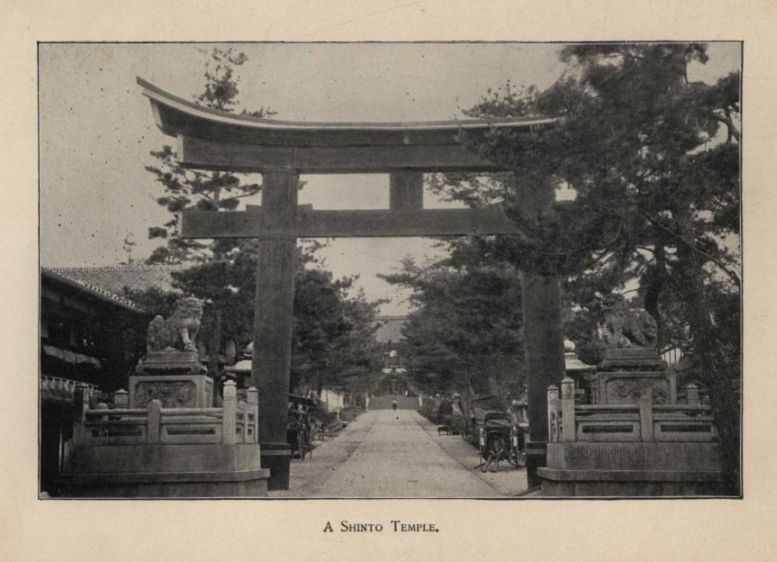
Since the beginning of the eighteenth century a revival of Shinto has sprung up. Native scholars tried to call up the past, to find out what pure Shinto was before its corruption by Buddhism, and to teach it as the national faith. In this effort they were partially successful. The old Buddhistic accretions were largely thrown off, and many of the temples, stripped of their Buddhist ornaments, were handed over to the Shinto priests. Buddhism was disestablished, and Shinto again became the religion of the state. A Shinto "Council for Spiritual Affairs" was appointed, which had equal rank with the Council of State. This, however, was reduced gradually to the rank of a department, then to a bureau, later to a sub-bureau. At present Shinto is the state religion, in so far as there can be said to be any state religion; but in reality there is no established religion. The connection of the government with Shinto extends no further than the maintenance of certain temples and the attendance of certain officials on some ceremonies. Shinto enjoys a large amount of popularity because it is indigenous, while Buddhism and Confucianism labor under the disadvantage of being of foreign origin. The majority of the upper classes in Japan who to-day have any religion at all are Shintoists.
Buddhism
The religion founded by Buddha in India is six centuries older than Christianity. Its nominal adherents comprise almost one third of the human race. Its philosophical precepts are deep and profound, while its ethical teachings are, for the most part, lofty and ennobling. This religion is worthy the careful study of any man who has the time and inclination.
We cannot attempt to give a full exposition of it, but will have to content ourselves with a bare mention of its more prominent teachings. Certain resemblances to Catholicism in ritual, ceremony, and ornamentation strike one very forcibly in observing Buddhist rites. The candles, the incense, the images and processions, all resemble Rome. But this resemblance extends no further than ritual and ceremony. In point of doctrine Buddhism is widely separated from every form of Christianity. In Buddhism the condition on which grace is received is not faith, but knowledge and enlightenment. Salvation is accomplished, not by the vicarious sufferings of a Redeemer, but by self-perfection through self-denial and discipline.
Dr. Griffis, a man who has written much and well on Japan, has pronounced the principal features of Buddhism to be atheism, metempsychosis, or the transmigration of souls, and absence of caste.
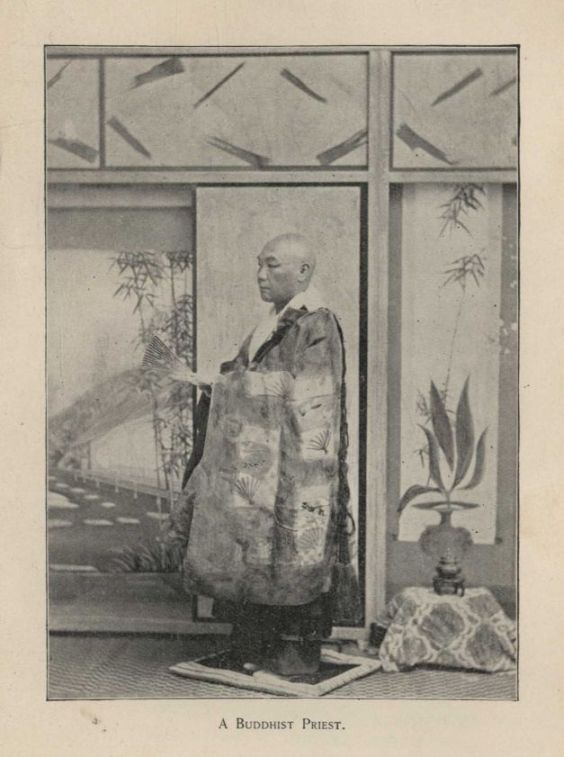
A Buddhist Priest.
Buddhism knows nothing of the existence of a supreme God who created the world. It inherited ideas of certain gods from Brahmanism, but these are made secondary to the hotoke, or buddhas, who are simply men who have finally reached the calm of perfect holiness after toiling through endless ages and countless existences. It teaches that existence itself is the chief of all evils. Instead of longing for eternal life, the Buddhist longs for annihilation. Happy, well-fed Western people, to whom existence is a delight, can hardly understand how any one can really desire its cessation. But the life of the lower classes in many countries of the East is one daily struggle for bread, so full of sorrow and misery that it is not unnatural they should desire to end it.
This religion teaches that the evil of existence springs from the double root of ignorance and human passions, and is to be overcome by knowledge and self-discipline. The heaven it offers is absorption in the Nirvana—the loss of personal identity and practical annihilation.
Buddhism numbers more devotees and exerts a greater influence than any of the other religions of Japan. It was received from Korea about the middle of the sixth century. After it had been transplanted and had grown into popular favor, many Japanese were sent to Korea and China to study its doctrines more fully; and they brought back with them not only Buddhism, but also Chinese literature and civilization. At first Buddhism encountered fierce opposition, but it was fortunate in securing court patronage, and very soon the opposition entirely ceased, so that in two or three centuries it spread itself throughout the whole empire. If ever a nation was ripe for the introduction of a foreign religion, that nation was Japan at that time. The national cult was silent, or almost so, in regard to the destiny of man and many other questions which religion is expected to answer. The religious nature of the people was asserting itself, and they were longing for more light on the great questions of life—its whence, why, and whither. Buddhism gave this light, and therefore was warmly welcomed. It had the whole field to itself, and took complete possession of it.
A Buddhist Cemetery.
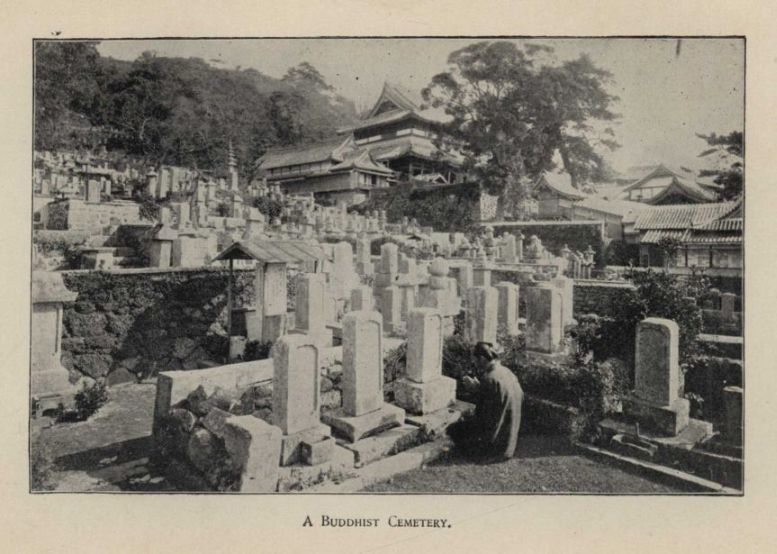
From the time of its introduction into Japan down to the present, Buddhism has enjoyed a wide popularity and exerted a powerful influence. It is not too much to say that Buddhism has largely formed Japanese civilization and national life. In the words of Professor Chamberlain, "All education was for centuries in Buddhist hands. Buddhism introduced art and medicine, molded the folk-lore of the country, created its dramatic poetry, deeply influenced politics and every sphere of social and intellectual activity. In a word, Buddhism was the teacher under whose instruction the Japanese nation grew up."
Buddhism has by no means lost its hold in Japan. It still has great life and power. Some writers have said that they have never seen a new temple in Japan—only old ones falling into decay. Their experience must have been limited. I see plenty of new temples, some of which are very costly.
Buddhist temples are numerous, and many are of imposing architecture. Being generally surrounded by tall trees, they have a lonely, mournful appearance. Hideous beasts, dragons, and serpents are carved upon them, and large, fierce-looking stone lions guard them, the effect being to awe and terrify the beholder. Some are furnished with gorgeous altars covered with beautiful flowers, images, and statues. Besides the temples there are everywhere little shrines. The religious spirit of the people prompts them to dedicate the most beautiful spots and nooks to the gods, and there to erect shrines and idols.
Buddhist priests dress in robes not very unlike the official robes of the Episcopal clergy. Their heads are always close-shaven, a mark by which they are easily distinguished. Forbidden to marry, they are expected to lead lives of purity and chastity. They have greatly degenerated, a large per cent. being illiterate and immoral. Their lives will not bear comparison with those of the Christian evangelists. That nearly all the cemeteries of Japan are in their hands gives them great influence.
Japanese Buddhism is divided into numerous sects, chief of which are the Tendai, Shingon, Jodo, and Zen, of Chinese origin, and the Shin and Nichiren, of native origin. The latter two are most prosperous.
Buddhism has profited by its contact with Christianity. As the reaction of Protestantism upon Catholicism was beneficial to the latter, so the reaction of Christianity upon Buddhism has been healthful It has forced a revival and purification of the Buddhist faith, and to-day it is better and more active than before it encountered Christianity. Still, Christianity is gradually encroaching upon its domain and is crippling its influence. That Buddhism is bound to perish in its encounter with Western civilization and Christianity seems a foregone conclusion.
Confucianism
Confucianism is even less deserving the name of a religion than Shinto. It consists chiefly in a set of moral teachings, of narrow application and mostly of a political nature. Confucius, avoiding all metaphysical abstractions and devotional rhapsodies, confined himself to the much more practical field of morals and politics. But his disciples and commentators, especially during the middle ages, expanded his doctrines and added ideas more or less religious. Thus developed, it became a sort of religious system, the only one believed by the old samurai or warrior classes.
Confucius, its founder, was born in the year 551 B.C., in the state of Lu, province of Shantung, China. He was an earnest student of the older Chinese classics, and one of the most learned men of his time. He gathered round him a circle of young men, whom he instructed, like Socrates, by questions and answers. He died in 478 B.C. No other human teacher has had more disciples or exerted a wider and stronger influence.
From its birthplace in China Confucianism spread to Korea, where it soon became, and still continues to be, the predominant faith. From Korea it advanced to the Japanese archipelago, where for many hundred years it has had much to do with shaping and molding the character of the people. Confucianism has undergone many modifications. At first a comparatively simple system of ethics and politics, it has expanded until to-day it is a complicated philosophico-religious system.
The basal principles of Confucian ethics are the "five relations." These are: sovereign and minister; father and son; husband and wife; elder brother and younger brother; friend and friend. I have named them in the order of their importance. The duty of loyalty is above that of filial obedience, while the relation of husband and wife is inferior to both of these. We will briefly consider each of these relations separately.
The duty of a minister, or servant, to his prince, or sovereign, is the first duty of man, and is emphasized to an extreme degree. In order to discharge this obligation to the feudal lord or emperor, one must, if necessary, give up everything: house, lands, kinsmen, name, fame, wife, children, society—all. And Japanese history is filled with instances of retainers who have counted their lives, their families, their all, as less than nothing when compared with their duty to their lord. Loyalty is the one idea which dominates all others in the Confucianism of Japan. Thus it has exerted an influence hardly second to Shinto in inculcating loyalty to the emperor and to Japan, and making the people fanatically patriotic.
The second relation is that of father and son, or parent and child. My readers perhaps would consider the relation of husband and wife the first of all human relations, but not so the Oriental. With him the family is of far more importance than the individual, and the chief aim of marriage is the maintenance of the family line. If the wife becomes a mother she is honored because she assists in perpetuating the family line; if she is childless she is probably neglected. Where there are no children adoption is the universal practice. The one adopted takes the family name and perpetuates it. No greater misfortune can be conceived than for the house to become extinct.
The relation of parent and child is very different from that to which we are accustomed. Mutual love hardly exists. The parent feels compassion and love for his child; the child reverences the parent. To speak of a child's love for his father, or a man's love for God, is repugnant to the Confucianist. It is thought to be taking an undue familiarity, and the proper relation is considered one of dependence and reverence. In old Japan the father was absolute lord and master, and had power over the life and death of his child. In recent times his power is more limited, and the idea is beginning to dawn upon thinking natives that children have rights as well as duties. A Japanese child feels more reverence for its parents, or at least for its father, than does the average child reared in the Christian homes of the West.
The third relation is that of husband and wife. On this point the teaching of Confucius is very different from that of Christ. Instead of having two parties bound together by mutual love, with equal rights and duties, we have the relation of superior and inferior, of master and servant. The husband precedes the wife in all things. She must serve him and his family zealously and uncomplainingly. She must be especially on her guard against the foolish sin of jealousy, and is not to complain if her husband introduces a concubine into the same house in which she resides. She is to yield absolute obedience to him in all things. She can be divorced for very slight reasons, and divorces are matters of every-day occurrence. Statistics show that the annual number of divorces is about one third the number of marriages. Sentiment is gradually changing in this regard, and marriage and divorce laws are becoming more strict.
Confucius condemned adultery as a heinous crime, but this teaching is made to apply only to the wife. She must remain true to her husband, but he is not considered under the same obligation to her.
The fourth relation is that of elder brother and younger brother. This is evident from the language used to express the relation of children of the same household to one another. The word for brother or sister is seldom used; in fact, there is no word to express just that idea. In its stead we hear "elder brother," "elder sister," and "younger brother," "younger sister." The children of a household are not considered equals; the elder ones are given the preference in all things. Especially does the eldest son hold a position of prominence far above that of the other children. He is looked upon as the perpetuator of the family line and is given especial honor. His younger brothers and his sisters, and even his mother, must serve and obey him.
The younger sons are subjects for adoption into other families, especially into those where there are daughters to be married and family names to be perpetuated. This is in accordance with the Eastern idea that the house is of more importance than the individual. Confucian ethics largely overlooks the idea of personality.
The fifth relation is that between friends. Some writers have spoken of this as that of man to man, and have thus read Christian ideas into Confucianism; but this relation as taught by Confucius is only between friends. As regards man and man, Confucius taught the duties of courtesy and propriety, but no others. He taught the duty of kindness to strangers, but most students of his writings are of the opinion that he did not include foreigners among strangers. The nearest approach to Christianity in Confucianism is the negative of the golden rule, "Do not do unto others as you would not have others do unto you." This approaches the teaching of Christ very nearly, but only in a negative form. Some have thought that Confucius taught the duty of returning good for evil, but this is a mistake. One of his contemporaries, Lao-tse, did teach this duty; but when Confucius was asked about it he replied, "What, then, will you return for good? Recompense injury with justice, and return good for good."
Certain it is that this relation, as understood in Japan, does not apply to foreigners. How the Japanese treated foreigners in former times is well known. Foreign sailors shipwrecked on her coasts were tortured and executed. Ships from abroad, bringing shipwrecked Japanese back to their own country, were met with powder and ball and repulsed. Commodore Perry, in attempting to establish a treaty with Japan, justly complained to the native authorities that the dictates of humanity had not been followed, that shipwrecked men were treated with useless cruelty, and that Japan's attitude toward her neighbors and all the world was that of an enemy and not of a friend. The fifth relation did not teach a common brotherhood of men and obligations of kindness to foreigners. It applied only to the charmed circle of friendship.
On these five relations rests the whole Japanese social and moral structure. Family and national life has been shaped and molded by them. They are the ten commandments of the East. How very different from the principles which have determined our own family and social life!
Confucianism in Japan has been developed into a highly complicated religious system, and in this form is believed by large numbers of high-class, educated Japanese. It is wholly pantheistic in its teaching, having points of resemblance with German pantheism. It knows no such thing as God as a separate existence. Rather, all is God. Dr. Martin, of China, has well styled it "a pantheistic medley."
Although Confucianism has long had a strong hold upon Japanese minds, its influence is waning. The ancient classics are little studied, and the younger generation knows almost nothing of them. The great temple of Confucius in Tokyo, the Seido, has been changed into an educational museum.
Tenrikyo
Perhaps some will think that Tenrikyo does not deserve mention along with the before-named great religions. Certainly it is not worthy of the respect accorded to them, and has not exerted such an influence as they have. It is of very recent origin and is as yet confined to the lower strata of society. But its disciples constitute one of the most vigorous and active religious bodies in Japan to-day. Its growth has been remarkably rapid, especially during the past five years. Government recognition has been already gained, and it is gradually making a place for itself among the religions of Japan. Some authorities place the number of its adherents as high as 5,000,000, but these figures are probably too high.
Tenrikyo is a missionary religion, having very earnest representatives in almost every district in Japan. These men rely almost exclusively upon preaching for the propagation of their doctrines, and their efforts are generally successful.
Space permits us to say only a few words in regard to the origin of this religion. Its founder was a peasant woman named Nakayama Miiki, popularly called Omiiki, who was born of a very poor family in the province of Yamato in 1798, There was nothing remarkable about her life until her fortieth year, when she fell into a trance. While in this state one of the old Shinto deities, Kuni-Toko-Tachi No Mikoto, appeared to her, and, after causing her much distress, left her for a short time undisturbed. After this brief interval of quiet she again fell into a trance, and was visited by a large number of gods, some of them the greatest of the Shinto pantheon. These gods revealed to her the substance of her teaching, representing it as the only true doctrine and the one which would ultimately triumph over all others. They also informed her that she was the divinely appointed instrument through whom this revelation was to be given to the world. From this time forward Omiiki devoted herself to the propagation of this revelation.
Not wishing to break entirely with the old religions, she represented her revelation as having been received from the Shinto gods, and gave a place in her teaching to some prominent Buddhist elements. By this means she won popular favor and gained an earnest hearing.
The term "Tenrikyo" signifies the "Doctrine of the Heavenly Reason." While many of its teachings differ but little from current Shinto and Buddhistic ideas, its more prominent tenets are radically different.
In the first place, Tenrikyo tends much toward monotheism. Omiiki herself accepted polytheism, but taught that man's real allegiance is due to the sun and the moon. These she regarded as the real gods; but as they always work together, and as the world and all things therein are the product of their joint working, they are practically one. Since her death the teaching has become more and more monotheistic in tendency, and some of its preachers teach explicit monotheism.
Omiiki taught a new relation between the gods and men—a relation of parents to children. The gods watch over and love their children just as earthly parents do. The emperor is the elder brother of the people, who rules as the representative of the divine parents.
Faith-healing formed a prominent part in the original teaching of Tenrikyo. It asserted that neither physicians nor medicine was needed, but that cures are to be effected through faith alone. Marvelous stories are told of the wonderful cures it has accomplished, many of which seem well authenticated. But while there seems no good reason for doubting the genuineness of some of these cures, the power of mind over mind, and the influence of personal magnetism in certain kinds of nervous disorders, are so well known that they can be easily explained without any reference to the supernatural. The faith-cure feature of this religion is now falling into disuse.
Tenrikyo makes very little of the future state, although Omiiki assumed its reality. In one passage she refers to the soul as an emanation from the gods, and says that after death it will go back to them. She teaches that the cause of suffering, disease, and sin is found in the impurity of the human heart, and that the heart must be cleansed before believers can receive the divine favor. She insists over and over again that no prayers nor religious services are of any avail so long as the heart is impure.
The aim of Omiiki and her followers seems to be a worthy one. The movement is highly ethical, and there is little doubt but that the adherents of the Tenrikyo are superior in morals to the rest of their class. Some features of this new religion are, however, looked upon with suspicion, and it is being closely watched by the government. Charges of gross immorality have been preferred against it, especially in reference to the midnight dances, in which both sexes are said to participate indiscriminately; but these charges are made by its enemies and have never been proved.
In many respects Tenrikyo materially differs from the other religions of Japan. Its adherents assemble at stated times for worship and instruction, while the Buddhists assemble in the temples for worship and preaching only three or four times a year, and the Shintoists seldom, if ever, assemble. The worship of Tenrikyo, for the most part, consists of praise and thanksgiving by music and dancing; but prayer is also practised.
Another distinguishing characteristic of Tenrikyo is that it is exclusive. The other religions of Japan are very tolerant of one another; one may believe them all. But Tenrikyo will not tolerate either Buddhism or Shinto. Its adherents must give their allegiance to it alone.
It is interesting to conjecture as to the influence Christianity has had upon Tenrikyo. It does not seem probable that Omiiki was at all influenced by it, unless the traditions of the Catholic Christianity of some two or three hundred years previous reached her in some way. But the expansion and development of the system by its later teachers have been very much affected by Christianity. Some of its present preachers, in constructing their sermons, borrow largely from Christian sources. In the minds of the common people Tenrikyo is generally associated with Christianity.
There are several other small religious sects in Japan, such as the Remmon Kyokwai, Kurozumi Kyokwai, etc., but they are not of sufficient importance to command notice here.
Any statement of the religions of contemporary Japan would be incomplete without notice of Christianity, but that will be reserved for another portion of this book.
The three great religions, Shinto, Buddhism, and Confucianism, are completely woven into the warp and woof of Japanese society. As Christianity has shaped the political, social, and family life of the West, so these ancient faiths have that of the East. The laws, the morality, the manners and customs of these peoples all have been determined by their religions. And to-day the masses of the people look to them for principles to guide their present life, and for their future spiritual welfare, with just as much confidence and trust as my readers look to Christianity. The missionary, in his work, must encounter and vanquish all of these religions, which is no light task. They all have elements of superstition, and their origin and supernatural teachings will not bear the search-light of the growing spirit of criticism and investigation. Each one of them is even now modifying gradually its doctrines in some features, so as to bring them into harmony with true learning and science; and as the nation progresses intellectually the hold of these ancient faiths upon the common mind will become more and more precarious. We expect to see them gradually retreating, though stubbornly resisting every inch of ground, until they shall finally leave the field to their younger and more vigorous antagonists, Christianity and civilization.
VIII
FIRST INTRODUCTION OF CHRISTIANITY
One of the most interesting chapters of Japanese history is that relating to the introduction and growth of Catholic Christianity in the sixteenth century. This story has been eloquently told in nearly all European languages, and is familiar to the reading public. The terrible persecutions then enacted are vividly represented in paintings and other works of art on exhibition in art galleries of Europe and America. This chapter is not written with the hope of saying anything new upon the subject, but because a story of mission work in Japan would be incomplete without it; and it may be that some for the first time will here read this story.
In order rightly to appreciate the introduction and spread of Christianity in Japan, it is necessary that we take a bird's-eye view of the internal condition of the country about the middle of the sixteenth century. The Japanese were not then, as now, a homogeneous people with a strong central government. The emperor, although the nominal ruler, was in reality the creature of the shogun, who was the real ruler. His title to the shogunate was frequently disputed, however, and rival claimants waged fierce war upon him. The whole of Japan was divided into warring factions that were hardly ever at peace with one another. The feudal lords of the various provinces were only bound to the central government by the weakest ties, and were continually in a state of rebellion. Many of these daimios were great and powerful, able to wage war with the shogun himself. Jealousy and rivalry between the provinces kept up constant quarrels and divisions. Bad government, internal wars, the disputes and quarrels of different clans, and the ambitions and jealousies of their rulers had destroyed the resources of the country and had devastated her rich and beautiful cities. Even the fine old capital of Kyoto is represented as at that time in a state of dilapidation and ruin, its streets filled with unburied corpses and all kinds of debris and filth. Kamakura, the seat of the shogun's government, once boasting 1,000,000 inhabitants, was in ashes.
In those dark times there was little in the prevalent religions to cheer and uplift discouraged men. Shinto was so completely overshadowed by Buddhism that it was little more than a myth. Buddhism had become a political system, and paid little attention to purely religious matters. The priests had degenerated into an army of mercenaries, living in luxury and dissoluteness. The common people were in a continual state of excitement and ferment.
Into this disordered, chaotic society Catholic Christianity was first introduced. The conditions were favorable to its reception.
St. Francis Xavier, one of the most devoted, earnest, and successful missionaries ever sent out by the Roman Church, has the honor of having been the first missionary to Japan. He was led to go there in the following manner: A refugee from Japan, named Anjiro, had wandered to Malacca, and there he met Xavier, who was at that time engaged in preaching the gospel in India and the Sunda Islands. Through Xavier's influence Anjiro was converted to Christianity. The stories which he told of his own people fired the great evangelist with the desire to preach the gospel to the Japanese. A few years prior to this some Portuguese traders had made their way to Japan, had been warmly received, and had begun a lucrative trade. Some of the daimios expressed to them a desire to have the Christian religion taught to their people; and Xavier no sooner heard of this than he set out for Japan, accompanied by the native convert Anjiro.
They landed at Kagoshima, a large city on the coast of the southern island of Kyushu, August 15, 1549. The prince of Satsuma gave Xavier a hearty welcome, but afterward became jealous because one of the rival clans had been furnished with firearms by the Portuguese merchants, so that Xavier was compelled to remove to Hirado. From there he went to Nagato, thence to Bungo, where he again met a warm reception. Although so great a missionary, and having labored in so many countries, Xavier is said never to have mastered completely a single foreign tongue. He studied the rudiments of Japanese, but, finding that way much too slow, began preaching through an interpreter, with marked success and power. Anjiro had translated the Gospel of Matthew, writing it in Roman letters, and Xavier is said to have read this to the people with wonderful effect. He stayed only two and a half years in Japan; yet in that short time he organized several congregations in the neighborhood of Yamaguchi and Hirado, and visited and preached in the old capital Kyoto. He then left the work in the hands of other missionaries, while he undertook the spiritual conquest of China. This ancient empire, with her hard, conservative civilization, impervious to foreign influence, lay like a burden on his heart. Contemplating her learning, her pride, and her exclusiveness, he uttered the despairing cry, "O mountain, mountain, when wilt thou open to my Lord?" He died December 2, 1551, on an island in the Canton River.
The inspiring example of Xavier attracted scores of missionaries to Japan, and also incited the native converts to constitute themselves missionaries to their kinsmen and friends; and their labors bore much fruit. In a very short time, in the region of Kyoto alone, there were seven strong churches; and the island of Amakusa, the greater part of the Goto Islands, and the daimiates of Omura and Yamaguchi had become Christian. In 1581 the churches had grown to two hundred, and the number of Christians to 150,000. The converts were drawn from all classes of the people; Buddhist priests, scholars, and noblemen embraced the new faith with as much readiness as did the lower classes. Two daimios had accepted it, and were doing all in their power to aid the missionaries in their provinces. At this period the missionaries and Christians found a powerful supporter in Nobunaga, the minister of the mikado. This man openly welcomed the foreign priests, and gave them suitable grounds on which to build their churches, schools, and dwellings; and under his patronage the new religion grew apace. Catholic Christianity took its deepest root in the southern provinces, flourishing especially in Bungo, Omura, and Arima; but there were churches as far north as Yedo, and evangelists had carried the tidings of Christ and the "Mother of God" even to the northern boundaries of the empire. This was the high tide of Japanese Catholicism.
The native Christians were so earnest and loyal to the church that, in 1583, they sent an embassy of four young noblemen to Rome to pay their respects to the pope and to declare themselves his spiritual vassals. They were suspected by some of their countrymen of desiring to become his vassals in another sense as well. This embassy was received with the greatest honors by the pope, as well as by the European princes, and was sent away heavily laden with presents. After an absence of eight years it returned to Nagasaki, accompanied by seventeen more Jesuit fathers. Up to this time all of the priests laboring in Japan were members of this order. From time to time other embassies were despatched from Japan to Rome, one of which was sent many years after the persecutions had begun. Catholic histories put the number of native Christians at this time at about 600,000, but native authorities put it much higher.
Persecutions
Such was the happy state of Christianity in this empire as the sixteenth century was drawing to a close. But, thick and fast, clouds were gathering over the horizon, and suddenly and furiously the storm broke. The loss of their protector, Nobunaga, was the beginning of the misfortunes of the Christians. This great man was slain by an assassin, Akechi by name, who attempted to take the reins of government into his own hands. Hideyoshi, one of the greatest men Japan ever produced, now came upon the stage. He was the loyal general of the mikado, and, by the help of the Christian general Takayama, he overthrew the usurper Akechi, and became the molder of the destinies of the empire. He was the unifier of Japan.
Hideyoshi was at first tolerant of Christianity; but his suspicions were by and by aroused, and he became a cruel and relentless persecutor. According to Dr. Griffis, his umbrage arose partly because a Portuguese captain would not please him by risking his ship in coming out of deep water and nearer land, and partly because some Christian maidens of Arima scorned his degrading proposals. The quarrels of the Christians themselves also helped to bring on the persecutions. Franciscan and Dominican missionaries from Spain had recently landed in Japan, and they were continually at strife with the Portuguese Jesuits. The jealousy and indiscretion of these unfriendly religious orders, and the slanders circulated by the Buddhists, stirred up the popular fury, and a persecution of fire and blood broke out. Hideyoshi issued an edict commanding the Jesuits to leave the country in twenty days; but this edict was winked at, and the persecutions were carried on only locally and spasmodically. The converts increased faster during these persecutions than before, about 10,000 being added each year.
In open violation of the edict, four Franciscan priests came to Kyoto in 1593 with a Spanish envoy. They were allowed to build houses and reside there on the express condition that they were not to preach or teach, either publicly or privately. Immediately violating their pledge, they began preaching openly in the streets, wearing the vestments of their order. They excited a great deal of discord among the Jesuit congregations and used most violent language. Hideyoshi was angered at this,—as he had good reason to be,—and caused nine preachers to be seized while they were building chapels in Osaka and Kyoto, and condemned to death. These, together with three Portuguese Jesuits, six Spanish Franciscans, and seventeen native Christians, were crucified on bamboo crosses in Nagasaki, February 5, 1597. They were put to death, not as Christians, but as law-breakers and political conspirators.
Hideyoshi was further confirmed in his opinion that these foreign priests had political designs by the remark of a Spanish sea-captain who showed him a map of the world, on which the vast dominions of the King of Spain were clearly marked, and who, in reply to the question as to how his master came by such wide territories, foolishly replied that he first sent priests to win over the people, then soldiers to coöperate with the native converts, and the conquest was easy. Hideyoshi's fears were not entirely ungrounded. The truth is that Catholic Christianity has always been, and was especially at that time, so intimately connected with the state that her emissaries could not keep from entangling themselves in politics.
Hideyoshi died in 1597, and with the death of their persecutor the missionaries again took heart and began their work anew. The political successor of Hideyoshi was Iyeyasu—a man even greater, perhaps, than his predecessor. He was not permitted to assume direction of affairs without a fierce and bloody struggle. Around the capital 200,000 soldiers were gathered under ambitious rival leaders. Soon the camps were divided into two factions, the northern soldiers under Iyeyasu, and the southern soldiers under their own daimios. Most of the Christians were naturally allied with the latter party. Believing Iyeyasu to be a usurper, the Christian generals arrayed themselves against him and went forth to meet him in the open field. On the field of Sekigahara a bloody battle was fought, and 10,000 men lost their lives. The Christians were beaten, and were dealt with after the custom of the time—their heads were stricken off. Iyeyasu, finding himself in undisputed possession of the reins of government, began at once the completion of the work of Hideyoshi, i.e., the creation of a strong central government and the subjugation of the several daimios. Henceforth the Christians had to deal with this central government instead of the petty local ones.