INTRODUCTORY NOTE TO CHAPTER X
Reading edition
The three summer months of 1838 were eventful in the life of the young Queen. It is not only that she attended an Eton Montem (that quaint ceremony so graphically described in Coningsby by one who was in future years to be her Prime Minister), and not only that she held her first Review in Hyde Park (which was somewhat of a disappointment to her owing to Lord Melbourne having dissuaded her from riding on horseback), but on the 28th June she was crowned in Westminster Abbey. There have been many accounts from eye-witnesses of the Coronation of British Sovereigns. Volumes have been written on the subject from the earliest times. Even the immortal pen of Shakespeare has touched upon this great ceremonial. Queen Victoria’s description, however, is unique in this, that the writer is the Sovereign herself, and that the Coronation is painted from the point of view of the central figure in the picture. Owing to the extreme youth of the Queen, her childlike appearance, her fairness and fragility, and the romance attaching to her sex, owing also to her dignity, simplicity, and composure amid that vast concourse in the setting of the great Abbey, surrounded as she was by every circumstance of pomp and splendour, and overweighted, as it seemed, by the tremendous and glittering responsibility of St. Edward’s Crown, the ceremony appeared to onlookers extraordinarily moving. The Queen noticed that Lord Melbourne was deeply stirred. He was one of the many who were in tears.
To the thousands who saw her on this occasion for the first time and to the millions who read the story of the Coronation, the 28th June, 1838, appeared to be the opening day of Queen Victoria’s reign. Who, among those present in the Abbey or in the streets of the metropolis, could foresee what her reign was to bring forth, and who could measure with any degree of accuracy the progress of the country she was about to rule, or the growth of the Empire over which she was destined to preside, between the day when the Crown was placed upon her head, and the day when it was borne away by her sorrowing servants from the Mausoleum at Frogmore sixty-three years afterwards?
“The guns are just announcing,” wrote Queen Adelaide to her niece, “your approach to the Abbey, and as I am not near you, and cannot take part in the sacred ceremony of your Coronation, I must address you in writing to assure you that my thoughts and my whole heart are with you, and my prayers are offered up to heaven for your happiness and the prosperity and glory of your reign.” The answer to this prayer for the young Queen is to be found in the story of her reign, and it is written large in golden letters across the face of her Empire.
CHAPTER X 1838 (continued)
Friday, 1st June.—I also told Lord Melbourne that I quite approved of what he had written to me (also in the afternoon) about the Homage at the Coronation; namely, that the Peers should kiss my hand; Lord Melbourne smiled when I said this. Lord Melbourne had left Lady Holland in a great fright, fearing there would be a thunderstorm, of which she is dreadfully afraid. We spoke of thunderstorms, of people being afraid of them, of there being always a certain degree of danger; of the danger of standing under a tree. I told Lord Melbourne I never could forgive him for having stood under a tree in that violent thunderstorm at Windsor last year; he said, “It’s a hundred to one that you’re not struck,” and then added smiling: “It’s a sublime death.” Spoke ... of Lord Durham for some time, of whose arrival we think we must soon hear. Lord Melbourne said, “I’ll bet you he’ll go by Bermuda,” which would be a good deal out of his way; I asked Lord Melbourne what could make Lord Durham wish to go there. He replied, “I’m sure I don’t know why he’s got it into his head, but I’ll bet you he’ll go there.” Spoke of my fear that Lord Melbourne was right in what he said about Lady Mary Lambton’s[498] great regret at leaving England, the other day; namely, her being attached to John Ponsonby,[499] which we think seems likely, as he (J. Ponsonby) is the only person to whom Lady Mary has written since she left England. Spoke of Epsom, and Lord Melbourne said there was scarcely ever “a Derby without somebody killing himself; generally somebody kills himself; it is not perfect without that,” he said laughing. Spoke of Don Giovanni, and the Statue having laughed so much the other night (about which Lablache told him he was so distressed), and Lord Melbourne said the original Piece and Music was very old; and on my observing that I thought this music by Mozart old-fashioned, he clasped his hands and looked up in astonishment....
Sunday, 3rd June.—We spoke of Music; of Lord Melbourne’s going to sleep when Thomas Moore was singing, which he would hardly allow. Lord Melbourne quoted some lines to prove that Lydian music used to put people to sleep; and of Phrygian music, which made people fight. I showed Lord Melbourne the 1st number of a work called, Portraits of the Female Aristocracy. Then he, and also I, looked at a new Work called Sketches of the People and Country of the Island of Zealand, which are very well done. Lord Melbourne said, in opening it, “These are a fine race, but they eat men, and they say it’s almost impossible to break them of it.” He farther added, “There are no animals whatever there, and therefore they are obliged to eat men.” Lady Mulgrave observed that she thought they only eat their enemies; Lord Melbourne said, “I fancy they eat them pretty promiscuously.” Lord Melbourne was in excellent spirits, and very funny in his remarks about the different drawings; it’s always my delight to make him look at these sorts of things, as his remarks are always so clever and funny. He again said that it was so difficult to break them (the New Zealanders) of eating men; “for they say it’s the very best thing,” which made us laugh. He added, “There was an old woman who was sick, and they asked her what she would like to have; and she said, ‘I think I could eat a little piece of the small bone of a boy’s head,’” and he pointed laughing to his own head, explaining what part of the head that small bone was.... Lord Melbourne went on speaking of New Zealand, &c., and said, “The English eat up everything wherever they go; they exterminate everything”; and Lady Mulgrave and Mr. Murray[500] also said that wherever the English went, they always would have everything their own way, and never would accommodate themselves to other countries. “A person in a public situation should write as few private letters as possible”....
Monday, 4th June.—Spoke of the Eton Montem, and I told Lord Melbourne I was going to the Provost’s house, which he said he was very glad of. There were two Montems while he was at Eton; he said no one knows the origin of the Eton Montem. Formerly there used to be, he said, a Mock Sermon at Salt Hill; a boy dressed like a clergyman and another like a clerk delivered a sort of sermon, and in the middle of it the other boys kicked them down the hill; George III. put a stop to it, as he thought it very improper. We spoke of the Montem, and of giving money, and Lord Melbourne said he thought he should give £20. I asked Lord Melbourne what he did when Lady Holland goes down to Brocket. “Oh! I give up the whole house to her,” he replied. And he says she twists everything about; not only in her own room but in other rooms downstairs. Then she swears she has too much light, and puts out all the candles; then too little, and sends for more candles; then she shuts up first one window, then another. I showed him in the Genealogy of Lodge’s Peerage how Lord Barham came to his title and how he was related to the Earl of Gainsborough. In looking over it, Lord Melbourne began to speak of Sir Charles Midleton, First Lord of the Admiralty, made 1st Lord Barham, and maternal grandfather to Lord Barham. He said he was a most distinguished and clever man. He told me, with the tears in his eyes, an anecdote of what he (Sir C. Midleton) did at the time of the Mutiny.[501] He was very much for those people and said, “I used always to think those poor fellows very hardly treated”; but when he heard of the Mutiny, he ordered two 74-gun ships to be put broadside of the ship in which the Mutineers were, and desire her to surrender, and if she did not, to send her to the bottom. So they said to him, “But if the men should disobey?” “Why, then we shall be in a scrape; but give your orders steadily and they won’t disobey.” “That was very fine,” said Lord Melbourne. Spoke of clothes, about which Lord Melbourne was very funny; said the fewer you had the better, and that he was certain it was very bad to keep things in store, at which we laughed much, and said it would be impossible for ladies to keep dresses in store, as the fashions always changed; and he was against keeping furs, as he said “The moth doth corrupt.” Spoke of Miss Chaworth, Byron’s first admiration, about whom Lord Melbourne told a story on Sunday, which I did not quite understand, and I begged him to repeat it which he did. It was as follows:—Miss Chaworth was told that she would like Lord Byron very much (she did admire him) and would in fact marry him. She said, No, she never would; for that if ever she married, it should be a man with two straight legs (Byron having one leg and foot quite deformed[502] from his birth, which made him limp very much); this was told to Byron, whom it shocked most exceedingly, as he was extremely unhappy and conscious of his lameness, and made him quite indignant. He went to her, made her copy a piece of music for him (they had been in the habit of singing together) in order to have a remembrance of her, took it, left the house, and never saw her again. Lord Melbourne told me there was an awkwardness between the two families; as in George II.’s reign Miss Chaworth’s ancestor was killed in a duel by a Lord Byron; they quarrelled at a Club, went upstairs, fought and Chaworth was killed[503]; Lord Melbourne said it was always suspected that he had been killed unfairly, as Chaworth was known to be the best fencer there was, and it was thought that Byron passed his sword through him before they fought. Miss Chaworth married afterwards a Mr. Musters and was very unhappy; lived on bad terms with her husband, and at last died deranged. Lord Melbourne said he saw her once, he went over to her place, Annesley, when he was staying in Nottinghamshire in 1813, and stayed there two days. She was then living on very bad terms with her husband, and everything was in a very uncomfortable state; but she was very kind to Lord Melbourne. I asked Lord Melbourne where Lord Byron made the acquaintance of his cousin, Miss Milbanke, now the Dowager Lady Byron; he said at his house, at Whitehall, where Byron used to come. Spoke of Irish and Italian servants, who Lord Melbourne says are very uncertain and not to be trusted. I asked Lord Melbourne if he had good servants; he said, “Not very”; he added, “I’m told that great drunkenness prevails in my house,” but that he never saw it, and as long as that was the case, he could not much complain; he, of course, can’t look after them. The man he always takes about with him, when he comes here, he says is a very steady, exact man, and always ready; he has risen from being a steward’s boy in his house. He told me that he has but few servants; a butler, this man, an under butler, and one footman; that’s all. He’s likewise told that his expenses in comparison to other people’s are very great; that the profuseness in his country house was beyond everything, people told him; he does not think the expense very great, in fact he says it cannot be, as he is so little at home.
Tuesday, 5th June.—At a ¼ to 11 we got into our carriages for Montem. Mamma and Lady Mulgrave were with me; Lord Melbourne, Miss Paget, Lord Albemarle and Lady Flora were in the next carriage to mine; then Lady Theresa, Miss Dillon, Lord Conyngham, and Miss Davys; and lastly Lord Lilford, Mr. Murray; Colonel Wemyss and Col. Cavendish. These carriages preceded us in going to Eton. We were stopped on the Bridge for “Salt.” When we reached Eton College we were received there by the Provost,[504] Dr. Hawtrey,[505] and the other Fellows; we went under the Cloisters and saw all the boys march by, 3 times, which is a pretty sight; some of the boys were beautifully dressed. We then all went up to one of the rooms in the Provost’s house, where we looked out of the window and saw the flag flourished; we then took some luncheon at the Provost’s, I sitting between the Provost and Lord Melbourne. The only people besides our own party there, were, Mrs. Goodall (the Provost’s wife), Lady Braybrooke,[506] Edward of Saxe-Weimar,[507] Mr. Wood,[508] and two nieces of the Provost’s. The room in which we lunched is hung round with many portraits of the young men (now mostly, if indeed not all, old) who had been at Eton; amongst which were Lord Grey’s, Lord Holland’s, Lord Wellesley’s, Mr. Canning’s.[509] Lord Melbourne’s was not there, which it ought to have been. Lord Melbourne, said he had been painted by Hoppner, for Dr. Langford (his Master, but not the Head Master, who was then Dr. Heath), and had been sold at the sale of his things when he died.[510] Lord Melbourne said that Lord Holland had a fine countenance when young, but always lame, there being some ossification in one of his legs; he was “very slim” when young!! After luncheon we got into our carriages again (the other carriages following mine), and drove to Salt Hill, where we saw the boy again flourish the flag. The heat was quite intense, and the crowd enormous! We got back to the Castle at 20 m. to 2. I saw Lord Melbourne from 7 m. to 2 till 7 m. p. 2, in my room on my return. He said he was not tired, and was very anxious I should not be so. Spoke of the Montem, the fine boys; he thought they looked “very sheepish” and shy as they marched by; and the boy (a great big boy) who held up the bag for “Salt,” very shy, on the bridge. Lord Melbourne gave £10; and I £100. Lord Melbourne thought that the Provost and Mrs. Goodall, knew nobody, for she took Lord Melbourne for Lord Ebrington. It is 69 years, Lord Melbourne told me (the Provost had said) since he (the Provost) walked in a Montem! Lord Melbourne was going to dine at Lord Anglesey’s. He said he was going away directly. He had neither slept well. At ½ p. 2 I left Windsor (as I came the day before), and reached Buckingham Palace at ½ p. 4 or 20 m. to 5....
Wednesday, 6th June.—I showed him the letter from Uncle Leopold which I got yesterday, and in which he touches upon these unhappy Affairs, wishing me to prevent my Government from taking the lead in these Affairs, &c., &c.; and saying his position is des plus embarassantes. Lord Melbourne read it over with great attention, and then spoke of it all most kindly and sensibly; said he did not see how we could get out of this Territorial Arrangement; said he felt that Uncle’s position was not an agreeable one, for that he was made to do what his people disliked and what was extremely unpopular; “and people and countries never make allowances for the difficulties Kings are placed in; the King is made the Instrument of an Act which is extremely unpopular; and all the blame will fall upon him.” All this is most true; we spoke of this, and of its being rather hard of Uncle appealing to my feelings of affection for him. I told him what Uncle had said of Stockmar to Van de Weyer, and that Stockmar said he did not fear all this, and was sure that Uncle would give way in a little time. Lord Melbourne said, “He always says that the pressure of circumstances will make him give way, but I think he trusts everything to that power”; which Lord Melbourne does not think always is the case. He was going to show the letter to Lord Palmerston. I showed him another letter from Ferdinand in answer to mine to him about the Slave Trade; he seems very anxious to do what we wish, but stated the difficulties are so great; which Lord Melbourne said was true.... Before this, Lord Melbourne said, “Immense crowd at the Montem; my servant told me he never saw such a number of people.” Lord Melbourne was in sight of us, in coming to London, already before Datchet. His servant also told him that there were 72 pair of Post-horses sent down the road yesterday, and he (Ld. M.) paid 8 guineas for going; whereas in general he only pays 4. Spoke of the Montem; and of the boys there; the Collegers generally stay longer than the others; they must stay till there is a vacancy at King’s, unless they are past 19; he says there are much fewer little boys than there used to be; the Provost told him “they had only 20 in the lower form.” “People don’t send their children as early as they used to do.” We spoke of the Montem; the deal of money said to have been collected, more than ever was known. Lord Melbourne spoke of the boy who held the bag and looked so sheepish; of the Provost, who Lord Melbourne said was an excellent Master; that nobody could make a lesson so pleasant to the boys; and that he was “a beautiful scholar” and “a good-natured man.” Lord Melbourne said that “A Master should have great spirits; better spirits than all the boys.” He went on saying, “It’s now 42 years ago since I left Eton, and I should like very much to be put back to that time.” He would not like, he said, to go through all he had gone through; but to go back to that time, with his present experience; “I should manage them all so much better,” he said laughing. He spoke of the extreme love of contradiction children have; of the great deal of disputing there used to be formerly in private Society. Lord Egremont used to say, that Society was not near so amusing as it used to be; people were all so well educated, that there were no more any originals to be seen. Lord Melbourne said the love of arguing was at an amazing height when he was born; “People used to argue till they got into a passion and swore at each other.” That people always would find the other in the wrong....
Sunday, 10th June.—I told Lord Melbourne that the Queen Dowager had come to me the day before, and had told me that Chambers[511] had told her that she must not pass another winter in England, and wished her to go to Madeira, which she declared was too far off; he then named Malta, to which she assented, and asked my leave to go, and to have a frigate to go in; about which Lord Melbourne said there could not be the slightest difficulty. I said she told me she preferred Malta, as being still in my dominions.... Lady Mulgrave began saying how much mischief the Eton boys committed after the Montem, hacking and cutting things all to pieces. Of the Montem, its origin; the wish of some to abolish it; the Provost’s declaring he never would. The Provost, he told us, is the son of the butler of Lord Lichfield’s grandfather. Spoke of Dr. Hawtrey’s introducing much new learning, which the Provost disliked. Spoke of what the boys learn, and many coming away amazingly ignorant. What makes the school one, Lord Melbourne said, is that the most gentlemanly boys are sent there. Lord Melbourne told us that Talleyrand said, “La meilleure éducation, c’est l’éducation Publique Anglaise; et c’est détestable!” There is one Head Master and an Under Master, and eight other Masters at Eton, Lord Melbourne said. The Masters, he says, who are quite young men, often require more keeping in order and are more irregular than the boys. “My opinion is,” said Lord Melbourne, “that it does not much signify what is taught, if what’s taught is well taught.” Then he added, “People too often confound learning and knowledge with talent and abilities”; for that the two former could not make the two latter. Lord Melbourne was sent to Eton at 9 years old, but had been with a clergyman before, who taught him on quite a different principle, but very well; made him work very hard, with a dictionary, by himself, and at Eton they construe it to you first; “so that when I came to Eton I was infinitely superior to most of the other boys, and I could do my lessons and theirs too.” That’s because he always was cleverer than most other people. He said, “I never was so surprised as when I came there; I did not know what to do. It was perhaps 12 o’clock, and they said that I might stay out till two. I said, ‘What can I do? Who is to stay with me now?’ I thought it then very odd, for I had been accustomed to have 2 or 3 nursery-maids after me, not allowing me to wet my heels near the water; and here you are let into a field alone, with a river running through it, which is 10 feet deep at the bank; and if you make a false step you’re drowned to a certainty.” Then he said his father gave him a great deal of money, and he ate such a quantity of tarts, made himself so sick, though he was only there three weeks when he first went—that he was very ill when he went home, with eruptions and spots over his face. This made us laugh much. Spoke of the fighting there, and that the Masters should never allow it to go on long. “I always yielded directly,” he said, “if I found the boy too much for me; after the first round if I found I could not lick the fellow, I gave it up, and said, ‘Come, this won’t do, I’ll go away, it’s no use standing to be knocked to pieces.’” All this and a great deal more Lord Melbourne told us in the funniest, most delightful way possible; he is so amusing about himself, and so clever and sensible about education.
Monday, 11th June.—At 20 m. to 2 Lord Palmerston introduced the Prince de Ligne to me, Uncle Leopold’s Ambassador to me for the Coronation; I then went into the Drawing-room where the Prince de Ligne (who is a gentlemanlike and rather young man) introduced five other Belgian gentlemen, who have accompanied him. I hear he came in the most splendid equipage, with four grey horses. At 7 m. to 2 came my good Lord Melbourne and stayed with me till 5 m. to 3. He said he was well, and we spoke of the weather. He then told me of the difficulty of replacing the Chief Baron of Ireland (Joy, of whose death he had told me last Friday), and he said it was wished, and he thought it was best, to make O’Loghlen, now Master of the Rolls, Chief Baron, and to offer the Mastership of the Rolls to O’Connell; he said O’Connell might possibly refuse it, but that it might likewise satisfy him and his party; on the other hand, the difficulties are, that O’Connell might not give up his agitation, and that “we,” as Lord Melbourne says, may be attacked for it by the other party. He then asked me twice over, “Have you any particular feeling about it?” I said none whatever, and therefore it is left to Ministers to offer it, or not, as they may think fit.[512]
Wednesday, 13th June.—I made Lady Mary Paget[513] sing after dinner which she did beautifully, two songs before the gentlemen came in, the pretty one from The Ambassadrice, and one by Alari; Lady Adelaide[514] accompanying her in the last. The gentlemen then came in; after this Lady Mary sang the other song by Alari which she sang at Buckingham Palace; and then “Ah! non giunge” (Lady Adelaide accompanying her), most beautifully, with all Persiani’s ornaments. They, particularly Lord Anglesey, then insisted on my singing; which I did, but literally shaking with fear and fright. I sang “Il superbo vinctor” from Il Giuramento. Lord Melbourne stood opposite me, listening, which really is marvellous, considering he does not care the least about music. Lady Mary sang a very pretty little thing from Beatrice; and I then sang “Sogno talor.” We then sat down (at a ¼ p. 10), I sitting on the sofa with Lady Surrey, Lord Melbourne sitting near me the whole evening, and several of the other ladies sitting round the table. I observed to Lord Melbourne how dreadfully frightened I had been; and he smiled and said “I can quite understand it.” Talked of Ascot Races; Lord Melbourne said he had not been to Ascot Races since he left Eton, 42 years ago!! The Eton boys are now not allowed to go to Ascot, but in Lord Melbourne’s days they were much less severe than they are now. “My brother” (Pen Lamb) “was a great man on the Turf. I used always to go to him; I always got leave all the week, and used to go all the week, and very good fun it used to be,” Lord Melbourne said.
Thursday, 14th June.—Spoke of Miss Pitt, and of our fearing she was attached to her brother-in-law; Lord Melbourne said such a marriage could not take place now[515]; that the Law preventing it was only made last year. Till then such a marriage could take place; but was void, if any of the parties made objections to such marriage. This Bill made good all such marriages which had taken place (like the Duke of Beaufort’s[516]) but prevented any others being made. Lord Melbourne said he did not know if it was right or wrong; we spoke of it for a little while.[517] I then asked him if he thought it would be well, if, on occasions like the Races, I should wear my Star and Ribbon; he said yes.[518] I said to him also, that, if he did not dislike it, I should be so very happy if he would wear the Windsor Uniform when he came down to Windsor; he replied kindly, “I shall be very happy,” and I added I hoped he would often be at Windsor.[519]
Friday, 15th June.—I told him that I had been reading in the morning in Coxe’s Life of Walpole; which I found very interesting, but that I had got a good deal puzzled with the South Sea Company, and the Redeemable and Irredeemable debt; and that it was very difficult and puzzling, which he said it was, and that I should not trouble or puzzle myself with that part of the book, which is not clearly written; and he explained to me in a few words and in his clear delightful way, like a father to his child, this difficult South Sea Scheme. We spoke of that strange proposition, the Peerage Bill,[520] which is curiously told in Coxe’s Life. “That was all a party scheme,” said Lord Melbourne; “and done with a view to cripple George II.” “If that had been done,” he continued, “there would be hardly any peerages left now.” Lord Melbourne was speaking of how many peerages, of that time, were extinct; and that there were now 20 peers in the House of Lords without heirs. I likewise told him that the Duke of Wellington had let me know that George IV. and William IV. always wore the Order of the Bath on that day—Waterloo Day—as also on the anniversary of the battle of Trafalgar; and I asked Lord Melbourne if he thought I should do so, or not. He said he thought I should. I observed I did not like giving up my Blue Ribbon, even for one night; but if he wished it I would do so. He said, “If you don’t dislike it, I think you should do it; it will be considered a compliment to the Army....”[521]
Monday, 18th June.—Lord Melbourne then gave me a list of the Creations and Advancements which are to take place, which are as follows:
The Earl of Mulgrave Marquis of Normanby
Lord Dundas Earl of Zetland
The Earl of Kintore (Scotch) Baron Kintore
The Viscount Lismore (Irish) Baron Lismore of Shanbally Castle in the County of Tipperary
The Lord Rossmore (Irish) Baron Rossmore of the County of Monaghan
The Lord Carew (Irish) Baron Carew of Castle Boro in the County of Wexford
The Hon. Wm. S. C. Ponsonby Baron de Mauley
Sir John Wrottesley, Bart. Baron Wrottesley of Wrottesley in the County of Stafford
Charles Hanbury Tracy, Esq. Baron Sudeley
Paul Methuen, Esq., of Corsham in the County of Wilts Baron Methuen of Corsham.
Lord Melbourne said he wished to add two more,[522] with my consent, namely, Lord King,[523] an Earl; and to call up Lord Carmarthen[524] to the House of Lords. I of course consented to both. Before I say another word, I must not omit to mention that I wrote a letter to Stockmar begging him to mention to Lord Melbourne my anxious wish to give him the Blue Ribbon (which I offered to him through Stockmar already last year, immediately upon my accession, and which he refused in the most noble manner), as I said I felt I owed him so much; and he had been and was so very kind to me that it would grieve me to be giving other people honours whom I cared not about, and him nothing. Stockmar told me this morning he had shown Lord Melbourne my letter and that Lord Melbourne would speak to me on the subject. Accordingly Lord Melbourne said to me, “The Baron showed me your letter, and I feel very grateful, I am very sensible of Your Majesty’s kindness”; upon which I assured him he was quite right (having previously heard from Stockmar that he would decline it); “I hope,” he continued, “you don’t think I’ve any contempt for these things, but it gives me such a command”; which is most true; “and therefore you’ll allow me to decline it.”[525] I added I thought him quite right but that I could not do less. This is a fine noble disinterested act, and worthy of Lord Melbourne, and I honour, esteem and admire him the more for it; it only increases my fondness of him....[526] [**F1: no anchor apparent in text]
Friday, 22nd June.—At a ¼ p. 2 came Marshal Soult, Due de Dalmatie, who was introduced by Lord Glenelg. I was very curious to see him; he is not tall, but very broad, and one leg quite crooked from having been severely wounded; his complexion is dark, and he has the appearance of great age; his features are hard, and he speaks slowly and indistinctly. His eyes are piercing; he seemed much embarrassed. I then went into the outer room, where he presented his 12 (I think) Attachés to me, amongst whom were the Marquis de Dalmatie (his son), and his son-in-law. Wrote to Aunt Louise. At 3 came Lord Melbourne, and stayed with me till 4. He asked how I was, and was sorry to hear I had so much to do. I told him I had just seen Soult, who was so much embarrassed; which Lord Melbourne said he was also when he came to him; and that he never would understand anything, and that he made Lord Melbourne repeat the things over 20 times. He gave me a list of the names to be made Baronets on the occasion of the Coronation; there are 30; amongst whom are Mr. E. Lytton Bulwer and Mr. Micklethwait,[527] which last I must say Lord Melbourne has been most exceedingly kind about. I then begged him to add (to write down) the two following names to the list of Peers which he gave me the other day, and which he did; Lord King to be Earl of Lovelace, and Viscount Ockham in the County of Surrey; and the Marquis of Carmarthen to be called up by the title of Baron Osborne....
Wednesday, 27th June.—At 20 m. p. 4 I went with Lady Lansdowne and Lady Barham (the Duchess of Sutherland going in her own carriage, as she feared an open one), and Lord Conyngham and Col. Wemyss to Westminster Abbey to see all the Preparations for to-morrow. The streets were full of people, and preparations of all kinds. I was received at the Abbey by Lord Melbourne, the Duke of Norfolk, Sir William Woods,[528] and Sir Benjamin Stevenson. The whole thing is beautifully and splendidly and very conveniently done; Lord Melbourne made me try the various thrones (that is, two) which was very fortunate, as they were both too low. I came home again as I went (crowds in the streets and all so friendly) at 5. The preparations for Fairs, Balloons, &c. in the Parks, quite changes all, and the encampments of the Artillery, with all their white tents, has a very pretty effect. I did not think Lord Melbourne looking well, though he said he was better. I’m very glad I went to the Abbey, as I shall now know exactly where I’m to go, and be. The Duchess of Sutherland came to ask for further Orders a few minutes after I had got home, and said she had taken Lord Melbourne in her carriage to Downing Street which is only one step from the Abbey. He walked to the Abbey. Wrote my journal. At ½ p. 7 we dined.
Thursday, 28th June!—I was awoke at four o’clock by the guns in the Park, and could not get much sleep afterwards on account of the noise of the people, bands, &c., &c. Got up at 7 feeling strong and well; the Park presented a curious spectacle; crowds of people up to Constitution Hill, soldiers, bands, &c. I dressed, having taken a little breakfast before I dressed, and a little after. At ½ p. 9 I went into the next room dressed exactly in my House of Lords costume; and met Uncle Ernest, Charles and Feodore (who had come a few minutes before into my dressing-room), Lady Lansdowne, Lady Normanby, the Duchess of Sutherland, and Lady Barham, all in their robes. At 10 I got into the State Coach with the Duchess of Sutherland and Lord Albemarle, and we began our Progress. It was a fine day, and the crowds of people exceeded what I have ever seen; many as there were the day I went to the City, it was nothing—nothing to the multitudes, the millions of my loyal subjects who were assembled in every spot to witness the Procession. Their good-humour and excessive loyalty was beyond everything, and I really cannot say how proud I feel to be the Queen of such a Nation. I was alarmed at times for fear that the people would be crushed and squeezed on account of the tremendous rush and pressure. I reached the Abbey amid deafening cheers at a little after ½ p. 11; I first went into a robing-room quite close to the entrance, where I found my eight Train-bearers: Lady Caroline Lennox, Lady Adelaide Paget, Lady Mary Talbot, Lady Fanny Cowper, Lady Wilhelmina Stanhope, Lady Anne Fitzwilliam, Lady Mary Grimston, and Lady Louisa Jenkinson,—all dressed alike and beautifully, in white satin and silver tissue, with wreaths of silver corn-ears in front, and a small one of pink roses round the plait behind, and pink roses in the trimming of the dresses. After putting on my Mantle, and the young ladies having properly got hold of it, and Lord Conyngham holding the end of it, I left the robing-room and the Procession began. The sight was splendid; the bank of Peeresses quite beautiful, all in their robes, and the Peers on the other side. My young Train-bearers were always near me, and helped me whenever I wanted anything. The Bishop of Durham[529] stood on one side near me. At the beginning of the Anthem where I’ve made a mark, I retired to St. Edward’s Chapel, a small dark place immediately behind the Altar, with my Ladies and Train-bearers; took off my crimson robe and kirtle and put on the Supertunica of Cloth of Gold, also in the shape of a kirtle, which was put over a singular sort of little gown of linen trimmed with lace; I also took off my circlet of diamonds, and then proceeded bare-headed into the Abbey; I was then seated upon St. Edward’s chair where the Dalmatic robe was clasped round me by the Lord Great Chamberlain. Then followed all the various things; and last (of those things) the Crown being placed on my head;—which was, I must own, a most beautiful impressive moment; all the Peers and Peeresses put on their Coronets at the same instant. My excellent Lord Melbourne, who stood very close to me throughout the whole ceremony, was completely overcome at this moment, and very much affected; he gave me such a kind, and I may say fatherly look. The shouts, which were very great, the drums, the trumpets, the firing of the guns, all at the same instant, rendered the spectacle most imposing. The Enthronization and the Homage of, 1st all the Bishops, then my Uncles, and lastly of all the Peers, in their respective order, was very fine. The Duke of Norfolk (holding for me the Sceptre with a Cross) with Lord Melbourne, stood close to me on my right, and the Duke of Richmond with the other Sceptre on my left. All my Train-bearers standing behind the Throne. Poor old Lord Rolle, who is 82 and dreadfully infirm, in attempting to ascend the steps, fell and rolled quite down, but was not the least hurt; when he attempted to reascend them I got up and advanced to the end of the steps, in order to prevent another fall. When Lord Melbourne’s turn to do Homage came, there was loud cheering; they also cheered Lord Grey and the Duke of Wellington; it’s a pretty ceremony; they first all touch the Crown; and then kiss my hand. When my good Lord Melbourne knelt down and kissed my hand, he pressed my hand and I grasped his with all my heart, at which he looked up with his eyes filled with tears and seemed much touched, as he was, I observed, throughout the whole ceremony. After the Homage was concluded I left the Throne, took off my Crown and received the Sacrament; I then put on my Crown again, and re-ascended the Throne, leaning on Lord Melbourne’s arm; at the commencement of the Anthem I descended from the Throne, and went into St. Edward’s Chapel with my Ladies, Train-bearers, and Lord Willoughby, where I took off the Dalmatic robe, Supertunica, and put on the Purple Velvet Kirtle and Mantle, and proceeded again to the Throne, which I ascended leaning on Lord Melbourne’s hand. There was another present at this ceremony, in the box immediately above the Royal Box, and who witnessed all; it was Lehzen, whose eyes I caught when on the Throne, and we exchanged smiles. She and Späth, Lady John Russell and Mr. Murray saw me leave the Palace, arrive at the Abbey, leave the Abbey and again return to the Palace!! I then again descended from the Throne, and repaired with all the Peers bearing the Regalia, my Ladies and Train-bearers, to St. Edward’s Chapel, as it is called; but which, as Lord Melbourne said, was more unlike a Chapel than anything he had ever seen; for, what was called an Altar was covered with sandwiches, bottles of wine, &c. The Archbishop came in and ought to have delivered the Orb to me, but I had already got it. There we waited for some minutes; Lord Melbourne took a glass of wine, for he seemed completely tired; the Procession being formed, I replaced my Crown (which I had taken off for a few minutes), took the Orb in my left hand and the Sceptre in my right, and thus loaded proceeded through the Abbey, which resounded with cheers, to the first Robing-room, where I found the Duchess of Gloucester, Mamma, and the Duchess of Cambridge with their ladies. And here we waited for at least an hour, with all my ladies and Train-bearers; the Princesses went away about half an hour before I did; the Archbishop had put the ring on the wrong finger, and the consequence was that I had the greatest difficulty to take it off again,—which I at last did with great pain. Lady Fanny, Lady Wilhelmina, and Lady Mary Grimston looked quite beautiful. At about ½ p. 4 I re-entered my carriage, the Crown on my head and Sceptre and Orb in my hand, and we proceeded the same way as we came—the crowds if possible having increased. The enthusiasm, affection and loyalty was really touching, and I shall ever remember this day as the proudest of my life. I came home at a little after 6,—really not feeling tired.[530]
At 8 we dined. Besides we 13, Lord Melbourne and Lord Surrey[531] dined here. Lord Melbourne came up to me and said, “I must congratulate you on this most brilliant day,” and that all had gone off so well. He said he was not tired, and was in high spirits. I sat between Uncle Ernest and Lord Melbourne, and Lord Melbourne between me and Feodore, whom he had led in. My kind Lord Melbourne was much affected in speaking of the whole ceremony. He asked kindly if I was tired; said the Sword he carried (the 1st, the Sword of State) was excessively heavy. I said that the Crown hurt me a good deal. He was much amused at Uncle Ernest’s being astonished at our still having the Litany[532]; we agreed that the whole thing was a very fine sight. He thought the robes,[533] and particularly the Dalmatic, “looked remarkably well.” “And you did it all so well; excellent!” said he with the tears in his eyes. He said he thought I looked rather pale, and “moved by all the people” when I arrived; “and that’s natural.” The Archbishop’s and Dean’s Copes (which were remarkably handsome) were from James the 1st’s time; the very same that were worn at his Coronation, Lord Melbourne told me. Spoke of the Duc de Nemours[534] being like his father in face; of the young ladies’ (Train-bearers’) dresses which he thought beautiful; and he said he thought the Duchess of Richmond (who had ordered the make of the dresses, and had been much condemned by some of the young ladies for it) quite right. She said to him, “One thing I was determined about; that I would have no discussion with their Mammas about it.” Spoke of Talleyrand and Soult having been much struck by the ceremony of the Coronation; of the English being far too generous not to be kind to Soult. Lord Melbourne went home the night before, and slept very deeply till he was woke at 6 in the morning. I said I did not sleep well. Spoke of the Illuminations and Uncle Ernest’s wish to see them.
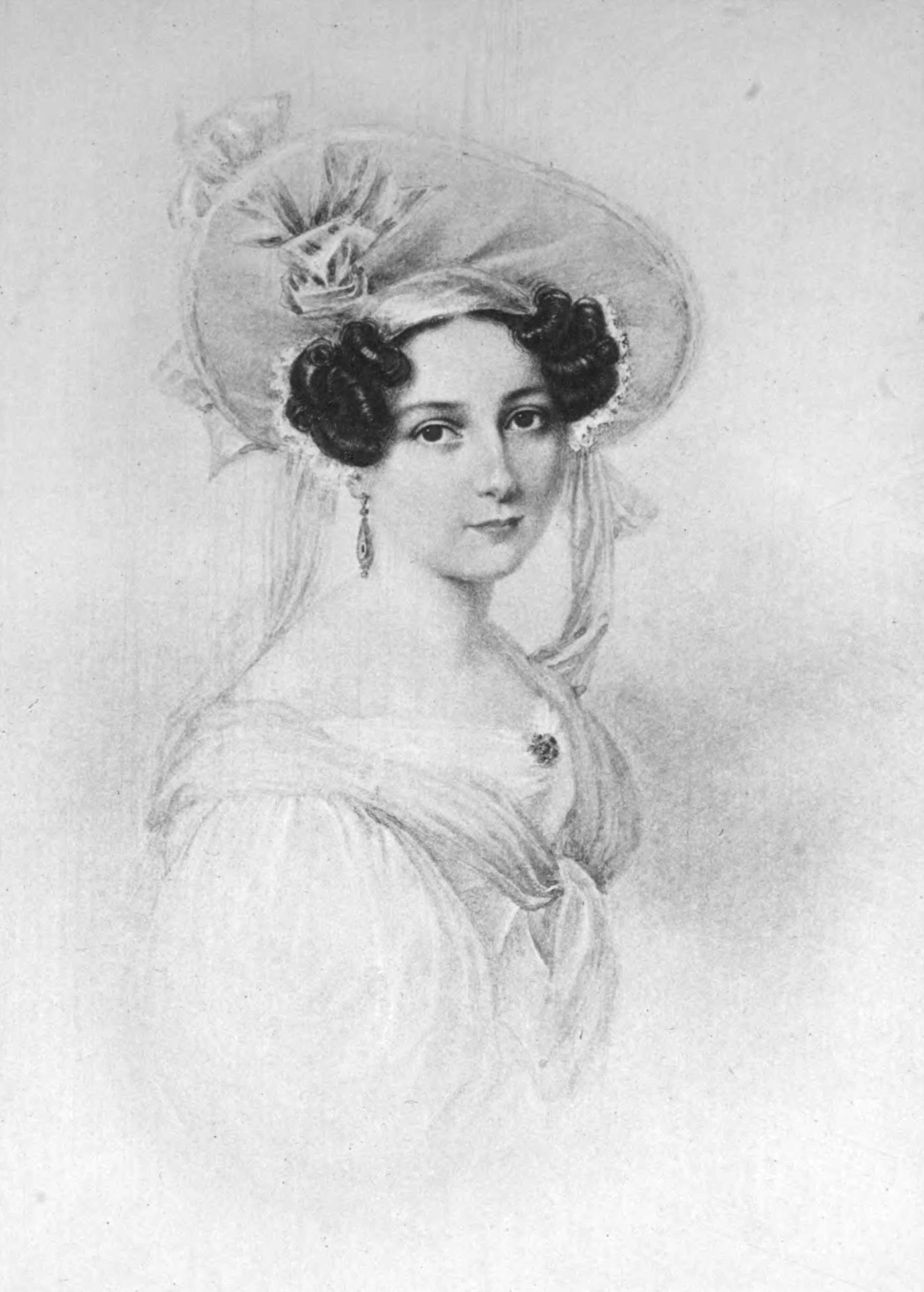
H.S.H. Feodora
Princess of Hohenlohe-Langenburg
from a portrait by Gutekunst 1830
After dinner, before we sat down, we—that is, Charles, Lord Melbourne and I—spoke of the numbers of Peers at the Coronation, which Lord Melbourne said was unprecedented. I observed that there were very few Viscounts; he said, “There are very few Viscounts”[535]; that they were an odd sort of title, and not really English; that they came from Vice-Comités; that Dukes and Barons were the only real English titles; that Marquises were likewise not English; and that they made people Marquises when they did not wish to make them Dukes. Spoke of Lord Audley who came as the 1st Baron, and who Lord Melbourne said was of a very old family; his ancestor was a Sir Something Audley[536] in the time of the Black Prince, who with Chandos gained the Battle of Poitiers. I then sat on the sofa for a little while with Lady Barham and then with Charles; Lord Melbourne sitting near me the whole evening. Mamma and Feodore remained to see the Illuminations, and only came in later, and Mamma went away before I did. Uncle Ernest drove out to see the Illuminations. I said to Lord Melbourne when I first sat down, I felt a little tired on my feet; “You must be very tired,” he said. Spoke of the weight of the robes, &c.; the Coronets; and he turned round to me, and said so kindly, “And you did it beautifully,—every part of it, with so much taste; it’s a thing that you can’t give a person advice upon; it must be left to a person.” To hear this, from this kind impartial friend, gave me great and real pleasure. Mamma and Feodore came back just after he said this. Spoke of these Bishops’ Copes, about which he was very funny; of the Pages, who were such a nice set of boys and who were so handy, Lord Melbourne said, that they kept them near them the whole time. Little Lord Stafford[537] and Slane (Lord Mountcharles)[538] were Pages to their fathers and looked lovely; Lord Paget[539] was Lord Melbourne’s Page and remarkably handy, he said. Spoke again of the young ladies’ dress about which he was very amusing; he waited for his carriage with Lady Mary Talbot and Lady Wilhelmina; he thinks Lady Fanny does not make as much show as other girls, which I would not allow. He set off for the Abbey from his house at ½ p. 8, and was there long before anybody else; he only got home at ½ p. 6, and had to go round by Kensington. He said there was a large breakfast in the Jerusalem Chamber, where they met before all began; he said laughing that whenever the clergy or a Dean and Chapter had anything to do with anything, there’s sure to be plenty to eat. Spoke of my intending to go to bed; he said, “You may depend upon it, you are more tired than you think you are.” I said I had slept badly the night before; he said that was my mind, and that nothing kept people more awake than any consciousness of a great event going to take place and being agitated. He was not sure if he was not going to the Duke of Wellington’s.
Stayed in the drawing-room till 20 m. p. 11, but remained till 12 o’clock on Mamma’s balcony looking at the fireworks in Green Park, which were quite beautiful.
Friday, 29th June.—I told Lord M. that I had been quarrelling with Feodore about Louis Philippe, whom she called a Usurper, and that I told her he was not, and that we disagreed amazingly about it; he smiled. That she called our William III. and Mary Usurpers; Lord Melbourne said it was that strong feeling of the divine right of Kings which some people have; that many people would not be convinced that Louis Philippe had not organised that Revolution; but that it did not do, he said, to wish well to the Family and not to Louis Philippe as Feodore did; for that the happiness of the one depended on the other....
Sunday, 8th July.—Got up at 20 m. to 10 and breakfasted at 11. Signed. Heard from Lord Melbourne that, “He finds himself much better this morning and will wait upon Your Majesty about three or a little after.” At ½ p. 3 came my excellent Lord Melbourne and stayed with me till a ¼ p. 4. He looks very thin and pulled as I think, but was in excellent spirits and as kind as ever. He said he felt much better today, but that his knee was still stiff and had been very painful yesterday. It’s the same leg (the left) which was first bad, but the foot was nearly well; he wore large loose shoes and no straps to his trousers. I showed Lord Melbourne a letter from Lord Glenelg I had got about Lord Durham and a letter from Lady Durham. And Lord Melbourne showed me one from Lord Palmerston about Van de Weyer’s being asked, and about the Ladies of the Ambassadors having some seat at the Balls....
Monday, 9th July.—At a ¼ p. 11 I went with Mamma and the Duchess of Sutherland, Feodore, Lady Barham, Lord Conyngham, Lord Albemarle, Miss Pitt, Lady Flora, Späth, Lord Fingall, Miss Spring Rice, and Miss Davys, Lady Harriet Clive and Mr. Murray to a Review in Hyde Park, of which I subjoin an account. I could have cried almost not to have ridden and been in my right place as I ought; but Lord Melbourne and Lord Hill thought it more prudent on account of the great crowd that I should not this time do so,[540] which however now they all see I might have done, and Lord Anglesey (who had the command of the day, looked so handsome, and did it beautifully and gracefully) regretted much I did not ride. I drove down the lines. All the Foreign Princes and Ambassadors were there, and the various uniforms looked very pretty. The troops never looked handsomer or did better; and I heard their praises from all the Foreigners and particularly from Soult. There was an immense crowd and all so friendly and kind to me....
Wednesday, 11th July.—Spoke of Soult, and that Uncle Ernest said that the Duc de Nemours told him that Soult was in excellent humour here, in better humour than he had ever seen him. Lord Melbourne seemed pleased. He said he was not at all surprised at the manner in which the English received Soult; as they were always curious to see distinguished foreigners. During the War, at the Peace of Amiens when Marshal Orison[541] came over, they took the horses out of his carriage and dragged him through the streets; “and that was in the midst of war,” he continued. “Many people were rather annoyed at that; but that was from mere curiosity.” I spoke of Feodore, and asked him if he saw any likeness between us; he said, “I see the likeness, though not perhaps very strong.” I spoke of her children and of Charles (her eldest) being her favourite, as he was so much the fondest of her. Lord Melbourne said smiling that one must not judge according to that, and to the manner in which children showed their love; “Children are great dissemblers; remember how Lear was deceived by that. They learn to be the greatest hypocrites,” he said.
Thursday, 12th July.—Lord Melbourne said that they were going to have a Cabinet upon what O’Connell and Sir Robert Peel declared in the House of Commons, the day before yesterday, upon the Irish Tithes. They proposed that the sum left from the sum which was voted in 1833 for the distressed Clergy, should be employed to pay the arrears of Tithes due. I asked Lord Melbourne if he thought this a good plan; he said it would have the effect of quieting the people, but that it was “rather a lavish way of bestowing the Public Money.” In general, Lord Melbourne said, when any sum of the kind is voted for a certain class of people, many miss it who ought to get it, and many get it who ought not to get anything.
Friday, 13th July.—Lord Melbourne said Ellice had told him that they cheered Soult amazingly when he went to Eton (that day), and Ellice told him he must ask for a Holiday, which he did, upon which the Boys cheered him much more; he shook hands with some of the Boys, and then they all wished to shake hands with him, so he shook hands with the whole school....
Tuesday, 17th July.—He (Ld. M.) said that the Sutherlands had a large family; and asked if the last was a boy or girl, at which I laughed very much, as I said he ought to know; he said boys were much more expensive than girls; there was only the girl’s dress that could be expensive and perhaps Masters; but nothing to what boys’ going to school cost. I said that younger sons were always so poor, and that girls married; he said certainly that was so, and even if girls did not marry they wanted less money. I said Feodore at one time liked having boys much better than girls, but she did not now, as she thought that boys got into more difficulties and scrapes than girls. “Men certainly get into more scrapes than girls,” said Lord Melbourne; “but there is risk in both.” We spoke of other things; and he said Lord Ebrington had come to him and spoken to him about its being reported that I had so many French things, and that the lace of the Servants’ coats came from France; which I said I knew nothing about, and I assured him I had quantities of English things, but must sometimes have French things. He said he knew quite well it was so, and that it was impossible not to have French things, if one wished to be well dressed. That it was not so much the material, but the make which we English could not do; he said they never could make a cap or a bonnet; and that the English women dressed so ill....
Monday, 24th July.—We spoke of Sir Edmund Lyons,[542] who writes such long despatches; and who Lord Melbourne has never seen before; he was a Naval Officer and never employed before in the Diplomatic Service. He was the Captain who took out Otho. I then went over to the Closet, where the Prince Royal of Bavaria was introduced by Lord Palmerston and Baron Cetto. Having neither attendants nor uniform, he came in morning attire. He is not quite good-looking, but nearly so,—slim, not very tall, but very gentlemanlike and agreeable and lively. I made him sit down, and he was completely à son aise and consequently put me at ease. I showed Lord Melbourne Hayter’s sketch for his great picture of the Coronation; which Lord Melbourne liked very much, and which was very generally admired; Lord Melbourne looked at it for some time observing upon each part; he said that Hayter would never get it as good in the large picture as he had got it here. I then said to Lord Melbourne that I thought the Coronation made him ill, and all the worry of it; he said he thought he would have been ill without it; “It wasn’t the Coronation,” he said, “it was all these Peerages; but I think that’s subsiding a little now.” I asked if Lord Derby expected being made a Duke; Lord Melbourne replied, “No, I don’t think he did; I told him at once that could not be, and that generally satisfies people.” Lord Derby has a very good claim for it, Lord Melbourne said, for the following reasons:—George III. declared he never would make any Dukes, and wished to reserve that Title only for the Royal Family; and he only made 2, Lord Melbourne thinks—the Duke of Northumberland and the Duke of Montagu[543]; Mr. Fox told the late Lord Derby that if he could ever make the King waive his objections, he should be made a Duke; and this, Lord Melbourne said, certainly was a strong pledge for a Whig Government; but Lord Grey passed him over (Ld. M. doesn’t know why) and made the Duke of Sutherland and the Duke of Cleveland; and Lord Derby said in his letter to Lord Melbourne, “he did not see why the names of Vane (D. of Cleveland), Grenville (Duke of Buckingham), and Grosvenor (Ld. Westminster), should be preferred before him.”[544] He did not mention Gower, Lord Melbourne thinks from civility, but that he feels the same respecting him. I asked what Duke he wished to be; Lord Melbourne said he supposed Duke of Derby, which was formerly a Royal title, having belonged to the Dukes of Lancaster; he takes his title from Derby, a Hundred of Lancashire—not from the Co. of Derby. He thinks, Lord Melbourne continued, that he has a right to be Duke of Hamilton, through his mother, Lady Elizabeth Hamilton, who was daughter to James, 6th Duke of Hamilton, and a very handsome person; I asked who she married afterwards; Lord Melbourne replied, “It was a very awkward business; she married nobody; she had a great attachment for the Duke of Dorset” (father to the late), “Lord Derby parted from her, but would not divorce her, in order that she might not marry the Duke of Dorset.” “The Duke of Dorset,” Lord Melbourne continued, “was a very handsome and agreeable man; with a great deal of gallantry....” I asked Lord Melbourne what sort of person Charles Sheridan was; he said an agreeable lively young man; but rather wild. We then spoke for a long time about all the Sheridans. C. Sheridan was in the Admiralty and rose to get £300 a year; but they fancied, he said, that he was in bad health, and made him give it up. There are three sons, Brinsley, Frank (who is with Lord Normanby), and Charles; “They are, like all the Sheridans, clever but careless, and have no application,” he said. They plagued Lord Melbourne constantly to give Charles a place; and Lord Melbourne offered him a Clerkship in the Audit Office; but he would not have that, and said it was less than he had had. George Anson[545] told Lord Melbourne it would be quite nonsense to give it to him, as he would never come, and there would be a complaint of him the first month. Lord Melbourne said that a person who leaves the situation he has, must not expect to be put in again in the same place he had. This is a £100 a year, “which is better than nothing.” I observed that a person who does not wish to submit to that cannot be very anxious to do much, in which Lord Melbourne agreed. This Charles Sheridan lives a good deal with the Chesterfields, and positively has nothing.[546] Lord Melbourne said, “I know they’ll get ruined, and we shall have to provide for them.” “They all have £60 a year.” There is one Charles Sheridan, an excessively ugly man, who is Uncle to all these people; he is Brinsley Sheridan’s son by his 2nd wife; his 1st wife was a professional singer, a Miss Linley, whom Lord Melbourne remembers when he was a boy; she died in 1794; she was excessively handsome[547]; “The women” (Lady Seymour) “are very like her; some of them,” he said. Spoke of young Brinsley Sheridan running away with his wife; of Lady Seymour, who, Lord Melbourne said, “is the most posée of them all.” “She says those odd things,” Lord Melbourne continued, “as if they were quite natural.” They (the Seymours) are always teazing Lord Melbourne about Titles, and are so vexed at their boy’s having no title; and they never will call him anything else but the Baby[548]; I said that was foolish; “Very foolish; and I’ve told them so,” replied Lord Melbourne, “but I can’t convince them.” The Sheridan[549] who wrote the Dictionary was Great-Grandfather to all these; his Wife was a very clever woman, Lord Melbourne said, and wrote some very good books; “they have been a very distinguished family for a long time,” he added.
Tuesday, 25th July.—At a ¼ to 4 I rode out with Lady Portman, Lord Uxbridge, Lord Lilford, Lord Portman, Col. Buckley, Col. Cavendish, and Miss Quentin, &c., and came home at 6. I rode dear Tartar who went most beautifully; it was a delightful ride; we rode to Acton, and round by East Acton home. We never rode harder. We cantered almost the whole way going out, but coming home we galloped at least for 3 miles without once pulling up. We came home through the Park and in at the front entrance of the Palace. It was a charming ride. At 7 we dined. Besides we 13 (Lady Charlemont, Lord Headfort, Lady Caroline Barrington, and Wm. Cowper replacing Lord Byron, Lady Tavistock, Mrs. Campbell, and Sir H. Seton), Lord Conyngham dined here. I sat between Lord Conyngham and Lord Headfort. At a ¼ p. 8 I went to the Opera with Mamma, dear Feo, Lady Charlemont, Lady Caroline, Miss Cavendish, Lord Conyngham, Lord Headfort, Mr. Cowper, Col. Buckley, Col. Cavendish, and Lady Flora. It was I Puritani, and Lablache and Grisi were singing their Duo when we came in. Unfortunately poor Grisi was taken ill, quite at the end of the 1st act, and was unable consequently to sing her fine Scene in the 2nd act. Fanny Elsler danced the Chachucha (at my desire) between the 2nd and 3rd acts.
Wednesday, 26th July.—Lord Melbourne said, “Lord Duncannon tells me he thinks that marriage of Lord Shelburne’s[550] is quite off.” Lord Melbourne said that somebody said to him (Ld. Shelburne) how handsome Miss Elphinstone was; upon which he replied, “I don’t think so; but beauty is not the thing to look to in a Wife.” Now this may have been repeated to her, Lord Melbourne says, and of course could not please her; and the young lady may have said, Lord Melbourne continued, “Why, you don’t seem to show that fondness for me you ought to have, and therefore I think we’d better break it off altogether.” Lady Kerry,[551] he said, had told Lord Duncannon that she believed it was all off; I observed, Why then had Lord Lansdowne announced it to me, if it was not quite settled?—Lord Melbourne said, “The same thing happened to Lord Duncannon that happened to you”; Lord Lansdowne announced it to him—said it gave him great pleasure—that it was very nearly settled but they did not wish to speak of it for the present; “and two hours afterwards he got a letter from Lansdowne, saying it was not at all settled,” and that he should not mention it.[552] Lord Melbourne then asked if I had got the letter he sent me, from the Duchess of Sutherland to him, saying her sister Lady Burlington[553] gladly accepted the situation of Lady of the Bedchamber; and Lord Melbourne said, “That may now be considered as settled”; and that Lady Lansdowne had best be spoken to about it all; which I begged him to be kind enough to do, which he said he would. I told Lord Melbourne that Conyngham had told me that he heard from Frederic Byng, that Lord Essex[554] was so excessively pleased at my having called up Lady Essex (Miss Stephens, the Singer that was, and married about 2 or 3 months ago to Lord Essex) at the Ball, and having spoken to her; this touched Lord Melbourne; we both agreed she was a very nice person.[555] Wrote my journal. At a ¼ to 8 I went into the Throne room with my Ladies and Gentlemen, Feo and Mamma, where I found the Duchess of Gloucester, the Duke of Sussex, the Duke and Duchess of Cambridge, and Augusta and George. After waiting a little while we went into the green drawing-room, which looked very handsome lit up, and was full of people all in uniform. I subjoin an account of all the arrangements and all the people. After remaining for about five minutes in that room, talking to several people, amongst others to good Lord Melbourne, we went in to dinner, which was served in the Gallery, and looked, I must say, most brilliant and beautiful. We sat down 103, and might have been more. The display of plate at one end of the room was really very handsome. I sat between Uncle Sussex and Prince Esterhazy. The music was in a small Orchestra in the Saloon, and sounded extremely well. Uncle Sussex seemed in very good spirits, and Esterhazy in high force, and full of fun, and talking so loud. I drank a glass of stein-wein with Lord Melbourne who sat a good way down on my left between the Duke of Devonshire and Lord Holland. After dinner we went into the Yellow drawing-room. Princesse Schwartzenberg looked very pretty but tired; and Mme. Zavadowsky beautiful, and so sweet and placid. About 20 m. after we ladies came in, the gentlemen joined us. I spoke to almost everybody; Lord Grey looked well[556]; the Duke of Wellington ill but cheerful and in good spirits. I spoke for some time also with Lord Melbourne, who thought the Gallery looked very handsome, and that the whole “did very well”; “I don’t see how it could do better,” he said. He admired the large diadem I had on. At about 11 came some people who (as the Gallery was full of dinner &c.) were obliged to come through the Closet, and of whom I annex a List. Lady Clanricarde I did not think looked very well; Lady Ashley, Lady Fanny, Lady Wilhelmina, and Lady Mary Grimston looked extremely pretty. Strauss played delightfully the whole evening in the Saloon. After staying a little while in the Saloon, we went and sat down in the further drawing-room, next to the dining-room. I sat on a sofa between Princesse Schwartzenberg and Mme. Stroganoff[557]; Lord Melbourne sitting next Mme. Stroganoff, and in a little while Esterhazy near him, and Furstenberg (who talked amazingly to Lord Melbourne, and made us laugh a good deal) behind him. The Duchess of Sutherland and the Duchess of Northumberland sat near Princess Schwartzenberg, and a good many of the other Ambassadors and Ambassadresses were seated near them. The Duchess of Cambridge and Mamma were opposite to us; and all the others in different parts of the room. Several gentlemen, foreigners, came up behind the sofa to speak to me. We talked and laughed a good deal together. I stayed up till a ¼ to 1. It was a successful evening....
Wednesday, 1st August.—I asked Lord Melbourne if he saw any likeness in me to the Duke of Gloucester; he said none whatever; for that when formerly they wished to make me angry, they always said I was like him. I asked if Lord Melbourne remembered the Duke’s father; he said he did; that he was a very good man, but also very dull and tiresome. His two brothers were Edward, Duke of York, who died long before Lord Melbourne was born, and Henry, the Duke of Cumberland. “The Duke of Gloucester and the Duke of Cumberland always remained Whigs,” Lord Melbourne said, “and never could understand the King’s (George III.) change; they said the Whigs brought their Family to this country; they went with the King but could not understand it.” Lord Melbourne said, “Whenever George IV. took offence at the church, he used to say, ‘By God, my Uncle the Duke of Cumberland was right when he told me, The people you must be apprehensive of, are those black-legged gentlemen.’” I said to Lord Melbourne that Princess Sophia Matilda told me that George III. had four illnesses. Lord Melbourne said they were not all declared illnesses. The 1st, he said, was in 1788; the 2nd in 1800, then in 1804, which was not exactly allowed to be so; and the last in ’10, when he never got well again; it is said, Lord Melbourne told me, that he had been ill in the early part of his reign; as early as 63 or 4, but no one knows exactly; he had a very bad fever then. I observed that the Cheltenham Waters, it was said, brought it on the first time. Lord Melbourne said, so it was said, but that he did very odd things when he first went down there.... He used to give, Lord Melbourne said, all the orders before his being ill with perfect composure. Whenever he was going to be ill, the King heard—Lord Melbourne continued—perpetually ringing in his ears, one of Handel’s oratorios; and was constantly thinking of Octavius[558] who died, “of whom he (the King) said, ‘Heaven will be no Heaven to me if my Octavius isn’t there.’” But his “master delusion,” as Lord Melbourne expressed it, was thinking that he was married to Lady Pembroke (Lady Elizabeth Spencer that was, and Mother to the late Lord Pembroke, and who only died 7 or 8 years ago), with whom he had been very much in love in his young days, and very near marrying. I told Lord Melbourne I remembered going to see her when she was ninety, and she was very handsome even then. Lord Melbourne then told me how very near George III. was marrying Lady Sarah Lennox,[559] sister to the late Duke of Richmond, who was excessively handsome. Lord Melbourne said he was only prevented from marrying her “by her levity.” This was quite early in his reign. He told Lady Susan Strangways, Lord Ilchester’s Aunt, “Don’t you think I ought to marry a Subject? I think I ought; and that must be your friend” (meaning Lady Sarah Lennox); “and you may tell her so from me.” “Then,” Lord Melbourne continued, “she” (Lady Sarah) “committed every sort of folly; she entered into a flirtation with the Marquis of Lothian, rode out with him after a masquerade quite early in the morning; this was represented to the King, and détournée’d His Majesty a little,” said Lord Melbourne laughing. Nothing could equal the beauty of the Women at that time, said Lord Melbourne, from all the accounts he heard, the Duchess of Argyll and Lady Coventry, sisters,[560] &c....
Sunday, 5th August.—Spoke of Lord Alfred’s[561] having gone to see his father’s leg, which is buried at Waterloo, and of 100 old women having come to see him get into his carriage when they heard whose son he was. We spoke of all this; of Sir H. Vivian’s suffering much now, Lord Melbourne said, in consequence of a severe blow he got at Waterloo “by a spent grape shot.” Lord Melbourne went over to Brussels almost immediately after the battle of Waterloo, to see Sir Frederic Ponsonby[562] who was dreadfully wounded, stabbed through and through; Lord Melbourne said, though he lived for 20 years afterwards, he certainly died in consequence of these wounds. I asked Lord Melbourne if he didn’t think Johnson’s Poetry very hard; he said he did, and that Garrick said, “Hang it, it’s as hard as Greek.” His Prose he admires, though he said pedantry was to be observed throughout it; and Lord Melbourne thinks what he said superior to what he wrote. In spite of all that pedantry, Lord Melbourne said, “a deep feeling and a great knowledge of human nature” pervaded all he said and wrote....
Tuesday, 7th August.—I asked him if he had seen Pozzo, which he told me in the evening he was going to do; he said he had, and it was about the Pasha of Egypt[563]; and he said Russia would go quite with England in the whole affair and quite approved of England’s intention of sending a Fleet there; at the same time, Lord Melbourne said, he stated distinctly, that if we didn’t send a Fleet, they would be obliged to march an Army into Turkey for its protection; but, Lord Melbourne said he hoped, from what he saw by the last despatches, that the Pasha had given up the idea of declaring his Independence. “I think he only tried it,” Lord Melbourne said, “to see what effect it would make!” Lord Melbourne said he had also seen Lord Palmerston, and had spoken to him about these Belgian Affairs, which they still hope, in spite of many difficulties, to settle; and they have now satisfied Sebastiani,[564] who, Lord Melbourne said, was of a jealous disposition and thought they were going on without him with Bülow[565]; Lord Palmerston had only got from Van de Weyer a statement of this Debt,[566] Lord Melbourne said; but that it would be impossible to alter; I expressed a fear of the Belgians resisting. Lord Melbourne said (which is quite true) that it would be very awkward if Uncle Leopold came over just in the midst of these Conferences, which would have the effect, as if he came for that purpose, and which Lord Melbourne said would prevent their acting as much for his interests as they otherwise might do. I said I quite felt it; but that Lord Melbourne had best send for Stockmar and get him to settle it with the King....
Sunday, 12th August.—Saw Stockmar for a little while, and then took leave of this good and kind friend, which I was really sorry to do. He told me he had been to see Lord Melbourne, and he said I should have (what I have always had) the greatest confidence in Lord Melbourne, and ask his advice, not only in Political Matters, but in domestic affairs,—and ask his advice just like a Father, which are quite my feelings. Lord Melbourne was very funny about the Statue of the Duke of Wellington which is put up (in wood) only as a Trial, on the Archway on Constitution Hill,[567] and which we think looks dreadful and much too large; but Lord Melbourne said he thought a statue would look well there, and that it should be as large. We then observed what a pity Wyatt should do the statue, as we thought he did them so ill; and we mentioned George III.’s; but Lord Melbourne does not dislike that, and says it’s exactly like George III., and like his way of bowing.[568] He continued, “I never will have anything to do with Artists; I wished to keep out of it all; for they’re a waspish set of people....”
Tuesday, 14th August.—I went and fetched the Speech, and he read it to me, in his beautiful, clear manner, and with that fine voice of his, and full of fine expression. I always feel that I can read it better when I have heard him read it. The Speech is, as Lord Melbourne said, “not long and safe.”
Wednesday, 15th August.—Lady Normanby then practised putting on my crown, for to-morrow. After this I read my Speech twice over, in my crown. Played and sang. Wrote. Wrote my journal. I forgot to say that I got in the morning, 2 notes from Lord Melbourne in which it seemed almost certain that the Prorogation could only take place on Friday; but at a little before 2 I got another note from him, in which he said that he heard from Lord John, it could take place next day, and therefore, that there would be a Council. I asked Lord Melbourne if it ever had been usual for the Sovereign to read the Speech after the Prime Minister had done so at the Council, as Lord Lansdowne had twice asked that question. Lord Melbourne said, never; but that the late King had done it once, when he was in a great state of irritation, and had said, “I will read it myself, paragraph by paragraph.” This was the last time the late King ever prorogued Parliament in person. I asked if Brougham was in the House; he said no, he was gone. I told him I heard Brougham had asked Lady Cowper down to Brougham Hall; but that she wouldn’t go; I asked if she knew him (Brougham) well; Lord Melbourne said very well, and “I’ve known him all my life; he can’t bear me now; he won’t speak to me; I’ve tried to speak to him on ordinary subjects in the House of Lords, but he won’t answer, and looks very stern”; Lord Melbourne said, laughing, “Why, we’ve had several severe set-to’s, and I’ve hit him very hard.” I asked if he (B.) didn’t still sit on the same bench with Lord Melbourne. “Quite on the gangway; only one between,” replied Lord Melbourne. Lord Melbourne and I both agreed that it was since the King’s death that Brougham was so enraged with Lord Melbourne; for, till then, he would have it that it was the King’s dislike to him (and the King made no objection whatever to him, Lord Melbourne told me) and not Lord Melbourne; “he wouldn’t believe me,” Lord M. said; and now he’s undeceived. Brougham always, he said, used to make a great many speeches. I observed that I thought if his daughter was to die, he would go mad; but Lord Melbourne doesn’t think so; and said, “A man who is always very odd never goes really mad.”
Thursday, 16th August.—“You were rather nervous,”[569] said Lord Melbourne; to which I replied, dreadfully so; “More so than any time,” he continued. I asked if it was observed; he said, “I don’t think anyone else would have observed it, but I could see you were.” Spoke of my fear of reading it too low, or too loud, or too quick; “I thought you read it very well,” he said kindly. I spoke of my great nervousness, which I said I feared I never would get over. “I won’t flatter Your Majesty that you ever will; for I think people scarcely ever get over it; it belongs to a peculiar temperament, sensitive and susceptible; that shyness generally accompanies high and right feelings,” said Lord Melbourne most kindly; he was so kind and paternal to me. He spoke of my riding, which he thought a very good thing. “It gives a feeling of ease the day one has done with Parliament,” said Lord Melbourne. He spoke of the people in the Park when I went to the House; and I said how very civil the people were—always—to me; which touched him; he said it was a very good thing; it didn’t do to rely too much on those things, but that it was well it was there. I observed to Lord Melbourne how ill and out of spirits the Duke of Sussex was; “I have ended the Session in great charity,” said Lord Melbourne, “with the Duke of Wellington, but I don’t end it in charity with those who didn’t vote with the Duke when he voted with us”; we spoke of all that; “The Duke is a very great and able man,” said Lord Melbourne, “but he is more often wrong than right.” Lord Holland wouldn’t allow this; “Well, let’s throw the balance the other way,” continued Lord Melbourne, “but when he is wrong he is very wrong.”
Friday, 17th August.—I then told Lord Melbourne that I had so much to do, I didn’t think I possibly could go to Windsor on Monday; he said if I put off going once for that reason, I should have to put it off again, which I wouldn’t allow; I said there were so many things to go, and to pack,—and so many useless things; “I wouldn’t take those useless things,” said Lord Melbourne laughing. I then added that he couldn’t have an idea of the number of things women had to pack and take; he said many men had quite as much,—which I said couldn’t be, and he continued that Lord Anglesey had 36 trunks; and that many men had 30 or 40 different waistcoats, and neck-cloths, to choose from; which made me laugh; I said a man couldn’t really want more than 3 or 4 coats for some months. He said in fact 6 were enough for a year,—but that people had often fancies for more. I said our dresses required such smooth packing; “Coats ought to be packed smooth,” replied Lord Melbourne. I asked Lord Melbourne if Pozzo had spoken at all about the Belgian affairs. He said he told him he wouldn’t meddle with them at all. Spoke of Pozzo’s disliking Lord Palmerston, who didn’t, he fancied, treat him with enough égard; and Lord Melbourne said Palmerston keeps them waiting sometimes for a long while,—which, though they say they don’t mind it, they do mind; and we both agreed that he was a little apt to sneer sometimes, and to make it appear absurd what people said. I said, independent of Uncle’s coming—hurting his interests in the Conferences—his own country was in too disturbed a state to do so[570]; Lord Melbourne said whatever would be done would be attributed to Uncle’s presence; that justice must be done to Belgium; but that there was such a desire in the Cabinet to settle the affair, that they wouldn’t be disposed to listen to any unreasonable demands of Belgium; I said one felt less anxious reading the Speech at the close than at the beginning of the Session. Lord Melbourne said he didn’t know; “The responsibility is so much greater during the Vacations; when Parliament is sitting one comes at once to Parliament; one has that to go to, and hears the worst at once....”
Sunday, 19th August.—Spoke of the Phœnix Park being considered unwholesome; of its being drained by what they call the Sub-soil-plough. He repeated the anecdote about Lord Talbot; the present Lord Talbot—(I believe I have already noted down the anecdote as he told it me twice before, but am not quite sure)—asked someone why they had never thought of draining the Phœnix Park, and they replied, “Why, your Ancestors were so much employed in draining the Country, that they had no time to think of draining the Park.” He said Talleyrand told an anecdote of a lady in the time of the Revolution who was speaking of what she would be, and she said, “Paysanne, oui; mais Bourgeoise, jamais.” I said to Lord Melbourne I was afraid he disliked the Germans, as he was always laughing at them, which he wouldn’t allow at all and laughed much. He said, “I’ve a great opinion of their talents, but not of their beauty.” He asked if I had seen Mr. MacNeill’s[571] despatches giving an account of his going into Herat at night; I replied, I had not; Lord Melbourne said it was a very curious and even fearful account, his going through these Barbaric Armies at night, 9 o’clock, all the Persians without, prepared for the Attack, and all those within, for Defence; and he gave an interesting account of one of the principal persons in Herat; Mr. MacNeill said he found them quite disposed to negotiate, but when he returned to the Shah’s camp, he found the Russian Ambassador there, and the Shah would listen to nothing; so Mr. MacNeill came away. Spoke of not liking the Cathedral Service and all that singing, and Lord Melbourne said, “It is inconsistent with a calm and right devotion; it’s papistical, and theatrical.”[572]
Monday, 20th August.—Spoke of Pozzo’s being very civil to Lord Melbourne; Lord Melbourne said, “He’s very fond of me,” upon which I said, “I don’t wonder at that,” which made Lord Melbourne smile. He continued, that Lord Palmerston gave Pozzo rather unnecessary offence by not treating him with respect and égard, which those sensitive Corsicans and Italians expect. I said to Lord Melbourne, I felt often ashamed at being so ignorant about many things, and at being obliged to ask him about so many things. He replied most kindly, “Oh! no, you know everything very well; it’s impossible for anybody to know everything that it is right for them to know.” We spoke of the Archduke Charles, who, as Mr. Macgregor told Lord Melbourne, “and as we know,” he said, was a most able man, but wouldn’t take the slightest part in public affairs. We spoke of how many brothers there are still alive: Archduke Charles, Archduke Palatine, Archduke John, Archduke Rainer, and Archduke Louis. Spoke of Hayter’s Picture, and of his having made the Duchess of Sutherland so like already. Spoke of the Duchess of Sutherland’s features being large, which he agreed in; but that he liked large features, for that people with small features and “Squeeny noses” never did anything. Spoke of the business of the Army, which Lord Melbourne said he was afraid Lord Howick would bring on, and that there would be a good deal of difficulty about it. Lord Howick, he says, has pledged himself about it, and is displeased with the Horse-Guards. He (Lord Howick) is very indiscreet in the House of Commons, Lord Melbourne said. He has written Lord Melbourne a letter about this Army business, which Lord Melbourne told him he would answer; but he begged Lord Melbourne not to write to him, as long as he was at Spa,—as the letter would be read. I said I hoped Lord Melbourne had never found me indiscreet, or that I had ever repeated things which I ought not to have done. He said, “Not at all; no one is so discreet,” and that it was impossible sometimes to help letting out things. I then also begged him always to tell me, when he heard anything, might it be agreeable or disagreeable, and that he should never be afraid of telling me so; which he promised to do.[573]
Tuesday, 21st August.—Lord Melbourne said he had seen Lord Palmerston, who told him he hoped to be able soon to bring this Belgian business[574] to a sort of conclusion; that he had had several conversations with Bülow, and Senfft,[575] “who seems a very fair man”; and that they think they may settle this Debt, and satisfy the Belgians by this slight change. “Then I talked to him,” continued Lord Melbourne, “about the King’s coming, and that it would be more for the disadvantage of his Interests.” I then spoke of my having received such an odd present of a Kitten in the morning, which made him laugh. (I got a basket, which they said came from Sir Henry Wheatley, and which I thought was full of flowers, and when my Maid opened it, we found a pretty little Kitten in it—which some poor people sent me as a present.)
Monday, 27th August.—Of Uncle Leopold; when he married Princess Charlotte; Lord Melbourne hadn’t the slightest acquaintance with her, and never had spoken to her. She never came to her father at that time. Lord M. said he never went near the Princess of Wales, for he said considering that he opposed the Regent so much in Parliament, he didn’t wish to oppose him in his quarrels with his Wife; for, he said, he had been so much with the Prince of Wales, and was so much attached to him, that he thought that would have been wrong.
Tuesday, 28th August.—Lord Melbourne then read me a letter from Lord John about all this Belgian business; he says that he won’t support Belgium in its new claims. Lord Melbourne said, “It’s very well of John saying he won’t support,” and so forth, but that it would be impossible for us not to take one side; our interests would compel us to do so; they lay so much with the Low Countries; England, he said, could never permit France to have possession of Antwerp, which was such a great Maritime place. He then read me a letter from Lord Minto relative to an alarm which prevails, and which was caused, Lord Melbourne says, by a speech the Duke of Wellington made in the House, about the weakness of our Naval force; which Lord Minto quite disclaims. Lord Melbourne sent him a paper of Sir Robert Inglis’s[576] about the Russian, French, and American Fleets; which Lord Minto says is quite erroneous; Lord Minto states that in a very few weeks, he could be quite ready for war; Lord M. says, what countries generally ruin themselves with, is, keeping up their Naval and Military Establishments during the time of peace; and he said, “Better be at War then.”[577] He owned that the Russians sending their fleet to the Black Sea “certainly is far from pleasant.” Then I spoke of Lord Ponsonby’s great alarm about Russian Influence, which Lord Melbourne said always was the case. Spoke of Queen Charlotte’s having been supposed to have had a great many presents which she was fond of, from Mrs. Hastings[578]; and Lord Melbourne said the King was thought rather to go with Hastings, who was accused and tried for misdemeanours in India. There was an ivory bed-stead Queen Charlotte got, which Lord M. believed was at Frogmore now. Spoke of Queen Adelaide’s having got all those Shawls which the King of Oude sent. This led us to speak of the Crown Jewels; of there not being many, yet more than I ever wished to wear, of my not liking those sort of things. Lord M. said he didn’t like a profusion of them, but thought a few fine ones the best. Spoke of the Jewels which Queen Charlotte left to her daughters. Lord Melbourne said the Queen Consort can do with her own things what she pleases; can make her own Will, and “is a femme seule,” for no other woman can—all is her husband’s. Lord Melbourne (in reply to my question when he first knew George IV.) said, as soon as he could remember any one; he was 4 when the King was 21, in ’83, when Lord Melbourne’s father was first put about the Prince of Wales. “He used to be at Whitehall, or Piccadilly[579] where we then lived, morning, noon and night,” Lord Melbourne said; and he used to come down to Brocket; he always was fond of children and took notice of them; I said he took notice of me; I observed how much more submissive we were to him than to the late King; Lord Melbourne said George IV. had more power. Lord Melbourne said none of the Royal Family could marry without the Sovereign’s leave since the Marriage Act, passed early in George III.’s reign, in consequence, Lord Melbourne believes, of the Duke of Cumberland’s marrying a Mrs. Luttrell[580] which was very much disliked; else the Duke of Sussex might have married Lady Augusta, and the late King Mrs. Jordan, Lord Melbourne said. The member of the Royal Family, Lord Melbourne continued, gives notice to the Privy Council of his intention to marry, and if they don’t disapprove, it’s supposed the King will consent. Lord Melbourne said it was a difficult subject the marriage of the Royal Family; marrying a subject was inconvenient, and there was inconvenience in foreigners; “It was very often done” (marrying subjects); “Kings did it; and I don’t know there was any harm in it,” said Lord Melbourne. Anne Hyde was the last who married a Prince who became King, and that was considered a dreadful thing. Lord M. said he had been looking at some of those letters [George III.’s] to Lord North which seemed to him very ill written,[581] both as to hand and style, and in bad English. Lord North was a great favourite of George IV.’s, Lord Melbourne said; “Lord North was a very easy, good-natured man,” and the King knew him “when he first came in to life.” Lord Thurlow, whom Mr. Pitt beat and turned out in ’93,[582] turned to George IV. and became also a great favourite of his. He was clever but ill-tempered, Lord Melbourne said.
Wednesday, 29th August.—Lord Melbourne said he had been looking at those letters to Lord North, and found on closer examination that they were written with much more practical knowledge and knowledge of men than he had at first thought. The letters he has been reading are relative to a Negotiation which the King entered into, with the Opposition, in order to strengthen the Government; and Lord Melbourne related several parts of it, which made him smile and which he said were true enough. Lord Melbourne said he (George III.) couldn’t bear Mr. Fox, for that he says in one of these letters that he (Lord North) might offer him any situation which did not bring him in immediate contact with the King, or into the Closet; and as he (Mr. Fox) never had any principles, he wouldn’t have any difficulty in changing. These letters prove, Lord Melbourne said, what strong personal dislikes the King had. These letters to Lord North, Lord M. thinks, were returned to George IV. by Mrs. Douglas on the death of her husband, who was the son of Lady Glenbervie, Lord North’s daughter; Lord North had three daughters, Lady Glenbervie, Lady Sheffield, and Lady Charlotte Lindsay (whom I know); all very clever, Lord M. says. He had 3 sons, George (who was a very pleasant, lively man and a great bon-vivant, Lord M. says), Frederic, and Frank; who were all in succession Earls of Guilford. The present Lord is son to Lord North’s brother[583] who was a Bishop, Lord M. told me. Lord North died in ’93, and Lord M. remembers seeing him (when Lord M. was a boy) led into the House of Lords, quite blind, at Hastings’ trial; he was Lord Guilford for a very short time.
Lord M. does not think that George III. was very fond of Mr. Pitt. Spoke of the violent dislikes George III. and George IV. had; William IV. had them also, but Lord M. said they were easily got over. Spoke of George III.’s hand-writing; of mine, which Lord M. thinks very legible and generally very good; of my inclination to imitate hand-writings, and people,—which Lord M. said, showed quickness, and was in the Family; of George IV.’s mimickry. I said I kept a journal, which, as Lord Melbourne said, is very laborious, but a very good thing; for that it was astonishing in transacting business, how much one forgot, and how one forgot why one did the things.
Thursday, 30th August.— ... I gave Lord M. this Pamphlet of Sir H. Taylor’s which Mamma lent me. We talked about many things, and in going home I asked Lord M. how long Lord North had been Prime Minister to George III.; “From ’70 till ’82,” he told me. “The Duke of Grafton” (who preceded him, and was the present Duke of Grafton’s father) “went away,” Lord M. continued, “without telling any body and without telling the King; they were difficult times, and he went away; I know why he went away, people are always doing those foolish things; and the King didn’t know what to do; he sent for Lord Gower”[584] (I forget what he was), who, I think Lord M. said, refused it; “and then he sent for his Chancellor of the Exchequer” (Lord North) “and made him his Prime Minister.” Lord M. spoke of Dr. Keate, and told me an anecdote of him and George III.; and then he said that Dr. Keate couldn’t bear to be reminded of his boyish days at Eton; somebody, who Lord M. knows, reminded Keate when he was walking across the School-Yard with him, of the window, pointing at it, out of which they had often jumped, upon which Dr. Keate said, “Don’t mention it; it’s a very foolish remark.”