INTRODUCTORY NOTE TO CHAPTER X (continued 2)
Reading edition
Friday, 31st August.—Lord M. then said, that the French were going to send out a fleet to Mexico, with which State they have been in a quarrel for some time,—and that they meant to send the Prince de Joinville with it, to ask for reparation, and if not, to attack the fort of Aloa which commands the river, and which it would not be agreeable for us if the French were to possess; and Lord Palmerston proposes we should send a swift sailing Vessel to Mexico to apprize the Mexicans of what was to take place and to advise them to make reparation. And also, Lord P. proposes sending a Vessel to Guiana, where the French are making great encroachments, and to see what they are about.
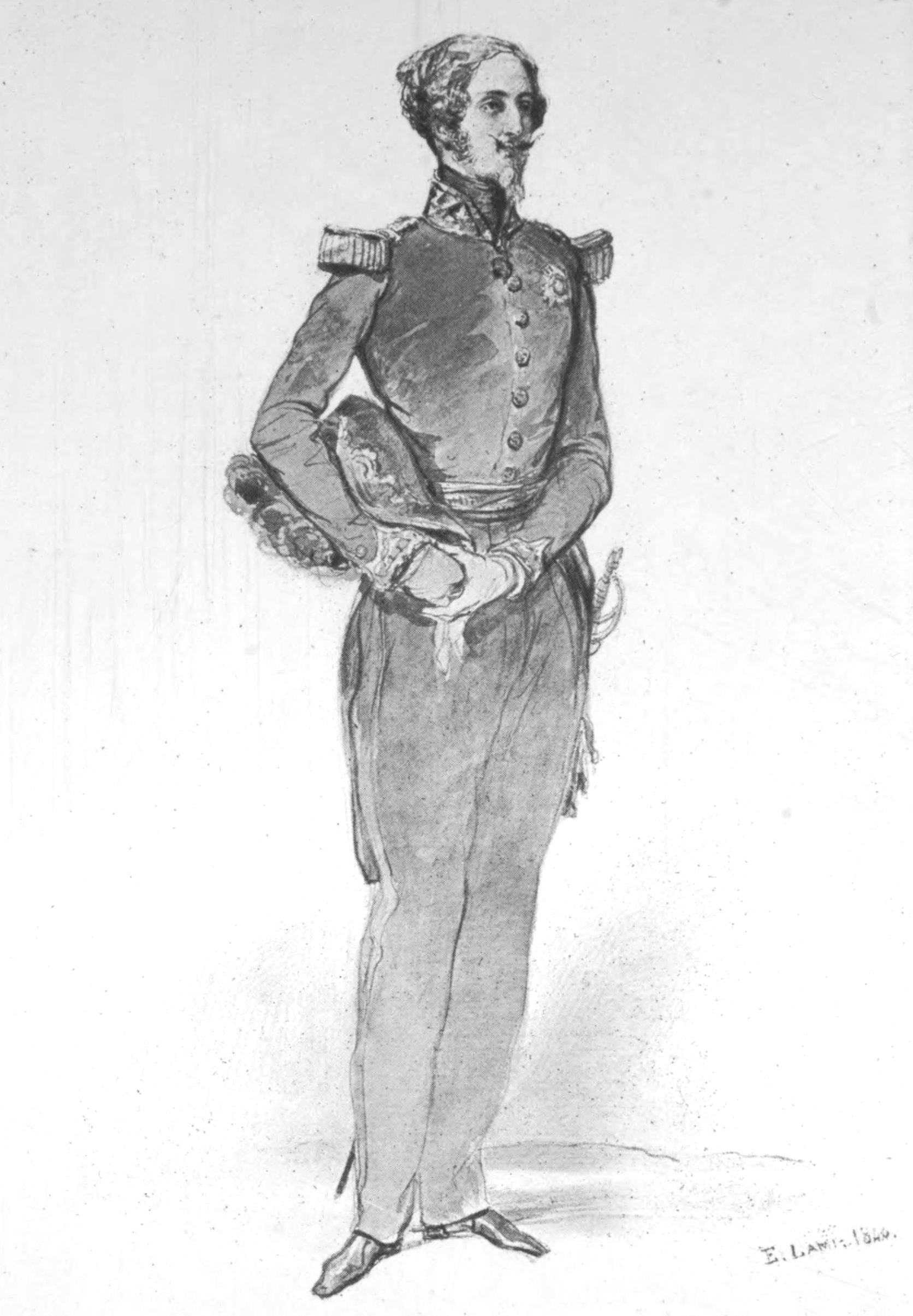
H.R.H. The Duc de Nemours
from a portrait by Eugene Lami
Lady Cork[585] is 92, a very strange old woman; Lord M. knows her; she was clever, a great favourite of George III. and Queen Charlotte. She was a Miss Monckton, sister to Lord Galway, he said. Lord M. said in returning Dr. Hook’s sermon (which I sent him to read) when he came in, that it was eager, but nothing very particular, and able. Lady Holland seems “very fond of Senfft,” Lord M. observed; “she would settle that Embassy too, as she does every thing else,” he said laughing. Lord M. said, in speaking of Taylor’s pamphlet,[586] “There is no force in it; it isn’t pointed.” Taylor is very fond of writing, he says, and fancies he writes well. Spoke of Lady C. Bury’s book.[587] Lord M. says these things make less impression than people fancy; they “make a day’s noise; but nobody minds them much.” Spoke of Lady Anne Hamilton,[588] who attended Queen Caroline at her Trial; Lady Charlotte Lindsay gave evidence. “Lord Egremont said,” continued Lord M., “‘As for Guilford,[589] he twaddled like a waiting maid when he gave evidence; but his Sister lied like a man,’” which made us both laugh very much. Spoke of Kenney,[590] who is Author (Lord M. told me) of Love, Law, and Physic, and Raising the Wind, and is at Holland House. Spoke of my knowing Rogers and Moore; having seen Scott and Southey. Lord M. rather admires Southey’s works, and thinks his Life of Nelson very pretty. Spoke of his Life of Cowper. Spoke of a new book lying on the table, sent to me by Granville Penn,[591] which Lord M. looked at and said he thought might be curious; it is the Life of Sir William Penn, Admiral in Cromwell’s time, and who, with Venables, took Jamaica. Spoke of Mrs. Hutchinson’s Memoirs of Colonel Hutchinson, which Lord M. thinks very curious; spoke of her violence; spoke of Clarendon’s book which Lord M. said “is a fine book.” I observed there were few books on the Parliamentary side; he replied few at the time, but a good many since. He mentioned one by Brodie, a Scotchman; Bishop Burnet’s Memoirs of his own time, during Charles II.’s reign; and he said, “There is a book which I think would amuse Your Majesty, and would be of use to you, and which isn’t long, which is Guizot’s account of the Revolution.” It’s only in 2 vols., and is a summary of whole thing, he said.
Lord M. said Lady Holland was a great friend of Pozzo’s, and that his first acquaintance with Pozzo was at Holland House. I asked if she knew Sebastiani; he said she did, but didn’t like him much, except from his connection with Napoleon “whom she adored.” She never knew Napoleon, Lord Melbourne added, but saw him at Paris at the Peace of Amiens. She used to send him things she knew he liked, said Lord M.; when he was at St. Helena she sent him gâteaux and chocolate, &c. “She was half on his side,” Lord M. continued, “if not more.” Spoke of Lady E. Wortley’s[592] admiration for Napoleon. Soult was no friend of Napoleon, Lord M. said; none of them, he continued, were to be compared to Napoleon himself; the two best after Napoleon, Lord M. said, were Dessaix who was killed at Marengo, and Kleber who was murdered in Egypt.
I asked Lord M. what Lord Gower, whom he mentioned to me before, was; that Lord Gower, he said, was the Duke of Sutherland’s grandfather; he was “Lord Privy Seal” when the King sent for him.[593] “He did not think himself equal to it” (being Prime Minister); “he was a man who took great part in politics.” Lord M. also told me that he believes the present Lord Bute to be the great-grandson of the Minister of George III. “George III. found the Duke of Newcastle and Mr. Pitt, and everything was going on very well, when he was advised to change; he couldn’t bear Mr. Pitt; who was afterwards Lord Chatham; and he took Lord Bute in his place; and then followed all that unpopularity.” I asked if these letters of George III. showed great confidence in Lord North; Lord M. said “they show a great liking for him, more than a great confidence.” That the King never seemed to think him strong enough; Lord North, all along, Lord M. continued, was pursuing a Policy contrary to what he himself approved, but which he was urged to by the King: and Lord North remonstrated very much with the King. The difference, Lord M. observed before, between George IV. and his father, was, that the former (which Knighton’s Memoirs show, Lord M. said) always required somebody to lean upon, whereas the latter always wished to act for himself, and only yielded, but said at the same time he disliked doing it. He never would have yielded on the Catholic Question, Lord M. continued, nor would the Duke of York; the late King was for it; but George IV. did it very unwillingly. George III. was deeply hurt at the loss of the American provinces, which I observed was no wonder; I said I thought it was his fault. Lord M. said most likely it was; but that it was impossible any longer to keep up the great Colonial Policy, namely that they should exclusively trade with England and make nothing for themselves; even Lord Chatham, Lord M. said, who all along advocated their cause, “said they shouldn’t drive one hob-nail for themselves.” The Separation was easily done, they had nothing to do but to declare it. Lord M. continued that the first settlers were composed of people who left England in discontent,—of dissenters &c., and consequently no loyal people could spring from them. Spoke of the people whom William III. ennobled, which I’ve no time to enumerate. He told a most absurd anecdote of a very fat little porter at Lansdowne House. “He is a leading man in all the Parish Debates,” said Lord M.; “and somebody told Albemarle, ‘He speaks very well; to tell you the truth he speaks very like my lord.’”
END OF VOL. I
Printed by Hazell, Watson & Viney, Ld., London and Aylesbury.
FOOTNOTES