OUR LILY GARDEN.
Reading edition
PRACTICAL AIDS TO THE CULTURE OF LILIES.
By CHARLES PETERS.
The first group of lilies, “Cardiocrinum,” contains but two lilies. These two plants strongly resemble each other but are both totally different from any other species.
Many years ago, long before we ever dreamed of growing lilies ourselves, we first made acquaintance with the magnificent Lilium Giganteum.
We had been walking all day in the south of Hertfordshire, and as evening was approaching we turned to retrace our steps. But the district was new to us, and we found that we had wandered many miles from our path. We looked about us for someone of whom to ask our way, but the road was deserted save for ourselves. We trudged onwards for about a mile, and seeing a cottage a short way ahead, we determined to ask our way of one of its inhabitants.
It was about eight o’clock in the evening of a broiling hot day in the beginning of July. We opened the gate, approached the house, and knocked at the door. But the house was apparently empty, for our knock was unheeded and there was no sign nor sound of any person in the house. We knocked again, but this summons also being futile, we walked round the house and entered the back garden. It was a beautiful garden, one of those old gardens in which flowers have been cultivated for centuries, and in which the most beautiful of garden-plants seem as much at home as do the weeds in our country lanes.
But it was not the flowers, nor the well-kept lawn, which arrested our attention. On turning round the house we had become aware of an intense fragrance not unlike that of the lily of the valley, but many times more powerful. We glanced around to discover what plant it was which exhaled this perfume, and for a few minutes we were unable to discover it. But on turning our gaze towards the opposite corner of the garden, we saw a magnificent clump of the giant lily under the shade of three tall lime-trees. There were five spikes, the shortest of which was over five feet high, each surmounted with from ten to twelve blossoms like bells of shining wax.
We approached the spot and stood admiring this glorious plant for many minutes. But the remembrance that we had lost our way was gradually forced upon us, and we left the lilies, filled with an admiration for them which will never tarnish. We found no one in the garden, but eventually we discovered the right way home.
The next year we tried to find this cottage and revisit the lilies, but we have never to this day been able to find it.
We did not again behold this wonderful lily till July, 1898, when we flowered a single one in our own garden. This specimen did not exceed four feet in height, but it matured nine perfect blossoms.
The Lilium Giganteum, the giant lily of the Himalayas may well stand at the head of the genus. Its blossoms are perhaps not so fine as those of some other species, but in foliage, in growth and in fragrance it is second to none.
The bulb of this species is about the size of a very large cocoa-nut, but varies considerably in size according to whether it is going to flower the next season or not. The bulb consists of few scales, which are large, fibrous, and of a dark russet hue. The tops of the scales have a rotten-looking appearance. The bulb is very compact, hard and heavy.
About the middle of March the plant begins to show above ground. Its appearance after this varies considerably. If it is not going to flower it puts up a large mass of fine, deep, glossy green leaves, which somewhat resemble those of the White Arum. These leaves are heart-shaped, very glossy, many-nerved and distinctly stalked. The lily will probably repeat this process next year, and perhaps the next too; but if it has been well attended to, in the third or fourth year it will put up a flower-spike. When the stem first shows it has an appearance very similar to a small lettuce. It grows very rapidly and attains its full height about the beginning of July.
When full grown this lily has a very noble appearance. Its stem is from four to fourteen feet high, perfectly straight and gradually tapering from its base, where it is one to three inches in diameter, to its top, which narrows almost to a point.
Three distinct forms of leaves are borne on this stem. The lower ones resemble the leaves sent up in the non-flowering years. The upper leaves are smaller, less heart-shaped and with stalks. The third set of leaves, the bracts, enclose the flower buds. These are simple sessile leaves which fall off when the flowers open.
The flowers vary in number from four to twenty. They are borne directly on the stem, without separate stalks. They are from six to nine inches long, of a pure white externally, slightly tinged with green near their attachments. Inside they are creamy white, with a broad streak of a rich claret colour down the centre of each petal. The pollen is yellow. The scent of this lily is intensely fragrant and almost overpowering. The seeds are flat and triangular with broad membranous wings.
The tips of the perianth are very slightly reflexed. In most drawings of this lily the flowers are made to look like those of L. Longiflorum, but they are quite different, being long and narrow, with very slightly reflexed petals and sepals.
It is often said in books that the bulb of this lily dies after once flowering, but this is not correct. The central part of the bulb does rot, but two or three small bulblets are left at its margin, which will in favourable circumstances grow and eventually flower.
This lily is a native of the Himalayas growing at a height of five to ten thousand feet above the sea-level.
The cultivation of this lily presents some difficulties, but surely it is worth while to give a little trouble to grow such a superb plant? We very rarely see it in cultivation, but in our garden it shall always find a home.
A plant growing in such a robust manner as this lily is not suitable for a flower-bed. It should be grown by itself in a shady nook. A clump of two or three looks very lovely, and it is possible to arrange matters so as to have at least one flowering spike every year.
It is not quite hardy, except in our southern counties, but it rarely needs more protection than a heap of bracken or other litter thrown over it in the winter.
If you wish to grow this lily, choose a suitable spot and dig out the earth to the depth of four feet. Fill in with a mixture of strong loam, decayed leaf mould and the remains of a hot-bed. To this add a little peat and plenty of sharp sand. The plant is a gross feeder and literally revels in “muck.” An occasional drenching with liquid manure is often very helpful. It requires large quantities of water during the growing period.
Resembling L. Giganteum so closely that formerly it was considered as a variety of that plant, but vastly inferior in every way, L. Cordifolium is the only other lily possessing heart-shaped leaves.
The bulb of L. Cordifolium is like that of L. Giganteum, but is scarcely a fourth the size.
Its leaves also resemble those of L. Giganteum, but the base leaves are not so numerous, and the lower ones are congregated into a whorl. The upper leaves are irregularly scattered. The lowest leaves are curiously marked with a deep mahogany hue, which is never present in those of L. Giganteum, and which helps to distinguish between the two plants. The leaves are even more cordate than are those of L. Giganteum, especially the lower ones which form a very tolerable image of the “artistic” heart.
The stem grows to about three or four feet high, and bears at its summit from two to six flowers somewhat like those of L. Giganteum, but smaller, poorer, and marked on the inside with brown rather than claret-colour. The flowers open wider than do those of L. Giganteum, and are incomparably less beautiful. This lily is a native of Japan and China.
It is decidedly a scarce lily, and is exceedingly difficult to flower. We have not succeeded in flowering it ourselves, but a solitary bulb that we possess sent up last summer a fair crop of its curious leaves.
This plant would look well in a mass grown in much the same way as L. Giganteum, but we have never tried it in the ground, and so cannot speak from experience in this particular.
Altogether it is so far inferior to L. Giganteum, more difficult to grow and much less effective that we do not recommend its culture to any but enthusiasts. It is not a hardy lily and requires some protection in winter. It begins to send up its leaves very early in spring, and these must be protected at this season from frosts, and later from the wind and sun.
Both L. Giganteum and L. Cordifolium can be grown in pots, but the great size of the former and comparative poorness of the latter render both unsuitable for this form of culture.
Eulirion—beautiful lily! What an appropriate name for the superb plants contained in this group! Beautiful lilies they are indeed, beautiful in shape, in colour and in scent! What flowers will you compare with the members of this group? None of the priceless orchids or choice stove plants are anything like so beautiful as these misunderstood and grossly neglected lilies!
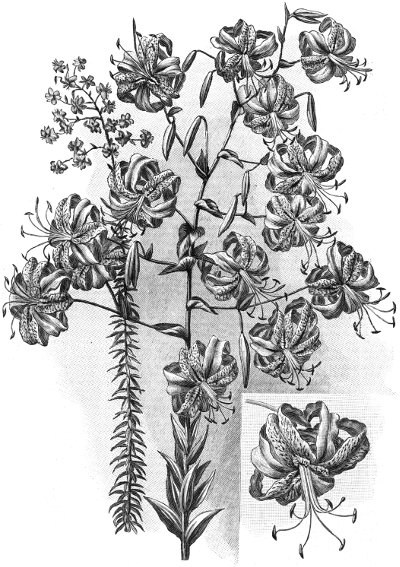
Lilium Henryi.
First among the Eulirions stands L. Longiflorum and its many varieties. This together with L. Formosanum, L. Philippinense, L. Wallichianum and L. Neilgherrense form a group of plants having many characteristics in common, and all very different from the rest of the genus.
The lilies of this group are all low-growing, rarely exceeding four feet in height. The flowers which are white or pale yellow are usually solitary, but some varieties of Lilium Longiflorum bear as many as five or six blossoms on each stem. The leaves are linear, smooth and numerous, scattered and are all similar. These lilies are natives of Western Asia.
L. Longiflorum, the most important member of the group named after it, is one of the best known and highly appreciated members of the genus. It is usually grown as a pot plant. But why? Why do we so rarely see this plant in the garden? Oh, it is so tender! It will not stand our winters! It dwindles so when grown in the open! Nonsense! This lily is perfectly hardy and is admirably suited to the open ground. But you do not do well with this plant because you will choose the only variety of it which cannot stand our climate.
To most persons L. Longiflorum is synonymous with L. Harrisii. But the latter plant is only one form, and is a rather unsatisfactory form of L. Longiflorum. L. Harrisii is a variety of L. Longiflorum altered by having been grown in the tropical climate of Bermuda. It is a hardy lily rendered tender by coddling. It is undoubtedly a fine variety for the greenhouse, but it is nothing like so fine as some of the other forms of L. Longiflorum.
Although this lily is undoubtedly “long-flowered,” it hardly deserves the specific title of Longiflorum, for it is the least long-flowered of the five plants placed in the same group as itself.
The bulb of this lily presents no deviation from the typical bulb. Indeed it is the typical lily-bulb.
The great number of varieties of this lily, though all are somewhat similar, yet possess considerable differences in regard to their growth, the size and number of their flowers and their period of blossoming.
The variety Harrisii is very fine. It flowers very early and produces three or four blossoms on each stem. The individual flowers are large and finely curved, but they are a little thin and green. When grown in the open, this variety sends up its shoots in February, and they are almost invariably killed by late frosts.
Another variety, called Praecox is similar to Harrisii, but more hardy. It flowers in the open in June and July.
The majority of Longiflorum bulbs received from Japan belong to the variety called, “Giganteum,” but the name is hardly appropriate, for this variety is not so large or fine as some others. For the flower-garden this variety is the most generally valuable. It is tall, robust, free-flowering, perfectly hardy and exceedingly cheap.
Last year we had a small hill-side covered with these lilies, and the effect was delightful. Although we cut several the bed was always gay with blossoms. They flowered in the beginning of August, producing from two to five flowers each, of a pure rich white, not greenish like the flowers of Harrisii, very large and sweet scented. They were not injured by a spell of three days’ rain which occurred in the middle of their flowering-time.
L. Takesima is a late flowering Longiflorum. It can readily be distinguished from the other varieties by the purple tint of its stem and flower buds. It is very free-flowering; one of our spikes contained six blossoms, all of which were matured.
Of all the varieties of Longiflorum none other is to be compared with that known as “Wilsoni” or “Eximium.” This is a perfectly lovely plant. As we are writing there is a specimen of this lily on the table before us. It is in a pot and is the result of a single bulb. There are eight blossoms, not one of which is aught but perfect. The blossoms are very long and possess the scent of lilac.
Among the other varieties of L. Longiflorum which we have grown there is one which, as far as we are aware, is unnamed. We bought ten bulbs of “Lilium Longiflorum, New Variety,” at an auction for half-a-crown. Most of the bulbs produced fair but ordinary results; but one which was grown in a pot was quite different from any variety that we know. This bulb sent up two spikes, each bearing two blossoms, but unfortunately one spike was spoilt by green fly. The other matured its two flowers. They were very long, almost as long as those of L. Philippinense, that is, about nine inches long. They were pure white at their open end, but greenish towards their attachment. The petals were much longer than the sepals, but not so strongly curved. Whether this is the “new variety,” or is a bulb of L. Formosanum or Philippinense out of place, we cannot tell.
One of the finest plants for the table that we know, both when in flower and previously, is the variety of L. Longiflorum with white-margined leaves. In this plant the centres of the leaves are an opaque pale green, and the margins are pure white. The buds show a similar colouration. Unlike most plants with variegated foliage, this lily has very fine blossoms of a dead white colour, but with curious transparent edges. Each bulb usually produces two flowers.
We cannot too strongly emphasise the extreme beauty of this species. Whether as cut flowers, in pots or in the garden, it is one of the loveliest of natural objects.
All lilies make good cut flowers and last well in water, but the L. Longiflorum is par excellence the lily for cutting. For all forms of floral decoration it is unrivalled, and of all flowers it is most suitable for church decoration.
During last July, on the occasion of an organ recital at our village church, we gathered a bunch of our lilies for decoration. There were about thirty flowers in all, chiefly L. Longiflorum and L. Brownii. The effect of them was exceedingly pure and beautiful, and many persons, both cottagers and those possessing gardens far larger than our own, remarked upon the grace and elegance of the lilies. Yet every person in that church could have grown those lilies, and for a few shillings’ outlay the church could be decorated with lilies throughout the summer.
London florists have a pernicious habit of removing the anthers from their lilies, because they say that the pollen gets rubbed off and dirties the petals. It is a great mistake to disfigure a lily in this way. It utterly ruins the appearance of white lilies, for it robs them of the one particle of colour which is so much needed to set off the white of their perianth. If you are afraid of the pollen injuring the appearance of the lily, you can wrap the floral organs in tissue paper when the plants are being moved from one place to another. But do not spoil the flower. Anybody with the smallest appreciation for this plant would far rather see the white leaves covered with yellow dust than the lily mutilated by having its centre removed.
The cultivation of L. Longiflorum presents but few difficulties. In the ground it needs a well-drained spot, but is not particular as to soil. A fairly rich soil is really the best for this lily, for in such soil it does not dwindle so much as it does in a light soil.
In some places where it is otherwise impossible to flower this plant, success may be obtained by growing it in a mixture of sand, peat, and leaf-mould, so light that the hand can easily be forced below the bulbs.
This lily is more often grown in pots than in the ground. In this case do not put three large bulbs into one small pot, as is so often done. The lilies must starve in such a prison, and though they may flower one year, they will not do so again.
You must grow lilies in large pots. It is often said that bulbs are smaller when they have grown a year in pots than they were when first planted. This is not true if plenty of room be given to the bulb to develop. It is only true when two or three bulbs have been cramped in a small pot not sufficiently large to grow one bulb properly. Our Longiflorum bulbs grown in pots increase in size and produce numerous small bulblets.
It is unfortunately true that whether grown in pots or in the ground, L. Longiflorum tends to degenerate. It blossoms well the first year, produces a wretched show the second year, and after that it fails to come up at all.
Now we think that the reasons for this are not beyond our powers to grapple with. In the first place the hardier varieties should be chosen. L. Harrisii always dwindles because it is a tropical plant and will not grow in our cold clime. In the second place the bulbs should be dug up every second year, separated, and replanted in fresh soil.
After all, it is no great matter if this lily will not flower more than twice, for the bulbs are exceedingly cheap and readily procurable.
Last year we obtained some bulbs of a species of lily much resembling L. Longiflorum, from the island of Formosa. We planted one in a pot and the rest in the ground.
Unfortunately the former came to nothing, and as our garden is so full of lilies, we were rather at a loss to identify some species. One spike which we came to the conclusion belonged to this species was intermediate in form between the Takesima variety of L. Longiflorum and L. Philippinense, but its blossoms were smaller than those of either. If this is the true L. Formosanum, it is certainly but a variety of L. Longiflorum, and not a distinct species.
On the mountain slopes of the north of the Philippine Islands is found a lily of very great beauty and elegance. It has not long been cultivated in England, and even at the present day it is exceedingly rarely seen in this country. We have never possessed this lily; indeed we have only once seen it in flower, but the sight of it was sufficient to engender a determination to possess it at the earliest possibility.
L. Philippinense is a low-growing lily, barely exceeding a foot in height. It never, to our knowledge, bears more than a solitary blossom, but that one blossom is so fine that its beauty makes ample recompense for the paucity of flowers.
The flower resembles that of L. Longiflorum, but is much longer and more tube-like. The specimen that we saw was eleven inches long. It is a very pale greenish-white, the apex of the tube being yellow. The petals are about an inch and a half longer than the sepals, and both petals and sepals are equally re-curved.
This lily, although a native of the tropics, should prove hardy in our southern countries, but it would be unwise to trust this rare lily out-of-doors. It is usually grown in a greenhouse, in a light sandy soil.
Of its cultivation we know nothing, as we have never ourselves possessed the plant.
The next lily is one of the most magnificent of the whole genus. It was discovered in the Himalayas by Hamilton in 1802, and twenty years later it was named in honour of Mr. Wallich, a great authority on lilies.
Lilium Wallichianum is the finest of the long-flowered lilies. It grows to the height of four to six feet, with a brown glossy stem and numerous lanceolate leaves. It starts growing very late in the year, the shoots rarely appearing before July.
The flowers of this species are always solitary in the wild state; but in cultivation two blossoms are occasionally produced. The flowers are very large and long, the tubes slightly curved and the mouth widely dilated. Its colour is a rich cream, the interior of the tube being pale yellow. It is very fragrant.
This is one of the latest lilies to bloom, flowering usually towards the middle of October. It is hardy in our climate, but the flowers, owing to their lateness to open, are sometimes injured by early frosts. It forms a fine pot-plant and is an admirable occupant for the conservatory. But why do we so very rarely see this plant in the conservatory? Why cannot we have a change from the eternal L. Harrisii, the only lily people grow in their greenhouses? L. Wallichianum is an infinitely finer plant, but it is almost totally neglected.
There is a variety of L. Wallichianum in which the flowers are larger and of a pale primrose colour. It is known to gardeners by the name of L. Wallichianum superbum or sulphureum. As we write this, we have before us a plant which bears two buds, but we rarely see more than a single flower on each stem.
This plant should be grown like L. Longiflorum, but it likes a somewhat richer soil. It must be watered. In its native land it has hot rain all through its growing season. In our climate, a dry July or August, the two months in which the plant grows most rapidly, kills it, and this is the reason why this lily is so very seldom grown. Be this lily in the ground or in a pot, it must be thoroughly saturated every day from the time that it first shows its spike, till the buds change from green to white. When this latter change has occurred, a copious drenching with liquid manure is of great service.
The last of the long-flowered lilies is L. Neilgherrense from the Neilgherry hills. This plant resembles the last, but its flowers are longer and larger though not so fine in colour. This plant bears the longest flowers of any lily, extra fine examples being upwards of a foot long. This lily will not grow well out of doors and should be grown in a conservatory. It is a very difficult plant to manage. Amongst other things, it has a creeping stem, and if grown in a pot it often sends up a shoot which meanders about beneath the soil, and eventually visits the light through a drainage hole, totally exhausted by its subterranean peregrinations.
It is said that this lily should be grown in a black heavy loam and should be watered but sparingly; but we have not grown the plant ourselves, and so we cannot say if this treatment is likely to be successful.
The price of the bulbs of the last four lilies is very variable. All are rather difficult to obtain and are very rarely to be met with in good condition. If you can, you should get bulbs of established plants, for those imported are often ruined by their journey from the tropics. These lilies, though natives of tropical parts of India and Western Asia, grow upon the mountains, and are killed by the heat of the plains.
(To be continued.)