Chapter XXI
Reading edition
IN VIEW OF CAPTAIN PEIRCE.
s prodigious an admirer as ever of Sir John Moore, Jack?”
“’Tis not my mode, Molly, to admire a man one week, and to cast him overboard the next!”
“And if ever so be that Sir John hies him to the Indies, sure you would be set on going too?”
Jack was not so quick in response as Molly expected. Would he, or would he not? He could not feel quite sure either way. Wherever Sir John might be, there no doubt Jack would wish to be also; yet it lay within the limits of possibility that he might still more strongly desire to be somewhere else. India in those days lay very far distant. Miles are miles in these days as in those, but actual distance is greatly diminished. A man writing from India to his friends in England may now look for a reply in six or seven weeks; but then he could not look for a reply in less than as many months.
Jack felt that such a separation from people at home—from Molly in particular—would be serious. He had not thus far gauged his state of mind critically. He was not in love with anybody; he had no particular wish to marry anybody—so he would have said. Jack still counted himself exclusively in love with his profession. He looked upon Molly as his particular friend—as the being beyond all others upon whose interest and sympathy he might most surely rely. She was not his sister—he quite scouted that notion—neither was he her lover. They were simply friends—bons camarades in the more modern phraseology. Where Molly happened to be, there Jack gravitated as naturally as a stone gravitates earthward; and whatever Jack had in his mind, that he told to Molly as naturally as water pours out of a tilted jug. He cared a good deal for Molly’s opinion. If Molly disapproved of aught that he did, he was discomfited; and if Molly put anyone before himself, he was conscious of jealous sensations. That was about all.
It seemed to him this evening that Molly was looking particularly nice and ladylike—or, in the language of the day, “pleasing and genteel.” She was not pretty; Jack would have said that he did not wish her to be pretty. He liked her better as she was. But she was not without her own measure of attractiveness.
“Of course you would wish it,” Molly added decisively. “In your place I would do so. And if—if I could be a soldier, Jack, I would feel as you do. I would wish to go where Sir John goes. ’Tis a thousand pities I am a girl and cannot be a soldier.”
“You would wish to go to the Indies, if I were to stay at home?”
Molly smiled at the conceit, as it seemed to her.
“’Tis vastly more likely that you may be the one to go and I to be the stay-at-home.” She did not speak as if it were in any sense a distressing question, though as a secondary consideration she remarked placidly, “And I should miss you, Jack.”
“As much as ever you profess to miss Roy?”
Molly laughed outright this time.
“Jack—why, Jack, what a question to ask! Roy is my twin. He is more to me than all the whole world beside. He always will be more. If I did not see Roy for fifteen years—for fifty years!—it would make no difference! Oh, none whatever! Never in my life shall I care for another as I care for Roy!”
Jack laughed in his turn derisively.
“Never, never, never!” repeated Molly. “I love my father and my mother dearly, and I love Polly, and I like you too, Jack. But Roy—Roy is more to me than all. If I could see Roy——”
“That is vastly well, Molly! But wait—wait till your time shall come—till somebody will be more to you than even Roy.”
“Never!” reiterated Molly. “You mean that one day I shall have a particular preference for—for some gallant gentleman, Jack. Nay, but I shall never marry, for I could not care for any beyond my caring for Roy. And so that matter is for ever settled!”
Jack was silent—perhaps a degree nettled by Molly’s assured indifference. He did not count himself in love with Molly; but he wanted her to love him.
“’Tis no more my mode than yours to change and change about. Some people sometimes would seem to forget.” That slight pucker came again to her smooth brow.
For one instant Jack imagined the words to be a possible reflection on himself, despite what went before, and his lips opened in ready protest. Then he saw where Molly was gazing; and as his glance followed her lead, his forehead drew into, not a mere pucker, but a frown.
Polly did look uncommonly lovely; there was no denying that fact. Jack and Molly both gazed hard at her, and then their eyes met.
“She is wondrous pretty!” Molly said softly.
“But Peirce? What business has Peirce?” Jack paused, frowning still. “He knows, sure, as to Ivor?”
“Why, Jack, all the world knows! Captain Peirce has known it pretty near from the beginning.”
“And Polly permits——”
“Does Polly permit? Can Polly help it?” asked Molly. “I in her place would help it; but I am not fair like Polly, and that makes so great a difference. For her, with all the world looking and loving, ’tis not easy. If she holds aloof and seeks to check them, why, they do but come after her the more—and Polly cannot be sharp with folks. She is so sweet, and ’tis not her way. And Mrs. Bryce, too, ever talking”—Molly breathed this very low—“ever seeking to persuade Polly that Denham will forget and will care no more for her.”
Jack muttered something to himself.
“Then, ’tis her wish?”
“Mrs. Bryce’s?” Molly’s face took an arch set. “Ay, since Captain Peirce came in for a great sum of money on the death of his grandfather. He will be a richer man than Denham—by a matter of ten pounds to one pound.”
“Phew!” muttered Jack, in disgust. “Ivor will have enough. But as to Polly—I cannot verily believe that her affections are engaged in any other direction.”
“Nor do I believe it, Jack. Yet—I am not always sure.”
“If she casts him off, she will deserve to suffer for it, all her life long. She will lose one of the best men living.”
“Second only to Sir John Moore!”
“’Tis easy to jeer! If you knew Sir John as I do——”
“Nay, but Jack—nay, you need not be vexed with me,” protested Molly. “I did not jeer truly. And ’tis a fact that when last I saw and spoke with Sir John, he brought to my mind the thought of Denham. Not that the two have the same face or the same way, but that both are soldierly and tall, and each holds his head as stately as a prince. And for the matter of Sir John Moore—why, I am proud of him as ever you can be.”
Jack nodded slightly, mollified at once by her apologetic tone. His gaze returned to Polly.
“And for the matter of Denham,” Molly continued, dropping her voice once more, “he has been always as a brother to me; and it would go hard with me to believe any ill of him. Yet—I wonder often that no letter comes from him to Polly. And Polly watches and grieves, I know, though she says little, and will not talk of him. Sure, if he had writ to her often, one letter now and again would find its way hither.”
“Who can say? But I would distrust the post and Boney a thousand times, before ever I would doubt Ivor,” Jack answered firmly. “And Polly, if indeed she knows him, sure would feel the same. He is no man to change.”
“Nor, I think, is Polly the girl to change—either!”
“In this brilliant assemblage of rank and fashion, though lightened by the fire of genius and radiant with feminine charms, there is for me but one star of greatest magnitude, before which all lesser orbs fade into insignificance.”
So spoke Captain Albert Peirce in the ears of Polly Keene; and he felt that he had expressed himself with the utmost elegance. Gentlemen in those days were prone to more flowing speech than they are in these; and such speeches did not necessarily mean much.
Ninety years later the grandson or great-grandson of Captain Peirce would merely drag his moustache, and mutter, “Awfully pretty girl!” But the two modes of expression, though rather unlike, probably implied and imply much the same in the end.
Captain Peirce did not pull his moustache—partly because it was not the fashion to do so, but yet more for the sufficient reason that he had none to pull. He bent a little nearer to Polly; and that was the moment when Jack’s glance followed Molly’s in their direction.
Polly did not appear to repulse him. She did not even exert herself to turn her head away. She had so much of this sort of thing! One flowery speech more or less made very little difference. Had it not been for the persistent pressure put upon her by Mrs. Bryce, Polly would not have imagined that Captain Peirce meant or could mean anything seriously. She stood in one of her most graceful attitudes, toying with a large fan; and the light from innumerable wax candles fell upon her round fair arms.
“Can you by any chance divine who that star of greatest magnitude may be, sweet Polly?”
This was audacious, and Captain Peirce fully expected a rebuff in consequence.
It did not come so soon as he expected. A thrill ran through Polly, almost amounting to a shiver. She too was instantaneously carried back, as a few minutes earlier Molly had been, bridging at a leap four long slow years.
“Sweet Polly, may I speak?” Captain Ivor had said.
The voices were different. Ivor’s was deep and quiet, with clear enunciation; while that of Captain Peirce was some semitones higher in key, with a rapid and rather indistinct intonation.
The other face too came up before Polly’s mind—a face generally of still outlines, grave and handsome, with eyes which looked other men straight in the face, and level brows, not quick to frown, though when they did frown there was no mistake about the matter, and a smile as quiet as his voice. Captain Peirce was of smaller and slighter make, and his features, as well as his tones, underwent much more rapid changes. An impulsive man altogether; not bad-looking; and he had a certain fascination of manner too, when he chose to exert it. Polly was not oblivious to the fascination while it lasted. Perhaps she liked his unequivocal admiration, and did not dislike to feel her power over him. But that flash of vivid recollection—did it arise from some subtle connection between her mind and Molly’s?—brought with it a totally different look from any that Captain Peirce had seen upon her face. Perhaps he might be excused for imagining that the change of expression was due to his own words.
“Sweet Polly, you will not be one of the cruel fair, who——”
This was going too far. Polly woke from her dream. She withdrew one step, and dropped a suggestion of a curtsey.
“Your pardon, sir. My name is Miss Keene, as you are aware.”
“Ah! adored one! so hard-hearted to your humble slave!”
“My word, Albert!” And the heavy hand of his uncle, the Admiral, fell with a smart slap upon the Captain’s shoulder. “So you do not fail to make hay while the sun shines! But there’s such a thing as poaching in another’s preserves, man. Ha, ha, Miss Polly! Well, and what news from abroad of the unfortunate prisoners, eh?”
Captain Peirce wore the look of a thunder-cloud under this interruption, which he dared not openly resent, not only because young men in those times were far more submissive to older men than now, but because, also, had he aroused the Admiral’s ire, he would have drawn upon themselves the attention of the whole room. Admiral Peirce was known to be hasty and prompt in speech, and not slow to speak out his mind. So he glowered silently, and Polly looked with a smile into the battered face of the old sailor, now on shore for a brief spell.
“Nay, sir, I have not heard for this very long while from any of them; and ’tis but seldom we may hope to hear. Letters go astray by hundreds. Doubtless they write, as do we—to no purpose.”
“Ay, ay, trust Boney for that! He’ll not help forward the post. Well, well, every lane in time has its turning; and Boney will come to his turning sooner or later. Nay, indeed, has he not already, at the glorious Battle of Trafalgar, of immortal memory?”
“And on land too, sir; in time our brave soldiers will have the best of it, and will gain the reward that is due to their valour,” suggested Polly.
Captain Peirce’s opportunity was gone; and though Polly did not appear to avoid him, yet he found no second chance. Jack and Molly, looking on, saw this little episode, and they wondered—had the old Admiral acted accidentally or on purpose? And was Polly glad or sorry? Neither question received an answer.
In the small hours of the morning, when dancing was ended, Mrs. Bryce drove home, with the two girls, in the fine yellow coach, which was considered to be a suitable “equipage” for one in her position. Mr. Bryce, having a cold, had not gone with them. The girls retired to their room, and Molly would have liked to question her companion, had she dared. But Polly, with all her sweetness, could hold folks aloof if she chose; and this night she did choose. She was very pale and tired—sad too, Molly thought, now that the excitement was over. Few words passed between them, before they crept into bed.
Was that a sound of smothered weeping? Molly was all but asleep, when it aroused her. She listened carefully.
“Polly!” No answer. “Polly—are you awake?”
A pause, and then—
“You must go to sleep, Molly!”
“You are not crying, Polly?”
Polly’s hand gently pressed hers, but Polly’s face was turned away, and another short break took place before she replied in a tone of strained cheerfulness—
“’Tis far too late. We may not lie and talk now. Go to sleep and dream. No, not one little word more.”
Molly had to obey. Yet she felt sure that soon again she heard the tiny smothered sound which had suggested tears. She lay long, listening. Was Polly thinking of Denham Ivor? Or could it be a question of Captain Peirce?
This side of life went on, and had to go on, even in such a period of stormy unrest, of perpetual warfare between nations. Men and maidens love and mate, work has to be done, hopes rise and sink, even the lesser amusements and gaieties and the small daily occupations of existence do not cease, though the whole world should be at loggerheads.
The deadly duel between Napoleon and Britain continued; and while Great Britain was supreme upon the ocean, Napoleon was all but irresistible upon land. Of all the nations, England still alone withstood him; and at this date she fearlessly faced a Europe in arms. For the Continent as a whole had crouched beneath the heel of the tyrant and was tamely ranged on his side.
In the year 1807 Britain had not one ally. Sweden, the last remaining, had been compelled by Russia to break away. One brother of Napoleon’s was king of Holland; another brother was king of Westphalia; a third brother was king of Naples; while lesser European kingdoms and the congeries of little German states had well-nigh disappeared into the vortex, and French soldiers swaggered about the streets of Berlin.
Great Britain was neither crushed nor intimidated. She had flung off the fear of invasion; and her ships triumphantly ranged the seas, attacking sea-board forts, fighting vessels double their own size and tonnage, capturing prizes, making prisoners, in all directions. At this date there were some thirty thousand French prisoners in England; and before the close of the Peninsular War their number had risen to ninety thousand.
In 1807 Britain had as yet been less successful on land than at sea. Many a battle indeed had been gained, many a deed of splendid valour had been done; but while one expedition after another had been despatched hither and thither, with intent to undermine and weaken the enormous power of Napoleon, most of these had failed to administer any serious check to his advances. At that date England seems to have had an army inadequate to her needs, if not in numbers, at least in military equipment; and the expeditions sent were usually far too small for the work they were intended to do.
All this while the inner life of the nation flowed on. Taxes were heavy, food was dear, much suffering existed, yet the spirit of the people neither failed nor faltered. They were cheery and full of courage, looking forward with high hope to a better state of things. In a little while, surely, justice would be meted out, and the cause of liberty would prevail.
Even in England Napoleon was not without his enthusiastic admirers. There are always some whose party feeling is stronger than their patriotism; and there are commonly a few also who will sentimentally put a man upon a pedestal, with regard to his intellect only, apart from questions of character. This they did with Napoleon, adoring his genius, worshipping his success, ignoring his selfishness and the darker shades which belong to his history. But though such people made a good deal of noise with their opinions, after the fashion of excitable minorities, they were in numbers small. The mass of the people was in deadly earnest. The nation as a whole was ready to fight Buonaparte to the last coin in its purse, the last warm drop of blood in its body.
One more tragic story had yet to be told! One more apparent failure, which contained in itself the heroic germ of coming victory, had yet to be lived through. One more great Englishman was to die, in the very moment of a success, which at the moment could only be read as a defeat. Then the ebb of the tide would have begun.
(To be continued.)
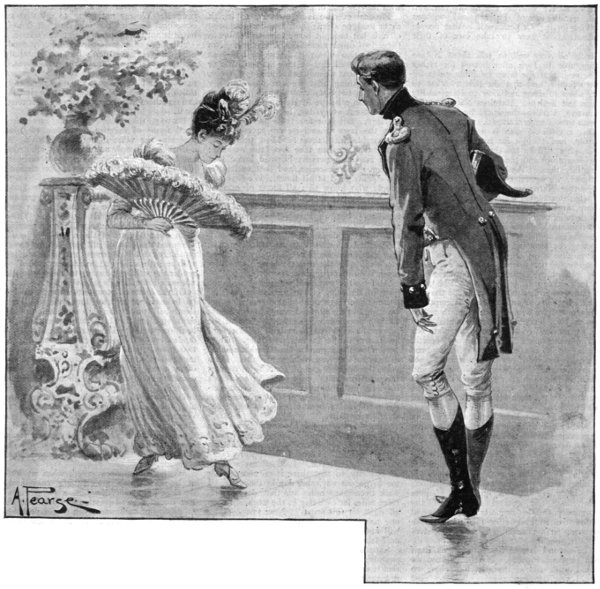
“‘YOUR PARDON, SIR. MY NAME IS MISS KEENE, AS YOU ARE AWARE.’”