MISCHIEVOUS JACK.
Reading edition
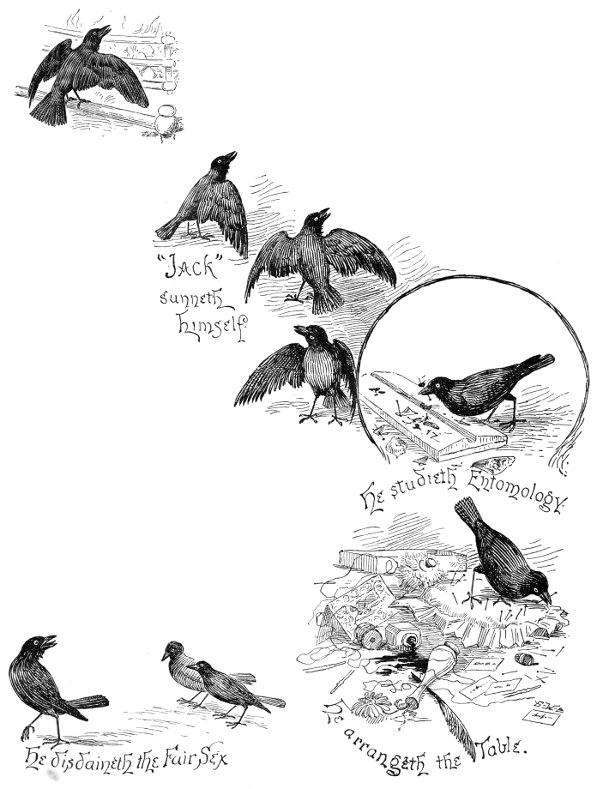
“Jack” sunneth himself. He studieth Entomology. He disdaineth the Fair Sex. He arrangeth the Table.
I am gradually learning to estimate rightly the responsibility of having a jackdaw loose upon the premises.
There is really no way of circumventing Jack’s craftiness except by keeping him shut up all day in an outdoor aviary. I feel sorry to be driven to this course, and would far rather let him roam where he pleases; but his mischievous pranks have become unendurable.
I thought to-day I had made a great discovery, and that by placing a large stuffed flamingo at the open French window I should effectually frighten the jackdaw from entering.
I found him in the drawing-room on my writing-table busy about some evil deed, so I held up the great stuffed bird, at which Jack cast one horrified glance and then fled precipitately out at the window as if his last hour had come. Now, I thought, by placing the flamingo near the window, I could leave the room with an easy mind. Vain hope! I came back after a few minutes and found the impertinent jackdaw hopping about as happy as a king. He had pulled to pieces a rare foreign insect I had just been setting on a piece of cork. He had overturned all the small curios he could find, had pulled all the pins out of a pin-cushion, and, worst of all, he had opened a Mudie book and torn its map and pages to ribbons. That book will have to become my property and remain a monument of Jack’s misplaced energy.
It was humiliating to think how he must have chuckled at my flamingo. He had seen through the device at once and had no idea of submitting to be scared away by such a bogie.
During the winter months we do not often have weather which will admit of open windows, so Jack exercised his talent for mischief out of doors by hiding the padlock of the aviary, pulling up flower labels, and drawing nails out of the walls. In these varied occupations he managed to spend his hours of idleness.
As a rare treat he was sometimes allowed to bask on the fender before the fire, and, charmed by the delicious warmth, he would assume the various attitudes shown in the illustration. His wings and tail expanded, his head on one side and beak wide open, he looked like a dying bird, but we knew that in reality he was in a state of ecstasy.
When next summer arrived Jack was again kept in the aviary, and I am sorry to have to reveal a very dark page in his moral character. He was usually content with raw meat and sopped bread; but, alas, he much preferred to catch his own dinner! And when, attracted by his food, innocent little robins, chaffinches, and sparrows found their way into his domain, I grieve to record the dreadful fact that none came out alive! Jack feasted on their small bodies, and left only a little bunch of feathers to show what he had been doing.
I have said enough to prove that Jack is neither to be loved nor respected; but he is unquestionably clever, and evidently has his own thoughts and ideas.
He will fly at one’s hand like a fury even when food is being given him; but when his mood changes and he wishes to be caressed, he picks up a twig or a dead leaf. This is a signal of peace, and whilst he continues to hold it in his bill he is quite safe, and may be stroked and petted.
One day in the height of summer Jack was perfectly electrified by a visit from six lively young magpies. The aviary door happened to be open, and these birds came hopping in with their usual free and easy manner, chattering to each other and coolly abstracting any morsels of food which suited their taste. At first Jack tried to drive out these audacious visitors, but they ignored him altogether and at last he had to stand aside and watch their depredations, a very discomfited and astonished bird. The magpies came at intervals for several days in succession, and then I suppose they went off to the woods, for we saw them no more.
It is rather curious that the mating instinct has not led Jack into the bands of matrimony. I have seen several attractive specimens of his own kind making overtures to him, but he treats them all with lofty disdain and elects to remain a bachelor.
Perhaps next year he may yield to the fascinations of a wild mate, and settle happily somewhere in my woods. It would be the best thing that could happen, only I fear we should all eagerly bid him good-bye without the addition of au revoir.
Eliza Brightwen.