Chapter II
Reading edition
THE “NEW GIRL.”
“And was her grandfather really an earl?”
“And shall we have to call her Lady Gwendoline when we speak to her?”
“I wonder what she is like; I am dying to see her!”
“She is coming to-night; but perhaps Miss Elder won’t trot her out until to-morrow.”
What an excited hubbub was going on in Meldon Hall schoolroom. The girls had been told that a new pupil would arrive that night. This alone, in mid-term, would have been enough to arouse some interest, but when it got abroad by some means or another that the importation was a beauty, an heiress, and related to an earl, their excitement knew no bounds.
Marion Edwards, perched on the back of a chair, gave out what she had heard, and a little more, to an admiring audience who took Marion’s words for vastly more than they were worth. In every school there are one or two leading spirits, and Meldon Hall had at present two leaders—Marion Edwards and Edith Barclay. Edith was the clever, studious girl of the school; and amongst those who were inclined to be industrious, she was looked up to with great reverence. Marion was handsome, rich, and had an aptitude for making witty remarks, which made her at once admired and feared by her “set.” The two leaders were quite friendly; they were in no wise rivals of each other, being altogether different in disposition and aims. Edith loved study for study’s sake, and had secret thoughts of entering a profession. Marion cared nothing for her lessons, but easily managed to get along in a superficial way; she was an only daughter and rich, and was looking forward to entering society after she left school. Marion’s feelings were divided between pleasure at the prospect of knowing a girl whose grandfather was an earl, and a secret fear that this rich beauty might want to queen it even over her, and that her set might forsake her for the greater light.
The only one who was really indifferent to the new arrival was Linnæa. She had had her times of hidden excitement over an expected newcomer, and vague longings that she might be “nice,” but these feelings were over and done, with long ago. Successive disappointments had embittered her, and now it was a matter of little moment to her who came and went. This night she had a slight headache and felt tired of her schoolfellows’ chatter and not inclined to face the introduction of a new girl, proud and haughty, who would doubtless criticise her looks and manners and set her down—as all the others had done—as hopelessly unattractive. She therefore slipped quietly away to her room.
“Oh, I do wish Miss Elder would bring her in to-night!” said one; and, as if in response to her wish, the door opened and the principal entered, followed by the new girl.
“This is Miss Gwendoline Rivers,” said Miss Elder, introducing a few of the girls who were nearest her by name. “I shall leave her with you for twenty minutes, but after that she must go to bed, as she has come a long way to-day.”
Shyness was not one of the new pupil’s failings, and she asked more questions than she answered. Soon she had found out all the rules and regulations of the school, and had taken mental note of a few of the characters around her. Report had been correct as far as her beauty and wealth were concerned—her connection with the earl was a little more remote—she was indeed a lovely girl. Her dark eyes were large and lustrous, and her face had an almost southern richness of colouring. Her appearance was aristocratic to a degree, and her clothes were expensive and in the best of taste.
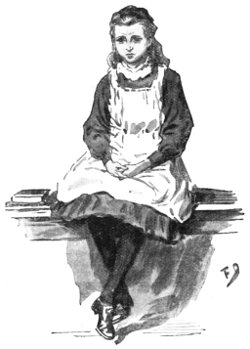
THE DUNCE OF THE SCHOOL.
“Are you all here?” she said by-and-by, looking round on the group.
“All except two. Alice Melrose is in bed with neuralgia, and Linnæa March has retired for the night.”
“And, pray, why has Linnæa March retired for the night? Had she not the curiosity to wait up and see the newest thing in girls? I suppose she knew I should arrive to-night, as you all did, and I know you were all dying for me to put in an appearance so that you might deluge me with questions. But I think I have got more out of you than you have out of me. I find the only way to avoid too many questions is to ask a great many yourself. Tell me about Miss March, please; I am quite excited. What an outlandish name, too? She is altogether very mysterious!”
“There is not much to tell about Linnæa March, as you will soon know. You will find the best way is to leave her alone, for, as sure as fate, she will not trouble herself about you, any more than she has about the rest of us.”
“But that is precisely what I never do! I never allow anyone to be indifferent to me; they may hate me, if they please, but they shall not be indifferent!”
“You don’t know Linnæa. I don’t believe she knows what love and hate are—love, at least; she might manage to hate you, perhaps!”
“I shall make her love me then!”
The girls laughed. There was something very fresh and original about this young lady who spoke as if the world and anything in it were hers for the asking. It was easily seen she had not been denied much during her life, and most of them felt very much inclined to carry on the spoiling process if only they might be termed friends of this beautiful and determined young woman; for if there is anything young people worship, it is determination. But to talk of making Linnæa March love her was a little too absurd.
“How long is it since this unimpressionable young lady left the company? She won’t be in bed yet, will she? One of you go up to her room and tell her the new girl wants to see her, and bring her down.”
Really, this was most ridiculous! Who was to go and give this extraordinary message to Linnæa March? As if to-morrow were not soon enough to see her! Whoever went would not get a very great reception.
“Has she a chum here?”
“She has no chum at all.”
“Then do you go!” said the imperious Miss Rivers, pointing to a pleasant-looking girl beside her. “Listen to me,” said Gwendoline, when the messenger had departed; “I mean to make this Linnæa March like me; in fact, I mean to make her fall over head and ears in love with me, and none of you must say a word to influence her in any way. I have never yet made up my mind to do a thing that I have not done, and I shall show you that I can do this.”
The excitement of the school was aroused, and the girls awaited with great interest the development of the comedy to be enacted in their midst. Would it be a comedy or a tragedy? If, as she boasted, Gwendoline Rivers were able to awaken the love which lay dormant in that sensitive heart, woe to Linnæa if she should discover the motive which had called it forth; it would run a chance of souring her whole after life.
After a few minutes the door opened and the messenger returned, accompanied by Linnæa.
“Now, you know, I don’t think it was nice of you to go off to bed without waiting to see me!” said Gwendoline, advancing towards her with a smile and holding out her hand.
Linnæa’s sensitive face flushed.
“I am sorry if I appeared rude,” she said; “I did not think of it.”
“You will be forgiven this time; but”—looking serious—“I hope you have not a headache; if so, I shall be sorry I brought you down.”
“Oh, no, thank you! I am quite well. I often go up earlier than the others.”
“Well, I sha’n’t keep you down long, for I am going to bed myself. I shall go up with you now and try if I can find my cubicle again.”
Calling good-night to the others, Gwendoline slipped her arm through Linnæa’s, and the two walked away in the direction of the stairs.
“How strange it is, coming in amongst a lot of girls one has never seen before! It is fortunate for me I am not shy, else, I suppose, I should feel dreadfully put out. How long have you been here?”
“Seven years.”
“Seven years! Such a long time to be away from home!”
“My father and mother are out in India. I shall go there when I am finished with school.”
“Oh, how splendid! I should love to go to India. I have a brother who went out last year, and when I leave school I mean to pay him a visit. Perhaps we may happen to go together. Wouldn’t that be nice? Is this your cubicle? Horrid, bare places, aren’t they? I was warned about it and brought some pictures and things with me; but I sha’n’t unpack them to-night—I am too sleepy. Shall we say good-night, then? I somehow think we shall be friends.”
Gwendoline, as she spoke, leant over and kissed Linnæa on the cheek, then ran away to find her bedroom.
“Funny, quiet little thing!” said Gwendoline as she went. “I wonder if I shall make good my words? She seemed almost workable to-night. I was prepared to brave a few snubs to begin with.”
And what about Linnæa? She did not begin to undress at once as usual. Why was she so excited to-night? Something had come over her, and it was nothing more nor less than a subtle magnetism towards this beautiful girl who had taken more notice of her than of any of the others—who had kissed her when she bade her good-night. Why had she felt so wooden and stupid? Why had she not returned the kiss? What must this girl think of her?
She was in bed at last, but could not sleep. She seemed to feel the kiss on her cheek and hear the voice saying they might be friends. By-and-by, when sleep came, she dreamt that her father and mother had come to school to take her home—the time she had looked forward to through all the seven years—and she told them she wanted to stay another year because Gwendoline had come.
(To be continued.)