Part 4 — ANSWERS TO CORRESPONDENTS.
Reading edition
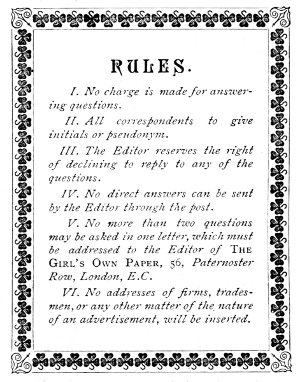
RULES.
I. No charge is made for answering questions.
II. All correspondents to give initials or pseudonym.
III. The Editor reserves the right of declining to reply to any of the questions.
IV. No direct answers can be sent by the Editor through the post.
V. No more than two questions may be asked in one letter, which must be addressed to the Editor of The Girl's Own Paper, 56, Paternoster Row, London, E.C.
VI. No addresses of firms, tradesmen, or any other matter of the nature of an advertisement, will be inserted.
MEDICAL.
Eileen.—Your troubles maybe due to any number of causes. The great number of symptoms having but little connection with each other, which you describe, strongly suggest that a large part, if not the whole, of your trouble is due to nervousness. There is a disease which, from the number and complexity of its symptoms, is called the protean disease, or, in common parlance, hysteria. This affection varies from the slightest forms of nervousness to absolute mental and physical perversion. It is in the slighter grades of this affection that you will find your own malady. Whether there is anything else besides this the matter with you is impossible for us to tell. It has been our experience that cocoa is quite as indigestible as tea or coffee, though it produces a form of indigestion differing considerably from that produced by tea. Drink nothing but warm milk, and take a liberal diet of easily-digestible food.
Priscilla.—Trichinosis is a very rare disease produced by eating underdone pork. One of the tapeworms (Tænia solium) is far more commonly obtained from the same cause. Both diseases are uncommon in England, for the English eat little pork, and always cook it well first. There is no danger of either disease from eating well-done pork. Where pork is eaten raw—as it is in some hams and sausages—the danger of tapeworms and trichinosis is very considerable; but it must always be remembered that sound meat cannot produce either disease.
Indigestion.—You are on the right track to treat indigestion, but you have made one or two errors. You should not drink “plenty of water.” The less water you drink the sooner you will be well again. You must not take anything to digest your meals for you. Of course you are referring to pepsin, etc. These may be taken by dyspeptics only when they are incurable or gradually starving to death. Dyspeptics are rendered worse by their use in the long run. You must relieve your constipation. A teaspoonful of liquorice powder will do this very well. Six miles daily is quite sufficient exercise.
Anxious.—If you suffer from flatulence you must attend very carefully to your digestion and guard against constipation. The pain of wind may often be relieved by taking half a teaspoonful of spirit of ginger or compound tincture of cardamom in a little water.
In Need of Advice.—Nothing save the surgeon's knife will remove moles from the face without great danger. The operation for removing moles is practically free from danger; but it is not always advisable. The best way to remove the hair which grows upon moles is to shave it off or bleach it with peroxide of hydrogen. Electrolysis is sometimes used to destroy hairs on moles, but it is infinitely inferior to, and more dangerous than, excision of the whole mole. Moles very rarely grow quickly; indeed, usually they grow less rapidly than does their bearer. If you have a mole which suddenly begins to grow rapidly, go to a surgeon at once, for in all probability it has altered its character and become a serious disease.
Brunette.—Dandruff and falling hair are usually present together, for the former is one of the commonest causes of the latter. Wash your head once a week in warm water and borax (one teaspoonful of borax to a pint of water). Wash the scalp particularly well, and thoroughly dry both the scalp and the hair afterwards. When the hair is quite dry, rub a very little sulphur ointment into the scalp. It is no good applying this to the hair itself. It is the scalp and hair-roots which need the ointment. Use a hair-wash of cantharides and rosemary.
Iris.—1. If you use peroxide of hydrogen to bleach your hands, do not put it in the water you wash in. Get from your chemist “hydrogen peroxide 10 vols.” Dilute this with three parts of water, and dip your hands in the solution once a day. This can do you no harm. Whether it will do what you want it to do is another question. Sometimes it serves its purpose; usually it fails.—2. Orris-root is the root of the iris, and not of the violet as is so commonly thought.
M. O.—You suffer from the double complaint of indigestion and feeble circulation. You must be very careful what you eat, avoid excess of starchy foods, sugar, alcohol, tea, coffee, and cocoa. But take a good nourishing diet. The pills will do you good; but you must be very careful to guard against constipation. Take a fair amount of exercise. Take a small dose of bicarbonate of soda when you are troubled with fulness after meals.
An Old Reader.—We think it quite improbable that your brother will derive any benefit from smoking. In fact, we think that it will simply make him worse.
Emily.—It is very difficult for us to advise you what to do, for the information that you give us is too scanty to enable us to form a just idea of your condition. You should have told us your age, and occupation, and habits of life, for it is necessary to know these before treating any complaint. The stiffness in your arms may be due to rheumatism or it may not. You might try gentle massage and friction with camphor or soap liniment over the joints of your arms. For your other troubles we cannot help you without information as to what they are and how they originated.
Gladys.—The chief causes of somnolence are overwork, insufficient sleep, underfeeding, overfeeding, indigestion, anæmia and other forms of physical weakness; and lastly hysteria and nervous exhaustion. From which of these are you suffering? Seven and a half hours' sleep daily is sufficient; but, if you could, we advise you to give yourself another hour. Do you eat properly? Do you eat sufficient, or do you eat inordinately? Do you have indigestion or fulness after meals? All these make you feel sleepy. Are you in any way unwell? Do you feel the cold severely, or have any symptom which would suggest that your circulation was not what it should be? Are you at all nervous, or do you belong to a nervous family? This last more commonly causes wakefulness than sleepiness. Lastly, are you worse in the morning or the evening? If you are all right in the morning, but tire and get sleepy as the day wears on, then we must look for a physical cause of your trouble. If you are worse in the morning than you are later in the day, then the cause is probably nervous. To cure yourself of your trouble you must find out and remove the cause. Take an extra hour's sleep if you can manage it. Look carefully to your digestion; many forms of dyspepsia give rise to scarcely any symptoms except sleepiness.
Alice.—Read the advice we gave to “Anxious.” You must be very careful about your digestion, and take the minimum amount of fluid that you can. Let your diet be as solid but as digestible as possible.
Sufferer.—You had far better see a physician, for you may be seriously ill, and it is quite beyond our power to help you. As regards hot-bottles, they should never be filled with boiling water, and should always be provided with jackets or wrapped in flannel. You are not the only person whose legs have been burnt through ignorance of the proper use of hot-bottles.
STUDY AND STUDIO.
Country Lass.—By far your best course would be to enter some small ladies' school, where you would associate with well-educated women. We do not think the scheme you mention would be very feasible. It is difficult for us to mention any one school; the fees (unless under special arrangements) would vary from £50 to £100 a year. Would you like to go on the Continent? If so, we should advise Lausanne. Perhaps you can give us a few more particulars.
Iris.—1. You might procure Creighton's First History of France, published at 3s. 6d., or Smith's Student's History, published at 7s. 6d. There is a book by Charlotte Yonge—Aunt Charlotte's Stories from French History—but we do not know it.—2. A thunderbolt, in the sense of a metallic substance, or bolt, hurled through the air by a thunderstorm, does not exist. The term is properly applied to the stream of electrical fluid passing from the clouds to the earth. Aërolites, or meteoric stones, have no connection with thunderstorms. Two questions are our limit.
Emerald.—We are sorry we cannot tell you of a good grammar of the Irish language. Perhaps some correspondent, noting your wish to obtain one, may help you.
Pateeth.—1. Write to the publishers of any of Jerome K. Jerome's works, and inquire for the recitation in question.—2. We do not know of any way of disposing of silver paper. Inquire at a confectioner's.
Dorothy will find the poem “Nothing to Wear” in Alfred Mile's American Reciter, price 6d.
“The Eldest Girl.”—Certainly we do not object to our girl-readers “writing about the articles and stories in the paper, saying what they like and dislike in them,” so long as the letters are as pleasant and courteous as your own.
Felicia.—Your quotation—
“The mighty master smiled to see That love was in the next degree,”
is from Alexander's Feast, by Dryden.
Arithmetician.—Many thanks for your solution of the problem in our August number.
Amateur Society.—We have received a notice of “The Budget” Manuscript Magazine Club; subjects optional; good criticism; two prizes yearly. Address, Miss Louise M. Larner, 22, Ladbroke Road, Notting Hill, W.
Zingara.—1. We do not recommend books on fortune-telling by cards.—2. We have observed in one or two of the larger weekly illustrated ladies' papers that character is described in the correspondence column from handwriting. A glance through these papers at any public library will inform you where to apply.
Bessie Matthews.—Your letter is beautifully written, and the white ink on the blue paper is very pretty, if a little too dazzling for ordinary use. We thank you for your information, which we repeat elsewhere.
Cissie (Southend).—You do not give us your Christian name, which we require for International Correspondence. “R.” is not enough.
Phœbe Wilson.—There is a picture in the National Gallery, we believe, of the first title you mention, but it is quite impossible for us to tell you either the painter or the value of your pictures by the names alone. You should let a local picture-dealer see them in the first instance, and if they are thought to be of value, you might send photographs or a rough sketch of them to “Christie, Manson & Woods,” or “Agnew's,” New Bond Street, London, asking for information.
Mercia.—We do not consider you at all too old to begin to study at a school of art. With perseverance and diligence you will doubtless make rapid progress. These are the great requisites; a very youthful age is a secondary consideration.
E. W. H.—The teacher who trains your voice will tell you whether it is a contralto, mezzo, or soprano. We should consider that F or G was about the lowest note for a contralto; but it is for the master who teaches you to judge of the compass of your voice, not for you to inform him of its range.
OUR OPEN LETTER BOX.
Miss Dorothea Knight, Keswick Old Hall, Norwich, wishes us to say that if any reader of The Girl's Own Paper who collects postage stamps cares to send her some duplicates, she will send some in exchange by return of post.
Briar Rose informs “Last Hymn” that the recitation of that name is in one of Buchanan's “Penny Pathetic Readings,” and is also published under another title—“The Haven”—in the Victorian Reciter, edited by Bernard Batigan, of Hull, price 1s.
Bessie Matthews, 3, High Street, Cheltenham, offers to send “Last Hymn” a copy of the poem on application, and informs Saxifraga that “The False Light of Rosilly” is in the Prize Reciter for May, 1897, to be obtained from the office of Great Thoughts. It is also contained in Childe Pemberton's Poems, published by Messrs. Ward, Lock & Co. We commend this information to Briar Rose.
GIRLS' EMPLOYMENTS.
Margaret Marshfield (Civil Service).—Please read our reply to “Wood Violet” last week. The examination fee is only a shilling, so there is no obstacle in that part of the matter. But there are other difficulties. You could only now offer yourself for appointment as a female sorting clerk, or telegraph learner in the provinces; and to do this you must obtain a nomination from a local postmaster to be sent to the Postmaster-General. You have then to pass the examination. You ask what we think of your writing and composition. The writing is very neat and clear, but composition is a trifle shaky. To say “mother's helps (our only other resource) seems to be so overstocked” is not first-rate English, though we understand what is meant. But why should your only other resource be to become a mother's help? Can it be because you think it would be derogatory to you to fill one of the more recognised positions in household service? If so, we would persuade you to reflect on the superior advantages enjoyed by a children's nurse, a cook and a parlourmaid. All these persons, as soon as they have obtained a fair amount of experience, can command good wages and an ample choice of situations. No doubt there is some little trouble in obtaining a first place; nevertheless, many ladies are willing to teach an active, hardworking woman, if the latter, on her side, will accept a small amount of payment during the period of apprenticeship. It really seems to us best that you should turn your thoughts towards domestic service; though, if you could afford to spend a little time and money, we should also have recommended you to learn laundry-work.
Azalea (Teaching in France or Germany).—It is almost impossible for an English teacher to obtain employment in France; but in Germany there is less difficulty, provided that the teacher has high qualifications. We recommend you to apply to the Foreign Registry of the Girls' Friendly Society, 10, Holbein Place, Sloane Square, S.W.; Miss Nash, Superintendent of the Home for British and American Governesses, 22, Kleinheerenstrasse, Berlin, might also be able to advise you, but you ought to furnish the fullest account of your general education and professional training.
Sincerity (Rural Nursing).—If you could go to a large London hospital training-school and remain there a year, so as to qualify you to become a Jubilee District Nurse, you would, from a professional point of view, be doing the best for yourself; but we think the work of cottage nurse on the Holt-Ockley system would probably be quite as congenial to you, and the likelihood of your obtaining an engagement would be greater. You should apply for further particulars to the Hon. Secretary, Mrs. Lee Steere, The Cottage, Ockley.
Freda (Evening Employment).—Such work, especially if it is only addressing envelopes, is peculiarly hard to obtain. You might consult the Secretary for Promoting the Employment of Women, 22, Berners Street, W., but we fear she will only be able to say the same.
Anxious to know (Missionary Work).—You had better make known your wish to become a missionary to the Women's Mission Association, 19, Delahay Street, Westminster, S.W., or to the Society for Promoting Female Education in the East, 267, Vauxhall Bridge Road. You would probably be required to undergo a course of preparation. Missionaries are supported by the societies which employ them, but only of course in a simple manner.
MISCELLANEOUS.
Inquisitive.—You should read Charles Kingsley's Heroes. That would give you all information about the heathen mythology, or system of myths, and ancient hallucinations respecting their false gods. Apollo was the reputed son of Jupiter and Latona, also called Phœbus, supposed to be the god of the fine arts and originator of poetry, music, and elocution. Besides the names already given, he was called Delius, Cynthius, Pæan, and Delphicus. He is represented as a handsome young man, with an almost feminine face, and beardless, holding a bow from which an arrow has been discharged. This refers to the fable that the Serpent Python had been destroyed by his arrows. Evil foreboded is represented by the “Sword of Damocles,” who was set down to a splendid banquet by the tyrant Dionysius (the elder), a sword being suspended over his head by a hair or thread. Thus the miserable courtier dared not to stir lest the slightest draught or vibration should bring it down upon his head.
Anxious Maria.—Because you may be full of faults, and weak in times of temptation, feeble in faith and too lukewarm in love and zeal, you would not be thereby justified in adding a fresh act of disobedience by drawing back from the Lord's Table and neglecting to obey one of His last commands. If you were to wait till really worthy in reference to sanctification, you would “draw back to perdition,” it is to be feared. Remember that, however faulty you may justly feel yourself to be, you can go to your divine Redeemer, “washed, sanctified, and justified” in His Name.
“All the fitness he requireth Is to feel your need of Him,”
and with that feeling to pray for His grace, and to “strive to enter in by the straight gate.” A battle has to be fought. Do not forget that.
Carnation inquires, “Are tomatoes healthy?” We fancy but very few of them are diseased. Those that lie long on the ground during wet weather do not remain so long. That, as an article of food, they conduce to our health is absolutely proved. Few vegetables are more wholesome. Ladies do not rise, if seated, when men address them.
Dot.—You should say, “It is I” (not “me”). The former is used in the nominative case, and the latter the accusative. But you should not say, “between you and I,” but “between you and me.” If you wish to speak correctly, be careful how you employ adjectives. You misapply the word “beautiful” when you say “beautiful butter,” or jam, or fat; but you may use it very correctly as regards a landscape, a flower, a rainbow, or any work of art. Also the word “delicious” is often unsuitably employed, such as when applied to a joint of meat, or a book. To apply it to fruit would be more suitable. The words which should often be employed as a substitute for “delicious” are “excellent,” “nice,” or “good.” The word “beautiful” is correctly used with reference to form, and colouring, and combinations of the latter. Another very commonly misused word is “expect,” “I expect she is,” etc. The word “expect” has reference to the future, and the speaker's anticipations in connection with it; “she is,” denotes the present and already existing condition, and the two cannot be used together. This misapplication of the term has come from over the Atlantic. You will find much to assist you as to right and wrong employment of words in that useful book Enquire Within. See pages 163-174.
Ignoramus.—All invitations are given by the mistress of the house, though she should include her husband's name in giving them; and all replies should be directed to her, although, inside, you thank for their united invitation. The house is the woman's domain, and she “guides” it.
Joan.—The beneficial influence, or the reverse, of allowing ivy to grow over the walls of a house has been a question of difference of opinion. Formerly it was condemned as harbouring moisture, and liable to injure the health of the occupants. Now it is said that the overlapping leaves preserve the walls from the rain, and they are found to be quite dry beneath them. It is also said that it renders a house cool in summer, and warm in winter. But there is a drawback, and that is that it brings insects of all kinds into the rooms—spiders, flies, earwigs, and woodlice. Whatever you may prefer to do in reference to its growth on your house, it is an unmitigated evil on trees, and it should always be sawn through, and then rooted up.
Mora.—Much depends on the species of palm, as to the watering they require. Also, they must not be exposed to a draught. Perhaps yours is not one that would grow tall under any circumstances. As we know nothing about it (for you give no particulars), we cannot help you.
Brownie.—We cannot do better than refer you to the articles on the care of the hands by “Medicus.” See vol. xiii., page 358. Doubtless you have been out without gloves, and the sun has tanned them. The very narrow rim of insensible skin that surrounds the nail preserves the true skin from being torn and made sore at its termination at the quick. Of course it will not bear rough usage, for if cut or cracked, the tender skin behind it, which it is designed to protect, will naturally become sore. Wear gloves until quite healed.
FOOTNOTES
[Transcriber's note.—The following changes have been made to this text:
Page 253: crépes changed to crêpes.]