OUR LILY GARDEN.
Reading edition
PRACTICAL AIDS TO THE CULTURE OF LILIES.
By CHARLES PETERS.
The life history of the lily is one of perpetual growth. The lily never lies dormant.[1] In the severest frost, or in periods of great drought, this plant is ever developing. As soon as the flower-stem has died down, the bulb begins to form fresh roots and continues to do so until the time comes round again for it to send up its flower spikes. Lilium Candidum throws up a winter crop of leaves during the autumn, but the other lilies perform all their winter labours below ground.
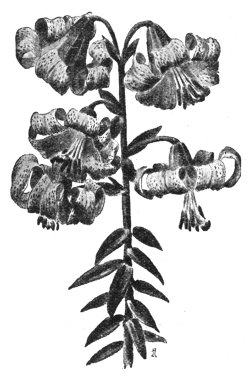
Lilium Monadelphum.
Let us follow the life of the lily through the year and see how each particular season has its special work and dangers.
We have planted our bulbs in November. They will do nothing but form roots till about March. During this period most bulbs will stand any frost that we are likely to have, but those of L. Wallichianum, L. Catesbaei, and one or two others, occasionally die during severe frost. Though cold does not appreciably injure lily-bulbs, it is far otherwise with wet. As we have said before, lilies love rain when the stems are growing, but when the bulbs are making root in winter they do not like much moisture. If the soil is perfectly well drained, we much doubt whether any quantity of rain would cause the bulbs to rot. But in soils where stagnant water can lie about the bulbs, the result of a wet winter is often disastrous.
"Our soil is a stiff clayey loam, but we wish to have lilies. What can we do to render our ground a fit place wherein to grow them?" You can do one of two things. Either you can provide that the lilies are well drained by digging deeply and filling in with crocks, stones, etc., and mixing plenty of sharp sand with the soil; or else you can follow the Japanese plan of placing the lily bulbs on their sides. Bulbs with large, open scales, such as those of L. Brownii, suffer much more from wet than such compact bulbs as those of L. Umbellatum, etc.
The second stage in the growth of lilies dates from the appearance of the shoot till the opening of the flower-buds. We have already described the treatment necessary at this stage. It is at this time that you must guard against drought and slugs, and look out for diseases.
The opening of the flower-buds is the most anxious but also the most exciting period in the life of the lily. When the buds have begun to change colour a good drenching of the roots with very weak liquid manure will materially help to develop the flowers. Do not give liquid manure before this time, and never give more than two doses to any plant.
The green fly or aphis is a very exasperating foe. It does not eat holes in the leaves, but lives upon the upper leaves and buds, usually upon their under surface. Its presence causes the buds to develop irregularly. The bud grows less quickly on that side where the aphides are domiciled, and the whole bud becomes curved or twisted. When this bud opens, it shows but an ugly, deformed flower.
The best way to deal with aphides is to brush them off with a soft brush. This is the only method of dealing with them that can do no harm to the buds. Fumigation or syringing with soft-soap and water are frequently used to destroy these pests.
Another cause which ruins the lily flowers is canker of the buds or blossoms. We described the cause and treatment of this calamity last month.
Very often a lily will produce more buds than it has strength to develop. Some of these superfluous buds will soon show signs of withering and should be at once removed.
It is well to remove every deformed or injured bud as soon as possible, for it gives the plant a better chance of developing the remainder.
When once the flowers have opened, the plant may be left alone till they wither. If possible, lilies should be placed in the shade whilst they are in blossom, as the flowers will then last for a longer time.
Usually one bud will open and then die before another is fully developed. In this case the dead blossom—or rather the seed-vessel, for the perianth falls of its own accord—should be cut off.
After the lily has flowered, it will require but little attention until the flower spike has completely died down. At this period but little water need be given.
The flower spike must never be cut down till it has completely withered to the base. When this has occurred the entire stem can be easily removed by a slight jerk.
The life of the lily for the year is now over. What are we to do with the bulbs? Shall we leave them as they are, or shall we transplant them?
Lilies in the ground do best when left undisturbed for years. Some lilies, such as Martagons and Lilium Candidum, never do well until they have been established for a year or two. Other lilies, such as L. Longiflorum, often dwindle in a very few years.
If the lilies have done well, have not been diseased and have blossomed freely, leave them as they are. If, on the other hand, the plants have borne poor or deformed blossoms, or have become diseased, or, above all, if they have been getting poorer year by year, take up the bulbs, as soon as the flower stems have died down, and plant them elsewhere.
Plant these bulbs in the same way and with the same precautions as you do new bulbs; detach any small bulblets and plant these separately. Never let the bulbs remain out of the ground longer than can possibly be helped.
Lilies in pots must be repotted every year. As soon as the stem has died down, empty the pot, shake out the bulb, separate any offshoots that it may have made, and replant at once.
Very little water need be given during the winter, but the bulbs must not be allowed to become dry. It is a great mistake to winter hardy lilies indoors or in a greenhouse, as it renders the plants tender and liable to disease.
Although all lilies are perennial, that is, they come up every year, there are some kinds, notably Lilium Canadense, which show great reluctance to becoming established, and after coming up well for two or three years, suddenly disappear altogether. This is especially the case when the plants have been allowed to ripen their seed. Indeed, all lilies tend to dwindle when they are allowed to go to seed. One reason why L. Candidum is so much better when grown in neglected situations than any other lily is because it never produces seed in this country.
There are four methods by which lilies may be propagated; by seed; by bulblets, which are formed in the axils of the leaves of some species; by offshoots from the parent bulb, and by detached scales. Again the bulbs often split into two or more parts. If a single bulb has sent up two flower spikes, the bulb will probably be found to have split into two, the scales re-arranging themselves accordingly. If these two bulbs are separated, each will send up flower spikes either next year or the year after.
Growing lilies from seed is a tedious affair and is not worth its salt except when trying to raise hybrids or new species of great rarity.
The seeds should be grown in seed-pans in a mixture of peat, leaf mould, sand and moss. They take from six weeks to two years to germinate. Under glass they germinate more quickly. They never produce flowering bulbs till at least two years after they have been sown. Lilium Tenuifolium grows the most rapidly, and often flowers in the third year. Other kinds take from three to ten years to form a flowering bulb—time enough to exhaust the patience of any amateur. The vast majority of seeds either never germinate, or, if they develop so far, die before they have formed a bulb of sufficient size to send up a flower spike. Not all lilies produce seeds in this country. L. Candidum, Testaceum, Chalcedonicum, and others never do. Most kinds only ripen their seeds in very propitious seasons. So much for seeds.
The second method of increasing lilies is by growing the small bulblets which form in the axils of the leaves. Only L. Bulbiferum, L. Tigrinum, and occasionally one or two others, produce these axial bulblets. Sow the bulblets as you do the seeds. They usually germinate very quickly, and produce flowering bulbs within two years.
The commonest, quickest and best way to increase lilies is through the small bulbs which grow round the base of the parent. These may be removed when the bulbs are lifted and planted at once. They will flower in one or two years.
Before we leave the question of the cultivation of lilies, we will refer to two or three constituents of the soil, the presence of which is by some authors described as imperative, by others as injurious.
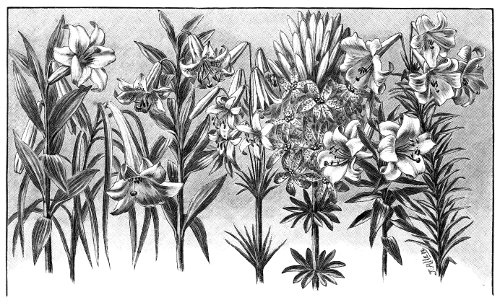
L. Neilghervense. L. Philippense. L. Nepalense. L. Parryi. L. Washingtonianum. L. Alexandræ. L. Longiflorum.
LILIES OF THE EULIRION GROUP.
Peat is absolutely necessary to L. Superbum, L. Canadense, L. Roezlii, L. Philadelphicum, L. Pardalinum, L. Parryi, and some others. Even those lilies to which peat is not a necessity, are yet benefited by its presence in the soil. This is notably the case with L. Auratum, L. Speciosum and L. Longiflorum. L. Candidum, L. Testaceum and most of the Martagons dislike peat. To L. Szovitzianum and the other varieties of L. Monadelphum peat seems to be positively injurious.
It has long been a moot point whether lilies should or should not have manure administered to them. Here, as elsewhere, we will give our own experience of the matter. Most lilies appreciate manure if it is not too strong or moist. Manure which is likely to turn the earth sour is fatal to lilies. The remains of a hot-bed is the best possible kind of manure to give to lilies. Place a little of the manure below the bulb and a little above it, but do not let it come within two inches of the bulb. The bulbs will rot if manure is placed near them.
Some lilies like a chalky soil, others show distinct aversion to it. The swamp lilies and others which like peat object to lime in the soil. L. Candidum and Monadelphum apparently require a considerable quantity of lime.
All lilies require sand. Sand should be placed round and below each bulb and should also be mixed with the earth in which the lilies are planted. Clean, sharp river sand is the best to use, but sea sand or clean silver sand may be used. Sand is used for the triple purpose of attracting moisture, preventing stagnation, and rendering the soil permeable.
The leaf mould most suitable for lilies is that formed from decayed oak or beech leaves.
Clay is prejudicial to most lilies, but in very dry, sandy soil lumps of clay may be placed about the lily bed. L. Auratum likes a small quantity of clay in the soil.
We have finished our remarks on the cultivation of the lily, and will now glance into the æsthetic side of these noble flowers.
Though every lily is beautiful in itself, it does not follow that it will look well in the flower bed. A garden should be a sheet of beauty, not a herbarium in which curious and beautiful flowers grow singly, each named and numbered, and requiring a guide to point out the various objects of interest. No! A garden must be one harmonious blaze of beauty, and though, of course, individually beautiful objects are necessary to produce this result, a great deal depends upon the proper grouping of the various constituents.
A bed of mixed lilies, in which all kinds were grown together, would look simply ridiculous. To have L. Giganteum, ten feet high, next door to L. Rubellum, of scarcely half as many inches, would be absurd. You must think of the general look of your garden. You must have pleasing contrasts of colour, and the plants arranged according to their height or method of growth.
One of the most beautiful sights that we have ever seen was a garden in Middlesex in which the path leading from the gate to the house was lined on either side with a border of very fine L. Candidum. The effect of the long lines of pure white blossoms was exceedingly fine, but unfortunately this lily is only in flower for about one month of the year. Still no one would grumble at having to wait eleven months if such a splendid effect could be obtained, even if it lasts but a twelfth of the year.
Have you ever seen a bed of L. Monadelphum at the back of the tropical palm-house at Kew? Last year it was a sight never to be forgotten. The lilies were grown in a bed of small azaleas, the green of whose foliage was a beautiful set-off to the gorgeous heads of blossoms which towered three or four feet above the carpet of foliage. There are other beds like this one planted with different sorts of lilies, but only one species is present in each bed. In one bed L. Brownii, in another L. Croceum, and in others again the various varieties of L. Auratum arrested the attention. All were perfect in their way, but none of them gave us such keen delight as this bed of L. Monadelphum.
A large clump of lilies of one variety is always a pleasing sight, and so is a solitary lily rearing up its head high above the other occupants of the flower bed. A small hillock covered with L. Longiflorum, or the side of a stream with the lofty L. Pardalinum is also very beautiful.
When you wish to grow various kinds of lilies in the same bed, a good deal of taste and experience is needed to produce a perfect effect. A gradation in height from the centre to the borders is necessary. Tall lilies planted at the edges of the bed are out of place, whilst the dwarfer lilies are insignificant in the centre. Lilies in the ground flower from April till November, and so a succession of these plants can be obtained throughout the late spring, the summer and the autumn. For artistic effects you must be careful not to place lilies of nearly the same colour together. Never, for instance, place L. Pomponium near to the red varieties of L. Elegans, else the effect is harsh and displeasing. A mixed border of L. Candidum and L. Chalcedonicum produces a fine effect, especially if both plants flower at the same time.[2]
Another fine picture can be caused by a mixed border of L. Longiflorum with the late red varieties of Lilium Elegans.
A considerable amount of taste can be shown in the proper grouping of lilies, and the flower-grower who likes constant variety can satisfy his desire by altering the arrangement from year to year.
(To be continued.)