Part 3 — PART III.
Reading edition
The Worcester Factories.
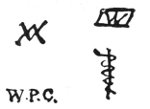
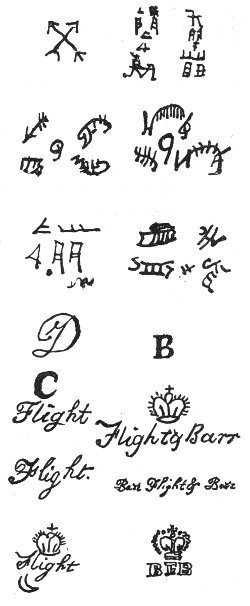
The factory at Worcester was opened in 1750-51, contemporaneously with that of Derby, the old mansion of Warmstry House being the first seat of the works. The latter passed into various hands, but were instituted by Dr. Wall, a physician, and Dr. Davis, an apothecary. The excellence of the colouring was a feature of manufacture, and it reached its highest degree of perfection from 1760 to 1780. Imitations from Chinese and Japanese designs were chiefly in vogue, enamelled, painted, or pencilled on the glaze, or in blue under it. Amongst the early marks distinguishing the Worcester porcelain, there is a "W" standing both for Worcester and Wall, the sign of Esculapius, a "W" enclosed in a square, and one formed of two "V's" intersecting each other, besides outlined crescents in gold or blue, fretted squares, anchors, and names. It may here be observed that according to general opinion no figures have been produced at Worcester.
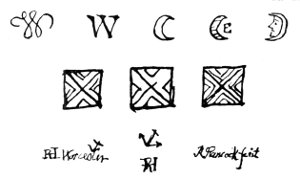
In the second period of the Worcester manufacture, under Messrs. Flight & Barr, 1783, the name "Flight," or that name with a crescent, distinguished the work, and likewise "Flight and Barr," surmounted by a crown; and then with initials. The Chinese, Chantilly, Dresden, and Sèvres marks were also borrowed, but the exact date of their adoption does not appear to be decided.
Robert Chamberlain, apprentice of the old Worcester factory, took up a separate business with his brother Humphrey, and Messrs. Kerr & Binns succeeded them, and employed the marks here following. One consisted of four "W's" enclosed within a circle; three initial letters, and a shield bearing initials and the name "Worcester."
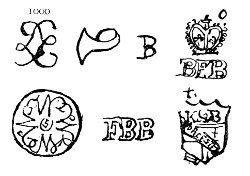
A third factory has been instituted by Chamberlain's nephew, Mr. Grainger, in partnership with Messrs. Lee & Co., under whose names the present Worcester china is executed.
The original founder, Dr. John Wall, died at Bath in 1776. In 1783 Mr. Flight purchased them, and took Binns into partnership, Solomon Cole, and Baxter. Amongst other names connected with the Worcester works are Blaney, Davis, Holdship, whose name, "R. Holdship," appears on some examples, and "RH" united as a monogram, as also a "B" for Binns. There are some fifty-seven workmen's marks on this china, which are too numerous to give, mostly of a very insignificant character. A large "W" (capital letter) is rare. Sometimes a square Chinese seal may be found on a specimen by no means oriental, and this is accounted for by the painting of such a mark on the paste before the glazing or the decorative design was executed or perhaps decided upon by the artist.
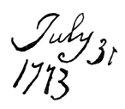
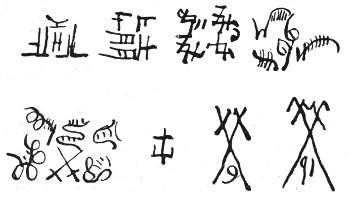
A few more of the Worcester marks may be added. First, the date, as given in the Shreiber Collection in the South Kensington Museum. The second is on the small sprig pattern of small blue flowers (like the Angoulême). The third is a group painted in blue, on imitation Japanese porcelain, very fine and old. The fourth, fifth, sixth, and seventh groups are all on Japanese china.
The Bristol Porcelain.
Richard Champion, the founder of the Bristol Porcelain works, Castle Green, 1765, having applied for an extension of his patent (granted for fourteen years), was strongly opposed by Josiah Wedgwood, and other Staffordshire potters. The extension under certain conditions was obtained, but two years subsequently he sold it to some Staffordshire potters, and the work was carried on at Tunstall and Shelton. The designs on Champion's Porcelain were taken extensively from Dresden, for which his work is often mistaken, as he affixed the crossed swords of that manufactory to his own china. He also copied those of Sèvres and Vincennes. In one case the Bristol cross is united with that of Plymouth, i.e.,
The plain cross is painted in blue. The Bristol marks next following are painted on the glaze in blue or slate-colour, i.e.,
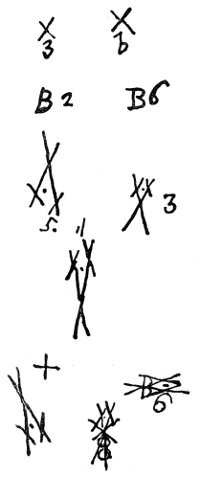
The marks of Champion, in designs taken more or less from the Dresden and French are as here given, all under the glaze in blue, excepting the last three which are over the glaze.
The letter "T" is embossed, standing in relief, and the plain cross is painted in blue. The Dresden crossed swords in a triangle, is impressed on the clay.
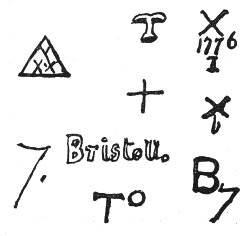
The painter's number is sometimes given over the glaze, as "7," and when in gold and added to the Dresden mark, in Bristol ware, it indicates the gilder and not the painter. Also we find the name "Bristoll" in double lined letters, and the following three, a cross, date, and figure 1 or T; a cross with a small "b" under it; and a capital "B" with the figure "7" beneath it on one side. The mark "To" is also distinctive of this factory.
To give an idea of the excellence to which the work attained in Bristol, I may observe that a tea-service presented by Richard Champion to his wife Judith in November, 1774, painted in figures, was sold at Sotheby's April, 1871, for £565. It consisted only of six pieces (counting a cup and saucer as one), i.e., the teapot, milk jug, sugar basin and three cups with their saucers. Of course, their value was greatly enhanced by their age.
Plymouth Porcelain.
To William Cookworthy, of Kingsbridge, and Lord Camelford we owe the production of porcelain at Plymouth. They worked together, and took out a patent in 1768. For the manufacture, Cookworthy discovered kaolin and pentuse in Cornwall, both natural substances, requisite for the production of hard paste; the former to supply an opaque body, and the latter a perfectly transparent substance, commonly called "moonstone," or "chinastone," the two being blended together.
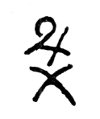
In the first patent taken out in this country in 1768, the porcelain was described as made of moonstone, or granite and china clay, the latter giving infusibility and whiteness, Henry Bone, the enameller, and M. Soqui, a painter from Sèvres, being the decorators of the Coxside manufactory at Plymouth. After a lapse of a few years, the interest of the latter was sold, and the patent rights transferred to Mr. Champion, of Bristol, in 1774. The mark of the original Plymouth porcelain was the alchemic symbol for tin, sometimes, but rarely, incised in the clay, in blue under the glaze, or in gold or red upon it; but many pieces have no mark at all. A great similarity appeared between the work executed at Plymouth and that in Bow, which may be accounted for by the fact that Cookworthy employed workmen procured from the last-named factory. Some £3,000 were expended in perfecting the discovery of how to bring the porcelain to perfection.

PLYMOUTH MARK.
(To be continued.)