BURNT WOOD DRAWING.
Reading edition
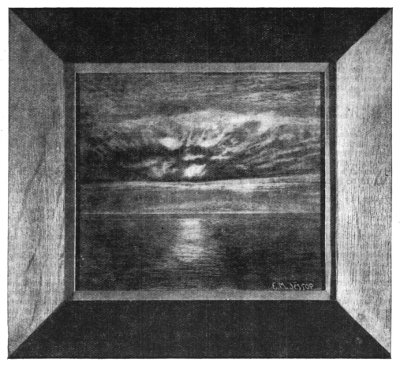
SUNSET OVER THE SEA.
(Burnt wood drawing in oak frame, by E. M. Jessop.)
Of all the graphic arts this is probably the most useful and durable. Under its old but ridiculous title of "poker work" it has flourished from time immemorial; gifted by some unknown genius with the modern name of Pyrography, it bids fair to become a universal favourite among the amusements of art-loving amateurs, but, owing to want of support, has not hitherto been much adopted by the professional artist who alone possesses the graphic skill, the power of technique and the breadth of execution which would do justice to such a beautiful art.
When we consider that nothing but fire or wanton mischief can really damage the pictures which may be produced in this work, and that the original cost of the materials for its production is so very slight, one marvels that so fine a medium for wall and furniture decoration has been so much neglected.
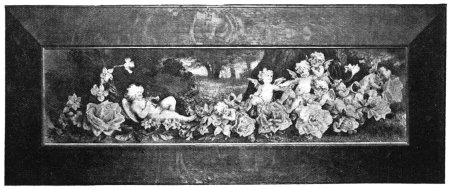
A SUMMER IDYLL.
(Burnt wood drawing in oak frame, by E. M. Jessop.)
In the specimens which I have recently had the honour to submit to H.R.H. The Princess of Wales, and which she was pleased to greatly admire, the materials used were of the very simplest. To be epigrammatic, were I asked how I did them, I could only reply, "With a few boards, two old chisels and a little intelligence."
So now to our wood-work's foundation. In the first place never commence a drawing on any but sound, well-seasoned wood, as nothing could well be more trying to the temper than seeing the result of a month's work curling up like a roll of paper or splitting across in a manner which places it beyond repair. Any good whitish wood is suitable for burnt drawing; holly on account of its close grain being the best, but, like the best of everything, holly of the width required is also the rarest of woods. Next to holly comes sycamore, a fine hard wood; then chestnut. In one of the specimens here illustrated (the child's head) I have used an old drawing-board made of poplar with beech clamps at either end. Never use wood of less than three-eighths of an inch in thickness, the thin plaques sold by most shops being quite useless for works of any size on account of their liability to split and cockle. By the way, the cockling of a wood drawing can to a certain extent be remedied by exposing the concave side to heat and leaving it to cool between two flat surfaces with heavy weights on top.
And now to our tools. For drawings of any size suitable for the doors of cabinets or rooms, plaques to insert in oak dadoes, etc. (and it is in these we shall get our finest effects), the little machines heated by spirits of wine and other mediums are not of much use. It is, in fact, like using the smallest sable brushes for fresco painting. For my own work I mainly use wood-carving tools. The broadest chisels and gouges are the best, and the thicker the steel the better the tool, as it retains the heat for a longer period. Again, I always heat my tools in an ordinary coal fire, but it should be quite possible to get a small gas stove to give all the heat required in a perhaps more convenient manner.
I might here mention that your most used tool, which should be a broad blunt chisel, say three-quarters of an inch in width, ought to have its sharp corners carefully ground down before using it, as it is otherwise liable to burn ugly little black spots on the drawing.
With these explanations we will now proceed to the drawing itself, and here it is necessary to give a very strong caution at the outset; this is, always bear in mind that whatever marks you burn on your wood must absolutely remain there. There is no way of rubbing out, and to erase with a knife is to spoil the surface of your wood, as you cannot draw properly over a scratched surface. For this reason also you can only copy either your own or other people's drawings in burnt wood-work.
Having selected your copy first draw a careful pencil outline from it on the wood plaque. We will here, for example, say it is the drawing of the child's head reproduced. Heat a small tool sufficiently to mark a very light brown line on the wood (to ascertain heat keep a small piece of waste wood by your side), then carefully go over the outline of the head and mark in all the features. Now with soft india-rubber erase all pencil marks from the parts you have burnt, and make a fresh pencil indication of the shape of your shadows, and proceed slowly and carefully with the hot tool to build up coat by coat from the lightest to the darkest these same shadows, never forgetting that lights cannot be applied afterwards, but must be left out. A darker shade can always be added, but a light never. Now once more remove your pencil-marks and proceed to draw in your figure in the same manner as above described. Next comes the background to be lightly sketched in by the hot irons; and, after this, all pencil-marks may be removed and the picture carefully worked up tone by tone from the copy.
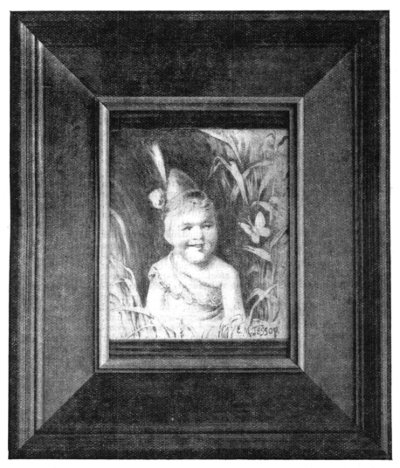
FRIVOLITY.
(Burnt wood drawing in ebony frame, by E. M. Jessop.)
In holding the tools (the handles of which may be covered with cork, or some non-conductor), it is necessary to remember that they should never be used to make pen-like strokes, but more of a pastel effect must be sought, as the soft-blurred appearance produced by gently drawing them along the wood gives the effect of old carved ivory, which is one of the chief charms of a fine burnt wood drawing. For instance, in the drawing of "Sunset over the Sea," I spent many hours in simply drawing a heated chisel slowly along the wood from end to end until I got the yellowish tone which now goes so well with its green oak frame. Here and there a white light had to be left. Its position was indicated to me by a pencil outline. For this drawing I had no sketch, it being entirely executed from memory. The main difficulty was to get the flat tones, without which it is impossible to indicate atmosphere and distance.
In the "Summer Idyll," given on the opposite page which is in size some thirty-six by ten inches, a great deal of the background effect was produced by using a small gas flame. This has to be done very slowly and carefully, as one is apt, if at all careless, to burn too deeply into the surface.
In conclusion, I may say that burnt wood drawing to be properly done requires both time and thought, it being a much more satisfactory result to produce one fine specimen by a month's labour than several odds and ends, which can only be compared with the daubs so often exhibited in shops as "painted by hand."
As to the applications of burnt wood work they are practically endless. Look, for instance at the mouldy, rickety, ill-designed, so-called antique chests so often sold at four times their original cost. For a very small sum a good carpenter will make you a really serviceable article with a framework of oak and white wood panels, which you can decorate with hot irons in such a manner as to make a truly beautiful piece of furniture. Again, for corner cupboards and cosy corners, panels of doors, etc., where is its peer to be found?
My last word is try but one carefully executed plaque, and I feel sure that you will not rest until you are making your home truly beautiful.
Ernest M. Jessop.
⁂ The original drawings from which these illustrations are taken were recently exhibited by desire to H. R. H. The Princess of Wales at Marlborough House, and H. R. H. was pleased to say that she had derived great pleasure from her inspection of them.
(All copyrights of drawings reserved by the artist.)