Part 2 — OUR LILY GARDEN.
Reading edition
PRACTICAL AIDS TO THE CULTURE OF LILIES.
By CHARLES PETERS.
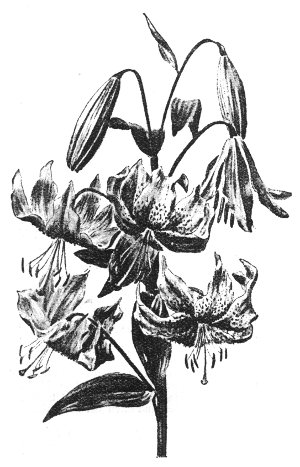
Lilium Speciosum.
For the last three months cut blossoms of Lilium Speciosum have decorated our table in the centre of London, and have afforded our friends and us real delight, creating subject for discussion at the dinner-table such as we have never known in connection with any other cut flowers.
Perhaps this has arisen from the fact that the floral decorations consisted of flowers of one botanical group only, making a truly consistent nosegay, and creating from its very uniqueness fit subject for special questionings and interest. Of course in the group there were several colours. The Speciosum Album and the varieties of white, the Speciosum Roseum with its varieties of lovely rose-colour, and finally the deep and rich Speciosum Melpomone. Nothing in the way of table decoration could be more æsthetic and cheerful-looking than an arrangement of such blossoms, in which we find real white mingled with a lovely purple red, and with nothing but the right gradations of colour between.
In the days of old it was the custom to group flowers of every conceivable colour—reds, blues, pinks, yellow, and others; but now we know better, two colours or three being the most effective scheme for table or bouquet effect, and in all our experience we have never found any general appearance more pleasing than that of our group of Lilium Speciosum.
One of the greatest testimonies to the value of these flowers is that the buds will develop and open into blossoms of their natural size while in water in a close room of a London square, and another reason for their value is that they last two or three weeks if attended to about every other day, that is, longer than any other cut flower of our cultivation.
A month ago we took up to town a bunch of Lilium Speciosum from our little country garden to garnish the dinner-table of a well-known doctor on the day of his golden wedding. There were, we were told, many other groups of flowers sent by friends for such an interesting occasion, but although many were from hot-houses, and some were valuable orchids, the group of Lilium Speciosum, so easy and so inexpensive to rear, had the place of honour, was admired the most, and lasted the longest number of days.
But we must not forget to mention an incident which happened to us while carrying this particular bunch through a City street from the railway terminus. We became conscious of a footstep close behind us, and felt that someone was keeping close to the flowers as they dangled at our side; but walking on unheeding, we presently relaxed our speed, when the follower made a semi-circle round the bouquet, watching it greedily until he faced it and us; then he turned and hastily disappeared, but not before we recognised in the London-dressed man a young and handsome Japanese! The flowers came from his distant land, and maybe reminded him of a home, a mother, or a sweetheart, and all so far away. We have ever since been ashamed of ourselves for not offering him one of the blossoms for a buttonhole.
The discouraging news given at the end of our first chapter led us to think: "Lilies will not grow in pots, but some kinds do fairly well in the open." "Lilies though suitable for pot plants are unsatisfactory for the flower-bed." Surely it is impossible to reconcile these two statements. Either one or both opinions must be incorrect. We must settle this point, and we can easily do so by growing lilies, both in pots and in the open ground.
We have before told you that we have ourselves grown eighty-seven distinct kinds of lilies. We have grown them in pots and in the open. We have obtained great satisfaction from both.
Few flowers are easier to grow in pots than lilies, and as they form probably the finest of all pot plants the culture of lilies in pots deserves more attention than it has heretofore received.
There are two ways of potting lilies, each of which has its advantages and uses, so we will describe both methods.
The first method is the simplest. Take a large flower-pot. No lily should be grown in a pot less than six inches in diameter. Of course the pot must vary in size with the size of the plant it has to contain. Lilium Concolor and Elegans grow well in six-inch pots; L. Auratum or Speciosum should have an eight or ten-inch pot, while L. Giganteum will require the largest sized pot procurable or a small tub.
One bulb only should be placed in each pot if absolutely perfect plants are desired; but very pretty effects can be obtained by growing two or three bulbs in a large pot or tub.
See that the pot is perfectly clean. Place about an inch depth of crocks, stones, etc., at the bottom, then put three inches of the prepared soil in the pot, and over this place a thin layer of peat, mixed with sharp sand and pieces of charcoal. Take the bulb, examine it, remove diseased scales and wash it in lime water, as you did in the case of the lilies you planted out last month. Dust it over with powdered charcoal and place it in the pot surrounded with sharp sand and peat. Then fill up the pot with the prepared soil.[1]
In potting lilies, deep potting is to be aimed at. No bulb should be placed at a less depth than four inches below the surface. Large bulbs require to be six, eight, or even twelve inches below the surface of the soil. The reason for this deep potting is that the flower stems send out roots above the bulb, and it is essential that these roots should be below the surface of the soil.
The second method of potting bulbs is similar in all respects to the above, except that the pots are not filled up at once. When you have placed the bulb in the pot you add a little soil, but leave the top of the bulb exposed. When growth commences, which will be shown by the appearance of roots and flower stems, you fill up the pots with the prepared soil.
Established bulbs and bulbs of the hardier lilies are best potted by the former method, but for bulbs received from abroad, especially those of the more tender species, the second method of potting is to be preferred.
Now that you have potted your lilies the question arises, Where shall you keep the pots? For the majority of lilies the best place is either a garden or a balcony. Lilies are too tall growing for window plants and it is totally unnecessary to coddle them up in rooms.
There are some lilies which will not come to perfection out of doors in our uncertain climate, except in very favourable seasons. These kinds, many of them among the finest of the tribe, will, however, grow admirably in a conservatory or room.
If lilies are grown in rooms, they should be put out of doors every fine day, as they require sun to mature their flowers.
The lilies which are not sufficiently hardy for the open air are, Wallichianum, Harrisii, Philippinense, Neilgherrense, Formosanum, Nepaulense, and Catesbaei. (With the exception of Neilgherrense, all these lilies will grow well out of doors in our southern counties in exceptionally fine seasons.)
November is over; our lilies are planted. How are we to treat them before the flowering season arrives?
Lilies out in the ground require but very little attention until the shoots appear. In severe winters Lilium Giganteum, Cordifolium, Speciosum, and one or two others, should be protected by bracken or other litter; but lilies stand the frost remarkably well, and rarely suffer from this cause before the flower shoots appear. Lilies grow all through the winter, forming roots. Lilium Candidum puts up an autumn growth of leaves, and occasionally other lilies do the same. When the shoots appear more attention is required. Those kinds which send up shoots in January, February, or March may need slight protection, such as a hand light, from frosts. As the season advances you must guard against two great enemies—slugs and drought. A dry April, not at all an unusual occurrence, will often do great damage in the lily garden.
During growth lilies require a very large amount of water. In a dry season it is a good plan to water them every day. An insufficient supply of water is one of the commonest causes of failure with lilies.
With lilies in pots only an occasional watering will be required before the shoots appear. As soon as this stage is reached they should be watered daily until the flower-buds appear.
If only we could guard against slugs! These are the greatest of all pests to the lily grower, and though there are many infallible preventives against slugs used and sold, not one of them answers its purpose. Soot is usually regarded as the best agent to use to prevent slugs from eating the tender spring growth of lilies. The soot is thickly dusted round the plant, and as slugs very much dislike any powder which adheres to their slimy bodies, they will not venture across the sooty track. No, they will not cross the soot—at least not until the soot gets damp, as it does after the first heavy dew or shower of rain. As soon as the soot gets wet it is no longer a deterrent to slugs. Lime is also recommended to be used in the same way as soot; but it, too, fails to serve its purpose when it has once become damp.
Then have we no way to keep down the ravages of slugs? Yes!—we have one way, a very excellent way, but a most tedious and unpleasant one to carry out. The only effective way of thwarting the ravages of the slugs is to pick off by hand the culprits, while they are gorging themselves in the evening.
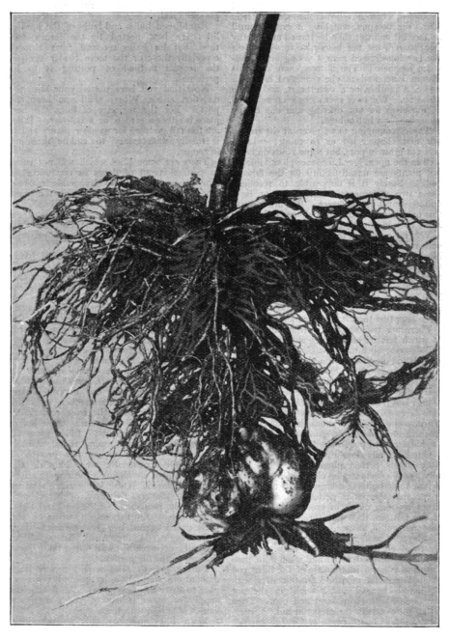
The stem and bulb of L. Auratum showing the relative quantity of roots given off above and below the bulb.
(From a photograph. Reduced to a quarter of original diameter.)
Go out as soon as the sun is set with a lanthorn and a gallipot filled with strong brine, and visit each lily-shoot in succession. You will see the slugs congregated on your pets by hundreds, from the little tiny fellow of one-quarter of an inch long, who is eating your best lilies in order that he may grow into a larger and more capacious enemy, to the slimy monster of six inches long, who is attempting to fill his vast maw with lilies of great value. All are there, all devouring your best specimens, as though you were their most hated enemy—as indeed you will be if you want your garden to look gay. These slugs are not, as one would suppose, dirty feeders, but they are gourmands of the deepest dye. They are not content with the outside or decaying leaves—not they—they want the very tenderest tops of the young shoots! When the lilies are about a foot high, they will not eat the leaves at the base, they must needs crawl up the stem to feed on the tender growing top of the plants. But now you can have your revenge. Pick off with your fingers[2] every slug you can see, be he little or great, and put him into the brine. The brine kills and dissolves them in a very short time.
Some gardeners place cabbage-leaves, etc., on the ground as "traps" for slugs, but alas! the tender lily shoot is far more tickling to the palate of a slug than any cabbage-leaf!
The damage which slugs can do to lilies is incredible, and unless these pests are summarily dealt with, every lily in a garden may be decapitated ere the summer commences. One reason why lilies in pots do so well is that it is not so easy for the slug to get at them.
The lilies are singularly exempt from the ravages of animals other than slugs. The aphides or green flies are, however, often very troublesome. We will refer to this pest when talking of the treatment of lilies just before and during the flowering stage.
The leaves of some lilies are sometimes eaten by the larvæ of the Lily Beetle (Crioceris Merdigera), but as this insect is a great rarity in England, we will not describe it.
There is neither animal nor plant which is exempt from disease, and the lily has inherited this universal tendency to disease. There are not many common diseases of lilies, and very few even of these do much damage to more than one or two kinds. But some of these diseases give great trouble to the lily grower, and often tax his patience to the utmost.
Some lilies are very prone to a form of mildew which, beginning as a minute spot of discolouration on one leaf, eventually destroys the whole of the foliage and flower-buds, and turns a beautiful, well-grown, apparently healthy lily into a brown slimy stick.
This disease usually begins to show itself about the middle of May. A small grayish transparent spot appears on one leaf, and in about a month it has spread and completely destroyed the plant. Not all lilies suffer from this disease, and of those which are liable to be attacked, not all suffer to the same extent. Of all lilies, Lilium Candidum is the most frequently attacked, and in this lily the disease usually destroys the deciduous portion of the plant altogether. The other members of the Eulirion group of lilies: L. Brownii, Wallichianum, Washingtonianum, etc., are also frequently attacked, but are rarely much injured by it. It also occurs on L. Speciosum, L. Superbum, L. Canadense, and, indeed, most kinds of lily; but in these it rarely attacks the flower-head and does not, in our experience, do much harm. We have never seen the disease in L. Auratum, L. Tigrinum, or L. Longiflorum.
Of the cause of this calamity we know but little, but we rather think that it is often due to growing lilies in soils which are too poor or are exhausted. This, indeed, seems highly probable in the case of Lilium Candidum, the most frequently attacked of all lilies, for it is grown by most people without any care being given to it, and made to shift in a dry sandy garden exposed to the full blaze of the sun and scarcely ever watered. Where lilies can have a good rich soil, with plenty of water, the disease is very uncommon.
Once established, this disease is very difficult to cure. Syringing with solution of sulphuretted potash, or of sulphur boiled in lime water, will sometimes stop it, but too frequently the disease runs its course to the bitter end. If you uproot the plant and examine its bulb and root, you will find both quite healthy-looking.
There is another disease which, though not so devastating to the lily garden as the last, is yet very exasperating and even more fatal in its results.
Here is a beautiful strong growing Lilium Auratum, eight feet high, just showing its flower buds, and showing a large series of beautiful glossy leaves. Next week we notice that the lower two or three leaves are yellow and withered. Every day more and more leaves die, and eventually what was once a beautiful plant is now a naked stalk with a girdle of fallen yellow leaves and buds around it. Dig up the plant and examine its bulb and roots. The base of the bulb is gone! And its place is taken by a mass of evil-smelling pulp. Swarms of little thread-like worms will be seen twisting about all over the diseased portion. It seems natural to think that these worms are the cause of the evil, but we do not think that this is so. The worms are the result, not the cause of the disease.
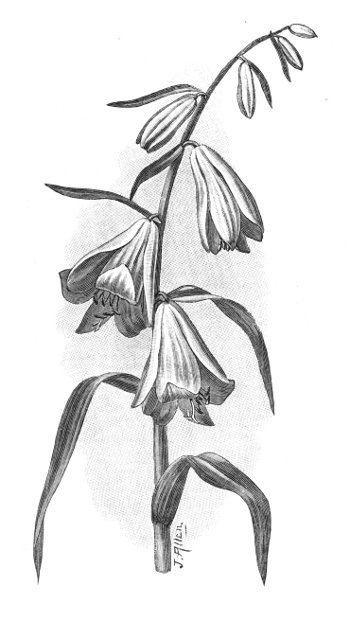
Lilium Hookeri.
Lilium Auratum and L. Speciosum are the two lilies which mainly suffer from this disease, but other kinds are occasionally attacked. When once manifest, no treatment has any effect. Take up the plant as soon as you are certain that this disease has started, thoroughly wash the bulb in water, and let it soak in lime water for three days. Then thickly cover with powdered charcoal, and replant. If you do this the bulb may recover, and send up a good spike of blossoms next year. If you have bought good bulbs, and have planted them as we directed last month, you need not fear that you will lose many plants from this disease. Of one hundred and six lilies which we had in pots this year we have only lost one from this cause.
Yet another disease to irritate and discourage the lily grower! Look at this Lilium Humboldti. Its leaves are well developed, and it already shows five flower-buds, but on closer observation you will see that the stalks which support these buds are black and withered. Or see this L. Martagon, which shows a head of twenty blossoms. Touch these blossoms, or gently shake the stem, and five or six buds drop off! These buds, you will observe, have a black rotten base!
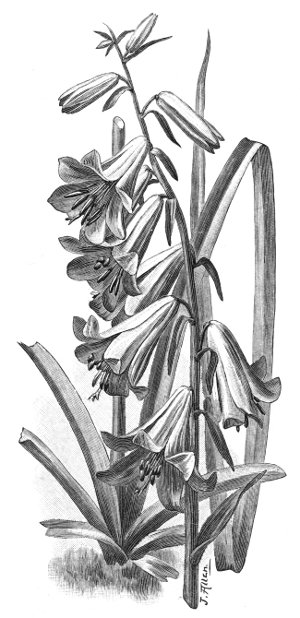
Lilium Roseum.
This disease is caused by three or four causes. If the bulbs have been planted in a poor or dry soil, or if the spot is unsuitable, you will lose many of your lilies from this cause. Bulbs which have not been properly ripened often disappoint you in this way. Again, if you delay planting your bulbs till February or March, you must expect to be treated in this way. But the most common cause of all is the presence of mildew among the scales. You can guard against this by paying attention to the methods described in our last number.
There are three other ways by which lilies may disappoint you. They may either not come up at all, or they may come out but fail to produce flowers, or they produce flowers which are damaged and are deformed or discoloured.
The first of these untoward results is usually due to the bulb having rotted in the ground. You can do nothing for this but bear the loss philosophically. You should remember, however, that some lilies, especially Lilium Longiflorum, often lie dormant for a year, but come up the next year better than ever.
No lily will flower every year, and some lilies require a year or two to get accustomed to a new home. These will not flower the first year. As a rule, when a bulb does not send up a flowering shoot, the bulb itself grows to a very large size.
It is most annoying to see a lily which promises well belie itself and produce either a deformed or a cankered flower. The cause of the first is almost always green fly. To this we will refer later. The cause of the latter is either too poor soil, abuse of liquid manure, or continuous rain just before the flowers open.
Lilies like the rain. If the weather were arranged to please a lily, it would rain every day from the time when the shoot appears till the flowering period has arrived. But lilies object to rain from the time that the buds begin to change from green to white, or whatever colour the bud will eventually become, until the flower is fully opened. It is here that lilies grown in pots have the pull over those grown in the open ground, for if a spell of rainy weather occurs at the wrong time, the pots can be taken indoors or placed under shelter, which is impossible in the case of lilies grown in the open. But something can be done for the lilies which are exposed to the weather. The buds can either be wrapped round with oiled paper, or else they can be sheltered by an old umbrella tied to a stick. By this latter means we have saved many valuable lilies from disaster.
Lilies vary much in their powers of enduring excessive rain at the flowering period. Lilium Auratum, Candidum, and some others are nearly always ruined when they happen to flower in a spell of rainy weather. Lilium Giganteum, Concolor, Tigrinum, and many others stand rain at their flowering time with ease.
Do not be frightened at this chapter of possible calamities. Although it comes so early in our series, do not let it damp your enthusiasm. These diseases have to be described, and we have described them, but though they are, unfortunately, far from uncommon, if you grow lilies carefully you will not lose many from any of these causes. We have grown many hundred lilies, we have seen all these adverse conditions, but they have not damped our ardour. We lose a few lilies every season, but then there are plenty which give us full satisfaction; and lilies are such gorgeous plants! If you were to lose half of your stock, and the other half were satisfactory, you would not complain at the result, for the good half would delight you and your friends as no other flowers would.
(To be continued.)