Part 2 — METHODS OF MOUNTING FOR GIRL CYCLISTS.
Reading edition
By Mrs. EGBERT A. NORTON.
Nothing else, I think, affords one such a good opportunity of judging of a girl's general capabilities or style in riding as the way in which she mounts her machine.
In this matter as in so many others a "good start is most important."
Having already mastered the principle of steering, the mystery of the mount is a matter of balance only.
There are several points which, if borne in mind, will considerably help the beginner in first attempts, namely—
1. To select a road inclining slightly down-hill.
2. Stand on rather higher ground than the bicycle.
3. Incline the front wheel slightly to the right.
4. Be careful not to check the motion of the machine by too much pressure on the pedal after it passes its lowest point.
5. Do not catch the left pedal too quickly, or apply pressure before it passes the top centre.
There are five distinct methods of mounting for skirted riders, two of which are suitable for beginners only, the other three for more advanced riders.
I.
Imagine an individual who has some knowledge of riding, but who is unable to mount alone; refusing all offers of assistance she determines to assert her independence.
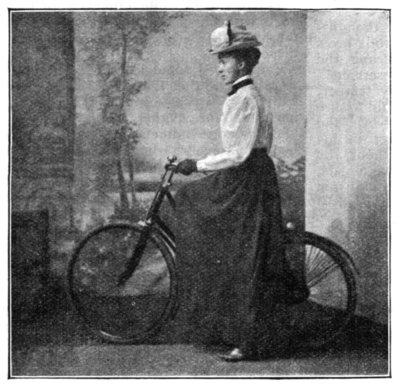
FIG. 1.
Standing on the left side of the machine with the right pedal just past its highest point, she steps across the frame, and places her right foot securely on the pedal, the saddle being so low that she is able to take her seat easily, the left foot being still on the ground. Then putting as much pressure as possible on the right pedal and pushing off with the left foot, she starts the machine—not perhaps without a few failures first, but nil desperandum. Independence must cost something, and if she will consider, I have no doubt her failure can be traced to one or the other of the above mentioned causes. But how tiring the ride will be, and how awkward the whole position, the knees moving most ungracefully high with each revolution of the pedal—all defects caused by the saddle being adjusted much too low.
II.
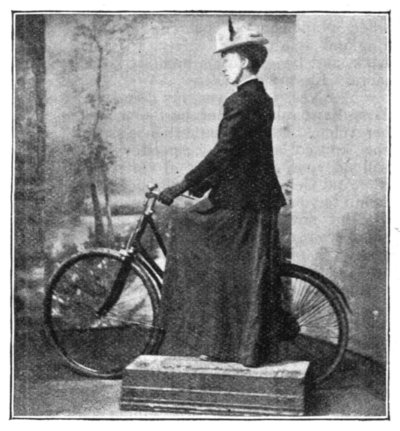
FIG. 2.
Now if she would only listen, I should advise her to raise her saddle inches higher until it is nearly on a level with the turn of the hip, and, if still determined to learn alone, wheel the machine to the kerbstone or other eminence, to enable her to seat herself in the saddle, and then push off as before. Her appearance once mounted is now greatly improved, and when I tell her so, after enjoying a nice little run with none of the previous feeling of tiredness, she is quite ready to listen to what further I have to say on the subject. Seeing that it is quite impracticable to always depend on the help of the friendly kerbstone, we will try and master mount
III.
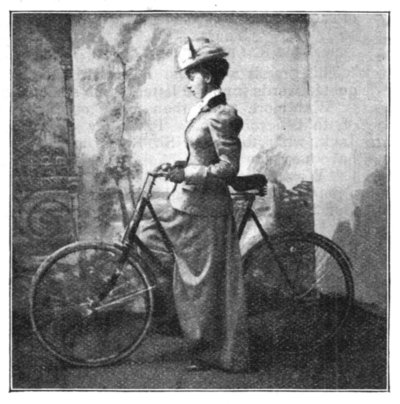
FIG. 3.
Having already learnt the importance of the height of saddle or length of reach from pedal to saddle, first ascertain that this is adjusted correctly. When sitting erect in the saddle with the leg straight and pedal at its lowest point, the heel of the foot should be able to rest on the centre bar of the pedal with ease. The saddle is now so high that it is impossible to sit on it with the foot still on the ground, so for this reason "The Spring Mount" is the term generally given to this method of mounting. Taking a fold of the skirt in the right hand, pass the right foot over the frame and place it securely on the right pedal when it is about half-way between its highest and lowest point, the left foot resting on the ground close to the machine and well before the left pedal, stand quite central with the body perfectly free from the saddle, then by standing on the right pedal the machine moves forward, the body is raised and drops gently back on to the saddle, the other pedal rises under the left foot ready for the next thrust forward, and the deed is done, easily, steadily, gracefully, but from the first there must be no hurry, no quick jump for the saddle, or scramble for the left pedal, but first the weight on the right pedal, then the saddle moves forward under one, and the downward thrust with the left foot preserves the balance. This is the mount most generally adopted, with more or less degree of efficiency, and on the whole is really difficult to improve upon; the only thing that can be said against it is, that the first position standing with the leg across the frame and the foot raised is not particularly graceful. Personally I much prefer mount
IV.
The near-side mount. It is more uncommon and infinitely prettier in my opinion when well done, than either of the others, but it requires a little practice to get the skirt to fall well. Stand close to the machine with the left foot on the left pedal, then firmly holding the handles throw all the weight on the pedal, at the same time springing forwards and sideways to the saddle. In first attempts all the fulness of the skirt invariably falls to the left; this can be remedied as the machine is in motion by a little forward movement throwing the weight on pedals and handle-bar, then as the skirt falls straight down, move centrally backwards to the saddle again. Be in no hurry to reach the saddle and the skirt will adjust itself. Move well forward with the downward movement of the pedal, throw the weight on the handles as it rises, the peak of the saddle will then divide the skirt as you take your seat and give your first thrust to the right pedal.
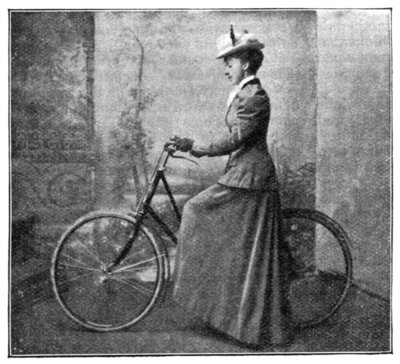
FIG. 4.
This is worth a little practice, as correctly done the skirt needs no arrangement with the hand, and the mount is certainly quicker and more graceful than any other.
V.
Is somewhat similar, but is done while the machine is in motion, and is therefore pre-eminently the mount for busy thoroughfares.
Walking on the left of the machine, give a quick hop with the right foot, placing the left on the pedal when in any position, then a sudden pull on the handles, will lift one forward on to the saddle without checking the motion of the machine.
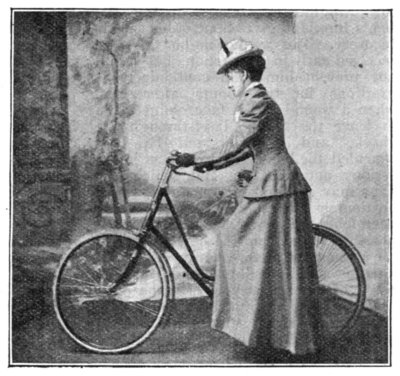
FIG. 5.
This is a most useful mount for traffic and for all occasions where a quick mount is necessary. It will probably require considerable practice to accomplish successfully, but the feeling of complete mastery it gives one over the machine is worth some little trouble to acquire, and when the feat is accomplished, I think you will look back on the learning of a new method of mounting as another pleasure added to the many enjoyments of cycling.