Part 1 — FROM LONDON TO DAMASCUS.
Reading edition
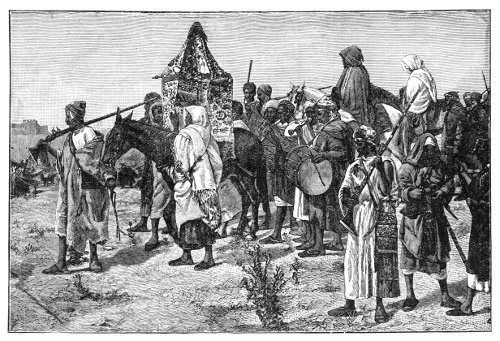
WATER SELLERS, PORT SAID.
I suppose most girl-readers will understand the thrill of surprise and delight with which I read the following sentences from a friend's letter one February morning.
"My uncle thinks I need a change, and suggests my going abroad. Will you go with me to Palestine for two or three months? We ought to get off before the warm season begins there. Do you think we could leave England at the end of this month?" Two or three times I read the words in a dazed sort of way, and then astonished my hostess (a well-known contributor to the G.O.P.) by quietly remarking—
"Would you be greatly surprised if I started for the Holy Land in a few days? Elizabeth N. has asked me to go with her."
"The Holy Land!" echoed Mrs. B. "Do you really mean it?"
For answer, I handed her my letter, and greatly enjoyed the sensation it created at the breakfast-table.
"How lovely," said kind Mrs. B., "to visit the sacred spots where our Lord began and ended his ministry. How I wish I was strong enough to go with you!"
"Shall we order the camels to come round to the front door?" exclaimed a lively and irreverent member of the family. "I can already picture you, dear E., riding over the trackless desert (composing poetry under an umbrella), living in Bedouin tents, and finally being carried off by a wild Arab chief, on a wild Arab steed, while we at home mourn and frantically petition the Home Secretary or somebody to institute a search for the missing English lady."
We all laughed at this ridiculous, unpunctuated speech, and then fell to discussing the possibilities of eastern travel.
The next post carried my answer to Elizabeth's letter, and in a few days we were in London making our final arrangements. We decided from motives of economy to go by long sea, and selected the North German Lloyd line of steamers because of their excellent second-class accommodation. We booked our passage to Port Said in the Prinz Heinrich, sailing from Southampton on February 28th.
Our remaining days were fully occupied with business, in the intervals of which we packed our small portmanteaux (not omitting warm wraps), got our passports viséd at the Turkish Consulate, and attended to the hundred and one trifles which seemed to crop up at the last moment. It was not till we were safely on board the steamer and waving our good-byes to the friends who had come to see us off, and who were now returning to shore, that we felt our eastern travels were to become a reality.
Fair indeed looked the green slopes of the Isle of Wight on that glorious morning, and as we passed the Needles, many eyes filled with tears, for the ship was bound for distant China and Japan, and few of her passengers could hope to look upon Old England again for many long years. As for us, our hearts were light, and we were eager to go forward. Not even the unknown terrors of the Bay of Biscay appalled us. Fortunately it proved most kind. We passed Gibraltar at midnight, on March 3rd, the wonderful old rock looking awful and mysterious in the moonlight. Genoa was reached on the 6th, but, alas! heavy rain and cold winds set in, and the "superb" city did not look tempting enough to draw us from our comfortable ship for the forty-eight hours we were tied up in her harbour. There was a general murmur of satisfaction when the last cargo had been shipped and we were on the move again. As we entered the bewitching Bay of Naples the weather cleared, and the sun shone warm and bright. Here we had to wait until the evening for the mails, and everybody seized this opportunity of going on shore. How well I remember my sensations of delight as we wandered about the old streets, admiring the queer, tall, gaily-painted houses and the quaint bits of picturesque Neapolitan life which we came upon in our long climb to the top of the old ramparts which overlooked the busy city. From this height we gazed our fill on the pretty picture. The lemon trees with the golden fruit shining through the glistening leaves threw a shade on the irregularly-built houses. Beyond glittered the glorious bay, dotted with stately vessels and other smaller craft, while above loomed the giant Vesuvius, his sullen frowns adding a touch of melancholy to the scene. All too swiftly that dream-like day passed, and once again we were sailing Eastward Ho!
Wickedly did the fair Mediterranean behave for the next four days, and wildly did our good ship pitch and toss on those treacherous blue waves! Those days were days of intense bitterness of spirit, when to most of us past sorrows and future hopes were forgotten in the agonising longing for immediate annihilation. But even sea-sickness yields to time and smooth water, and we had begun to take a more cheerful view of life when we dropped anchor in Port Said on Sunday the 13th. Our curiosity was strongly excited, and though we were truly sorry to say good-bye to our travelling-companions, whose lives had touched ours for a brief space in pleasant intercourse, we were eager to get our first glimpse of eastern life. We smiled in quite a superior manner when an old gentleman, noticing our impatience, remarked cynically—
"Well, young ladies, if you can find anything pleasing in that hole"—indicating the town—"I should say your capacity for enjoyment must be abnormal."
Summoning a boat, whose boatmen bore on their scarlet jerseys the legend "New Continental Hotel," Elizabeth and I stepped into it and waved adieu to the good ship Prinz Heinrich. We were quickly rowed ashore, where the hotel guide took our passports, showed them, and us, to the Turkish official, who courteously handed us over to the customs-house officers. These gentlemen proved to be equally civil, evidently seeing nothing suspicious either in us or our modest luggage. Our formal introduction to Egypt being thus agreeably made, we walked to the hotel, and were soon seated under the cool verandah, discussing delicious tea and bread and butter. We ascertained that the steamer going to Jaffa did not leave before Tuesday evening, so that we had ample time to become acquainted with Port Said. What an un-Sabbath-like appearance our novel surroundings presented! Noisy donkey-boys, with bold inventiveness, were loudly urging the new arrivals to mount Queen Victoria, Lord Salisbury, Prince Bismarck, Mrs. Langtry, Mrs. Cornwallis West, etc., for these high-sounding names were tacked on to the wretched little donkeys. Bare-legged shoe-blacks, with most engaging smiles, seized your feet and began operations without even a "By your leave." Importunate blind beggars, whose picturesque garments were indescribably dirty, demanded backsheesh, and according to the response, poured out a choice selection of blessings or curses in Arabic, which would have astonished the most accomplished Irish professor of the same craft. Shrewd, hook-nosed Jewish money-changers sat in the highway, each before his glass box, which contained a wire tray covered with a tempting store of bank-notes and coins. These had doubtless been exchanged at an exorbitant rate of interest for Turkish money. Black men, white men, brown men, yellow men in their native dress, sat drinking coffee and playing backgammon and dominoes in the open street, or walked leisurely along the road. It was a strange, fascinating scene, unlike anything we had witnessed before, and the ubiquitous bicycle as it flashed by with its British rider failed to break the charm.
Towards evening we strolled into the town, where we discovered an English "Sailors' Rest." We opened the door, and following the sound of voices, boldly walked upstairs. In an upper room knelt twenty Jack Tars, who had come in from one of her Majesty's ships lying in the harbour. Very hearty and refreshing were the simple prayers uttered by the men. Only too well they knew the dangers and temptations of a shore life. We heard afterwards from the gentle lady who presided at this gathering how that bright little room, with its books and pictures, and, above all, the presence of kindly friends, had proved a haven of peace to many of our British sailors, for whom the perils of the ports are more terrible than the perils of the deep. On our return we found letters from our friends in Jaffa, telling of unprecedented storms visiting the coast, and reminding us, that unless the present wind went down, we should find it impossible to land. In the event of this happening, the only other alternative was to go on to Beyrout, and from thence to Damascus by rail. This plan did not commend itself to us in the least, for we particularly wished to begin our Palestine wanderings from Jaffa, and also we desired to consult our friends there as to the best routes, and other important items relating to our tour. It was no use grumbling, however, and as we could not arrange the weather to our liking, we wisely agreed to let it alone, hoped that all would be well, and that we should yet enter Jaffa with a fair breeze and in smooth water.
Two days served to satisfy our curiosity and exhaust for us the delights of Port Said; therefore we were not sorry when Tuesday night arrived, and we were once more on board a ship, which we trusted would bring us in a few hours to our desired haven.
Before the sun rose next morning we were straining our eyes towards the dim coast-line. Presently the compact little town of Jaffa came in sight, and before long our last fear about landing was set at rest, for we saw the boats putting off from the surf-beaten shore and racing one another towards our ship. In one of them sat our missionary friends coming out to meet us, delightedly waving their pocket-handkerchiefs. On board the steamer wild excitement prevailed. Travellers were hunting for lost luggage, or rushing distractedly hither and thither, while everybody seemed to be talking at once in unknown tongues, making confusion worse confounded. In the midst of it all our friends managed to find us, and gave us a warm welcome to Palestine. They kindly undertook all the difficulties connected with the customs and passports. A porter was secured, who seized our boxes and wraps, and promptly disappeared. We wondered whether we should ever see them again, but our friends said they would turn up all right. We then joined the group of nervous passengers who were being encouraged to jump into the boat below. I don't remember how we managed it, but I think we blindly took the "leap" at the right moment. Anyway, we discovered ourselves unhurt on the top of a big trunk, which swayed perilously with our weight. Passengers and luggage were hopelessly mixed up, but we were delighted to find all our party together. At last we were off, and in a short time the dangerous reefs were passed safely, but we were on the Jaffa beach, the dreaded landing having been accomplished without any accident.
We were now marched through the Customs House into a narrow lane, muddy from recent rains; here we had to wait until our baggage was examined. An hour or more elapsed before we and our belongings came together again. Occasionally we would see a portmanteau, which we knew to be ours, rapidly vanishing in an opposite direction; then ensued a lively dialogue in Arabic between the porter and one of our missionaries, which ended by the disputed article being brought and placed near at hand, to await the arrival of the remainder. I may mention that the Jaffa porters are veritable Samsons. They carry with the greatest ease a couple of boxes, one of which would break the back of an ordinary London porter. We were told of one who carried a grand piano bodily on his back from one house to another, a distance of several hundred yards.
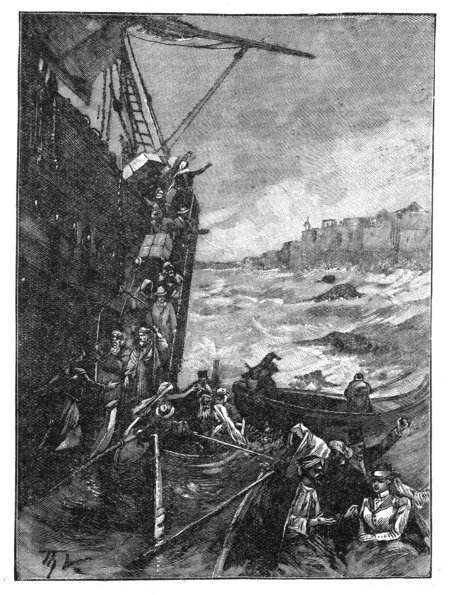
LANDING AT JAFFA.
We were greatly interested in our muddy lane. The scene was so truly oriental that it is worth describing, though the vivid colouring and the intensely blue sky must be left to the imagination. Turbaned merchants, indifferent alike to puddles and slush, sat on little straw-covered stools smoking the hookah, or hubble-bubble, in the dignified leisurely manner of the East. Hawkers carrying huge brass trays, filled with curious cakes and sweetmeats, cried their wares. Water-sellers, with their uninviting-looking goat skins slung across their shoulders, went to and from the well. Moslem ladies thickly veiled, and covered from head to foot with a white sheet, stopped to look at the new arrivals. Fellaheen women, their faces uncovered, did their marketing, grave Syrian gentlemen, tall powerful Abyssinians, Jews with lovelocks on each side of their faces, graceful Levantines, stately Persians, fair-complexioned Armenians, long-haired, black-bearded Greek priests, shaven Latin priests, pilgrims from many lands on their way to the Holy City, stopped to exchange greetings, or passed on with a brief salaam.
Strings of camels, laden with oranges, ambled by, their long necks bobbing from side to side, their "melting" eyes looking such unutterable things—we felt quite drawn to the creatures. Afterwards, when we knew the camel better, we liked him less, and ended by accepting Mr. Kipling's unflattering estimate of him, who—
"When all is said and done, Is a devil, and an ostrich, and an orphan child in one."
Swift little donkeys, and gaily caparisoned Arab horses, ridden by resplendent-looking Arabs, pushed their way unceremoniously through the crowds. We noticed that nearly all the animals were decorated with blue bead necklaces, or else one or two beads were tied to their tails or forelocks. These are believed to act as a charm against the "evil eye." Mothers fasten these charms to their children's hair, and it is neither safe nor wise for a "Frangi"—as the European is called—to look admiringly on either child or beast, for fair-haired, blue-eyed people are credited with possessing special power of casting the evil eye.
During our week's stay in Jaffa, as guests of our missionary friends, we had exceptional opportunities of seeing the country and the inner life of its people. Most travellers leave the same day they arrive, going up to Jerusalem by the afternoon train, and carrying away the impression that Jaffa is a dirty, uninteresting town. We found our days all too short, there was so much to see and hear. Several afternoons were spent in the famous orange gardens, or bayaras, and very grateful was the shade of the trees even in March. The scent of the flowers and fruit fills the air; indeed, in certain winds, it is wafted miles away out to sea. We often had boughs of this delicious fruit presented to us. To eat it seemed almost a crime; the oranges looked so beautiful hanging amid their shining leaves and silver blossom. We were constantly reminded of the appropriateness of Solomon's simile, as we listened to the courteous speech of our Arab friends, accompanied by pleasant smiles. "A word fitly spoken is like oranges[A] of gold in pictures of silver."
Within the last few years Jaffa has shown a desire for progress. The thrift and prosperity of the German and Jewish colonies are teaching the Arabs the value of commercial intercourse with other nations, as well as the best methods of cultivating their land. The missionaries are also doing much towards civilising the people, by teaching the gospel, and opening schools for the children, where they learn invaluable lessons to carry back to their homes.
The English hospital is also another proof of missionary zeal, and brings the fellaheen from distant villages into touch with skilful hands and loving service, unknown and undreamt of by these poor men and women; for the Moslem is a fatalist; his religion makes him one. If his favourite wife or child dies, he accepts it without emotion, as being "God's will." If he is ill himself he takes little or no pains to seek remedies; his illness is "from God." I heard of a man who went on pilgrimage to Mecca last year. He was sincerely attached to his wife, and allowed her to accompany him as a very special mark of his favour. After five months' absence he returned, having exchanged his ordinary turban for the sacred green one, and resumed his interrupted work. One day he called at the house of a friend of ours. She inquired after his wife's welfare, and received the unexpected answer, "The Prophet had need of her, and I left her in the desert." It seems that the poor woman fell ill on the long journey, but with an unusual display of affection her husband cared for her until she recovered. She again became sick, and this second attack convinced him "that the Prophet wanted her," and allowing fatalism and superstition to stifle the feelings of humanity, he left her in the desert to die, where, in a few hours, the vultures were feeding on the poor dead body.
We visited the prison one morning, and saw the wretched prisoners huddled together, in cells like cages, ranged round an open courtyard. Eager hands were thrust through the bars, and cries of "backsheesh" filled the air. One of the "cages" was called the blood prison, in which several murderers were imprisoned; they clamoured with the rest for money. We looked with pity upon the miserable creatures, for we were told that it was quite possible most of them had not committed the crimes of which they were accused, but that private spite and intrigue had brought them there, where they would probably remain, unless large bribes were paid for their release.
Another day, as we were riding across the plain of Sharon, we were much amused at seeing a camel ploughing. He strode along, ostrich fashion, with his most supercilious air, pulling behind him a ridiculous little plough of primitive make. He looked so irresistibly funny that we burst out laughing. In other parts of the country we saw camels and oxen yoked together, but more generally the latter animals only. Ploughing would seem to be but a pastime in Syria. The soil is so rich and fertile that it only needs turning over slightly, when the seed dropped into the furrows springs up in a marvellously short time and yields a rich harvest.
We had many discussions with our friends about plans for further travel. Eventually we decided to go to Jerusalem, and while there engage an experienced dragoman to accompany us through Judea, Samaria and Galilee. We made up our minds to go alone, and avoid tourist routes and tourist parties. Though this decision was thought somewhat rash, we had no occasion to regret it.
S. E. B.