Part 1 — FROCKS FOR TO-MORROW.
Reading edition
By "THE LADY DRESSMAKER."
If the French craze for plaids and tartans be followed in England, it will be as well to remind everyone that there are certain people to whom they are quite forbidden. I refer to the very stout and the very thin. And it is to be hoped that these two classes may be wise in season and avoid them. For the rest, the new plaids are, some of them, pretty and in quiet hues, though I noticed, when in Paris, that people liked them more vivid as to colouring, and one consequently saw some very lively-looking ones in scarlet and bright red. These plaids are more used as skirts than as entire dresses; in fact, the newest departure in coats and skirts is to have the skirt of plaid and the coat of a plain cloth which suits it in colour. For this purpose a sacque coat is always used, and this is a fortunate thing, for they suit all figures, thin and stout, equally well; but they, more than any other description of jacket, require a good cut, as they are so easily made to hitch up or to droop at the back by an inexperienced cutter. And the oddest part of it is that no alteration seems to do any good, for the trouble appears to lie deeper than that, in the very foundation of the jacket.
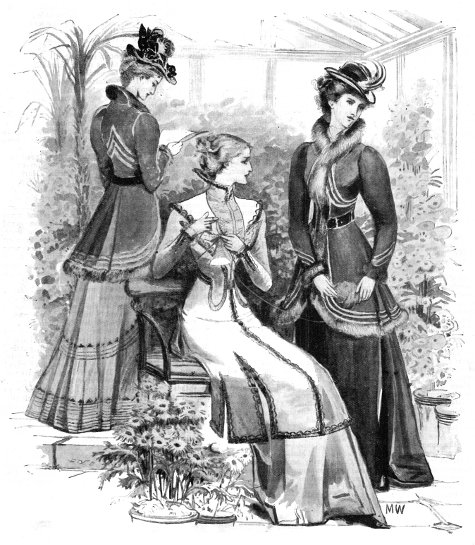
JACKET WITH ROUNDED FRONTS. GOWN WITH TUNIC.
The few notes that I have collected together on the subject of furs I will use at the beginning of my article. Fur trimmings of all kinds are very much worn, and so many of the winter gowns are decorated with fur bands, that the fashion seems like a uniform. The peculiarity of this form of trimming is that this season it must be accompanied by bands of brightly-coloured velvet and generally with braid. Seal and sable are constant favourites, and they will be used in combination for the fitted-back jackets or sacque-backed ones, which are the two shapes for fur jackets at present. Skunk and bear, which were last year so popular, have fallen out of favour; but caracul is much used, and has not been freshly named this year. So far as I can see, white satin seems to be the popular lining for all fur jackets and capes, though I have seen one or two lined with gold colour and pale blue. The capes of fur follow the fashion of those in cloth and are flounced just as they were last year, many of them; but this year the flounces are wider and more visible to the eye. The collars of all fur garments are very high. And, lastly, I must mention that long fur boas are expected to take the place of the feather ones to which we have been so faithful.
As I look round trying to satisfy myself as to the fashionable colours for the autumn, I find myself in a decided difficulty. There is a new shade of lavender or hyacinth-blue, which is very pretty, but needs to be toned down with white or black, and I am sure others will have noticed that there is a perfect run on lavender-blue hats, which are prepared for the winter in every shade of this hue. Then there is a deep-hued tomato-red, which is very handsome in velvet, and a new blue known as "old Japanese." Dark brown cloth, with reliefs of orange velvet and satin; grey face cloth, with reliefs of turquoise blue; and red with black cordings, are all fashionable winter mixtures. Pink, ranging from a pale coral to a very deep du Barry rose hue, is quite as much worn as ever, and from what I see, orange-colour is the same.
Both for day and night the hair is now dressed quite low on the nape of the neck, in a coil of twists, and on the head and over the ears it is waved in wide undulations, the front hair being cut short and curled over the forehead. For the evening a rose fastened in by a diamond pin behind the left ear is said to be the latest idea.
The reason of this change in the style of dressing the hair appears to lie in the change in the style of the hats and bonnets of the season. There is no doubt that, to the majority of Englishwomen, the hair dressed in this manner is more becoming than in any other style.
In the way of new skirts we find several in which there are neither pleats nor gathers at the back; but the most popular have two box-pleats, on which there are placed (in some skirts at least) a row or two of rather large buttons, from the waist to the hem. Dresses are, I am sorry to say, being made very much longer in the skirt. They touch the ground at the front and sides, and lie on it completely at the back, while for evening use the long train is universally adopted. I think the Princess-gown will be the favourite one for evening use, and here sleeves seem to be banished entirely, a velvet ribbon or a flower being considered a sufficient substitute for them. For walking-skirts in thick materials, however, the sensible ones are to be left a choice, so we shall probably see as many short skirts worn as long ones. After all, the bicycle-skirt has to be considered, and many of us wear that in the country nearly all day long.
Our first illustration shows two of the reigning winter and autumn styles, namely, the three-quarter jacket, and the strapped cape, with bands of cloth piped with scarlet silk. The figure on the left wears a tailor-made and beautifully-fitting jacket of grey cloth, which is braided with a darker grey braid over bands of paler grey cloth, the lines running longitudinally from the top of the collar to the edge of the jacket. The skirt is of plain cloth of the same tone of grey as the jacket. The latter is lined with orange silk. The toque is of orange velvet, with cream-coloured lace, and feathers and wings of orange and black.
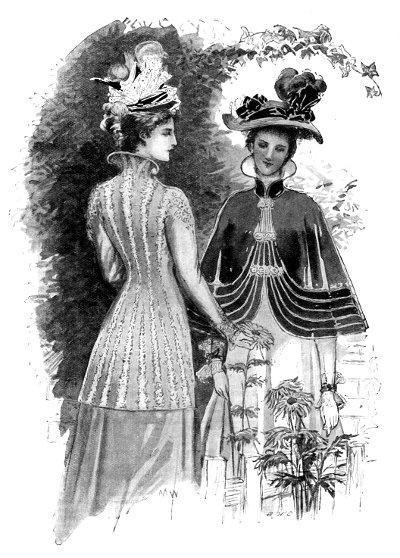
GOWN OF GREY CLOTH.CAPE WITH CLOTH BANDS.
The second figure in the illustration wears a black cloth cape, lined with scarlet silk, and piped with the same at each side of the wide cloth bands, which make the decoration of the cape. These bands are tapered gradually round the fronts and up the sides, where they are crossed with ornamental straps which fasten the cape in front. The collar is high, and is piped and lined with scarlet. The hat is of straw, with scarlet and black velvet, and black feathers at one side, and scarlet and black rosettes below the brim at the back and sides.
The next illustration consists of a single figure only, who wears one of the new jackets of the winter, the material of which is dark green cloth, braided in black, and edged with caracul fur. The new feature in this jacket is the flounce of cloth of about eight inches in depth, which is placed round the edge, and which is also trimmed with fur. The hat is of white felt, with trimmings of green velvet, and green feathers; and the dress worn is of green cashmere, with green velvet trimmings.
The group of three figures fully displays one of the most stylish of the season's confections, two views being given of it, a front and a back one, on the figures which stand on the right and left. This jacket is of cloth, tight-fitting, and of three-quarter length, with the fronts rounded to the bands at the waist. It is trimmed with bands of fur, and with cloth bands of a lighter colour, which taper towards the waist in front, and on the bodice are arranged so as to simulate an Eton jacket. The seated figure shows one of the new tunics. The material is of dark blue cloth, and the tunic is cut to reach a little below the knee. The bodice is open in front to show a vest of apricot-coloured velvet which has white lace motifs on it. The tunic and the revers of the bodice are edged with bands of astrachan, which is laid on apricot velvet, edged and overlaid with fancy braiding in black. There is a large collar high at the back, which is bordered in the same manner, and lined with black velvet. The edge of the skirt is trimmed with bands of astrachan, which are put on to match the battlements of the tunic.
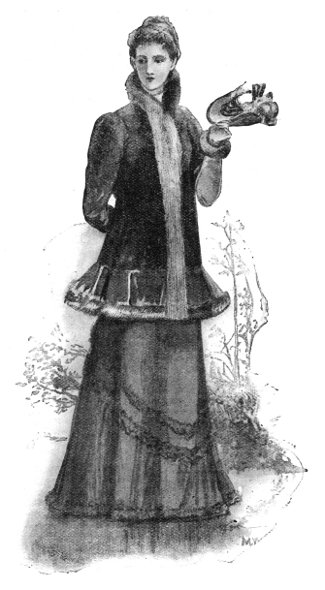
NEW WINTER JACKET.
The very smart coats of the autumn are all made of a thick satin merveilleux, which was used for the same purpose some years ago, and seems to have returned to favour. Other coats are of black velvet, on one of which a great deal of Irish crochet lace has been lavished as decoration; but all of them are of the same three-quarter length, and aspire to great perfection of cut and fit. One sees by these coats how desirable it is to be slight in figure, for most of these fashions are only suitable for the thin. Pipings are the predominant ornament; and, indeed, this form of decoration is more popular than anything else.
Mittens are coming into use, and, for the evening, will perhaps supersede gloves; the late tropical heat has rendered the most careful people quite careless of their gloves, and it has been nothing remarkable to meet well-dressed women in the street carrying their gloves in their hands. The ribbon bands round the neck, which have been so much used this year, are now being replaced by velvet ones, tied in the same manner—in a bow at the back. It is rumoured that wide strings of ribbon for bonnets are coming in again, but I do not think it likely, as they add much to the look of age on the face.
Hats turned up in front were an introduction of the later summer season; but they have taken immensely, and will be worn during the winter, and it is well to remember, nevertheless, that they require a plump face, for thin cheeks stand no chance at all, in their very uncompromising lack of shadow.
The following is sent by an anonymous reader in response to the address on our Prospectus.—Ed.