Part 2 — OUR LILY GARDEN; PRACTICAL AIDS TO THE CULTURE OF LILIES.
Reading edition
Every person needs some form of hobby—something to employ his time when the work of day is over. The mind wants some kind of recreation from the worries of business cares. We have felt this want, but we found that when we came to consider what our hobby should be many difficulties presented themselves.
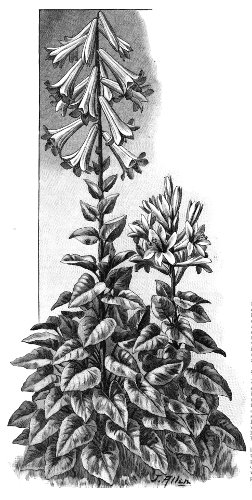
Lilium Giganteum. Lilium Cordifolium.
In the first place, we wanted a hobby which would really interest and instruct us; one which would tell us something which we would be glad to know. Secondly, as our lives are spent in the heart of London, we wanted some form of recreation which would prove healthful and invigorating. We can find but one amusement which fulfils this last necessity, and that is the study of natural history.
But natural history is a very large subject, and we have not the time to study all its branches. We must decide on one branch. And here the great difficulty occurred. Which branch shall we take up? Well, after discussing the various pros and cons of the subject we at length determined upon gardening. But gardening is a very hackneyed subject, and besides, it has too wide a scope. Let us decide to cultivate one family or genus of plants. But which shall it be? Let us think. We do not want to grow vegetables; we want flowers. Shall we say roses? No, we have numbers of roses already, and besides, our country garden is in the most sandy part of Surrey, the very worst soil for many kinds of roses. Well, shall we try lilies? Ah, why not? No one, we know, gives special attention to lilies. Yes; let us decide upon lilies.
You see, there are so few lilies that we can easily grow them all! Why, we only know of five or six different kinds, and are quite sure that there cannot be very many other varieties! Fond delusion! There are not only five, nor fifty, different varieties of lilies; there are over one hundred and twenty varieties known to botanists. This was rather a damper to our enthusiasm, but on further consideration we congratulated ourselves upon this discovery. For if there are one hundred and twenty distinct varieties of lilies, and only some half-a-dozen kinds are well known, what a chance there is for us to do something original!
How splendid it would be to be able to grow lilies which not one person in a thousand has ever seen! With what pride could we show to our friends a beautiful garden filled with magnificent flowers, not one of which they had ever seen before. What interest will this spirit of adventure lend to an otherwise tame recreation! Yes; lilies are the plants for us. Yes, and we hope that we can instil into the reader an enthusiasm for growing lilies.
Most rare plants are curious rather than beautiful, and nothing palls so much as curiosity alone. But the little known lilies are beautiful; they are among the most magnificent flowers that grow. Have you ever seen a row of stately Madonna lilies in an old cottage-garden? Is it not a sight to remember throughout your life? The beauty of its pure white flower, with which the bright yellow of its anthers forms such a striking contrast, renders this lily one of the most delightful of all flowers.
And then its scent, filling the air for yards around on a still, warm evening at the end of July! Or, if later in the summer, while strolling in a large, well-kept garden in the evening of a fierce day in August, you have beheld, in a shady nook, a clump of the magnificent "Golden Lily of Japan"[A] standing as high as yourself, with its small leaves and crown of immense white blossoms, striped and spotted with gold, and have recognised the luscious scent exhaled from the blossoms, you will no longer wonder at the enthusiasm of the lily-grower. For many of the almost unknown lilies are quite as beautiful as these.
We were pleased to find that most of the lilies are but little known, but we were destined to find that this same fact had its own particular disadvantages. We found difficulties which were by no means trivial. Lilies will not grow of themselves. Like most plants which bear blossoms out of proportion to their leaves, lilies are rather difficult to cultivate. If you merely stick the bulbs in the ground, the chances are that they will either be eaten by slugs or die. Again, not all the one hundred and twenty kinds of lilies want the same treatment. Coming, as they do, from every part of the northern temperate zone of the earth, some from the vast mountains of the Himalayas, others from the plains of India, and others from the woodlands of Japan or the swamps of North America, lilies will not all grow in the same soil or situation. Each wants its own particular treatment, and if this is denied it, failure must of necessity follow. But when we consider the different habits and habitats of this wonderful genus of plants, it is astonishing that, with the exception of two or three kinds, all the lilies are hardy in our English gardens. Although this family of flowers has the name amongst gardeners for being unsatisfactory and difficult to grow, we have found the reverse to be true, and that, if their few requirements are attended to, you need not fear disappointment.
Suppose this day is the 1st of November. We are going to-day to a sale of lily bulbs. What lilies shall we get? How shall we choose our bulbs? What price ought we to pay for them? Let us glance through our gardening books and see. What do these books tell us? Nothing whatever! Or rather nothing which is of any value. You will find so little information about lilies in books on gardening, and that little is so full of errors, that it is best to ignore it altogether, except in the case of lilies which are commonly cultivated. And there is no practical book upon lilies alone before the public. Elwes' Monograph of the Genus Lilium is a good book in its way, and the plates are excellent, but the information is much too scanty, and it is also out of date. As this book is not published by any house, is out of print, and is very rarely met with, and as its price is about £12, we may well say that this volume is impracticable. Wallace's little volume on Lilies and Their Culture is twenty years old. There is practically no satisfactory book about lilies, and it is to fill this blank that we write these papers. Our knowledge of the subject is mainly the result of actual experience, for we have grown eighty-seven distinct varieties of lilies, to which is added a little information obtained from books tested by ourselves, and a good many valuable hints derived from gardeners and others who have devoted some of their time to the study of these plants.
Determination will solve nearly all difficulties. We have been to the sale and bought our lilies; now how are we to grow them? In pots? In the ground? Will they grow out of doors, or must they be kept in the greenhouse? When we first took up our hobby we could not have answered these questions, but we can do so now, for we have found out these points for ourselves, and are more than satisfied with our results.
Upon arriving at the conclusion, that if we wished to cultivate lilies we must find out all about them, we got a large note-book, and therein we kept a record of the year's work. We will describe this book a little later in the year, when we will not be so busy in the garden.
For the lily grower, November is one of the busiest months in the whole year. It is during this month that most of the planting should be done, for though lily bulbs are perhaps better planted a month or two earlier than this, they are exceedingly difficult to obtain until November has begun.
If you wish to grow lilies, the first necessity is to obtain your bulbs. You can grow lilies from seed, and we will explain how to do this later, but for a beginner it is a most tedious and unsatisfactory proceeding. Whichever way you may grow lilies when you thoroughly know them, commence by growing them from bulbs only. Well, we must get these bulbs, and how are we to obtain them? We can either go to a seedsman and buy what we choose, or we can obtain our lilies from public auction-rooms. Both methods have their advantages, and both have their disadvantages. If you go to the seedsman you can buy all your bulbs at once, you can make your choice, and you need buy but one lily of each species. But you will have to pay high, often fancy prices for them, and you can never be sure that the bulbs are fresh. On the other hand, in the auction-room you usually must get a large number of one variety, and you cannot obtain all kinds at the same auction. But you will have but a small price to pay, in fact, only the current market price of the day. You will usually find that the bulbs are fresh, and when you know how to choose bulbs you will be able to secure first-rate articles for your money.
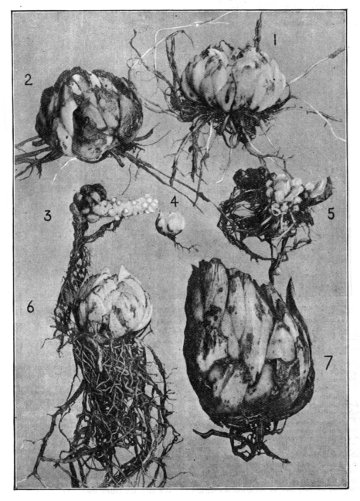
LILY BULBS. (To scale ¼ of original diameter.)
1. Lilium Umbellatum.
2. Lilium Auratum (small but good bulb).
3. Bulb and rhizome of Lilium Canadense.
4. Bulb of Lilium Wallacei.
5. Bulb of Lilium Roezlii.
6. Bulb of Lilium Hansoni.
7. Bulb of Lilium Humboldti.
The next question which you will ask is, "How much ought to be paid for the bulbs?" The bulbs vary much in price from several causes. Of course the price of one kind of lily is very different from that of another kind. For instance, bulbs of Lilium Davuricum can be purchased at an auction for half-a-crown a dozen, whereas you will have to pay about a sovereign for a moderately good bulb of Lilium Dalhansoni. Again, the bulbs vary in price according to their size and condition; Lilium Auratum bulbs cost from fourpence to half-a-crown each. The time of year also greatly influences the price of lily bulbs. Last May we bought twenty-five bulbs of Lilium Auratum for a shilling. Six months previous, these same bulbs would have fetched about twenty-five shillings. Then the price varies much in different years owing to the success of the growers in Holland or Japan. For the guidance of our reader we will give some average prices for a few lilies. Lilium Brownii, ten for nine shillings. Lilium Longiflorum (several varieties) from two to five shillings for ten. Lilium Auratum about four shillings for ten. Lilium Giganteum, nine shillings for a single bulb. Lilium Tigrinum, Candidum, Calcedonicum, Pyranaicum, Speciosum, and Elegans, from four to six shillings a dozen.
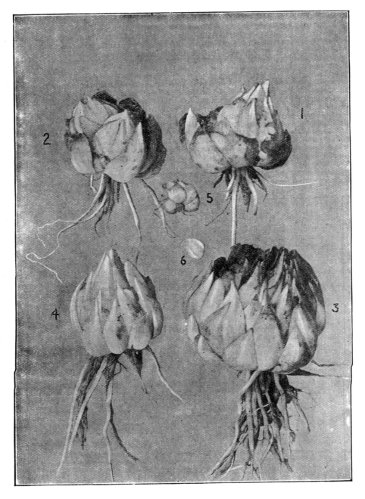
BULBS OF
Lilium Candidum
OR MADONNA LILY. (To scale ¼ of original diameter.)
1. Good sound bulb showing one crown.
2. Bulb showing two crowns.
3. Mammoth bulb.
4. Young bulb of two years' growth.
5 and 6. Bulblets removed from No. 1.
(
From photographs of fresh bulbs exhumed in August. The roots have been left entire.
)
We said that lily bulbs are very much cheaper at the end of the season than they are in October or November, and some persons might be tempted to put off buying their bulbs till March or April. But this is a great mistake, for very few of such bulbs ever live to flower.
The greatest difficulty in lily culture is to know how to choose the bulbs. There are so many ways in which the unwary may be "done," that many persons give up growing lilies from the constant disappointment which results from their ignorance of how to choose good, sound, flowering bulbs.
Lily bulbs vary a good deal in appearance and size, but there are certain qualities by which the value of any bulb can be more or less accurately determined. All the bulbs should be of moderate size for the species; very firm and compact; fresh and not withered; not broken; showing one or two points from which the shoot will appear (they should not show the flower spike itself); well ripened; not in any way attacked by vermin, or spotted by mildew, and if possible home grown.
We said lily bulbs should be of moderate size. No point is more misleading or less important than this question of size. Mere size goes for nothing! Some of the "mammoth" bulbs of auratum, so much advertised by nurserymen, often send up a miserable spike of flower-buds which wither ere the flowers open. We think that we know what is the cause of so many large bulbs going wrong. If the buds of a lily be cut off, the bulb increases enormously in size, and next year sends up a very superior shoot bearing many fine blossoms. Lily growers often cut off the flower buds from their lilies so as to improve the bulbs. These large bulbs are excellent. But the bulbs greatly increase in size if the plant does not flower for a year. Even if the whole plant dies from drought (a very common cause of failure with lilies), or if the roots are destroyed by vermin or by disease, the bulbs often become enormous. These large bulbs rarely do well, as the disease which killed their shoots the first year will probably do so again the second year.
Good bulbs are very firm and compact. This is much more important than that they should be large. We would rather have a small, compact, but heavy bulb than a light bulb with wide open scales, even though it be twice the size of the smaller bulb.
Always choose bulbs which are fresh and plump. Bulbs which have been kept one or two years out of the ground very rarely blossom or, indeed, come up at all. Such bulbs may be recognised by the outside scales being dry and withered. Always choose bulbs which are entire, if you can. But it is not very important that the bulbs should be perfect. We have done very well with bulbs which have lost the majority of their outer scales. Beware of purchasing bulbs which have begun to grow. Bulbs must be planted in the dormant condition. If you plant a bulb which has already thrown up an inch or two of flower-spike, the chances are that it will form no root, and that the stem will wither ere the flowering period arrives.
Unfortunately we have no way of telling whether bulbs are thoroughly ripened. Many bulbs, especially those of Lilium Auratum, come over from Japan, which, though they look perfectly sound and healthy, never live to flower. This is due in part to the bulbs having been sent from abroad in an immature state. Foreign bulbs purchased in July, August or September, must either be immature, or else rubbish left over from last year.
Examine the outer scales of the bulbs for little worms or mildew spots, and do not purchase any which show either of these parasites.
We are always told that lilies give greater satisfaction if grown from bulbs which have been established in England for some years. You should, therefore, choose these in place of those imported from Japan or Holland. English bulbs are, however, a little dearer than imported bulbs.
There is a popular delusion that you can grow lilies in sand. You cannot do so. All lilies require a rich soil; many require peat, and some excel only when grown in earth strongly enriched with manure.
The question of soil for lilies is an important one, and, as it is in general overlooked, we will carefully describe in tabular form the soils suitable for various lilies. For this purpose we will divide lilies into various classes dependent upon what soil they require.
Class 1.—Lilies which will grow in any good soil: Tigrinum, Bulbiferum, Croceum, Davuricum, Elegans, Hansoni, Henryi, etc.
Class 2.—Lilies which require a moderately light soil with a slight admixture of peat and leaf mould: Auratum, Speciosum, Longiflorum, Krameri, Brownii, Japonicum odorum, etc.
Class 3.—Lilies which want a heavy loam, well enriched and of good depth: Cordifolium, Wallichianum, Candidum, Washingtonianum, Humboldti, Martagon, Testaceum, Calcedonicum, etc.
Class 4.—Lilies which require a large admixture of peat and leaf mould with plenty of sharp sand: Canadense, Superbum, Pardalinum, Roezlii, Leichtlini, Philadelphicum, etc.
Class 5.—Lilies that want a very rich soil with large quantities of well rotted manure and leaf mould of great depth: Giganteum, Monodephum.
As a matter of fact many lilies will grow in two or three different kinds of soil. We have only given the form of culture by which we have ourselves obtained, or friends have obtained, the best results.
Position is of first importance in the cultivation of lilies. All kinds like partial shade, but not a position overhung with trees. It is best to plant them in a place where they can get the full sun for two or three hours daily, but where they are sheltered from the sun at midday. The position chosen should be well drained, preferably on the slope of a hill, and protected from high winds which can do very serious damage to plants which grow to such a height as these.
The best position in which to plant lilies is a bed devoted to azaleas, rhododendrons, or other shrubs. These protect the bulbs from severe frost in winter and shelter the young shoots from the high winds in spring. Moreover the soil which suits rhododendrons—a peaty leaf mould—is also an admirable soil for many lilies.
We planted a number of lily bulbs among beds of pinks last year, thinking that this situation would afford all that was required. But, alas! we had forgotten an enemy, of which you will hear more later, which has proved the very worst of our foes—the slugs. Oh, those slugs! We go out on a warm morning in March and see five hundred thick, healthy, green shoots, looking like tender asparagus. We have a slight rain in the night and go out next morning to see how our lilies are faring. During the night the slugs have eaten the tops off all those that were most promising!
The swamp lilies such as L. Canadense, L. Pardalinum, and L. Superbum, are best grown in damp situations, as these lilies require plenty of moisture. The dry bank of a stream suits them admirably.
Let us now proceed with the planting, which should be done at once. Take the bulb you are going to plant, examine it carefully and pull off any diseased or mildewy scale. Wash it well in lime water to destroy any hidden enemy and leave it a few hours to dry.
While the bulb is drying dig a hole, which must vary in size according to the size of the bulb, in which to plant your bulb. Suppose Lilium Auratum be the kind that you are planting. Dig the hole two feet deep. Place an inch or two of broken crocks in the hole, and fill half full with the compost which the species requires.
Take the bulb and dust it over with powdered charcoal, which prevents the development of mildew. Place it in the hole prepared with a thin layer of peat (preferably burnt or previously strongly heated to kill all insects, etc., which it may have contained) below and around it and with a good handful of sharp river sand. Then fill up with the soil suitable to the species.
Our work for November is done, and we return to town to tell our friends of our new venture. We meet with nothing but discouragement. One says, "Oh, you cannot grow lilies satisfactorily!" Another tells us that she has never yet succeeded in growing these troublesome plants. One gardener tells us that lilies are the most difficult of all plants to grow. Another gravely informs us that though some lilies will grow in pots, only one or two kinds will do anything in the ground. But next day we read in a gardening paper that lilies cannot be grown in pots, but some will do well in the open border! What are we to believe? Shall we be successful, or are we doomed to disappointment?
We have gone through the year, having grown lilies both in the ground and in pots. Several hundreds were planted in the ground, and one hundred and three (eighty-seven varieties) in pots. Of the latter we have lost four plants. Twenty-two have not flowered but will flower another year; so that we are highly delighted with our success. To see the constant succession of the loveliest blooms filled our heart day after day with delight, and we trust many of our readers will receive for themselves pleasure as innocent and great.
(To be continued.)