TAME VOLES.
Reading edition
One day last August, when strolling in a secluded part of my garden, I was surprised to see some little brown mice playing about and racing after each other without at all regarding my presence.
I stood and watched these playful gambols, and soon discovered that the little animals were short-tailed field-mice, or voles, as I believe they ought to be called. Some differences in structure separate the voles from the true mice and rats; they also differ in their food, the voles being almost entirely vegetable feeders.
The water-rat, so called, is a vole and a perfectly harmless little animal. I often endeavour to explain this fact to farmers and working-men, who seem to think they have done something meritorious when they have hunted to death one of these voles, whose harmless diet consists chiefly of duckweed, flag, rushes, and other water-plants; but, unfortunately, it looks like a land rat, and so it has to suffer for the evil reputation of its relative.
There are two small voles, the red field-vole and this commoner short-tailed species which inhabits my garden.
I had often wished to catch and keep these little animals as pets for purposes of study; and, finding some specimens already so tame, I began to entice them to come to a special place under a stone archway by daily strewing at exactly the same spot some oatmeal and canary seed.
Very soon the tiny creatures would allow me to stand and watch them feeding, and I drew nearer and nearer until I could almost touch them.
I then put a mouse-cage under the arch in the hope that they might accept it as a home and thus be led into voluntary captivity. This new idea met with a measure of approval, for one little vole scooped out a small cavity beneath the cage and appeared to make itself quite at home there, even allowing me to lift up the cage without moving, gazing curiously at me with its small black eyes.
This went on from August until October. The voles and I grew to be quite good friends; but, as the colder weather would soon be hindering my daily visits, our friendship would have to cease unless I could bring my small pets indoors.
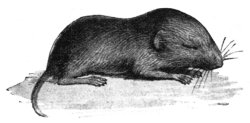
VOLE, THIRTEEN DAYS OLD.
It struck me that they might be coaxed into captivity by another device. I placed a glass globe under the arch, containing their favourite food, and a piece of wood leaning against the globe to enable the mice to climb up and leap in.
When I went next morning there was a little vole inside the globe and by no means frightened, for it allowed me to stroke its soft fur without alarm.
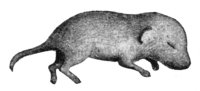
VOLE, THREE DAYS OLD.
I have had great pleasure in watching the graceful attitudes of this small creature. It sits up like a squirrel holding a grain of wheat in its paws; then, its meal over, it thoroughly cleans its fur, brushes its whiskers, and performs a careful toilet before going to sleep, curled up in a lump of cotton wool and moss.
My ultimate aim being to obtain some baby voles to be trained into absolute tameness, I set to work to secure a mate, and placed the globe as before, baited with tempting food.
In a few days' time I caught a second vole, and now Darby and Joan live happily together in a square glass case where they have room for exercise and where I can see and record their doings.
All this may seem to some readers exceedingly trivial and not worth writing about; but, seeing that we cannot be all day out-of-doors making observations about these and other subjects of study, there seems some use in keeping creatures in happy captivity, because one can thus become ultimately acquainted with them and learn many facts about their life and habits which would otherwise be difficult or impossible to observe.
I am now testing their liking for various plants, and after a time I may be able to make a list of the weeds they consume which may possibly be a set-off to the damage they do in other directions.
Voles have an acute sense of smell, as I learn in this way. The little pair may be sound asleep in their bed of moss and wool, but I no sooner place an earthy root of groundsel or chickweed in their glass case than I see an inquisitive nose at the entrance of the dormitory sniffing the air, and in another minute out comes mousie to enjoy the feast of fresh greenery.
The winter passed by uneventfully, until on the morning of January 26th I heard quite loud growls and squeaks proceeding from the voles' residence.
The cotton-wool quivered and was upheaved by unseen forces. Something serious must evidently be going on, so I cautiously interfered.
In lifting the woollen mass I disturbed four little sprawling infants of a bright pink colour and no particular shape! They were, of course, speedily replaced, and I could well understand the state of affairs.
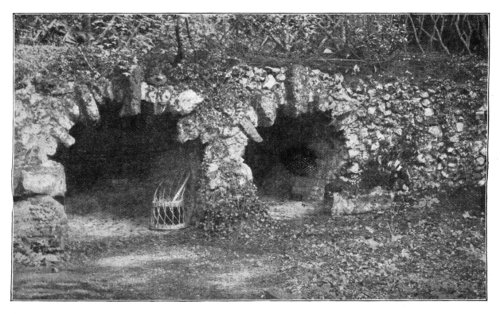
THE VOLE'S RETREAT.
The father mouse must be removed somehow as he was evidently in the way and quite upsetting the nursery arrangements, but how I was to tell which was which was a real puzzle.
I thought I would try to learn a lesson from the wise king of old and see whether maternal love would not prove a sure test. I thought I would allow the vole that first returned to the nest to remain and place the other in a separate globe.
The plan was successful, for the mother mouse went back to the nest at once and set to work to repair the dwelling which I had somewhat disarranged.
The young voles were by no means beautiful. Bright red in colour, the thin hairless, almost transparent, skin allowed one to see the beating of the heart and its circulation very plainly.
The head was nearly half the length of the body, and the eyes were, of course, closely shut, yet, feeble though they were, when only two days old the small creatures were full of life, and resented being touched by giving angry little kicks and plunges. Indeed, I never knew any family so forward.
I purposely stroked and handled the four small mites daily so that they might grow up to be perfectly tame from their babyhood. In doing this I noted one or two rather curious traits of instinct.
Whilst still quite blind, the young voles, if placed on a table, would invariably creep backwards and continue a retrograde movement, until at last they would have fallen over the edge of the table if I had allowed them to do so.
I imagine nature teaches this evolution so that, in their native burrow, these defenceless weak young creatures may invariably retreat as far back as possible out of the reach of danger.
About ten days later, whilst I was holding one of the young voles in my hand in order to take its portrait, it surprised me by sitting up and beginning to clean its fur and whiskers as carefully and neatly as if it had been a cat by the fireside, even licking each little paw in succession until its toilet was complete. The creature was only thirteen days old and still quite blind, so it shows how soon instinct teaches the important lesson of cleanliness.
On the morning of the fourteenth day the little mice could see and became quite enterprising, nibbling lettuce leaves and oatmeal and roaming about their small domain. A little later on they could feed themselves, and I believe I ought then to have taken away the hard-worked little mother, for I imagine family cares and worries must have accounted for my finding poor Joan had died on the very day when I purposed letting her and her mate have their liberty.
I set Darby free in his old home under the archway, where no doubt he will soon find another mate, and I shall probably discover by their depredations in my garden that he has reared strong and healthy families to prey upon my cherished plants and trees.
At present the young voles are by no means tame, and still indulge in kicking, squeaking, and scratching if I attempt to stroke them, but I have learnt a good deal about their domestic life and derived a great deal of amusement from my experiment in vole-rearing.
Eliza Brightwen.
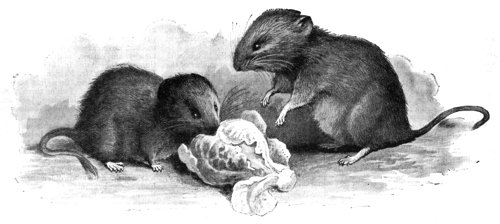
DARBY AND JOAN.