PART I.
Reading edition
The name porcelain is derived from the Italian porcellana, signifying a cowrie shell, on account of the delicate translucent glaze on its surface. At how early a date the manufacture of pottery began in this country, before the Roman invasion, is not absolutely known. In the Anglo-Saxon times the pottery of the Celtic tribes was confined to the manufacture of cinerary urns and very common utensils of household use; as they preferred the employment of glass and horn for drinking purposes, and metal or wood for solid food. In the thirteenth century pottery was reinstated in public favour; and a great advance was made in the art, a glaze being employed from the fourteenth to the beginning of the sixteenth century, when a new description of pottery was invented, a salt-glazed stoneware, which came into the market with importations of Italian fayence and oriental porcelain.
It was not until the good Père d'Entrecolles introduced into this country the learning of that ancient Empire of China, in the mysteries of the ceramic art, that our own ideas became enlarged and elevated above the improvements made in our potteries. The Père, being a resident in a district distinguished for its porcelain manufactories, sent samples to his own country (A.D. 1727, 1729,) with information as to the substances employed at King-te-Chin, for which kilns affording greater heat and suitable for firing the differently-coloured enamels were employed.
Hard paste was made at Plymouth, Bristol and Lowestoft, and the soft paste at Chelsea, Bow, Derby, Nantgarw, Liverpool, Pinxton, Swansea, Rockingham, Worcester, Shropshire and Staffordshire; felspar being superadded in the latter two manufactories. The soft paste is produced from an alkaline flux, combining chalk, bone-ash, sand or gypsum.
Stratford-le-Bow.
At Stratford-le-Bow (called "New Canton") soft-paste china was produced in the old pottery works, believed to have been established in 1730, though little is known of them till 1744, when Edward Heylin and Thomas Frye, a painter, took out the first patent, and a second in 1749. The marks attributed to these works are as here illustrated.
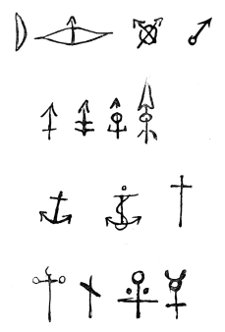
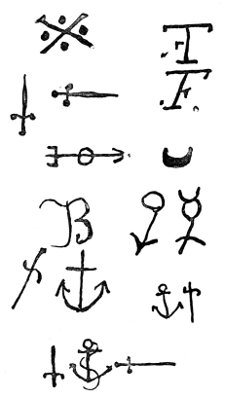
The glaze on the Bow ware was very brilliant, but sometimes erred in point of thickness. The blue china was generally decorated with birds, flowers, figures and Chinese landscapes. A pattern of hawthorn was a favourite, consisting of two sprigs united. The bow and arrow mark is usually found on small objects, and the dagger and anchor, with a crescent at times, appears on figures. A small blue crescent, with the horns turned up, have also been used. The monogram of Thomas Frye, sometimes reversed, identified some figures from the Bow works at a date previous to 1760. Many variations of Frye's signature have been used by the workmen of this factory; too many for the space at disposal in these columns. It was carried on for many years by Messrs. Crowther and Weatherby, who employed some ninety painters, of whom one was Thomas Craft. The Bow paste is very hard and compact, and therefore heavy. But the most delicate ware was also produced; as in cups and saucers, which were like egg-shells in thinness, and of a milky whiteness.
Under Thomas Frye the china was brought to great perfection. It was after him we find that the works passed into the hands of Weatherby and Crowther, and were closed by the bankruptcy of the latter in 1763, Weatherby having died the previous year.
I may observe that sprigged tea-sets, Dresden sprigs and white bud sprigs—all very popular patterns—were largely produced at Bow, in addition to landscapes and dragon services; also statuettes and groups of figures, vases, etc.
Chelsea Porcelain Works.
The Chelsea manufacture of china is said to date from Cenvirons, 1745-49, but a species of porcelain was produced in a glass factory at Chelsea in 1676, established there by some Venetians, patronised by the then Duke of Buckingham. Clay from Dorsetshire, sand from the Isle of Wight and kaolin, and chinastone from Cornwall and Devonshire, were employed at this factory. An anchor sometimes barbed, and at other times with amulets, and one within a double circle; as also a triangle, with the name "Chelsea," and the date "1745" beneath it, were the marks chosen to distinguish this ware. On the finest specimens the anchor is gilt, on those of second quality in red, brown or purple upon the glaze.
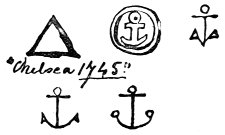
The porcelain of Chelsea bears some resemblance to that of Venice of about the same date—the Cozzi period, 1780—which is natural, the founders of the manufactory having been Venetians; and the porcelain produced there stands amongst the very first of our English ceramic works in every respect, ranking higher than that of Bristol. The workmen were originally procured from Bow, Burslem and other works; the china manufacture being carried on at first by William the Duke of Cumberland and Sir Everard Faulkenor, the latter dying in 1755 or 1758, and the former in 1765, when Sprimont became sole proprietor. Three blemishes, or spots, characterise the china of this factory, appearing at equal distances where the glaze has been removed, apparently by contact with what the article rested upon.
The work executed at the Chelsea factory ranked in the highest place that was ever attained at others in this country. It was greatly admired by Wedgwood, and was scarcely inferior to the best at Sèvres. The whole contents of the manufactory were sold by auction by M. Sprimont on his retirement; Mr. Duesbury purchasing the house, etc., and the remainder of the stock was sold by Christie and Ansell in 1779.
One of the earliest of the Chelsea marks is here given showing the date; and two anchors side by side and one inverted, in gold, is only found on the finest examples.
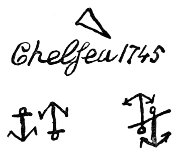
The early productions of Chelsea were of soft paste, and the glaze was thick and creamy, much of the white ground being left without decoration. The pieces with the bleu de Vincennes, the peacock green and turquoise blue, copied from the Sèvres ceramists, were of later date. Those of claret-colour are very rare. All these self-coloured examples are highly gilt.
(To be continued.)