Part 5 — THE HEAD-DRESS OF THE LADIES OF HOLLAND.
Reading edition
The peculiar head-dress worn by the ladies of Holland during the last thousand years, and known as the Friesland cap, has undergone no change whatever from the time of its adoption until now, and yet it is not becoming, nor does it in any way add to the grace and beauty of the women.
Much curiosity has been expressed as to its origin, and why its form has been so strictly adhered to while every other article of dress has changed its fashion with the seasons. We might never have been able to solve the problem but for the discovery of a legend by a great authority on Frisian lore. The following is but a bare outline.
Some twelve hundred years ago a celebrated preacher of the Gospel appeared among the Frisians. His influence upon the people was remarkable, especially upon Fostedina, the prime minister’s daughter, a beautiful girl of eighteen. She took a deep interest in his words and in the hymns sung by his followers, and but for fear of her father and the priest would have acknowledged herself a Christian. The priest attached to the Court was a cruel man, and furious with all who adopted the Christian religion. He not only imprisoned them, but threatened that unless they should recant he would cast them into the arena among the wolves and wild boars.
The day was at hand when this threat was to be carried out, and the prisoners, as they lay in their gloomy cells, heard the preparations with sinking hearts. In the dark hours of the night, however, Fostedina came to their aid and arranged their escape, bidding them fly to the land of the Franks.
When the steward came in the morning to conduct the band of Christians to the arena, the prison was empty save for the girl Fostedina. She pointed to the open window and the ladder, and said, “They are safe, thank God.”
The steward thought she was mad, and begged her to go to her room, as he felt sure the people would tear her to pieces if they found out what she had done. She, however, determined to remain and face the consequences of her deed, lest the punishment should fall upon the missionary and his followers, who were still living in their midst.
She was taken before the King and his council, and when asked why she had done this thing, answered—
“Because I pitied the men and abhorred the cruelty with which they were to have been killed, and because I believe that our gods of wood and stone are no gods, and that Jesus Christ is the son of the living and true God.”
The King, turning to the Prime Minister, said—
“She is your child; what is to be done with her?”
The father answered—
“She is my only child, and the joy of my life. If you throw her to the wolves I go with her.”
Then Adgillus, the King’s son, who loved this girl, came forward to plead with his father for her forgiveness, and he would probably have succeeded but for the sarcasms and taunts of the priest.
At length she was taken out and placed between the council and the howling mob, while the King said—
“Ye men of Friesland, this is the girl who saved the Christians. What are we to do with her?”
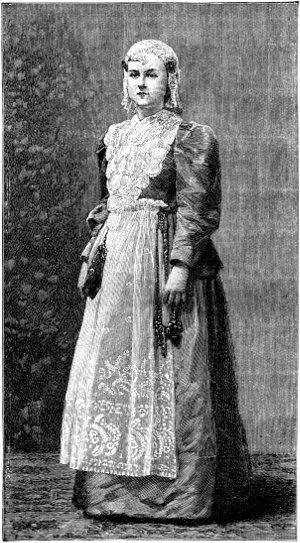
[From photo: C. B. Broersand, Leuwarden.
The girl was loved by the people, and they felt compassion for her; but the priest, in a loud voice, cried shame on them for their cowardice, urging them to cruelty, until with a savage cry they shouted, “To the wolves!”
Then Adgillus came forward, saying—
“If you kill her I will be a Frisian no longer. If you throw her to the wolves I go with her and fight with them for her with my sword, which I have sworn to use for the protection of the innocent and defenceless, and God helping me, I’ll keep my oath!”
The applause of the people was deafening, but the priest silenced them, saying—
“This girl has insulted our gods and embraced the new religion. Therefore our law requires her death.”
But the people cried out, with their thousands of voices—
“She shall not die!”
The priest, pale with spite and anger, said—
“Well, let her live. She has been trying for a crown; let her have her wish. Here is one exactly like that worn by the Christ whom she worships.” So saying, he took from under his cloak a crown of thorns and held it up for inspection. Again a shout went up, “Crown her! Crown her!”
And so it happened that on the following day she stood in the arena from sunrise to sunset, wearing the crown of thorns, and although her forehead and temples were painfully pierced by the sharp thorns and the blood ran down her cheeks she did not utter a sigh or a murmur. The next day, having been banished, she left the country, accompanied by the missionary and his followers, nor was the King’s son seen in Friesland for many a long day after this. He joined the army of the Franks, and accounts of his prowess and valour filled the land.
At the King’s death Adgillus succeeded him notwithstanding the opposition of the priests. The people loved him and offered no objection to receive Fostedina as their Queen, and she and Adgillus were married by the missionary, according to Christian rites.
The marks of the crown of thorns were still visible on her forehead and temples when, by the side of her royal husband, Fostedina rode into the old city of Stavorly, where the Frisian kings resided. At the sight of these scars the people were greatly troubled, for it reminded them of the cruelty with which they had treated her in days gone by.
On the morning of the great festival with which the new king’s inauguration was to be celebrated, twelve high-born maidens entered the Queen’s apartment and presented her with a golden crown of such a shape that it completely hid the marks made by the crown of thorns. Two golden plates covered her temples, while a splendid golden strip passed over the forehead. Fostedina accepted, but did not like it. She remarked—
“It will never come up to the crown of thorns, but my God has still a better crown in store for me.”
From that time it became the fashion for every noble lady to wear one like it, a custom which has continued down to the present day, though the reason of its adoption has been forgotten.