Part 5 — OUR LILY GARDEN.
Reading edition
PRACTICAL AIDS TO THE CULTURE OF LILIES.
By CHARLES PETERS.
lthough we have no true lily indigenous to our island, there is at least one species which has established itself in England, and by this time can claim to be called a British wild flower. This lily is the Martagon or Turk’s cap, a flower long cultivated in English gardens, and, after the Madonna lily, the most familiar of the whole genus.
The fifth group of lilies, the Martagons, is the most extensive of all. It includes over twenty species which differ widely from each other in most particulars. The usual description of the members of this group (“perianth cernuous, with the segments very revolute, stamens diverging on all sides”) is certainly applicable to all the Martagons, but it is equally so to the tiger-lily or L. Speciosum.
Most of the Martagons are remarkable rather for the number of their blossoms than for the size of the individual flowers. There are, however, many exceptions to this; Lilium Monadelphum bears blossoms in large numbers, but the individual flowers are large and showy. L. Medeoloides and L. Avenaceum bear but one or two blossoms of small size.
The prevailing colours of the flowers of the Martagons are yellow, orange and red. A few are purple, and one rare variety of the common Martagon is white.
In a former article we sub-divided this group of lilies into several smaller sections. We do not advance any scientific reason for so classifying them. The divisions are adopted merely for convenience of description.
The first of our sub-divisions is the group of lilies which we have called True Martagons. This group contains ten species. In all the members except one the bulb is perennial, and does not bear a rhizome. They are all natives of the Old World, being for the most part natives of Central Europe.
The leaves of the true Martagons are narrow, but vary in width from those of L. Martagon, which are three-quarters of an inch across, to those of L. Tenuifolium, which are scarcely more than the tenth of an inch wide. In some species the leaves are arranged in whorls, in others they are scattered.
The flowers of this group of lilies are mostly small but numerous. In all except L. Hansoni, L. Avenaceum, and L. Medeoloides, the segments of the perianth are very revolute, which fact has given to these lilies the name of “Turk’s cap,” from the resemblance of the fully-opened blossom to a turbaned cap.
The true Martagons are among the easiest of the lilies to cultivate, but they have one or two peculiarities which would seem to negative this statement. For instance, these lilies very much dislike being meddled with. Consequently they rarely do well the first year they are planted. It is very annoying after having bought fifty bulbs of L. Pomponium not to have a single blossom the first season. But you have only got to wait until the bulbs have established themselves, when they will flower year after year and increase at a prodigious rate.
All the true Martagons like a cool loamy soil. On the whole they object to peat. Many kinds, as the common Martagon, for instance, like chalk, and are seen to perfection when grown in heavy loam on a limestone bottom. The heavy, black loam of London suits the Martagons very well, and we have seen these lilies in greater perfection in suburban gardens than anywhere else.
First among the true Martagons stands the lily which has given its name to the group—Lilium Martagon, or the Turk’s-cap lily. This lily has a very wide range, being found wild throughout Central Europe and Siberia. We have said that it also grows wild in England, but our readers can hardly expect ever to see the plant growing wild in our island. It used to be fairly plentiful in Surrey, Devonshire and the Isle of Wight, but the rage for collecting specimens has pretty well exterminated the species from our shores. It is, however, occasionally met with, especially in Surrey.
The Martagon lily is one of our oldest garden flowers. When once established, it is very loath to go and very free to increase, so in many gardens this lily has come up and flowered every year for centuries.
The bulb of Lilium Martagon is about the size of a hen’s egg, and of the ordinary ovoidal shape. It is very compact and usually stained on the outside with bright yellow or purple. The leaves are of a greyish-green colour and are arranged in whorls. The flower-head is visible when the plant is but a few inches high. It consists of from four to forty little buds closely packed together. The lily flowers in July, and a well-grown specimen is a very pretty object.
The flower spike forms a perfect cone or pyramid. The blossoms are very small—about one and a quarter inches across—and borne on stalks which grow out at right angles to the main stem. These stalks gradually diminish in length as they get towards the top, thus producing the characteristic cone shape. The nodding blossoms are of a lilac-purple, splashed and spotted with claret colour. The pollen is red, the segments of the perianth are fleshy and very much curled.
There are several well-marked varieties of the Martagon lilies. The variety Dalmaticum, as its name implies, is found in Dalmatia. It is a finer plant than the type. The leaves are deep glossy green, and the flowers are very dark purple. In another variety called Cattaneae, the flowers are still darker, appearing in some lights to be quite black.
There is a white variety of the Martagon lily, a lovely little gem, which, though rare, is one of the easiest culture. It is curious that this is the only variety in the whole group of Martagons which bears white flowers. It is of garden origin, and is not found in the wild state.
Then there is the double Martagon, about the stupidest flower which owns the name of lily. It is extraordinary the rage people have for double flowers. It is very rarely that a double flower has half the beauty of the single variety. In the rose, the chrysanthemum, the aster and other composite flowers, the double varieties are indeed vastly superior to the single flowers. But to us all the double bulbous plants are incomparably inferior to the single ones. In the lilies, the double varieties are scarcely worth growing.
Lilium Martagon and its varieties should be grown in masses or as a thick border. Beyond seeing that the plants are well watered, they give no trouble and should never be disturbed.
Lilium Pomponium, or, as it is sometimes called, Lilium Pomponicum, is another well-known lily from Central Europe. It resembles the last in many particulars, but the leaves are linear and scattered, and the blossoms are not nearly so numerous as are those of L. Martagon.
From three to ten flowers are produced on each stem. The flowers are nodding with the segments much recurved, and are about an inch across. In the type the colour is a dullish-red, but there are also orange and yellow varieties.
This lily looks well in big masses, for the blossoms are very graceful, though perhaps rather disappointing for a lily.
Lilium Pyrenaicum, or the yellow Turk’s cap, is by some authorities considered to be only a variety of the last; by others to be a distinct species. As its name tells you, it comes from the Pyrenees, and it is not known as a wild plant in other parts of the continent. Yet, by the way, we see that it is sometimes included among the British wild flowers from some apparently wild examples having been found in the Isle of Wight. Probably these are simply garden escapes; still it is possible that they are indigenous to that island.
Except in the colour of its flowers, the Pyrenean Martagon exactly resembles the Pompon lily. The flowers are slightly larger than are those of L. Pomponicum, and are of a fine yellow colour, spotted with purple. The outside of the tube is red.
Lately this lily has become very popular, but it is not altogether a desirable plant as the blossoms exhale a rank and disagreeable odour.
In the Japanese Islands is found a Martagon lily, differing very markedly from the European species, which we have just described. This lily, Lilium Hansoni by name, is very rare and not often seen in cultivation. But we believe that in a short time it will become a well-known and popular plant.
A well-grown specimen of Hanson’s lily stands about five feet high and bears a pyramidal spike of yellowish-orange blossoms. The flowers are not nearly so much recurved as are those of the other Martagons. The segments are thick and fleshy, of a bright orange slightly spotted with purple. The flowers are about two inches across. From three to fifty are present in each spike.
This lily is one of the first to blossom in favourable seasons, coming into flower in the first week of June.
It is also perfectly hardy, and shows no tendency to degenerate if it is provided with suitable soil. A rich but light loam with abundance of leaf-mould and a little peat and sand is the proper compost in which to grow Lilium Hansoni.
Another lily from Japan, Lilium Medeoloides, somewhat resembles Hanson’s lily, but is much smaller, rarely exceeding twelve inches in height, and the blossoms are far fewer and smaller.
L. Medeoloides is very imperfectly known. The bulb consists of a large number of small oat-shaped scales very loosely packed together. The leaves are in whorls. The blossoms are frequently upright, and for this reason the plant is often included among the Isolirions.
Except as a curiosity, this lily is certainly not worth growing. It is very difficult to manage, and the bulbs almost invariably rot in the winter.
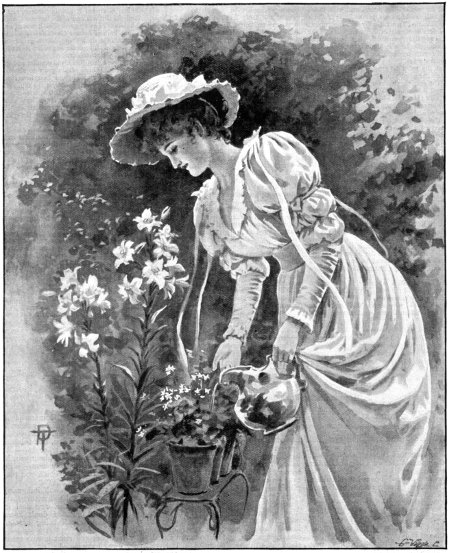
A LILY-GROWER.
Lilium Avenaceum is another Japanese species which very closely resembles the last; but the flowers invariably bend downwards, and are very slightly spotted. Like the last, it is not worth growing except as a curiosity.
Resembling L. Pomponium in many points, but of far smaller dimensions, and with much more brilliant blossoms is the little Lilium Tenuifolium. This little lily inhabits Siberia and differs from most of the species in that the bulb is not truly perennial. Some authorities state that the bulb is annual, but this we do not believe to be correct. It is more likely a triennial species.
This lily must be grown from seed. Fortunately the plant produces seed in abundance, and the seeds germinate freely, often producing a flowering bulb in two years.
In this plant the leaves are extremely thin. The blossoms are about an inch across, of the colour of red sealing-wax. Rarely are more than three blossoms present on each stem. It is a pretty little flower, and makes a good pot-plant.
Lilium Callosum, the callous-bracted lily, is something like a magnified version of the last. The leaves are broader and less numerous than in L. Tenuifolium. The flowers about an inch and a quarter across, of a vivid scarlet or orange. The bracts are thick and horny, a characteristic which has given the plant its name.
The callous lily likes a rich peaty soil, but it is very accommodating and will grow in most good soils. It is perfectly hardy, and is of little difficulty to cultivate.
We now come to a lily which will always be famous, not so much for its intrinsic beauty—though, to be sure, it is a beautiful plant—but because it is the flower which has generally been considered to be the “lily of the fields,” the only plant mentioned by name by our Saviour.
The lily to which we refer is the scarlet Martagon, lily of the fields, lily of Chalcedony, or Lilium Chalcedonicum.
It is doubtful whether we shall ever know for certain which flower was referred to by Christ as “the lily of the fields.” Why the scarlet Martagon should have borne the honour for so long is difficult to see. As far as we have been able to discover, this lily does not grow in Palestine, and though of course we cannot be certain that it did not inhabit the Holy Land in the time of Christ, it is very unlikely that it did, for the lily of Chalcedony knows how to take care of itself, and it is unlikely that it would have become exterminated.
We have no real reason for supposing that the lily of the fields was a true lily—that is, a member of the genus lilium. Even in England at the present day we call a host of liliaceous plants “lilies,” and in the East they are very lax in floral nomenclature.
That the plant referred to was one of superior beauty is probable, but even the meanest flower would answer to the description that “Solomon in all his glory was not arrayed like one of these.”
It is commonly held now that the plant referred to was either the yellow star-lily (Amaryllis Lutea) or else an anemone. But it may well be that our Saviour meant no special blossom, but by “the lily of the field” He intended any flower to be taken.
Before it became the fashion to “bed out” the gardens of the wealthy, the scarlet Martagon graced alike the palaces of the rich and the cottages of the poor. Throughout England this magnificent lily was one of the commonest of garden flowers. But when the finest gardens were turned into puzzle pictures, manufactured out of geraniums, blue lobelias and yellow calceolarias, all the fine old garden plants were rooted up and destroyed, and many plants ceased to know England as their home.
How thankful we all are that the formal garden has left us! Now it is considered in its true light, as a vulgar waste of soil.
We have returned to the old-fashioned garden, but alas! we cannot make old gardens at a day’s notice. We have reinstated our old herbaceous plants, and now we are attempting to place the lily of the fields in its old position, as queen of the flower-bed.
Unfortunately this lily is difficult to establish, though when once it is established it gives no trouble and will grow for centuries. But we do not often see it now in gardens, and it is doubtful if it will ever again become a constant inhabitant of every garden, as it was of old.
The bulb of Lilium Chalcedonicum is about the size of a duck’s egg, and is very compact and heavy. The outer scales are stained with a bright yellow colour.
The growth of this lily is peculiar and unlike any other. Good plants grow to about four and a half feet high, and bear from four to eight blossoms in a cluster at the top.
The lower leaves of this species are long and lance-shaped. The upper leaves, which are extremely numerous, are small and linear and embrace the stem, giving the plant a curious resemblance to a Maypole.
The flowers are borne in a cluster with very short pedicles. They are of a brilliant sealing-wax red, usually unspotted, quite scentless, and about two inches across. The segments are very revolute, and altogether this lily resembles a much glorified edition of Lilium Pomponium. There is a variety with yellowish-orange flowers. This plant blossoms at the beginning of August.
To cultivate this lily successfully is by no means an easy matter. It delights in a rich heavy loam of great depth and with a chalk basis. It dislikes peat and manures. If it can have the soil it likes, it does best when exposed to the sun all day long. This lily rarely does well for the first year or two, but when established gives no trouble whatever. It is a native of Greece and the Ionian Isles.
Closely resembling the last lily is the nodding red lily of Carniola (Lilium Carniolicum). Comparing this lily with the last, we see that it is altogether smaller, the leaves fewer and the blossoms less lividly red, but spotted and usually solitary. It inhabits South Europe, and flowers in June.
(To be continued.)