THE PRINCESS OF WALES’S DAIRY AT SANDRINGHAM.
Reading edition
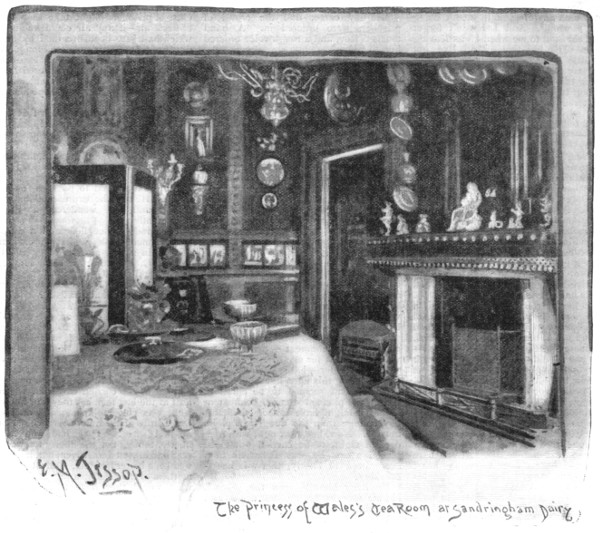
The Princess of Wales’s Tea Room at Sandringham Dairy
Let us start from the pretty little “Feathers Inn” at Dersingham, which, by the way, is the only house of entertainment for strangers allowed on the Prince’s estate, for the reason that H.R.H. very wisely objects to colonies of observation being posted on the confines of his beautiful country home.
We first turn to the right, past some trim allotment gardens, then a sharp bend to the left brings us to the grand, wide, straight road which leads to the Norwich gates of Sandringham. Here on either side are grouped the fine old trees and leafy coverts, where the guns are usually placed for the last drive in the Prince’s big “shoots.” This, too, is the road down which, day after day, without state or ceremony, her only escort a smart young groom (or phaeton boy, as he is called in the stables), her usual equipage a tiny pony and cart, this latter familiarly known as the “Blues” cart, drives the sweet Princess with the noble face on her errands of grace and charity. Possibly the time may be about five o’clock, when the little dots of children are toiling along the sandy roads from school. Up pulls the little cart, down drops the smart groom, into the tiny vehicle are crammed as many of the lucky youngsters as can be compressed into so small a space. On go the happy load, each item to be duly delivered at its parents’ door with a pleasant smile and a pretty word of farewell from our gracious Princess. Or it may be that the call comes from age or sickness or sorrow. ’Tis all the same. At the door of the stricken cottage stands the same little cart, while within is the noble mistress administering with ungrudging hand the remedies, whether mental or physical, which she knows so well how to dispense. In sickness nothing is left to the underlings’ care. That which is adjudged best for the sufferer goes with the royal lady, and is dispensed by her own fair hands. So might it be with all our poor!
Past the Norwich gates, almost the only emblem of royalty at Sandringham, we turn to the left by the East Lodge, a lovely little vision of living greenery, the pillars of its rustic porch being entirely composed of living box, and the building entirely hidden by ivies and Virginian creepers.
Pretty as the picture is, we must turn away from it again to the left, and cross the road to get to our object, the dairy. Through the fruit and flower gardens, up the centre walk all ablaze with light and colour, with a great curious fountain in its centre, we go, past the long ranges of glass-houses with their luscious contents, the apple-trees trained to a tall cone shape on iron hoops, and their cousins the plums representing immense fans on a background of rich red-brick wall, until we arrive at a little secluded garden encircling the rustic dairy.
The dairy, which was built some time in the eighties, is, or rather was, of Swiss design, but mother Nature has of late so bedecked it with climbing plants that it is difficult to detect the handiwork of man under its dainty mantle of greenery. Entering first the dairy proper, one sees a beautifully cool, lofty room some twenty odd feet square, with a plain tiled floor, and a handsome high dado of rare old blue and white Indian tiles, which were specially sent from India to occupy their present position. A row of tables surrounds the room, and a most welcome sight after the walk in the blazing sun these are, at present occupied by some thirty or forty flat pans of such milk as we London folk only dream of.
After a somewhat critical discussion on the quality of the milk, we turn to notice its surroundings. Over the triple window which faces the door as one enters there hangs on a shield the handsome head of “Jewess the Fourth,” who won the champion prize at the Cattle Show in 1874 for her owner, H.R.H the Prince of Wales; beneath this stands a present from H.R.H. in the shape of a finely modelled bronze statuette of a Jersey champion bull. In front of the bull is a replica of Focardi’s ever welcome statuette “You Dirty Boy.”
In the centre of the dairy is a two-tier white marble and iron table, bearing some handsome coloured German drinking-glasses, a few small china ornaments, some silver cream ewers and spoons, and the Princess’s own dainty little strawberry dish. This last is made of white glazed porcelain, with a strawberry plant in its proper colours entwined about the dish and handle.
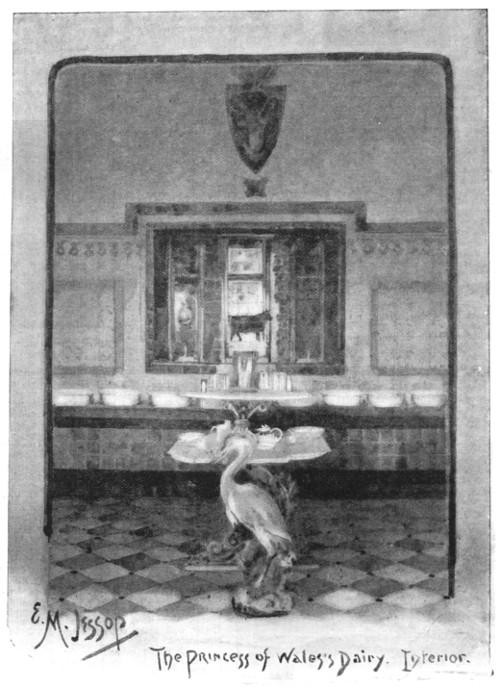
The Princess of Wales’s Dairy. Interior.
One may mention here for the encouragement of lesser lights that both the Princess and her daughters have a thorough technical knowledge of dairy work, and it is no uncommon occurrence for H.R.H. to notice any defects in the produce of her dairy, and also to suggest methods for their remedy. In their younger days the royal princesses and their brothers were constant patrons of the dairy produce, and many a pleasant tale has the dairywoman to tell of the kindness and courtesy of the late Duke of Clarence, with her, as with all on the estate, a prime favourite. The young princesses also, in days of yore, as they skimmed the cream from the dishes of milk for their own consumption, would laughingly remark on the superior advantages of helping oneself. “We can have as much as we want here, at home we get so little.”
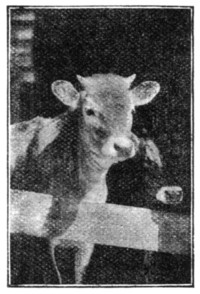
JERSEY COWS BELONGING TO THE PRINCESS OF WALES.
Passing by the pretty little fountain supported by a china stork standing amid rushes, which so pleasantly cools the dairy, we next come to the “butter-room,” the walls of which are entirely covered with plain blue glazed tiles, and the floor with Indian matting. Along the window end of the room runs a broad shelf, which literally bends with the weight of a perfect menagerie of china animals; cats, dogs, hares, bulls, etc., are mixed up in bewildering profusion with every kind of jug, the Brown Toby in all its varieties being conspicuous in this latter class. The place of honour is held by a group of cats, in which sentimental Tommy, with one paw round the waist of Tibbs, is delicately trimming with the other the whiskers on her half-averted but not too shy face.
On the right-hand wall are to be seen four Jersey creamers with which is made the “Devonshire” cream for winter use. In addition to the “Devonshire,” butter and cream cheese are made here in sufficient quantities for the use of the Royal Family, whether residing at Sandringham or Marlborough House. To the latter the dairy produce is regularly forwarded by an afternoon train in special receptacles duly marked with the Prince’s crest.
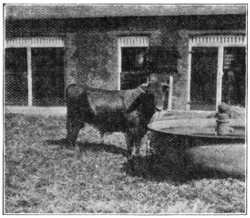
“CUSH,” A PEDIGREE BULL AT SANDRINGHAM.
The dairy in former days was frequently visited by H.M. the Queen, who, in comparing it with her own magnificent dairy at Windsor, which was designed by the late Prince Consort, has always remarked on the completeness of its arrangements and management.
The dairy herd consists of some twelve cows of the Prince’s own breeding. Needless to say, they are models of their species. They are accommodated, when not out at pasture, in the very completely filled range of cow-houses which surrounds a square courtyard in the immediate neighbourhood of the dairy. Here one may usually see in addition one or two fine specimens of bulls, and also, in the proper season, some lovely calves, which delight to frisk about in the knee-deep straw with which the courtyard is bestrewn.
Last of all, if furnished with the proper credentials, one may see the sanctum sanctorum of the dairy; this is the Princess’s own tea-room. It is a small sunny room of about sixteen feet square, with a large bay window overlooking a pretty little garden. The floor is covered with a plain felt carpet of a dull bluish colour, on which are strewn some of the Prince’s Indian trophies in the shape of tiger, leopard, and other skins. The walls are divided into panels by black-edged mouldings of unpolished oak, the interior of each panel being painted with blue-green flatted paint to match the floor. This forms a perfect background for the specimens of china with which the walls are almost covered. Apropos of this china, it may be mentioned that it nearly all consists of presents from personal friends of the Princess, and also that the greater number of the pieces were painted for the purpose by some of the greatest ladies in England.
One particularly notices, at the top of the low dado surrounding the room, a row of china tiles framed in oak, with some capital reproductions from Caldecott, Kate Greenaway and others, each tile being painted and presented by a different lady. A circular china plaque, with a portrait of the Princess as Queen Elizabeth hangs above one of the doors, and is faced by one of the Prince as Henry VIII. over the other entrance. These same oaken doors, with their handsome old wrought-iron hinges and fittings must also be noticed for their beautiful panels made of slate and covered with designs of Cupids sporting amid flowers, which were painted and presented by the Duchess of Devonshire. The plain white marble chimney-piece, draped with olive velvet, is surmounted by a mirror in a massive ebony frame, which is surrounded by some very rich blue plates and vases. The centre of the mantel-shelf is appropriately occupied by a bust of H.M. the Queen. Any artificial light required in the tea-room is supplied by candles only, in connection with which we notice the handsome brass candelabrum, brought by the Princess from Denmark, which hangs from the ceiling.
The furniture of the pretty little room is of the plainest. It is framed in light oak, and is covered in a small pattern damask. Here and there in the room and the adjoining corridor are some small cabinets containing very fine specimens of old and modern china: Sèvres, Worcester, Chelsea, and Derby, with many others, being represented.
In one corner cabinet stands a quaint old tea service, the cups being made without handles. This is watched over by a most eccentric-looking cow, which has flowers painted all over her body. On a small whatnot is the afternoon tea-service presented by the Queen, a fine specimen of modern work, printed with orchids enclosing views of Balmoral and Windsor.
The large round table is covered by a piece of Indian embroidery, and bears yet more china, an album of dried New Zealand ferns, and another of orchids. The ebony-framed screen, which encloses the table was another present, and is painted with a design of birds and flowers. The curtains and hangings of the room are of similar material to that with which the furniture is covered. A cuckoo clock hangs by the side of the fireplace.
A narrow corridor leads from the tea-room to the garden, and its entrance is known as the Princess’s door. This corridor has for ornament some fine Indian blue-and-white china, and some old Chinese vases. The rustic seats under the verandah front of the dairy are the favourite resting-places of the Princess and her daughters in the summer weather.
The tea-room and the dairy are in constant use when the family are in residence at Sandringham. About four o’clock (all Sandringham clocks are kept thirty minutes in advance of London time) the Princess and her guests make their way on foot or by pony carriage usually along the pleasant road through the fruit gardens to the rendezvous. Should the Prince arrive before the Princess, he invariably awaits her arrival before entering.
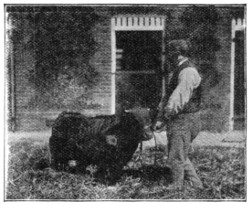
A BULL CALF AT SANDRINGHAM.
Of whatever number the party may be composed the services of one attendant (a footman) only are utilised.
Fruit having been sent from the neighbouring garden, tea is served at half-past five o’clock, the party rarely separating until it is time to dress for dinner at seven-thirty. But not to Royalty and its guests alone go all the niceties produced at the dairy. When one hears that some hundreds of persons are employed on the estate, that there are workmen’s clubs, schools, almshouses, and cottage hospitals, all erected and cared for by the Royal owners, that there are no unemployed, work being found for everyone, that the fortnightly bill for wages alone is some six hundred pounds, it is easy to see that in a colony of this size there must always be a proportion of ailing and delicate. And with such a Princess as ours, having the able assistance of Miss Knollys and Sir Dighton Probyn, it is equally certain that no call is neglected and no want left unsatisfied.
Ernest M. Jessop.