Part 5 — ANSWERS TO CORRESPONDENTS.
Reading edition
MEDICAL.
From the South.—Your cheeks burn after meals because you have indigestion. If you pay attention to your digestion your trouble will soon cease. Do you masticate your food properly? and do you rest after meals? These are two of the cures of indigestion—and they are generally overlooked. You should wear a veil when you go out, for cold winds of themselves may make the cheeks burn. A veil does a great deal to temper the severity of the wind.
Little Pussy.—Your complaint is by no means uncommon. Thousands, we might almost say millions, of girls suffer from the same form of nervousness as you do. A short time back we published an article on this complaint, which deals specially with that form of nervousness from which you suffer.
Peggie.—It is very common for persons, especially children, to grind their teeth during sleep. There are many things which can account for the habit. Errors of diet are the chief of these. Late, or large suppers are very potent causes. Another cause is irritation about the face or head. The presence of bad teeth, of enlarged tonsils, or adenoids, or of anything hindering free respiration through the nose are also very apt to cause tooth grinding during sleep. The treatment for it is to breathe through your nose, or if you cannot do so now, have your nose seen to so as to enable you to breathe properly, and avoid late suppers. You should also be careful not to sleep upon your back.
A. M. O. L.—Yes; sulphur soap and sulphur ointment used as we advised “Fair Isabel” to use them in last year’s volume, page 448. Whatever you do, be very careful of the soap you use for your face.
Dilly.—You are quite right in persevering in the treatment of acne. What troubles you now is really a very simple matter. The sulphur kills the outer layer of the skin and that causes the flaking and cracking of the skin which annoys you. Now what you should do is to leave off the ointment for a fortnight or more and see how you get on. If the acne gets worse, then return to the sulphur ointment, only use it diluted with an equal quantity of lanoline or vaseline. Your face will soon get right again. Wear a veil when you go out, and apply a little glycerine and rose water (a dram of glycerine to an ounce of rose water).
Alma.—Do not let your daughter grow up with a hare-lip. This hideous deformity is readily cured by a small operation. Nothing is left of it but a small scar to mark the site of the operation. The earlier the operation is done the more excellent will be the result.
Belle.—Undoubtedly the use of tight corsets is a very fertile cause of indigestion. And, indeed, it is a potent factor of that terrible form of indigestion associated with ulceration of the stomach. Some of the greatest medical authorities aver that the reason why that most serious disease is so far more common in women than in men, is because the former wear corsets. Be this as it may, it is an absolute fact that it is quite impossible to cure indigestion if the sufferer wears tight corsets. There is no necessity to abandon corsets altogether, but you must wear them loose. And why should you not wear them loose? It is no longer fashionable to have a waist like a wasp!
Vega.—Your condition is one of the commonest which the aural surgeon is called upon to treat. You have done perfectly right and you have been well treated. You really have no cause to complain, for it is a condition which often requires years of treatment to completely cure. The giddiness, after syringing, is usually due to injecting the fluid too forcibly. What kind of syringe do you use? You must go on with the treatment. You suggest that the syringing increases the discharge, because since you have left off treatment the discharge has stopped. But you are labouring under a great fallacy. The discharge has not stopped, but it has caked in the ear and cannot find an exit. You must be very careful to guard against this, as it is a dangerous condition. There is, or rather there may be, a connection between the discharge from your right ear and the weakness in your right eye. Without a knowledge of anatomy and medicine you could not appreciate this connection if we were to describe it. Suffice it to say that the connection is through the nose. Both the ear and the eye have tubes ending in the nose.
S. G.—We really cannot give you much advice without further information. You say you have had “inflammation.” Where? When? And of what kind? More than three-quarters of the diseases of man are due to inflammation. What we believe is the matter with you is anæmia and debility. And the treatment we advise is plenty of good food and outdoor exercise, or as much of these two as you can get. A short course of a mild preparation of iron would probably do you good. But we think that cod-liver oil or malt extract would be better still.
Vegetarian.—Vegetables vary very much in the ease with which they can be digested. There are very few vegetables indeed which are really easily digested. Potatoes, parsnips, uncooked celery and salads, artichokes, and to these we would add the green vegetables, give difficulty to the digestion, though they should certainly not be excluded from the dietary. Dried peas, Indian corn and haricot beans are about as difficult to digest as paving stones. Indeed, by actual experience, we have proved that paving stones are more soluble in the gastric juice than is Indian corn! Tomatoes are fairly easy to digest, but are liable to produce acidity and heartburn. Carrots, turnips, green artichokes and asparagus are moderately easy to digest.
Amelia.—Read the answer we gave to “Vegetarian.” The old saying that—
“An onion a day Keeps the doctor away.”
is moderately accurate. Onions will keep away the doctor as they will everyone else who possesses an “æsthetic olfactory apparatus.” But, apart from that, raw onions are indigestible. There is a popular idea that onions only scent the breath if they disagree, but this is incorrect. The reason why the breath of persons smells after eating onions is that the vegetable contains a large quantity of an aromatic oil which is excreted by the breath.
Harrow.—We cannot give you the address of any person who removes superfluous hair by electrolysis. For, in the first place, we will advertise no one. In the second place, except in very few cases, we disapprove of electrolysis; and, in the third place, electrolysis being a surgical procedure, it is strongly against our principles to allow any but a surgeon to perform it. If therefore you wish to have your hairs removed, and you think that possibly electrolysis may effect this, at all events, temporarily, you must go to a specialist in skin diseases. You will have to pay highly, but no higher than you would have to pay a so-called “professional epilator,” and you can have the assurance that the surgeon will not consent to the procedure unless he himself thinks that the treatment will prove of value.
Turquoise.—Rare as Méniere’s disease is, we know it, alas, too well! It is one of those diseases which baffle medicine. There are very many excellent physicians in Dublin, and the reason why they will not express a definite opinion as to the curability of your friend’s case is because they do not know. We do not know—nobody knows how long the disease will last, or if it can be cured. Some cases recover spontaneously, others recover after medical treatment, others after a severe surgical procedure, others again never recover. We suppose your friend has been to an aural specialist. We advise her to go again, and tell him that her hopes are beginning to sink, and that lately she has become despondent. Perhaps then he may suggest some further and more radical attempts to relieve her.
GIRLS’ EMPLOYMENTS.
Firenze (Dressmaking in Paris).—We fear it would be by no means easy to obtain employment in a Parisian dressmaking firm. The French are not so eager to employ English dressmakers as we in this country are to engage French women. On the other hand, English tailoring is very fashionable in Paris. If you do go to Paris, you had certainly better ask the Girls’ Friendly Society beforehand whether you could be received into the Home at 48, Rue de Provence.
E. W. (Dispensing).—The course of preparation for a dispenser is a long one, and also somewhat expensive. In the first instance you would need to pass the preliminary examination of the Pharmaceutical Society, Bloomsbury Square, London. For this, as you suppose, you would require enough Latin to pass an examination in the first books of Virgil or Cæsar. You would also be examined in arithmetic and in English subjects. Having passed this, you must be trained for three years in a dispensary or chemist’s shop. If you select a dispensary, you might apply to become a pupil at the New Hospital for Women, Euston Road, London, or at the Ryde Dispensary, Isle of Wight. A course of study must also be followed either in the Pharmaceutical Society’s classes in Bloomsbury, or in certain other centres of teaching, such as Owen’s College, Manchester. At the end of three years’ training (which, exclusive of board and lodging, would cost about £70), you would take the Minor Examination. The Major Examination is usually only taken by those persons who wish to set up shops as pharmaceutical chemists.
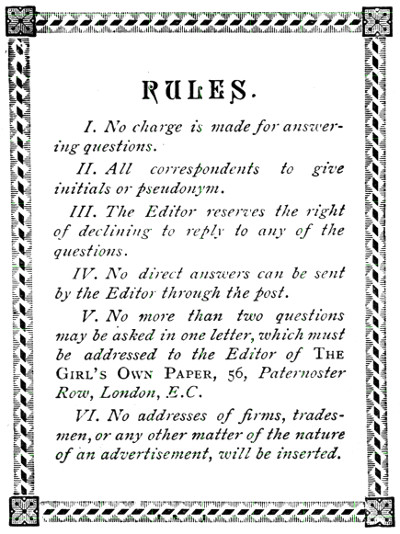
RULES.
I. No charge is made for answering questions.
II. All correspondents to give initials or pseudonym.
III. The Editor reserves the right of declining to reply to any of the questions.
IV. No direct answers can be sent by the Editor through the post.
V. No more than two questions may be asked in one letter, which must be addressed to the Editor of The Girl’s Own Paper, 56, Paternoster Row, London, E.C.
VI. No addresses of firms, tradesmen, or any other matter of the nature of an advertisement, will be inserted.
N. L. and Ma Belle (Hospital Nursing).—You will need to wait till you are twenty-one before you can be admitted to any hospital, and the majority of hospitals demand that probationers shall be not less than twenty-three. At twenty-one you might possibly be admitted to the Chelsea Infirmary, or to one or two of the children’s hospitals. You should address your application to “The Matron, —— Hospital.” An infirmary is to be recommended in cases where girls are not able to pay to be trained, but require to earn something from the first. It may be worth while to add that a large infirmary is being erected in connection with the Bethnal Green Union, and there will be openings in it for a certain number of probationers.
E. D. H. B. (Telephone Service).—You are unfortunately too old to enter the service of the National Telephone Company. The limits of age for clerks entering the service are from seventeen to nineteen. A doctor’s certificate is necessary, and girls must be not less than 5 ft. 3 in. in height. Altogether it is clear that you must turn your attention to some other occupation. Much walking or standing would probably not be advisable for you. Some sedentary work, such as millinery or dressmaking, would seem to be preferable if you could do it.
May (Post Office Clerkship).—You ask whether it is better for your future to enter as a girl clerk between the age of sixteen and eighteen, or as a woman clerk between eighteen and twenty. The general opinion is that it is decidedly better to enter as a girl clerk. The vacancies for women clerks that are thrown open to competition, become fewer in proportion as girl clerks are promoted to fill them. We have never heard that copies of questions set in past examinations were published regularly; but specimens are, we believe, sometimes given in the handbooks of Civil Service coaches. If you attended classes at the Birkbeck Institute you would probably be taught all that is requisite for the examination.
Tulip (Kindergarten Teaching).—Had you not expressed an unwillingness to come to London, we should have advised the Froebel Institute, West Kensington, as one of the best places in which to be trained for Kindergarten work. But since you do not wish to leave your home near Cheltenham, we would suggest that you inquire whether training could be given to you at the Kindergarten which exists in connection with the Cheltenham Ladies’ College. Otherwise we know of no place in your neighbourhood where a young teacher could be trained.
Masseuse (Registry Office Wanted).—A registry is carried on by the Society of Trained Masseuses, 12, Buckingham Street, Strand. You should apply to the Secretary, and give at the same time a full account of your qualifications as a Swedish masseuse.
Marie (The Stage).—Your description of your friend is hardly definite enough for us to judge of her chances as an actress. We would recommend her to ask for advice from the Actors’ Association, St. Martin’s Lane, Trafalgar Square. To be “pretty” is a help, no doubt, but it is by no means enough. So many English girls are pretty, or at all events, can look pretty when nicely dressed. It is the aptitude for acting that is all-important. You say that she wishes to learn some instrument; but not the piano or the violin, neither of which she can play. Also that it must be an instrument to which she need not sing. Really we are quite at a loss. We have known a lady play the clarionet, but it is an instrument calculated to prove decidedly “trying” to the appearance of the performer.
Mayflower (Dressmaking).—The Paris firm you mention has no shop in London.
C. J. M. (Starting a Servants’ Registry).—Before starting a registry you should acquaint yourself with the terms usually charged by good registries. It is becoming very much the practice not to charge either servants or employers until an engagement is effected; but then, of course, to make a tolerably high charge, and one proportioned to the amount of wages offered. You should also try to secure the interest of as many ladies as possible, and especially of the wives of country clergy, who are in the way of hearing of girls who desire to enter service. When your registry is established it would be advisable to make application to the Secretary of the Associated Guild of Registries, to have it enrolled upon the list of registries which the Guild recommends. This would be considered a guarantee of your registry’s bonâ fide character. The Associated Guild may be addressed, care of the Girls’ Friendly Society, 39, Victoria Street, Westminster.
MISCELLANEOUS.
Constant Reader.—Polish the cocoanut shells with glass-paper, and then rub with French polish. They might be fitted into a small stand, like that of a wine-glass only larger, made at any ordinary turner’s for a trifling sum, and glued in, and then it would be of use as a flower vase.
Inquirer.—It matters nothing in any legal transaction by what fancy name you may be known amongst your friends. It is your baptismal name, duly registered, by which you must be called in the banns. If anyone should question your individuality, they have only to inquire at the church vestry.
Alpha.—To make Scotch shortbread, take two pounds of flour, one pound of butter, and six ounces of loaf-sugar. Rub these into a stiff paste; cut into square or oblong cakes of about half an inch thick, pinch along the edges to make a border, and put them on a baking-tin, buttered first of course, and bake in a moderately hot oven till of a light brown.
Heather.—We see no reason why you should not accept the invitation of the Vicar’s family to call on their “at home” day. As your mother cannot call, take her card and go with your sisters as desired.
Mabel.—We are sorry for you; but unless personal violence be offered, or you have reason to know that some other person has supplanted you, you have no legal ground for a separation. Incompatibility of temper is sometimes a mutually agreed-upon excuse for living apart. In your case, we think you might confide in your parents, and ask their advice, for the question is a very grave one, and your father might see fit to represent to his son-in-law that his daughter’s health was suffering from unhappiness through something amiss between them, and express his wish to promote more pleasant relations and a better understanding between them. Are you sure that you are doing your best to make your husband’s home comfortable and cheerful? If he comes home to see you with red eyes and a doleful face, and see no attempt to make his home bright and attractive, then some of the blame lies on your own shoulders. Ask God to show you any errors of your own, and to guide you in the path of duty.
Fan.—The origin of wearing a widow’s cap appears to be Eastern, where the shaving of the head and covering it is a token of mourning. The Romans instituted a cap for widows, and obliged them to wear weeds for ten months; and they were forbidden to marry again under a year.
FOOTNOTES: