GIRTON GIRL.
Reading edition
By CATHERINE GRANT FURLEY.
“Why, sir, should you seem so startled When you chance to come on me Talking silly baby-language To the child upon my knee— To this happy, crowing urchin, While his peasant mother stands Watching us, while she is wiping Thick-flaked soapsuds from her hands? “When you met me first, at dinner, At the Hall the other night, You were seated on my left hand, The professor on my right; And you saw I cared to listen— Saw it with a scornful mirth— To the facts that he was telling Of the strata of the earth. “And again, when of the Iliad My companion chanced to speak, You were less pleased than astounded That I quoted Homer’s Greek. And beneath my half-closed eyelids I observed your covert smile, When our hostess spoke of Ruskin, And I answered with Carlyle. “Then you thought you read me fully— ‘Woman in her latest phase, Following with feebler footsteps In far-reaching manhood’s ways. A half-taught, conceited creature, Something neither wise nor good; Losing for a vain chimera All the grace of womanhood. “‘Failing in her mad endeavour, Though in every languid vein Love-warmed heart-blood she replaces With cold ichor from the brain. Woman striving to be manlike, Making him her enemy, Fighting where she best had yielded’— This was what you saw in me. “Sir, I claim to be a woman: Nothing less and nothing more; Laughing when my heart is joyful, Weeping when my heart is sore; Loving all things good and tender, Nor so coldly over-wise As to scorn a lover’s kisses, Or the light of children’s eyes. “Over-wise! Nay, it were folly If I cherished in my mind One poor fancy, one ambition That could part me from my kind— From the maiden’s hopes and longings, From the mother’s joy and care, From the gladness, labour, sorrow, That is every woman’s share. “Not for all life’s garb of duty In the self-same tint is dyed; I must walk alone, another Shelters at a husband’s side. Yet I claim her for my sister, While—though I must stand apart— All her hopes, her fears, her wishes Find an echo in my heart.
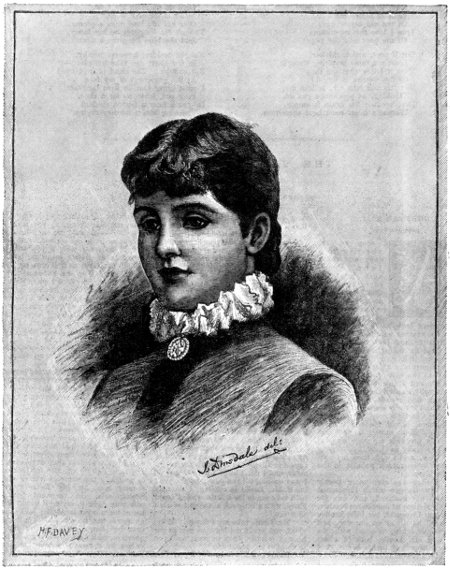
A GIRTON GIRL.
“True it is I love to study Every page of nature’s lore. Must that make my soul less gentle? Nay, it softens me the more. True it is I love the story Of the old heroic age, True I love the aspirations Of the poet and the sage; “But if poet, artist, thinker, Lend me some inspiring thought, Must it follow that the duty Of the woman is forgot? No; ’tis you who err, believe me, Thinking, as perchance you do, That because her brain is empty, Woman’s heart must beat more true. “’Tis not learning that unsexes, ’Tis not thought will make us cold, Nor at sight of heavy volumes Love on us relax his hold. Woman is for ever woman; O’er her life love rules supreme, Though his kingdom be but fancy, And the bliss he gives a dream. “Nought besides, however worthy, In her heart can take his place— But enough! The child is frightened At the graveness of my face. I must bring him back to laughter. Pray you, leave us for a time, Or you’ll hear a Girton student Teaching him a nursery rhyme.”