ANSWERS TO CORRESPONDENTS.
Reading edition
EDUCATIONAL.
Nurse and Housemaid should apply to the secretary, St. Mary’s Hospital, Paddington, W., stating full particulars.
L. Martin will obtain information on schools, etc., by getting “The Englishwoman’s Year Book” from Messrs. Hatchards and Co., Piccadilly, W. Her question is too vague.
One of the Girls (Belfast).—The openings in India at present are generally in connection with medical missions, and good governess situations are not easy to get. You are far too young to think of it yet.
A Cornish Lassie.—We recommend you to study Dr. Angus’s “Handbook of the English Tongue” (Mr. Tarn, 56, Paternoster-row, E.C.). You must not end any sentence with a preposition such as with, for, by, to, in, or of. Transpose the phrase so as to avoid it or alter it. “What did he do it for?” is incorrect. You should say, “Why did he do it?” or “For what reason did he do it?”
Schoolgirl (Toronto).—Backboards and stocks were both used. The former are to be seen now in many schoolrooms in England, and when one sees the rounded shoulders and poor carriage of so many of the present generation of girls, one wishes that the backboard régime could be restored.
E. M. H.—The name Abram meant “a high father.” This was afterwards changed to Abraham, which means the “father of a great multitude.” See the promises of God to him in the Book of Genesis.
H. Y. M.—We must request you to read all that we have recently said to other correspondents desiring to become governesses, and reckoning on salaries in accordance with the amount of their certificated acquirements, but overlooking the circumstances of youth and inexperience. In your own case, your hand is not formed, and you are incapable of teaching that essential branch of education—writing; nor do you express yourself properly—i.e., you should not say “for teaching same as above.” This is a very commercial style of abbreviating a sentence. Also, you should not say “over seventeen,” but “upwards of.” We point out such little inelegancies only in kindness, because your style of letter-writing might obtain or lose you a good situation, and we wish you well. A visiting governess is generally better paid than a resident one.
A Constant Reader.—We recommend you to procure a small “Directory of Girls’ Clubs,” published by Griffith and Farran, corner of St. Paul’s-churchyard, E.C.
Miss A. S.—We are glad to bring the Parkinson Society of Lovers of Hardy Flowers into the notice of our readers, and regret that, although not specially designed for our girls, it was not until too late for publication brought before the compiler of the shilling manual of girls’ clubs above-named. It was founded by the late Juliana H. Ewing, and had its origin in her story of “Mary’s Meadow,” in reference to the cultivation, study, and preservation of hardy wild flowers. The name was given in commemoration of the old herbalist, John Parkinson. Members of this society receive a parcel of MSS. and books on gardening every month, from April 1st to November 30th. For rules and other particulars, apply to the hon. secretary, Miss A. Sargant, 7, Belsize-grove, London, N.W.
ART.
Mimica.—The remains of Turner, the painter, are buried in the crypt of St. Paul’s Cathedral, close to those of Sir Joshua Reynolds.
Cotaghaleurin.—We do not usually give addresses. You may procure cheap unmounted photos in all London bazaars and at many art shops, and the prices range from four pence to half-a-crown. Your handwriting is good. We are obliged for your kind offer of a fern, which we are unable to accept.
Celandine.—1. We consider milk and water a good preparation for setting pencil drawings. 2. Probably you have forgotten to dip your mould in cold water, and so wet it before pouring in your lemon sponge.
K. A.—For setting a smoked picture, see answer on page 399, vol. iii., to “Charing Cross.”
Two Schoolberries.—To preserve holly berries, dip them in a solution of sealing-wax and spirits of wine, such as you employ for colouring soiled baskets.
An Interested Reader.—An annual exhibition of china paintings is held by Messrs. Howell and James, and they will take any articles for it if fairly well executed. The price is attached to each piece, for which if sold a small commission is charged.
Elise.—To remove the gloss on the surface of a photo, apply the tongue to the paper, for no preparation is as safe as this natural one.
Violent.—We cannot make promises as to competitions. Read our replies on this subject to other inquirers. They can only be of rare occurrence, and are so planned as to suit the majority of our girls.
Daphne.—It is difficult to paint without a few lessons at the commencement. Bad habits are formed, which have to be abandoned. Green’s three shilling volumes on painting from nature, sold by Messrs. Rowney, might assist you. Study them carefully, and copy the examples given after having enlarged them.
Sag.—A “cold shadow” in painting is one that runs from a blue-grey to black, and a “warm shadow” is a grey tint inclining to crimson or purple. The shadows are effected by the amount of sunlight at the time the picture is taken. Megilp is mixed with oil colours and other mediums, but not to any great extent. Make your capital letters more distinct. We cannot tell whether you call yourself Sag, Say, Tag, Lag, or Lay.
Howell and Emmeline (Barbadoes).—For an article on waxwork, see vol. i., page 355. It is sufficient for a beginner. We are surprised that you should select such a field of art in so warm a climate. Surely it would be very unsuitable? To model in clay or carve in wood or ivory would, we should fancy, be much more practicable.
WORK.
Judy.—The cashmere skirt with the beaded bodice would be quite suitable for a quiet evening at home.
Gertrude.—The only way is to procure orders for the things you make by going round with a collection of them to the shops, and showing what you can do; but it would be a very precarious way of living.
Grannie must send the cloth to a good French cleaner. We fear the crimson spot is a dye, not a stain.
Daisy Randolph.—Alas! so many of our correspondents write to us about “a little work they could do at home to add to their incomes.” Such work is the most difficult to get; but dressmakers are always in request. Why cannot “Daisy” try dressmaking or millinery, and make a small home business?
E. Gemmell writes in behalf of the Decorative Needlework Society, 45, Baker-street, W., to say that scientific or other dressmaking is not taught at their institution. The art of decorative needlework, including church embroidery, is taught, and all desiring such instruction should address the hon. secretary, Miss Mary Haworth. The promoters of this society were formerly engaged in that of the Royal School of Art Needlework.
Seventeen, minus the Sweetness.—Nun’s-cloth, cashmere, or fine alpaca, are all suitable for inexpensive evening gowns for young girls. We should think that a crimson or ruby-coloured material would suit you, though as a rule youth looks best in white. Black lace over a red foundation is also used by young girls at present, and is not expensive.
Thermometer.—Steam the plush on the wrong side and shake it well. Curl the feather with a blunt penknife, drawing each filament separately and gently between your thumb and the blade.
Miss Rendell.—Inquiries being perpetually made by our correspondents as to any method of disposing of their needlework, we are glad to have found one at last in a society for the aid of girls and young women. To those who live by their work, the yearly subscription is 2s. 6d., and Miss Rendell’s depôt is at 12, Shawfield-street, King’s-road, Chelsea, S.W. The names of all lady workers are kept quite private. The depôt is open from 10 a.m. to 3 p.m., Saturdays excepted. A commission of 2d. in the shilling is charged on all work sold, the rent of the house, etc., having to be met.
Miss E. Radcliffe.—The Pinafore Society is one conducted by this lady, to which each member subscribes one shilling annually, and must contribute, as we understand, two pinafores a year likewise. For further particulars write to the hon. secretary, Balmore, Caversham, Oxon.
Amy W.—To make a handsome sermon-case, embroider an ecclesiastical design upon strong linen with floss silk and gold threads. Transfer this to good dark velvet, and hide the linen edges by couching a gold cord round them, lining the velvet with rep silk of same shade of colour.
F. L. C. W. (Leicester).—A verse of four lines suitable to embroider on a needlebook is not easy to find, especially as you give no particulars as to the receiver of your gift.
MISCELLANEOUS.
Edith C. Jarvis.—Your little poem gives promise of better to come. There is considerable freedom, but no original ideas. Had the writer been younger, we might have tried to find space for it.
Daisy should read our series of articles on good breeding and etiquette under every circumstance of life. Possibly these may be published in separate form, and if so, it may be shortly; but, in any case, we advise you to read them in their present form.
Doris.—See our articles on the meaning of “Girls’ Christian Names,” in vol. iv., pages 39, 134, 235, and 381.
Rothsay Bay.—Of course, you should say grace before breakfast and dinner. A very usual form is, “For these, and all Thy mercies, we give Thee thanks, O Lord!” or, “O Lord! relieve the wants of others, and make us truly thankful.” It is certainly to be regretted that people who recognise the duty of returning thanks to God for the “daily bread” for which they pray, should mutter them hurriedly over, as if ashamed of them!
Bessie.—1. Cousins of any degree of nearness may be legally married. 2. May 27th, 1868, was a Wednesday.
Horseshoe inquires “why some people have different coloured eyes.” We will tell her if she can inform us why some people’s noses turn up and some turn down. Such peculiarities may be hereditary, but what the ancient origin of the distinctive features of various races may be we do not propose to investigate for our correspondents.
Heliotrope and Mary’s Lamb.—The word “marmalade” is of Greek origin, composed of two words, “apple” and “honey.” From the same source the French derive their kindred word marmelade, the Spaniards their mermelada, and the Portuguese their marmelo. The term is not merely applied to an orange confection, but likewise to one of apples and of quinces.
An Old Friend at Aachen.—We read your letter with much interest. We are not certain whether you intend to say you are earning £30 in English money and have also £30 income. If so, and you are now in a situation, you should dress on £20 and save the rest.
Vanity.—We have pleasure in directing attention to the opening of a home for destitute children of the upper classes at Tunbridge Wells. So much is done for the lower orders, and so very little for poor gentry, that we sincerely wish this little institution will meet with abundant support. Address Mrs. Ladds, hon. secretary, 11, South-grove, Tunbridge Wells. The objects are twofold—to provide a home for the children till able to earn a livelihood, and to offer temporary change of air to those whose parents (military, naval, or professional) can only make a small payment for it.
Jo.—1. We recommend you to go or write to the New Zealand Emigration Office in Victoria-street, Westminster, S.W., where you will obtain all the information you need. 2. The 14th of September, 1864, was a Wednesday.
Fauvette.—To fasten small shells on boxes, strong glue is used, or cement such as you buy at a chemist’s for mending china. We are much pleased that you value our paper. Of course, you are one of “our girls.”
Venture.—The poem is prose badly rhymed. How can you make a “thankoffering of a friend”? Your thoughts are confused, and your metaphors nonsense.
Alice Cann.—Your duty is to serve the Lord faithfully, relying on His grace and aid in whatever situation His Providence has placed you; but if one of special temptation, you may seek a less trying one when able. On no account, however, neglect your obedience to His command, and give up your attendance on His divine ordinances, especially that of Holy Communion. It would be the first step in a downward direction. We have a battle to fight, the “fight of faith,” and must “overcome evil with good.” You write a very pretty hand. Accept our best wishes.
Mabelle.—There is no sequel to either book, nor has the “Mystery of Edwin Drood” been finished by anyone bearing authority from the Dickens family.
Just Eighteen.—The mutual opening of each other’s letters should be made from the beginning a matter of distinct agreement between a husband and wife. However great the mutual confidence may be, expediency may often render the indiscriminate opening of letters undesirable as a regular rule. In fact, it would be better, in our opinion, that each should open their own and respect those of the other, thereby showing the greater confidence in that respect. Voluntarily to read aloud the ordinary letters to each other is certainly desirable.
Troublesome Flo.—We do not think the lines original enough to get into print, but they show a very sweet and tender-hearted disposition, and no doubt it gave you pleasure to write them, and relieved your heart at the time; so be satisfied with that, and cherish the good and loving thoughts, and seek ever what is best.
Tulliallan.—Christmas Day, 1860, was a Tuesday.
Bobtail.—January 4th, 1874, was a Sunday.
Jeanette.—You would be both rash and imprudent in marrying so unreliable a man. His saying that he “could do so much with you” is mere talk, when every act has contradicted the assertion. Besides, he has no right to reckon upon leaning on you. You have a right to expect to lean upon him. He is a broken reed to depend upon, and would drag you down to poverty, and then, when failures and want have tried his weak nature, who knows the result? Drink might follow. It is unmanly and dishonourable in a man who has no home nor money to ask any woman to marry him, and you are fully justified in withdrawing from the engagement without asking his permission, having already excused his failures so often. Ask your parents to dismiss him if troublesome.
Margaret.—What is called house-leek, or, vulgarly, “hen and chickens,” is a very good plant for bordering a garden bed.
A Young Mother (New Zealand).—Your very gratifying letter has been long unanswered, but we greatly appreciate the opinion you express respecting this paper, and thank you for it sincerely, the more so as your sole object in writing is to encourage us in our work by a few gracious words. Accept our best wishes for you and yours.
Rogator.—We read in Notes and Queries that whenever the German knights headed an infamous Jew hunt in the Middle Ages they shouted “Hip-hip!” equivalent to saying “Jerusalem is destroyed!” “Hip” is said to be a notarica of the letters Hierosolima est perdita. The authority given is Henri van Laun. The word “hurrah!” is taken from the word Huraj, “to Paradise,” and the two words thus connected would seem to mean “Jerusalem is lost to the Infidel” (or unbelieving Jew or Saracen), “and we are on the way to Paradise.”
Mumbles.—“There is a tide in the affairs of men,” is taken from Shakespeare’s Julius Cæsar, act iv., scene 3.
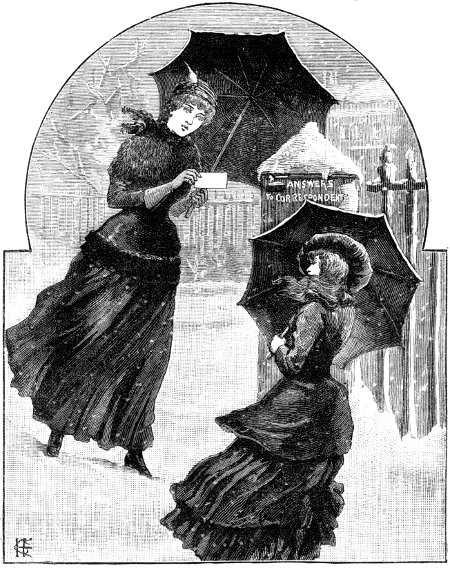
“FREEZE, FREEZE, THOU BITTER SKY, THOU DOST NOT BITE SO NIGH AS BENEFITS FORGOT.”
A Constant Reader tells us that she became so deaf from a severe cold, that she could not hear the clock strike when close to it. For this deafness she tried the following prescription, for which, she says, a lady paid a physician three guineas. She moistened a little wool with the fat of uncooked bacon, and put it in her ears, changing it every second day. The weather being cold, she tied a lace lappet over her ears, and when out of doors covered them with her bonnet strings. In less than a fortnight her hearing was restored, and she has had no return of deafness. Another lady recovered her hearing by means of taking a strong tonic, taking also nourishing food, and so strengthening the entire system, and with equally satisfactory results.
S. Mearer.—We do not recommend the profession you name. It is one of such great temptation, and such a hindrance to spiritual life and progress. It is also exceedingly trying to the health.
Helen Ada.—All games of ball are of very remote origin. The Greeks played them assiduously, and gave a statue to Aristonicus for his wonderful play. Tennis is thought, from the terms used in the game, to have originated in France prior to the fifteenth century. There is a book called “Annals of Tennis,” by Julian Marshall, which would interest you.
Awkward Sixteen.—Ask a surgeon. We could not give an opinion without seeing them. It is always a risky thing to carry bottles full of any liquid in a trunk; it is better to put them in the handbag, if there be room.
Note of Interrogation.—A widow can claim a third of her husband’s property, and the remaining two-thirds are divided in equal shares between his children, by whichever wife. The marriage settlements, if any exist, are apart from this. You may have money from this source.
A. B. C.—Always consult your rector as to the decorations of his church. Your writing is fairly good and legible.
Persis.—It would be better to consult your doctor about your fits of sneezing, as there are several causes, and, independently of outward irritation of the air passages, some affections of the stomach are said to produce them.
Sara Amelia.—The Mishna of the Jews was the oral law, and the Gemara was the commentary upon it, and these two united form the Talmud. The Masora is the true reading of the Scriptures, while the before-named Mishna and Gemara combined gave the true interpretation. The commencement of the Masoretic Notes is dated by some as far back as the time of Ezra, the inspired writer of the book bearing his name in the Old Testament.
Violet and Sunflower.—The St. Bernard puppies could be disposed of by advertising them. Of course, a pedigree would make them more valuable. We should think that the fowls wanted a much warmer fowl-house.
Ella must put her name on her mother’s card. Young ladies of twenty-one do not have separate cards.
Ariel.—Leave the steel brooch in oil for a day or two, and then rub it well with chamois leather. Should that prove ineffectual in removing the rust, send it to a silversmith to be cleaned.
E. M. H. must let her friends know that she has returned, and the best way to do that is to call and see them.
Ernestine.—The name De Lesseps is pronounced as in English, excepting that the final “s” is mute. The name Sodor is derived from Sodor Eys, or South Isles—i.e., the Hebrides, the Orkneys being known as the North Isles. These Southern or Western Isles were made an Episcopal diocese by Magnus, King of Norway, in 1098, and were united as one diocese to the Isle of Man in 1113.
John’s Kitten.—May 6th, 1853, was a Friday, and July 21st, 1867, was a Sunday. We are glad to hear that our answers have helped you.
Janie Shaw.—Miss Ellman, The Rectory, Berwich, Sussex, is secretary of an early rising society, as well as of other societies.
F. E. S.—There is always a table for finding dates in every “Whitaker’s Almanack.”
Miss Moore Smith wishes it to be known that her Home Workers’ Missionary Union passed from her hands into those of Miss Chute, 25, Longford-terrace, Monkstown, co. Dublin, and thence again into other management. Perhaps Miss Chute might give any information desired.
Daisy A. (Moor-street).—The “Old Maid’s Story” is not without merit. The language flows very easily, and, with more experience and plenty of perseverance, we think the writer might do something worth reading later on.
Forget-me-not, Maggie Davies, and Little Dot.—Write to our publisher about the index, “Crown of Flowers,” etc. The 13th November, 1833, was a Wednesday, and the 12th October, 1833, a Saturday. It is pleasant to hear of your appreciation of the G. O. P.
FOOTNOTES:
[Transcriber’s Note—the following changes have been made to this text.
Page 211: dreadfuly to dreadfully—“dreadfully sensible”.]